


Reviewed by ThaiLawOnline, a licensed Thai law firm practising in Thailand since 2006. Thai lawyer of record: Wichuda Atthamethakon, LL.M., Thai Bar Licence 3149/2556.
Last updated on
Update, 31 August 2026: it is now law. The Ministry of Interior announcements were published in the Royal Gazette on 31 August 2026 and take effect on 15 September 2026. From that date the visa-exemption period referenced below drops from 60 to 30 days for a final list of 60 countries and territories (tourism only, one 30-day extension), and Visa on Arrival narrows to Azerbaijan, Belarus and Serbia (not India, which made the exemption list). The announcement also writes the border-run limit into the exemption itself: a maximum of two visa-exempt land-border entries per calendar year, with nationals of Malaysia, Brunei, Indonesia and Singapore excepted. Travelers admitted before 15 September 2026 keep their 60-day stamp, and immigration can still refuse anyone who appears to be living in Thailand on tourist stamps. Full details in our article on the new visa rules in Thailand and our Tourist Visa Guide.
If you are relying on repeated entries, a proper long-stay route is usually cheaper: compare them with our Thai visa finder.
If you have been using “border runs” to stay in Thailand, you need to pay attention. Since late 2024 Thai Immigration has run a sustained crackdown on what it calls “visa abuse.” The rules that set the border-run limits are the ones published in November 2025, and they are set out below. Understanding the new Border Runs Limits in Thailand is essential for maintaining your stay legally.
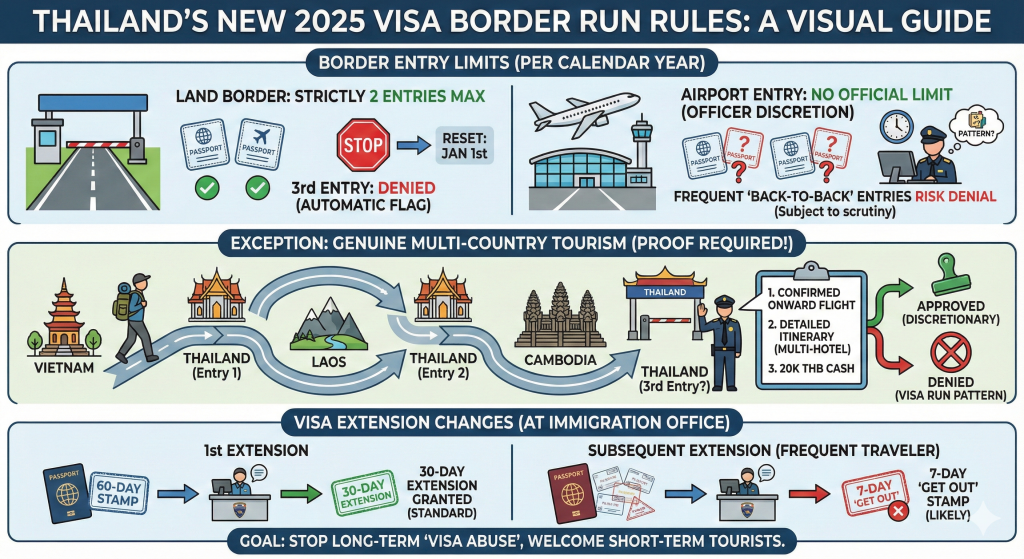
In July 2024, Thailand opened to 93 countries that can come to Thailand for 60 days and can extend to 30 days (that scheme ended on 14 September 2026; from 15 September 2026 the stamp is 30 days for 60 countries). Sometimes, they will deny your 30 days if they think you exaggerated and you get only 7 days (denied extension), not 30. Most blogs still say you can extend 30 days every time. However, in November 2025 the government announced that this would be limited. The Thai Examiner explains the situation here and here’s the government website where they do write that it is limited to two. However, seasoned expats will know this is not a new phenomenon. It is the latest, and strictest, enforcement of laws that have existed for over a decade.
The November 2025 announcement worried travelers. They are used to the more relaxed entry rules from before. Understanding the rules about border runs in Thailand is important. This is especially true for anyone planning to visit or stay for a long time. Be aware of how the Border Runs Limits in Thailand are evolving as regulations tighten. This history illuminates the reasoning behind current Border Runs Limits in Thailand.
Poipet Warning
According to recent posts, Poipet (Cambodia) border has the highest rejection rate for “valid reason” claims.
Last reviewed: 3 September 2026. The two-entry land-border cap and the 15 September 2026 change are stated as the Ministry of Interior announcements published in the Royal Gazette on 31 August 2026 record them, consistent with the rest of this site’s visa cluster. The proof-of-funds figure was aligned to 10,000 THB per person or 20,000 THB per family. Police Order 327/2557 is named here as the instrument behind the valid-reason refusals as a matter of record. ⚠️ It was repealed on 26 September 2023 by Order of the Royal Thai Police No. 542/2566, and the criteria passed to the Commissioner of the Immigration Bureau, first under Immigration Bureau Order No. 242/2566 from 30 September 2023 and now under Immigration Bureau Order No. 12/2568 of 23 January 2025, both of which we have read. The refusal power an officer exercises at the border comes from the Immigration Act itself, not from that order, so the account below is unaffected; what is corrected is the citation.
This review does not certify the border-specific practice described below, including the refusal rates at particular crossings and the seven-day extension reports, which are traveller accounts rather than published rules, nor the discretionary criteria an officer applies, which are by definition not fixed.
Understanding Border Runs Limits in Thailand
1. This Has Happened Before: A History of “Crackdowns”
To understand why this is happening now, you must look at the legal history. Thailand does not create new laws for these crackdowns. They just enforce existing Police Orders. These orders are often ignored during times of leniency, like after COVID when tourism is recovering.
- 2014: The “Out-In” Ban (Police Order 327/2557) After the 2014 coup, the “Out-In” practice was officially banned. This practice involved walking across a border and then turning back right away. Police Order 327/2557, in force from 29 August 2014, set the criteria for extensions of stay (it has since been replaced by Immigration Bureau Order 12/2568); the power to refuse entry comes from section 12 of the Immigration Act, and officers applied it to repeated out-in entries. This change ended the practice of unlimited monthly border runs.
- In December 2016, a new rule was introduced. It limits you to two land entries each year. It wasn’t invented in 2025. It was designed specifically to stop foreigners from living in Thailand on visa-exempt stamps while working illegally.
- 2018: “Good Guys In, Bad Guys Out”Under previous immigration leadership, a massive sweep saw thousands of overstayers arrested. The current 2025 crackdown is a return to this strict strictness after the “relaxed” COVID years (2020-2023).
The Takeaway: This is not a sudden change; it is the “pendulum swinging back.” If you argue with an officer that “it was fine last year,” you are flagging yourself as someone who doesn’t understand Thai law. Please note that the latest changes are not part of the immigration Act. They are just rules, and rules can change easily. They can also be applied differently in different borders. We know that some people have been refused to get out in Nong Khai by land. They normally had an exemption of visa of 60 days and an extension of 30 days. That is not the law but policies and application can vary. Be aware.
2. The Core Rule: The “Two-Entry” Limit (UNLESS VALID REASONS)
Understanding the Border Runs Limits in Thailand allows you to navigate immigration smoothly.
The most critical rule for overland travel remains the hard cap on visa-exempt entries.
- Land Borders: You can enter without a visa at land checkpoints only 2 times each year. This applies to borders with Cambodia, Laos, Malaysia, and Myanmar. From 15 September 2026 this cap is written into the Ministry of Interior announcement itself, with nationals of Malaysia, Brunei, Indonesia and Singapore excepted.
- Airports: Technically, there is no written “number” limit for air arrivals. However, under Section 12 of the Immigration Act B.E. 2522 (1979), officers can deny entry to anyone. They can do this if they think a person has no means of support appropriate to the purpose of entry (section 12(2)) or is entering to do work prohibited to foreigners (section 12(3)).
The “Calendar Year” Reset
The count resets on January 1st of each year. If you used two land entries in 2024, you theoretically get two fresh ones in 2025. Officers can still see your full history. They may deny you if your total time in Thailand seems like residency.
3. Can You Enter More Than Twice with a “Valid Reason”?
Consider a common multi-entry itinerary: traveling Vietnam → Thailand → Laos → Thailand → Cambodia → Thailand.
This itinerary involves 3 entries. According to the law for Visa Exemption, the land border computers automatically flag a third entry.
Why It May Be Refused:
- The “Out-In” Red Flag: If you spend only 1-2 days in Laos or Cambodia, you may be a “visa runner.” This is a group targeted by the 2014 Order.
- The “Cumulative Stay” Risk: If you have spent 4 to 5 months in Thailand this year, you may face a risk. A third entry into the country suggests that you are living there, not just visiting.
How to Get Approved (The “Genuine Tourist” Defense):
You can be granted a 3rd entry, but it is discretionary. You must build a case that overrides the officer’s suspicion:
- Proof of Onward Travel: A confirmed flight ticket out of Thailand within the stay you are granted (30 days for a visa-exempt entry since 15 September 2026). A bus ticket is rarely accepted as “proof” at strict borders like Poipet.
- Detailed Itinerary: Show hotel bookings in different provinces (e.g., confirmation in Bangkok, then Chiang Mai, then Krabi). This proves tourism, whereas a single booking in one city suggests residency.
- Proof of Funds: the requirement for visa-exempt tourists is 20,000 THB per person, or 40,000 THB per family (the figure Thai embassies state; transit and Visa on Arrival remain 10,000 / 20,000), and at a land border you should expect to show it in cash. Credit cards are often rejected as proof during interrogation.
But if you want to avoid any problem, get the TOURIST VISA DOUBLE ENTRY (Multiple). That is just simply better than taking a chance. With the new Border Runs Limits in Thailand, travelers must adapt to evolving policies.
4. The New 2025 Twist: “30 Days + 7 Days”
A major shift reported in late 2024 concerns visa extensions.
Previously, you could enter visa-exempt (60 days, or 30 days for entries from 15 September 2026), extend at immigration (30 days), leave, and repeat.
The New Reality: Immigration offices are applying the tourist-extension rule more strictly. That rule is now clause 2.4 of the table annexed to Immigration Bureau Order No. 12/2568 (it carried the same number in the repealed Police Order 327/2557), and it allows a tourist one extension only, of not more than 30 days counted from the end of the permitted stay.
- 1st Extension: Standard 30-day extension is usually granted.
- 2nd Extension (after a new entry): Many border runners are saying they are not getting a full 30-day extension. Instead, they receive a 7-day “denied/get out” stamp.
- Land Entry Restrictions: Some offices now completely deny extensions for land entries if the passport shows past abuse.
Summary Checklist for Travelers
| If you are… | The Risk Level | Recommendation |
| A Genuine Tourist | Low | The 2-entry land limit applies unless valid reason. Strategy: Plan your route to enter by air for your 3rd entry (e.g., fly Siem Reap to Bangkok instead of taking the bus). Air entries do not count toward the “2 land entry” limit. |
| An Expat without a Visa | Critical | Do not rely on a border run. Apply for the DTV (Destination Thailand Visa) or LTR Visa. The “good old days” of monthly runs are over. Any other visa. |
| Backpacking SE Asia | Medium | If your route requires 3+ Thailand entries, ensure your stays in neighboring countries are at least 3-4 days long. “Same day” returns are the #1 reason for refusal. |
Official Resources
By understanding the Border Runs Limits in Thailand, you can ensure compliance and avoid penalties.
- Royal Thai Immigration Bureau: immigration.go.th
- Immigration Act B.E. 2522 (1979): The governing law for all entry denials.
- Thai E-Visa Official System: thaievisa.go.th
Next Step for You
If you are planning a trip to multiple countries, I suggest flying from Cambodia to Thailand. This route goes through Vietnam, Thailand, Laos, and Cambodia. It avoids the land-border count limit and the “Poipet trap.” The Poipet trap is a border crossing known for rejecting travelers with too many stamps.
Adjust your travel plans according to the latest Border Runs Limits in Thailand. Prioritize knowledge about the Border Runs Limits in Thailand for a successful journey.
Frequently Asked Questions
What is a border run in Thailand?
A border run means leaving and re-entering Thailand to obtain a fresh period of stay, often used by travellers on visa-exempt entries.
How many border runs can I do in Thailand?
There is a published number for land borders: a maximum of two visa-exempt land-border entries per calendar year, written into the Ministry of Interior announcements published in the Royal Gazette on 31 August 2026 and in force from 15 September 2026, with nationals of Malaysia, Brunei, Indonesia and Singapore excepted. Air arrivals carry no numeric cap, but an officer may still refuse entry under the Immigration Act where it appears you are living in Thailand on tourist stamps.
Are visa runs still allowed in Thailand?
They remain possible but are increasingly scrutinised. Relying on repeated runs risks refusal of entry, so a proper long-stay visa is safer.
What is the difference between a border run and a visa run?
A border run is a quick exit and re-entry for a new stay stamp, while a visa run means leaving to obtain a new visa from an embassy abroad.
Can I be refused re-entry to Thailand after too many runs?
Yes. Immigration officers have discretion to deny entry to travellers who appear to be living in Thailand on back-to-back tourist entries.
Try it yourself first, free
You do not have to book anything to get started. These run in your browser, and you only pay us if you decide you want a lawyer involved.
Thai Visa Finder Free
Answer a few questions and see which Thai visa actually fits your situation.
Open the toolAsk our AI assistant Free
Trained on Thai law and 77,000+ Supreme Court decisions. Ask anything, free.
Thai Law Updates, free by email
Plain-English updates on Thai law changes that affect foreigners: property, visas, marriage, business and wills. One short email a month from a firm practicing since 2006. No spam, unsubscribe anytime.