


Reviewed by ThaiLawOnline, a licensed Thai law firm practising in Thailand since 2006. Thai lawyer of record: Wichuda Atthamethakon, LL.M., Thai Bar Licence 3149/2556.
Last updated on
Starting the journey of adoption can be rewarding but also complicated, especially when adopting Thai children. Thailand is known for its rich culture and friendly people. It also has a clear adoption process for those wanting to grow their families. This Thailand Adoption Guide gives a clear overview of the adoption process in Thailand. It covers key steps, eligibility requirements, costs, choosing an agency, and support after adoption. In our Thailand Adoption Guide, we explore the different parts of adopting a child from this lovely country. We want to make sure you are ready for every step.

Disclaimer: Please be aware that adoption laws and procedures can be complex and subject to change. The following information is intended as a general guide and does not constitute legal advice. You should always consult with qualified legal professionals and authorized adoption agencies for advice specific to your situation. If you are thinking about adopting from Thailand, our Thailand Adoption Guide can help you understand the process. Text Updated in April 2025.
Table of Contents
Understanding Adoption in Thailand: A Guide for Prospective Parents
This Thailand Adoption Guide explains the steps and legal requirements for adopting a child in Thailand. It helps future parents know what to expect during the process. In this Thailand Adoption Guide, we explain key rules and steps that all future adoptive parents should know before starting their journey.
Many foreigners choose to adopt a child in Thailand. This gives them a chance to provide a loving home for a child in need. However, the process requires following certain legal rules from Thai authorities. This mainly includes the Department of Children and Youth (DCY). Whether you reside outside Thailand, live here permanently, or are here temporarily, understanding the eligibility criteria, procedures, and documentation is crucial.
What are the Key Steps in the Thailand Adoption Process?
In this Thailand Adoption Guide, we discuss the financial requirements for those adopting a child from Thailand.
Starting the adoption journey in Thailand involves a few steps. First, you need to check your eligibility. Then, choose an adoption agency that is licensed to work with Thai authorities. Prospective parents must first have a home study. A licensed social worker will conduct this study to check their readiness for adoption. This involves interviews, home visits, and background checks. After completing the home study report, it is sent along with an application. This is done to the Thai Department of Children and Youth (DCY). This department oversees adoptions.
Adopting a child from Thailand requires a detailed and comprehensive set of documents. Prospective parents must provide proof of identity and residence, marriage certificates if applicable, and financial statements to demonstrate stability. You also need medical reports showing the health of the adopting parents. Letters of reference are required too. A statement of intent explaining why they want to adopt is also needed. All documents must be authenticated and translated into Thai, as per the requirements of the DCY.

The adoption process in Thailand can take a long time. The timeline varies based on several factors. These include the child’s age and health, as well as how quickly everyone involved responds. On average, it can take from one to three years to complete the adoption process. The first steps of applying and getting approved can take a few months. After that, you will wait to be matched with a child. Once a match is made, more legal steps must be taken in Thailand and the adopting parents’ home country.
Who is Eligible for Adoption in Thailand?
Eligibility to adopt from Thailand is determined by specific age and marital status requirements for applicants for adoption. Generally, adoptive parents must be at least 25 years old and at least 15 years older than the child they wish to adopt. Thailand allows both married couples and single people to adopt. However, married couples must have been together for at least three years. The age difference between the child and the adoptive parents is important. It affects the approval process for adopting Thai children.
Single individuals are eligible to adopt from Thailand, although the process may be more challenging compared to married couples. Single applicants must demonstrate their capacity to provide a stable and nurturing environment for the child. The DCY reviews applications from single parents. They focus on the support network, financial stability, and reasons for wanting to adopt. Single applicants often face additional scrutiny, but successful adoptions have been completed under these circumstances.
Thailand requires future adoptive parents to meet specific financial criteria. This ensures they can support an extra family member. Applicants must submit detailed financial statements, including income verification, assets, and liabilities, to demonstrate financial stability. There is no specific income limit. However, being able to meet the child’s long-term needs is very important for adoption approval.
Note: since the Marriage Equality Act came into force on 23 January 2025, adoption rules that refer to a husband and wife apply equally to married same-sex couples.
- Age: Prospective adoptive parents usually need to be at least 25 years old. They should also be at least 15 years older than the child they want to adopt.
- Marital Status:
- Married Couples: Usually, both partners must apply together. They should have been married for a good amount of time, often at least three years. However, it is best to check the exact requirements.
- Single Applicants: Single people can apply for adoption in Thailand. However, the process may require more checks on their support system and ability to provide a stable home.
- Residency Status: The application process differs based on your residency:
- Foreigners Living Outside Thailand: Usually, they must work with an approved adoption agency in their home country. This agency should partner with the DCY or other licensed child welfare groups in Thailand.
- Foreigners Residing Permanently in Thailand: Must provide proof of residency (e.g., house registration/Tabien Baan) and apply locally.
- Foreigners Living Temporarily in Thailand:They might qualify if they have a valid work permit. This permit must be issued by the Ministry of Labour. They must also have lived in Thailand for at least 6 months before applying.
Where to Submit Your Adoption Application:
- Applicants Outside Thailand: You must submit your application through your home country’s Competent Authority or a licensed adoption agency. They will work with the DCY in Thailand.
- Applicants Residing in Bangkok: Submit applications directly to the Child Adoption Centre of the DCY in Bangkok.
- Applicants Residing Outside Bangkok: Submit applications to the provincial Social Development and Human Security Office where they reside. Do note that you must verify as before, these were only accepted in Bangkok and this can change.
- Temporary Residents: Apply at the right office (the Child Adoption Centre in Bangkok, or the provincial office) based on where you live. Bring the required residency and work permit documents certified by your embassy or consulate.
Types of Adoption in Thailand
Thai law recognizes different types of adoption. These depend on the relationship between the child and the adoptive parent, their nationality, and the legal process. The table below outlines the most common types of adoption in Thailand and their main requirements.
| Type of Adoption | Who Can Apply | Governing Authority | Key Requirements |
|---|---|---|---|
| Domestic Adoption | Thai citizens or Thai couples | Child Adoption Center (Thailand) | Must be at least 25 years old and 15 years older than the child |
| Intercountry Adoption | Foreigners with approval from the DCY and their home country | Department of Children and Youth (DCY) | Must meet requirements under Thai and home country law |
| Stepchild Adoption | Foreigners or Thai nationals married to a biological parent | Thai Family Court | Consent from biological parent usually required |
| Relative Adoption | Thai or foreign relatives of the child | Thai Family Court / DCY | May be simplified but still requires legal process |
The Adoption Process in Thailand: Key Stages
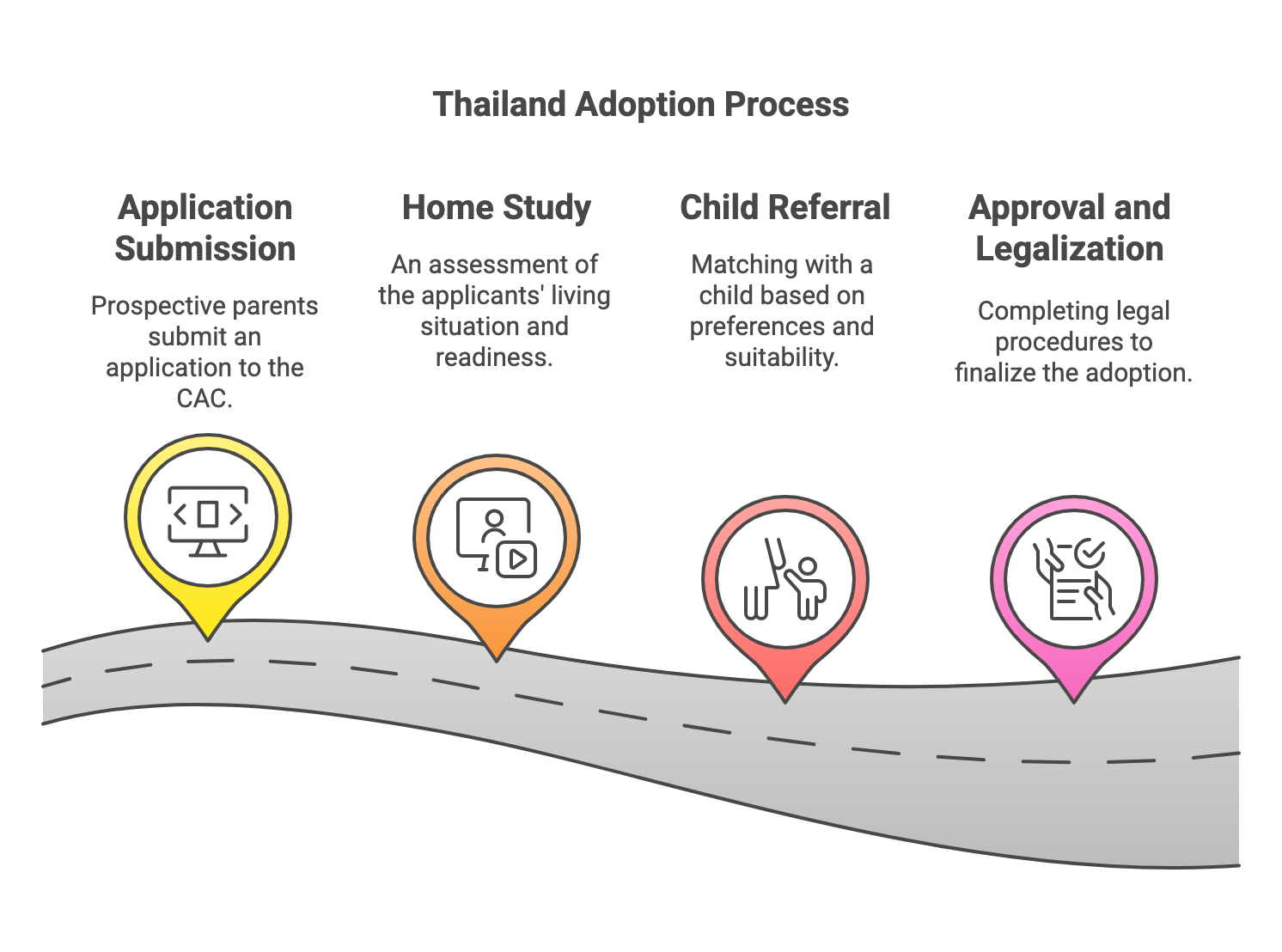
While timelines can vary (often 1-3 years), the inter-country adoption process generally follows these steps:
- Application & Home Study: Contact an authorized agency (if abroad) or the DCY (if residing in Thailand). You will need to gather a lot of documents. You must also complete a Home Study by a licensed social worker in your country. This assesses your suitability to adopt.
- Submission to the DCY: Your finished application, including the Home Study, is sent to the DCY in Thailand for review.
- Approval as Prospective Adoptive Parents: The Child Adoption Board reviews your qualifications. If approved, you are officially recognized as prospective adoptive parents.
- Matching: The DCY identifies a child legally available for adoption whose needs match your profile. You will receive information about the child.
- Acceptance & Pre-Adoption Placement: If you accept the match, the case goes back to the Board. They will get approval for a pre-adoption placement. This is a mandatory trial placement (at least 6 months by law, Child Adoption Act section 23) where the child lives with you under supervision. Progress reports are required.
- For applicants from other countries, you need special permission. This permission is from the Ministry of Social Development and Human Security. It is required to take the child out of Thailand during this placement period.
- For applicants in Thailand: The placement occurs within Thailand.
- Supervision & Reporting: During the pre-adoption placement, the supervising agency sends regular progress reports to the DCY. These reports are sent every two months.
- Final Approval: After the placement period ends, the Child Adoption Board reviews the reports. If the reports are positive, they give final approval for the adoption.
- Legal Registration:
- If residing abroad: The adoption is typically registered at the Royal Thai Embassy or Consulate in your country.
- If residing in Thailand: The adoption is registered at the local District Office (Amphur).
- Post-Adoption: You need to take more steps to secure the child’s visa or citizenship in your home country. You may also need to re-finalize or register the adoption based on your country’s laws. Post-adoption reports may also be required.
Required Documentation (General Overview)
Make sure to refer back to the Thailand Adoption Guide for insights into how to prepare your application properly.
Compiling the necessary paperwork is a significant part of the process. While specific requirements can vary, expect to provide documents such as:
The Thailand Adoption Guide can also aid in understanding the key stages involved in the adoption process.
- From Applicants:
- Completed Application Form(s)
- Copies of Passports & Visas/Work Permits (if applicable)
- Proof of Residency (House Registration, Certificates of Residence)
- Marriage Certificate (plus Divorce/Death Certificates from previous marriages, if any)
- Medical Certificates (confirming physical and mental health)
- Proof of Occupation and Income
- Financial Statements (Bank statements, proof of assets)
- Criminal Record Checks (from country of nationality and residence)
- Photographs (Applicants, home environment)
- Letters of Reference (certifying suitability to adopt)
- Home Study Report (prepared by a licensed social worker)
- Statement from Competent Authority/Agency (confirming eligibility, agreement to supervise placement)
- Proof of eligibility for the adopted child to enter your home country (e.g., letter from immigration authorities)
- Letter of consent from spouse (if applying individually while married) or court order.
- Confirmation that the adoption will be legally recognized in your home country.
- From Birth Parents (if applicable and involved):
- Identification Documents
- House Registration
- Marriage/Divorce Certificates
- Written Consent for Adoption
- Relevant court orders or certifications if parentage is unclear or a parent cannot be located.
- Death Certificates (if applicable)
- From the Child:
- Birth Certificate
- House Registration (if applicable)
- Photographs
- Letter of Consent (if the child is old enough to understand, typically required by law at a certain age)
Additionally, the Thailand Adoption Guide provides insights into the costs you may encounter throughout the adoption journey.
Important Notes on Documents:
- Certification: Many documents originating outside Thailand must be certified by the Royal Thai Embassy or Consulate in that country. Some need a process called “Legalization” of documents which is normally done at the Ministry of Foreign Affairs.
- Translation: Documents not in English or Thai must be translated by an authorized translator, and the translation certified.
Key Considerations for a Successful Adoption in Thailand:
- Legal Compliance: Strictly adhere to both Thai law and your home country’s adoption laws. Thailand is a party to the Hague Convention on Intercountry Adoption.
- Work with Authorized Bodies: Only work with government-approved agencies in your country or Thailand. You can also work directly with the DCY.
- Patience: The process is thorough and takes time. Be prepared for potential delays.
- Costs: Budget carefully for agency fees, government fees, travel, document translation/certification, legal fees, and potential post-adoption support. Costs can range significantly ($10,000, $30,000+ USD is often cited, but varies greatly).
- Cultural Sensitivity: Respect Thai culture and be prepared to help your child maintain a connection to their heritage.
- Post-Adoption Support: Plan for post-adoption requirements (reports, legal finalization in your country) and seek support networks.
What are the Costs Involved in Adopting from Thailand?
The costs of adopting from Thailand can vary a lot. This depends on the adoption agency and each case’s details. Agency fees typically cover services such as the home study, application processing, and legal representation. These fees can range from $10,000 to $30,000, reflecting the complexity and duration of the adoption process. Prospective parents should get a clear fee schedule from their chosen agency. This helps them understand the financial commitment involved.
In addition to agency fees, adoptive parents should anticipate additional expenses that may arise throughout the adoption process. These can include travel costs for required trips to Thailand, accommodation, translation services for necessary documents, and legal fees for processing the adoption in both countries. Post-adoption costs are important. These include follow-up visits and counseling services. They should be part of the overall budget for adoption cases.
Budgeting for the adoption process requires careful planning and consideration of all potential expenses. Prospective parents should start by creating a comprehensive budget that includes agency fees, travel expenses, and post-adoption services. It is advisable to set aside additional funds for unforeseen costs that may arise during the process. Financial planning tools and talks with adoption finance experts can help manage the costs of adoption. This ensures that future parents are ready to meet all financial responsibilities.
At ThaiLawOnline, we help clients with the adoption process in Thailand. We make it easier, clearer, and less stressful, especially when paperwork and procedures seem overwhelming. You can expect to pay between 50,000 and 200,000 baht for legal fees. This amount depends on legalization, translation, and other services.
While you can go through the adoption process alone, many clients choose our law firm. We help prepare all the necessary documents. We also translate and certify papers. Plus, we guide clients through each step. This saves time and helps avoid costly delays or rejections.
In most cases, we support in-family adoptions. This includes when a foreigner adopts their Thai spouse’s biological child. It also includes when relatives want to make their parental relationship official. These cases are usually simple. They are handled at the district office (amphoe), especially if the child is already in their care.
We sometimes handle more complex cases, like international adoptions or pre-approval adoptions through the Juvenile and Family Court. These cases are less common and usually require working with lawyers or agencies from other countries.
What Post-Adoption Support is Available for Families?
Post-adoption support is an important part of the adoption journey. It helps adoptive families get the help they need as they adjust to their new lives. Many adoption agencies provide follow-up services. These services include regular check-ins, home visits, and resources. They help support the child’s integration into the family. These services help check the child’s well-being. They also guide parents as they face the challenges of adopting a child from a different culture.
Adoptive families in Thailand have access to various counseling services and support groups that facilitate the transition and address any emotional or psychological challenges. Adoption agencies often provide referrals to qualified counselors who specialize in adoption-related issues. Support groups provide a community for families with similar experiences. They offer a place to share advice, emotional support, and practical tips for parenting adopted children.
Once the adoption is finalized, families must follow legal steps. This ensures the adoption is recognized in Thailand and their home country. This may include re-adoption or recognition of the adoption in the home country, depending on its specific laws. Families should work with lawyers to understand these requirements. They need to make sure all documents and legal steps are done. This will help secure the child’s citizenship and legal status in their new home.
FAQS about Adoption in Thailand
What are the requirements for foreigners wishing to adopt a Thai child?
Foreigners who want to adopt a Thai child must meet the legal requirements of their home country and Thailand. They must apply for adoption through the Ministry of Social Development and Human Security. They also need to meet the requirements set by the child adoption board.
How does the Thai adoption process work for adoptive parents not residing in Thailand?
Adoptive parents living outside Thailand must work with a child adoption center in their home country. This center partners with Thai child welfare agencies. The adoption application is then submitted to the child adoption center of the department in Bangkok for approval.
What types of adoption are available in Thailand?
Thailand offers both domestic and inter-country adoption. Domestic adoption is for people living in Thailand. Inter-country adoption is for people living outside Thailand, foreign or Thai, who want to adopt a Thai child. This process is managed by child welfare agencies and the Thai embassy or consulate.
Can a foreigner residing in Thailand apply for adoption directly?
Yes, a foreigner residing in Thailand can apply for adoption directly through the local adoption center. They must follow the legal rules set by the Ministry of Social Development and Human Security.
What role does the adoption center play in the Thai adoption process?
The adoption center acts as an intermediary between the adoptive parents and the child welfare system. It helps manage the adoption application, ensures compliance with thai law, and provides support throughout the adoption process.
How long does the Thai child adoption process typically take?
The duration of the Thai child adoption process can vary. It commonly takes one to three years from application to registration. This depends on the type of adoption, the applicant’s situation, and the review process by the child adoption board.
What is the role of natural parents in the adoption process?
The natural parents may be involved in the adoption process if they are known and willing to consent to the adoption. Their consent is important for the child to be adopted. This is unless the child is an orphan or abandoned and available for adoption through the child welfare system.
Is it necessary to engage a law firm for the adoption process in Thailand?
While it is not required, working with a law firm like ThaiLawOnline can help you understand legal rules. They can also make sure you follow both Thai and international adoption laws.
What happens after the adoption application is approved?
Once the adoption application is approved, the adoptive parents may proceed with the legal process to finalize the adoption. After a trial-custody period of at least six months, the Child Adoption Board decides whether to approve the adoption, and the adoption is then registered at the district office. A court is involved only if the Board refuses and the applicant appeals.
Need Assistance with Adoption in Thailand?
Navigating the legal intricacies of Thai adoption requires careful attention to detail. ThaiLawOnline has experience assisting clients with the legal aspects of child adoption in Thailand, helping prepare documentation and liaise with relevant authorities.
Other links:
Intercountry Adoption from Thailand: The Full Process
The sections below cover intercountry adoption in detail: which authorities decide, who qualifies, the process step by step, the documents, the real costs and timelines, what happens to nationality and inheritance afterwards, and the warning signs of an unlawful placement.
Who Controls Adoption in Thailand
Two laws sit at the center. The first is the Child Adoption Act B.E. 2522 (1979), with its later amendments. The second is the Civil and Commercial Code, Sections 1598/19 to 1598/37. The Act handles the administrative machinery. The Code handles the private-law relationship between parent and child.
One agency runs the show. That’s the Department of Children and Youth, known as the DCY. It sits under the Ministry of Social Development and Human Security. Its Child Adoption Center is the operational unit you’ll deal with.
The Department of Children and Youth (DCY)
For foreign families, the DCY is the gatekeeper. It reviews applications, manages waiting lists, and proposes matches. It also acts as Thailand’s Central Authority under the Hague Convention. That last role matters more than most people realize. We’ll come back to it.
The DCY does not work alone. Licensed private child welfare organizations help with parts of the domestic process. But for intercountry cases, the DCY stays in control from start to finish.
The Child Adoption Board (CAB)
No intercountry adoption clears Thailand without Board approval. The Child Adoption Board reviews each case. It signs off on the match and the placement. The Board includes representatives from various government bodies plus qualified experts. The Director-General of the relevant department chairs it.
Think of the Board as the checkpoint. Your file can look perfect and still wait for its meeting. That’s normal. Build it into your expectations.
The Hague Convention and why it matters
Thailand is a party to the Hague Convention on Protection of Children and Co-operation in Respect of Intercountry Adoption. The Convention dates to 1993. It entered into force for Thailand in 2004. The DCY is the designated Central Authority.
Here’s what that means in plain terms. If you live in another Hague country, the adoption runs through two Central Authorities. Yours and Thailand’s. They talk to each other. They agree before the child moves. This is a safeguard against trafficking and against rushed, unsafe placements. It adds steps. It also protects everyone, including you.
Quick point. The Hague Adoption Convention is not the same treaty as the Hague Child Abduction Convention. People mix them up constantly. They cover different problems. This guide is about adoption.
Thailand Adoption Requirements: Who Can Adopt
Thai law sets clear baselines. Your home country adds its own. You must clear both. Let’s start with the Thai side.
Age and the 15-year gap
Section 1598/19 of the Civil and Commercial Code is the anchor. The adopter must be at least 25 years old. The adopter must also be at least 15 years older than the child. Both conditions apply together. There’s no waiver for being a great parent on paper.
The official intercountry guidelines repeat this. You must be 25 or older. And you must be eligible to adopt a foreign child under your own country’s law. Miss either test and the file stops.
Consent: the part people underestimate
Consent rules run through several sections of the Code. They protect the child and the birth family. Read them as a system, not a checklist.
- The birth parents. If the child is a minor, the parents’ consent is generally required. If one parent has died or lost parental power, the other consents (Section 1598/21).
- The child. A child aged 15 or over must consent to their own adoption (Section 1598/20). Their voice counts.
- When consent is refused unfairly. Say a parent or guardian withholds consent without good reason. If the refusal is unreasonable and harms the child’s health, progress or welfare, the prospective adopter, either parent or the Public Prosecutor can ask the court to allow the adoption in place of that consent (Section 1598/21, paragraph two).
- Your spouse. A married applicant needs the consent of their spouse (Section 1598/25). If the spouse cannot consent or has vanished for at least a year, you petition the court instead.
One more rule trips people up. A child who is already someone’s adopted child cannot be adopted by a second person at the same time. The only exception is adoption by the adopter’s spouse (Section 1598/26). That’s the stepparent route.
Single applicants, couples, and stepparents
Married couples are the typical intercountry applicants. Both spouses must consent and usually both are assessed. Single people can be considered too. But suitability gets judged hard, and your home country’s rules may be stricter than Thailand’s.
Stepparent adoption is a different animal. That’s when you adopt your Thai spouse’s biological child. It’s common in Thai-foreign families. It still needs consent and review, and it’s not a rubber stamp. If that’s your situation, our Thai family law team can map the exact steps for your case.
Domestic vs Intercountry Adoption
Not every adoption is intercountry. The label depends on where the adoptive parents live, not just their nationality. A foreigner legally resident in Thailand may use the domestic track. A foreigner living abroad uses the intercountry track. The difference changes everything about the process.
| Feature | Domestic adoption | Intercountry adoption |
|---|---|---|
| Who it covers | Thai nationals, or foreigners legally resident in Thailand | Foreign nationals living abroad, or Thais living abroad |
| Entry point | DCY or district office, or a licensed child welfare organization | Your home country’s Central Authority, then the DCY |
| Two-country coordination | Usually none | Required under the Hague Convention |
| Board approval | Child Adoption Board | Child Adoption Board, with extra international scrutiny |
| Placement period | Supervised trial-custody period of at least six months (Child Adoption Act section 23) | Supervised placement plus post-placement reports |
| Private/direct adoption | Limited and supervised | Prohibited. Must go through government channels |
| Finalization | Thai authorities and registration | Board approval, then registration, coordinated with the receiving country |
Notice the bottom row. For intercountry cases, there is no legal “private” route. Anyone offering you a fast, off-the-books placement is offering you trouble. Walk away.
The Intercountry Adoption Process, Step by Step
Intercountry Adoption in Thailand: Overview
The full path is long. It’s also logical once you see it laid out. Here’s the sequence for a typical Hague-country applicant.
- Apply at home first. You start in your own country. You apply through its Central Authority or an accredited adoption agency. You complete a home study. A social worker assesses your home, finances, health, and readiness.
- Your country confirms eligibility. Once approved, your authority certifies that you’re eligible to adopt. It forwards your file to Thailand’s DCY. This is the Hague handshake.
- The DCY reviews and lists you. The Child Adoption Center checks your application. If it’s complete, you join the waiting list. Patience starts here.
- Matching. The DCY proposes a child whose needs fit your family. You receive the child’s background and medical information. This is the heart of the process. It cannot be rushed.
- You accept the match. If you accept, both Central Authorities agree to continue. The Hague rules require this joint agreement before anything moves forward.
- The Child Adoption Board approves. The Board reviews and approves the proposed placement. This is a hard gate, not a formality.
- Pre-adoption placement. The child is placed with you for a supervised trial period. Social workers monitor the bond. Reports are filed. This protects the child and confirms the fit.
- Finalization. The adoption is completed by Child Adoption Board approval followed by registration within six months of the approval (Child Adoption Act sections 27 and 29). A court is involved only if the Board refuses and you appeal (section 28). An adoption certificate is issued and recorded at the district office (amphur). Depending on your country, the legal finalization may happen in Thailand or be completed at home.
- Immigration and travel. The child needs the right visa to enter and live in your country. Coordinate this early with your embassy. Nationality follows your country’s law, not the Thai adoption.
- Post-placement reports. You report back to the DCY at set intervals after the child arrives. This continues for a period after placement.
From experience: the two stages that surprise families are matching and the placement period. Both depend on the child’s welfare, not your calendar. Clients who accept that early have a far smoother time than those who treat the process like a transaction.
Documents You’ll Need
The paperwork is heavy. Most of it is generated in your home country, then legalized for use in Thailand. The exact list varies by country and case. The table below covers the core set.
| Document | Notes |
|---|---|
| Application form | Filed through your Central Authority or accredited agency |
| Home study report | Prepared by a licensed social worker in your country |
| Certificate of eligibility to adopt | From the competent authority in your home country |
| Marriage certificate | Translated and legalized (for married applicants) |
| Birth certificates and passports | Certified copies, with translations |
| Medical certificates | For each applicant |
| Proof of income and employment | Evidence of financial stability |
| Police clearance certificate | Criminal background check for each applicant |
| Photographs | Of the applicants and the family home |
| Commitment to post-placement reports | A written undertaking to file progress reports |
Two rules apply to almost all of it. Documents not in English or Thai need certified translation. And original documents plus translations usually need verification through the Royal Thai Embassy or Consulate, or legalization via the Ministry of Foreign Affairs. Get this wrong and your file bounces. We see it happen often.
Costs and Timeline: The Honest Version
Nobody likes vague answers on money and time. So here’s the real shape of it. The Thai government’s own processing fees are modest. The big costs sit elsewhere: your home-country agency, document legalization, translation, and travel.
| Item | What to expect |
|---|---|
| Thai government processing | Administrative fees are low. Confirm the current schedule with the DCY |
| Home-country agency fees | Usually the largest cost. Set abroad, not in Thailand |
| Translation and legalization | Varies with the number of documents |
| Travel to Thailand | For placement and any required appearances |
| Legal and advisory support | ThaiLawOnline consultations are THB 2,000 per hour |
| Overall timeline | Commonly 18 months to 3 years, end to end |
That timeline is not padding. Matching alone can take many months. The supervised placement adds more. Anyone promising you a child in a few weeks is not describing a legal adoption. Be skeptical of speed.
After the Adoption: Nationality, Inheritance, and Reporting
Registration is not the finish line. Three issues follow you home. Get ahead of all three.
Does adoption give the child citizenship?
No, not automatically. A Thai adoption does not hand your child a passport from your country. Citizenship outcomes depend on the receiving country’s law. This is exactly why immigration advice belongs at the start, not the end. The child needs lawful entry and status in your country. Plan it in parallel with the adoption, not after.
What does the adopted child inherit?
Once registered, the adopted child holds the same status as a legitimate child of the adopter. That includes inheritance rights under Thai law. Here’s the part many parents miss. The adopted child does not lose inheritance rights in their birth family. They keep both. If you hold assets in Thailand, this affects your estate planning. Our Last Will service in Thailand can make sure your wishes line up with the new family structure.
Post-placement reports
You agreed to report back. So follow through. After the child arrives, you file progress reports with the DCY at set intervals, often every six months, for a defined period. A social worker in your country usually prepares them. These reports assess the child’s adjustment and wellbeing. Skipping them can affect future applications and damages Thailand’s trust in the whole system. Treat them as part of the commitment, because they are.
Red Flags and Ethical Safeguards
Adoption attracts good people. It also attracts bad actors. The Hague framework exists because some intercountry adoptions, in the past, slid into child laundering and trafficking. Protect yourself and the child by knowing the warning signs.
- Anyone who offers a “private” intercountry placement that bypasses the DCY. This is not allowed.
- Pressure to pay large, unexplained, or off-the-record fees.
- Vagueness about the child’s true history, or pressure to falsify it.
- A push to skip the home study, the matching process, or the placement period.
- Refusal to put fees and procedures in writing.
The safeguards are simple to state. Licensed agencies. Full disclosure of the child’s history. Documented consents. Transparent accounting. Central-authority coordination. If any of those is missing, stop and get advice. A delayed adoption is recoverable. A corrupt one is not.
Last reviewed: 5 September 2026. Corrected against primary sources: adoption is administered by the Department of Children and Youth (DCY), not the Department of Social Development and Welfare. The Child Adoption Centre is a DCY unit and Thailand’s own government service catalogue names DCY as the responsible agency for this procedure and the other department not at all; this page had been naming both, eighteen times and seventeen times, and was the only page on the site using the superseded name. The outbound link that described that department as responsible for adoption was repointed to the Child Adoption Centre’s own service. Also corrected: the route when consent is refused unreasonably is Civil and Commercial Code section 1598/21, paragraph two, not section 1598/22 (which covers a deserted child under an institution’s care), and that route is open to the prospective adopter or either parent, not only to the Public Prosecutor. Verified as correct and left alone: CCC ss.1598/19 (adopter at least 25 and at least 15 years older), 1598/20 (a child of 15 or over must consent), 1598/21 paragraph one, 1598/25 and 1598/26. Not verified against a primary source, and stated here so the date above does not imply more than it should: which provincial office receives an application outside Bangkok, the 1 to 3 year timeline, the 50,000 to 200,000 baht legal-fee range, the two-monthly reporting interval, and the photograph, which shows a building of the department that no longer administers adoption.
Thai Law Updates, free by email
Plain-English updates on Thai law changes that affect foreigners: property, visas, marriage, business and wills. One short email a month from a firm practicing since 2006. No spam, unsubscribe anytime.