


Reviewed by ThaiLawOnline, a licensed Thai law firm practising in Thailand since 2006. Thai lawyer of record: Wichuda Atthamethakon, LL.M., Thai Bar Licence 3149/2556.
Last updated on
Thailand has restructured its non-immigrant visas from 17 categories to 7, effective August 31, 2025. The goal is to reduce overlap and speed up processing while keeping all existing rights and eligibility rules. The 2025 modernization also rolls out the Thailand Digital Arrival Card (TDAC) nationwide and expands e-Visa service.
This reform is part of several modifications already applying like the E-Visa portal and the mandatory TDAC. Some other changes have been delayed. This includes the Electronic Travel Authorization (ETA), a 300 baht tourist tax, and a visa-free stay. Update (August 2026): the cut of visa-exempt stays from 60 days back to 30 days was published in the Royal Gazette on 31 August 2026 and applies to entries from 15 September 2026, for a final list of 60 countries and territories (tourism only, extendable once for 30 more days). Azerbaijan, Belarus and Serbia move to Visa on Arrival, while India and the Maldives are on the 30-day exemption list. Travelers should verify current rules before booking. These are important for anyone planning a trip to Thailand in 2026. Facial recognition is already used in many airports.

Example of facial recognition at Hat Yai Airport in September 2025. It works with your boarding pass.
Table of Contents
The New 7-Category Non-Immigrant Visa System : Thailand Visa Reform in 2025
The Thai Ministry of Foreign Affairs changed the visa system on August 31, 2025. They combined similar categories that confused both applicants and immigration officials. The transformation addresses decades of administrative complexity while maintaining all existing eligibility requirements and applicant rights.
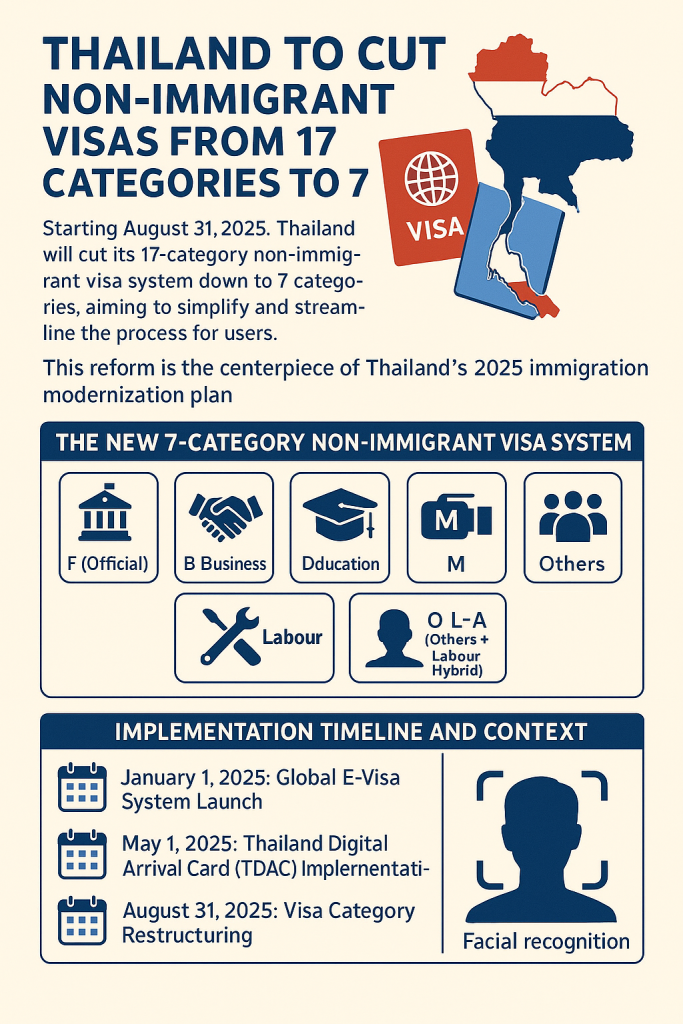
The Seven New Visa Categories Explained
Table: Thailand’s New 7 Non-Immigrant Visa Categories (Effective August 31, 2025)
| New Category | Previous Categories | Main Purpose | Typical Applicants |
|---|---|---|---|
| F (Official) | F | Government and diplomatic missions | Diplomats, embassy staff, official delegations |
| B (Business) | B, B-A, IM, IB, EX | Business, investment, executive activities | Entrepreneurs, investors, company directors, executives |
| ED (Education) | ED, ED-A, R, R-A, RS | Study, research, religious work | Students, academic staff, researchers |
| M (Mass Media) | M | Journalism and media work | Journalists, documentary makers, press staff |
| O (Others) | O, O-A, O-X | Retirement, family, general stay | Retirees, foreign spouses, dependents |
| L-A (Labour) | L-A (kept as it was) | Employment and work authorization | Skilled and unskilled foreign workers |
| O L-A (Hybrid) | O L-A (kept as it was) | Mixed personal and work reasons | Applicants combining family and work grounds |
(Names and mergers confirmed in MFA/consulate and professional summaries.)
F (Official), Diplomatic and Government Missions
Covers diplomatic personnel, embassy staff, and official government travel. Requirements remain unchanged. The F category maintains its specialized requirements for international relations and diplomatic activities, which are crucial for passport holders.
B (Business), Comprehensive Commercial Activities
The B category now unifies B, B-A, IM, IB, and EX into one label. This removes overlap between business and investment routes. This unified approach eliminates the confusion that arose from overlapping business categories, creating a single pathway for entrepreneurs, investors, executives, and business professionals. The consolidation particularly benefits foreign investors and company directors who previously struggled to determine the appropriate visa category.
ED (Education), Academic and Research Activities
ED now covers the former ED, ED-A (exchange students), R and R-A (religious work) and RS (research), so it takes in students, researchers, faculty and missionaries. This streamlined approach covers students at all levels, academic researchers, university faculty, and participants in educational programs. The consolidation simplifies applications for international students and academic professionals while maintaining Thailand’s commitment to educational excellence.
M (Mass Media), Journalism and Media Professionals
This specialized category remains focused on media professionals, journalists, documentary filmmakers, and other media-related activities. The M category recognizes Thailand’s importance as a regional media hub and maintains specific provisions for international press operations.
O (Others), Family, Retirement, and Miscellaneous Purposes
The O category combines the old O, O-A, and O-X visa types. This change makes it easier for applicants to understand entry requirements. It mainly serves retirees, family members of Thai citizens, and people who do not fit into other specific categories. This unified approach simplifies applications for Thailand’s substantial expatriate retirement community and mixed families.
L-A (Labour), Employment and Work Authorization
L-A is an existing code that the restructuring left unchanged. It addresses foreign workers and employment-related entries. The L-A classification gives clear rules for work permit holders and employment-based immigration. This helps reduce confusion about work authorization requirements.
O L-A (Others + Labour Hybrid), Special Combined Category
O L-A is not a new creation. It is one of the four existing codes the restructuring kept on their own (F, M, L-A and O L-A), which is how 17 codes became 7: thirteen merged into B, ED and O. It combines elements of the Others and Labour classifications and covers special cases. These are for people who have personal and work reasons for staying in Thailand for a long time. Detailed subcategory handling occurs internally during processing.
Implementation Timeline and Context of the Thailand Visa Reform
Thailand’s immigration modernization extends far beyond visa category restructuring, representing a comprehensive digital transformation of border management systems. The year 2025 has witnessed multiple significant changes implemented in phases:
• January 1, 2025, Global e-Visa expansion. Applicants submit online through the Thai e-Visa platform; missions process without physical stickers.
• May 1, 2025, TDAC goes live. All travelers submit pre-arrival data online before travel. Remember, the Thailand Digital Arrival Card is free. You can access the portal here: https://tdac.immigration.go.th/arrival-card/#/home Do not get scammed into paying for that. The official TDAC is free at tdac.immigration.go.th.
• August 31, 2025, Non-immigrant categories consolidated 17→7. Label change only; rights and eligibility unchanged.
Reasons Behind the Restructuring of the Thailand Visa Reform
The change targets duplication, unclear boundaries between business types, and inconsistent labeling across missions. The aim is faster decisions and lower training overhead, not a policy shift.
Administrative Efficiency and Clarity
The old 17-category system had a lot of overlap and redundancy. This was especially true for business visas. Five categories (B, B-A, IM, IB, EX) served similar purposes. This overlap led to frequent misapplications, processing delays, and confusion among both applicants and immigration officers. Immigration officials regularly encountered situations where applicants could qualify for multiple categories, creating uncertainty about proper classification.
Reduced Processing Times and Costs
Streamlining categories enables faster application processing and reduced administrative costs. With fewer categories to evaluate, immigration officers can process applications more efficiently, potentially reducing wait times for applicants. The simplified system also reduces training requirements for embassy and consular staff worldwide.
Enhanced User Experience
The consolidation eliminates the need for applicants to research multiple overlapping categories. Before, business applicants often needed help to understand the differences between B, B-A, IM, IB, and EX categories. The unified B category removes this complexity while maintaining all necessary subcategory distinctions through internal processing.
International Competitiveness
Thailand’s immigration modernization aligns with global trends toward digital-first, user-friendly visa systems. Countries throughout Asia and beyond have implemented similar consolidations to attract international investment, tourism, and talent. The simplified system positions Thailand competitively for attracting digital nomads, remote workers, and international businesses.
What Remains Unchanged: Rights and Requirements
This is an administrative relabeling. Eligibility, stay lengths, renewal rules, and documentary evidence remain the same. Existing visas remain valid until expiry and renew under the new labels. It will not affect applicant rights, eligibility, or visa conditions for travel to Thailand. All individuals eligible under previous visa categories retain their eligibility under the new system. Duration of stay, renewal processes, and visa conditions remain identical to previous requirements.
Grandfathering and Transition Protections
Existing visa holders experience no disruption to their current status. People with valid visas from the old system still have full rights and privileges until their visas expire. Renewal applications will be processed under the new category system, but with identical requirements and benefits.
Documentation and Evidence Requirements
The types of documentation required for visa applications remain unchanged. Business applicants still need corporate documentation, financial statements, and business registration materials. Education applicants continue to require acceptance letters, academic transcripts, and enrollment verification. The consolidation affects only the category designation, not the substantive requirements.
Delayed and Postponed Immigration Initiatives
Thailand has successfully changed its visa rules. However, many other planned immigration changes have been delayed for now. This shows the government’s careful approach to making big changes in the immigration bureau’s policies.
Electronic Travel Authorization (ETA) System
Electronic Travel Authorization (ETA): discussed since late 2024, piloting was delayed. Authorities have not launched a mandatory nationwide ETA as of today. Monitor official notices for any start date.
300 Baht Tourist Tax
The planned 300 baht (about $8.50 USD) tourist tax has been delayed for now. Authorities are focusing on the digital arrival card. The tax was intended to fund tourism infrastructure improvements and provide travel insurance coverage for foreign visitors. Long-term visa holders and Thai residents would have been exempt from this fee. In July 2025 the target shifted to mid-2026, according to EuroNews. As of September 2026 no collection has started: press reports describe the fee as limited to air arrivals and still awaiting Cabinet approval and a collection system.
Visa-Free Stay Period Reduction
Thailand’s cut of visa-free stays from 60 days to 30 days was published in the Royal Gazette on 31 August 2026 and took effect on 15 September 2026. The cut applies to a final list of 60 nationalities for tourism only (extendable once for a further 30 days). It responds to concerns about illegal employment and unauthorized business activities among visa-exempt travelers. Visa on Arrival is reduced to Azerbaijan, Belarus and Serbia (15 days); Mauritius and Seychelles get 15 days; India and the Maldives are on the 30-day exemption list; South Korea and several South American countries keep 90 days under bilateral agreements. See the full list in our article on the 30-day visa exemption (in force since 15 September 2026).
Impact on Different Traveler Categories
The visa restructuring affects various types of international travelers differently, with some experiencing significant simplification while others see minimal changes.
Business Travelers and Investors
Business travelers benefit most significantly from the restructuring. The consolidation of five business categories into one unified B category eliminates confusion about appropriate visa selection. Foreign investors, company leaders, and business representatives can now apply in one category. This change helps reduce application errors and speeds up processing.
Students and Academic Professionals
International students and academic staff experience similar benefits through the consolidated ED category. Before, students had to tell the difference between ED and ED-A categories. Researchers had to choose between R, R-A, and RS classifications. The unified education category simplifies these decisions while maintaining appropriate subcategory processing internally.
Retirees and Family Members
The consolidated O category streamlines applications for Thailand’s substantial expatriate retirement community. Retirees previously navigated between O, O-A, and O-X categories based on specific circumstances. The unified approach reduces complexity while maintaining all existing benefits and requirements for long-term stays.
Media Professionals
Journalists and media workers see minimal changes as the M category remains specialized for those traveling to Thailand.. This reflects Thailand’s recognition of media professionals’ unique requirements and the country’s role as a regional media hub.
Regional and Global Context
Thailand’s visa system simplification reflects broader trends in international immigration management, particularly in Southeast Asia where countries compete for talent, investment, and tourism revenue.
ASEAN Regional Competition
Thailand’s reform positions the country competitively within ASEAN for attracting international business and talent. Singapore, Malaysia, and other regional competitors have implemented similar streamlined visa systems, making Thailand’s previous 17-category system appear outdated and bureaucratic by comparison.
Digital Nomad and Remote Work Trends
The Destination Thailand Visa (DTV) took effect on 15 July 2024 for remote workers, digital nomads, freelancers and qualifying soft-power activities. The later non-immigrant visa restructuring did not create the DTV; it is a separate visa measure.
Post-Pandemic Recovery Strategies
Thailand’s immigration modernization supports broader economic recovery efforts following the COVID-19 pandemic’s impact on tourism and international business. Easier visa processes help international visitors, investors, and long-term residents. They can enter more freely and support economic growth.
Implementation Challenges and Solutions
The transition to the new system has required extensive coordination between Thai embassies, consulates, and immigration offices worldwide.
Embassy and Consulate Training
Thai diplomatic missions globally have updated their visa processing procedures to reflect the new categories. This includes retraining consular staff, updating application forms, and revising guidance materials in multiple languages.
Technology System Updates
Immigration database systems require updates to process the new category structure. Thai authorities have coordinated these changes to ensure seamless processing while maintaining data integrity for existing visa holders.
Public Communication and Outreach
The Thai government has reached out to the public. They want to inform passport holders about new visa options. This will help potential applicants understand the changes. This includes updated embassy websites, informational videos, and guidance materials for visa agents and legal professionals involved in Thailand travel.
Looking Ahead: Future Immigration Developments
While the 7-category restructuring represents a major milestone, Thai authorities continue to evaluate additional immigration system improvements.
Potential Further Consolidations
Officials may consider additional simplifications based on the success of the current restructuring. Future consolidations could address other administrative inefficiencies or respond to changing international mobility patterns.
Integration with Digital Systems
The visa category restructuring complements ongoing digitalization efforts. Future developments may include enhanced e-visa capabilities, automated processing for routine applications, and improved integration between visa approval and border control systems.
Regional Coordination Initiatives
Thailand may coordinate with other ASEAN countries to streamline entry requirements for travelers. to harmonize visa categories and facilitate regional mobility. Such cooperation could benefit business travelers, students, and professionals moving between Southeast Asian countries.
Last reviewed: 27 September 2026. The 17-to-7 consolidation and its effective date were checked against the Department of Consular Affairs announcement and the code-by-code list published by KPMG, and the 30-day exemption, ETA and TDAC statements against our own sourced pages on each. The tourist entry fee status rests on press reports. The sections on reasons, regional context and implementation describe policy aims and are not legal statements.
FAQs about the New Thailand Visa Reform in 2025
What are the Thailand 2025 non-immigrant visa changes (17 to 7 categories) and why were they made
Starting August 31, 2025, Thailand combined its 17 non-immigrant visa types into 7 simpler categories. This change aims to reduce overlap, speed up processing times, and make things clearer for applicants and immigration officers. The reform is the main part of the 2025 immigration modernization plan. It focuses on digital border management, expanding the e-visa portal, and using biometric pre-screening. It will also keep the current eligibility rules and applicant rights the same. No change to rights or eligibility. This is a label change.
What are the seven new Thai non-immigrant visa categories (B, F, ED, M, O, L-A, O L-A) and who’s eligible?
The seven categories are:
F (Official): For government and diplomatic missions.
B (Business): For entrepreneurs, investors, executives, and company directors.
ED (Education): For students, researchers, and faculty.
M (Mass Media): For journalists and media professionals.
O (Others): For retirees, family of Thai citizens, and other purposes.
L-A (Labour): For work-permit holders.
O L-A (Others + Labour): For long-stay cases with both personal and work ties. This consolidation simplifies selection for business travelers, students, retirees, and mixed-purpose applicants without changing benefits or conditions.
How do the Global e-Visa and Thailand Digital Arrival Card (TDAC) work in 2025?
Global e-Visa: apply online through the official portal used by embassies.
TDAC: submit pre-arrival information online before travel; keep your QR/confirmation handy.
Do rights, eligibility, durations, or renewals change under the 2025 restructuring?
No change to rights, eligibility, durations, or renewals. Existing visas remain valid; renewals use the new labels with the same documents.
What’s postponed in 2025 (ETA, 300-baht tourist tax), and is visa-free stay 60 or 30 days?
ETA and the 300-baht “Travel Fee” are postponed. The visa-exempt cut is no longer pending: the Ministry of Interior announcements were published in the Royal Gazette on 31 August 2026 and take effect on 15 September 2026, when visa-exempt entry becomes 30 days for a final list of 60 countries and territories, tourism only, extendable once by a further 30 days. Entries on or before 14 September 2026 still receive 60 days.
Conclusion and Recommendations for Applicants
Thailand now uses seven non-immigrant visa labels. Processing should be clearer and faster, while rules and rights remain the same. TDAC pre-arrival and the e-Visa platform complete the 2025 rollout. ThaiLawOnline helps you select the correct route and prepare documents. We secure DTV, non-immigrant B, ED, O, M, F, and work-linked L-A entries based on your facts.
Thai Law Updates, free by email
Plain-English updates on Thai law changes that affect foreigners: property, visas, marriage, business and wills. One short email a month from a firm practicing since 2006. No spam, unsubscribe anytime.