

Last updated on April 12, 2026
For expatriates and long-term travelers living in the “Land of Smiles,” your visa is your most valuable asset. However, a common mistake by officials often surprises foreigners. This can turn a relaxing holiday into a bureaucratic nightmare. If you have a long-term Thai visa, you need a Re-Entry Permit to travel internationally. This permit is important for your travels. Without this specific stamp, your active visa will be cancelled as soon as you go through immigration to leave the country. This happens no matter how many months are left on your visa.
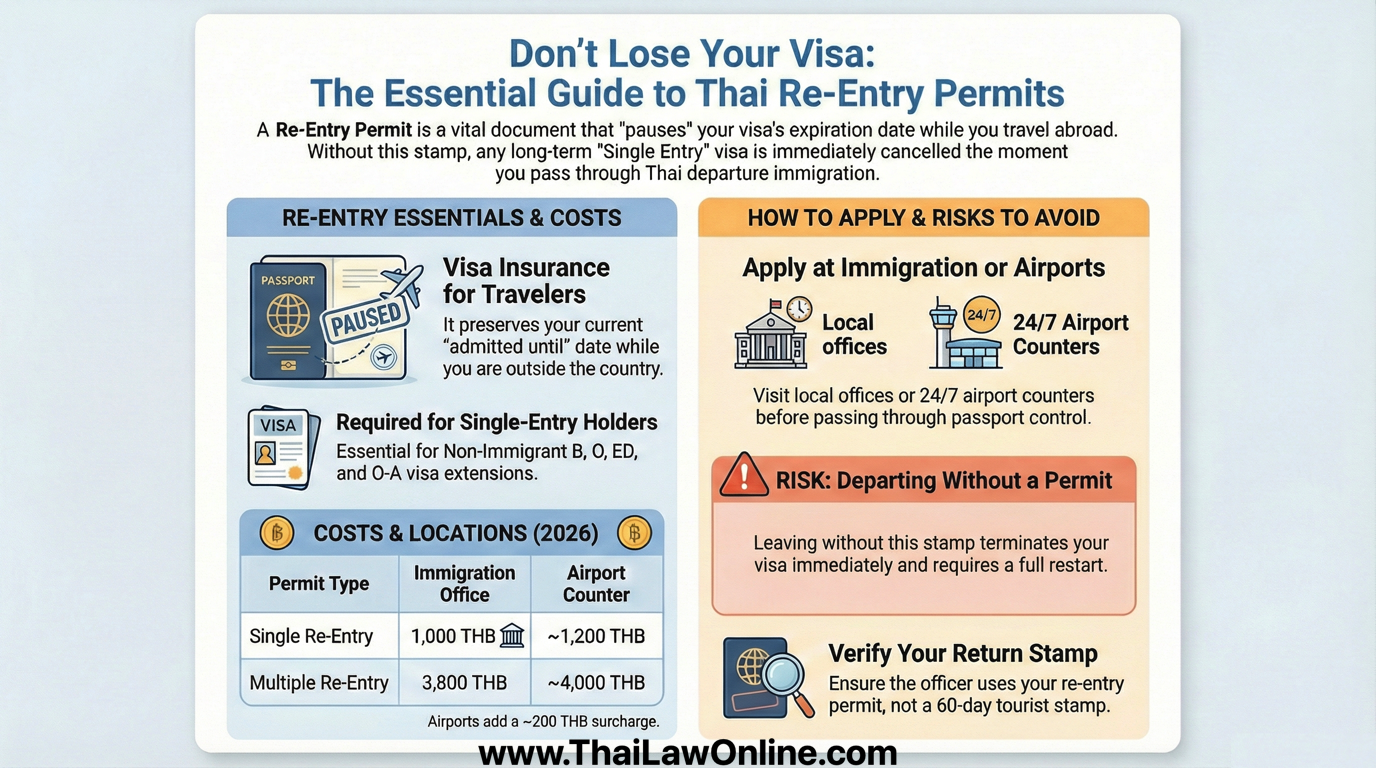
As we move into 2025 and 2026, the landscape of Thai immigration is shifting. With the new Thailand Digital Arrival Card (TDAC) starting in May 2025, travel plans need to change. Rising airport service fees in 2026 also add to this. Now, leaving and re-entering the Kingdom requires careful planning. This guide covers everything you need to know about the Thailand re-entry permit. It includes current costs, airport counter locations, and tips to avoid common mistakes that could cost you your visa.
Table of Contents
What Is a Re-Entry Permit and Who Needs One?
A Re-Entry Permit is an official document from the Thai Immigration Bureau. It lets a visa holder leave Thailand for a short time and return with the same visa.
It is essential to understand the difference between a visa extension and a re-entry permit. An extension prolongs the date you are allowed to stay in Thailand. A re-entry permit simply “pauses” or preserves your current “admitted until” date while you are outside the country. It does not add days to your visa; it merely ensures your visa is not voided upon departure.
Why It Matters
Imagine this: you have a marriage visa valid for another six months, but you fly out of Thailand without a re-entry permit. When you return, immigration gives you a 30-day tourist stamp. Your marriage visa is gone. You would have to restart the process and may lose time, money, and even your legal status.
This kind of situation happens more often than you might think. A re-entry permit helps you avoid all of that.
Types of Re-Entry Permits in Thailand
There are two types of re-entry permits, and choosing the right one depends on how often you plan to travel.
| Type | Description | Validity | Best For |
|---|---|---|---|
| Single Re-Entry | Allows one exit and return. Expires after use. | Valid for one trip | Short trips once or twice a year |
| Multiple Re-Entry | Allows unlimited exits and returns while visa is valid | Valid as long as your visa or extension is valid | Frequent travelers or those unsure about travel dates |
Can I get it at the airport right now?
Yes, 24/7 both Don Mueang (DMK) and Suvarnabhumi (BKK).
Visa Types Requiring a Re-Entry Permit
If you have a “Single Entry” version of these long-term visas, you must get a re-entry permit before leaving Thailand
• Non-Immigrant B Visa: Holders of work visas (and their associated dependents).
• Non-Immigrant O Visa: This includes Retirement visas (based on being over 50), Marriage visas, and dependent visas.
• Non-Immigrant ED Visa: Students attending language schools or private institutions generally require a permit for every trip.
• Non-Immigrant O-A (Long Stay): This visa is often given as a multiple entry at first. However, for annual extensions, you usually need a re-entry permit to keep your status.
Exemptions: Who Can Skip This Step?
Not everyone needs to queue for this stamp. You are generally exempt if:
You have a Multiple Entry Tourist Visa (METV) or a valid Multiple Entry Non-Immigrant Visa. Check that your visa sticker says “Multiple.”
• You hold a Thailand Elite / Privilege Visa (these are inherently multiple entry).
• You hold the new Destination Thailand Visa (DTV), which is valid for 5 years with multiple entries.
• You hold a Long-Term Resident (LTR) Visa.
• You are a university student under the new Non-ED Plus scheme, which now allows free travel without a re-entry permit.
Thailand Re-Entry Permit Costs and Fees (2026)
Budgeting for your exit is important, especially as fees vary depending on where you apply.
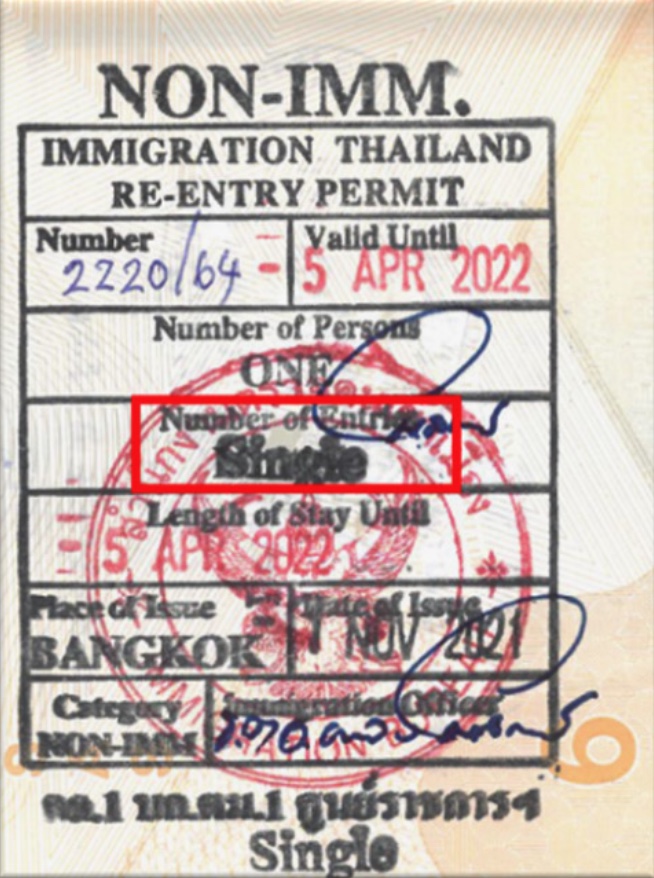
Example of Re-Entry Permit. That is valid until 5 April 2022. It is a single re-entry permit.
Official Government Fees
If you apply at a standard Immigration Office during regular business hours, the statutory fees are:
Cost of Thailand Re-Entry Permit (2026)
| Permit Type | Immigration Office Cost | Airport Counter Cost* | Validity |
|---|---|---|---|
| Single Entry | 1,000 THB | ~1,200 THB | 1 Trip |
| Multiple Entry | 3,800 THB | ~4,000 THB | Unlimited Trips |
*Airport costs include an estimated 200 THB service/photo surcharge.
Airport Surcharges and Service Fees
Convenience comes at a premium. If you apply at an international airport, you will have to pay an extra fee. This applies to Suvarnabhumi, Don Mueang, Chiang Mai, or Phuket airports. The extra fee is charged if you apply on the day of your flight.
• Airport Surcharge: Approximately 200 THB per application.
• Total Cost at Airport:
◦ Single: 1,200 THB
◦ Multiple: 4,000 THB.
This fee pays for the “fast track” service. It usually includes the digital photo service from the counter officers. Note: Payment at these counters is almost exclusively in Thai Baht Cash. Do not rely on credit cards or QR codes at the desk.
2026 Travel Cost Projections
Travelers should also prepare for broader travel cost increases. Airports of Thailand (AOT) has received approval to raise the Passenger Service Charge (PSC). This tax is part of your flight ticket and will start in early 2026.
• Current PSC: 730 THB.
• 2026 PSC: 1,120 THB. This does not change the re-entry permit fee. However, it raises the total money needed for international travel from Thailand.
How to Apply at Immigration Offices (Recommended Method)
Applying at your local immigration office is the safest and most stress-free method. It removes the stress of rushing at the airport. It also makes sure your paperwork is ready days or weeks before your flight.
Required Documents Checklist
To ensure a smooth application process, prepare the following dossier. Missing a single photocopy can result in being sent to the back of the queue.
1. Passport: Must be valid for at least 6 months and contain your current visa/extension stamp.
2. Form TM.8: The “Application for Re-Entry Permit into the Kingdom.” This can be downloaded online or picked up at the office.
3. Photo: One 4×6 cm photograph (white background, taken within the last 6 months). Tip: Dress professionally in the photo; no tank tops.
4. Photocopies (Signed):
◦ Passport biodata page (photo page).
◦ Current visa stamp page.
◦ Latest arrival stamp page.
◦ TM.6 Departure Card (if you still have a paper version in your passport).
Locations and Operating Hours
Bangkok:
• Immigration Division 1 (Chaeng Wattana): The primary hub for most expats. Open Monday–Friday, 8:30 AM – 4:30 PM (Closed for lunch 12:00 – 1:00 PM).
• Chamchuri Square (One Stop Service Center): Available strictly for those holding visas under BOI privileges.
Chiang Mai:
• Main Office (Airport Road): Offers full services. This office usually opens on the 2nd and 4th Saturday of the month. The hours are 9:00 AM to 4:00 PM, making it a good weekend option.
• Central Festival Branch: Great for shopping, but they only handle re-entry permits in the morning (8:30 AM – 12:00 PM). Do not go here in the afternoon.
Processing Time: Generally, the process takes 30 to 60 minutes, depending on the queue. However, during peak seasons (before Songkran or New Year), queues can stretch to several hours.
How to Get a Last-Minute Re-Entry Permit at the Airport
If you forgot to apply for a permit in advance or have an emergency trip, you can still get a permit. You can obtain it at major international airports in Thailand. This service is available 24 hours a day.
Suvarnabhumi Airport (BKK) Process
At Bangkok’s main airport, the re-entry desk is in a specific spot. Rushed travelers sometimes miss it.
1. Check in for your flight and receive your boarding pass.
2. Proceed through the security checkpoint (screening for liquids/laptops).
3. STOP. Do not go through the automated immigration gates or the standard passport control lines yet.
4. Look for “Immigration Zone 2”. The re-entry permit counter is in the departure hall. It is usually to the left or right after security, but before you go through immigration.
5. Timing: While the desk is open 24/7, queues can be unpredictable. It is highly recommended to arrive at the airport at least 3 hours before your flight.
Don Mueang (DMK) and Regional Airports
• Don Mueang (DMK): The counter is in the international departure area. It is past the security check, near the “Overstay Payment” desk.
• Chiang Mai (CNX): The counter is located past the security checkpoint. Note that you may need to explicitly look for the desk or ask staff, as it is separate from the main immigration queue.
• Phuket (HKT): A dedicated counter exists within the immigration area.
Practical Tip: At the airport, officers usually fill out the digital form for you. They also take your photo with a webcam. This service explains the 200 THB surcharge. Ensure you have cash (1,200 or 4,000 THB) ready.
How to Get a Re-Entry Permit at Suvarnabhumi Airport (Step-by-Step):
1. Check in and obtain your boarding pass.
2. Clear airport security (body/bag scan).
3. Do NOT pass through immigration passport control yet.
4. Locate Immigration Zone 2 (Departure Hall).
5. Present Passport, Boarding Pass, and Fee (Cash) to the Re-Entry Counter.
6. Receive stamp, then proceed to passport control.
Common Mistakes That Cancel Visas
One of the biggest mistakes foreigners make is assuming their visa will remain valid automatically when they leave. It won’t. If you leave without a re-entry permit, your visa or extension is canceled. You’ll either get a tourist stamp when you return or be refused entry. Another common mistake is thinking that the re-entry permit gives you more time in Thailand. It doesn’t. It only preserves what you already have. Also, remember that the re-entry permit becomes invalid if your visa expires while you’re outside the country. So, check your visa dates carefully before traveling.
The rules regarding re-entry are strict, and errors are rarely forgiven. Here are the pitfalls to avoid.
Departing Without a Permit
This is the “cardinal sin” of Thai immigration. If you walk past the re-entry desk and get stamped out of Thailand without a permit, your single-entry visa is terminated immediately.
• Consequence: You cannot “fix” this once you have left. You will have to apply for a brand new visa at a Thai Embassy abroad, starting the entire application process (and costs) from scratch.
Re-Entry Validity vs. Visa Extension
A common misconception is that buying a re-entry permit extends your stay.
• Scenario: Your visa extension expires on October 1st. You buy a re-entry permit on September 1st and leave for a month.
• Reality: When you return, you must still enter before October 1st. The permit does not give you extra days beyond the original expiry date of your visa extension.
Entering on the Wrong Stamp
When you return to Thailand, check your passport stamp immediately before leaving the immigration booth.
• The Risk: Sometimes, officers may miss your re-entry permit and stamp you in with a 60-day “Visa Exempt” tourist stamp instead.
• The Fix: If this happens, your long-term visa status is technically inactive. You must point out the Re-Entry Permit to the officer while you are at the desk to ensure they use the correct stamp. Fixing this after leaving the airport is difficult and time-consuming.
Action Plan for Travelers:
1. Check your visa type: If it says “Single,” you need a permit.
2. Decide on frequency: 4+ trips a year? Get a Multiple Entry permit.
3. Prepare cash: Keep 1,200 or 4,000 THB in your travel wallet.
4. Don’t risk it: Check your passport for the re-entry stamp before you board your outbound flight.
Safe travels, and welcome back to Thailand!
Legal Reference
The legal reason for needing a re-entry permit is the Immigration Act B.E. 2522 (1979). This is found in Section 37(5). It explains the duties of foreigners who are allowed to stay temporarily in the Kingdom.
Frequently Asked Questions about Re-entry permit in Thailand
Do I need a re-entry permit for every trip?
If you have a single re-entry permit, yes. If you have a multiple re-entry permit, you can travel in and out of Thailand. You can do this as often as you want. Just make sure your visa and re-entry permit are still valid. A re-entry permit is normally valid for 1 year.
Can I apply for a re-entry permit in advance?
Yes. You don’t need to wait until the day you travel. You can get the re-entry permit days or even weeks before your departure.
Can I apply online?
No. Re-entry permits must be issued in person at an immigration office or airport.
Is the re-entry permit valid forever?
No. It’s only valid as long as your visa is valid and normally 1 year from when you ask for it. Once your visa expires, your re-entry permit expires too.
How can I get a re-entry permit Thailand?
You can get a re-entry permit by going to an immigration bureau in Thailand. You can find these at major airports like Suvarnabhumi or Don Mueang, or at local immigration offices. You will need to fill out an application form and submit the required documents.
Can I leave Thailand without a re-entry permit?
If you leave Thailand without a re-entry permit, your visa may be canceled (single entry). You will then need to apply for a new visa to come back to Thailand or enter with a visa exemption.
What documents are required to apply for a re-entry permit?
You need to provide a few things. First, complete an application form. Second, include passport-sized photos. Lastly, bring your passport that has a valid Thai visa. Additional documents may be requested by immigration officers.
Is there a difference between a single-entry and a multiple re-entry permit?
Yes, a single-entry re-entry permit lets you leave and come back to Thailand once. A multiple re-entry permit allows you to leave and return many times, as long as your visa is still valid.
Can I apply for a re-entry permit at airports in Thailand?
Yes, you can apply for a re-entry permit at major airports in Thailand. This includes Suvarnabhumi and Don Mueang airports before you leave.
How long is a re-entry permit valid?
A re-entry permit is valid as long as your current visa remains valid. It does not extend the validity of your visa or stay in Thailand. it is normally 1-year if you have a visa over 1 year.
Is it advisable to consult a visa expert before leaving Thailand?
Yes, talking to a visa expert can help you understand your situation. They can also make sure you have the right documents and permits to re-enter Thailand without problems. But it is not absolutely necessary. The information on this page will explain what a re-entry is, why it matters, and how to get it.
Securing a Re-Entry Permit in Thailand is a fundamental responsibility for expats and long-term visitors. You can choose the local immigration office for a cheaper option or the 24-hour airport counter for convenience. The stamp is the only proof of your visa status.
As we are now in 2026, we need to plan more for international travel. The new TDAC digital system and higher AOT fees are important factors to consider. To make your return to the Kingdom smooth, keep your documents organized. This includes your TM.8 form, photos, and cash. Also, register for the TDAC at least 72 hours before your return. If you didn’t notice, immigration has been stricter at the end of 2025. Prepare yourself.
Let ThaiLawOnline Help You
At the moment, we do not offer legal services services for re-entry permit. It is very easy to get through immigration. Please check the following link from Thailand’s immigration to help you.