


Reviewed by ThaiLawOnline, a licensed Thai law firm practising in Thailand since 2006. Thai lawyer of record: Wichuda Atthamethakon, LL.M., Thai Bar Licence 3149/2556.
Last updated on
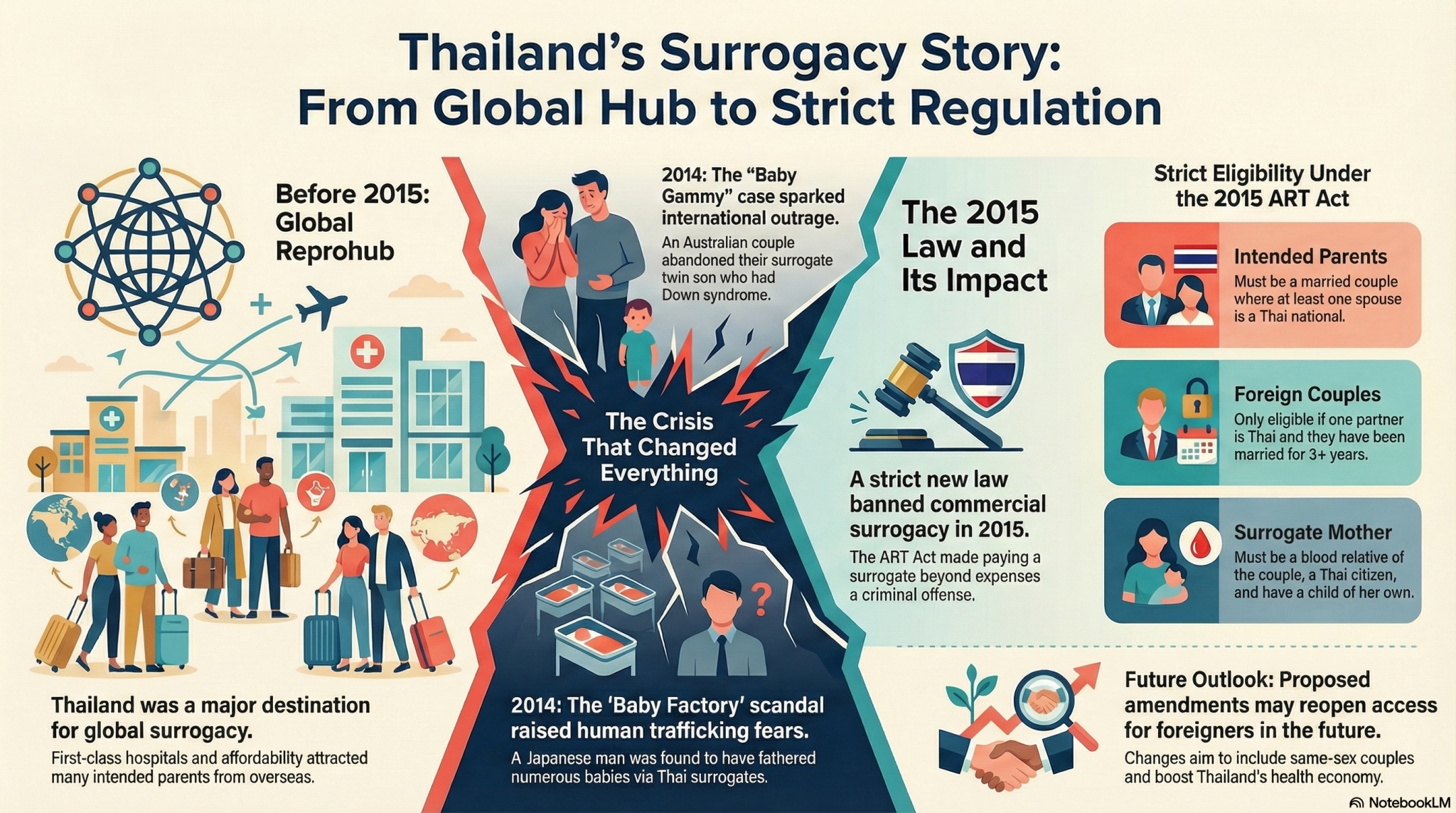
Surrogacy is when a woman carries and gives birth to a child for intended parents. This topic has sparked important legal and ethical discussions in Thailand. ThaiLawOnline has done intensive work during the surrogacy crisis in Thailand around 2014-2015. The government changed the law during these years. Cases like “Baby Gammy” and the “Baby Factory” made news worldwide.
FREE DOWNLOAD
Parental Consent to Travel (Free): Guide + Bilingual Consent Letter
A ready-to-sign consent letter in English and Thai for a child travelling abroad, with a practical guide: the Immigration check for Thai children under 18 since 3 August 2026, who must sign, and how to have the letter certified at the amphur or a Thai embassy. Essential after a divorce, for single parents, and in surrogacy and guardianship situations. Free, updated 30 September 2026. หนังสือยินยอมให้บุตรเดินทาง ฟรี
Parentage established through assisted reproduction interacts with the rules in our guide to Thai family law.
If you need a surrogacy lawyer, we might be some of the best in Thailand. Khun Wichuda, partner at ThaiLawOnline, has a master degree around surrogacy in Thailand. Reform has been discussed for years and has not happened. The Department of Health Service Support put a redrafted bill out for public consultation from 2 to 31 July 2026; it has still not gone to the Cabinet, and nothing has been published in the Royal Gazette. The 2015 Act therefore governs today. This note examines the law as it stands in September 2026, so that foreigners and expats can see what is actually permitted now rather than what has been proposed.
Table of Contents
Understanding Surrogacy: Definitions and Types
Surrogacy involves a surrogate mother carrying a pregnancy for intended parents. There are two primary types:
- Traditional Surrogacy: The surrogate uses her own egg, making her the biological mother.
- Gestational Surrogacy: The embryo is made using the intended parents’ or donors’ eggs and sperm. The surrogate has no genetic link to the child.
The distinction decides whether the arrangement is lawful here at all. Section 22 of the 2015 Act permits only two methods: an embryo from the sperm of the husband and the egg of the wife, or an embryo from the sperm of the husband or the egg of the wife together with a donor egg or sperm. The section ends by expressly forbidding the use of the surrogate’s own egg. Traditional surrogacy is therefore not available in Thailand, whoever the parties are and whatever they agree.
Legal Framework: The 2015 ART Act
Thailand’s surrogacy laws are set by the Protection for Children Born through Assisted Reproductive Technologies Act. This law was enacted on February 19, 2015. It became effective 90 days after it was published in the Government Gazette. The law was introduced after famous scandals, like the “baby Gammy” case. This case showed problems with child abandonment and human trafficking related to commercial surrogacy.
Key provisions, as detailed in the official document of the law that you can find here. Let’s just mentionned some conditions:
- Under Section 21 (1) the intended husband and wife must be lawfully married and of Thai nationality; where one of them is not Thai, the marriage must have been registered for at least three years. So a couple with no Thai spouse is excluded however long they have been married. The surrogate must not be an ascendant or descendant of either spouse (Section 21 (2)) and must already have had a child of her own (Section 21 (4)),
- no commercial benefits (Section 24),
- no advertising (Section 28).
- A child born through technology is a legitimate child of the intended parents. Donors have no rights or duties. If the parents die before the birth, the surrogate mother becomes the guardian (Section 30)
These are criminal prohibitions, not guidance. Under Section 48 anyone who breaches the Section 24 ban on arranging surrogacy for commercial purposes is liable to imprisonment not exceeding ten years and a fine not exceeding 200,000 baht; the Act uses and, so both are imposed. Under Section 49 a breach of the Section 28 advertising ban carries up to five years, or a fine up to 100,000 baht, or both, and Section 28 applies whether or not the advertising is for commercial purposes, so simply publicising that a woman is willing to carry a child, or that a couple is looking for someone to do so, is an offence. Under Section 47 a doctor who provides surrogacy services without the Committee approval required by Section 23 faces up to six months, or a fine up to 10,000 baht, or both. The law prohibits commercial surrogacy, meaning no financial compensation beyond necessary expenses is allowed. It limits surrogacy to a lawfully married husband and wife. Under section 21 the surrogate must be a blood relative of one of them, and only where there is no blood relative may another woman carry the child, on criteria set by the Minister of Public Health; she must already have had a child of her own, she must not be an ascendant or descendant of either spouse, and if she has a husband or a partner living with her as such, his consent is required. In practice this excludes single people and same-sex couples, and it excludes a couple in which neither spouse is Thai. It does not exclude a foreigner married to a Thai for at least three years.
Historical Context and Ethical Concerns
Thailand’s surrogacy laws have undergone substantial changes in recent years to regulate the practice more strictly. The Assisted Reproductive Technologies Act, or the Surrogacy Act, was created to ensure ethical and legal standards in surrogacy. One key change was banning commercial surrogacy. This means surrogate mothers cannot get paid more than their reasonable expenses. The law now mandates that only altruistic surrogacy is permissible, thereby limiting financial transactions associated with the surrogacy process. This change aims to protect the rights of surrogate mothers and prevent exploitation.
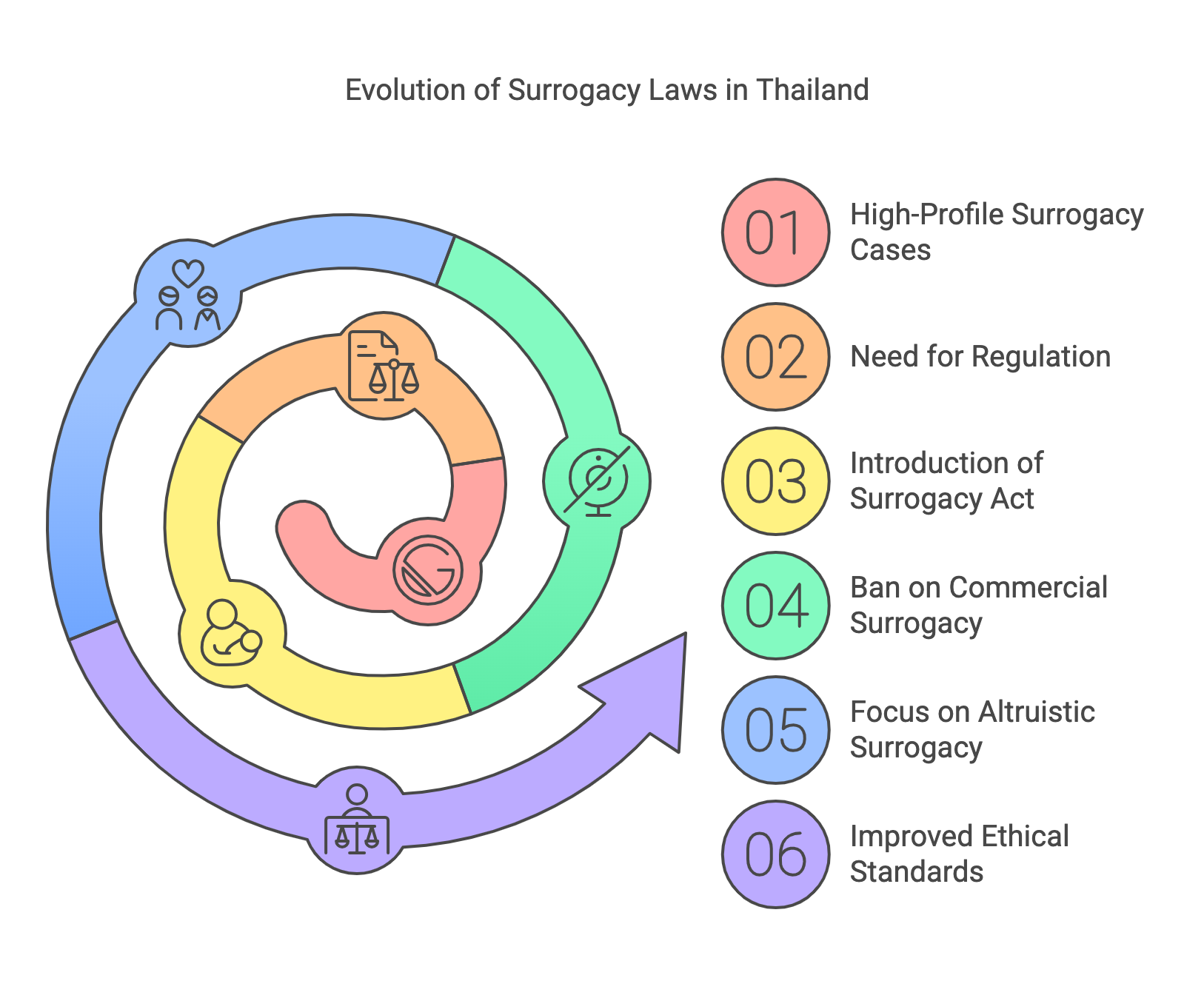
New surrogacy laws in Thailand were created because of several high-profile cases. The case of “Baby Gammy” gained attention in 2014. It highlighted issues in Thailand’s surrogacy industry. An Australian couple faced accusations for leaving their son with Down syndrome in Thailand. They took his healthy twin sister back to Australia. This incident showed the legal problems related to surrogacy in Thailand. It happened shortly after the 2014 military coup. At the same time, there was another scandal with a Japanese father called the “baby factory”. Thailand took action against commercial surrogacy by enforcing new laws.
Moreover, Surrogacy Thailand is increasingly recognized for its ethical practices, aiming to provide a supportive environment for both surrogate mothers and intended parents. This growing reputation is important for those considering Surrogacy Thailand.
Understanding the nuances of Surrogacy Thailand is essential for intended parents navigating this process and seeking guaranteed surrogacy. The country’s changing laws bring both challenges and benefits. It is important for couples to reach out to us for informed choices.
These cases showed the need for regulation. These cases often involved couples from other countries. They raised ethical and legal questions about the rights of children born through assisted reproductive technologies. The Thai government wanted to protect everyone involved. This includes the surrogate mother and the intended parents. They did this by creating a clear legal framework. The new law aims to improve Thailand’s reputation for ethical surrogacy. It ensures that all surrogacy agreements are clear and fair.
The legislation surrounding surrogacy, in Thailand established in 2015.
The Thai government approved a new law after facing scandals about surrogacy. This law is called the “Protection of Children Born from Assisted Reproductive Technologies Act B.E. 2558 (2015)”. This law changed surrogacy practices in Thailand. Some important aspects of the 2015 law comprise;
This new law from 2015 aimed to ban surrogacy. It made surrogacy so restricted that few people wanted to use Thai surrogacy services after that year.
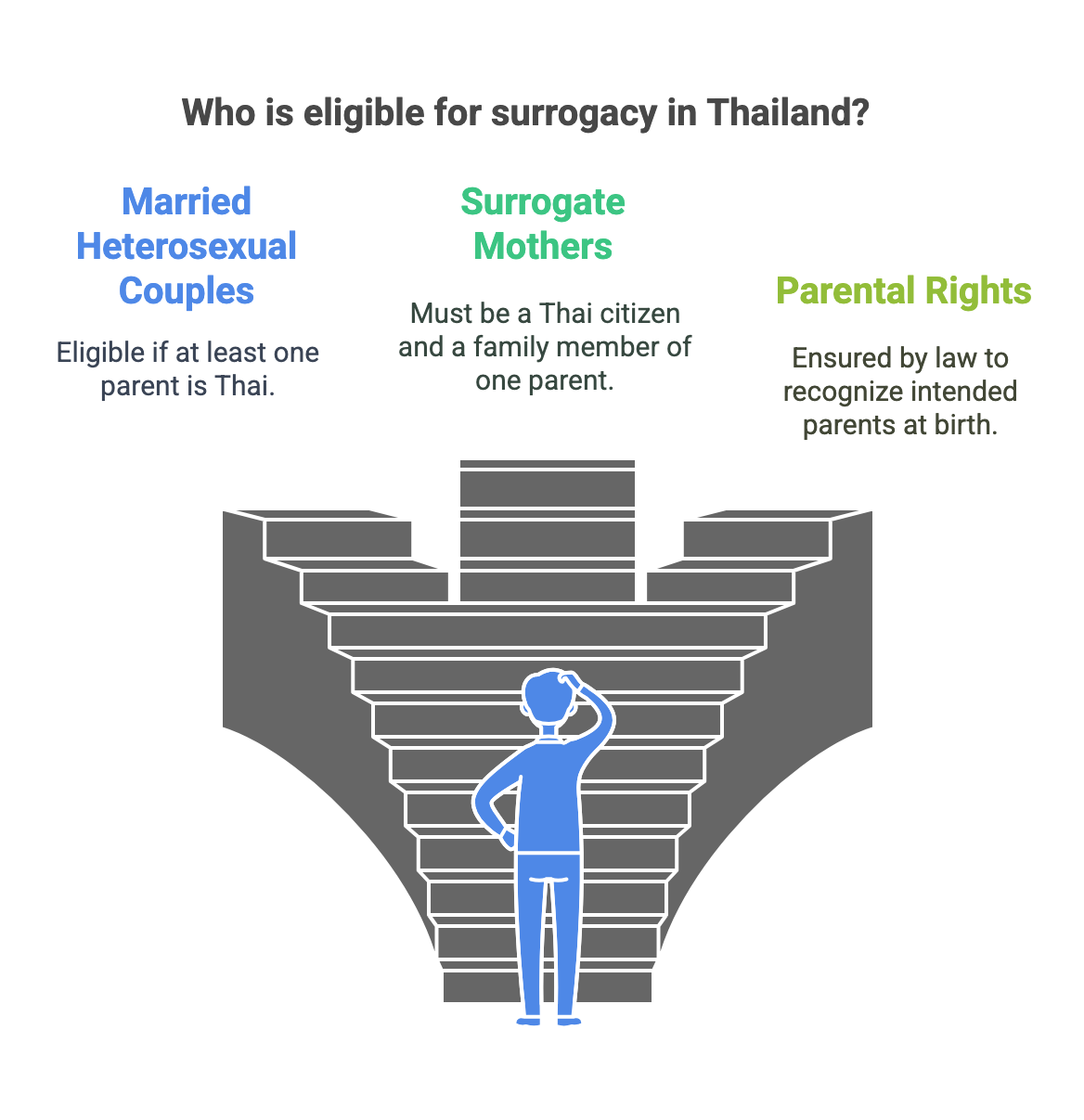
The Eligibility limitations include:
- Married heterosexual couples with least one Thai national can engage in surrogacy as intended parents.
- The surrogate must already have had a child of her own and must not be an ascendant or descendant of either spouse (section 21(2) and (4)). She must be a blood relative of one of the spouses; only where there is none may another woman carry the child, with the Committee’s permission, and she must then share the nationality of one of the spouses.
- Parental rights are defined by law. This ensures that parents who plan to raise a child are recognized as the child's parents. This recognition starts at birth to avoid any confusion about parental roles.
Breaking the rules could lead to fines and time behind bars, for both the surrogate and the parents involved in the process. Note that Thailand opened marriage to same-sex couples on 23 January 2025, the first country in Southeast Asia and the third in Asia to do so, after Taiwan in 2019 and Nepal in 2023. That did not open surrogacy. Section 21(1) of the 2015 Act still requires a lawful husband and wife, and section 67 paragraph 2 of the Marriage Equality Act leaves provisions that treat a husband and a wife differently exactly as they were. Adoption and surrogacy are governed by separate statutes and each has to be amended on its own.
Overview of Current Surrogacy Laws and Process in Thailand
| Topic | Details | Applies to Foreigners? | Notes |
|---|---|---|---|
| Legal Surrogacy Allowed? | Yes, but only for Thai couples or Thai-foreigner married couples | Partially (if married to a Thai) | Must be legally married for at least 3 years |
| Commercial Surrogacy | Prohibited by law | No | No payment allowed beyond medical & related expenses |
| Who Can Be a Surrogate? | A woman who has had a child before; a non-relative must be aged 20 to 40 | No | A blood relative of one spouse; another woman only if there is none, with Committee permission |
| Parental Rights | The child is the legitimate child of the intended husband and wife from birth (section 29) | Yes (if legal conditions are met) | No court order is needed: the Act itself confers parentage |
Recent Developments: Proposed Amendments
Recent government initiatives suggest a potential liberalization of surrogacy laws. In March 2024, the Department of Health Service Support announced plans to change the ART Act. The change would let foreign couples use surrogacy services, bringing their own surrogate or using a Thai surrogate. This move aims to boost the health economy and address Thailand’s declining birth rate.
- Replacing terms like “husband” and “wife” with “spouses” to align with the Marriage Equality Act.
- Allowing same-sex couples to access surrogacy.
- Welcoming overseas couples, with vetting by a government committee.
In 2024, Thailand initiated significant changes to its surrogacy laws, aiming to reopen services to foreign couples, including same-sex partners. This marks a departure from the 2015 legislation that restricted surrogacy to Thai heterosexual couples. The proposed amendments are designed to boost medical tourism and address demographic challenges posed by a declining birth rate.
The draft law says that intended parents must be legally married. They also need to show proof that the child will have protection and rights in their home country. Same-sex marriage is no longer pending: registrations began on 23 January 2025. It did not by itself open surrogacy, because section 21(1) of the 2015 Act is written for a lawful husband and wife, and section 67 of the Marriage Equality Act does not carry across provisions that treat a husband and a wife differently. These developments underscore Thailand’s commitment to evolving its legal framework in response to changing societal needs and international perspectives.
For more detailed information, you can refer to the following sources:
- Thailand takes steps to end ban on surrogacy services for foreign same-sex couples
- Public Health Drafts a Law Allowing Foreigners to Use Thai Surrogacy
Those amendments did not become law. The Department of Health Service Support reopened the redrafted bill for public consultation from 2 to 31 July 2026, and it must still go to the Cabinet and through the legislature after that. As of September 2026 nothing has been enacted and the 2015 restrictions stay in place in full.
Implications for Foreigners and Expats
For foreigners and expats the framework is restrictive, but it is not a blanket bar, and this is the point most often reported wrongly. A foreign national married to a Thai national qualifies under section 21(1) provided the marriage has been registered for at least three years and the other conditions of section 21 are met. What is closed is surrogacy for a couple in which neither spouse is Thai, and any commercial arrangement. The U.S. Embassy in Thailand advises against commercial surrogacy arrangements, citing potential legal risks.
However, the proposed changes could open doors in the future. Foreign couples should watch legislative changes. They might also think about other places like the United States. There, surrogacy laws are more flexible. You can read more about this here. Costs in Thailand used to be about $60,000. This included clinic fees and surrogate expenses. However, this is no longer an option for a couple with no Thai spouse under current law.
What Is the Surrogacy Cost in Thailand?
As Surrogacy Thailand changes, intended parents should stay active in getting updates and clarifications about the laws.
The cost of surrogacy in Thailand can vary greatly. It is important for couples to understand the financial aspects before pursuing surrogacy. This depends on many factors, like the clinic and the medical procedures needed. The cost is mostly influenced by three main factors. These are medical care fees, legal service fees, and travel and accommodation costs for the intended parents. Even though commercial surrogacy is not allowed, intended parents must pay for the reasonable costs of the surrogate mother. These costs can include medical expenses and other related fees. Costs can also be affected by choosing an egg donor. This choice can increase the total financial commitment needed for surrogacy.
Many factors can affect the cost of surrogacy in Thailand. These include the complexity of medical procedures, the clinic’s location, and the needs of the intended parents. Clinics in Bangkok may have different prices than those in other parts of the country where surrogacy is allowed. The choice and quality of the surrogacy service provider are important. Better clinics often provide more services, but they may charge higher prices. Legal costs for drafting contracts and dealing with regulations can increase overall expenses. It is important for intended parents to budget carefully and get advice from experienced professionals.
The cost of surrogacy in Thailand can change based on different factors. These include medical care fees and legal service fees. This shows how important it is to plan carefully.
In recent years, Surrogacy Thailand has undergone significant legal changes. The new surrogacy law prohibits commercial arrangements, meaning surrogate mothers cannot receive payment beyond medical and ancillary expenses. This change aims to stop exploitation and ensure ethical practices. However, it also affects costs. Intended parents can only cover essential expenses. This change means that intended parents must work closely with legal advisors. They need to follow the law and estimate the costs of their surrogacy journey accurately.
If you are thinking about surrogacy in Thailand, you should know that there are new legal rules. All surrogacy agreements must follow these rules. These rules are meant to support ethical practices.
Who Can Be a Surrogate Mother in Thailand with the 2015 law?
To become a surrogate mother in Thailand, individuals must meet specific requirements set forth by the surrogacy law. She must have had a child of her own, must not be an ascendant or descendant of either spouse, and needs the consent of her husband or the man living with her as husband, if she has one (section 21). A woman who is not a blood relative of either spouse also needs the Committee’s permission, must be aged 20 to 40, must share the nationality of one of the spouses, and may carry a child for others no more than twice (Ministry of Public Health criteria of 25 November 2015). Additionally, potential surrogates must undergo comprehensive medical and psychological evaluations to ensure they are fit for the role. The law aims to protect both the surrogate and the intended parents. It ensures that only qualified people can take part in surrogacy. This helps reduce the risk of problems during the surrogacy process.
Yes, Thailand’s surrogacy law includes specific regulations to protect surrogate mothers. These regulations ensure that surrogates are fully informed about the process and their rights. Surrogates are required to give informed consent, and they are entitled to receive appropriate medical care throughout the pregnancy. The law also stipulates that surrogate mothers cannot be subject to legal obligations beyond the agreed-upon responsibilities. These rules are made to protect surrogate mothers. They ensure that these women are treated fairly and with respect during the surrogacy process.
The process for choosing surrogate mothers in Thailand is careful. It has several steps to make sure they are suitable and follow the law. The surrogate is found within the family first (section 21(3)), and nobody may act as a paid go-between: arranging or pointing the way to a surrogate for money or any other benefit is an offence under section 27, punishable under section 49 by up to five years, a fine up to 100,000 baht, or both. The licensed clinic conducts extensive background checks, health screenings, and psychological evaluations to assess potential surrogates. The selection process includes talks to align expectations and responsibilities. This helps the surrogate and intended parents understand each other and commit to the surrogacy arrangement. This careful approach makes sure everyone is ready for the journey ahead. It helps reduce conflicts and keeps the process smooth.
What Are the Steps to Engage in a Surrogacy Program in Thailand at the moment?
Intended parents looking to join a surrogacy program in Thailand should start by doing some research. They need a medical practitioner licensed to provide assisted reproduction, who must obtain the Committee’s permission for each surrogacy (section 23). This initial step is crucial as it sets the foundation for the entire process. Once an appropriate service provider is chosen, intended parents undergo consultations to understand the legal, medical, and financial aspects of surrogacy in Thailand. They must also ensure they meet the eligibility criteria set by Thai law. After these initial steps, the next part is to create a surrogacy agreement. Then, you will select a surrogate mother. Finally, you will coordinate medical procedures like embryo transfer. These are important stages in the surrogacy journey.
An egg donor plays a critical role in surrogacy, particularly when the intended mother cannot provide viable eggs. In such cases, an egg donor provides the genetic material necessary for conception. Choosing an egg donor is an important process for couples who want to use surrogacy. It involves medical and genetic tests. These tests help ensure the donor’s health and compatibility. Using an egg donor can increase the cost of surrogacy. This is because it involves extra medical procedures and legal arrangements. In Thailand only a medical practitioner may receive and use donated eggs (section 35), and the donor has no rights or duties towards the child (section 29). They make sure the donor’s rights and wellbeing are protected during the process.
FAQs about Surrogacy in Thailand
What is the current legal framework for surrogacy in Thailand?
Thailand regulates surrogacy strictly under the 2015 ART Act. It is open only to a lawfully married husband and wife where the wife cannot bear a child. Section 21(1) requires them to be Thai nationals, except that where one spouse is not Thai the couple must have been registered as married for at least three years, so a foreigner married to a Thai can qualify. A couple in which neither spouse is Thai cannot. Commercial surrogacy is banned by section 24.
Are international and gay surrogacy options available in Thailand?
Surrogacy is not available to a couple with no Thai spouse, or to a same-sex couple, under the current law. Only a lawfully married husband and wife may use it: both must be Thai, or, where one is not, the marriage must have been registered for at least three years (section 21(1)).
How much does surrogacy cost in Thailand?
The cost of surrogacy in Thailand can vary a lot. This depends on factors like medical procedures, legal fees, and agency charges. However, strict rules about surrogacy make it hard for foreign couples to use surrogacy services in the country.
Does Thailand allow the use of an egg donor in surrogacy arrangements?
Yes, Thailand allows the use of an egg donor in surrogacy arrangements. However, the embryo must come from the husband’s sperm or the wife’s egg (section 22(2)), and the surrogate’s own egg can never be used.
What protections are in place for children born through surrogacy in Thailand?
The law includes specific protections for children born through surrogacy to ensure their well-being and rights. Parental rights are automatically assigned to the intended parents, provided all legal requirements are fulfilled.
Can foreign couples receive surrogacy services in Thailand?
No, the current law for surrogacy does not allow foreign couples to receive surrogacy services in Thailand. The process is restricted to legally married Thai couples only, including a foreigner that is married with a Thai person.
What types of surrogacy are permitted under Thailand surrogacy laws?
Gestational surrogacy is the only type allowed by Thailand’s surrogacy laws. It is only for Thai couples who meet the legal requirements. Traditional surrogacy and commercial surrogacy are not allowed.
Why did Thailand implement tough regulations to control surrogacy?
The strict rules were put in place to protect the rights and well-being of everyone involved. This is especially important for children born from surrogacy. The goal is to stop exploitation and the commercialization of surrogacy.
How can Thai couples initiate the surrogacy process?
Thai couples interested in surrogacy must meet specific legal criteria and go through approved surrogacy clinics. ouples should reach out to us or legal experts to contact us for help with the surrogacy process in Thailand.
Conclusion and Recommendations
In summary, surrogacy in Thailand is open only to a lawfully married husband and wife where the wife cannot bear a child. Section 21(1) of the 2015 ART Act requires them to hold Thai nationality, and where one spouse is not Thai it requires instead that the marriage has been registered for at least three years. Commercial surrogacy is prohibited outright by section 24. The government has drafted changes to admit foreign and same-sex couples, but as of September 2026 those changes are a bill at consultation stage and are not law. Foreigners and expats should keep up with legal updates. They should also talk to legal experts for advice. This is important because laws may change in the future.
This analysis highlights the need to understand local laws. It also shows how surrogacy rules in Thailand can change. This is especially important for people exploring international family-building options. Even if the current situation is unclear, if you need a surrogacy lawyer in Thailand, contact us at info@thailawonline.com
Last reviewed: 5 September 2026. The Protection for Children Born through Assisted Reproductive Technologies Act B.E. 2558 was read in Thai for this review from the full corpus copy of the Act: Sections 2, 21, 22, 23, 24, 25, 28, 30 and the penalty chapter, Sections 46 to 53. Three things were added and one corrected. The page described commercial surrogacy and surrogacy advertising as prohibited without ever stating that both are crimes: Section 48 punishes commercial surrogacy with imprisonment not exceeding ten years and a fine not exceeding 200,000 baht, and Section 49 punishes advertising with up to five years, a fine up to 100,000 baht, or both, whether or not the advertising is commercial. It defined traditional surrogacy as one of two types without saying that Section 22 forbids the use of the surrogate’s own egg, so that form is not lawful in Thailand at all. And it compressed Section 21 (1) into an either-or; the Act requires the intended couple to be Thai and imposes the three-year registered marriage only where one spouse is not. What this review does not cover, said rather than implied. The 2014 and 2015 history, the Baby Gammy account and the clinic and cost material were not verified. The statement that a redrafted bill went out for public consultation from 2 to 31 July 2026 and has not reached the Cabinet is a claim about an unpublished bill and could not be checked against the Royal Gazette; it is left as written. The ministerial and Medical Council notifications made under the Act, including the criteria for a non-relative surrogate under Section 21 (3), exist in our sources but were not read for this review. On 4 October 2026 sections 21 to 23, 27, 29, 30, 35, 48 and 49 and the Ministry of Public Health criteria for a non-relative surrogate (25 November 2015) were read in Thai, and the older lower half of the page, which still described paid agency matching, a court step for parentage and a surrogate who could not be a mother, was aligned with them.
Thai Law Updates, free by email
Plain-English updates on Thai law changes that affect foreigners: property, visas, marriage, business and wills. One short email a month from a firm practicing since 2006. No spam, unsubscribe anytime.