


Reviewed by ThaiLawOnline, a licensed Thai law firm practising in Thailand since 2006. Thai lawyer of record: Wichuda Atthamethakon, LL.M., Thai Bar Licence 3149/2556.
Last updated on
The Thailand Elite Visa has changed a lot in 2024. It is now officially called the Thailand Privilege Visa. This guide gives expats important information about this premium long-term residency option. It covers pricing changes, application requirements, and key tips for applicants.
For how this compares with the other long-stay options, use our Thai visa finder.
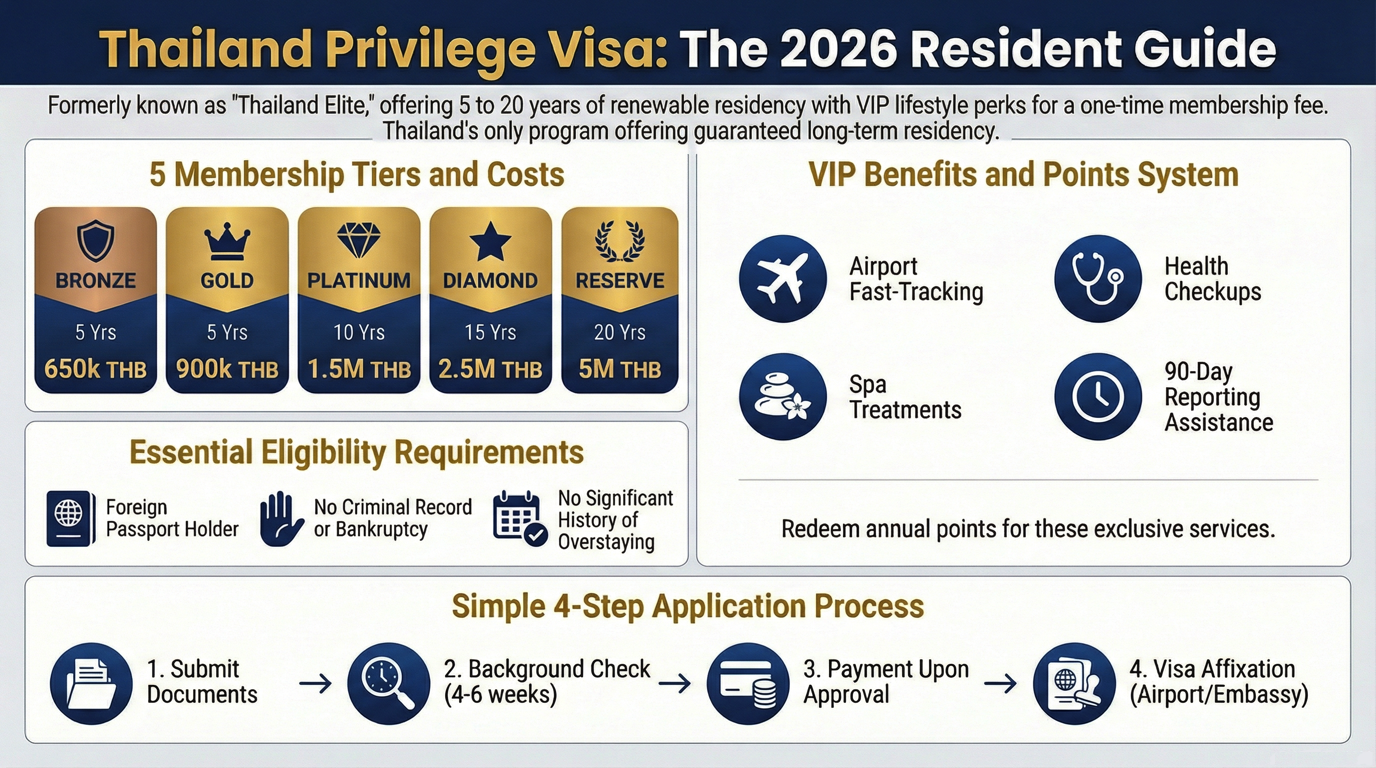
Thailand Elite Visa is now called “Thailand Privilege Visa”
Table of Contents
What is the Thailand Privilege Visa?
The old Thailand Elite Visa, now called the Thailand Privilege Visa, is not a tourist visa. A member is granted a Privilege Entry visa, a special temporary-stay visa created by a Ministry of Interior announcement of 22 February 2013, made under section 17 of the Immigration Act with Cabinet approval and published in the Government Gazette (volume 130, special part 34 Ngor, page 8, 14 March 2013). Under that announcement the visa is valid five years with unlimited entries for the life of the membership and the visa fee is waived; immigration grants one year of stay on each entry; and after that year an officer may extend the stay one year at a time on application. It is run by the Thailand Privilege Card Company Limited. This company is wholly owned by the Tourism Authority of Thailand (TAT), a state enterprise under the Ministry of Tourism and Sports. The programme started in 2003: the first Ministry of Interior announcement for it, made under the same section 17 power, is dated 17 October 2003 and was published in the Royal Gazette on 7 November 2003, and Thailand Privilege dates the launch of the card project to the same year. It is a paid membership rather than an investment programme, and what it produces is a temporary-stay visa rather than residency.
There are different designs of the Thailand Privilege Visa Cards representing various membership options.
The program gives foreign nationals special residency rights for 5 to 20 years. It also includes many VIP benefits and services. The Thailand Privilege Visa is different from traditional visa types. It provides a 5-year renewable multiple-entry visa with 1-year entry stamps. This means you won’t need to do visa runs like other long-term visa holders.
Key features include 5-year renewable multiple-entry visas and a 1-year length of stay per entry. Members do not have to do ‘visa runs’ every 90 days. However, they must still complete the 90-Day Report of address to Immigration. Privilege members can get help from the Elite Personal Assistant (EPA) service, which can assist with or handle this reporting for them. There are VIP airport services with fast-track lanes for immigration. You also get 24/7 concierge services. Members gain access to exclusive privileges across Thailand’s hospitality sector, including hotels, restaurants, golf courses, and spa facilities.
| Membership Tier | Validity (Years) | Membership Cost (THB) | Privilege Points (Per Year) | Additional Family Member Cost (THB) | Income Tax Status | Key Benefits |
|---|---|---|---|---|---|---|
| Reserve | 20 | 5,000,000 | 120 | 750,000 (Next Member promotion, while advertised) / 2,000,000 (standard) | Subject to standard Thai progressive rates (up to 35%) on remitted foreign income if you are in Thailand 180 days or more in the tax year (Revenue Code s.41). | Invitation only, maximum exclusivity, 120 privilege points, private investment consultations, and VIP concierge. |
| Diamond | 15 | 2,500,000 | 55 | 750,000 (Next Member promotion, while advertised) / 1,500,000 (standard) | Subject to standard Thai progressive rates (up to 35%) on remitted foreign income if you are in Thailand 180 days or more in the tax year (Revenue Code s.41). | Fast Track immigration, 55 privilege points, elite lifestyle perks including health checkups and networking events. |
| Platinum | 10 | 1,500,000 | 35 | 750,000 (Next Member promotion, while advertised) / 1,000,000 (standard) | Subject to standard Thai progressive rates (up to 35%) on remitted foreign income if you are in Thailand 180 days or more in the tax year (Revenue Code s.41). | Fast Track immigration, airport lounge access, 35 privilege points for services like dental checkups or domestic flights. |
| Gold | 5 | 900,000 | 20 | 900,000 | Subject to standard Thai progressive rates (up to 35%) on remitted foreign income if you are in Thailand 180 days or more in the tax year (Revenue Code s.41). | Fast Track immigration, 1-year stay per entry, 20 privilege points for airport transfers or spa sessions. |
| Bronze | 5 | 650,000 | 0 | 650,000 | Subject to standard Thai progressive rates (up to 35%) on remitted foreign income if you are in Thailand 180 days or more in the tax year (Revenue Code s.41). | Fast Track immigration, Elite Personal Assistant (EPA) for airport assistance, 1-year stay per entry. |
| LTR Wealthy Global Citizen | 10 | 50,000 (Administrative fee) | N/A | Dependants (spouse, parents, children under 20) apply for their own LTR visa (BOI Announcement Por. 3/2568, item 2.2) | Tax exemption on foreign-sourced income from an earlier tax year that is brought into Thailand (Royal Decree No. 743). | 10-year stay, 1-year address reporting (instead of 90-day), fast-track immigration at international airports. |
| LTR Wealthy Pensioner | 10 | 50,000 (Administrative fee) | N/A | Dependants (spouse, parents, children under 20) apply for their own LTR visa (BOI Announcement Por. 3/2568, item 2.2) | Tax exemption on foreign-sourced income from an earlier tax year that is brought into Thailand (Royal Decree No. 743). | 10-year stay for retirees, annual address reporting, fast-track immigration, and exemption on foreign income. |
| LTR Highly-Skilled Professional | 10 | 50,000 (Administrative fee) | N/A | Dependants (spouse, parents, children under 20) apply for their own LTR visa (BOI Announcement Por. 3/2568, item 2.2) | Thai employment income from a qualifying employer taxed at no more than 17% (Royal Decree No. 743, s.3), instead of up to 35% progressive rates. | 10-year stay, annual address reporting, simplified work permit processing, and reduced income tax rate. |
2024 Pricing Revolution and Current Costs
The Thailand Elite Visa saw a big price change in 2024. Costs went up about 50% from the Elite programs in 2023-2024. The program changed from the old Elite structure to the new Thailand Privilege Card system. It now uses a tiered membership approach with privilege points.
Comparison of Thailand Privilege Card membership packages, detailing fees, validity, and included benefits across various tiers.
Current Membership Packages for the Thailand Privilege Visa
Bronze Membership (Limited Time Offer)
The most affordable option costs 650,000 THB (~$19,250 USD) for a 5-year validity period. This package was introduced as a limited-time offer on 15 December 2024 and is still listed by Thailand Privilege at the time of writing, but it has no guaranteed end date, so treat the price as subject to change. It offers basic VIP services but does not include rewards based on privilege points.
Gold Membership
Priced at 900,000 THB (~$25,000 USD) for 5 years, this entry-level standard option includes 20 privilege points annually. The Gold membership represents the baseline for most individual applicants seeking medium-term residency.
Platinum Membership
The family-friendly option costs 1,500,000 THB (~$41,000 USD) for 10-year validity, featuring 35 privilege points per year. Under the “Next Family Member” promotion, you can add a family member to Platinum, Diamond, or Reserve memberships. When this page was last checked, Thailand Privilege was advertising that promotion at a flat 750,000 THB per additional member (still advertised on 4 October 2026 with no end date shown; confirm it before paying), well below the standard 1,000,000 THB (Platinum), 1,500,000 THB (Diamond) and 2,000,000 THB (Reserve) rates. Promotional rounds are extended and withdrawn without notice, so confirm the price with Thailand Privilege before you commit.
Diamond Membership
Targeting luxury seekers, this 15-year membership costs 2,500,000 THB (~$70,000 USD) with 55 privilege points annually. You can add a family member to your Platinum, Diamond, or Reserve memberships. This is part of the ‘Next Member’ promotion. When this page was last checked the promotion was advertised at a flat 750,000 THB per additional member (still advertised on 4 October 2026 with no end date shown; confirm it before paying), against standard rates of 1,000,000 THB (Platinum), 1,500,000 THB (Diamond) and 2,000,000 THB (Reserve).
Reserve Membership (Invitation Only)
The exclusive 20+ year membership costs 5,000,000 THB (~$140,000 USD) with 120 privilege points per year. Additional family members cost 2,000,000 THB each, and this tier is available only through invitation.
Critical Pricing Updates
A 50,000 THB membership application fee (VAT included) is payable up front, at the time you submit the application, and it is refundable only if the background check comes back as “immigration not approved”. Thailand Privilege suspended this fee once, for applications submitted between 1 September and 31 December 2024, and that suspension has long since expired. No further waiver has been published, although some authorised agents still advertise applications with no application fee, so confirm the position with Thailand Privilege or your agent before you transfer anything. Family discounts are available for Platinum and higher tiers during promotional periods, though specific terms vary.
Requirements and Eligibility Criteria
The Thailand Privilege Visa has simple eligibility requirements compared to other long-term visas. However, some restrictions have become stricter in recent years.
Basic Qualifications
All foreign passport holders can apply, except for North Korean citizens. There are no age limits or income requirements, except showing you can pay the membership fees. Applicants must maintain a clean immigration record with no overstays in Thailand within the last three years.
Criminal history restrictions prohibit applicants convicted of imprisonment in any country, except for negligence-related offenses. Additionally, applicants cannot have been declared bankrupt or mentally incompetent.
Special Considerations and Restrictions
Education Visa Holders Face Increased Scrutiny
Recent policy changes have significantly impacted applicants with previous education visa history. Starting in June 2023, Thailand Immigration increased scrutiny on applicants with a history of Education (ED) Visas. These applicants do not face an automatic rejection. However, they must now submit extra verification. This includes the Education Visa Acknowledgement Form. They may also go through a more detailed background check. It is due to the abuse of the ED visa system. Applicants with education visa history must now provide comprehensive documentation including school establishment licenses, academic records, and attendance reports.
Work Permit Holders
A current work permit holder cannot carry an employment-based permission to stay and the Privilege Entry visa at the same time, because a passport holds one permission to stay at a time, so the existing non-immigrant visa is cancelled before the Privilege Entry visa is affixed. That is the reason, and it is worth stating correctly: it is not that the Privilege Visa is a tourist visa. It is not one. The announcement that creates it places it in the special temporary-stay category.
Required Documentation
To apply, you need to complete an application form. You also need to sign a Personal Data Protection Act (PDPA) form. Lastly, include a color copy of your passport’s identification page. High-resolution passport photos with white backgrounds are mandatory, along with proof of family relationships for family applications.
Passport validity must exceed 12 months with at least three blank pages available for visa affixing. Applicants with previous education visas must submit additional school-related documentation to avoid automatic rejection.
Application Process and Timeline
The Thailand Privilege Visa application has four steps, and how long it takes depends on your nationality and on how complex your file is. Thailand Privilege’s own figure for the background check is about four to six weeks, and a notice on its news page, live when this guide was last checked, says the check is currently running longer than usual because of extended processing at the Foreign Affairs Division of the Royal Thai Police, with some cases going beyond six weeks. Budget for longer than the headline figure.
Step 1: Application Submission and Background Check
Applications can be submitted through authorized agents or directly via the online portal, regardless of current location. The comprehensive background check involves four government agencies: Immigration Bureau, Department of Consular Affairs, Foreign Affairs Division of Royal Thai Police, and Central Investigation Bureau.
Processing time differs by nationality and by how complex the file is. Thailand Privilege quotes roughly four to six weeks for the check and currently warns that some cases are taking longer than six weeks. Applicants with a complicated immigration history should plan for the longer end.
Step 2: Approval and Payment
Upon successful background clearance, applicants receive an approval letter with detailed payment instructions. Payment methods include international wire transfer, local bank transfer, and online credit card payment. Full payment must be completed before visa issuance, with no partial payment options available.
Step 3: Membership Acceptance
Payment confirmation triggers membership registration, resulting in a Thailand Privilege membership ID and welcome letter detailing program benefits. This stage confirms visa readiness for passport affixing and full program approval.
Step 4: Visa Issuance
There are three ways to get a visa based on your situation. You can apply at the Thai Embassy or Consulate in your home country. You can also get a visa upon arrival at Suvarnabhumi, Chiang Mai, or Phuket airports. If you live in Thailand, you can apply at the Chaengwattana Immigration Bureau in Bangkok.
Agency vs. Self-Application: Strategic Analysis
Choosing between an authorized agent or applying directly is an important decision for Thailand Privilege Visa applicants. This choice affects success rates, convenience, and support.
Arguments for Using an Authorized Agent
Authorized General Sales and Services Agents (GSSA) have special knowledge of Thai government processes. They help reduce application errors that can cause delays or rejections. These agents maintain direct relationships with Thailand Privilege Card Company and relevant government agencies, facilitating smoother processing.
GSSAs offer document preparation assistance, translation services, and ongoing consultation throughout the membership period. Many authorized agents provide additional value-added services including legal consultation, bank account opening assistance, and post-approval immigration support.
Authorized agents offer services for free to applicants. Their commissions come directly from the Thailand Privilege Card Company, not the applicants. This eliminates financial barriers to professional assistance while providing substantial value.
Arguments for Direct Application
Control and Transparency
Direct applications offer complete control over timeline management and direct communication with Thailand Privilege. The online application portal provides straightforward submission processes for uncomplicated cases.
Simplified Requirements
For applicants with clean immigration histories and straightforward circumstances, the application requirements are relatively simple and may not require professional intervention.
Strategic Recommendation
Use an authorized agent if you are:
- A first-time applicant unfamiliar with Thai bureaucracy
- An applicant with complex circumstances, including previous visa issues or education visa history
- Seeking additional services like legal consultation or ongoing immigration support
- Applying as a family requiring coordination of multiple applications
Consider direct application if you are:
- An experienced expatriate familiar with Thai administrative processes
- A straightforward case with clean immigration history
- Preferring direct control over application management
A detailed comparison of the Thailand Privilege Gold, Platinum, and Diamond membership packages. This includes fees, validity, and a full list of benefits.
Visa Limitations and Legal Framework
The Thailand Privilege Visa is not a tourist visa, and the difference decides more than it looks. The Ministry of Interior announcement of 22 February 2013 that creates it, issued under section 17 of the Immigration Act B.E. 2522 with Cabinet approval of 12 November 2012, entitles a member to the Privilege Entry visa, which clause 2 places in the special temporary-stay category, not the tourist category. What that announcement does not do is mention work at all. It grants the visa, five years of validity with unlimited entries for the life of the membership, one year of stay on each entry and extensions of a year at a time, and nothing beyond that. It confers no right to work in Thailand. Work is governed separately, by the Emergency Decree on Managing the Work of Aliens B.E. 2560, whose section 8 forbids an alien to work without a work permit. So the planning point is real, but the reason is not the one usually given: a member who wants to work needs a work permit and the status that supports one, and that is a different application from the membership.
The programme is not itself a route to permanent residency. The Privilege Entry visa is a temporary-stay permission renewed a year at a time for the life of the membership, and permanent residence is a separate application under the Immigration Act with its own conditions. Membership changes nothing about property: a foreigner may own a condominium unit within the foreign-ownership quota the Condominium Act sets for the building, and cannot own land except in the narrow cases the Land Code itself allows.
Practical Benefits for Daily Life
Banking and Financial Services
Privilege members have an easier time opening bank accounts. This helps with one of the toughest parts of living in Thailand as an expatriate. The program provides access to multi-currency accounts with internet banking capabilities.
Treat with care the common claim that a Privilege member may work remotely for foreign clients without a Thai work permit because no Thai employer is involved. That is not the test Thai law applies. Section 5 of the Emergency Decree on Managing the Work of Aliens B.E. 2560, as amended by (No. 2) B.E. 2561, defines work as engaging in any occupation, whether or not there is an employer, and section 8 forbids an alien to work without a work permit. The absence of a Thai employer therefore does not by itself put an activity outside the Decree, and the 2013 announcement that creates the Privilege Entry visa grants no work right to weigh against it. If remote work is the reason for the move, read our Destination Thailand Visa guide: the DTV is the category whose own conditions speak to remote work for foreign employers and clients.
Healthcare and Lifestyle Services
Health check-ups are among the benefits that privilege points can be spent on, so what you get depends on the tier: the 650,000 THB entry package carries no privilege points. This offers peace of mind for long-term residents. Members gain access to exclusive events and networking opportunities within the Thailand Privilege member community.
Administrative Assistance
The Elite Personal Assistant service can handle mandatory 90-day reporting requirements, eliminating the need for regular immigration office visits. Additional assistance includes Thai driving license applications and various bureaucratic processes.
Tax and Financial Implications
The Privilege Visa does not decide your tax position. The Revenue Code does, and it does not care what your visa is called. Under section 41 paragraph 3 you are a resident of Thailand for tax purposes in any tax year in which your stays total 180 days or more, counted across one visit or several. That is 180, not 183, and reaching 180 is enough. A resident who brings foreign income into Thailand is taxed on it under section 41 paragraph 2, as the Revenue Department reads that paragraph in Departmental Instructions Por. 161/2566 and Por. 162/2566: residence is tested in the tax year the income arose, the money is taxed in the year it is brought in, and income that arose before 1 January 2024 stays outside the rule. Those instructions are guidance to revenue officers, not amendments to the Code. Members can use privilege points to access wealth advisory services. This offers professional financial help for complex expat situations.
Recent Changes and Market Position
2024 Program Evolution
The transformation from Thailand Elite to Thailand Privilege represents the most significant program update since its inception. The introduction of privilege points allows customizable benefits, providing members with greater flexibility in utilizing their membership advantages.
Application processes have been streamlined with enhanced online capabilities, though background check procedures have become more comprehensive. The expanded benefits portfolio includes new categories across wealth management, healthcare, and lifestyle services.
Competitive Landscape and Future Outlook
The Thailand Privilege Visa now competes more with the Long-Term Resident (LTR) visa. The LTR visa provides options for rich retirees and digital nomads. It has different benefits from the Thailand Privilege Visa. The programme is run by Thailand Privilege Card Co., Ltd., a company wholly owned by the Tourism Authority of Thailand.
Market demand remains strong despite significant price increases, indicating sustained appeal among affluent expatriates. The government’s continued investment in program enhancement suggests long-term viability and expansion of services.
Conclusion
The Thailand Privilege Visa is a special way to get long-term residency in Thailand. It offers great convenience and VIP treatment for eligible foreign nationals. In 2024, price increases have made it harder to join the program. However, it still offers great value for expats. They can enjoy convenience, comfort, and full support services. Many people believe the DTV visa is a cheaper option. However, there can be issues when opening a bank account with a DTV visa.
When deciding to get Privilege Visa membership, think about your personal situation. Consider your long-term plans to live in Thailand. Also, be aware of the large upfront cost involved. For most applicants, utilizing authorized agents provides optimal results due to their expertise, government relationships, and comprehensive support services offered at no additional cost.
The program particularly suits digital nomads, retirees, investors, and affluent individuals who value premium services and seamless immigration experiences over cost considerations. As the land of smiles enhances its programs, the Thailand Privilege Visa stays the best option for long-term residency. It is ideal for expatriates who want the best Thai lifestyle experience.
Last reviewed: 5 September 2026. The legal framework on this page was read against the instruments themselves, not against secondary summaries. What was read: the Ministry of Interior announcement of 22 February 2013 that creates this visa, made under section 17 of the Immigration Act B.E. 2522 with Cabinet approval of 12 November 2012 and published in the Royal Gazette at volume 130, special part 34 Ngor, page 8 on 14 March 2013, clauses 1 to 5, which is where the Privilege Entry visa, its five-year validity, the one year of stay per entry and the yearly extension come from; the original 2003 announcement for the same programme, dated 17 October 2003 and gazetted on 7 November 2003, as amended in 2009; the Emergency Decree on Managing the Work of Aliens B.E. 2560 as amended by (No. 2) B.E. 2561, sections 4, 5, 8, 59 and 101, for everything this page says about work; and section 41 of the Revenue Code together with Revenue Department Departmental Instructions Por. 161/2566 and Por. 162/2566, for the tax section. The five membership tiers, their fees, validity and privilege points, and the current supplementary-card promotion were checked the same day against Thailand Privilege’s own website. Four things were corrected as a result: this page had described the visa as a tourist visa in three places while its own opening paragraph said the opposite; it gave 183 days as the tax-residence threshold, where the Revenue Code says 180; it told readers that no work permit is needed so long as there is no Thai employer, which is not the test the Emergency Decree uses; and it quoted a supplementary-card promotion that had already closed, at a price 250,000 THB below the one the operator was advertising.
What this review does not cover, said plainly rather than left to be assumed. Everything on this page that comes from Thailand Privilege’s own terms rather than from a statute was not verified against the operator and should be confirmed with it before you pay anything: the 50,000 THB application fee, its VAT treatment, its refund condition and the 2024 suspension window; the standard supplementary-card rates of 1,000,000, 1,500,000 and 2,000,000 THB, which the operator does not publish; the eligibility and refusal conditions, including the nationality exclusion, the three-year clean immigration record, the bankruptcy, mental-capacity and criminal-conviction bars and the extra scrutiny of former education-visa holders; the documentation list; the four agencies named in the background check; the places at which the visa can be affixed; the arrangement under which authorised agents are paid; and the US dollar conversions, which move with the exchange rate. The benefit descriptions are the operator’s marketing, not law.
Frequently Asked Questions
What is the Thailand Privilege Visa?
It is a long-stay membership visa programme, formerly known as the Thailand Elite Visa, that offers multi-year stays and concierge-style privileges in return for a membership fee.
How long can you stay with a Thailand Privilege Visa?
Depending on the package, membership runs from 5 up to 20 years, with renewable long-stay permission granted on each entry.
How much does the Thailand Privilege Visa cost?
Membership fees vary by tier and start in the hundreds of thousands of baht, rising for longer-term and higher-benefit packages.
Can I work in Thailand with a Privilege Visa?
No. The Ministry of Interior announcement that creates the Privilege Entry visa grants entry and stay only and says nothing about work, and the Emergency Decree on Managing the Work of Aliens B.E. 2560 requires a work permit for any occupation, whether or not there is an employer. A work permit and the status that supports it are a separate matter from the membership.
Does a Thailand Privilege Visa holder need to do 90-day reporting?
Yes. Members must still comply with Thailand’s 90-day address reporting and other standard immigration obligations.
Thai Law Updates, free by email
Plain-English updates on Thai law changes that affect foreigners: property, visas, marriage, business and wills. One short email a month from a firm practicing since 2006. No spam, unsubscribe anytime.