


Thai Estate Administrator: Buying Land From an Estate
Thai estate administrator sold you land but never transferred title? Dika 1085/2569 shows why you must sue the administrator in a case of your own.
Choose a subject or search for your question. New articles appear here when published.
Property and real estate law in Thailand: buying, leasing, usufruct, title deeds and foreign ownership.
Thai estate administrator sold you land but never transferred title? Dika 1085/2569 shows why you must sue the administrator in a case of your own.
Land and building tax exemption in Thailand turns on the house registration. Dika 144/2569 shows why a spouse’s blue book entry is not enough.
How mortgage laws in Thailand work under the Civil and Commercial Code, which home financing options are open to foreigners, what they cost and what happens on default.
Dika 3228/2569: two 2017 land transfers revoked, two 2006 claims time-barred. Spousal consent, buyer protection and due diligence in Thailand.
Dika 97/2569: property bought together before marriage is co-owned half each, whatever name is on the deed. Rules for unmarried couples in Thailand.
Supreme Court 1511/2569: a developer cannot keep 2.8M baht of instalments as a forfeited deposit. Earnest-money rules (CCC s.377-378) for condo buyers.
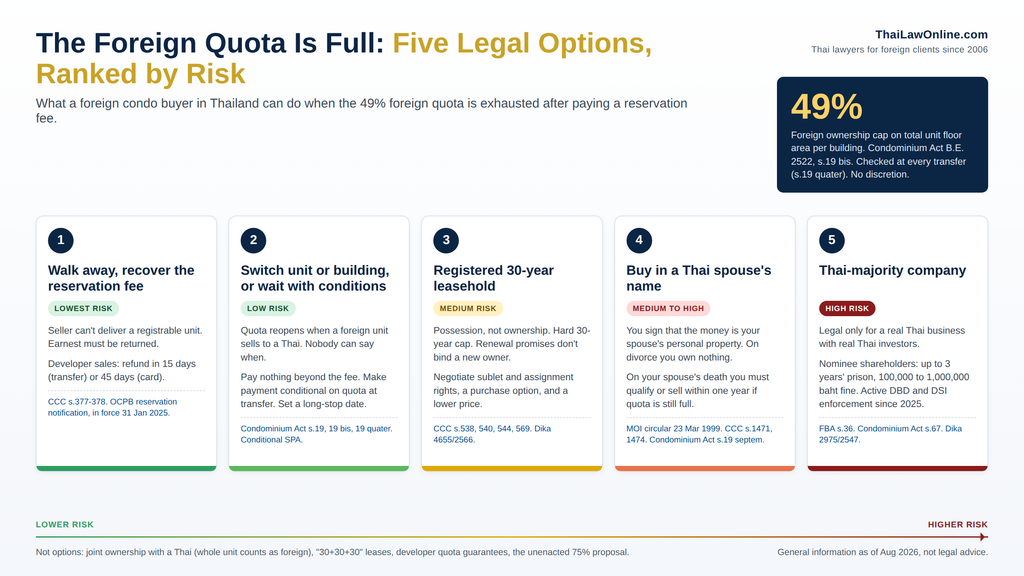
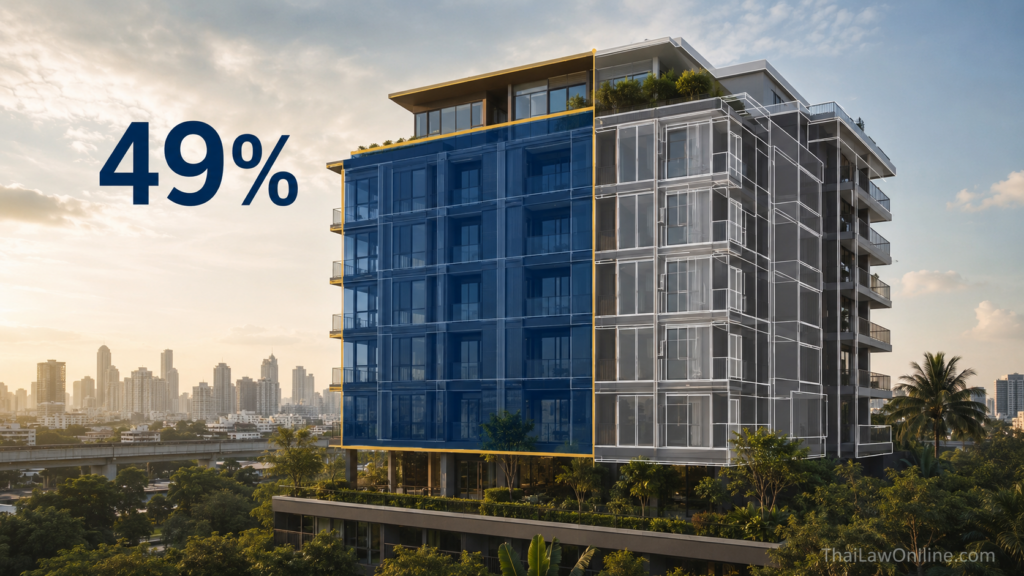
You paid the reservation fee. You picked the unit. Then the sales office called: the foreign quota is full. This page is for that moment. It sets out the five legal options a foreign buyer has in Thailand when a condo’s 49% foreign quota is exhausted. They’re ranked from lowest risk to highest, with the statute behind each one.
Short answer. When the foreign quota is full, the Land Office will not register the unit in your name (Condominium Act B.E. 2522, Section 19 quater). You have five options. (1) Walk away and recover your reservation fee. (2) Move to a unit or building that still has quota. (3) Register a 30-year lease. (4) Buy in a Thai spouse’s name. (5) Buy through a real Thai-majority company. Options 1 and 2 are low risk. Option 3 is medium. Options 4 and 5 carry real legal and financial exposure. Nothing else on offer (joint ownership with a Thai, “30+30+30” leases, a promised 75% quota) actually works.
We’ve handled this call many times while advising foreign clients in Thailand since 2006. The buyer is usually a few days into a transaction and under pressure to “just sign the lease version”. Don’t. Read this first. It takes ten minutes, and it can save you from paying for a unit you never legally own.
Two 2026 rulings of the Committee on Jurisdiction between Courts (212/2569, 213/2569) decide which court hears land disputes with the State. What foreign buyers and condo owners must know.
A buyer faked a lost chanote, got a new deed and sold the land. Dika 914/2569 shows how Thai courts punish title deed fraud and compensate victims.
What changed: Nothing in the foreign ownership quota. Proposals to raise the condominium foreign quota from 49 percent to 75