


Reviewed by Wichuda Atthamethakon, LL.M., Thai Bar Licence 3149/2556, for ThaiLawOnline, a Thai law firm acting for foreigners since 2006.
Update log
- 2 November 2026: Added the statute box with Thai, English and French text and checked the page against the official text
What changed: Nothing in the foreign ownership quota. Proposals to raise the condominium foreign quota from 49 percent to 75 percent, and to allow 99-year leases, have circulated since 2024. Neither has been enacted. No bill has been tabled in parliament. The 49 percent cap and the 30-year lease ceiling both remain the law.
The quota is one of the first checks in our guide to buying property in Thailand.
Effective: Not applicable, because there is nothing in force to be effective. What did change in 2026: the transfer and mortgage fee cut to 0.01 percent was renewed by Ministry of Interior announcements published in the Royal Gazette on 1 July 2026, running to 30 June 2027. Read the next line carefully, because most coverage omits it: that fee cut is restricted to individual Thai nationals and does not apply to foreign buyers.
Who it affects: Foreign buyers considering a Thai condominium, anyone offered a 90-year or 99-year lease structure, and owners in buildings already at the 49 percent foreign limit. The quota decides whether a given unit can go in your name at all, so check it before you pay anything.
What to do now: Buy on the law as it stands. Never pay a premium for a unit priced on an expected rule change. Verify the building’s remaining foreign quota in writing before you sign, and treat any 99-year lease offer as a structure a Thai court has already looked through.
Last verified: 1 August 2026, against the Condominium Act B.E. 2522 section 19 bis, section 540 of the Civil and Commercial Code, Supreme Court Decision 4655/2566, and a negative check of the Royal Gazette for any amending instrument.
FREE DOWNLOAD, READ IT BEFORE YOU PAY A DEPOSIT
Buying a Condo in Thailand: Checklist for Foreign Buyers (Word + PDF, English & Thai)
The 49% foreign quota, how to bring the money in so the Land Office accepts it (FET form), what to check before the deposit, taxes and fees, transfer day, six red flags and a purchase record sheet. Complete English text first, then the complete Thai text. Checked 3 October 2026.
Download free Want us to run the checks? Condominium Package ฿19,900 →
Table of Contents
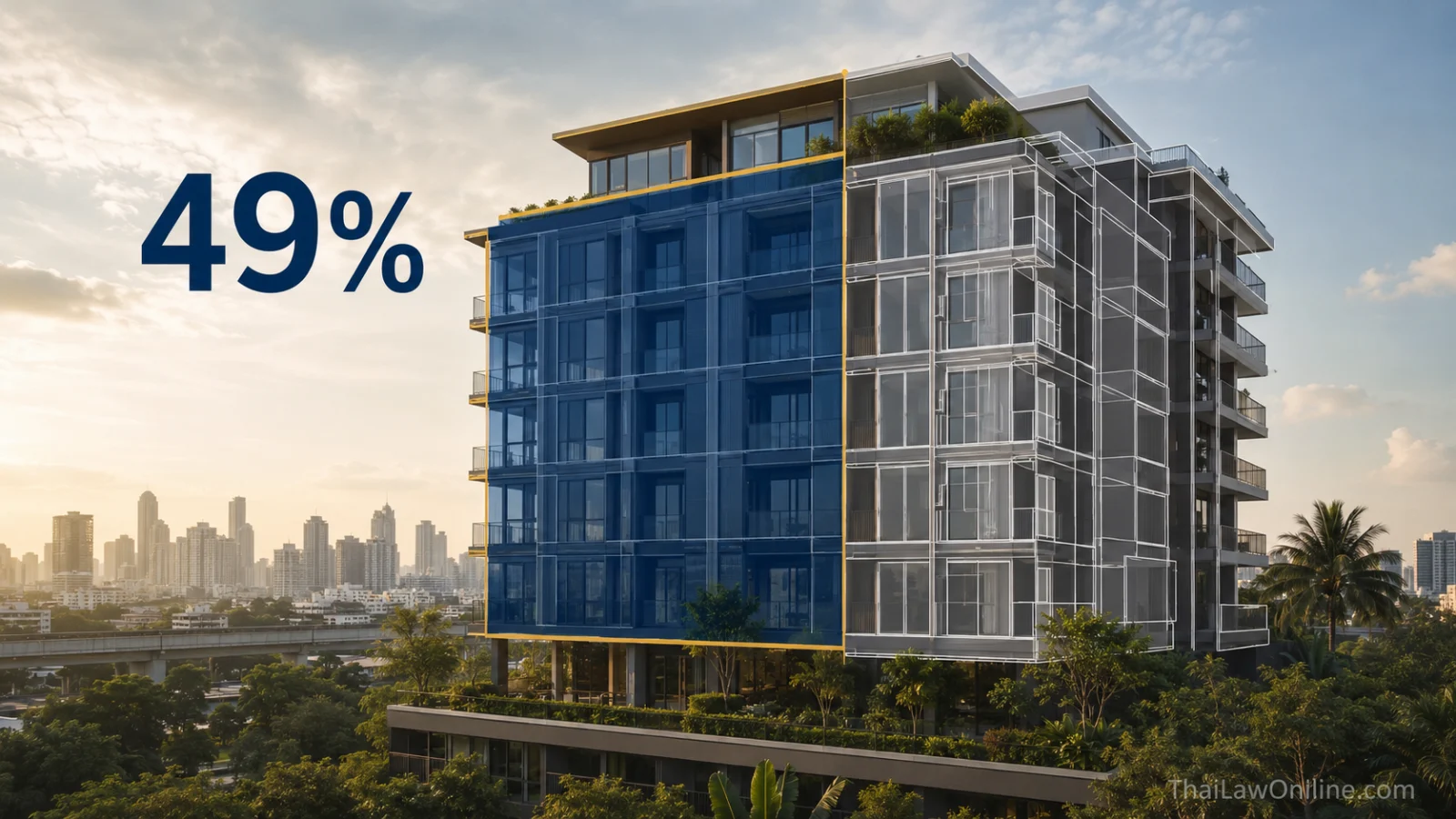
The rule that still applies: 49 percent
Section 19 bis of the Condominium Act B.E. 2522 lets foreigners own units in a registered condominium up to 49 percent of the combined area of all the units of the building. The remaining 51 percent must be held by Thai nationals or Thai-majority entities.
Two details catch buyers out. The measure is floor area, not unit count, so a building can hit its foreign limit with fewer than half its units sold to foreigners. And the quota belongs to the building, not to you. Whether you can register in the foreign quota depends on what previous buyers have already taken.
Unless you hold Thai permanent residence or entered under the investment promotion law, you qualify under section 19(5), which means the purchase money must come in from abroad in foreign currency (or be withdrawn from a non-resident baht account or a foreign currency account), in an amount not less than the price of the unit, and you need the bank’s Foreign Exchange Transaction form. Without it the Land Office will not register you under the foreign quota. Our guide to buying a condominium in Thailand works through the sequence, and moving money to Thailand from abroad covers the transfer mechanics.
The law behind this page
English
Section 19 bis Condominium Act B.E. 2522
Full text
In each condominium, the units held in ownership by the aliens or juristic persons specified in section 19 must not, taken together, exceed 49 percent of the area of all the units in that condominium at the time the application to register the condominium under section 6 is made.
ThaiLawOnline translation
Section 19 Condominium Act B.E. 2522
Full text
Aliens and juristic persons deemed by law to be aliens may hold ownership of condominium units if they are the following aliens and juristic persons: (1) an alien permitted to reside in the Kingdom under the law on immigration; (2) an alien permitted to enter the Kingdom under the law on investment promotion; (3) a juristic person specified in sections 97 and 98 of the Land Code that is registered as a juristic person under Thai law; (4) a juristic person that is an alien under Announcement of the Revolutionary Council No. 281 dated 24 November B.E. 2515 and has received an investment promotion certificate under the law on investment promotion; (5) an alien, or a juristic person deemed by law to be an alien, who brings foreign currency into the Kingdom, or withdraws money from a baht account of a person residing outside the country, or withdraws money from a foreign currency deposit account.
ThaiLawOnline translation
Section 19 ter Condominium Act B.E. 2522
Full text
On a transfer of ownership of a condominium unit to an alien or juristic person specified in section 19, the applicant for the transfer shall notify the competent official of the names of the aliens or juristic persons specified in section 19, together with the proportion of unit area that those aliens or juristic persons already hold in ownership, and the alien or juristic person applying to receive the transfer shall also produce the following evidence to the competent official: (1) an alien specified in section 19 (1) must produce evidence of having been permitted to reside in the Kingdom under the law on immigration; (2) an alien specified in section 19 (2) must produce evidence of having been permitted to enter the Kingdom under the law on investment promotion; (3) a juristic person specified in section 19 (3) must produce evidence of registration as a juristic person under Thai law; (4) a juristic person specified in section 19 (4) must produce evidence of having received an investment promotion certificate under the law on investment promotion; (5) an alien or juristic person under section 19 (5) must produce evidence of bringing foreign currency into the Kingdom, or evidence of withdrawing money from a baht account of a person residing outside the country or from a foreign currency deposit account, in an amount not less than the price of the unit to be purchased.
ThaiLawOnline translation
Section 19 quater Condominium Act B.E. 2522
Full text
When the competent official has received the documents and evidence under section 19 ter and, having examined them, finds that they are correct under section 19 ter, and that the ratio of ownership of units in the condominium by aliens or juristic persons under section 19, counting both those who already hold ownership and those applying to take the transfer, does not exceed the ratio prescribed in section 19 bis, the competent official shall register the rights and juristic acts relating to the unit under Chapter 4 for the alien or juristic person applying to take the transfer.
ThaiLawOnline translation
Section 540
An ordinary fixed-term lease of immovable property is limited to 30 years. Section 540 permits renewal for up to 30 years from renewal. A lease made for a longer term is reduced to 30 years.
Full text
Immovable property may not be let for a period exceeding thirty years. If a contract has been made for a longer period, that period shall be reduced to thirty years. The period of hire referred to above may, on its expiry, be renewed, but the renewal must not exceed thirty years from the date of renewal.
ThaiLawOnline translation
Section 19 quinquies Condominium Act B.E. 2522
Full text
An alien or juristic person specified in section 19 must dispose of a condominium unit in the following cases: (1) when an alien or juristic person specified in section 19 acquires a unit by inheritance as a statutory heir or legatee, or otherwise, as the case may be, and, when combined with the units already owned by aliens or juristic persons specified in section 19 in that condominium, the ratio prescribed in section 19 bis is exceeded; (2) when the permission of an alien specified in section 19 (1) to reside in the Kingdom is revoked or the alien's residence certificate becomes invalid; (3) when an alien specified in section 19 (1), (2) and (5) is ordered to be deported from the Kingdom and is not granted a reprieve, or is sent to engage in an occupation at any place in lieu of deportation; (4) when an alien specified in section 19 (2) is not permitted by the Board of Investment to stay in the Kingdom; (5) when a juristic person specified in section 19 (4) has its investment promotion certificate revoked. An alien or juristic person required to dispose of a unit under paragraph one must notify the competent official in writing within sixty days from the date on which the cause for disposal under paragraph one arises. In case (1), only the units exceeding the prescribed ratio shall be disposed of; in cases (2), (3), (4) and (5), all units owned shall be disposed of. The disposal of units under paragraph three shall be made within a period not exceeding one year from the date of acquiring ownership of the unit, or the date on which the permission to reside in the Kingdom is revoked or the residence certificate becomes invalid, or the date of the deportation order, or the date on which the Board of Investment revokes the permission to stay in the Kingdom, or the date on which the investment promotion certificate is revoked, as the case may be. If the disposal is not made within that period, the Director-General of the Department of Lands shall have the power to dispose of the unit, and the provisions on compulsory disposal of land in Chapter 3 of the Land Code, and the Ministerial Regulations issued under those provisions, shall apply mutatis mutandis to the disposal of that unit.
ThaiLawOnline translation
ไทย
มาตรา 19 ทวิ พระราชบัญญัติอาคารชุด พ.ศ. 2522
ข้อความเต็ม
อาคารชุดแต่ละอาคารชุดจะมีคนต่างด้าวหรือนิติบุคคลตามที่ระบุไว้ในมาตรา ๑๙ ถือกรรมสิทธิ์ในห้องชุดได้เมื่อรวมกันแล้วต้องไม่เกินอัตราร้อยละสี่สิบเก้าของเนื้อที่ของห้องชุดทั้งหมดในอาคารชุดนั้นในขณะที่ขอจดทะเบียนอาคารชุดตามมาตรา ๖
ตรงตามข้อความในราชกิจจานุเบกษา / สำนักงานคณะกรรมการกฤษฎีกา (Verbatim from the Royal Gazette / Office of the Council of State)
มาตรา 19 พระราชบัญญัติอาคารชุด พ.ศ. 2522
ข้อความเต็ม
คนต่างด้าวและนิติบุคคลซึ่งกฎหมายถือว่าเป็นคนต่างด้าว อาจถือกรรมสิทธิ์ในห้องชุดได้ ถ้าเป็นคนต่างด้าวและนิติบุคคลดังต่อไปนี้ (๑) คนต่างด้าวซึ่งได้รับอนุญาตให้มีถิ่นที่อยู่ในราชอาณาจักรตามกฎหมายว่าด้วยคนเข้าเมือง (๒) คนต่างด้าวซึ่งได้รับอนุญาตให้เข้ามาในราชอาณาจักรตามกฎหมายว่าด้วยการส่งเสริมการลงทุน (๓) นิติบุคคลตามที่กำหนดไว้ในมาตรา ๙๗ และมาตรา ๙๘ แห่งประมวลกฎหมายที่ดิน ซึ่งจดทะเบียนเป็นนิติบุคคลตามกฎหมายไทย (๔) นิติบุคคลซึ่งเป็นคนต่างด้าวตามประกาศของคณะปฏิวัติ ฉบับที่ ๒๘๑ ลงวันที่ ๒๔ พฤศจิกายน พ.ศ. ๒๕๑๕ และได้รับบัตรส่งเสริมการลงทุนตามกฎหมายว่าด้วยการส่งเสริมการลงทุน (๕) คนต่างด้าวหรือนิติบุคคลที่กฎหมายถือว่าเป็นคนต่างด้าวซึ่งนำเงินตราต่างประเทศเข้ามาในราชอาณาจักรหรือถอนเงินจากบัญชีเงินบาทของบุคคลที่มีถิ่นที่อยู่นอกประเทศหรือถอนเงินจากบัญชีเงินฝากเงินตราต่างประเทศ
ตรงตามข้อความในราชกิจจานุเบกษา / สำนักงานคณะกรรมการกฤษฎีกา (Verbatim from the Royal Gazette / Office of the Council of State)
มาตรา 19 ตรี พระราชบัญญัติอาคารชุด พ.ศ. 2522
ข้อความเต็ม
การโอนกรรมสิทธิ์ในห้องชุดให้แก่คนต่างด้าวหรือนิติบุคคลตามที่ระบุไว้ในมาตรา ๑๙ ให้ผู้ขอโอนกรรมสิทธิ์ในห้องชุดแจ้งรายชื่อคนต่างด้าวหรือนิติบุคคลตามที่ระบุไว้ในมาตรา ๑๙ พร้อมทั้งอัตราส่วนเนื้อที่ของห้องชุดที่คนต่างด้าวหรือนิติบุคคลดังกล่าวถือกรรมสิทธิ์อยู่แล้วต่อพนักงานเจ้าหน้าที่ และให้คนต่างด้าวหรือนิติบุคคลผู้ขอรับโอนกรรมสิทธิ์ในห้องชุดแสดงหลักฐานดังต่อไปนี้ต่อพนักงานเจ้าหน้าที่ด้วย (๑) สำหรับคนต่างด้าวตามที่ระบุไว้ในมาตรา ๑๙ (๑) ต้องแสดงหลักฐานการเป็นผู้ได้รับอนุญาตให้มีถิ่นที่อยู่ในราชอาณาจักรตามกฎหมายว่าด้วยคนเข้าเมือง (๒) สำหรับคนต่างด้าวตามที่ระบุไว้ในมาตรา ๑๙ (๒) ต้องแสดงหลักฐานการเป็นผู้ได้รับอนุญาตให้เข้ามาในราชอาณาจักรตามกฎหมายว่าด้วยการส่งเสริมการลงทุน (๓) สำหรับนิติบุคคลตามที่ระบุไว้ในมาตรา ๑๙ (๓) ต้องแสดงหลักฐานการจดทะเบียนเป็นนิติบุคคลตามกฎหมายไทย (๔) สำหรับนิติบุคคลตามที่ระบุไว้ในมาตรา ๑๙ (๔) ต้องแสดงหลักฐานการเป็นผู้ได้รับบัตรส่งเสริมการลงทุนตามกฎหมายว่าด้วยการส่งเสริมการลงทุน (๕) สำหรับคนต่างด้าวและนิติบุคคลตามมาตรา ๑๙ (๕) ต้องแสดงหลักฐานการนำเงินตราต่างประเทศเข้ามาในราชอาณาจักรหรือหลักฐานการถอนเงินจากบัญชีเงินบาทของบุคคลที่มีถิ่นที่อยู่นอกประเทศหรือถอนเงินจากบัญชีเงินฝากเงินตราต่างประเทศในจำนวนไม่น้อยกว่าค่าห้องชุดที่จะซื้อ
ตรงตามข้อความในราชกิจจานุเบกษา / สำนักงานคณะกรรมการกฤษฎีกา (Verbatim from the Royal Gazette / Office of the Council of State)
มาตรา 19 จัตวา พระราชบัญญัติอาคารชุด พ.ศ. 2522
ข้อความเต็ม
เมื่อพนักงานเจ้าหน้าที่ได้รับเอกสารและหลักฐานตามมาตรา ๑๙ ตรี และตรวจสอบแล้วเห็นว่าเป็นเอกสารและหลักฐานที่ถูกต้องตามมาตรา ๑๙ ตรี และอัตราส่วนการถือกรรมสิทธิ์ในห้องชุดของคนต่างด้าวหรือนิติบุคคลตามมาตรา ๑๙ ทั้งผู้ที่ถือกรรมสิทธิ์อยู่แล้วและผู้ที่ขอรับโอนไม่เกินอัตราที่กำหนดไว้ในมาตรา ๑๙ ทวิ ให้พนักงานเจ้าหน้าที่ดำเนินการจดทะเบียนสิทธิและนิติกรรมเกี่ยวกับห้องชุดตามหมวด ๔ ให้แก่คนต่างด้าวหรือนิติบุคคลผู้ขอรับโอนนั้น
ตรงตามข้อความในราชกิจจานุเบกษา / สำนักงานคณะกรรมการกฤษฎีกา (Verbatim from the Royal Gazette / Office of the Council of State)
มาตรา 540
ข้อความเต็ม
อันอสังหาริมทรัพย์ ท่านห้ามมิให้เช่ากันเป็นกำหนดเวลาเกินกว่าสามสิบปี ถ้าได้ทำสัญญากันไว้เป็นกำหนดเวลานานกว่านั้น ท่านก็ให้ลดลงมาเป็นสามสิบปี อนึ่ง กำหนดเวลาเช่าดังกล่าวมานี้ เมื่อสิ้นลงแล้วจะต่อสัญญาอีกก็ได้ แต่ต้องอย่าให้เกินสามสิบปีนับแต่วันต่อสัญญา
ตรงตามข้อความในราชกิจจานุเบกษา / สำนักงานคณะกรรมการกฤษฎีกา (Verbatim from the Royal Gazette / Office of the Council of State)
มาตรา 19 เบญจ พระราชบัญญัติอาคารชุด พ.ศ. 2522
ข้อความเต็ม
คนต่างด้าวหรือนิติบุคคลตามที่ระบุไว้ในมาตรา ๑๙ ต้องจำหน่ายห้องชุดในกรณีดังต่อไปนี้ (๑) เมื่อคนต่างด้าวหรือนิติบุคคลตามที่ระบุไว้ในมาตรา ๑๙ ได้มาซึ่งห้องชุดโดยได้รับมรดกในฐานะทายาทโดยธรรม หรือผู้รับพินัยกรรม หรือโดยประการอื่น แล้วแต่กรณี เมื่อรวมกับห้องชุดที่มีคนต่างด้าวหรือนิติบุคคลตามที่ระบุไว้ในมาตรา ๑๙ ถือกรรมสิทธิ์อยู่แล้วในอาคารชุดนั้นเกินอัตราที่กำหนดตามมาตรา ๑๙ ทวิ (๒) เมื่อคนต่างด้าวตามที่ระบุไว้ในมาตรา ๑๙ (๑) ถูกเพิกถอนการอนุญาตให้มีถิ่นที่อยู่ในราชอาณาจักรหรือใบสำคัญถิ่นที่อยู่ของคนต่างด้าวใช้ไม่ได้ (๓) เมื่อคนต่างด้าวตามที่ระบุไว้ในมาตรา ๑๙ (๑) (๒) และ (๕) ถูกสั่งเนรเทศออกไปนอกราชอาณาจักรและไม่ได้รับการผ่อนผันหรือถูกส่งไปประกอบอาชีพ ณ ที่ใดแทนการเนรเทศ (๔) เมื่อคนต่างด้าวตามที่ระบุไว้ในมาตรา ๑๙ (๒) ไม่ได้รับอนุญาตจากคณะกรรมการส่งเสริมการลงทุนให้อยู่ในราชอาณาจักร (๕) เมื่อนิติบุคคลตามที่ระบุไว้ในมาตรา ๑๙ (๔) ถูกเพิกถอนบัตรส่งเสริมการลงทุน คนต่างด้าวหรือนิติบุคคลซึ่งต้องจำหน่ายห้องชุดตามวรรคหนึ่ง ต้องแจ้งเป็นหนังสือให้พนักงานเจ้าหน้าที่ทราบภายในกำหนดเวลาหกสิบวันนับแต่วันที่มีเหตุต้องจำหน่ายตามวรรคหนึ่ง ทั้งนี้ สำหรับกรณี (๑) ให้จำหน่ายเฉพาะห้องชุดที่เกินอัตราที่กำหนด สำหรับกรณี (๒) (๓) (๔) และ (๕) ให้จำหน่ายห้องชุดที่มีกรรมสิทธิ์อยู่ทั้งหมด การจำหน่ายห้องชุดตามวรรคสาม ให้จำหน่ายภายในกำหนดเวลาไม่เกินหนึ่งปีนับแต่วันที่ได้มา ซึ่งกรรมสิทธิ์ในห้องชุด หรือวันที่ถูกเพิกถอนการอนุญาตให้มีถิ่นที่อยู่ในราชอาณาจักร หรือใบสำคัญถิ่นที่อยู่ใช้ไม่ได้ หรือวันที่ถูกสั่งเนรเทศ หรือวันที่ถูกคณะกรรมการส่งเสริมการลงทุนเพิกถอนการอนุญาตให้อยู่ในราชอาณาจักร หรือวันที่ถูกเพิกถอนบัตรส่งเสริมการลงทุน แล้วแต่กรณี ถ้าไม่จำหน่ายภายในกำหนดเวลาดังกล่าว ให้อธิบดีกรมที่ดินมีอำนาจจำหน่ายห้องชุดนั้น และให้นำบทบัญญัติเรื่องการบังคับจำหน่ายที่ดินตามความในหมวด ๓ แห่งประมวลกฎหมายที่ดิน และกฎกระทรวงที่ออกตามบทบัญญัติดังกล่าวมาใช้บังคับแก่การจำหน่ายห้องชุดดังกล่าวด้วยโดยอนุโลม
ตรงตามข้อความในราชกิจจานุเบกษา / สำนักงานคณะกรรมการกฤษฎีกา (Verbatim from the Royal Gazette / Office of the Council of State)
Français
Article 19 bis Condominium Act B.E. 2522
Dans chaque immeuble en copropriété, les lots détenus par les étrangers ou personnes morales de l'article 19 ne peuvent excéder au total 49 % de la superficie de tous les lots, calculée au moment de la demande d'enregistrement prévue à l'article 6.
résumé non officiel
Article 19 Condominium Act B.E. 2522
Peuvent posséder un lot: étrangers autorisés à résider; étrangers admis via la promotion des investissements; personnes morales des articles 97 et 98 du Code foncier enregistrées en Thaïlande; personnes morales étrangères promues; étrangers ou personnes morales étrangères finançant par devises importées, compte en bahts de non-résident ou compte en devises.
résumé non officiel
Article 19 ter Condominium Act B.E. 2522
Lors du transfert à un étranger ou une personne morale visés à l'article 19, le demandeur déclare à l'agent compétent la liste des détenteurs visés et leur quote-part de superficie; l'acquéreur prouve sa qualité ou, pour l'article 19 (5), l'origine de fonds au moins égaux au prix du lot.
résumé non officiel
Article 19 quater Condominium Act B.E. 2522
Si les documents de l'article 19 ter sont conformes et que la quote-part étrangère (détenteurs actuels et cessionnaire) ne dépasse pas le plafond de l'article 19 bis, le fonctionnaire compétent enregistre les droits et actes juridiques sur le lot au profit de l'étranger ou de la personne morale cessionnaire.
résumé non officiel
Article 540
Un immeuble ne peut être donné à bail pour une durée excédant trente ans. Si le contrat a été conclu pour une durée plus longue, celle-ci est réduite à trente ans. La durée du bail ci-dessus mentionnée peut, à son expiration, être renouvelée, mais sans excéder trente ans à compter du jour du renouvellement.
résumé non officiel
Article 19 quinquies Condominium Act B.E. 2522
Vente obligatoire: l'excédent de quota acquis par héritage ou autrement; tous les lots si résidence révoquée, expulsion sans dispense ni affectation de remplacement, refus ou révocation BOI. Avis écrit sous soixante jours; vente sous un an, sinon le Directeur général des Terres vend selon le Code foncier.
résumé non officiel
Supreme Court decisions
- 4655/2566 (2023): A 30+30+30 Lease Paid Up Front: the Renewal Promise Is Void, the First 30 Years Stand
- 17923/2557 (2014): Lease That Was Really a Sale: Foreign Buyers Cannot Compel Transfer to a Nominee Company
Sources
- Condominium Act B.E. 2522, retrieved 31 October 2026
- Civil and Commercial Code, Office of the Council of State, retrieved 31 October 2026
- deka.supremecourt.or.th, Supreme Court of Thailand decisions database (copy held in our library), retrieved 19 February 2026
What is actually proposed
Two separate measures get discussed together and are frequently conflated in property marketing.
| Measure | Current law | Proposed | Stage as at 1 Aug 2026 |
|---|---|---|---|
| Condominium foreign quota | 49% of the combined area of all the units | Up to 75%, in some versions limited to designated zones or price floors | Proposal only. Under study since 2024. No bill tabled. |
| Maximum lease term | 30 years (CCC s.540) | Up to 99 years | Proposal only. No enacted amendment. |
| Transfer and mortgage fee | Standard 2% transfer, 1% mortgage | Reduced to 0.01% for qualifying homes up to 7 million baht, Thai nationals only | IN FORCE. Gazetted 1 Jul 2026, runs to 30 Jun 2027. Not available to foreign buyers. |
The contrast in that last row is the whole lesson, and it cuts two ways. One measure actually completed the legislative journey while the other two have been discussed for two years. But completing the journey is not the same as helping you. Both announcements state that the buyer must be an individual Thai national, so a foreign buyer pays the standard 2 percent transfer fee regardless.
Both Ministry of Interior announcements gazetted on 1 July 2026 require that the buyer be an individual Thai national. A great deal of English-language property coverage reports the headline rate without this condition, which leads foreign buyers to budget 700 baht on a 7 million baht purchase when the real figure is 140,000 baht. If you are buying in your own name under the foreign quota, budget the standard 2 percent transfer fee. Where the reduction can matter to you is on a resale: a Thai buyer purchasing from you may qualify, which affects what the market will bear before 30 June 2027.
Why the quota proposal keeps stalling
The economic argument is easy to state. Thai developers hold unsold inventory, foreign demand exists, and raising the cap would clear stock. The political argument against it is just as easy, and it has proven stronger: opponents frame a 75 percent cap as allowing foreign-majority buildings, and enclave anxiety is potent in Thai politics.
Successive governments have studied the measure without tabling it. Draft versions have narrowed it to particular provinces or imposed minimum prices, which signals the political difficulty rather than resolving it. Treat any specific figure you read as provisional until a bill exists.
The 99-year lease: a court has already ruled
The lease proposal deserves separate treatment, because the gap between what is marketed and what is enforceable is already settled law.
Section 540 of the Civil and Commercial Code caps a lease of immovable property at 30 years. Agents have long marketed a workaround: a 30-year lease with two pre-agreed 30-year renewals, sold as 90 years of security.
A promise, made on the same day as a registered 30-year lease, to renew it twice more for 30 years each at the original rent and on the original terms is void as an evasion of section 540, even where the tenant prepaid all 90 years.
The tenant had paid 2.7 million baht for the first term and both renewals. The Court held the two renewal promises void because their object was clearly prohibited by law, and refused to enforce them even as a personal obligation between the two parties, since that would defeat section 540. When the first 30 years ended the tenant was evicted and ordered to pay damages for staying on.
So a buyer paying today for 90 years is paying for 30 years of enforceable right plus a hope. If parliament later permits 99-year leases, that will not retroactively validate a structure a court has already struck down. We cover this in depth at the 90-year lease myth, with the mechanics at automatic renewal of a lease and renewal options on a 30-year lease. Related rulings sit at Supreme Court decisions about leases.
Enforcement tightened while the proposals stalled
This is the part most coverage misses. Ownership rules did not loosen in 2026. Enforcement of the existing rules got sharper.
Between 15 and 25 May 2026 the Department of Lands issued three consecutive circulars marked most urgent to every Provincial Land Office, addressing land held for foreigners through Thai proxies. The lead reference is MT 0515.2/W 10722, dated 15 May 2026.
Be precise about what these are. They are administrative circulars, not legislation. They create no new law and impose no new reporting duty on the public. What they do is consolidate existing Land Code powers into a single operational framework and direct officers to apply it consistently. The legal exposure of a nominee arrangement is unchanged. The likelihood of it being examined is not.
Anyone holding Thai property through a Thai spouse, a Thai company, or a Thai friend should read Thai nominee shareholders and recent crackdowns on nominees. The rule that foreigners cannot own land directly is set out at foreigners buying land in Thailand, with the wider picture at foreign ownership restrictions in Thailand.
What to do instead of waiting
- Verify the building’s foreign quota in writing. Ask the juristic person for the current foreign-owned percentage of the combined area of all the units, dated and signed. A verbal assurance from a sales agent is worth nothing at the Land Office.
- Budget the full 2 percent transfer fee. The 0.01 percent rate is restricted to individual Thai nationals, so it will not reduce your bill if you buy in your own name under the foreign quota. Factor the reduction into your exit planning instead: a Thai buyer purchasing from you before 30 June 2027 may qualify.
- Price a lease at 30 years. If a structure only makes financial sense across 60 or 90 years, it does not make sense.
- Consider the lawful alternatives. A usufruct gives a right of use for life, and lease, usufruct and sap ing sith compares the options honestly.
- Run proper due diligence. Title, encumbrances, the juristic person’s finances, and the developer’s record. See due diligence in Thailand.
Two related changes bear on the same buyers. Money you remit to fund a purchase interacts with Thailand’s remittance tax regime, covered in our article on foreign income and Thai tax residence. And if you plan to spend significant time in the property, the 2026 visa rule changes affect how long you can stay.
The quota position on your specific unit has to come in writing from the juristic person. We get that letter as part of every purchase: see condo lawyer in Thailand.
Last reviewed: 27 September 2026. Condominium Act B.E. 2522 sections 19 and 19 bis and Civil and Commercial Code section 540 were read in Thai, Supreme Court Decision 4655/2566 was read in full to its disposition, and the Department of Lands circulars of 15, 21 and 25 May 2026 and its 30 June 2026 fee-reduction circular were checked. Not independently verified: the history of the 75 percent and 99-year proposals, which rests on press reports, and the Gazette date of the fee-reduction announcements.
Frequently asked questions
Can foreigners own 75 percent of a Thai condominium building in 2026?
No. The 49 percent limit in section 19 bis of the Condominium Act B.E. 2522 remains in force. The 75 percent figure comes from a proposal that has been under study since 2024 and has not been enacted. No bill has been tabled in parliament.
Are 99-year leases legal in Thailand yet?
No. Section 540 of the Civil and Commercial Code caps a hire of immovable property at thirty years, and a term written for longer is reduced by law to thirty years. The section does allow a renewal once the term has run, but the renewed term cannot itself exceed thirty years from the date of renewal, which is why renewals signed in advance do not build a 99-year right. See the 90-year lease myth.
What happens if a building has already used its 49 percent foreign quota?
You cannot register that unit in the foreign quota. You would be buying a Thai-quota unit, which a foreigner cannot hold in their own name. Agents sometimes propose a company or nominee arrangement at this point, which carries the exposure described in recent crackdowns on nominees. Always confirm the remaining quota in writing first.
Did the Department of Lands circulars create new obligations for foreign owners?
No. The May 2026 circulars are internal administrative guidance to Provincial Land Offices. They create no new law and no new public reporting duty. They consolidate existing Land Code powers into one enforcement framework, so scrutiny of nominee structures has increased without the underlying law changing.
Can a foreigner use the 0.01 percent transfer fee reduction?
No. The reduction is real and runs to 30 June 2027, but both Ministry of Interior announcements gazetted on 1 July 2026 require the buyer to be an individual Thai national. A foreign buyer registering a unit under the foreign quota pays the standard 2 percent transfer fee. Most English-language coverage reports the headline 0.01 percent rate without this condition, which is how foreign buyers end up budgeting 700 baht for a fee that will actually be 140,000 baht on a 7 million baht purchase. See property taxes in Thailand.
Should I wait for the quota to change before buying?
Buy on the law as it stands or do not buy. The proposal has been discussed for two years without a bill, faces real political opposition, and may never pass or may pass in a narrowed form limited to certain zones. Meanwhile the gazetted fee reduction expires on 30 June 2027, so waiting has a measurable cost.
Check the ownership structure before you sign
Serving foreigners in Thailand since 2006, ThaiLawOnline.com verifies foreign quota availability, reviews lease and purchase contracts, and tells clients plainly when a structure will not hold. We would rather stop a bad purchase than litigate it later.
Schedule a consultation, book a property consultation, or review our flat-fee property packages and property guide for foreigners.
Thai Law Updates, free by email
Plain-English updates on Thai law changes that affect foreigners: property, visas, marriage, business and wills. One short email a month from a firm practicing since 2006. No spam, unsubscribe anytime.