


Reviewed by ThaiLawOnline, a licensed Thai law firm practising in Thailand since 2006. Thai lawyer of record: Wichuda Atthamethakon, LL.M., Thai Bar Licence 3149/2556.
Last updated on
Picture this. You’ve just signed a lease in Bangkok and accepted a job offer. Or maybe you’re opening a small business and hiring your first Thai staff. Either way, you need to understand Thailand labor law before anything goes wrong.
Thailand’s labor framework is detailed and protective. It covers everything from daily minimum wage rates to mandatory severance calculations. The core statute is the Labor Protection Act B.E. 2541 (1998), known as the LPA, explaining employee rights in Thailand. The Civil and Commercial Code (CCC) Sections 575 through 586 govern the basic “hire of services” relationship. On top of those sit dozens of ministerial regulations, Wage Committee orders, and Supreme Court rulings that shape how the law works in practice.
Since we started helping expats and businesses in Thailand in 2006, we’ve seen the same mistakes over and over. Employers skip written contracts. Employees don’t know their severance rights. Both sides miscalculate overtime. This guide covers the rules you actually need: current minimum wage rates, contract requirements, working hours, leave, termination, and social security. We’ve included the specific legal references so you can verify everything yourself.
The following article is written by Sébastien Brousseau (LL.B.) and Wichuda Atthamethakon (LL.M.)
Last reviewed: 4 September 2026. The leave section was checked against the Labour Protection Act (No. 9) B.E. 2568 and the Ministry of Labour’s own published clarification of it, which quotes the amended sections verbatim. The figures on this page were right: 120 days’ maternity leave, 60 days of it paid by the employer, 15 further days at 50% for an infant with complications, and 15 fully paid days of spouse-assistance leave. Two things were wrong and are corrected: the table gave the legal basis for spouse-assistance leave as “2025 Amendment”, which names no instrument, where it is Sections 41/1 and 59/2; and the 90-day deadline for applying, after which the employer may refuse, was missing. What this review did not re-check, said rather than implied: the wage, working-hours, overtime, severance and termination sections, and the other rows of the leave table. Re-checked on 6 October 2026: Labour Protection Act sections 9 and 144 read in Thai in the consolidation to Act No. 9; the late-payment example was wrong (30 days of deliberate delay on 10,000 THB comes to about 14,600 THB, not 11,000) and is corrected with the section 9 conditions; the minimum wage table was compared with Wage Committee Announcement No. 14 as recorded on our minimum wage page, and two rows corrected (380 THB covers Hat Yai district, and 337 THB only the three southern border provinces). The Employee Welfare Fund dates were not re-checked. Re-checked on 10 October 2026: Labour Protection Act sections 130 and 131 read in Thai (consolidation to Act No. 9), and the Ministerial Regulation prescribing the Employee Welfare Fund contribution rates B.E. 2568 read in its Royal Gazette text (volume 142, part 60 Kor, page 3, 15 September 2025); the dates and rates on this page match it, and the paragraph no longer says the fund was approved in 2025, since it has existed under the Act since 1998 and only contributions start in October 2026. The wage figures elsewhere and the practice guidance were not re-checked here.
Table of Contents
Thailand’s Minimum Wage in 2025-2026
How Minimum Wage Works in Thailand
Thailand doesn’t set a single national minimum wage. Instead, the Tripartite Wage Committee (representatives from government, employers, and workers) sets rates province by province. The rates reflect local cost of living, economic activity, and labor demand.
Your employer must pay at least the daily rate for the province where you work. This applies regardless of how you’re paid: daily, weekly, or monthly. A monthly-salaried worker in Bangkok earning below the equivalent of 400 THB per day is being underpaid. That’s illegal.
Current Daily Rates by Province (Effective July 2025)
Thailand adjusted minimum wages twice in 2025. The January 1 increase brought rates up across the board. Then on July 1, 2025, Bangkok joined the 400 THB tier. The rates below remain current through 2026.
| Tier | Provinces / Areas | Daily Rate (THB) |
|---|---|---|
| 1 | Bangkok, Phuket, Chonburi, Rayong, Chachoengsao, Surat Thani (Koh Samui) | 400 |
| 2 | Chiang Mai (Mueang Chiang Mai district), Songkhla (Hat Yai district) | 380 |
| 3 | Nakhon Pathom, Nonthaburi, Pathum Thani, Samut Prakan, Samut Sakhon | 372 |
| 4 | Khon Kaen, Chiang Mai (other), Prachinburi, Ayutthaya, Saraburi | 357 |
| 5 | Kanchanaburi, Chanthaburi, Chiang Rai, Tak | 352 |
| 6 | Kamphaeng Phet, Phichit, Ratchaburi, Udon Thani, Maha Sarakham | 347 |
| 7 | Narathiwat, Pattani, Yala | 337 |
The table shows a selection. Announcement No. 14 sets 17 rate bands in all, from 337 to 400 THB, and every other province falls somewhere between those figures: see the full province-by-province table on our minimum wage in Thailand page.
Hotels (types 2, 3, and 4) and entertainment venues nationwide must pay at least 400 THB daily regardless of province. That’s a sector-specific rule many employers miss.
As of December 2025, individuals working under service contracts for government agencies, state enterprises, or local administrations are legally entitled to the same fundamental benefits as regular employees, including minimum wage, leave, and holidays, if they work under direct managerial supervision.
The Road to 600 Baht Per Day
The government has floated a target of 600 THB daily minimum wage by 2027. Labor unions support it. Business groups warn it will hurt small employers and border-province competitiveness. So far, increases have been incremental. Bangkok went from 372 to 400 THB in a single step. Other provinces moved by 7 to 20 THB at a time.
Don’t budget for a sudden jump to 600 THB. Plan for gradual annual increases of 5-10% instead. If you’re an employer, build this into your financial forecasts. If you’re an employee, your negotiating power comes from skills and performance, not from waiting for the floor to rise.
Legal basis: LPA Section 78 (minimum wage), Wage Committee Notification No. 13 (rates effective January 1, 2025), Notification No. 14 (rates effective July 1, 2025).
Case citations reviewed: 17 September 2026. The Supreme Court decisions cited on this page were read in Thai against the published judgments. Three were corrected: 3114/2567 (the retirement rule is right, but that employee’s claim for further severance failed because he stayed on by agreement), 3150/2568 (the ruling is that the Labour Court decided a question nobody had pleaded, not that the employer bore a burden of proof) and 39/2567 (the point decided is who may be made to refund the wages, not the joint liability itself). Decision 1162/2569 on release documents stands as published and its sourcing is recorded with it. Decision 731/2568 decides the income-tax treatment of a lump sum paid on resignation under the Revenue Code, not a Labour Protection Act point, and was removed from the legal-basis lines on 3 October 2026. The wage figures, the leave section reviewed on 4 September 2026 and the practice guidance were not re-checked here.
Statute passages reviewed: 3 October 2026. Labour Protection Act sections 17, 29, 36, 54, 55, 57 to 59, 70, 76, 108, 115/1, 118, 124 and 125 were read in Thai in the consolidation through Act No. 8 (law.go.th version 18437). Corrected: wage payment (timing is Section 70, currency Section 54, place Section 55), the Section 76 deduction list, which never included court orders, and its caps, in the body and in the FAQ; the inspector’s order deadline, 60 days and not 30; holidays, which the employer announces under Section 29; training leave, which no section requires to be paid; the fixed-term rule, which is in Section 118 and not Section 17; work rules, which the current Section 108 does not require to be filed; and the claim that an expired work permit voids employment. Written notice under Section 17 was checked and is right.
Employment Contracts Under Thai Law
Written vs. Verbal Contracts
Here’s something that surprises most Western clients. Thai law doesn’t require a written employment contract for indefinite-term employment. A verbal agreement is legally binding. CCC Section 575 defines a “hire of services” simply as one person agreeing to work for another in exchange for wages.
But don’t rely on a handshake. Verbal contracts leave both sides exposed. When a dispute hits the Labor Court, the judge will ask one thing: “What did you agree to?” Without a written document, you’re stuck arguing about old conversations. That never ends well. We’ve seen this go badly more times than we can count.
Best practice: always use a written contract. It doesn’t need to be complicated. Two to three pages covering the essentials will do.
Fixed-Term vs. Indefinite Contracts
Thai law recognizes two main contract types. Fixed-term contracts have a specific end date. They suit project work, seasonal jobs, or temporary replacements. Indefinite contracts run until either side terminates with proper notice.
Here’s the catch with fixed-term contracts. If you keep renewing them with the same employee, a court may treat the arrangement as indefinite employment. That means full severance obligations if you later let the person go. Section 118 of the LPA addresses this directly. The severance exemption for a fixed term covers only a specific project outside the employer’s normal business or trade with a definite start and end, occasional work, or seasonal work, finished within two years and agreed in writing at the start.
In our experience, most clients overestimate how useful fixed-term contracts are. Unless you have a genuine project with a real end date, use an indefinite contract with a probation clause instead.
What Your Contract Should Include
A solid employment contract covers the basics: job title, workplace location, start date, wages, and payment schedule. It should also address working hours, rest days, probation period, benefits, and grounds for termination.
You should also address overtime terms, confidentiality obligations, and non-compete restrictions if relevant. Both parties sign and date the contract. Give the employee a copy. This isn’t legally required for all contracts, but it prevents disputes later.
Key rule: No contract clause can waive rights the LPA grants. You can’t agree to work below minimum wage. You can’t waive severance in advance. You can’t accept terms that fall below the statutory floor. A clause that does this is void as contrary to public order under Section 150 of the Civil and Commercial Code, and Section 14/1 of the LPA also lets the Labor Court enforce a one-sided term only to the extent that is fair. A release signed after the employment has ended is a different matter: see the section on waiving severance after termination below.
Non-Compete and Confidentiality Clauses
Thai courts will enforce non-compete clauses. But they must be reasonable. A clause that bars an employee from working in any related field for 5 years across all of Asia? A court will throw that out. A 1-year restriction within a specific geographic area for a specific competitor? That’s more likely to hold up.
Confidentiality clauses are more straightforward. Employees have a duty not to disclose trade secrets. Spelling this out in the contract adds clarity and makes enforcement easier. If you’re hiring for a role with access to sensitive data, don’t skip this section. A business law specialist can draft these clauses properly.
Legal basis: CCC Sections 575-586 (Hire of Services), LPA Sections 14/1 and 17.
Employee Rights in Thailand: Working Hours, Overtime, and Rest Days
Standard Working Hours
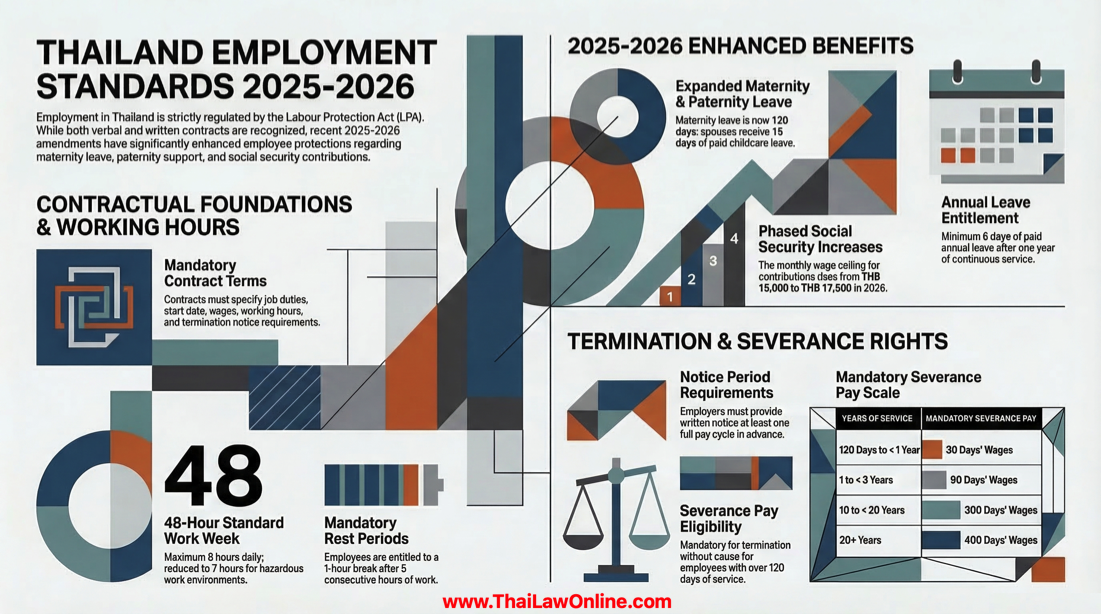
The LPA caps regular working hours at 8 per day and 48 per week. Most office jobs use a 5-day week with 8-hour days, totaling 40 hours. That’s fine. The 48-hour limit is a ceiling, not a target.
For hazardous work (chemical exposure, extreme heat, confined spaces), the cap drops to 7 hours per day and 42 hours per week. Your employer decides working hours in the employment contract. Changing them later requires your consent.
Every employee gets at least one rest day per week. Rest periods during the workday must total at least one hour after five consecutive hours of work.
Overtime Pay Calculations
Your employer can’t force you to work overtime. Section 24 of the LPA requires employee consent. When you do work overtime, the pay rates are non-negotiable minimums.
| Overtime Scenario | Pay Rate | LPA Section |
|---|---|---|
| Regular overtime (beyond daily hours on a workday) | 1.5x hourly rate | Section 61 |
| Work on a holiday (first 8 hours, for daily/hourly workers) | 2x hourly rate | Section 62 |
| Work on a holiday (first 8 hours, for monthly-salaried) | 1x hourly rate (extra) | Section 62 |
| Overtime on a holiday (beyond 8 hours) | 3x hourly rate | Section 63 |
Total overtime can’t exceed 36 hours per week. Some employers push this limit. If yours does, you have grounds to file a complaint with the Department of Labor Protection and Welfare.
Proposed 40-Hour Workweek Amendment
On September 24, 2025, Thailand’s House of Representatives voted to approve draft amendments to the LPA. The key change: reducing the standard workweek from 48 hours to 40 hours. Hazardous work would drop to 35 hours. The draft also mandates at least two rest days per week.
This hasn’t become law yet. It still needs Senate approval and Royal Gazette publication. But if it passes, employers will face higher effective labor costs. Anything beyond 40 hours would trigger overtime rates. Watch this space closely if you’re planning staffing budgets for 2027 and beyond.
Legal basis: LPA Sections 23-27 (working hours), 61-63 (overtime), 28-30 (rest days and holidays).
Employee Leave Entitlements
Annual Leave and Public Holidays
After completing one full year of service, every employee gets at least 6 days of paid annual leave per year. Many employers offer more. Unused leave carries over to later years only if you and your employer agree (Labour Protection Act section 30). Once leave has been carried over, the employer must pay for it when the employment ends, whether you resign or are dismissed, even for a section 119 cause (section 67). If the employer ends the employment other than for a section 119 cause, it must also pay for the current year’s leave pro rata.
Section 29 of the LPA requires the employer to announce in advance at least 13 paid traditional holidays a year, including National Labour Day, chosen from the official public holidays, religious holidays and local custom. A traditional holiday that falls on an employee’s weekly day off is replaced by the next working day. Employers who require work on public holidays must pay at the holiday overtime rate.
Sick Leave
You can take sick leave whenever you’re genuinely ill. There’s no annual cap on sick days in the LPA. However, your employer only has to pay wages for the first 30 sick days per year. After that, sick leave is unpaid unless your contract says otherwise.
Your employer can require a doctor’s certificate for absences longer than 3 consecutive days. Abusing sick leave is grounds for disciplinary action.
Maternity and Spouse-Assistance Leave (Act No. 9 of 2568)
The Labour Protection Act (No. 9) B.E. 2568 was published in the Royal Gazette on 7 November 2025 (vol. 142, part 74 Kor) and came into force on 7 December 2025. Under the amended Section 41 paragraph one, maternity leave is now up to 120 days per pregnancy, up from 98, and those days include prenatal check-up days. Under Section 59 the employer pays wages for up to 60 days of it, up from 45; the Social Security Fund benefit is unaffected. Under Section 41 paragraph four a female employee who has taken that leave may take up to 15 further consecutive days to care for the infant where the child has complications, an abnormality or a disability, on a doctor’s certificate, paid at 50% of wages under Section 59/1.
Spouse-assistance leave is the genuinely new right. New Section 41/1 gives an employee up to 15 days of leave to assist a spouse who has given birth, paid in full by the employer under Section 59/2. Two conditions decide whether it can be used at all. It must be applied for before or on the day the leave starts and within 90 days of the birth, after which the employer may refuse it. And the couple must be legally married at the date the leave is taken; the spouse does not have to work for the same employer, does not have to be Thai, and the marriage may be registered after the birth so long as the 90-day window has not closed. “Spouse” carries the meaning it has since the Marriage Equality amendment, so it is not limited by gender.
Other Types of Leave
| Leave Type | Duration | Pay Status | LPA Section |
|---|---|---|---|
| Annual leave | 6+ days/year (after 1 year) | Paid | Section 30 |
| Sick leave | As needed (30 days paid) | Paid (first 30 days) | Section 32 |
| Maternity leave | 120 days | Following the 2025 amendment, leave is 120 days (up from 98). The employer must pay full wages for up to 60 days. An additional 15 paid days (at 50%) is available for newborns with serious health complications. | Section 41 |
| Spouse-assistance leave (paternity) | 15 days per birth, and it must be applied for within 90 days of the birth | Paid in full, up to 15 days | Section 41/1 (leave), Section 59/2 (pay) |
| Personal/business leave | 3 days/year minimum | Paid | Section 34 |
| Sterilization leave | As prescribed by doctor | Paid | Section 33 |
| Military conscription | Duration of service | Paid (up to 60 days) | Section 35 |
| Training/skill development | As set by ministerial regulation | Not paid by law (sections 57 to 59 do not cover it) | Section 36 |
Legal basis: LPA Sections 28-36, 41, 57, 59. Labour Protection Act (No. 9) B.E. 2568 (2025 maternity/paternity amendments).
Termination and Severance Pay
Notice Period Requirements
To terminate an indefinite employment contract, the employer must give advance written notice of at least one full pay cycle. For monthly-paid employees, that means notice by the end of one month, effective at the end of the next. In practice, this works out to 30 to 60 days depending on when notice is given.
The employer can choose to pay wages in lieu of notice instead. That’s common when the employer wants an immediate departure. Either way, the employee keeps all accrued benefits.
Employees can resign with the same notice period. Walking out without notice technically forfeits some protections. But in practice, most employers don’t pursue this.
Severance Pay by Years of Service
Section 118 of the LPA is the section every employee should memorize. It sets mandatory severance based on your length of service. This applies when the employer terminates you. It doesn’t apply to voluntary resignation.
| Length of Service | Severance (Days of Last Wage Rate) |
|---|---|
| 120 days but less than 1 year | 30 days |
| 1 year but less than 3 years | 90 days |
| 3 years but less than 6 years | 180 days |
| 6 years but less than 10 years | 240 days |
| 10 years but less than 20 years | 300 days |
| 20 years or more | 400 days |
Note: employees who have worked fewer than 120 days receive no severance. The severance amounts above are based on the employee’s “last wage rate,” meaning the final regular daily wage before termination.
Real-world example: An employee in Bangkok earning 600 THB/day who has worked for 8 years is entitled to 240 days x 600 THB = 144,000 THB in severance. That’s a significant sum. Employers who don’t plan for this get hit hard.
Unfair Dismissal Protections
Thai courts take unfair dismissal seriously. You can’t be fired for union membership, filing a complaint, testifying in legal proceedings, or exercising any right under the LPA. Pregnancy is a protected status. So is physical disability if it doesn’t affect job performance.
Recent Supreme Court decisions have clarified important points. In Decision No. 3114/2567 the court confirmed that where a handbook fixes retirement at 55, reaching that age is a dismissal under Section 118/1 of the Labour Protection Act, so severance is due and service counts up to the retirement date. The same decision sets the limit on that rule: this employee stayed on after 55 by agreement and was not paid severance then, so there was no dismissal on the retirement date, his service simply continued, and his claim for further severance failed because the 240 days he was later paid already covered his full service.
Decision No. 3150/2568 addressed a dispute where the employer claimed no termination had occurred. The only issue raised was whether there had been a dismissal, so when the Labour Court went on to hold that the employee had misconduct warnings and could be dismissed without severance, it decided a question nobody had pleaded. The Supreme Court held that this breached Section 51 of the Labour Court Act and sent the case back to be decided on the issue that was actually before it.
And in Decision No. 39/2567 the Supreme Court interpreted Section 12 of the LPA on subcontractor liability. Everyone up the chain, to the main contractor, is liable to the workers for unpaid wages, which is what protects workers in outsourced arrangements. What the case decides is who pays in the end: a main contractor who has paid may recover from the subcontractor who actually employed the workers, and from nobody else, so an intermediate subcontractor who was never the employer cannot be made to refund it.
Waiving Severance: Advance Waiver Void, Release After Termination Valid
Severance and annual leave pay are protected by a law of public order, so an agreement made while you are still employed to give them up is void under Section 150 of the Civil and Commercial Code. That does not mean they can never be released. In Supreme Court Decision No. 1162/2569 (Labor Division, 2026), a company president who retired on 31 August 2020 signed two receipt documents on his retirement date stating that he had been paid in full and would claim nothing further. He then sued for severance of 6,205,548 THB and accumulated annual leave pay of 1,087,711.40 THB. The Labor Court dismissed the claim, the Court of Appeal for Specialised Cases awarded 6,170,832 THB in severance and the leave pay in full, with 15% interest, and the Supreme Court dismissed both claims again.
The Supreme Court’s reasoning: the employment relationship ended on the retirement date, so what he signed afterwards was not an advance waiver but a compromise under Section 850 of the Civil and Commercial Code, settling an existing dispute by mutual concessions. Because he knew the amounts he was entitled to, held the most senior position in the company and was not in a position where he had to fear his employer, the compromise bound him, and under Section 852 the claims he had given up were extinguished.
What this means for you: never sign a document before your last day that waives statutory amounts, and treat any “full and final settlement” receipt handed to you at exit as a release that can end your severance claim. Work out the statutory figure first and have the document reviewed before signing. Employers can rely on a release only if it is signed after termination, the employee knew the statutory entitlement, and the release is a genuine compromise. The full analysis is in our guide to the severance pay waiver rule in Thailand.
Termination for Cause (No Severance)
Section 119 of the LPA lists situations where an employer can terminate without severance. These include: dishonesty or intentional criminal acts against the employer, willfully causing damage, violating work rules after a written warning, absence without justification for three consecutive working days, and being sentenced to imprisonment (except for offenses of negligence or petty offenses).
The standard is high. “Underperformance” alone doesn’t qualify. You need documented misconduct with proper warnings. We’ve seen employers try to fire someone for “attitude problems” and lose badly in Labor Court.
Legal basis: LPA Sections 17, 67, 118-122; CCC Sections 150, 850, 852. Supreme Court Decisions No. 3150/2568, 3114/2567, 39/2567, 1162/2569.
Social Security and Employer Obligations
Social Security Contributions
Every employer with one or more employees must register with the Social Security Office within 30 days of hiring. Both employer and employee contribute 5% of wages each, capped at a maximum of 875 THB per month (based on a wage ceiling of 17,500 THB).
The fund covers seven benefit categories: sickness, maternity, disability, death, child allowance, old age pension, and unemployment. Foreign employees with valid work permits participate in the same system. This isn’t optional for either party.
Employee Welfare Fund (Starting October 2026)
The Employee Welfare Fund is not new: it was set up by the Labour Protection Act in 1998, and section 130 makes every employee of a business with ten or more employees a member, unless the employer runs a registered provident fund or an approved scheme for employees who leave or die. What is new is that members now pay in. The Ministerial Regulation on contribution rates B.E. 2568, signed on 9 September 2025 and published in the Royal Gazette on 15 September 2025, starts contributions on 1 October 2026, a year later than the 2024 regulation it replaces had planned. From 1 October 2026 to 30 September 2031 the employee pays 0.25% of wages, deducted by the employer, and the employer adds 0.25%; from 1 October 2031 each pays 0.5% (section 131 caps the rate at 5%).
This is a separate fund from Social Security. It provides supplementary benefits for workers. Budget for it now if you’re an employer. The amounts are small, but compliance is mandatory once it takes effect.
Wage Payment Rules and Penalties
Section 70 of the LPA requires wages to be paid at least once a month, and everything owed on termination within three days, except pay in lieu of notice, which is due on the day the employee is made to leave (Section 17/1). Under Sections 54 and 55, pay must be in Thai currency at the workplace; another currency, place or method, such as a bank transfer, needs the employee’s consent. The key rule: pay on time, every time.
Late payment triggers serious consequences. The employee earns 15% annual interest on overdue wages. If the employer withholds the money deliberately and without reasonable cause, a further 15% of the unpaid amount is added for every 7-day period once 7 days have passed since the due date (Section 9). These penalties stack. An employer who deliberately pays a 10,000 THB wage 30 days late owes about 14,600 THB: the wage, about 120 THB of interest, and three 7-day surcharges of 1,500 THB each. An employer who deposits the money with the Department of Labour Protection and Welfare stops both from that date.
Section 76 of the LPA forbids deductions from wages, overtime and holiday pay except for: income tax and other sums a law requires (Social Security contributions among them); union dues under the union’s rules; debts to a savings cooperative, or welfare debts solely for the employee’s benefit, with the employee’s prior consent; a guarantee deposit under Section 10, or compensation for damage the employee caused wilfully or by gross negligence, with the employee’s consent; and provident fund contributions under the fund agreement. Each of the last four is capped at 10 percent, and all four together at one fifth, of the pay due on a payday, unless the employee consents to more.
Employer Reporting Obligations
Companies with 10 or more employees must have written work rules in Thai, announced within 15 days of reaching 10 employees, with a copy kept at the workplace (Section 108). These rules cover working hours, leave, discipline, termination procedures, and benefits. They must be posted openly where staff work, and may also be published electronically. The current Section 108 contains no duty to file them with the Department.
Annual reporting on employment conditions is required every January. Failure to file creates regulatory exposure and can trigger inspections. If you’re setting up a business in Thailand, a good business setup adviser will build these compliance steps into your launch plan.
Legal basis: Social Security Act B.E. 2533, LPA Sections 70, 76, 108-115 (workplace rules).
Labor Disputes and How to Resolve Them
Thai labor disputes follow a specific resolution pathway. Understanding it saves you time and money.
Filing a Complaint with the Labor Inspector
The first step for most employees is filing a complaint at the nearest Provincial Labor Protection Office. A Labor Inspector investigates and must issue an order within 60 days of the complaint, extendable by up to 30 days (Section 124). This is free and effective for straightforward wage or severance disputes.
If you disagree with the Inspector’s order, you can appeal to the Labor Court within 30 days. If neither side appeals, the Inspector’s order becomes final and enforceable.
The Labor Court
Thailand has specialized Labor Courts in Bangkok and major provinces. These courts handle employment disputes exclusively. The process is faster than regular civil courts. Filing fees are minimal. Many employees represent themselves, though legal representation improves outcomes significantly.
Labor Court judges are trained in employment law. They often push for mediation before trial. In our experience, roughly 60-70% of cases settle during the mediation phase. Going to full trial is the exception, not the rule.
One advantage of the Thai system: the employee doesn’t bear the burden of proving unfair dismissal in most cases. The employer must demonstrate just cause. This tilts the playing field toward workers, by design.
If you need help with a labor dispute or business law matter, professional legal advice makes a real difference in outcomes.
Foreign Workers and Thai Labor Law
Foreign nationals working in Thailand with a valid work permit receive the same labor protections as Thai citizens. Full stop. Minimum wage, severance, leave, overtime, social security. All of it applies.
The distinction matters for undocumented workers. Thai courts have sometimes extended protections even to workers without proper permits, reasoning that the employer shouldn’t benefit from their own failure to obtain legal documentation. But this area is legally uncertain. Don’t count on it.
Certain occupations are reserved for Thai nationals. The Foreign Business Act and the Ministry of Labour notification on work prohibited to aliens, made under the Emergency Decree on Managing the Work of Aliens B.E. 2560, restrict foreigners from professions like manual labour, hairdressing and taxi driving. They are not restricted in the same way: hairdressing and driving for the carriage of passengers sit in Schedule 1 and are prohibited absolutely, while general labouring sits in Schedule 4 and is open only to a worker who has an employer and was admitted to Thailand under a memorandum of understanding between the Thai government and a foreign government. Before hiring a foreigner for any role, confirm the position isn’t on the restricted list.
If you’re a foreigner employed in Thailand, keep your work permit current. Working on an expired permit is an offence for you and for your employer under the Emergency Decree on Managing the Work of Aliens B.E. 2560, and it invites a dispute about your status. The LPA itself does not make its protections depend on holding a permit. For details on work permit requirements, our work permit guide covers the process.
Tax obligations also apply. Foreign employees pay personal income tax on Thailand-sourced income at progressive rates from 5% to 35%.
Pending Draft Legislation (Not Yet Enacted into Law) As of early 2026, employers should closely monitor two major draft labor bills that have passed their first reading in the House of Representatives but have not yet become law. Aimed at improving worker quality of life and workplace equality, these proposed, but not yet enacted, amendments would introduce sweeping changes to the Thai labor market. If passed, the key features of the new legislation would include:
Pending Draft Legislation (Not Yet Enacted into Law)
As of early 2026, employers should closely monitor two major draft labor bills that have passed their first reading in the House of Representatives but have not yet become law.
- Reduced Working Hours: Capping the standard workweek at 40 hours (down from 48) and hazardous work at 35 hours (down from 42).
- Increased Rest and Annual Leave: Mandating at least two rest days per week (up from one), and granting a minimum of 10 days of paid annual leave for employees who have completed just 180 days of continuous service (replacing the current standard of 6 days after one full year).
- Menstrual Leave: Introducing a new entitlement for female employees of up to 3 days of menstrual leave per month, which would be entirely separate from standard sick leave quotas.
- Family Care Leave: Creating a new leave category allowing employees to take up to 15 working days per year to care for a sick family member.
- Breastfeeding Rights: Requiring employers to provide dedicated, private lactation spaces and allowing nursing mothers two paid 30-minute breaks per day for up to one year after childbirth.
- Expanded Anti-Discrimination: Adding strict prohibitions against workplace discrimination based on disability, gender identity, religion, or political beliefs.
Frequently Asked Questions
What is the minimum wage in Bangkok in 2026
The minimum daily wage in Bangkok is 400 THB per day. This rate took effect July 1, 2025, and remains current through 2026.
Can me employer fire me without notice?
Generally, your employer must give at least one full pay cycle of written notice. However, Section 119 of the LPA allows immediate termination without notice and without severance for serious misconduct. This includes dishonesty, intentional criminal acts against the employer, willful damage to company property, unjustified absence for three consecutive working days, and being sentenced to imprisonment. Outside of these grounds, termination without notice requires payment in lieu of notice plus full severance.
How much severance pay am I entitled to after 5 years?
For 3 to 6 years of service, severance is 180 days of your last daily wage rate. For 6 to 10 years, it rises to 240 days. Check the severance table above for all tiers under Section 118 of the LPA.
Can I waive my severance pay, or sign it away in a settlement?
Not in advance. A waiver agreed while you are still employed is void under Section 150 of the Civil and Commercial Code. After the employment has ended, a full and final release signed with knowledge of the amounts due and without pressure is a valid compromise that extinguishes the claim (Supreme Court Decision No. 1162/2569). Have any exit document reviewed before you sign it.
Are employment contracts required to be in writing?
Not legally required for indefinite contracts. Verbal agreements are valid under Thai law. But written contracts protect both sides and are strongly recommended. Without a written document, proving your agreed terms in a Labor Court dispute becomes extremely difficult.
How many hours of overtime can my employer require per week?
Overtime can’t exceed 36 hours per week. Your employer also needs your consent before assigning overtime. You can refuse. Forced overtime violates the LPA.
What happens if my employer doesn’t pay minimum wage?
File a complaint with the Labor Inspector at your provincial labor office. Employers face fines up to 100,000 THB, imprisonment up to 6 months, or both under Section 144 of the LPA. You’re entitled to back pay plus interest.
Do foreign workers have the same labor rights as Thai nationals?
Yes. Foreign workers with valid work permits get the same protections: minimum wage, severance, leave, overtime, and social security. The LPA doesn’t distinguish by nationality.
Can my employer deduct money from my salary for damages?
Only for the items Section 76 of the LPA lists. Damage you caused wilfully or by gross negligence may be deducted with your consent, at most 10 percent of each payment and one fifth together with the other consented items, unless you agree to more. Any other deduction is unlawful.
How long is maternity leave in Thailand after the 2025 amendment?
120 days total.
How ThaiLawOnline Can Help
Getting Thailand labor law right matters. Mistakes cost money, time, and relationships. Whether you’re drafting employment contracts, handling a termination, navigating a dispute, or setting up a new business, our team has been working since 2006 hands-on experience in Thai law.
Explore our legal services in Bangkok, learn about Thai business law, or get started with a company setup. Need a work permit? We handle that too.
DOWNLOAD, LAWYER-DRAFTED TEMPLATE
Employment Pack (3-in-1): Contract + Written Warning + Termination Letter
Bilingual English-Thai, drafted by our licensed Thai lawyers. Includes the statutory severance table, Supreme Court practice indications, a certificate of service, and step-by-step instructions in both languages. Instant download (Word + PDF), lawyer review included for Gold members. ชุดเอกสารการจ้างงานสองภาษา พร้อมคำแนะนำครบถ้วน
Thai Law Updates, free by email
Plain-English updates on Thai law changes that affect foreigners: property, visas, marriage, business and wills. One short email a month from a firm practicing since 2006. No spam, unsubscribe anytime.