


Reviewed by ThaiLawOnline, a licensed Thai law firm practising in Thailand since 2006. Thai lawyer of record: Wichuda Atthamethakon, LL.M., Thai Bar Licence 3149/2556.
Last updated on
The minimum wage in Thailand is between 337 and 400 baht per day, set province by province. The 400 baht top rate applies in Bangkok, Chachoengsao, Chonburi, Phuket, Rayong and on Koh Samui. The 337 baht floor applies in Narathiwat, Pattani and Yala. Everywhere else falls between the two, across 15 further rate bands from 345 to 380 baht (17 bands in all). The full table of all 77 provinces is below.
These rates come from Wage Committee Announcement on Minimum Wage (No. 14) of 17 June 2025, in force since 1 July 2025 and still the current announcement, re-checked against the Ministry of Labour on 23 August 2026. The Ministry publishes the announcement itself, with the rate table, in an official English translation and in the Thai original. Thai law sets a minimum daily wage, not a monthly salary. This guide covers the legal framework under the Labour Protection Act B.E. 2541, the full provincial rates, and what an employer actually has to do to stay compliant.
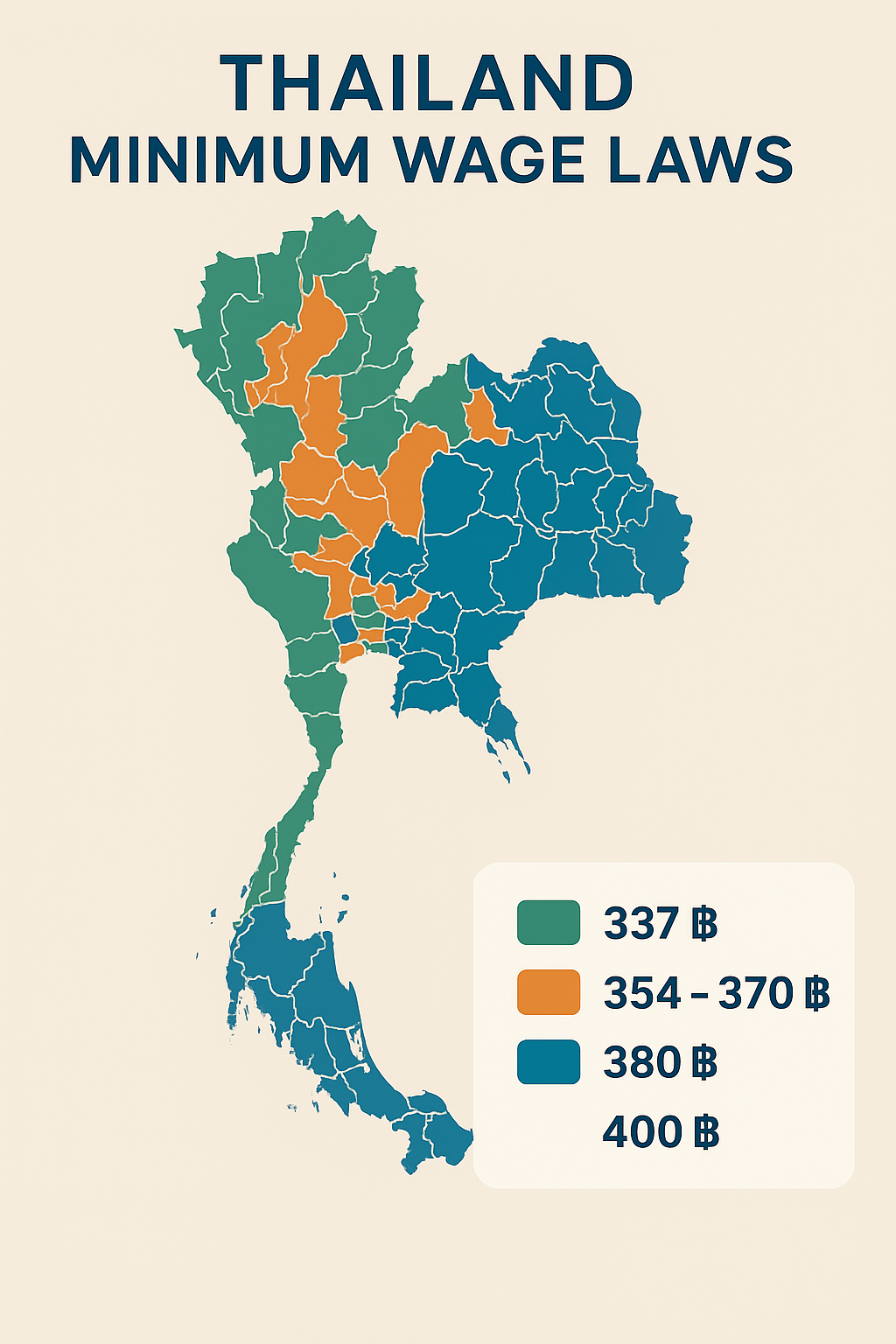
Table of Contents
Historical Development of Thailand’s Minimum Wage System
Origins and Early Development (1972-1998)
The system related to the minimum wage in Thailand was first established on March 16, 1972 through Revolutionary Council Announcement No. 103, making Thailand one of the early adopters of minimum wage legislation in Southeast Asia. The initial authority was granted to the Ministry of Interior, which established the National Wage Committee (NWC) as a tripartite body representing government, employers, and employees.
The first minimum wage was set at 12 baht per day in April 1973, applied only to Bangkok, Samut Prakan, Nonthaburi, and Pathum Thani. This modest beginning would eventually evolve into a comprehensive nationwide system. Since 1974, minimum wage rates have been applied throughout the Kingdom using a geographical zoning system that remains in place today.
The minimum wage was originally defined as “a wage rate which an employee deserves and is sufficient for an employee’s living”. During the early decades, adjustments were primarily based on cost of living studies and inflation rates. Since 1990, economic growth has been incorporated into wage adjustment calculations using the formula: (economic growth rate ÷ 2) + inflation rate.
The Labour Protection Act Era (1998-Present)
The most significant transformation occurred with the Labour Protection Act B.E. 2541 (1998), which established the modern framework for minimum wage determination. This landmark legislation addressed previous system problems including non-compliance with minimum daily wage standards, unclear criteria, and unreliable data collection.
Prior to the 1998 Act, the system faced criticism from the International Labour Organization (ILO), which provided technical assistance in 1995. The ILO recommended a “two-tier” system distinguishing between poverty safety net wages and fair wages enabling workers to benefit from economic development. While the industrial minimum wage concept was not adopted, the 1997 reforms introduced a structure combining national “base wages” with “provincial minimum wages”.
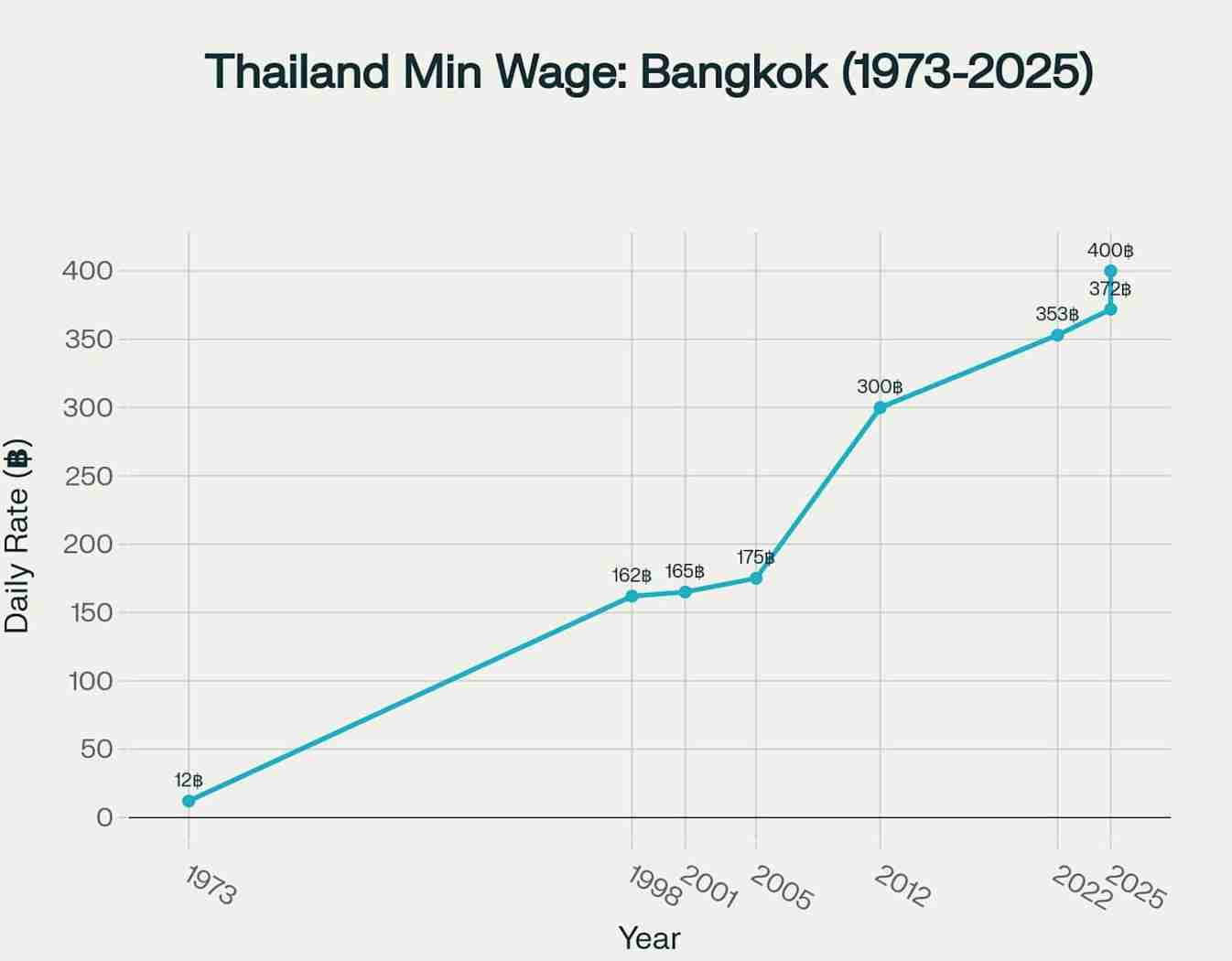
Historical progression of Thailand’s minimum wage in Bangkok area from 1973 to 2025, showing key policy milestones and rate changes
Current Legal Framework of the Minimum Wage in Thailand
Legislative Foundation
The Labour Protection Act B.E. 2541 (1998) serves as the primary legislation governing minimum wages in Thailand. This Act establishes comprehensive provisions for wage determination, payment requirements, and enforcement mechanisms. The minimum wage system operates under three core principles:
- Labor Protection: Minimum wage serves as a major measure of worker protection
- Tripartite Determination: Wage levels determined through collaborative machinery involving government, employers, and employees
- Provincial Decentralization: Wage-fixing decentralized to provincial levels to account for local economic conditions
Institutional Framework
National Wage Committee (NWC)
The NWC, chaired by the Permanent Secretary of the Ministry of Labour, has 15 members under section 78 of the Labour Protection Act: the chair, four government representatives, and five employer and five employee representatives appointed by the Cabinet. Appointed members serve two-year terms and may be reappointed (section 80). Its duties under section 79 include:
- Proposing wage policy recommendations to the Cabinet
- Setting basic minimum wage rates
- Determining provincial minimum wage rates
- Providing guidance on wage adjustments based on socio-economic conditions
Provincial Subcommittees on Minimum Wage (PSMW)
Each province has a tripartite PSMW including the governor, provincial commerce and industrial officers, public interest representatives, and equal numbers of worker and employer representatives. These committees recommend provincial wage adjustments to the NWC based on local economic conditions.
Subcommittee on Technical Affairs and Review (STAR)
Established in 2004, STAR reviews PSMW recommendations before final NWC consideration, ensuring technical accuracy and consistency across provinces in relation to the daily minimum wage rates.
Determination Criteria
According to Section 87 of the Labour Protection Act, the Wage Committee must study the wages employees actually receive and weigh nine factors. The three headings below are our grouping, not the Act’s:
Cost of Living Indicators:
- Consumer price index
- Inflation rate
- Standard of living requirements
- Prices of goods and services
Employer Capacity Indicators:
- Business operational capacity
- Cost of production
- Labor productivity levels
Economic Conditions:
- Gross Domestic Product (GDP)
- Overall socio-economic situation
What Is the Current Minimum Wage in Thailand? (Rates in Force Since 1 July 2025)
Provincial Rate Structure
Thailand currently implements a graduated minimum wage system ranging from 337 to 400 baht per day, reflecting regional economic disparities and cost of living variations. The rates, effective from different dates in 2025, demonstrate the government’s approach to balancing worker welfare with business sustainability.
The highest rates of 400 baht per day apply to economically robust areas including Bangkok (effective July 1, 2025), Phuket, Chachoengsao, Chonburi, Rayong, and Koh Samui district in Surat Thani (effective January 1, 2025). The lowest rates of 337 baht per day apply to the three southern border provinces of Narathiwat, Pattani, and Yala, reflecting the challenging security and economic conditions in these areas.
| Daily rate | Provinces | Areas | Monthly equivalent at 26 working days |
|---|---|---|---|
| 400 baht | Bangkok, Chachoengsao, Chonburi, Phuket, Rayong, Surat Thani (Koh Samui district only) | 6 | 10,400 |
| 380 baht | Chiang Mai (Mueang Chiang Mai district only), Songkhla (Hat Yai district only) | 2 | 9,880 |
| 372 baht | Nakhon Pathom, Nonthaburi, Pathum Thani, Samut Prakan, Samut Sakhon | 5 | 9,672 |
| 359 baht | Nakhon Ratchasima | 1 | 9,334 |
| 358 baht | Samut Songkhram | 1 | 9,308 |
| 357 baht | Chiang Mai (all districts except Mueang Chiang Mai), Khon Kaen, Phra Nakhon Si Ayutthaya, Prachinburi, Saraburi | 5 | 9,282 |
| 356 baht | Lopburi | 1 | 9,256 |
| 355 baht | Nakhon Nayok, Nong Khai, Suphan Buri | 3 | 9,230 |
| 354 baht | Krabi, Trat | 2 | 9,204 |
| 352 baht | Buriram, Chanthaburi, Chiang Rai, Kanchanaburi, Mukdahan, Nakhon Phanom, Phang Nga, Phitsanulok, Prachuap Khiri Khan, Sa Kaeo, Sakon Nakhon, Songkhla (all districts except Hat Yai), Surat Thani (all districts except Koh Samui), Tak, Ubon Ratchathani | 15 | 9,152 |
| 351 baht | Chumphon, Phetchaburi, Surin | 3 | 9,126 |
| 350 baht | Lamphun, Nakhon Sawan, Yasothon | 3 | 9,100 |
| 349 baht | Bueng Kan, Kalasin, Nakhon Si Thammarat, Phetchabun, Roi Et | 5 | 9,074 |
| 348 baht | Ang Thong, Chai Nat, Chaiyaphum, Phatthalung, Sing Buri | 5 | 9,048 |
| 347 baht | Amnat Charoen, Kamphaeng Phet, Lampang, Loei, Maha Sarakham, Mae Hong Son, Nong Bua Lamphu, Phichit, Ranong, Ratchaburi, Sisaket, Satun, Sukhothai, Udon Thani, Uthai Thani, Uttaradit | 16 | 9,022 |
| 345 baht | Nan, Phayao, Phrae, Trang | 4 | 8,970 |
| 337 baht | Narathiwat, Pattani, Yala | 3 | 8,762 |
Three provinces are split, because the rate follows the district and not the province: Chiang Mai (380 baht in Mueang Chiang Mai, 357 baht elsewhere), Songkhla (380 baht in Hat Yai, 352 baht elsewhere) and Surat Thani (400 baht on Koh Samui, 352 baht elsewhere). Pay the rate for the district where the work is actually done.
Separately from the provincial rates, a rate of 400 baht per day applies nationwide to hotel businesses in grades 2, 3 and 4 and to service and entertainment establishments, whatever province they sit in.
On the monthly column. Thai law sets a minimum daily wage. There is no statutory monthly minimum, so the last column is arithmetic for budgeting only: the daily rate times 26 working days. An employee who works a six-day week reaches roughly that figure; one who works five days a week reaches about 22 times the daily rate. It is not a floor an employer can be prosecuted against, and it does not include overtime, holiday pay or social security.
Special Sector Provisions
Beyond provincial rates, Thailand has implemented sector-specific minimum wages for tourism and entertainment industries nationwide. These provisions recognize the higher revenue potential and labor-intensive nature of these sectors.
The 400 baht daily minimum wage applies nationwide to:
- Hotels of types 2, 3 and 4 under the Hotel Act, in every province
- Entertainment venues registered under the Service Establishments Act (bars, karaoke venues, massage parlors)
Latest Changes: The Bangkok 400 Baht Increase
Implementation Details
The most significant recent development is Bangkok’s minimum wage increase to 400 baht per day, effective July 1, 2025. This represents a 28 baht increase from the previous 372 baht rate, marking a 7.5% wage increase for workers in the capital.
The tripartite Wage Committee approved this increase on 17 June 2025, the date the announcement bears. The Cabinet took note of it on 1 July 2025, and it was published in the Royal Gazette and took effect the same day. There was no retroactive effect.
Coverage and Impact
This wage increase affects all businesses and workers in Bangkok are required to adhere to the minimum daily wage standards set by law, regardless of sector, benefiting an estimated 700,000 workers nationwide when combined with the sector-specific increases. The decision extends the 400 baht rate, previously limited to selected tourist provinces and upmarket hotels, to encompass Thailand’s economic center.
The government’s rationale emphasizes improving worker welfare and stimulating economic growth, particularly in tourism and service sectors considered better positioned to absorb increased labor costs Deputy government spokeswoman Sasikarn Watthanachan stated the policy would “improve the living conditions of more than 700,000 workers nationwide” and inject spending power into local economies.
Business Reactions and Concerns
The increase has generated mixed reactions from the business community. The Federation of Thai Industries and small business associations have expressed concerns about rising operational costs during economic uncertainty. Hotel owner Chatchai Kosawisut from Khon Kaen described the policy as “punishment” rather than reform, arguing that increased costs could force businesses to reduce staff.
However, government officials maintain that the targeted approach focusing on tourism and hospitality sectors minimizes broader economic disruption while supporting workers in industries with higher revenue potential.
The Other Statutory Wage Floor: Skill Standard Rates
The minimum wage is not the only rate an employer can be obliged to pay. Under sections 79(4) and 88 of the Labour Protection Act B.E. 2541, as amended by the Labour Protection Act (No. 3) B.E. 2551, the same Wage Committee also fixes wage rates according to skill standards. These are trade by trade and level by level, they sit well above the provincial minimum, and they are numbered in their own separate series. That numbering trips people up: an announcement carrying a higher number than the minimum wage one is usually from this series, not a new minimum wage.
The rule is in clause 5 of each announcement. Where an employer has an employee work in a position or on work that requires the skill, knowledge and ability of a national skill standard in a given trade and level, whether the work covers the whole of that standard or only part of it, the employer must pay not less than the skill standard rate for that trade and level. Clause 6 puts the first move on the employee: someone who has passed the skill standard test, whether before or after the announcement takes effect, must give the certificate to the employer promptly, and the employer then pays the rate from the day the certificate was received.
A new announcement takes effect on 14 September 2026 on the Ministry of Labour’s own reckoning. Wage Committee Announcement on Wage Rates according to Skill Standards (No. 15), resolved by Wage Committee set 22 at meeting 8/2568 on 22 December 2025, signed on 29 January 2026 by the Permanent Secretary for Labour as Chairman of the Wage Committee, and published in the Royal Gazette volume 143 special part 150 Ngor of 16 June 2026. Clause 1 does not name a date. It reads ประกาศนี้ใช้บังคับเมื่อพ้นกำหนดเก้าสิบวันนับแต่วันประกาศในราชกิจจานุเบกษาเป็นต้นไป: the announcement applies once ninety days from Gazette publication have elapsed. The Ministry of Labour states the effective date as 14 September 2026 in the footer of its published copy of the announcement, and that is the date the Ministry itself works from. Counted strictly under section 193/3 of the Civil and Commercial Code, which excludes the day of publication, the ninety days end on 14 September and the announcement commences on 15 September 2026. An employer gains nothing from that one-day difference: pay the new rates from 14 September. It adds four trades:
| Trade | Level | Not less than, per day |
|---|---|---|
| Flux cored arc welder (machinery and production) | Level 1 | 550 baht |
| Flux cored arc welder | Level 2 | 650 baht |
| MIG welder (machinery and production) | Level 1 | 550 baht |
| MIG welder | Level 2 | 650 baht |
| Off grid solar cell system installer (electrical and electronics) | Level 1 | 560 baht |
| Industrial robot maintenance technician (automation and robotics) | Level 1 | 630 baht |
Clause 4 defines a day as the employee’s normal working time, so these are daily rates on the same basis as the minimum wage. Earlier announcements in the same series cover many other trades and remain in force, so an employer of certified workers should check the series rather than this one announcement. The full Thai text of No. 15 is on the Ministry of Labour site.
The practical point. Paying 400 baht a day in Bangkok satisfies the minimum wage and can still leave an employer underpaying. If the worker holds a national skill certificate in one of these trades and has handed it over, the floor is 550, 560, 630 or 650 baht, and the shortfall is recoverable as unpaid wages in the same way as any other underpayment.
What Are an Employer’s Obligations Under the Thai Minimum Wage?
Fundamental Payment Obligations
Under the Labour Protection Act, employers are legally prohibited from paying wages below the prescribed minimum rates once announced in the Government Gazette. This obligation applies immediately upon the effective date of any wage adjustment, superseding any existing employment contracts or agreements that specify lower compensation.
Key employer obligations include:
Wage Payment Requirements
- Currency: Wages must be paid in Thai currency unless employee consent is obtained for alternative payment methods
- Location: Payment must occur at the employee’s workplace unless alternative arrangements are agreed upon
- Timing: Regular payment schedules must be maintained according to contract terms
- Documentation: Employers must maintain accurate wage records and provide payment documentation
Working Time Definitions
The minimum wage applies to specific working time definitions:
- Normal work: 8 hours per day constitutes a full working day for minimum wage calculation
- Hazardous work: 7 hours per day for work potentially harmful to health and safety
- Part-time considerations: Employees are entitled to the full daily minimum wage regardless of reduced working hours, provided they work their normal scheduled day
Compliance Monitoring and Reporting
Where a company sponsors foreign staff, the Immigration Bureau looks at its Thai payroll when it considers a visa extension. Item 2.1(5) of the criteria annexed to Immigration Bureau Order 12/2568 of 23 January 2025 requires four permanent Thai employees for each foreigner (Royal Thai Police Order 327/2557, which carried the rule before, was repealed on 26 September 2023), and immigration offices check it against the company’s monthly filings:
- Monthly tax returns (Form PND.1)
- Social security contribution reports (Form Sor Bor Sor 1-10)
The order itself sets no wage figure for those Thai employees. In practice an officer who sees Thai staff on the company’s filings paid below the provincial minimum wage will question whether they are genuine employees, and underpaying them is in any case an offence under section 90 of the Labour Protection Act.
Record-Keeping and Notification Requirements
Employers must:
- Post minimum wage notifications in prominent workplace locations throughout the enforcement period, including areas with specific minimum daily wage rates
- Maintain comprehensive wage records including overtime, holiday pay, and other compensation
- Ensure equal pay provisions for workers performing the same nature, quality, and quantity of work regardless of gender
- Comply with deduction limitations as specified in Section 76 of the Labour Protection Act
Enforcement Mechanisms and Penalties
What Happens If an Employer Does Not Pay the Minimum Wage?
Violations of minimum wage requirements carry serious legal penalties under Thai law, the minimum daily wage is a fundamental right for all workers. Employers who fail to pay the prescribed minimum wage face:
- Imprisonment: Up to 6 months
- Monetary fines: Up to 100,000 baht
- Combined penalties: Both imprisonment and fines may be imposed
These are the maximums under section 144 for each offence. The Act does not itself say that each underpaid employee is a separate offence; how many counts are charged depends on the facts, and the unpaid wages remain recoverable whatever the penalty.
Labor Inspection System
The Department of Labour Protection and Welfare conducts regular inspections to ensure minimum wage compliance. Recent inspection data reveals ongoing challenges:
- 2003 inspection results: 10.4% of inspected establishments (11,240 out of 108,043) paid below required minimum wages
- 2002 survey findings: 1.71 million workers were paid less than applicable minimum wage rates
While these figures show improvement from the estimated 37% non-compliance rate in 1994, enforcement remains a significant challenge, particularly among small establishments and informal sector businesses.
Worker Rights and Remedy Procedures
Workers experiencing minimum wage violations have several recourse options:
- Direct reporting to labor inspectors through provincial labor offices
- Filing complaints through the formal labor dispute resolution system
- Seeking assistance from labor unions and worker advocacy organizations
The Labour Protection Act provides workers with preferential rights over employer assets in cases of unpaid wages, equivalent to tax and duty preferences under the Civil and Commercial Code.
Economic Impact and Government Support Measures
Economic Analysis and Projections
Research indicates that the minimum wage increases will have varied economic impacts across sectors and regions. Studies suggest a nationwide 400 baht minimum wage could:
- Increase inflation by approximately 0.1%
- Raise average labor costs by 6%
- Benefit workers primarily in labor-intensive industries such as agriculture, domestic work, and accommodation/food services
The Bank of Thailand’s analysis indicates limited overall wage impact, with average wages expected to increase by only 2.3% due to indirect effects on wage structures. Most workers (approximately 85%) already earn above the new minimum wage rates, limiting direct impact.
Government Support for Businesses
Recognizing the potential burden on small and medium-sized enterprises (SMEs), the government has implemented measures to support compliance with the minimum daily wage in regions like Chiang Mai and Songkhla:
Soft Loan Programs
- 30 billion baht in soft loans coordinated through six commercial banks to help businesses adjust to higher wage costs
- Low-interest rates (0.01% to banks, maximum 3.5% to SMEs) for three-year terms
- Targeted support for affected sectors including manufacturing, hospitality, and service industries
Regional Support Initiatives
Special provisions for economically challenged areas include:
- 15 billion baht soft loan scheme for SMEs in southern border provinces (Yala, Pattani, Narathiwat) at 1.99% annual interest
- Extended program duration through 2027 to ensure business continuity
- Maximum borrowing limits of 20 million baht per borrower for liquidity and expansion needs
Conclusion
Thailand’s minimum wage system represents a sophisticated balance between worker protection and economic sustainability, evolved over more than five decades of continuous refinement. The recent increase to 400 baht per day in Bangkok and specific sectors nationwide demonstrates the government’s commitment to improving worker welfare while maintaining economic competitiveness through the enforcement of daily minimum wage rates.
For employers, compliance is not optional but a legal requirement carrying significant penalties for violations. Understanding the complex provincial rate structures, sector-specific provisions, and reporting obligations is essential for maintaining legal compliance with the minimum daily wage and avoiding costly penalties.
For workers, the minimum wage provides crucial protection against exploitation while serving as a foundation for economic advancement. The current system’s emphasis on regional variation acknowledges Thailand’s diverse economic landscape while ensuring basic living standards for all workers.
The ongoing evolution of Thailand’s minimum wage policy reflects broader economic and social changes, with future adjustments likely to continue balancing worker welfare, business sustainability, and national economic competitiveness. As Thailand advances toward its development goals, the minimum wage system will remain a critical tool for ensuring that economic growth benefits all segments of society.
Employers must stay informed about regulatory changes, maintain accurate wage records, and ensure full compliance with all applicable minimum wage requirements. The investment in proper compliance systems and worker welfare ultimately contributes to Thailand’s broader economic development and social stability.
FAQs about Minimum Wage in Thailand
What is the minimum wage in Thailand in 2026?
Between 337 and 400 baht per day, depending on the province. The rates come from Wage Committee Announcement No. 14 of 17 June 2025, in force since 1 July 2025, and they have not been changed for 2026. The 400 baht top rate applies in Bangkok, Chachoengsao, Chonburi, Phuket, Rayong and on Koh Samui. The 337 baht floor applies in Narathiwat, Pattani and Yala.
How does the minimum wage vary across provinces in Thailand?
Minimum wage rates are not uniform across all provinces in Thailand. Under Wage Committee Announcement No. 14, in force since 1 July 2025, the daily rates range from THB 337 to THB 400 depending on the province. For instance, Bangkok and certain business types may have higher rates compared to the southernmost provinces of Narathiwat.
When will the minimum wage be adjusted again?
No further increase has been announced. Announcement No. 14 is still the operative instrument for 2026. The Wage Committee reviews rates periodically, but any change binds employers only once it is published in the Royal Gazette, so check that date before relying on a figure reported in the press.
What are the daily wage rates for Bangkok and its surrounding provinces?
In Bangkok, the minimum daily wage rate is set at THB 400. This rate applies to various sectors, including certain business types that may be covered by the Service Establishments Act, whose establishments are on 400 baht in every province.
What is the minimum wage in Hat Yai?
380 baht per day in Hat Yai district. It is one of only two districts on that rate, the other being Mueang Chiang Mai. The rest of Songkhla province is on 352 baht per day. The rate follows the district where the work is actually done, not the province.
What are the provisions for workers regarding paid public holidays?
Workers are entitled to at least 13 paid traditional holidays a year, including National Labour Day, which the employer must announce in advance (section 29 of the Labour Protection Act), and the holiday is paid at the normal day’s wage (section 56). An employee who is required to work on a holiday is owed holiday pay on top.
How can workers resolve individual labor disputes related to wages?
Workers facing issues related to wages can seek assistance in resolving individual labor disputes through official labor offices or legal channels. The Thai government has mechanisms in place to help workers address their concerns effectively.
What are the implications of the new minimum wage for the Mueang Chiang Mai District?
Mueang Chiang Mai district is on 380 baht per day, not the 400 baht top rate. It is one of only two districts assessed separately from the province around it, the other being Hat Yai in Songkhla, and the rest of Chiang Mai province is on 357 baht. The rates come from Wage Committee Announcement No. 14, in force since 1 July 2025.
Links:
Last reviewed: 4 September 2026. Currency of the rates was the point of this review and it was checked rather than carried forward: Wage Committee Announcement on Minimum Wage (No. 14) of 17 June 2025 is still the operative instrument, no later announcement in that series was found, and the 337 to 400 baht range is unchanged for 2026. Mueang Chiang Mai at 380 baht was corrected in the FAQ, where it had said 400; the rate table on this page was already right. How that was checked, so the date above does not imply more than it should: the Ministry of Labour’s own site is behind a bot wall and could not be read directly, so currency rests on independent Thai and international sources agreeing that No. 14 is unchanged, and on this page’s own re-check of 23 August 2026. The two wage series are numbered separately, so Announcement No. 15 is a skill-standard announcement and not a newer minimum wage. Not verified against a primary source: the historical section before 2013, the SME soft-loan figures, the inflation and GDP estimates, and the social security and monthly-reporting figures. Re-checked on 4 October 2026: Labour Protection Act sections 11, 23, 29, 54, 55, 56, 78 to 80, 87, 89, 90 and 144 were read in Thai in the text consolidated to Act No. 9 B.E. 2568, clause 2 of Announcement No. 14 was read as quoted verbatim in Thai press reports of 1 July 2025 (the Ministry’s copies are behind a bot wall), and the Thai-staff ratio was read in Royal Thai Police Order 327/2557, since repealed. Wage Committee composition, the section 87 factors, the hotel and service-establishment rate, the Gazette date, the penalties, the immigration paragraph and two FAQs were corrected; the historical section, inspection statistics and economic figures remain unverified. Re-checked on 10 October 2026: the Thai-staff ratio now cites item 2.1(5) of the criteria annexed to Immigration Bureau Order 12/2568, read in Thai, in place of the repealed police order.
Minimum wage is only one part of the framework. Thai labour law sets the rest of the employment terms, and our guide to employee rights in Thailand covers what an employee can actually enforce.
Thai Law Updates, free by email
Plain-English updates on Thai law changes that affect foreigners: property, visas, marriage, business and wills. One short email a month from a firm practicing since 2006. No spam, unsubscribe anytime.