


Reviewed by Wichuda Atthamethakon, LL.M., Thai Bar Licence 3149/2556, for ThaiLawOnline, a Thai law firm acting for foreigners since 2006.
Update log
- 2 November 2026: Added the statute box with Thai, English and French text and checked the page against the official text
“Ratchaphatsadu” (ราชพัสดุ) literally translates to “royal supplies” or “state property.” In Thai real estate law, Ratchaphatsadu land means any immovable property owned by the State, with some exceptions. It is the single largest category of government-held land in Thailand. It is often called “treasury land” or “Thanarak land”, after the Treasury Department (กรมธนารักษ์) that administers it. It has nothing to do with the tax forms sometimes confused with it: Por Bor Tor 5 (ภ.บ.ท. 5) was a receipt for the local development tax, repealed from 2020, and Por Dor Sor 3 (ภ.ด.ส. 3) is a form used under the Land and Building Tax Act B.E. 2562. Neither is a title to State land.
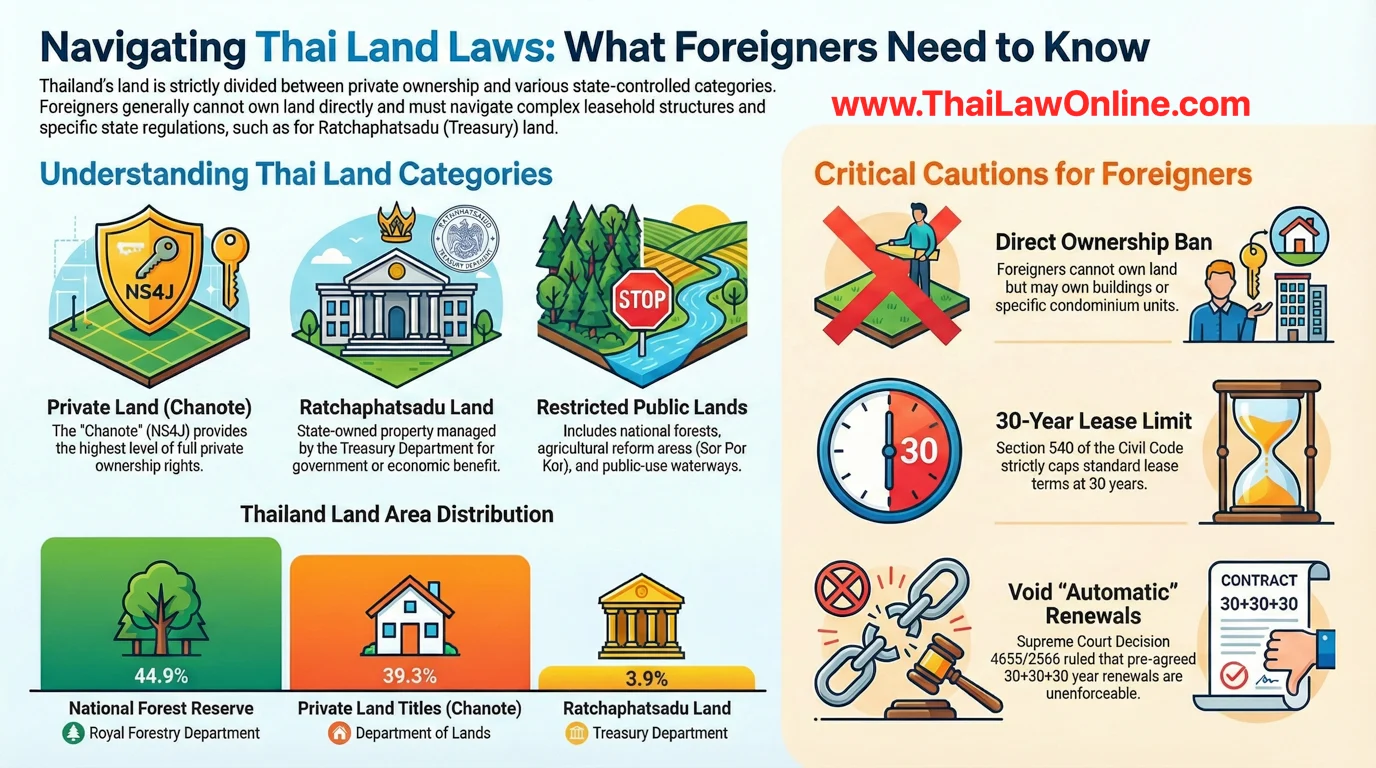
Table of Contents
1. What Is Ratchaphatsadu Land in Thailand (ที่ราชพัสดุ)?
The governing statute is the Ratchaphatsadu Land Act B.E. 2562 (2019), which by its Section 3 repealed the B.E. 2518 (1975) Act outright. Older sources, and much of the English-language web, still quote the 1975 Act.
Section 6 provides that Ratchaphatsadu land comprises (1) immovable property of every kind that is property of the State, (2) land reserved or set aside for the specific benefit of the State, and (3) land reserved or set aside for official benefit under the law. Because limb (1) reaches immovable property of every kind, buildings and permanent structures on State land are themselves Ratchaphatsadu, not merely fixtures on it.
Section 7 sets out what is not Ratchaphatsadu. It excludes waste and vacant land, and land expropriated, abandoned or otherwise reverted to the State under the land law, except where that land is itself reserved or set aside for the specific benefit of the State or for official benefit.
Key Fact
The Thai Treasury Department manages about 12.5 million rai of Ratchaphatsadu land in Thailand. That is roughly 2 million hectares. Its estimated value, as reported in the Thai press from Treasury Department figures, is over 5 trillion Baht.
In simple terms, Ratchaphatsadu land includes government office buildings. It also includes military sites. It includes state-owned markets. It includes land set aside for agencies. It also includes land the State leases to private parties for commercial or residential use. It does not include public commons land, such as beaches or public roads. It also leaves out land owned by autonomous state enterprises. These include the State Railway of Thailand and the Electricity Generating Authority of Thailand.
For Western readers, Ratchaphatsadu land is similar to “Crown land” in Commonwealth countries or “treasury land”. Examples include Canada, Australia, and the UK.It is also similar to “federal land” in the United States. It is government-owned land that may be leased or used for specific purposes.The public cannot freely buy it.
2. The Legal Framework: Key Legislation Governing Treasury Land
Ratchaphatsadu land is governed by a layered system of primary legislation, secondary regulations, and ministerial policies. Understanding this framework is essential for anyone seeking to lease or interact with government-owned land in Thailand.
2.1 Ratchaphatsadu Land Act B.E. 2518 (1975)
The original Ratchaphatsadu Land Act was enacted on February 14, B.E. 2518 (1975). It served as the foundational law for more than four decades. This Act has 12 sections. It defined Ratchaphatsadu land. It created the Ratchaphatsadu Land Committee, chaired by the Minister of Finance. It also set basic rules to supervise, maintain, use, and manage state property.
Section 5 of the B.E. 2518 Act vested ownership of all Ratchaphatsadu land in the Ministry of Finance. Section 6 established the Ratchaphatsadu Land Committee with authority to formulate policy and issue Ministerial Regulations. Section 8 said you needed an Act of Parliament to transfer Ratchaphatsadu land. This applied when the land was public land set aside for special state use. Section 9 stated that when the land was no longer needed for its purpose, a Royal Decree had to revoke its reserved status.
Reference: Ratchaphatsadu Land Act B.E. 2518 (1975), Sections 4 to 12; Royal Gazette Vol. 92, Part 54, special issue, page 1, 5 March B.E. 2518.
2.2 Ratchaphatsadu Land Act B.E. 2562 (2019)
The newer Ratchaphatsadu Land Act B.E. 2562 (2019) was published in the Royal Gazette on March 9, 2019. It replaced the 1975 Act to modernize state property management. This updated law set clearer rules for buying, managing, and leasing Ratchaphatsadu land. It also added rules for managing state property outside Thailand. This change reflects Thailand’s growing international government interests.
The B.E. 2562 Act reinforced a rule for government agencies and local administrative organizations. If they want to use Ratchaphatsadu land, they must notify the Treasury Department of their goals. They must also seek formal approval under Ministerial Regulations. It also moved State-property deals out of the Public-Private Partnership (PPP) regime. Under Section 29, exploiting Ratchaphatsadu land with a private party is exempt from the PPP law, except for infrastructure and public-service projects above a value set by ministerial regulation; the 2021 regulation sets that at 5,000 million baht or more (MR B.E. 2564, clause 3). Under Section 28, a deal where the State land is valued at more than 500 million baht needs the Ratchaphatsadu Land Committee’s approval.
Reference: Ratchaphatsadu Land Act B.E. 2562 (2019); Royal Gazette Vol. 136, Part 31 Kor.
2.3 Ministerial Regulations B.E. 2563 (2020) and B.E. 2564 (2021)
For many years the working rules were the Ministerial Regulation on the Administration, Maintenance, Use and Exploitation of Ratchaphatsadu B.E. 2545 (2002), made under the 1975 Act. It no longer applies. Two regulations made under the 2562 Act now cover the ground: the Ministerial Regulation on the Use of Ratchaphatsadu B.E. 2563 (2020), for use by government agencies, and the Ministerial Regulation on the Exploitation of Ratchaphatsadu B.E. 2564 (2021), which governs leases to private parties and whose clause 1 repeals the 2002 regulation. Much of the English-language material still describes the 2002 rules.
The 2021 regulation is the one a private lessee meets. It caps a lease at 30 years unless it is a commercial or industrial lease under the 1999 Act, which needs the Minister’s approval (clause 9). Rent may not be below the rate the Director-General approves, or the Committee’s rate where the land is worth more than 500 million baht (clause 10). The lessee is chosen by auction unless an exception applies (clauses 15 to 17). Deals over 500 million baht go through a separate track: the Committee approves the project and then the contract, a selection committee that includes the Office of the Attorney General runs the tender, and a supervisory committee monitors the contract (clauses 19 to 43).
Reference: Ministerial Regulation on the Exploitation of Ratchaphatsadu B.E. 2564 (2021), Royal Gazette Vol. 138, Part 2 Kor, page 4, 14 January 2021, clauses 1, 3, 9, 10, 15 to 43; Ministerial Regulation on the Use of Ratchaphatsadu B.E. 2563 (2020).
The law behind this page
English
Section 1304
The public domain of the State comprises property held for public use or the common benefit, including waste land, roads, rivers, and dedicated public property. Its transfer and prescription are governed by Sections 1305 and 1306.
Full text
Public domain of the State includes property of every kind belonging to the State which is used for the public benefit or reserved for common use, such as: (1) waste land, and land surrendered, abandoned or otherwise reverting to the State under the land laws; (2) property for common use by the public, for example the foreshore, waterways, highways and lakes; (3) property used specifically for the purposes of the State, for example fortresses and military barracks, government offices, warships, arms and munitions.
ThaiLawOnline translation
Section 540
An ordinary fixed-term lease of immovable property is limited to 30 years. Section 540 permits renewal for up to 30 years from renewal. A lease made for a longer term is reduced to 30 years.
Full text
Immovable property may not be let for a period exceeding thirty years. If a contract has been made for a longer period, that period shall be reduced to thirty years. The period of hire referred to above may, on its expiry, be renewed, but the renewal must not exceed thirty years from the date of renewal.
ThaiLawOnline translation
Section 3 Act on Lease of Immovable Property for Commerce and Industry B.E. 2542
Full text
In this Act: "lease" means a lease of immovable property for commerce or industry with a lease term exceeding 30 years but not exceeding 50 years; "Director-General" means the Director-General of the Department of Lands.
ThaiLawOnline translation
Section 538
Any lease of immovable property is unenforceable by action without written evidence signed by the party liable. A lease for more than 3 years, or for the life of the lessee or lessor, must also be made in writing and registered, otherwise it is enforceable only for 3 years.
Full text
A hire of immovable property is not enforceable by action unless there is some written evidence signed by the party liable. If the hire is for more than three years, or for the life of the hirer or of the letter, it is enforceable by action for three years only, unless it is made in writing and registered with the competent official.
ThaiLawOnline translation
Section 5 Land and Buildings Tax Act B.E. 2562
Full text
In this Act: "tax" means the land and buildings tax; "taxpayer" means a natural person or juristic person who is the owner of land or buildings, or who possesses or makes use of land or buildings that are State property, and who is liable to pay tax under this Act, and includes a person liable to pay tax on behalf of a taxpayer under this Act; "land" means the ground, and includes areas of mountains or water; "building" means a house, structure, edifice or other construction which a person may occupy as a dwelling or use, or which is used as a place for storing goods or for carrying on industry or commerce, and includes a condominium unit or raft which a person may use as a dwelling or which is held for profit; "condominium unit" means a unit under the law on condominiums for which a unit title deed has been issued; "local administrative organisation" means a municipality, a Subdistrict Administrative Organisation, the Bangkok Metropolitan Administration, the City of Pattaya and any other local administrative organisation established by law, but does not include a Provincial Administrative Organisation; "local administrative organisation area" means: (1) a municipal area; (2) a Subdistrict Administrative Organisation area; (3) the Bangkok Metropolitan area; (4) the City of Pattaya area; (5) the area of any other local administrative organisation prescribed by law, but does not include a Provincial Administrative Organisation area; "local executive" means: (1) the Mayor of a municipality; (2) the Chief Executive of a Subdistrict Administrative Organisation; (3) the Governor of Bangkok; (4) the Mayor of the City of Pattaya; (5) any other local executive prescribed by law, but does not include the Chief Executive of a Provincial Administrative Organisation; "local ordinance" means: (1) a municipal ordinance; (2) a Subdistrict Administrative Organisation ordinance; (3) a Bangkok Metropolitan ordinance; (4) a City of Pattaya ordinance; (5) an ordinance of any other local administrative organisation prescribed by law, but does not include a Provincial Administrative Organisation ordinance; "Capital Assessment Valuation Committee" means the Capital Assessment Valuation Committee under the Land Code; "Provincial Subcommittee" means the Provincial Subcommittee under the Land Code; "Tax Assessment Appeal Committee" means the Provincial Tax Assessment Appeal Committee or the Bangkok Metropolitan Tax Assessment Appeal Committee, as the case may be; "survey officer" means a person appointed with the duty of surveying land and buildings owned or possessed by taxpayers; "assessment officer" means a person appointed with the duty of assessing tax; "tax collector" means a person appointed with the duty of receiving payment of tax and expediting payment of tax; "year" means a calendar year; "Minister" means the Minister having charge and control of the execution of this Act.
ThaiLawOnline translation
Section 8 Land and Buildings Tax Act B.E. 2562
Full text
Land or buildings that are the following property shall be exempt from the collection of tax under this Act: (1) property of the State or of a State agency used for the affairs of the State or of the State agency or for public purposes, provided it is not used for profit; (2) property used as the offices of the United Nations, specialised agencies of the United Nations or other international organisations, to which Thailand is bound to grant tax exemption under a treaty or any other agreement; (3) property used as the offices of foreign embassies or consulates, subject to the principle of reciprocity; (4) property of the Thai Red Cross Society; (5) religious property of any religion used exclusively for religious activities or public purposes, or property used as the dwelling of monks, ascetics, clergy or priests of any religion, or property that is a shrine, provided in each case that it is not used for profit; (6) property used as a public cemetery or public crematorium without receiving remuneration; (7) property of a foundation, organisation or public charitable institution as prescribed by notification of the Minister of Finance, provided it is not used for profit; (8) private property, only the portion which the owner has consented to the government arranging for public use, in accordance with the rules and conditions prescribed by notification of the Minister of Finance; (9) common property held for the use or common benefit of co-owners under the law on condominiums; (10) land that is a public utility under the law on land allocation; (11) land that is a public utility area under the law on the Industrial Estate Authority of Thailand; (12) other property as prescribed in Ministerial Regulations.
ThaiLawOnline translation
Section 545
Full text
If the hirer lawfully sublets the hired property, the sub-hirer is directly liable to the original letter. In such a case, the sub-hirer may not set up against the letter any payment of rent made in advance to the hirer. This provision does not prevent the letter from exercising his rights against the hirer.
ThaiLawOnline translation
Section 544
Full text
The hirer may not sublet the property hired, or transfer the hirer's rights in the whole or in any part of that property to a third person, unless otherwise agreed in the contract of hire. If the hirer acts in breach of this provision, the letter may terminate the contract.
ThaiLawOnline translation
ไทย
มาตรา 1304
ข้อความเต็ม
สาธารณสมบัติของแผ่นดินนั้น รวมทรัพย์สินทุกชนิดของแผ่นดินซึ่งใช้เพื่อสาธารณประโยชน์หรือสงวนไว้เพื่อประโยชน์ร่วมกัน เช่น(๑) ที่ดินรกร้างว่างเปล่า และที่ดินซึ่งมีผู้เวนคืนหรือทอดทิ้งหรือกลับมาเป็นของแผ่นดินโดยประการอื่น ตามกฎหมายที่ดิน(๒) ทรัพย์สินสำหรับพลเมืองใช้ร่วมกัน เป็นต้นว่า ที่ชายตลิ่ง ทางน้ำ ทางหลวง ทะเลสาบ(๓) ทรัพย์สินใช้เพื่อประโยชน์ของแผ่นดินโดยเฉพาะ เป็นต้นว่า ป้อมและโรงทหาร สำนักราชการบ้านเมือง เรือรบ อาวุธยุทธภัณฑ์
ตรงตามข้อความในราชกิจจานุเบกษา / สำนักงานคณะกรรมการกฤษฎีกา (Verbatim from the Royal Gazette / Office of the Council of State)
มาตรา 540
ข้อความเต็ม
อันอสังหาริมทรัพย์ ท่านห้ามมิให้เช่ากันเป็นกำหนดเวลาเกินกว่าสามสิบปี ถ้าได้ทำสัญญากันไว้เป็นกำหนดเวลานานกว่านั้น ท่านก็ให้ลดลงมาเป็นสามสิบปี อนึ่ง กำหนดเวลาเช่าดังกล่าวมานี้ เมื่อสิ้นลงแล้วจะต่อสัญญาอีกก็ได้ แต่ต้องอย่าให้เกินสามสิบปีนับแต่วันต่อสัญญา
ตรงตามข้อความในราชกิจจานุเบกษา / สำนักงานคณะกรรมการกฤษฎีกา (Verbatim from the Royal Gazette / Office of the Council of State)
มาตรา 3 พระราชบัญญัติการเช่าอสังหาริมทรัพย์เพื่อพาณิชยกรรมและอุตสาหกรรม พ.ศ. 2542
ข้อความเต็ม
ในพระราชบัญญัตินี้ “การเช่า” หมายความว่า การเช่าอสังหาริมทรัพย์เพื่อพาณิชยกรรมหรืออุตสาหกรรมที่กำหนดเวลาเช่าไว้เกินสามสิบปีแต่ไม่เกินห้าสิบปี “อธิบดี” หมายความว่า อธิบดีกรมที่ดิน
ตรงตามข้อความในราชกิจจานุเบกษา / สำนักงานคณะกรรมการกฤษฎีกา (Verbatim from the Royal Gazette / Office of the Council of State)
มาตรา 538
ข้อความเต็ม
เช่าอสังหาริมทรัพย์นั้น ถ้ามิได้มีหลักฐานเป็นหนังสืออย่างหนึ่งอย่างใดลงลายมือชื่อฝ่ายที่ต้องรับผิดเป็นสำคัญ ท่านว่าจะฟ้องร้องให้บังคับคดีหาได้ไม่ ถ้าเช่ามีกำหนดกว่าสามปีขึ้นไป หรือกำหนดตลอดอายุของผู้เช่าหรือผู้ให้เช่าไซร้ หากมิได้ทำเป็นหนังสือและจดทะเบียนต่อพนักงานเจ้าหน้าที่ ท่านว่าการเช่านั้นจะฟ้องร้องให้บังคับคดีได้แต่เพียงสามปี
ตรงตามข้อความในราชกิจจานุเบกษา / สำนักงานคณะกรรมการกฤษฎีกา (Verbatim from the Royal Gazette / Office of the Council of State)
มาตรา 5 พระราชบัญญัติภาษีที่ดินและสิ่งปลูกสร้าง พ.ศ. 2562
ข้อความเต็ม
ในพระราชบัญญัตินี้ “ภาษี” หมายความว่า ภาษีที่ดินและสิ่งปลูกสร้าง “ผู้เสียภาษี” หมายความว่า บุคคลธรรมดาหรือนิติบุคคลซึ่งเป็นเจ้าของที่ดินหรือสิ่งปลูกสร้างหรือเป็นผู้ครอบครองหรือทำประโยชน์ในที่ดินหรือสิ่งปลูกสร้างอันเป็นทรัพย์สินของรัฐ ซึ่งเป็นผู้มีหน้าที่เสียภาษีตามพระราชบัญญัตินี้ และให้หมายความรวมถึงผู้มีหน้าที่ชำระภาษีแทนผู้เสียภาษีตามพระราชบัญญัตินี้ด้วย “ที่ดิน” หมายความว่า พื้นดิน และให้หมายความรวมถึงพื้นที่ที่เป็นภูเขาหรือที่มีน้ำด้วย “สิ่งปลูกสร้าง” หมายความว่า โรงเรือน อาคาร ตึก หรือสิ่งปลูกสร้างอย่างอื่น ที่บุคคลอาจเข้าอยู่อาศัยหรือใช้สอยได้ หรือที่ใช้เป็นที่เก็บสินค้าหรือประกอบการอุตสาหกรรมหรือพาณิชยกรรมและให้หมายความรวมถึงห้องชุดหรือแพที่บุคคลอาจใช้อยู่อาศัยได้หรือที่มีไว้เพื่อหาผลประโยชน์ด้วย “ห้องชุด” หมายความว่า ห้องชุดตามกฎหมายว่าด้วยอาคารชุดที่ได้ออกหนังสือแสดงกรรมสิทธิ์ห้องชุดแล้ว “องค์กรปกครองส่วนท้องถิ่น” หมายความว่า เทศบาล องค์การบริหารส่วนตำบล กรุงเทพมหานคร เมืองพัทยา และองค์กรปกครองส่วนท้องถิ่นอื่นตามที่มีกฎหมายจัดตั้ง แต่ไม่หมายความรวมถึงองค์การบริหารส่วนจังหวัด “เขตองค์กรปกครองส่วนท้องถิ่น” หมายความว่า (๑) เขตเทศบาล (๒) เขตองค์การบริหารส่วนตำบล (๓) เขตกรุงเทพมหานคร (๔) เขตเมืองพัทยา (๕) เขตองค์กรปกครองส่วนท้องถิ่นอื่นตามที่มีกฎหมายกำหนด แต่ไม่หมายความรวมถึงเขตองค์การบริหารส่วนจังหวัด “ผู้บริหารท้องถิ่น” หมายความว่า (๑) นายกเทศมนตรี (๒) นายกองค์การบริหารส่วนตำบล (๓) ผู้ว่าราชการกรุงเทพมหานคร (๔) นายกเมืองพัทยา (๕) ผู้บริหารท้องถิ่นอื่นตามที่มีกฎหมายกำหนด แต่ไม่หมายความรวมถึงนายกองค์การบริหารส่วนจังหวัด “ข้อบัญญัติท้องถิ่น” หมายความว่า (๑) เทศบัญญัติ (๒) ข้อบัญญัติองค์การบริหารส่วนตำบล (๓) ข้อบัญญัติกรุงเทพมหานคร (๔) ข้อบัญญัติเมืองพัทยา (๕) ข้อบัญญัติขององค์กรปกครองส่วนท้องถิ่นอื่นตามที่มีกฎหมายกำหนด แต่ไม่หมายความรวมถึงข้อบัญญัติองค์การบริหารส่วนจังหวัด “คณะกรรมการกำหนดราคาประเมินทุนทรัพย์” หมายความว่า คณะกรรมการกำหนดราคาประเมินทุนทรัพย์ตามประมวลกฎหมายที่ดิน “คณะอนุกรรมการประจำจังหวัด” หมายความว่า คณะอนุกรรมการประจำจังหวัดตามประมวลกฎหมายที่ดิน “คณะกรรมการพิจารณาอุทธรณ์การประเมินภาษี” หมายความว่า คณะกรรมการพิจารณาอุทธรณ์การประเมินภาษีประจำจังหวัด หรือคณะกรรมการพิจารณาอุทธรณ์การประเมินภาษีกรุงเทพมหานคร แล้วแต่กรณี “พนักงานสำรวจ” หมายความว่า ผู้ซึ่งได้รับแต่งตั้งให้มีหน้าที่สำรวจที่ดินและสิ่งปลูกสร้างที่ผู้เสียภาษีเป็นเจ้าของหรือครอบครองอยู่ “พนักงานประเมิน” หมายความว่า ผู้ซึ่งได้รับแต่งตั้งให้มีหน้าที่ประเมินภาษี “พนักงานเก็บภาษี” หมายความว่า ผู้ซึ่งได้รับแต่งตั้งให้มีหน้าที่รับชำระภาษี และเร่งรัดการชำระภาษี “ปี” หมายความว่า ปีปฏิทิน “รัฐมนตรี” หมายความว่า รัฐมนตรีผู้รักษาการตามพระราชบัญญัตินี้
ตรงตามข้อความในราชกิจจานุเบกษา / สำนักงานคณะกรรมการกฤษฎีกา (Verbatim from the Royal Gazette / Office of the Council of State)
มาตรา 8 พระราชบัญญัติภาษีที่ดินและสิ่งปลูกสร้าง พ.ศ. 2562
ข้อความเต็ม
ให้ที่ดินหรือสิ่งปลูกสร้างที่เป็นทรัพย์สินดังต่อไปนี้ได้รับยกเว้นจากการจัดเก็บภาษีตามพระราชบัญญัตินี้ (๑) ทรัพย์สินของรัฐหรือของหน่วยงานของรัฐซึ่งใช้ในกิจการของรัฐหรือของหน่วยงานของรัฐหรือในกิจการสาธารณะ ทั้งนี้ โดยมิได้ใช้หาผลประโยชน์ (๒) ทรัพย์สินที่เป็นที่ทำการขององค์การสหประชาชาติ ทบวงการชำนัญพิเศษขององค์การสหประชาชาติหรือองค์การระหว่างประเทศอื่น ซึ่งประเทศไทยมีข้อผูกพันที่ต้องยกเว้นภาษีให้ตามสนธิสัญญาหรือความตกลงอื่นใด (๓) ทรัพย์สินที่เป็นที่ทำการสถานทูตหรือสถานกงสุลของต่างประเทศ ทั้งนี้ ให้เป็นไปตามหลักถ้อยทีถ้อยปฏิบัติต่อกัน (๔) ทรัพย์สินของสภากาชาดไทย (๕) ทรัพย์สินที่เป็นศาสนสมบัติไม่ว่าของศาสนาใดที่ใช้เฉพาะเพื่อการประกอบศาสนกิจหรือกิจการสาธารณะ หรือทรัพย์สินที่เป็นที่อยู่ของสงฆ์ นักพรต นักบวช หรือบาทหลวง ไม่ว่าในศาสนาใด หรือทรัพย์สินที่เป็นศาลเจ้า ทั้งนี้ เฉพาะที่มิได้ใช้หาผลประโยชน์ (๖) ทรัพย์สินที่ใช้เป็นสุสานสาธารณะหรือฌาปนสถานสาธารณะ โดยมิได้รับประโยชน์ตอบแทน (๗) ทรัพย์สินที่เป็นของมูลนิธิหรือองค์การหรือสถานสาธารณกุศลตามที่รัฐมนตรีว่าการกระทรวงการคลังประกาศกำหนด ทั้งนี้ เฉพาะที่มิได้ใช้หาผลประโยชน์ (๘) ทรัพย์สินของเอกชนเฉพาะส่วนที่ได้ยินยอมให้ทางราชการจัดให้ใช้เพื่อสาธารณประโยชน์ ทั้งนี้ ตามหลักเกณฑ์และเงื่อนไขที่รัฐมนตรีว่าการกระทรวงการคลังประกาศกำหนด (๙) ทรัพย์ส่วนกลางที่มีไว้เพื่อใช้หรือเพื่อประโยชน์ร่วมกันสำหรับเจ้าของร่วมตามกฎหมายว่าด้วยอาคารชุด (๑๐) ที่ดินอันเป็นสาธารณูปโภคตามกฎหมายว่าด้วยการจัดสรรที่ดิน (๑๑) ที่ดินอันเป็นพื้นที่สาธารณูปโภคตามกฎหมายว่าด้วยการนิคมอุตสาหกรรมแห่งประเทศไทย (๑๒) ทรัพย์สินอื่นตามที่กำหนดในกฎกระทรวง
ตรงตามข้อความในราชกิจจานุเบกษา / สำนักงานคณะกรรมการกฤษฎีกา (Verbatim from the Royal Gazette / Office of the Council of State)
มาตรา 545
ข้อความเต็ม
ถ้าผู้เช่าเอาทรัพย์สินซึ่งตนเช่าไปให้ผู้อื่นเช่าช่วงอีกทอดหนึ่งโดยชอบ ท่านว่าผู้เช่าช่วงย่อมต้องรับผิดต่อผู้ให้เช่าเดิมโดยตรง ในกรณีเช่นว่านี้หากผู้เช่าช่วงจะได้ใช้ค่าเช่าให้แก่ผู้เช่าไปก่อน ท่านว่าผู้เช่าช่วงหาอาจจะยกขึ้นเป็นข้อต่อสู้ผู้ให้เช่าได้ไม่อนึ่ง บทบัญญัติอันนี้ไม่ห้ามการที่ผู้ให้เช่าจะใช้สิทธิของตนต่อผู้เช่า
ตรงตามข้อความในราชกิจจานุเบกษา / สำนักงานคณะกรรมการกฤษฎีกา (Verbatim from the Royal Gazette / Office of the Council of State)
มาตรา 544
ข้อความเต็ม
ทรัพย์สินซึ่งเช่านั้น ผู้เช่าจะให้เช่าช่วงหรือโอนสิทธิของตนอันมีในทรัพย์สินนั้นไม่ว่าทั้งหมดหรือแต่บางส่วนให้แก่บุคคลภายนอก ท่านว่าหาอาจทำได้ไม่ เว้นแต่จะได้ตกลงกันไว้เป็นอย่างอื่นในสัญญาเช่า ถ้าผู้เช่าประพฤติฝ่าฝืนบทบัญญัติอันนี้ ผู้ให้เช่าจะบอกเลิกสัญญาเสียก็ได้
ตรงตามข้อความในราชกิจจานุเบกษา / สำนักงานคณะกรรมการกฤษฎีกา (Verbatim from the Royal Gazette / Office of the Council of State)
Français
Article 1304
Le domaine public de l'État comprend ses biens d'usage public ou réservés à l'utilité commune, notamment: (1) terres vacantes, délaissées, abandonnées ou revenues à l'État en droit foncier; (2) biens d'usage commun (rivages, cours d'eau, routes, lacs); (3) biens du service de l'État (forts, casernes, administrations, navires militaires, armements).
résumé non officiel
Article 540
Un immeuble ne peut être donné à bail pour une durée excédant trente ans. Si le contrat a été conclu pour une durée plus longue, celle-ci est réduite à trente ans. La durée du bail ci-dessus mentionnée peut, à son expiration, être renouvelée, mais sans excéder trente ans à compter du jour du renouvellement.
résumé non officiel
Article 3 Act on Lease of Immovable Property for Commerce and Industry B.E. 2542
Dans cette loi, le bail s'entend d'un bail immobilier à usage commercial ou industriel de plus de 30 ans et d'au plus 50 ans ; le directeur général est celui du Département des terres.
résumé non officiel
Article 538
Le louage d'un immeuble ne peut donner lieu à une action en exécution en justice s'il n'existe aucun écrit, de quelque nature que ce soit, signé par la partie tenue. Si le louage est conclu pour une durée supérieure à trois ans, ou pour la durée de la vie du preneur ou du bailleur, et qu'il n'a pas été fait par écrit et enregistré auprès de l'officier compétent, il ne peut donner lieu à une action en exécution que pour trois ans.
résumé non officiel
Article 5 Land and Buildings Tax Act B.E. 2562
Définitions: taxe; contribuable (propriétaire, ou possesseur d'un bien de l'État, et redevable pour autrui); terrain; construction (dont lot de copropriété titré et radeau); collectivité locale, son territoire, son exécutif et ses ordonnances (hors organisation administrative provinciale); comités d'évaluation et d'appel; agents de recensement, d'évaluation, de recouvrement; année civile; Ministre.
résumé non officiel
Article 8 Land and Buildings Tax Act B.E. 2562
Exonérés, sauf usage lucratif selon les cas: biens publics d'usage public; organisations internationales; ambassades et consulats (réciprocité); Croix-Rouge; biens affectés au culte; cimetières gratuits; fondations agréées; parts privées ouvertes au public avec consentement; parties communes de copropriété; équipements de lotissement et zones industrielles; autres biens par règlement.
résumé non officiel
Article 545
Si le locataire sous-loue régulièrement le bien, le sous-locataire est directement responsable envers le bailleur et ne peut lui opposer les loyers payés d'avance au locataire. Le bailleur conserve ses droits contre le locataire.
résumé non officiel
Article 544
Le preneur ne peut sous-louer la chose louée, ni céder à un tiers, en tout ou en partie, les droits qu'il détient sur cette chose, sauf stipulation contraire du contrat de bail. Si le preneur contrevient à la présente disposition, le bailleur peut résilier le contrat.
résumé non officiel
Supreme Court decisions
- 4655/2566 (2023): A 30+30+30 Lease Paid Up Front: the Renewal Promise Is Void, the First 30 Years Stand
Sources
- Civil and Commercial Code, Office of the Council of State, retrieved 31 October 2026
- Act on Lease of Immovable Property for Commerce and Industry B.E. 2542, retrieved 31 October 2026
- Land and Buildings Tax Act B.E. 2562, retrieved 2 November 2026
- deka.supremecourt.or.th, Supreme Court of Thailand decisions database (copy held in our library), retrieved 19 February 2026
3. Classification of State Land in Thailand
To understand Ratchaphatsadu land properly, it must be situated within the broader classification of state-owned land in Thailand. The Land Code B.E. 2497 (1954) and related laws recognize several types of government land. Each type has different legal rules and administrative frameworks.
| Category | Thai Term | Description | Managing Authority | Can Be Leased? |
|---|---|---|---|---|
| Publicly Used Land | ที่สาธารณประโยชน์ | Land commonly used by the public: roads, rivers, beaches, canals, public parks | Ministry of Interior / Local Government | No, protected as public domain |
| Waste Land | ที่รกร้างว่างเปล่า | Abandoned or unused land that has reverted to the State | Ministry of Interior / Land Department | May be allocated for private use under certain programs |
| Treasury Land (Ratchaphatsadu) | ที่ราชพัสดุ | State-owned land used for government administration, military, commercial leasing | Treasury Department / Ministry of Finance | Yes, under the Ratchaphatsadu Land Act |
| State Enterprise Land | ที่ดินรัฐวิสาหกิจ | Land owned by state enterprises with juristic person status (e.g., SRT, EGAT) | Respective State Enterprise | Under the enterprise’s own governing law |
| Government-Reserved Land | ที่ดินสงวนหวงห้าม | Land reserved for specific purposes: natural resources, environmental protection | Various (Forestry Dept., etc.) | Generally no, protected by reservation |
Reference: Land Code B.E. 2497 (1954); Chandler MHM, “Doing Business in Thailand,” Chapter 8, Section 2(A).
The key commercial distinction is that Ratchaphatsadu land can be leased to private parties. Unlike public-use or reserved land, it is often leased for business, housing, and farming. This makes it a significant category for businesses, investors, and individuals seeking to utilize state-owned property in Thailand.
4. The Treasury Department (กรมธนารักษ์): Role and Powers
The Treasury Department (กรมธนารักษ์, Krom Thanarak) is a government unit within the Ministry of Finance. It oversees and maintains all Ratchaphatsadu land across Thailand. The Department’s mandate includes surveying state property and keeping a national registry of government-owned immovable property. It also sets assessed land values for tax and fee calculations nationwide. It also manages lease agreements for treasury land.
The Treasury Department’s assessed land values are very important. They set the baseline for transfer fees, taxes, and registration costs in Thailand. This applies to all land transactions. It includes Ratchaphatsadu land and private land transactions. The assessed price announced by the Treasury Department is usually much lower than the property’s market value.
The Department runs provincial offices (สำนักงานธนารักษ์พื้นที่) in every province.These offices act as the local administrative arm. They process lease applications and conduct inspections. They also manage lease relationships. They work with tenants who use state property.
5. The Ratchaphatsadu Land Committee
The Ratchaphatsadu Land Committee (คณะกรรมการที่ราชพัสดุ) is the top policy body for state property in Thailand. It first appeared as Section 6 of the B.E. 2518 Act, but that Act was repealed rather than amended, so the Committee now exists under Chapter 2, Section 9 of the Ratchaphatsadu Land Act B.E. 2562. The 2562 Act also changed who sits on it: it added the Permanent Secretary for Natural Resources and Environment and, for the first time, three expert members appointed by the Minister from people qualified in economics, land, or property development.
The Committee is chaired by the Minister of Finance. It includes the Permanent Secretary of the Ministry of Finance. It also includes the Director-General of the Treasury Department. The Director-General serves as both a member and secretary. Various other senior officials from relevant ministries are also included. Under Section 15 the Committee sets policy on managing Ratchaphatsadu land, sets the rules for the Ratchaphatsadu register and for reporting, and recommends ministerial regulations to the Minister, who issues them. Under Section 28 it must approve any deal with a private party where the land is worth more than 500 million baht, and under Section 22 it decides when a government agency will not hand back land the Treasury Department has recalled.
Practice Point: For high-value or large-scale leases, the lessee must navigate the Treasury Department’s process. The lessee must also secure approval from the Ratchaphatsadu Land Committee. Prospective lessees should factor this committee approval process into their project timelines.
6. How to Lease Ratchaphatsadu Land
Leasing Ratchaphatsadu land is a main way the State earns revenue from its property holdings. The Treasury Department runs a clear process for awarding leases. The terms follow the Ministerial Regulation on the Exploitation of Ratchaphatsadu B.E. 2564 (2021), which replaced the 2002 regulation.
6.1 Eligibility Requirements
Neither the 2562 Act nor the 2021 regulation limits lessees by nationality. Applicants are commonly Thai nationals or Thai-registered juristic persons, and each tender or lease invitation sets its own qualifications. Government agencies, state enterprises, local administrative organizations, educational institutions, and temples may also be granted the right to use state property. Private entities seeking commercial leases must show a valid business purpose. They must also have enough money to develop and maintain the property. This must meet the Treasury Department’s requirements.
The default is an auction (clause 15 of the 2021 regulation). A lease can be granted without one in the cases clause 16 lists, including residential land of up to 100 square wah valued at no more than 50,000 baht per square wah, agricultural land of up to 15 rai valued at no more than 500,000 baht per rai, non-profit public-benefit bodies, civil servants’ welfare schemes, disabled persons’ organisations, and the owner of adjoining land where the State plot is too small to build on.
6.2 Lease Duration and Renewal
| Kind of lease | Maximum term | Source |
|---|---|---|
| Ordinary lease (residential, retail, agricultural) | 30 years | CCC s.540; MR B.E. 2564 cl.9 |
| Commercial or industrial lease under the 1999 Act | More than 30 years, up to 50, with the Minister’s approval | MR B.E. 2564 cl.9 |
| Lease in an EEC promotion zone for target industries | 50 years, renewable for up to 49 more | EEC Act B.E. 2561 s.52 |
| Use by a government agency | No lease: agreement with the Treasury Department | Act B.E. 2562 s.19; MR B.E. 2563 |
The general maximum lease period is 30 years, under Section 540 of the Thai Civil and Commercial Code. It states that a lease of immovable property cannot exceed 30 years. If the parties agree to a longer term, it will be reduced to 30 years. However, certain special legislation provides exceptions. The Lease of Immovable Property for Commercial and Industrial Purposes Act B.E. 2542 (1999) allows 50-year leases. These leases apply to qualifying commercial and industrial projects. On Ratchaphatsadu land a lease of more than 30 years under that Act also needs the Finance Minister’s approval (clause 9 of the 2021 regulation). The Eastern Special Development Zone Act B.E. 2561 (2018), the EEC Act, allows leases of up to 50 years in its promotion zones, renewable for no more than 49 years (Section 52), and where the EEC Policy Committee resolves to use Ratchaphatsadu land, the Treasury Department’s powers over it pass to the EEC Office (Section 53).
Important: A renewal clause in a Ratchaphatsadu lease does not create a vested right. Renewal is always up to the Treasury Department. The terms, including rental rates, may be renegotiated at renewal. Lessees should not assume automatic renewal.
6.3 Rental Rates and Fees
Rent is not left to the market alone, but market rent is part of the test. Section 27 of the 2562 Act requires any deal with a private party to take into account its purpose, the land’s condition and location, normal market rent, any other return to the State, and the value of buildings that will pass to the Ministry of Finance when the contract ends. Rent may not be below the rate the Director-General approves (clause 10 of the 2021 regulation), and for residential and agricultural leases it is often lower than private-market rent. In addition to monthly or yearly rent, lessees often pay key money (เงินกินเปล่า). They may also pay a building usage fee. This may apply if the lease includes state-owned structures.
The standard registration fee for a Ratchaphatsadu lease is 1% of the total rental value. This amount covers the full lease term. It follows the Land Department’s fee schedule for registered leases in Thailand. Stamp duty of 0.1% of total rent applies (agricultural leases are exempt from stamp duty).
| Fee / Cost | Rate | Payable By | Notes |
|---|---|---|---|
| Annual rent | Based on assessed value formula | Lessee | Lower than private market rates |
| Key money (เงินกินเปล่า) | Varies by property | Lessee | One-time upfront payment |
| Lease registration fee | 1% of total rent throughout lease term | Lessee (by practice) | Registered at Land Office |
| Stamp duty | 0.1% of total rent throughout lease term | Lessor under the Revenue Code schedule, unless the contract says otherwise; waived where that is the Government (s.121) | Agricultural leases exempt |
| Land and Building Tax | Varies (0.01%, 0.7% of assessed value) | Lessee, by law: the occupier or user of State property is the taxpayer | Under Land and Building Tax Act B.E. 2562 |
Reference: Ratchaphatsadu Land Act B.E. 2562, Section 27; Ministerial Regulation B.E. 2564, clause 10; Revenue Code, Sections 107 and 121 and Stamp Duty Schedule, instrument 1; Land and Building Tax Act B.E. 2562, Sections 5 and 8.
6.4 Step-by-Step Lease Procedure
Obtaining a lease on Ratchaphatsadu land has several steps and often takes months to finish. The exact time depends on the project’s size and value.
Step 1, Identification and Inquiry: The prospective lessee identifies the specific Ratchaphatsadu land plot. They ask about it at the provincial Treasury Department office (สำนักงานธนารักษ์พื้นที่). The office will confirm whether the land is available for leasing and the permitted use categories.
Step 2, Application Submission: The applicant submits a formal lease application. It includes ID documents and business registration for juristic persons. It also includes a proposed use plan and proof of financial capacity. The applicant must also provide any supporting documents required by applicable Ministerial Regulations.
Step 3, Evaluation and Inspection: The Treasury Department conducts a site inspection. It evaluates the application against the Ministerial Regulations. It reviews the proposed rental rate and terms. For large-scale projects, an environmental impact assessment may be required.
Step 4, Committee or Ministerial Approval: Depending on the lease value and type, approval is needed. Where the land is worth more than 500 million baht, the Ratchaphatsadu Land Committee must approve the project and then the negotiated contract (Section 28; clauses 23 and 32 of the 2021 regulation). Below that, the Treasury Department acts under rules the Director-General sets, and a lease over 30 years needs the Finance Minister (clause 9). Cabinet approval is required for transferring Ratchaphatsadu land (Section 31), not for leasing it.
Step 5, Lease Execution and Registration: After approval, the Treasury Department and the lessee sign the lease agreement. If the lease term is more than 3 years, you must register it at the relevant Land Office. This ensures it is enforceable under Section 538 of the Civil and Commercial Code.
Step 6, Ongoing Compliance: The lessee must follow the lease terms. This includes use limits, maintenance duties, and regular reports. The Treasury Department retains the right to inspect the property and may terminate the lease for material breach.
7. Types of Permitted Use of Ratchaphatsadu Land
The Treasury Department permits Ratchaphatsadu land for many uses.These include commercial uses like hotels, department stores, markets, and shophouses.It also allows residential use. Educational and religious uses are allowed, such as temples, schools, and universities. Agricultural use is also permitted.Government agencies may use the land for administrative functions. The permitted uses for any parcel come from the Treasury Department’s zoning and use plan. Lessees must follow the approved use category. Unauthorized changes in use constitute grounds for lease termination.
Several large commercial properties in Bangkok and other provinces sit on Ratchaphatsadu land. These include popular markets, government-owned shop rows, and some hotel projects. The long-term nature of these leases and their lower rental rates make Ratchaphatsadu leases commercially attractive. However, the lessee must accept limits when leasing from the government. The lessee cannot own the land outright.
8. Foreigners and Ratchaphatsadu Land
The intersection of Ratchaphatsadu land and foreign investment is a nuanced area of Thai law. As a general rule, Ratchaphatsadu land leases are awarded to Thai nationals or Thai-registered entities. The Land Code B.E. 2497 (1954) limits foreign land ownership. The Treasury Department’s internal policies are also strict. It follows a similar approach when granting leases on state property.
However, foreigners may indirectly access Ratchaphatsadu land through several recognized structures. A Thai-majority company, with at least 51% Thai shareholding, may apply for a Ratchaphatsadu lease as usual. Foreign investors in BOI projects or in the EEC may also lease state property. They may do so under special lease rules in the related promotional laws. In such cases, the lease is between the Treasury Department and the Thai-registered project entity.
Legal Risk Warning: Using nominee shareholders to bypass Thai ownership rules is illegal. Leasing land is not acquiring it, so a foreign lessee does not breach the Land Code by leasing, but a nominee structure used to run a business the Foreign Business Act B.E. 2542 (1999) reserves to Thais is an offence under that Act. Violations carry criminal penalties including fines and imprisonment. The Treasury Department may also terminate the lease if nominee arrangements are discovered.
8.1 The 99-Year Lease Proposal
A proposal to allow foreigners to hold long-term land leases for up to 99 years has been discussed in Thai policy circles. Under this proposal, Thai landowners who want to lease land to foreigners would first transfer the title deed. They would transfer it to the Treasury Department for oversight. Foreign lessees would then hold a lease for up to 99 years. After that, the land would return to state ownership under the Treasury Department. Restrictions would prevent foreigners from acquiring agricultural land or developing low-income housing under this scheme.
However, as of early 2026, this proposal remains at the discussion stage and has not been enacted into law. The Finance Ministry’s permanent secretary has said that this proposal would need changes to state property law. It would also need changes to related laws. Public consultation would be required under the Constitution. Prospective foreign investors should not rely on this proposal for current planning. They should work within the existing 30-year framework. Special laws may allow a 50-year term.
9. Ratchaphatsadu Land vs. Private Land vs. Public Domain: Comparison
| Feature | Ratchaphatsadu Land (ที่ราชพัสดุ) | Private Land (Chanote / NS4) | Public Domain (ที่สาธารณะ) |
|---|---|---|---|
| Ownership | State (Ministry of Finance) | Private individual or entity | State, for public benefit |
| Can be purchased? | No (except in limited disposal cases under the B.E. 2562 Act) | Yes, freely transferable | No |
| Can be leased? | Yes, up to 30 years (50 years under special laws) | Yes, up to 30 years (50 years under special laws) | No |
| Can be mortgaged? | No (leasehold interest only; no security over the land itself) | Yes | No |
| Managing authority | Treasury Department | Land Department (registration only) | Ministry of Interior / Local Govt. |
| Title document | Treasury Department registry | Chanote (NS4), NS3G, NS3 | No private title issued |
| Rent level | Below market (based on assessed value) | Market rate (negotiated between parties) | N/A |
| Foreign access | Limited, through Thai entities, BOI, or EEC | Lease only (no ownership for foreigners, except condos) | None |
| Key legislation | Ratchaphatsadu Land Act B.E. 2562 (which repealed B.E. 2518) | Land Code B.E. 2497; CCC Sections 537-571 | Land Code; CCC Section 1304 |
10. Tax Obligations on Ratchaphatsadu Land
Under the Land and Building Tax Act B.E. 2562 (2019), Ratchaphatsadu land leased to private parties may face annual land and building tax. The tax is based on the value of the land and buildings. It is calculated using rates that vary by use category. These include residential, commercial, agricultural, and vacant. Tax rates range from 0.01% to 0.7% of the assessed value, depending on the use classification and the value tier.
Ratchaphatsadu land used directly by government agencies for governmental purposes is generally exempt from land and building tax. That exemption covers State property used for State or public purposes without profit (Section 8(1)). Once the land is leased to a private party it is being used for profit, and the Act makes the lessee the taxpayer directly: Section 5 defines the taxpayer to include a person who occupies or uses land or buildings that are State property. No clause in the lease is needed for this. The Treasury Department’s assessed land value, which is typically below market value, serves as the tax base.
Lessees should also be aware of income tax implications on buildings or improvements constructed on Ratchaphatsadu land. Upon lease expiration, any structures on the land may revert to the State. This depends on the lease terms. The lessee may or may not receive compensation for these improvements. This is a critical commercial consideration that must be addressed clearly in the lease negotiations.
Reference: Land and Building Tax Act B.E. 2562 (2019); Revenue Code.
11. Transfer, Revocation, and Disposal of Treasury Land
Ratchaphatsadu land cannot be freely transferred or sold in the manner of private land. The rules now sit in Chapter 5 of the B.E. 2562 Act, which carried the 1975 scheme forward with one significant addition. Under Section 30, transferring ownership of Ratchaphatsadu land that is public domain set aside for the specific benefit of the State still requires an Act of Parliament, with a boundary map annexed. Under Section 31, transferring any other Ratchaphatsadu land follows criteria set by ministerial regulation and needs Cabinet approval, which the 1975 Act did not require. Separate routes apply where the transfer is for agricultural land reform, for expropriation, or for a government project the Cabinet has already approved. When land reserved for official use is no longer needed, a Royal Decree revokes the reserved status, again with a boundary map attached.
The B.E. 2562 Act did add one genuinely new mechanism, and it runs the other way. Under Section 32, where Ratchaphatsadu land was acquired by donation and is not put to use within the period the donor set, or within five years of the gift, the donor or their heirs may ask for the land back. Nothing comparable existed in 1975.
Reference: Ratchaphatsadu Land Act B.E. 2562, Chapter 5, Sections 30 to 32.
11. Supreme Court Decisions on Ratchaphatsadu Land (คำพิพากษาศาลฎีกา)
Thai Supreme Court (San Dika, ศาลฎีกา) decisions interpret the Ratchaphatsadu Land Act and related state property laws. These decisions give essential guidance on how these laws apply in practice. Unlike common law jurisdictions, Thai court decisions do not formally create binding precedent. However, Supreme Court judgments carry strong persuasive weight. Lower courts, lawyers, and the Treasury Department often rely on them. For lessees, investors, and legal advisors, knowing these landmark decisions is key to judging risk. It also helps them handle disputes over treasury land.
11.1 Classification: What Qualifies as State Property (สาธารณสมบัติของแผ่นดิน)
One of the most common issues in Thai land law is whether a parcel is Ratchaphatsadu land.This is state land used for government purposes. Or it may be private land that people can own and sell freely. The Supreme Court has developed a robust body of case law on this classification question.
Supreme Court Decision No. 5200/2566 (2023)
In this landmark case, the Supreme Court addressed the evidentiary weight of a prior final judgment declaring land to be state property. The disputed land was split from a plot that a court had already ruled was public domain property. The property was used for the State’s specific benefit under Section 1304(3) of the Civil and Commercial Code. The defendants argued that the subdivided parcels should not carry the same classification.
The Supreme Court held that a judgment awarding property ownership to one party can bind third parties. This applies unless the third parties prove they have stronger rights. This is based on Section 145, paragraph 2(2) of the Civil Procedure Code. Since the defendants only reinterpreted existing documents, they did not prove stronger rights. The Court upheld the property’s status as state-owned.
Key Principle: When the Supreme Court classifies land as state property (สาธารณสมบัติของแผ่นดิน), that status applies to all subdivided parcels. Third parties claiming rights must affirmatively prove superior title, merely offering alternative interpretations of existing documents is insufficient.
Reference: คำพิพากษาศาลฎีกาที่ 5200/2566; CCC Section 1304(3); CPC Section 145.
Supreme Court Decision No. 3169/2564 (2021)
This decision addressed a dispute. The Ministry of Finance registered its name on a land utilization certificate (NS3, Nor Sor 3). It did so after buying the land from one individual. However, the actual occupant, a different person (“S.”), had possessed and cultivated the land for years. Later, S. sold the land to the plaintiff.
The Supreme Court ruled that the name appearing on the NS3 creates only a presumption of possessory rights under Section 1373 of the CCC. When the possessor (“S.”) had physical control of the land, “S.” had valid possessory rights under Section 1367. “S.” could also transfer those rights. The Ministry of Finance registered its name after buying it from someone without land ownership. This did not override the rights of the person who actually possessed the land.
Key Principle: Listing the Ministry of Finance on a land certificate creates a presumption, not final proof. Actual physical possession (การครอบครอง) prevails over paper registration. A person who never took physical possession cannot validly sell land to the government. The government’s later registration does not fix this defect.
One caveat before you rely on this as a Ratchaphatsadu case. The buyer here was the Agricultural Land Reform Office (ส.ป.ก.), and Section 36 bis of the Agricultural Land Reform Act B.E. 2518 provides that land it acquires is not to be treated as Ratchaphatsadu land. The possession rule the case lays down is general and applies either way, but the land itself sat outside the Ratchaphatsadu regime.
Reference: คำพิพากษาศาลฎีกาที่ 3169/2564; CCC Sections 1367, 1373; Agricultural Land Reform Act B.E. 2518, Section 36 bis.
What the Act itself defines as Ratchaphatsadu land
The definition does not come from case law at all. It is set out in Section 6 of the Ratchaphatsadu Land Act B.E. 2562 (2019), which by Section 3 repealed the 1975 Act that older sources still cite. Ratchaphatsadu land is (1) immovable property of the State of every kind, which is why buildings and other structures on state land are included, (2) land reserved or set aside for the specific benefit of the State, and (3) land reserved or set aside for official use under any law.
Section 7 matters just as much, because it lists what is not Ratchaphatsadu land, including vacant and abandoned land under the Land Code, public property for the common use of the people, and the immovable property of state enterprises that are juristic persons and of local administrative organisations. If your plot falls under Section 7, the Treasury Department is not your counterparty.
Reference: Ratchaphatsadu Land Act B.E. 2562, Sections 3, 6 and 7.
11.2 Encroachment and Eviction from Treasury Land
Disputes involving unauthorized occupants on Ratchaphatsadu land are among the most common state property cases in the Thai courts. The Supreme Court has upheld the government’s right to evict encroachers. It has also recognized the rights of occupants with valid possessory claims.
Supreme Court Decision No. 2103/2565 (2022)
The plaintiff lived on a plot of land in Kanchanaburi Province, paid local taxes, and installed concrete boundary posts. The provincial Treasury Department office (สำนักงานธนารักษ์พื้นที่กาญจนบุรี) later surveyed the land. It found the land was Ratchaphatsadu property. It also had the features of a public right-of-way. When third parties entered the property to lay drainage pipes, the plaintiff sued for trespass and criminal damage. The Supreme Court held that the land was ultimately state property. Still, the plaintiff’s ongoing physical occupation gave him standing. He could file trespass and property damage claims. The plaintiff’s possessory rights, inherited from his predecessor in title, were enough to maintain the criminal action. This was true even if the state owned the property.
Key Principle: A person physically occupying Ratchaphatsadu land, even without formal authorization, retains possessory rights that the courts will protect against third-party interference. However, this does not create ownership rights. The occupant is still subject to the Treasury Department’s authority to take back the land.
Reference: คำพิพากษาศาลฎีกาที่ 2103/2565; Criminal Code Sections 362, 365, 358.
Supreme Court Decision No. 8649/2560 (2017)
The defendant pleaded guilty to occupying Ratchaphatsadu land, charged under the Land Code and the Forestry Act together, and the prosecution also asked for eviction of the defendant, workers, contractors, agents and dependents. The trial court treated the conduct as a single act offending several laws and sentenced under the heaviest provision, which is how Section 90 of the Criminal Code works. It is not a case of cumulative penalties under each statute.
What the Supreme Court actually decided is narrower and worth knowing if you are charged. It held that Section 74 bis of the Forestry Act is not an offence-creating provision at all. It only empowers the court to forfeit tools, animals, vehicles and machinery used in committing certain offences, so convicting the defendant under it was wrong. And because the prosecution had not pleaded that anything was seized, there was nothing for the court to forfeit even though the request appeared at the end of the charge.
Reference: คำพิพากษาศาลฎีกาที่ 8649/2560; Land Code Sections 9, 108; Forestry Act Sections 54, 55.
11.3 Lease Disputes and Sub-Lease Rights
Supreme Court Decision No. 8901/2563 (2020)
This important decision addressed the legal position of sub-lessees on Ratchaphatsadu land. The defendant, the body holding the Ratchaphatsadu area and acting as head lessor, signed a lease with Plaintiff No. 1. Plaintiff No. 1 then subleased the property to Plaintiff No. 2. Plaintiff No. 2 then subleased the property to Plaintiff No. 3.When a dispute arose, Plaintiff No. 3 tried to claim rights directly against the Treasury Department.
The Supreme Court ruled under Section 545 of the CCC.A sub-lessee is directly responsible to the original lessor. This is a one-way obligation. It is a statutory exception to the general rule. Contracts usually bind only the parties who signed them. The Court held that this exception cannot be read in reverse. It does not allow a sub-lessee to bring claims against the original lessor. Because no law gives the sub-lessee rights against the original lessor, Plaintiff No. 3 lacked standing and its claim was dismissed as well.
Key Principle (Critical for Lessees): Section 545 runs one way only. A sub-lessee is directly liable to the head lessor, but acquires no rights against it, and the exception cannot be read in reverse. On Ratchaphatsadu land the head lessor is the government body holding the area, which is not necessarily the Treasury Department itself, so identify it from the head lease before assuming who your counterparty is. Either way the sub-lessee must enforce its rights against its own immediate lessor: if the head lease ends, the sub-lessee cannot challenge that decision and can only claim damages from the head lessee.
Reference: คำพิพากษาศาลฎีกาที่ 8901/2563; CCC Section 545.
Supreme Court Decision No. 13387/2555 (2012)
Two landowners sued four defendants over whether land occupied by an agricultural college was Ratchaphatsadu property. Two of those defendants were the college and the Singburi provincial Treasury office (ธนารักษ์พื้นที่สิงห์บุรี).
The Supreme Court threw those two out of the case, and this is the practical point for anyone planning to sue. It read the body of the complaint rather than the names in the caption, found that both had been sued as government sub-units rather than as the individuals heading them, and held that a sub-unit which is not a juristic person cannot be sued at all. The plaintiffs had no power to sue them. A provincial Treasury office is a branch of the Treasury Department, not a legal person in its own right.
Practical effect: name the Treasury Department itself, or the ministry the agency sits under. Naming the provincial office will cost you that defendant, and the Court will look at how you pleaded the claim, not at the caption.
Reference: คำพิพากษาศาลฎีกาที่ 13387/2555.
11.4 Retrial Finality: When the Court of Appeal Has the Last Word
Supreme Court Decision No. 5161/2566 (2023)
This is a procedural ruling, not a land case, and we include it only for the appeal rule it settles. The underlying prosecution had nothing to do with title deeds: it concerned charges under Section 112 of the Criminal Code, alongside a separate fraud case about a construction contract.
The rule is the useful part, and it applies to any retried criminal case. Once a trial court has reopened a case under the Criminal Case Retrial Act B.E. 2526, quashed the old judgment and entered a fresh one under Section 13(1), the right of appeal is governed by Section 15. If that fresh judgment goes to the Court of Appeal, the Court of Appeal decision is final and there is no further appeal to the Supreme Court. A defendant who files one anyway will find it was never properly admitted.
Reference: คำพิพากษาศาลฎีกาที่ 5161/2566; Criminal Case Retrial Act B.E. 2526, Sections 13, 15.
11.5 Jurisdictional Issues: Civil Courts vs. Administrative Courts
Supreme Court Decision No. 4818/2562 (2019)
This significant procedural decision clarified the boundary between civil court and administrative court jurisdiction in Ratchaphatsadu land disputes. The plaintiffs filed a civil case challenging the legality of a Royal Decree affecting state property. The Jurisdictional Dispute Resolution Committee ruled that the case challenged the legality of a Royal Decree.
The Decree was issued by, or approved by, the Cabinet. The Committee said this issue falls under the Supreme Administrative Court’s exclusive jurisdiction. The Supreme Court confirmed that the Committee’s decision is final.This is based on Sections 10 and 11 of the Jurisdictional Dispute Resolution Act B.E. 2542 (1999). The civil court must either transfer the case or dismiss it so that the parties can re-file in the Administrative Court.
Key Principle: Disputes that challenge Royal Decrees about Ratchaphatsadu land must go to the Supreme Administrative Court. They must not be filed in civil courts. Filing in the wrong court will result in dismissal or transfer, costing the litigant significant time and expense. Legal counsel should carefully assess jurisdictional questions before commencing proceedings.
Reference: คำพิพากษาศาลฎีกาที่ 4818/2562; Jurisdictional Dispute Resolution Act B.E. 2542, Sections 10, 11.
11.6 Forest Reserve to Ratchaphatsadu Conversion: What a Defamation Case Does and Does Not Settle
Supreme Court Decision No. 321/2568 (2025)
Read this one carefully, because it is a criminal defamation case and not a ruling on land law. It is included here only because conversion of national forest reserve land into Ratchaphatsadu land was the subject of the accusation. In this case from Phetchabun Province, the defendant put up large vinyl banners. The banners were placed along the Phitsanulok-Lom Sak highway.They accused the provincial governor of seeking Cabinet approval. The approval was to convert national forest reserves into Ratchaphatsadu land.The defendant claimed this would benefit capitalists and politicians. They were allegedly linked to illegal forest encroachment in the Khao Kho area. The banners used language like, “Use Khao Kho as a model to help politicians who take forest land keep it legally.”
The Supreme Court upheld the criminal defamation conviction. The Court found the defendant’s accusations were untrue. The governor had only applied existing government policy. This was one way to address illegal forest encroachment. The Court also ruled that putting up public banners was not good-faith criticism. This was under Section 329 of the Criminal Code. The Court affirmed damages of 500,000 Baht for reputational harm.
Significance for Ratchaphatsadu law, stated precisely. The Court made no ruling on whether converting national forest reserve land (ป่าสงวนแห่งชาติ) into Ratchaphatsadu land is lawful, and this case is not authority that it is. What the Court found, in the course of holding the accusation untrue, is narrower: the governor was an official with a duty to protect the forest and had “merely acted in accordance with the government’s policy at the time, which was only one approach to solving the problem of encroachment on national forest reserves”. That establishes that such a conversion route was being pursued as government policy in the relevant period. It does not establish that the route is legally valid, and nothing in the judgment addresses the question. Treat the conversion mechanism as a policy matter to be checked against the Treasury Department and the governing Act, not as something settled by this decision.
Reference: คำพิพากษาศาลฎีกาที่ 321/2568; Criminal Code Sections 136, 328, 329.
11.7 Summary Table: Key Supreme Court Principles on Ratchaphatsadu Land
| Legal Issue | Case No. | Year | Key Ruling / Principle |
|---|---|---|---|
| State property classification extends to subdivisions | 5200/2566 | 2023 | Once land is classified as state property, all subdivided parcels carry the same classification. Third parties must prove superior rights. |
| Actual possession prevails over paper registration | 3169/2564 | 2021 | Physical possession trumps the Ministry of Finance’s name on land certificates. Government registration without actual possession is a mere formality. |
| Occupants retain possessory rights against third parties | 2103/2565 | 2022 | Even unauthorized occupants of treasury land can sue third-party trespassers. Possessory rights exist independently of ownership. |
| Sub-lessees have no direct claim against the head lessor | 8901/2563 | 2020 | CCC s.545 runs one way: a sub-lessee is directly liable to the head lessor but acquires no rights against it. Enforce against your immediate lessor. |
| Royal Decree challenges go to Administrative Court | 4818/2562 | 2019 | Disputes over Royal Decrees affecting state property are within the exclusive jurisdiction of the Supreme Administrative Court. |
| Forestry Act s.74 bis is a forfeiture power, not an offence | 8649/2560 | 2017 | Occupying state land is chargeable under the Land Code and the Forestry Act together, but as one act punished under the heaviest provision. Convicting under s.74 bis, which only allows forfeiture, was wrong. |
| Provincial Treasury offices CANNOT be sued | 13387/2555 | 2012 | A provincial Treasury office is a government sub-unit, not a juristic person, so it cannot be sued. Name the Treasury Department itself. |
| Not a land-law ruling (defamation case) | 321/2568 | 2025 | A criminal defamation judgment. It records that a forest-to-Ratchaphatsadu conversion was being pursued as government policy at the time, but decides nothing about whether the conversion is lawful. |
| Retrial finality (a procedural rule, not a land case) | 5161/2566 | 2023 | Once a case is retried under the Criminal Case Retrial Act, the Court of Appeal decision is final and there is no further appeal to the Supreme Court. |
Practical Lessons for Lessees and Investors
Supreme Court rulings on Ratchaphatsadu land offer key practical lessons for anyone leasing or dealing in state property:
1. Conduct thorough due diligence on land classification. The 5200/2566 decision shows that state property classification, once established, is extremely difficult to overturn. Before entering any land transaction with possible government ties, check its classification history. Use records from the Treasury Department and the Land Department.
2. Verify actual possession, not just paper titles. The 3169/2564 decision shows that Thai courts focus on who uses and occupies the land. They do not rely only on the name on the certificate. This is critical when purchasing land from entities claiming government-derived title.
3. Structure sub-lease arrangements carefully. The 8901/2563 decision makes clear that sub-lessees have no direct recourse against the Treasury Department. Any sub-lease on Ratchaphatsadu land must include contract protections from the head lessee. This is because if the head lease ends, the sub-lessee can only claim against the head lessee. The sub-lessee cannot claim against the government.
4. File in the correct court. The 4818/2562 decision confirms this rule.You must file challenges to government decisions in the Administrative Court.This includes Royal Decrees and Ministerial Regulations.This applies when decisions affect Ratchaphatsadu land.Do not file these cases in the civil court. Filing in the wrong forum wastes time and resources.
5. Unauthorized occupation carries criminal liability, but check the sections charged. Encroachment on state land is a criminal matter, not merely a civil dispute. Section 45 of the 2562 Act punishes occupying Ratchaphatsadu land without right, disturbing its use, or damaging it with up to five years’ imprisonment, a fine of up to 100,000 baht, or both; the court can order the offender, workers, contractors, agents and dependants off the land, and tools and machinery used are forfeited. The 8649/2560 decision is a caution on the other side: the courts below convicted under a Forest Act provision that creates no offence, and the Supreme Court quashed that part. Read every section in the charge before advising on exposure.
12. Practical Considerations and Risks
Leasing Ratchaphatsadu land offers commercial benefits, mainly lower rent and access to prime government-owned locations. However, it also brings unique risks that private land deals do not.
No ownership interest: The lessee acquires only a leasehold right, not an ownership interest. The land cannot be used as collateral for a mortgage. Still, the leasehold interest may have some value in financing talks. This limits the lessee’s ability to leverage the property for external financing.
Government discretion on renewal: Lease renewal is not a right but a privilege. The Treasury Department may decline to renew, change the terms, or reallocate the land for a different purpose. Lessees who invest a lot in improvements should negotiate clear renewal terms and compensation in the original lease.
Restricted transferability: As with a private lease (section 544 of the Civil and Commercial Code), a Ratchaphatsadu lease cannot be assigned or sublet without the Treasury Department’s prior written consent. This limits the lessee’s ability to exit the arrangement or bring in partners.
Reversion of improvements: Unless the lease explicitly provides otherwise, structures and improvements made by the lessee on Ratchaphatsadu land may revert to the State upon lease expiration. This is a major financial risk, particularly for lessees who invest heavily in building development on state property.
Political and policy risk: Government policy on Ratchaphatsadu land may shift with changes in administration. New policies regarding rental rates, permitted uses, or lease durations can affect existing lessees, particularly upon renewal.
Last reviewed: 27 September 2026. Read in Thai for this review: the Ratchaphatsadu Land Act B.E. 2562 (all sections) and the 1975 Act it repealed; the Ministerial Regulation on the Exploitation of Ratchaphatsadu B.E. 2564; the Land and Building Tax Act B.E. 2562, sections 5 and 8; the EEC Act B.E. 2561, sections 52 and 53. The Revenue Code stamp-duty provisions (sections 107 and 121 and the Schedule) were read in the Revenue Department’s English text. The Supreme Court decisions were checked against the judgments in an earlier review and were not re-read for this one. The land-area and value figures come from press reports of Treasury Department data, and the 99-year lease proposal was not re-checked.
13. Frequently Asked Questions
What is the difference between “tanarak” and “ratchaphatsadu”?
“Tanarak” (ธนารักษ์) refers to the Treasury Department itself, the government body that manages state property. “Ratchaphatsadu” (ราชพัสดุ) refers to the state property (land and buildings) that the Treasury Department manages. In everyday Thai, people often say “ที่ดินธนารักษ์” (tanarak land). They mean Ratchaphatsadu land. They use the managing agency’s name instead of the legal land type.
Can I build a house on Ratchaphatsadu land?
Yes, if the lease permits residential construction. Many Thais build homes on leased Ratchaphatsadu land, especially in areas set aside for housing. However, the lessee should carefully review the lease terms regarding ownership of the structure upon lease expiration.
Is Ratchaphatsadu land cheaper than private land?
Yes, rental rates for Ratchaphatsadu land are usually lower than similar private-market rates. The Act requires regard to normal market rent among other factors (Section 27), with a floor the Director-General approves. However, the trade-off is the lack of ownership rights and the restrictions inherent in leasing from the government.
Can a Ratchaphatsadu lease be inherited?
A standard lease under the Civil and Commercial Code is a personal right and ends when the lessee dies. For Ratchaphatsadu leases, clause 11 of the 2021 Ministerial Regulation lets the Treasury Department allow one of the heirs to take over the lease for the remaining term, on the Director-General’s rules. It is a discretion, not an automatic right.
What happens if I default on the lease?
The Treasury Department may terminate the lease for non-payment of rent or breach of lease conditions. The lessee may need to leave the land. They may also lose any structures or improvements without compensation, based on the lease terms.
Ratchaphatsadu land represents a substantial and strategically important category of real property in Thailand. With over 12.5 million rai managed by the Treasury Department, it supports government operations nationwide. It also supports businesses, homes, and public institutions across the country. The legal framework is the Ratchaphatsadu Land Act B.E. 2562 (2019), which by its Section 3 repealed the Ratchaphatsadu Land Act B.E. 2518 (1975) outright rather than amending it. It is supported by the Ministerial Regulations B.E. 2563 (2020) and B.E. 2564 (2021), which replaced the 2002 regulation. It provides a clear system for administering, leasing, and managing state property.
For Thai nationals and Thai-registered businesses, leasing Ratchaphatsadu land can be a strong option. It offers lower rental costs, access to well-located government property, and long-term stability. For foreign investors, the opportunities are more limited but not fully closed. They are available through BOI-promoted projects, EEC zone developments, and well-structured Thai-majority entities.
As with all aspects of Thai property law, proper legal due diligence and expert guidance are essential. The Ratchaphatsadu Land Act, the Land Code, the Civil and Commercial Code, and other special laws create complex rules. These rules reward careful planning and punish assumptions.
Thai Law Updates, free by email
Plain-English updates on Thai law changes that affect foreigners: property, visas, marriage, business and wills. One short email a month from a firm practicing since 2006. No spam, unsubscribe anytime.