


Reviewed by Wichuda Atthamethakon, LL.M., Thai Bar Licence 3149/2556, for ThaiLawOnline, a Thai law firm acting for foreigners since 2006.
Update log
- 2 November 2026: Added the statute box with Thai, English and French text and checked the page against the official text
A foreigner pays for a house on his Thai wife’s land. He registers a right at the Land Office, sleeps well for fifteen years, and dies. Whether his children receive that house turns on one word in the register. Register a superficies and they inherit it. Register a usufruct or a right of habitation and they get nothing, because both rights die with him. Our full guide: usufruct in Thailand.
Full guide: usufruct agreement in Thailand
Table of Contents
Most English-language guides to this subject get that answer backwards. The page currently ranking first for the three-way comparison tells readers that all three rights end at the death of the holder. Section 1411 of the Civil and Commercial Code says the opposite about superficies, in one sentence, with no ambiguity.
This page compares five registrable rights, not three, and it names the section behind every claim. ThaiLawOnline has drafted and registered these instruments for foreign clients since 2006.
If you already know you want a usufruct, we draft it in Thai and English for a fixed 3,900 THB. See usufruct agreements in Thailand. Not sure which right fits your house? A consultation is 2,000 THB per hour.
The five rights, side by side
Thai law offers you five ways to hold a registered interest in land you cannot own. Read the table on the two columns that decide most real cases: transferable and inheritable.
| Right | Thai term | Sections | Maximum term | Transferable | Inheritable | Income rights |
|---|---|---|---|---|---|---|
| Registered lease | สัญญาเช่า | CCC ss.537-571 | 30 years | Only if the lease says so | No, unless stipulated | Yes, subletting if permitted |
| Usufruct | สิทธิเก็บกิน | CCC ss.1417-1428 | 30 years, renewable, or life | Exercise only, s.1422 | No, ends at death, s.1418 | Yes, full management, s.1417 |
| Superficies | สิทธิเหนือพื้นดิน | CCC ss.1410-1416 | 30 years, renewable, or life of either party | Yes by default, s.1411 | Yes by default, s.1411 | Owns the building, so yes |
| Habitation | สิทธิอาศัย | CCC ss.1402-1409 | 30 years, renewable, or life | No, s.1404 | No, s.1404 | No, dwelling only, s.1402 |
| Sap Ing Sith | ทรัพย์อิงสิทธิ | Act B.E. 2562 (2019) | 30 years | Yes | Yes | Yes, and mortgageable |
The four real rights (usufruct, superficies, habitation and Sap Ing Sith) are complete only when made in writing and registered at the Land Office (Civil and Commercial Code section 1299; Sap Ing Sith Act sections 4 and 12). A lease of more than three years must also be in writing and registered, or it is enforceable for three years only (section 538). Sign a usufruct agreement and leave it in a drawer, and it binds the person who signed it and nobody else. A buyer of the land takes free of it. Registration is the whole point.
The law behind this page
English
Section 1418
A usufruct may be created for a fixed period or for the life of the usufructuary. If no period is fixed, it is presumed to be for the usufructuary's life. Where a period is fixed, Section 1403 paragraph 3 applies, so it cannot exceed thirty years, though it may be renewed. A usufruct comes to an end on the death of the usufructuary and does not pass to heirs.
Full text
A usufruct may be created either for a fixed period or for the lifetime of the usufructuary. If no period is fixed, the usufruct is presumed to last for the lifetime of the usufructuary. If a period is fixed, the provisions of section 1403 paragraph three apply mutatis mutandis. If the usufructuary dies, the usufruct always comes to an end.
ThaiLawOnline translation
Section 1411
Superficies is transferable and inheritable unless the creating instrument provides otherwise. Check the instrument and the remaining duration before treating the right as an asset available to a buyer or heir.
Full text
Unless otherwise provided in the juristic act creating it, a superficies may be transferred and inherited.
ThaiLawOnline translation
Section 1404
Habitation is personal to the holder and cannot be transferred, even by inheritance. A separate damages award is not the same right as continued occupation.
Full text
A right of habitation is not transferable, even by inheritance.
ThaiLawOnline translation
Section 1417
A usufruct gives a person the right to possess, use and take the fruits and income of another person's immovable property, and the right to manage it. Ownership stays with the owner. The term is governed by Section 1418: it may be for a fixed period or for the usufructuary's life, and where a period is fixed, Section 1403 paragraph 3 applies, which caps it at thirty years.
Full text
An immovable property may be subject to a usufruct, by virtue of which the usufructuary is entitled to possess, use and take the benefit of that property. The usufructuary has the power to manage the property. A usufructuary of a forest, mine or quarry is entitled to exploit the forest, mine or quarry.
ThaiLawOnline translation
Section 1410
Superficies gives another person ownership of buildings, structures or plantations on or under the owner’s land, separately from the land itself. Registration, duration, transfer and inheritance require examination of the relevant provisions and the creating instrument.
Full text
The owner of a piece of land may create a right of superficies in favour of another person by giving him the right to own, upon or under the land, buildings, structures or plantations.
ThaiLawOnline translation
Section 1299
Subject to other applicable statutory provisions, acquisition by juristic act requires writing and registration to be complete. Acquisition by another route follows a separate rule: an unregistered right cannot alter the register or defeat a third party who acquired for value and in good faith and registered in good faith.
Full text
Subject to the provisions of this Code or of other laws, an acquisition by juristic act of immovable property, or of a real right appertaining to immovable property, is not complete unless the juristic act is made in writing and the acquisition is registered with the competent official. Where a person acquires immovable property, or a real right appertaining to immovable property, otherwise than by juristic act, the acquirer's right, so long as it has not been registered, cannot be the subject of any change in the register, and that unregistered right may not be set up against a third person who has acquired a right for value and in good faith and has registered that right in good faith.
ThaiLawOnline translation
Section 538
Any lease of immovable property is unenforceable by action without written evidence signed by the party liable. A lease for more than 3 years, or for the life of the lessee or lessor, must also be made in writing and registered, otherwise it is enforceable only for 3 years.
Full text
A hire of immovable property is not enforceable by action unless there is some written evidence signed by the party liable. If the hire is for more than three years, or for the life of the hirer or of the letter, it is enforceable by action for three years only, unless it is made in writing and registered with the competent official.
ThaiLawOnline translation
Section 540
An ordinary fixed-term lease of immovable property is limited to 30 years. Section 540 permits renewal for up to 30 years from renewal. A lease made for a longer term is reduced to 30 years.
Full text
Immovable property may not be let for a period exceeding thirty years. If a contract has been made for a longer period, that period shall be reduced to thirty years. The period of hire referred to above may, on its expiry, be renewed, but the renewal must not exceed thirty years from the date of renewal.
ThaiLawOnline translation
ไทย
มาตรา 1418
ข้อความเต็ม
สิทธิเก็บกินนั้น จะก่อให้เกิดโดยมีกำหนดเวลา หรือตลอดชีวิตแห่งผู้ทรงสิทธิก็ได้ ถ้าไม่มีกำหนดเวลา ท่านให้สันนิษฐานไว้ก่อนว่าสิทธิเก็บกินมีอยู่ตลอดชีวิตผู้ทรงสิทธิ ถ้ามีกำหนดเวลา ท่านให้นำบทบัญญัติมาตรา ๑๔๐๓ วรรคสาม มาใช้บังคับโดยอนุโลม ถ้าผู้ทรงสิทธิเก็บกินถึงแก่ความตาย ท่านว่าสิทธินั้นย่อมสิ้นไปเสมอ
ตรงตามข้อความในราชกิจจานุเบกษา / สำนักงานคณะกรรมการกฤษฎีกา (Verbatim from the Royal Gazette / Office of the Council of State)
มาตรา 1411
ข้อความเต็ม
ถ้ามิได้กำหนดไว้เป็นอย่างอื่นในนิติกรรมอันก่อให้เกิดสิทธิเหนือพื้นดินไซร้ ท่านว่าสิทธินั้นอาจโอนได้และรับมรดกกันได้
ตรงตามข้อความในราชกิจจานุเบกษา / สำนักงานคณะกรรมการกฤษฎีกา (Verbatim from the Royal Gazette / Office of the Council of State)
มาตรา 1404
ข้อความเต็ม
สิทธิอาศัยนั้นจะโอนกันไม่ได้แม้โดยทางมรดก
ตรงตามข้อความในราชกิจจานุเบกษา / สำนักงานคณะกรรมการกฤษฎีกา (Verbatim from the Royal Gazette / Office of the Council of State)
มาตรา 1417
ข้อความเต็ม
อสังหาริมทรัพย์อาจต้องตกอยู่ในบังคับสิทธิเก็บกิน อันเป็นเหตุให้ผู้ทรงสิทธินั้นมีสิทธิครอบครอง ใช้ และถือเอาซึ่งประโยชน์แห่งทรัพย์สินนั้น ผู้ทรงสิทธิเก็บกินมีอำนาจจัดการทรัพย์สิน ผู้ทรงสิทธิเก็บกินในป่าไม้ เหมืองแร่ หรือที่ขุดหิน มีสิทธิทำการแสวงประโยชน์จากป่าไม้ เหมืองแร่ หรือที่ขุดหินนั้น
ตรงตามข้อความในราชกิจจานุเบกษา / สำนักงานคณะกรรมการกฤษฎีกา (Verbatim from the Royal Gazette / Office of the Council of State)
มาตรา 1410
ข้อความเต็ม
เจ้าของที่ดินอาจก่อให้เกิดสิทธิเหนือพื้นดินเป็นคุณแก่บุคคลอื่น โดยให้บุคคลนั้นมีสิทธิเป็นเจ้าของโรงเรือน สิ่งปลูกสร้าง หรือสิ่งเพาะปลูก บนดินหรือใต้ดินนั้น
ตรงตามข้อความในราชกิจจานุเบกษา / สำนักงานคณะกรรมการกฤษฎีกา (Verbatim from the Royal Gazette / Office of the Council of State)
มาตรา 1299
ข้อความเต็ม
ภายในบังคับแห่งบทบัญญัติในประมวลกฎหมายนี้หรือกฎหมายอื่น ท่านว่าการได้มาโดยนิติกรรมซึ่งอสังหาริมทรัพย์หรือทรัพยสิทธิอันเกี่ยวกับอสังหาริมทรัพย์นั้นไม่บริบูรณ์ เว้นแต่นิติกรรมจะได้ทำเป็นหนังสือและได้จดทะเบียนการได้มากับพนักงานเจ้าหน้าที่ ถ้ามีผู้ได้มาซึ่งอสังหาริมทรัพย์หรือทรัพยสิทธิอันเกี่ยวกับอสังหาริมทรัพย์โดยทางอื่นนอกจากนิติกรรม สิทธิของผู้ได้มานั้น ถ้ายังมิได้จดทะเบียนไซร้ ท่านว่าจะมีการเปลี่ยนแปลงทางทะเบียนไม่ได้ และสิทธิอันยังมิได้จดทะเบียนนั้น มิให้ยกขึ้นเป็นข้อต่อสู้บุคคลภายนอกผู้ได้สิทธิมาโดยเสียค่าตอบแทนและโดยสุจริต และได้จดทะเบียนสิทธิโดยสุจริตแล้ว
ตรงตามข้อความในราชกิจจานุเบกษา / สำนักงานคณะกรรมการกฤษฎีกา (Verbatim from the Royal Gazette / Office of the Council of State)
มาตรา 538
ข้อความเต็ม
เช่าอสังหาริมทรัพย์นั้น ถ้ามิได้มีหลักฐานเป็นหนังสืออย่างหนึ่งอย่างใดลงลายมือชื่อฝ่ายที่ต้องรับผิดเป็นสำคัญ ท่านว่าจะฟ้องร้องให้บังคับคดีหาได้ไม่ ถ้าเช่ามีกำหนดกว่าสามปีขึ้นไป หรือกำหนดตลอดอายุของผู้เช่าหรือผู้ให้เช่าไซร้ หากมิได้ทำเป็นหนังสือและจดทะเบียนต่อพนักงานเจ้าหน้าที่ ท่านว่าการเช่านั้นจะฟ้องร้องให้บังคับคดีได้แต่เพียงสามปี
ตรงตามข้อความในราชกิจจานุเบกษา / สำนักงานคณะกรรมการกฤษฎีกา (Verbatim from the Royal Gazette / Office of the Council of State)
มาตรา 540
ข้อความเต็ม
อันอสังหาริมทรัพย์ ท่านห้ามมิให้เช่ากันเป็นกำหนดเวลาเกินกว่าสามสิบปี ถ้าได้ทำสัญญากันไว้เป็นกำหนดเวลานานกว่านั้น ท่านก็ให้ลดลงมาเป็นสามสิบปี อนึ่ง กำหนดเวลาเช่าดังกล่าวมานี้ เมื่อสิ้นลงแล้วจะต่อสัญญาอีกก็ได้ แต่ต้องอย่าให้เกินสามสิบปีนับแต่วันต่อสัญญา
ตรงตามข้อความในราชกิจจานุเบกษา / สำนักงานคณะกรรมการกฤษฎีกา (Verbatim from the Royal Gazette / Office of the Council of State)
Français
Article 1418
L'usufruit peut être constitué soit pour une durée déterminée, soit pour la vie de l'usufruitier. À défaut de durée fixée, l'usufruit est présumé constitué pour la vie de l'usufruitier. Si une durée est fixée, les dispositions de l'article 1403, alinéa 3, s'appliquent par analogie. Si l'usufruitier décède, l'usufruit s'éteint dans tous les cas.
résumé non officiel
Article 1411
Sauf stipulation contraire de l'acte constitutif, le droit de superficie est cessible et transmissible par succession.
résumé non officiel
Article 1404
Le droit d'habitation est incessible, même par succession.
résumé non officiel
Article 1417
Un immeuble peut être grevé d'un usufruit, en vertu duquel l'usufruitier a le droit de posséder ce bien, d'en user et d'en tirer profit. L'usufruitier a le pouvoir d'administrer le bien. L'usufruitier d'une forêt, d'une mine ou d'une carrière a le droit d'exploiter cette forêt, cette mine ou cette carrière.
résumé non officiel
Article 1410
Le propriétaire d'un terrain peut constituer au profit d'autrui un droit de superficie, en conférant à cette personne le droit d'être propriétaire de bâtiments, d'ouvrages ou de plantations sur ou sous ce terrain.
résumé non officiel
Article 1299
Sous réserve des dispositions du présent Code ou d'autres lois, l'acquisition par acte juridique d'un immeuble ou d'un droit réel immobilier n'est parfaite que si l'acte juridique est fait par écrit et si l'acquisition est enregistrée auprès du fonctionnaire compétent. Lorsqu'une personne acquiert un immeuble ou un droit réel immobilier autrement que par un acte juridique, le droit de l'acquéreur, tant qu'il n'a pas été enregistré, ne peut donner lieu à aucune modification du registre, et ce droit non enregistré ne peut être opposé au tiers qui a acquis un droit à titre onéreux et de bonne foi et qui a fait enregistrer ce droit de bonne foi.
résumé non officiel
Article 538
Le louage d'un immeuble ne peut donner lieu à une action en exécution en justice s'il n'existe aucun écrit, de quelque nature que ce soit, signé par la partie tenue. Si le louage est conclu pour une durée supérieure à trois ans, ou pour la durée de la vie du preneur ou du bailleur, et qu'il n'a pas été fait par écrit et enregistré auprès de l'officier compétent, il ne peut donner lieu à une action en exécution que pour trois ans.
résumé non officiel
Article 540
Un immeuble ne peut être donné à bail pour une durée excédant trente ans. Si le contrat a été conclu pour une durée plus longue, celle-ci est réduite à trente ans. La durée du bail ci-dessus mentionnée peut, à son expiration, être renouvelée, mais sans excéder trente ans à compter du jour du renouvellement.
résumé non officiel
Supreme Court decisions
- 8015/2551 (2008): An Unregistered Superficies Still Binds the Parties Who Signed It: Just Not Third Parties
- 4655/2566 (2023): A 30+30+30 Lease Paid Up Front: the Renewal Promise Is Void, the First 30 Years Stand
- 7199/2552 (2009): A Will Granting 'Right of Habitation and Usufruct for Life' Gives Only Usufructuary Rights, Not Ownership
- 2756/2565 (2022): A Shared Wall Between Adjoining Townhouses is Co-Owned Property: Not a Superficies Under Section 1410
Sources
- Civil and Commercial Code, Office of the Council of State, retrieved 31 October 2026
- deka.supremecourt.or.th, Supreme Court of Thailand decisions database (copy held in our library), retrieved 19 February 2026
Usufruct: possession, management and income, for your lifetime
Section 1417 gives the usufructuary possession, use and enjoyment of the property, plus the right of management. That is the broadest bundle of the three code rights. You live there, you collect the rent, you decide who maintains the roof.
Section 1418 sets the term. You take it for a fixed period or for your life, and if the instrument fixes no period, Thai law presumes a lifetime usufruct. A fixed term cannot exceed 30 years. The section ends with the line that matters most: in any case the usufruct comes to an end on the death of the usufructuary. Your heirs receive nothing. No drafting trick changes that.
You also carry the running costs. Section 1426 puts management expenses, taxes, duties and interest on charges over the property on you. Section 1424 gives you ordinary maintenance and petty repairs, while section 1425 leaves extraordinary expenses with the owner. Section 1421 holds you to the care a person of ordinary prudence takes of his own property, and section 1420 makes you liable for destruction or depreciation unless you prove no fault.
One misunderstanding runs through nearly every competing page: the claim that a usufructuary cannot transfer anything. Section 1422 says that unless the creating instrument provides otherwise, the usufructuary may transfer the exercise of his right to a third person, and the owner may then sue that person directly. The right itself does not move. Its exercise does. If you are the landowner granting the usufruct, you can switch that default off in the drafting. Almost nobody tells grantors this.
A practical ceiling sits on top of the statute. On the face of the Code a usufructuary holding the right of management may grant a registered lease of more than three years. Land Offices refuse to register a foreign national as lessor, reasoning that a foreigner may not control or manage land. So a foreign usufructuary in practice lets the property in terms of three years or less, unregistered, under section 538. That restriction comes from administrative practice, not from the Code. Competitors state it as a hard rule and cite nothing.
Watch the clock at the end. Section 1428 bars any action between the owner and the usufructuary, or his transferee, more than one year after the usufruct ends. An owner who could not have known of the ending gets the year from the date he knew or should have known. Miss it and the claim disappears.
Read more on usufruct agreements in Thailand and on usufruct for foreigners.
Superficies: you own the building
Section 1410 lets the landowner create a right for another person to own buildings, structures or plantations on or under the land. The land stays hers. The house becomes yours, as property, recorded separately through the building’s own records rather than on a title deed of its own.
Section 1411 then does the work: unless the act creating it provides otherwise, the right of superficies is transferable and transmissible by way of inheritance. Your children inherit the house. You can sell the right. The default runs in your favour, and the parties can contract out of it, which means you read that clause before you sign anything a developer hands you.
Section 1412 offers three shapes and no others. A fixed period capped at 30 years, the life of the landowner, or the life of the superficiary. Guides that describe a superficies “in perpetuity” as technically possible have no section to point at. Where no period is fixed, section 1413 lets either party terminate on reasonable notice, and where rent is payable, one year’s notice or one year’s rent.
Section 1416 governs the ending, and buyers should negotiate it at the start. You may take away your buildings and restore the land to its former condition. If the landowner instead notifies an intention to buy them at market value, you may not refuse except on reasonable ground. That converts “do I lose my house” into a valuation question. Fix the valuation method in the instrument and you have removed the worst fight before it starts.
More detail on the right of superficies in Thailand.
Habitation: a place to live, nothing more
Section 1402 entitles the grantee to occupy a building as a dwelling place without paying rent. Charge rent and you have created a lease, whatever the paper says. Section 1404 removes any exit: the right of habitation is not transferable, even by way of inheritance.
Section 1405 lets your family and household live with you unless the grant limits the right to you personally. Section 1406 lets you take natural fruits or products of the land, but only as much as your household needs. You cannot run the property as a business.
Habitation also shows the renewal rule most clearly. Section 1403 caps a fixed term at 30 years and then permits renewal for a further period not exceeding 30 years from the time of renewal, and sections 1412 and 1418 apply the same paragraph to a fixed-term superficies and usufruct. Compare that to the lease renewal problem, where the Supreme Court in Decision 4655/2566 struck down pre-paid automatic renewal clauses reaching past the 30 year cap. Renewal of a real right under section 1403 is textually cleaner. Habitation is still useless to anyone who needs income or heirs.
See the right of habitation in Thailand.
The two the comparison pages leave out
The registered lease still does most of the work in the market. It runs 30 years, section 538 requires registration above three years, and after Decision 4655/2566 you should treat pre-paid 30+30+30 structures as unsafe. Our page on 30 year lease renewal options and the Supreme Court lease decisions set out where the line now sits.
Sap Ing Sith sits outside the Civil and Commercial Code, in its own Act of B.E. 2562 (2019). It creates a registrable right to use and take benefit from immovable property for up to 30 years, over land with a full title deed, buildings on titled land, and condominium units under the Condominium Act. The right is transferable, inheritable and mortgageable. The Act contains no renewal clause, so continuing past year 30 requires a fresh agreement and a fresh registration with whoever owns the land then. Read Sap Ing Sith in Thailand and the Sap-Ing-Sith Act itself.
One right people arrive at by mistake: a servitude burdens a neighbouring plot for the benefit of yours, under sections 1387 onward. It gives access and utility routes, not a place to live. If you bought a landlocked plot, you want servitudes, not a usufruct.
If your Thai spouse owns the land, read section 1469 first
The most common pattern in the market is a Thai wife granting her foreign husband a lifetime usufruct over the land she holds. Guides recommend it constantly. Almost none of them mention section 1469.
Section 1469 lets either spouse avoid any contract concerning property concluded between them during the marriage, at any time during the marriage or within one year from the day of dissolution, without proving anything. The rights of third persons acting in good faith survive. A usufruct granted by a wife to her husband during their marriage is exactly such an agreement.
The accurate version has five parts, and it is more reassuring than the panic version:
- Your wife cannot walk into the Land Office and cancel a registered usufruct. It is a real right entered on the title.
- She can avoid the underlying agreement under section 1469 and ask a court to order the entry removed. That takes litigation, time and a judgment.
- Third parties acting in good faith keep their rights, which is why a registered usufruct still beats an unregistered promise by a wide margin.
- The exposure window closes one year after the marriage dissolves.
- A right granted before the marriage, or granted by someone who is not your spouse, sits outside section 1469 entirely.
Point five is the practical fix, and no competitor states it. Register the usufruct or superficies before the wedding, or take the grant from the seller at the moment of purchase rather than from your spouse afterwards. Same protection, no section 1469 exposure. See also marital property under Thai law.
What it costs, and who pays afterwards
Where no consideration passes between the parties, the registration fee is 50 baht per plot (Ministerial Regulation No. 47, clause 2(7)(ฑ)). Where a usufruct, superficies or habitation is granted for consideration, the fee is 1% (clause 2(7)(ฏ)), and a lease is also 1% (clause 2(7)(ฐ)). Creating a right over land for consideration also attracts stamp duty as a receipt under instrument 28(b) of the stamp duty schedule, at 1 baht for every 200 baht (0.5%), according to the Department of Lands’ own fee manual. A lease carries lease stamp duty of 0.1% instead.
Each right takes its own filing and its own fee. Registering a lease, a superficies and a usufruct over the same villa means three applications, not one.
Running costs follow the instrument. A usufructuary pays management costs, taxes and duties under section 1426 and handles ordinary repairs under section 1424, while the owner covers extraordinary expenses under section 1425. Habitation has its own allocation: the grantor is not bound to keep the property in repair (section 1407), and section 1409 applies the lessee’s duties of care, repair and return (sections 552 to 555, 558, 562 and 563) to the occupier. Buyers costing out a structure almost never see this until the first tax bill.
One 2026 development belongs in your planning. The Department of Lands issued Urgent Circular มท 0515.2/ว 10722 on 15 May 2026, followed by further Most Urgent instructions, requiring registrars to investigate the source of funds when a Thai individual or a Thai-held company buys land with a cash payment of THB 2 million or more, or at an appraised value of THB 5 million or more (clause 1). The circular’s trigger is a purchase of land, not the grant of a usufruct or superficies. The registrar’s underlying power to question the parties and call for documents, Land Code section 74, applies to every registration, so a usufruct or superficies filing can still be examined. Our note on recent nominee crackdowns covers the enforcement context.
Those are the Land Office’s fees. Ours for drafting a bilingual usufruct agreement is a fixed 3,900 THB; see usufruct agreements in Thailand.
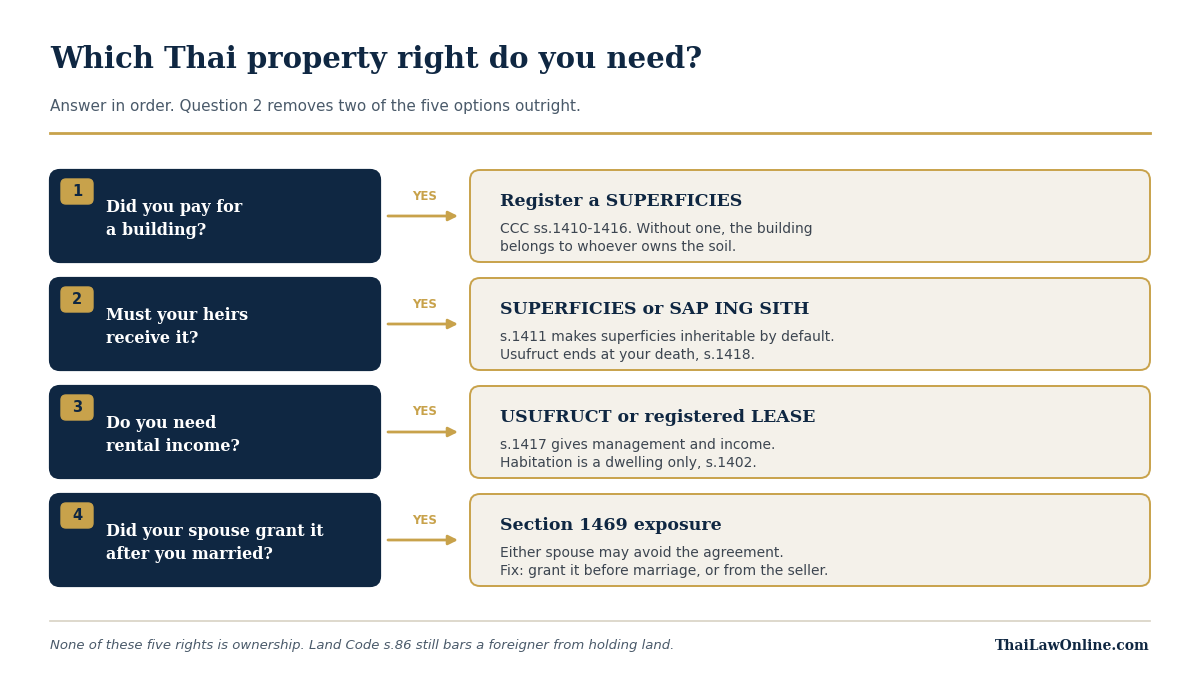
Which one do you need? Four questions
- Did you pay for a building? If yes, register a superficies over it. Without one, the building belongs to whoever owns the land under the ordinary rule that a structure follows the soil.
- Do your heirs need to receive it? If yes, superficies or Sap Ing Sith. Usufruct ends at your death under section 1418. Habitation cannot pass under section 1404.
- Do you need rental income? If yes, usufruct or a registered lease. Habitation gives you a dwelling and nothing more.
- Is the grantor your spouse, and were you already married when she granted it? If yes, price in section 1469 and consider whether a pre-marriage grant or a grant from the seller does the same job with less risk.
Stacking rights, and where stacking stops working
Clients often register more than one right over the same property. A 30 year lease secures occupation and a rent-based claim. A superficies puts the building in your name and passes it to your children. A usufruct adds management and income. The three coexist because they answer different questions, and Thai law registers them separately.
Stacking costs three sets of fees and three sets of drafting. It also has a ceiling. None of these rights is ownership. Section 86 of the Land Code lets a foreigner acquire land only under a treaty and with the Minister’s permission (section 96 bis adds a narrow route: up to one rai for a home after an investment of at least 40 million baht, also with permission), and section 94 gives a foreigner who acquired land unlawfully or without permission a period set by the Director-General, between 180 days and one year, to dispose of it before the Director-General sells it. Stack as high as you like. The land stays hers.
Last reviewed: 26 September 2026. Civil and Commercial Code sections 538, 544, 1299, 1402 to 1413, 1416 to 1418, 1420 to 1422, 1424 to 1426, 1428 and 1469, the Sap Ing Sith Act B.E. 2562 sections 3, 4 and 12, Land Code sections 74, 86, 93 and 94, Department of Lands circular มท 0515.2/ว 10722 clause 1, and the Department of Lands public-service manual on registration fees (Ministerial Regulation No. 47, clause 2(7)) and stamp duty (instrument 28(b)) were read in Thai. Re-checked on 5 October 2026: Sap Ing Sith Act sections 4 and 12 re-read in Thai and the registration citation widened to both; nothing else changed.
Commercial property arrangements
Commercial Property Arrangements
Businesses sometimes use usufruct to structure property use in commercial contexts. This includes agricultural operations, resort developments, and retail premises. The usufructuary’s management power under Section 1417 is particularly valuable for commercial use. It allows independent decision-making about the property. You don’t need the landowner’s consent for day-to-day operations.
Frequently asked questions
Can my Thai wife cancel my usufruct?
Not at the Land Office counter. A registered usufruct is a real right on the title. She can ask a court to avoid the underlying agreement under section 1469, because you concluded it during the marriage, and the court can then order the entry removed. She loses that option one year after the marriage dissolves, and she never had it if you registered the right before you married.
Is a superficies inheritable in Thailand?
Yes. Section 1411 makes the right transferable and transmissible by inheritance unless the instrument creating it says otherwise. Read that clause before signing, because the parties may contract out of it.
Can a foreigner register a usufruct on a condominium unit?
Yes, subject to the registrar. No statute bars a foreigner from holding a usufruct, and Land Offices register them over condominium units. The officer handling your file keeps discretion to impose conditions or refuse. Most foreign buyers who qualify under the 49% foreign quota take freehold title instead, so the usufruct route usually appears where the unit sits in the Thai quota.
What does a usufruct cost to register?
A registration fee of 50 baht per plot where no money changes hands. Where the usufruct is granted for consideration, the fee is 1%, plus stamp duty of 0.5% as a receipt. Over a condominium unit the condominium fee regulation applies instead: 100 baht per unit with no consideration, 2% with consideration. Our page on usufruct costs for foreigners breaks down a worked example.
Can I rent out a property I hold under usufruct?
Section 1417 gives you management and section 1422 lets you transfer the exercise of your right, so the Code permits it unless your instrument forbids it. In practice Land Offices decline to register a foreigner as lessor, so foreign usufructuaries let in terms of three years or less without registration.
What happens to my house when a superficies ends?
Section 1416 gives you the right to remove the buildings and restore the land. If the landowner notifies an intention to buy them at market value, you may refuse only on reasonable ground. Agree the valuation method in the original instrument.
Which is better, usufruct or superficies?
They answer different questions. Superficies gives your heirs the building. Usufruct gives you management and income over the whole property for your lifetime and stops at your death. Clients who built a house and want to pass it on register both.
Does a usufruct survive a sale of the land?
A registered usufruct is a real right attached to the property, so a purchaser takes the land subject to it: registration is what completes the right under section 1299. An unregistered agreement gives you nothing against a buyer.
How can foreigners engage in business using a usufruct in Thailand?
Foreigners can do business in Thailand using a usufruct. This gives them rights to manage and benefit from the property, like a lease. This allows foreigners to operate businesses on the land without owning it. Just do note that most “work” made by foreigners in Thailand will require a work permit with some exceptions.
Can the landowner borrow money against land that carries a usufruct?
Yes, the owner of the land with a usufruct registered can borrow money. However, this can be limited by drafting contract about it.
Where to start
Bring us the title deed, the identity of the grantor, and the answer to question two above. We will tell you which instrument fits, draft it bilingually, and attend the Land Office registration with you. ThaiLawOnline has handled Thai property rights for foreign clients since 2006.
Thai Law Updates, free by email
Plain-English updates on Thai law changes that affect foreigners: property, visas, marriage, business and wills. One short email a month from a firm practicing since 2006. No spam, unsubscribe anytime.