


Révisé par ThaiLawOnline, un cabinet d'avocats thaïlandais agréé exerçant en Thaïlande depuis 2006. Avocate thaïlandaise en charge du dossier : Wichuda Atthamethakon, LL.M., licence du barreau thaïlandais 3149/2556.
Dernière mise à jour :
Un étranger paie une maison sur le terrain de sa femme thaïlandaise. Il enregistre un droit de Bureau foncier, dort bien pendant quinze ans, et meurt. Que ses enfants reçoivent cette maison dépend d'un seul mot dans le registre. Enregistrer un droit de superficie et ils l'héritent. Enregistrer un usufruit ou un droit d'habitation et ils n'obtiennent rien, car les deux droits s'éteignent avec lui.
Table des matières
La plupart des guides en anglais sur ce sujet inversent cette réponse. La page qui se classe actuellement en première position pour la comparaison à trois indique aux lecteurs que les trois droits s'éteignent au décès du titulaire. L'article 1411 du Code civil et commercial Dit exactement le contraire à propos de la superficie, sans la moindre ambiguïté.
Cette page compare cinq droits enregistrables, et non trois, et nomme la section à l'origine de chaque revendication. ThaiLawOnline rédige et enregistre ces instruments pour des clients étrangers depuis 2006.
Les cinq droits, côte à côte
La loi thaïlandaise vous offre cinq façons de détenir un droit enregistré sur un terrain que vous ne pouvez pas posséder. Lisez le tableau sur les deux colonnes qui décident de la plupart des cas réels : cessible et transmissible par héritage.
| Droit | terme thaïlandais | Sections | Durée maximale | Transférable | Héréditaire | Droits aux revenus |
|---|---|---|---|---|---|---|
| Bail enregistré | สัญญาเช่า | C.cr. art. 537 à 571 | 30 ans | Seulement si le bail le prévoit | Non, sauf stipulation contraire | Oui, la sous-location si elle est autorisée |
| Usufruit | สิทธิเก็บกิน | CC art. 1417-1428 | 30 ans, renouvelable ou à vie | Exercice uniquement, art. 1422 | Non, prend fin au décès, art. 1418 | Oui, gestion complète, art. 1417 |
| Droit de superficie | สิทธิเหนือพื้นดิน | CC art. 1410-1416 | 30 years, renewable, or life of either party | Oui par défaut, art. 1411 | Oui par défaut, art. 1411 | Il est propriétaire du bâtiment, donc oui |
| Habitation | สิทธิอาศัย | CC art. 1402-1409 | 30 ans, renouvelable ou à vie | Non, art. 1404 | Non, art. 1404 | Non, habitation seulement, art. 1402 |
| Sap Ing Sith | ทรัพย์อิงสิทธิ | Loi B.E. 2562 (2019) | 30 ans | Oui | Oui | Oui, et hypothécaire |
The four real rights (usufruct, superficies, habitation and Sap Ing Sith) are complete only when made in writing and registered at the Land Office (Civil and Commercial Code section 1299; Sap Ing Sith Act sections 4 and 12). A lease of more than three years must also be in writing and registered, or it is enforceable for three years only (section 538). Sign a usufruct agreement and leave it in a drawer, and it binds the person who signed it and nobody else. A buyer of the land takes free of it. Registration is the whole point.
Usufruit : possession, gestion et revenus, sa vie durant
L'article 1417 confère à l'usufruitier la possession, l'usage et la jouissance du bien, ainsi que le droit d'administration. C'est le plus vaste ensemble des trois droits du code. Vous y habitez, vous percez les loyers, vous décidez qui entretient le toit.
L'article 1418 fixe la durée. Vous l'obtenez pour une période déterminée ou pour votre vie, et si l'acte ne fixe aucune période, la loi thaïlandaise présume un usufruit viager. Une durée déterminée ne peut excéder 30 ans. L'article se termine par la phrase qui importe le plus : dans tous les cas, l'usufruit prend fin au décès de l'usufruitier. Vos héritiers ne reçoivent rien. Aucune astuce de rédaction n'y changera rien.
Vous supportez également les frais de fonctionnement. L'article 1426 met à votre charge les frais de gestion, les impôts, les taxes et les intérêts grevant le bien. L'article 1424 vous met à la charge l'entretien ordinaire et les petites réparations, tandis que l'article 1425 laisse les dépenses extraordinaires à la charge du propriétaire. L'article 1421 vous impose la diligence qu'une personne d'une prudence ordinaire apporte à la gestion de ses propres biens, et l'article 1420 vous rend responsable de la destruction ou de la dépréciation à moins que vous ne prouviez l'absence de faute.
Un malentendu traverse presque toutes les pages concurrentes : l'affirmation selon laquelle un usufruitier ne peut rien céder. L'article 1422 dispose que, sauf disposition contraire de l'acte constitutif, l'usufruitier peut céder l'exercice de son droit à un tiers, et le propriétaire peut alors intenter une action directement contre cette personne. Le droit lui-même ne se déplace pas. Son exercice, si. Si vous êtes le propriétaire foncier qui accorde l'usufruit, vous pouvez désactiver cette règle par défaut lors de la redaction. Presque personne ne le dit aux constituants.
Un plafond pratique s'impose à la loi. Au vu du Code, un usufruitier détenant le droit de gestion peut accorder un bail enregistré de plus de trois ans. Les bureaux fonciers refusent d'enregistrer un ressortissant étranger en qualité de bailleur, au motif qu'un étranger ne peut pas contrôler ou gérer des terres. Ainsi, en pratique, un usufruitier étranger loue le bien pour une durée de trois ans ou moins, sans enregistrement, en vertu de l'article 538. Cette restriction découle d'une pratique administrative et non du Code. Les concurrents la présentent comme une règle absolue sans citer aucune référence.
Surveillez bien l'horloge à la fin. L'article 1428 interdit toute action entre le nu-propriétaire et l'usufruitier, ou son ayant cause, plus d'un an après la fin de l'usufruit. Le propriétaire qui n'a pas pu avoir connaissance de cette fin dispose d'un an à compter du jour où il a su ou aurait dû savoir. Ratez l'échéance et la créance disparaît.
En savoir plus les accords d'usufruit en Thaïlande et sur usufruit pour les étrangers.
Superficie : vous êtes propriétaire du bâtiment
L'article 1410 permet au propriétaire foncier de créer un droit pour une autre personne de posséder des bâtiments, des structures ou des plantations sur ou sous le terrain. Le terrain reste le sien. La maison devient vienne, en tant que propriété, enregistrée séparément par le biais des propres registres du bâtiment plutôt que sur son propre titre de propriété.
L'article 1411 fait alors le travail : sauf disposition contraire de la loi qui l'institue, le droit de superficie est cessible et transmissible par voie de succession. Vos enfants héritent de la maison. Vous pouvez vendre le droit. La règle supplétive joue en votre faveur, et les parties peuvent y déroger par contrat, ce qui signifie que vous lisez cette clause avant de signer quoi que ce soit qu'un promoteur vous tend.
L'article 1412 offre trois formes et pas d'autres. Une période fixe plafonnée à 30 ans, la vie du propriétaire terrien, ou la vie du superficiaire. Les guides qui qualifient de techniquement possible une superficie “ à perpétuité ” ne comportent aucune section à citer. En l'absence de terme fixé, l'article 1413 permet à l'une ou l'autre des parties de résilier moyennant un préavis raisonnable et, lorsqu'un loyer est payable, moyennant un préavis d'un an ou le paiement d'un loyer d'un an.
L'article 1416 régit la fin du contrat, et les acheteurs doivent le négocier dès le début. Vous pouvez enlever vos bâtiments et remettre le terrain dans son état initial. Si le propriétaire terrien notifie plutôt son intention de les acheter à leur valeur marchande, vous ne pouvez pas refuser sauf pour un motif raisonnable. Cela transforme la question “ est-ce que je perds ma maison ? ” en une question d'évaluation. Fixez la méthode d'évaluation dans l'acte et vous aurez éliminé le pire conflit avant qu'il ne commence.
Plus de détails sur le droit de superficie en Thaïlande.
Habitation : un lieu pour vivre, rien de plus
L'article 1402 donne au bénéficiaire le droit d'occuper un bâtiment comme lieu d'habitation sans payer de loyer. Facturez un loyer et vous avez créé un bail, quoi que dise le document. L'article 1404 supprime toute issue : le droit d'habitation n'est pas transférable, pas même par voie de succession.
L'article 1405 permet à votre famille et à votre foyer de vivre avec vous, à moins que la concession ne limite ce droit à vous personnellement. L'article 1406 vous permet de prélever les fruits naturels ou les produits de la terre, mais uniquement dans la limite des besoins de votre foyer. Vous ne pouvez pas exploiter la propriété comme une entreprise.
Habitation also shows the renewal rule most clearly. Section 1403 caps a fixed term at 30 years and then permits renewal for a further period not exceeding 30 years from the time of renewal, and sections 1412 and 1418 apply the same paragraph to a fixed-term superficies and usufruct. Compare that to the lease renewal problem, where the Cour suprême in Decision 4655/2566 struck down pre-paid automatic renewal clauses reaching past the 30 year cap. Renewal of a real right under section 1403 is textually cleaner. Habitation is still useless to anyone who needs income or heirs.
Voir le droit d'habitation en Thaïlande.
Les deux pages de comparaison omettent
Le bail enregistré fait toujours l'essentiel du travail sur le marché. Il court sur 30 ans, l'article 538 exige un enregistrement au-delà de trois ans, et après la décision 4655/2566, vous devez considérer les structures prépayées 30+30+30 comme non sûres. Notre page sur options de renouvellement de bail de 30 ans et le décisions de la Cour suprême en matière de baux indiquez où se situe la ligne actuellement.
Sap Ing Sith se trouve en dehors du Code civil et commercial, dans sa propre loi de 2562 (2019). Elle crée un droit enregistrable d'utiliser et de tirer profit de biens immobiliers pour une durée maximale de 30 ans, sur des terrains dotés d'un titre de propriété complet, des bâtiments situés sur des terrains titrés et des unités de copropriété sous le régime de Loi sur les copropriétés. Le droit est cessible, transmissible par héritage et susceptible d'hypothèque. La loi ne contient aucune clause de renouvellement, de sorte que la poursuite au-delà de la 30e année nécessite un nouvel accord et un nouvel enregistrement auprès du propriétaire du terrain à ce moment-là. Lire Sap Ing Sith en Thaïlande et le L'acte de la Sagesse, de l'Invention et des Ténèbres lui-même.
Un droit auquel les gens arrivent par erreur : un servitude grève un terrain voisin au profit du vôtre, en vertu des articles 1387 et suivants. Elle confère des voies d'accès et de desserte, non un lieu de résidence. Si vous avez acheté un terrain enclavé, vous voulez servitudes, et non un usufruit.
Si votre conjoint thaïlandais est propriétaire du terrain, lisez d'abord l'article 1469
Le modèle le plus courant sur le marché est celui d'une épouse thaïlandaise accordant à son mari étranger un usufruit viager sur le terrain qu'elle détient. Les guides le recommandent sans cesse. Presque aucun d'entre eux ne mentionne l'article 1469.
Section 1469 lets either spouse avoid any contract concerning property concluded between them during the marriage, at any time during the marriage or within one year from the day of dissolution, sans rien prouver. Les droits des tiers de bonne foi subsistent. Un usufruit consenti par une épouse à son mari pendant leur mariage est précisément un tel accord.
La version exacte comporte cinq parties, et elle est plus rassurante que la version panique :
- Votre femme ne peut pas se rendre au Bureau foncier pour annuler un usufruit enregistré. C'est un droit réel inscrit sur le titre.
- Elle peut échapper à l'accord sous-jacent en vertu de l'article 1469 et demander à un tribunal d'ordonner le retrait de l'inscription. Cela demande des procédures judiciaires, du temps et un jugement.
- Les tiers agissant de bonne foi conservent leurs droits, c'est pourquoi un usufruit enregistré l'emporte toujours largement sur une promesse non enregistrée.
- La fenêtre d'exposition se ferme un an après la dissolution du mariage.
- Un droit accordé avant le mariage, ou accordé par une personne qui n'est pas votre conjoint, échappe entièrement à l'article 1469.
Le point cinq est la solution pratique, et aucun concurrent ne l'énonce. Enregistrez l'usufruit ou la superficie avant le mariage, ou obtenez l'attribution directement du vendeur au moment de l'achat plutôt que de votre conjoint par la suite. Même protection, aucune exposition à l'article 1469. Voir aussi biens matrimoniaux en droit thaïlandais.
Ce que cela coûte, et qui paie après
Where no consideration passes between the parties, the registration fee is 50 baht per plot (Ministerial Regulation No. 47, clause 2(7)(ฑ)). Where a usufruct, superficies or habitation is granted for consideration, the fee is 1% (clause 2(7)(ฏ)), and a lease is also 1% (clause 2(7)(ฐ)). Creating a right over land for consideration also attracts stamp duty as a receipt under instrument 28(b) of the stamp duty schedule, at 1 baht for every 200 baht (0.5%), according to the Department of Lands’ own fee manual. A lease carries lease stamp duty of 0.1% instead.
Chaque droit fait l'objet de sa propre formalité et de ses propres frais. L'enregistrement d'un bail, d'une superficie et d'un usufruit sur la même villa nécessite trois demandes, et non une.
Running costs follow the instrument. A usufructuary pays management costs, taxes and duties under section 1426 and handles ordinary repairs under section 1424, while the owner covers extraordinary expenses under section 1425. Habitation has its own allocation: the grantor is not bound to keep the property in repair (section 1407), and section 1409 applies the lessee’s duties of care, repair and return (sections 552 to 555, 558, 562 and 563) to the occupier. Buyers costing out a structure almost never see this until the first tax bill.
One 2026 development belongs in your planning. The Department of Lands issued Urgent Circular มท 0515.2/ว 10722 on 15 May 2026, followed by further Most Urgent instructions, requiring registrars to investigate the source of funds when a Thai individual or a Thai-held company buys land with a cash payment of THB 2 million or more, or at an appraised value of THB 5 million or more (clause 1). The circular’s trigger is a purchase of land, not the grant of a usufruct or superficies. The registrar’s underlying power to question the parties and call for documents, Land Code section 74, applies to every registration, so a usufruct or superficies filing can still be examined. Our note on récentes répression contre les prête-noms couvre le contexte d'application.
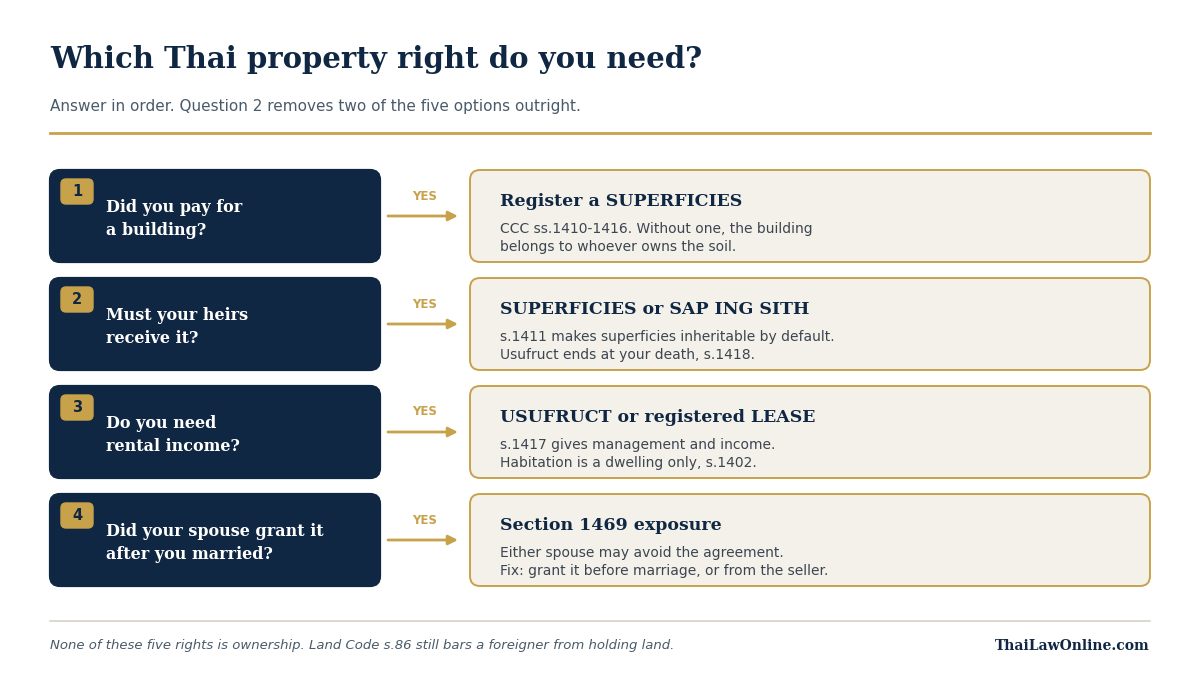
Lequel avez-vous besoin ? Quatre questions
- Avez-vous payé pour un bâtiment ? Si oui, constituez un droit de superficie sur celui-ci. Sans ce droit, le bâtiment appartient au propriétaire du terrain en vertu de la règle générale selon laquelle la construction suit le sol.
- Vos héritiers doivent-ils le recevoir ? Si oui, superficie ou Sap Ing Sith. L'usufruit prend fin à votre décès en vertu de l'article 1418. L'habitation ne peut pas être transmise en vertu de l'article 1404.
- Avez-vous besoin de revenus locatifs ? Si oui, un usufruit ou un bail enregistré. L'habitation vous donne un droit d'habitation et rien de plus.
- Le cédant est-il votre conjoint, et étiez-vous déjà mariés lorsqu'il l'a cédé ? Si oui, évaluez l'article 1469 et examinez si une donation avant mariage ou une donation du vendeur remplit la même fonction avec moins de risques.
Cumul des droits et limites du cumul des droits
Les clients enregistrent souvent plus d'un droit sur la même propriété. Un bail de 30 ans garantit l'occupation et une créance fondée sur le loyer. Une superficie met le bâtiment à votre nom et le transmet à vos enfants. Un usufruit y ajoute la gestion et les revenus. Les trois coexistent parce qu'ils répondent à des questions différentes, et le droit thaïlandais les enregistre séparément.
Stacking costs three sets of fees and three sets of drafting. It also has a ceiling. None of these rights is ownership. Section 86 of the Land Code lets a foreigner acquire land only where a treaty grants that right, and section 94 gives a foreigner who acquired land unlawfully or without permission a period set by the Director-General, between 180 days and one year, to dispose of it before the Director-General sells it. Stack as high as you like. The land stays hers.
Dernière mise à jour : 26 septembre 2026. Civil and Commercial Code sections 538, 544, 1299, 1402 to 1413, 1416 to 1418, 1420 to 1422, 1424 to 1426, 1428 and 1469, the Sap Ing Sith Act B.E. 2562 sections 3, 4 and 12, Land Code sections 74, 86, 93 and 94, Department of Lands circular มท 0515.2/ว 10722 clause 1, and the Department of Lands public-service manual on registration fees (Ministerial Regulation No. 47, clause 2(7)) and stamp duty (instrument 28(b)) were read in Thai. Re-checked on 5 October 2026: Sap Ing Sith Act sections 4 and 12 re-read in Thai and the registration citation widened to both; nothing else changed.
Foire aux questions
Est-ce que ma femme thaïlandaise peut annuler mon usufruit ?
Pas au guichet du Bureau foncier. Un usufruit enregistré est un droit réel sur le titre. Elle peut demander à un tribunal d'annuler sous-jacent l'accord en vertu de l'article 1469, parce que vous l'avez conclu pendant le mariage, et le tribunal peut alors ordonner la radiation de l'inscription. Elle perd cette option un an après la dissolution du mariage, et elle ne l'a jamais eue si vous avez enregistré le droit avant de vous marier.
Un droit de superficie est-il transmissible par héritage en Thaïlande ?
Oui. L'article 1411 rend le droit cessible et transmissible par succession, à moins que l'acte constitutif n'en dispose autrement. Lisez cette clause avant de signer, car les parties peuvent y déroger par contrat.
Un étranger peut-il enregistrer un usufruit sur un lot de copropriété ?
Oui, sous réserve de l'accord du conservateur des registres. Aucune loi n'interdit à un étranger de détenir un droit d'usufruit, et les services du cadastre les enregistrent pour les lots en copropriété. Le fonctionnaire chargé de votre dossier dispose d'un pouvoir discrétionnaire pour imposer des conditions ou refuser la demande. La plupart des acheteurs étrangers éligibles au titre du quota étranger 49% optent plutôt pour la pleine propriété ; le recours à l’usufruit intervient donc généralement lorsque le logement relève du quota thaïlandais.
Combien coûte l'enregistrement d'un usufruit ?
A registration fee of 50 baht per plot where no money changes hands. Where the usufruct is granted for consideration, the fee is 1%, plus stamp duty of 0.5% as a receipt. Our page on coûts d'usufruit pour les étrangers décompose un exemple résolu.
Puis-je louer un bien immobilier que je détends en usufruit ?
L'article 1417 vous confère la gestion et l'article 1422 vous permet de transférer l'exercice de votre droit, de sorte que le Code l'autorise à moins que votre titre ne l'interdise. En pratique, les bureaux fonciers refusent d'enregistrer un étranger en tant que bailleur, de sorte que les usufruitiers étrangers concluent des baux d'une durée de trois ans ou moins sans enregistrement.
Que devient ma maison lorsqu'un droit de superficie prend fin ?
L'article 1416 vous donne le droit d'enlever les bâtiments et de remettre le terrain en état. Si le propriétaire notifie son intention de les acheter à leur valeur de marché, vous ne pouvez refuser que pour un motif raisonnable. Convenez de la méthode d'évaluation dans l'acte initial.
Lequel vaut-il mieux, l'usufruit ou la superficie ?
Ils répondent à des questions différentes. La superficie donne le bâtiment à vos héritiers. L'usufruit vous donne la gestion et les revenus de l'ensemble de la propriété de votre vivant et s'arrête à votre décès. Les clients qui ont construit une maison et qui veulent la transmettre enregistrent les deux.
Un usufruit survit-il à la vente du terrain ?
A registered usufruct is a real right attached to the property, so a purchaser takes the land subject to it: registration is what completes the right under section 1299. An unregistered agreement gives you nothing against a buyer.
Par où commencer
Apportez-nous le titre de propriété, l'identité du cédant et la réponse à la question deux ci-dessus. Nous vous indiquerons quel acte convient, le rédigerons de manière bilingue et assisterons à l'enregistrement au Bureau foncier avec vous. ThaiLawOnline gère les droits immobiliers thaïlandais pour des clients étrangers depuis 2006.
Actualités juridiques thaïlandaises, gratuites par courriel
Des informations claires et concises sur les changements législatifs thaïlandais concernant les étrangers : propriété, visas, mariage, affaires et testaments. Un court courriel par mois, envoyé par un cabinet d’avocats établi depuis 2006. Zéro spam, désabonnement possible à tout moment.