


Révisé par ThaiLawOnline, un cabinet d'avocats thaïlandais agréé exerçant en Thaïlande depuis 2006. Avocate thaïlandaise en charge du dossier : Wichuda Atthamethakon, LL.M., licence du barreau thaïlandais 3149/2556.
Dernière mise à jour :
Portée des revenus étrangers vérifiée le 17 septembre 2026. Le Département des recettes, dans ses indications sur le crédit d'impôt étranger , exclut de la nouvelle interprétation relative aux transferts les revenus étrangers perçus avant le 1er janvier 2024. Ses indications sur les revenus étrangers expliquent les conditions de résidence et de transfert. Un transfert ou un paiement doit être rattaché à sa source ; dépenses et revenu imposable ne sont pas interchangeables.
Comprendre l’impôt sur le revenu des personnes physiques en Thaïlande est essentiel pour tout expatrié vivant dans le Royaume. Que vous enseigniez l’anglais à Bangkok, dirigiez une entreprise à Phuket ou viviez votre retraite avec votre conjoint thaïlandais dans l’Isan, vous devez savoir comment fonctionne le système fiscal thaïlandais, car il a une incidence directe sur votre planification financière et votre conformité juridique. Ce guide complet couvre tout, des règles de résidence fiscale aux changements de 2024 concernant les transferts de revenus étrangers, en passant par les déductions, les procédures de déclaration et les stratégies d’optimisation fiscale.
Table des matières
Le reste du paysage fiscal thaïlandais
Revenu de source étrangère et règles de versement
Obtenir un numéro d'identification fiscale thaïlandais
Impôts fonciers
Droits de succession et de donation
Impôts sur les sociétés
Crypto-monnaies et actifs numériques
Qu'est-ce que la résidence fiscale en Thaïlande ?
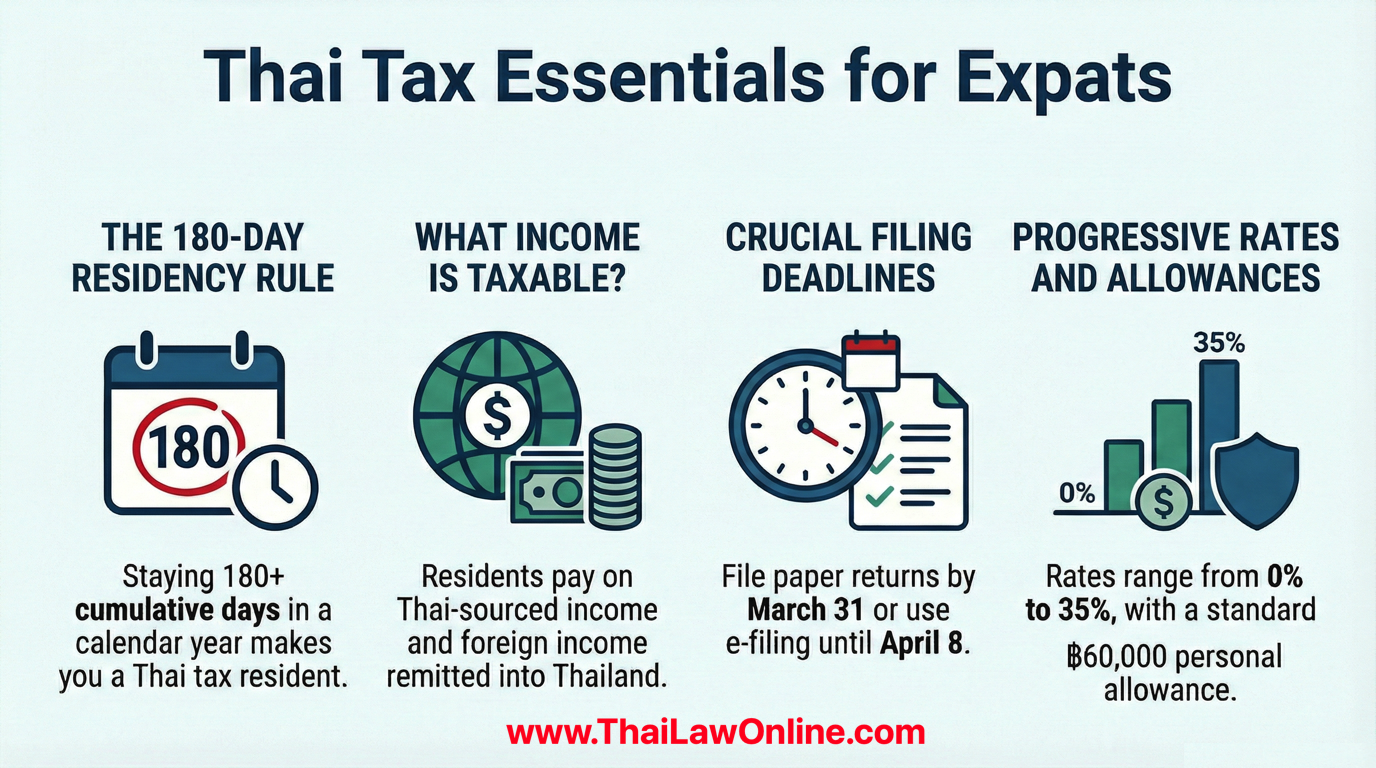
La résidence fiscale en Thaïlande est déterminée uniquement par la présence physique, et non par le type de visa, la nationalité ou le statut d'immigration. En vertu de l'article 41 du Code des impôts thaïlandais, toute personne résidant en Thaïlande pendant 180 jours ou plus au cours d'une année civile (du 1er janvier au 31 décembre), est considéré comme résident fiscal thaïlandais.
Cette classification a des implications majeures :
- résidents fiscaux sont redevables de l'impôt sur le revenu personnel sur tous les revenus de source thaïlandaise ET sur revenus de source étrangère transférés en Thaïlande.
- Non-résidents ne sont imposés que sur les revenus de source thaïlandaise, tels que les salaires versés par des employeurs thaïlandais ou les revenus locatifs de biens immobiliers thaïlandais.
Le décompte de 180 jours n'a pas besoin d'être consécutif. Chaque jour passé en Thaïlande compte pour atteindre ce seuil, quel que soit le visa détenu. Les enseignants, les retraités, les chefs d'entreprise et les nomades numériques qui dépassent les 180 jours sont tous soumis aux mêmes règles de résidence.
Important
Le visa Thailand Privilege (Élite) n’offre pas d'exonération fiscale. Il s'agit essentiellement d'un visa touristique assorti de privilèges VIP. Les titulaires qui séjournent 180 jours ou plus restent des résidents fiscaux à part entière selon les règles ordinaires.
Règle de 2024 sur le transfert des revenus étrangers (Por.161/2566)
Qu'est-ce qui a changé le 1er janvier 2024 ?
Le 15 septembre 2023, le Département des recettes thaïlandais a publié Instruction Départementale N° Por.161/2566, modifiant fondamentalement la manière dont les revenus de source étrangère sont imposés en Thaïlande. Les nouvelles règles sont entrées en vigueur le 1er janvier 2024, et représentent le changement fiscal le plus important pour les expatriés depuis des décennies.
Avant 2024 : le Département des recettes considérait les revenus de source étrangère comme imposables uniquement lorsqu’ils étaient transférés en Thaïlande au cours de la même année civile que celle où ils avaient été perçus. Cette position relevait de la pratique administrative et des réponses aux demandes de rescrit plutôt que du Code des impôts lui-même, ce qui explique que le point 2 de l’instruction Por.161/2566 ait pu l’écarter en une seule phrase : il abroge tout règlement, toute règle, toute instruction, toute réponse à une demande de rescrit et toute pratique contraires à l’instruction. L’effet pratique était une stratégie de planification simple : gagner à l’étranger, attendre l’année suivante pour transférer l’argent, et celui-ci arrivait en franchise d’impôt.
À compter du 1er janvier 2024 : les revenus de source étrangère sont imposables lorsqu’un résident fiscal thaïlandais les introduit en Thaïlande, quelle que soit l’année d’imposition au cours de laquelle ils sont introduits. Le point 1 de l’instruction Por.161/2566 impose à la personne qui était résidente de Thaïlande au cours de l’année d’imposition où le revenu a pris naissance, et qui introduit ce revenu en Thaïlande dans n'importe quelle année d'imposition, de l’inclure dans le calcul prévu à l’article 48 pour l’année d’imposition au cours de laquelle il est introduit. Le point 3 applique l’instruction aux revenus imposables introduits en Thaïlande à compter du 1er janvier 2024. C’est donc l’année d’entrée de l’argent en Thaïlande qui déclenche l’imposition, et non l’année où il a été gagné à l’étranger. Ce que l’instruction ne fait pas, c’est remonter dans le passé, et la disposition qui le prévoit fait l’objet de la section suivante.
Protection du revenu avant 2024 (Por.162/2566)
Le 20 novembre 2023, le Département du Revenu a émis Instruction Départementale N° Por.162/2566, qui ne fait qu'une chose : elle ajoute au point 1 de l'instruction Por.161/2566 un deuxième alinéa disposant que ce point “ ne s'applique pas aux revenus imposables nés avant le 1er janvier de l'année B.E. 2567 (2024)”. Les revenus nés avant cette date échappent donc à la règle de 2024, même s’ils sont transférés ultérieurement. Les deux instructions sont des khamsang krom sanphakon, c’est-à-dire des instructions du Département, et chacune indique dans son propre préambule qu’elle est émise afin que les agents des recettes disposent d’une ligne directrice pratique pour examiner et conseiller les contribuables. Elles ne modifient pas le Code des impôts. Toutes deux ont été lues ici dans leur version thaïe originale, sur le site du Département des recettes : Por.161/2566 ET Por.162/2566.
Pour bénéficier de cette protection, les expatriés doivent :
- Maintenir comptes bancaires séparés pour les fonds antérieurs à 2024 et postérieurs à 2024.
- Préserver relevés bancaires de décembre 2023 la présentation des soldes de comptes comme justificatif
- Conservez les justificatifs de vos revenus (bulletins de paie, factures, relevés de pension).
- Ne vous fiez pas à l’hypothèse FIFO (Premier entré, premier sorti) . L’idée couramment avancée pour les comptes mixtes, selon laquelle les fonds les plus anciens sont réputés dépensés en premier, ne figure ni dans Por.161/2566 ni dans Por.162/2566 et n’est pas une règle publiée. Considérez-la comme une pratique comptable et non comme une règle de droit, et conservez des documents qui identifient directement les fonds.
Qu'est-ce qui compte comme “ envoi de fonds ”
La notion de transfert de fonds est plus large que ne le pensent de nombreux expatriés. Chacune des méthodes suivantes fait entrer de l’argent en Thaïlande. L’exigibilité de l’impôt dépend ensuite de la nature de cet argent : les revenus étrangers imposables nés à compter du 1er janvier 2024, au cours d’une année où vous étiez résident fiscal thaïlandais, sont imposables quel que soit le moyen par lequel ils arrivent.
| Méthode de remise de fonds | Exemple | Cela compte comme un apport de fonds ? |
|---|---|---|
| Virements bancaires | Envoyer de l'argent d'une banque américaine/britannique vers un compte bancaire thaïlandais | Oui |
| Retraits au guichet automatique | Utiliser une carte de débit étrangère à un distributeur automatique de billets thaïlandais | Oui |
| paiements par carte de crédit/débit | Payer des achats en Thaïlande avec une carte étrangère | Oui |
| Argent liquide | Transport de devises étrangères à travers la frontière | Oui |
| Conversion de cryptomonnaie | Transférer des cryptomonnaies vers une plateforme d'échange thaïlandaise et les convertir en THB | Oui |
| plateformes de paiement en ligne | Virements PayPal ou Wise vers un compte bancaire thaïlandais | Oui |
Qu’est-ce qui n’est pas taxé en vertu de la règle des virements :
- Revenus étrangers conservés entièrement à l'étranger (jamais introduits en Thaïlande).
- Revenus perçus avant le 1er janvier 2024, avec justificatifs appropriés.
- Les revenus nés au cours d'une année d'imposition durant laquelle la personne n'était pas un résident fiscal thaïlandais. Le Département des recettes l’indique clairement : une personne qui a séjourné en Thaïlande moins de 180 jours l’année où le revenu a pris naissance ne doit rien sur ce revenu, même si l'argent est ultérieurement versé alors qu'elle est résidente.
On dit souvent l'inverse, et nous ne pouvons pas le soutenir. Le critère du Département des recettes comporte deux éléments : le revenu doit naître le 1er janvier 2024 ou après dans une année d’imposition où la personne a passé 180 jours ou plus en Thaïlande, et la personne doit l’introduire en Thaïlande dans cette année d’imposition ou dans une année ultérieure. Le critère de résidence s'apprécie au regard de l'année où le revenu a pris naissance. Rien dans les deux instructions départementales, dans le document de questions-réponses de huit pages que la Division juridique du Département des recettes leur a consacré, ni dans aucun arrêt publié de la Cour suprême que nous ayons pu trouver, n’indique que le fait d’être non-résident l’année où vous remit rendrait exonéré un transfert autrement imposable. Le Département a traité ce point directement, et pas seulement de manière implicite. Le document de la Division juridique présente un tableau de quatre cas, selon la date à laquelle le revenu a pris naissance, la durée du séjour du contribuable en Thaïlande et la date à laquelle l’argent a été introduit. Sa seule colonne relative à la résidence est intitulée le temps passé en Thaïlande au cours de l’année d’imposition dans laquelle le revenu assujetti à impôts a été réalisé. Le tableau aboutit à une réponse, imposable ou non imposable, dans les quatre cas sans jamais demander si le contribuable était résident l’année du transfert. Dans le premier cas, celui d’un revenu né le 1er janvier 2024 ou après, au cours d’une année de 180 jours ou plus, et introduit à cette date ou après, la réponse est que l’impôt est dû. Deux limites méritent d’être dites clairement. Il s’agit d’instructions et d’orientations du Département, qui s’imposent aux agents des recettes comme règle de travail mais ne modifient pas le Code des impôts, et aucun arrêt publié de la Cour suprême n’a tranché la question. Partez donc du principe que les revenus nés au cours d’une année de résidence sont imposables quel que soit le moment où vous les introduisez, et prenez conseil avant toute opération qui reposerait sur la solution inverse.
Proposition d'exonération fiscale de deux ans sur les transferts de fonds (en attente)
En juin 2025, le Département des recettes préparait, selon la presse, une législation visant à alléger la charge fiscale sur les revenus étrangers. Selon cette proposition, les revenus de source étrangère perçus à partir de 2024 seraient exonérés d'impôt s'ils sont transférés dans un délai de deux années civiles, ce qui signifie l'année où l'argent a été gagné ou l'année suivante.
| Scénario | Statut fiscal (en cas d'adoption) |
|---|---|
| Revenus perçus en 2025, transférés en 2025 | Exempté |
| Revenus perçus en 2025, transférés en 2026 | Exempté |
| Revenus perçus en 2025, transférés en 2027 ou ultérieurement | Imposable aux taux progressifs |
Une telle période de deux ans devrait être instaurée par un texte avant de s’appliquer à quiconque, et elle ne l’a pas été. Au 4 septembre 2026, les décrets royaux pris en vertu du Code des impôts vont jusqu’au N° 807, publié au Journal officiel (Royal Gazette) le 23 août 2026, et aucun de ceux qui figurent au registre du Département des recettes ne concerne les revenus de source étrangère. Le registre ne mentionne aucun décret n° 806. Les décrets les plus récents portent sur la prorogation du taux réduit de TVA , la rénovation des hôtels, les séminaires organisés dans le pays, la numérisation des PME, les artistes, une exonération liée aux dons et les panneaux solaires en toiture.
État actuel : NON promulgué
Au 4 septembre 2026, la proposition n’a pas été promulguée. Rien d’autre n’a modifié la règle : aucune instruction départementale publiée après Por.162/2566 ne touche à l’article 41, la série étant arrivée à Por.164/2568, qui concerne la vente de biens hors du Royaume, et les deux seules entrées de la série relatives à l’article 41, alinéa deux, restent Por.161/2566 et Por.162/2566. Le manuel du Département des recettes relatif à l’outil de calcul du crédit d’impôt étranger, publié en novembre 2025, présente comme droit applicable aux revenus de source étrangère les articles 40, 41, 48 et 56 du Code des impôts, le décret royal (n° 18) B.E. 2505, Por.161/2566 et Por.162/2566, et ne mentionne rien d’autre. Tant qu’une exonération n’est pas publiée au Journal officiel, les règles décrites ci-dessus sont celles qui s’appliquent.
Avertissement
Les résidents fiscaux ne devraient pas s’appuyer sur cette proposition pour leurs déclarations fiscales de 2026. Planifiez et déclarez selon les règles en vigueur jusqu’à ce que l’exonération soit officiellement publiée au Journal officiel (Royal Gazette).
Huit catégories de revenus imposables en Thaïlande
Le Code des impôts thaïlandais (article 40) divise le revenu imposable en huit catégories. Classer correctement les revenus est important car les différentes catégories permettent des taux de déduction standard différents. Voici les catégories de revenus personnels en Thaïlande :
| Catégorie | Type de revenu | Déduction standard |
|---|---|---|
| 1 | Revenus d'emploi : salaires, traitements, primes, pensions | 50% de revenus, plafond de 100 000 THB |
| 2 | Rémunération pour travaux/services : commissions, honoraires d’agent, honoraires de directeur | 50% du revenu, maximum 100 000 THB, cumulé avec la catégorie 1 |
| 3 | Droits et rentes : clientèle, droits d'auteur, franchises | 50% de revenus, plafond de 100 000 THB |
| 4 | Revenus de placements : dividendes, intérêts, plus-values, cryptomonnaies | Pas de déduction forfaitaire |
| 5 | Revenus locatifs : biens immobiliers, véhicules, autres actifs | De 10% à 30%, selon le type d’actif |
| 6 | Services professionnels : médical, juridique, ingénierie, comptabilité | 30% ou 60% selon le métier |
| 7 | Services de construction et contrats de travaux | 60% de revenus |
| 8 | Autres revenus : activités d’entreprise, commerce, agriculture, transport | 60% de revenus |
Taux d’impôts sur le revenu des particuliers en Thaïlande (2026)
La Thaïlande applique un système d'imposition progressive, ce qui signifie que chaque fraction du revenu est imposée au taux de la tranche correspondante, et non l’ensemble du revenu à un taux unique. Les ressortissants thaïlandais et les résidents fiscaux étrangers sont soumis au même barème.
Deux textes composent le tableau ci-dessous, ce qu’il est utile de savoir si vous le comparez un jour à la loi. Les taux sont issus du barème de l’impôt sur le revenu du Code des impôts (banchi atra phasi ngoen dai, point 1), tel que remplacé par la loi portant modification du Code des impôts (n° 44) B.E. 2560 et applicable à compter de l'année d'imposition 2560. Lu isolément, ce barème impose les premiers 300 000 bahts à 5 % : l'exonération de 0 à 150 000 n'y figure pas. L'exonération est accordée séparément par Décret royal n° 470 de l’année 2551, qui exonère les premiers 150 000 bahts de revenu net calculé selon l’article 48 (1) du Code. La première tranche du tableau ci-dessous provient donc d’un décret royal, et non de la loi, et c’est celle qui pourrait être modifiée le plus facilement.
| Revenu net imposable (THB) | Taux d'imposition | Impôt maximal dans cette tranche |
|---|---|---|
| 0-150,000 | Exonéré | 0 THB |
| 150,001-300,000 | 5% | 7 500 THB |
| 300,001-500,000 | 10% | 20 000 THB |
| 500,001-750,000 | 15% | 37 500 THB |
| 750,001-1,000,000 | 20% | 50 000 THB |
| 1,000,001-2,000,000 | 25% | 250 000 THB |
| 2,000,001-5,000,000 | 30% | 900 000 THB |
| Plus de 5 000 000 | 35% | Pas de plafond |
Comment fonctionne l'impôt progressif : un exemple pratique pour l'impôt sur le revenu des personnes physiques en Thaïlande
Un expatrié percevant un revenu net imposable de 500 000 THB ne paie pas 10% sur la totalité de ce montant. En revanche :
- Premiers 150 000 THB → Exonérés = 0 THB. Aucun impôt n’est exigible sur cette tranche, mais cela ne supprime pas l’obligation de présenter un formulaire de déclaration : voir les seuils de déclaration ci-dessous.
- Suivant 150 000 THB (150 001-300 000) → 5% = 7 500 THB
- Suivant 200 000 THB (300 001-500 000) → 10% = 20 000 THB
- Taxe totale : 27 500 THB (taux effectif de 5,5%)
Déductions et abattements fiscaux
Maximiser les déductions légales est le moyen le plus efficace de réduire l'impôt sur le revenu des personnes physiques en Thaïlande. Le Code des impôts offre un large éventail d'abattements personnels, de déductions pour assurances et d'incitations à l'investissement.
Allocations personnelles et familiales pour l'impôt sur le revenu des personnes physiques en Thaïlande
| Type de déduction | Montant maximum (THB) |
|---|---|
| Abattement personnel (contribuable) | 60,000 |
| Allocation pour conjoint (si le conjoint n'a aucun revenu) | 60,000 |
| Allocation familiale (par enfant) | 30 000 pour chaque enfant légitime, sans limite de nombre. Les enfants adoptés ouvrent droit à 30 000 chacun, mais trois enfants au plus peuvent être déclarés au total, et si vous avez déjà trois enfants légitimes vivants ou plus, vous ne pouvez rien déduire pour un enfant adopté. L’article 47 (1) (ค) n’accorde la déduction que pour un enfant mineur, ou âgé de moins de 25 ans et étudiant dans une université ou un autre établissement d’enseignement supérieur, ou déclaré incapable ou quasi incapable par un tribunal et placé sous votre garde, et elle est perdue pour un enfant ayant perçu un revenu imposable de 30 000 bahts ou plus au cours de l’année d’imposition, sans compter les revenus exonérés en vertu de l’article 42 |
| 2e enfant ou plus né en 2018 ou après | 60 000 par enfant : les 30 000 ordinaires plus 30 000 supplémentaires pour le deuxième enfant légitime et les suivants nés en 2018 ou après, ajoutés par la loi portant modification du Code des impôts (n° 46) B.E. 2561 à compter de l’année d’imposition 2561. Attention à la façon dont le rang de naissance est compté, car il détermine si un enfant est le deuxième : pour cet abattement supplémentaire, l’article 47 (1) (ค) compte tous les enfants que vous avez eus, qu’ils soient vivants ou non. La limite de trois enfants figurant ci-dessus est calculée d'une autre manière, uniquement en fonction des enfants vivants. |
| Parent dépendant et parents d'un conjoint également | 30 000 par parent. Les conditions sont celles énoncées à l’article 47(1)(ญ) du Code des impôts et elles ne concernent pas le lieu de résidence du parent : le parent doit être 60 ans et plus, doit avoir des revenus insuffisants pour subvenir à ses besoins, et doit être à votre charge. Cette allocation n’est pas disponible pour un parent dont le revenu imposable au cours de l’année d’imposition est supérieur à 30 000 bahts, qui est le test qui élimine la plupart des demandes |
| personne à charge handicapée ou incapable | 60 000 par personne. L’article 47 (1) (ฎ) vise un parent, le conjoint, un enfant légitime ou adopté, un parent ou un enfant du conjoint, ou toute autre personne dont vous êtes le tuteur légal. Le même plafond de revenus de 30 000 bahts s’applique à la personne à charge |
| frais liés à l'accouchement | Jusqu'à 60 000 par grossesse |
| Exonération de revenu pour les contribuables âgés (65 ans et plus) | Jusqu’à 190 000. Il s’agit d’une exonération de revenu supplémentaire, et non d’une déduction. |
Déductions pour assurance et retraite
| Type de déduction | Montant maximum (THB) |
|---|---|
| Primes d'assurance-vie (compagnie d'assurance thaïlandaise) | 100 000 |
| primes d'assurance maladie | 25 000. Le règlement ministériel n° 365 (B.E. 2563), Journal officiel (Royal Gazette) du 17 juin 2020, a relevé ce plafond, auparavant fixé à 15 000 par le règlement ministériel n° 334, et s’applique aux primes payées à compter du 1er janvier 2020. Le plafond combiné avec l’assurance-vie, à la ligne ci-dessous, figure dans le même texte. |
| Plafond d'assurance combiné | 100,000 |
| Assurance maladie des parents | 15 000. Il n’existe pas de condition d’âge : chaque parent assuré doit avoir un revenu imposable ne dépassant pas 30 000 bahts au cours de l’année d’imposition. |
| Cotisations au fonds de prévoyance | 15% de revenus, plafond de 500 000 |
| Fonds commun de placement retraite (RMF) | 30% du revenu imposable, plafonné à 500 000. Le règlement ministériel n° 357 (B.E. 2563), Journal officiel (Royal Gazette) du 10 mars 2020, a relevé ce taux, auparavant de 15%, pour les revenus perçus à compter du 1er janvier 2020. Les parts doivent être détenues au moins cinq ans à compter de la première souscription et rachetées à 55 ans ou plus, faute de quoi l’avantage est perdu. |
| Assurance-vie par pension (annuité) | 15% de revenus, plafond de 200 000 |
| Fonds national d'épargne (NSF) | Le montant effectivement versé en tant que épargne, jusqu’à 500 000, et dans le cadre de la limite cumulée de 500 000 pour la retraite. C’est la clause 2 (90) du règlement ministériel n° 126, insérée par le règlement ministériel n° 314 (B.E. 2559). Le plafond annuel du fonds n’est pas fixé par la loi sur le Fonds national d’épargne : l’article 31 exige un montant minimum de 50 bahts par mois et un maximum fixé par règlement ministériel, donc vérifiez le plafond actuel auprès du fonds avant de vous fier à un chiffre. |
| Plafond de retraite combiné | 500,000 |
Autres déductions pour l'impôt sur le revenu des personnes physiques en Thaïlande
| Type de déduction | Montant maximum (THB) |
|---|---|
| Intérêts hypothécaires | 100 000 |
| Cotisations de sécurité sociale | Montant effectivement versé, jusqu’à 10 500 pour 2026 (875 par mois au nouveau plafond salarial de 17 500 prévu pour les cotisations de l’article 33). Un taux réduit de 3% s’est appliqué de décembre 2025 à mai 2026 dans neuf provinces du Sud touchées par les inondations, de sorte que les salariés concernés déduisent le montant inférieur effectivement versé. |
| Investissements du fonds ESG thaïlandais (2024-2026) | 30% de revenus, plafonné à 300 000 |
| Investissement dans l'entreprise sociale | 100 000 par an |
| dons de bienfaisance (concession 100%/200%) | Jusqu’à 10% du revenu net après déductions. Pour les dons effectués à compter du 1er janvier 2026, seuls les dons enregistrés dans le système e-Donation du Département des recettes ouvrent droit à la déduction. |
Deux mesures temporaires évoquées en 2025 ne sont pas reconduites en 2026. La déduction pour le tourisme intérieur (“ Tiew Dee Mee Khuen ”), prévue par le règlement ministériel n° 401 (B.E. 2568) publié au Journal officiel (Royal Gazette) le 19 novembre 2025, couvrait uniquement les dépenses d'hôtel, de chambre d'hôtes et de restaurant engagées entre le 29 octobre et le 15 décembre 2025 : jusqu'à 10 000 THB sur toute facture fiscale, 10 000 THB supplémentaires lorsque la facture était une e-Tax Invoice, et une fois et demie ces montants pour les séjours dans les 55 provinces secondaires énumérées. Elle relevait de la déclaration 2025, qui devait être déposée au plus tard le 31 mars 2026, et aucune édition 2026 n'avait été approuvée au 3 septembre 2026. La déduction pour les fonds Thai ESG (30% du revenu imposable, jusqu'à 300 000 THB, parts détenues au moins cinq ans) s'applique aux souscriptions effectuées entre le 1er janvier 2024 et le 31 décembre 2026 en vertu du règlement ministériel n° 395 (B.E. 2567), de sorte que 2026 est sa dernière année sauf prorogation. Les déductions changent chaque année : vérifiez la liste en vigueur avant de déclarer.
Quelles déductions ont changé pour l'année d'imposition 2026 ?
Trois changements s’appliquent aux revenus gagnés en 2026 et déclarés avant le 31 mars 2027 (8 avril en ligne). Aucun d’entre eux ne découle de la “ réforme ” des déductions annoncée en octobre 2025, qui est traitée dans la section suivante et qui n’est pas une loi.
1. La déduction pour sécurité sociale a été portée à un maximum de 10 500 THB. Le règlement ministériel prescrivant les salaires minimum et maximum servant de base aux cotisations de l’article 33, B.E. 2568, pris en application des articles 7 et 46 de la loi sur la sécurité sociale B.E. 2533 (1990), promulgué par le ministre du Travail le 11 décembre 2025, publié dans le Royal Gazette volume 142 partie 81 Kor le 12 décembre 2025 et en vigueur à compter du 1er janvier 2026, augmente le plafond des salaires sur lesquels les cotisations de l’article 33 sont calculées en trois étapes. Le taux d’employé reste à 5%, donc le montant déductible augmente avec le plafond :
| Période | Limite mensuelle du salaire (THB) | Contribution maximale des salariés par mois | Déduction maximale par an |
|---|---|---|---|
| Jusqu'au 31 décembre 2025 | 15,000 | 750 | 9,000 |
| Du 1er janvier 2026 au 31 décembre 2028 | 17,500 | 875 | 10,500 |
| Du 1er janvier 2029 au 31 décembre 2031 | 20,000 | 1,000 | 12,000 |
| À partir du 1er janvier 2032 | 23,000 | 1,150 | 13,800 |
Les employés des neuf provinces du sud concernées par les secours en cas de catastrophe (Trang, Nakhon Si Thammarat, Narathiwat, Pattani, Phatthalung, Yala, Songkhla, Satun et Surat Thani) ont payé un taux réduit de 3% de décembre 2025 à mai 2026 et ont déduit le montant réel qu'ils ont payé.
2. Les dons doivent être effectués via e-Donation. En août 2025, le directeur général du Département des recettes a écrit au Bureau national du bouddhisme qu’à compter du 1er janvier 2026, un don à un temple, une fondation, une association, un fonds ou tout autre bénéficiaire agréé n’ouvre droit à une déduction fiscale que s’il est enregistré dans le système e-Donation du Département. Un reçu papier ou un certificat anumodana peut toujours être délivré, mais le Département a déclaré qu’il n’ouvrirait pas droit à la déduction. Au 3 septembre 2026, nous n’avons trouvé au Journal officiel (Royal Gazette) ni règlement ministériel ni notification du directeur général donnant cet effet, et la lettre du Département elle-même le présentait comme une modification qu’il apporterait au droit. En pratique, la question est de toute façon tranchée : le système de déclaration en ligne préremplit les dons à partir des données e-Donation, et il faut s’attendre à ce qu’un don de 2026 qui n’existe que sur papier soit refusé. Donnez en scannant le code QR e-Donation du bénéficiaire, ou par un canal bancaire qui transmet au système, et vérifiez l’enregistrement sur le portail e-Donation du Département avant de déclarer. La double déduction applicable aux dons effectués via e-Donation au profit d’écoles, d’universités et d’organismes sportifs suit le chemin inverse : le Cabinet a approuvé le 16 juin 2026 deux projets de décrets royaux l’étendant aux dons effectués du 1er janvier 2025 au 31 décembre 2027, mais aucun n’avait encore été publié au Journal officiel (Royal Gazette) lors de notre dernière vérification du registre des décrets royaux du Département des recettes, le 4 septembre 2026, dont la dernière entrée est le n° 807 de B.E. 2569 et qui ne mentionne aucun décret prorogeant cet avantage. Elle ne peut donc pas encore être demandée.
3. Les déductions pour les dépenses liées aux achats et aux voyages ont expiré. Easy E-Receipt 2.0, prévu par le règlement ministériel n° 397 (B.E. 2568) publié le 10 janvier 2025, couvrait les achats effectués du 16 janvier au 28 février 2025 et se déduit dans la déclaration 2025, et non dans celle de 2026. La déduction pour le tourisme a pris fin le 15 décembre 2025. Rien ne les a remplacées pour les dépenses de 2026.
La Thaïlande a-t-elle plafonné les déductions fiscales en 2026 ?
Non. La législation thaïlandaise ne prévoit pas de plafond pour les déductions totales, et les revenus gagnés en 2026 sont régis par les tableaux ci-dessus. Ce qui s’est réellement produit :
- 14 octobre 2025 : Le vice-Premier ministre et ministre des Finances Ekniti Nitithanprapas a déclaré que le système des déductions était “ éparpillé ”, a évoqué un plafond unique pour le total des déductions et a promis un cadre opérationnel pour novembre 2025. Le secrétaire permanent du ministère des Finances a indiqué que la première application possible concernerait les revenus perçus en 2026, car le Code des impôts devrait être modifié.
- Novembre 2025 : aucun cadre n'a été publié en tant qu'instrument.
- 12 décembre 2025 : La Chambre des représentants a été dissoute, bloquant ainsi la réforme avec le reste du programme législatif.
- 8 février 2026 : élections générales, suivies d’un nouveau gouvernement dirigé par Anutin Charnvirakul.
- Juillet 2026 : Le plan de réforme fiscale de dix points du ministère des Finances prévoit “ une révision de la structure de l’impôt sur le revenu personnel et une révision de certaines déductions et abattements ” pour 2027. Le rapport du Bangkok Post sur le plan indique que les recettes projetées s’élèveraient à 50 milliards de THB par an ; un chiffre de 45,8 milliards de THB figure dans d’autres articles traitant de cette même révision. Le même plan prévoit une taxe additionnelle et une taxe de 1 000 THB pour les voyages à destination de l’étranger en 2027, ainsi qu’une hausse de la TVA à 8,5% en 2028.
État, vérifié le 3 septembre 2026 au regard des registres des textes d’application tenus par le Département des recettes : les règlements ministériels pris en vertu du Code des impôts vont jusqu’au n° 401 (Journal officiel du 19 novembre 2025) et les décrets royaux jusqu’au n° 807 (23 août 2026), et aucun d’eux, ni aucune loi modificative, n’impose de plafond aux déductions. Un tel plafond exigerait une modification du Code des impôts votée par le Parlement, ou un décret royal lorsque le Code délègue déjà ce pouvoir, et l’un comme l’autre doit être publié au Journal officiel avant de lier quiconque. Selon le propre calendrier du ministère, l’effet le plus précoce réaliste concernerait les revenus perçus en 2027 et déclarés en 2028. Il n’y a rien à faire aujourd’hui, sinon conserver ses reçus et ses enregistrements e-Donation.
Existe-t-il un reçu électronique facile (Easy E-Receipt) pour 2026 ?
Non. Le 3 septembre 2026, le ministre des Finances a déclaré qu’il n’était pas prévu de réintroduire cette mesure à court terme, invoquant les pertes de recettes et le fait que l’avantage profite surtout aux hauts revenus. Easy E-Receipt 2.0 était l’édition 2025 : achats du 16 janvier au 28 février 2025, jusqu’à 30 000 THB plus 20 000 THB supplémentaires pour les produits OTOP et des entreprises communautaires, avec dans les deux cas une e-Tax Invoice ou un e-Receipt. Il se déduit dans la déclaration 2025 déposée début 2026 et ne s’applique à aucune dépense de 2026. Si une nouvelle édition est approuvée, elle prendra la forme d’un règlement ministériel pris en vertu du Code des impôts et paraîtra au Journal officiel (Royal Gazette) avant d’entrer en vigueur ; cette section sera mise à jour à ce moment-là.
Conventions de double imposition (CDI)
La Thaïlande a signé Accords de double imposition avec 61 pays afin d'éviter que les revenus soient imposés deux fois. Ces conventions sont devenues plus importantes que jamais avec les règles de 2024 sur les transferts de fonds.
Comment les conventions fiscales protègent les expatriés
Les conventions de double imposition fonctionnent principalement selon la méthode de crédit d'impôt étranger: si l'impôt a déjà été payé sur le revenu dans le pays d'origine, ce montant peut être imputé sur l'impôt thaïlandais dû sur ce même revenu. Ce crédit est limité au moindre des deux montants suivants : (a) l'impôt effectivement payé à l'étranger ou (b) l'impôt thaïlandais qui serait applicable à ce revenu.
Le 6 janvier 2026, le Département des recettes thaïlandais a mis en ligne un outil officiel : Outil de calcul du crédit d'impôt étranger.Cela aide les résidents à calculer correctement leurs crédits admissibles lors de la présentation des déclarations PND 90 ou PND 91.
Pays ayant conclu une convention de non-double imposition avec la Thaïlande
Les 61 pays partenaires de la Thaïlande en matière de conventions de double imposition comprennent :
Asie-Pacifique : Australie, Bangladesh, Cambodge, Chine, Hong Kong, Inde, Indonésie, Japon, Corée, Laos, Malaisie, Myanmar, Népal, Nouvelle-Zélande, Pakistan, Philippines, Singapour, Sri Lanka, Taïwan, Vietnam
Europe: Arménie, Autriche, Biélorussie, Belgique, Bulgarie, Chypre, République tchèque, Danemark, Estonie, Finlande, France, Allemagne, Hongrie, Irlande, Italie, Luxembourg, Pays-Bas, Norvège, Pologne, Roumanie, Russie, Slovénie, Espagne, Suède, Suisse, Turquie, Ukraine, Royaume-Uni
Amériques : Canada, Chili, États-Unis
Moyen-Orient et Afrique : Bahreïn, Israël, Koweït, Maurice, Oman, Seychelles, Afrique du Sud, Émirats arabes unis
Asie centrale : Tadjikistan, Ouzbékistan
Considérations particulières relatives aux conventions de double imposition pour les pays d'expatriation courants
- Sécurité sociale américaine : Généralement imposable uniquement aux États-Unis en vertu de la convention fiscale, pas en Thaïlande.
- Pensions d'État canadiennes (RPC/SV) : Généralement imposable uniquement au Canada.
- Pensions australiennes : Selon l’article 18 de l’accord entre l’Australie et la Thaïlande, une pension versée à un résident thaïlandais est imposable uniquement en Thaïlande, et l’Administration fiscale australienne a appliqué cette règle à la pension d’un vétéran de guerre. Seuls les pensions liées au service public australien (article 19) sont généralement imposables uniquement en Australie.
- Pensions privées/employeurs : Généralement sont imposables en Thaïlande en cas de transfert, bien que des crédits au titre de l'impôt payé dans le pays d'origine puissent s'appliquer.
- Citoyens américains : En raison d’une “ clause de sauvegarde ” (Savings Clause) dans la convention de double imposition entre les États-Unis et la Thaïlande, les Américains devraient principalement recourir aux mécanismes américains (crédit d’impôt étranger ou FEIE) pour atténuer la double imposition.
Visa LTR : Exonération d’impôt sur les revenus étrangers
Le Visa de résident de longue durée (LTR) offre l'avantage fiscal le plus important dont puissent bénéficier les expatriés éligibles. En vertu du Décret royal n° 743 (B.E. 2565), publié au Journal officiel (Royal Gazette) le 23 mai 2022, trois des quatre catégories de visa LTR bénéficient d’une exonération totale de l’impôt sur le revenu des personnes physiques sur les revenus de source étrangère introduits en Thaïlande. L’article 5 du décret la définit précisément : l’exonération couvre les revenus imposables au sens de l’article 40 du Code des impôts nés dans une année d'imposition précédente de l'emploi ou de l'activité commerciale menée à l'étranger, ou de biens situés à l'étranger, puis importés dans le pays.
| Catégorie de visa LTR | Impôt sur le revenu étranger | Exigences |
|---|---|---|
| Citoyens du monde fortunés | Exonéré | Actif de plus de 1 million USD, investissement en Thaïlande de plus de 500 000 USD |
| Retraités fortunés | Exonéré | 80 000 $+/an de revenus passifs |
| Professionnels travaillant depuis la Thaïlande | Exonéré | Salaire de 80 000 USD et plus par an, employeur établi |
| Des professionnels hautement qualifiés | Pas exempté. L’article 5 du décret ne vise que les trois catégories ci-dessus ; cette catégorie est donc imposée sur les revenus étrangers introduits en Thaïlande selon les règles ordinaires. Ce que l’article 3 lui accorde à la place, c’est un taux forfaitaire de 17% sur les revenus de l'emploi thaïlandais provenant d'un employeur du secteur ciblé | Emploi dans une entreprise d’une industrie ciblée en vertu de la loi de promotion de la compétitivité, de la loi de promotion des investissements ou de la loi du Corridor économique de l’Est |
L'exemption s'applique à compter de la date à laquelle le visa LTR est accordé et reste valable tant que le visa est en cours de validité. Elle ne s’applique pas rétroactivement aux transferts effectués avant l’approbation du visa. Ces conditions de délai ne figurent pas dans le décret lui-même : l’article 6 renvoie les qualifications et conditions à une notification du directeur général, qui est pour ce décret la notification sur l’impôt sur le revenu n° 427, et l’article 7 suspend l’avantage pour toute année d’imposition au cours de laquelle les conditions ne sont pas remplies, pour cette seule année.
Fiscalité des cryptomonnaies et des actifs numériques
La Thaïlande a mis en œuvre un exonération d'impôt sur le revenu personnel pendant cinq ans sur les plus-values de cession de cryptomonnaies et de jetons numériques (voir notre guide : impôt sur les cryptomonnaies en Thaïlande), en vigueur à partir de Du 1er janvier 2025 au 31 décembre 2029.
Conditions essentielles pour bénéficier de l'exemption :
- Les transactions doivent être exécutées par le biais de bourses, courtiers ou négociants agréés par la SEC en Thaïlande.
- L'exemption s'applique à individus seulement. Les sociétés restent imposées à 20% au titre de leur impôt sur les sociétés.
- Les transactions de gré à gré ou sur des plateformes non agréées restent imposables au taux progressif standard.
Une documentation correcte de toutes les transactions sur actifs numériques pendant la période d'exonération est essentielle pour rester en règle une fois l'exonération temporaire expirée.
La déduction de perte est une règle distincte et elle est plus ancienne. Elle ne découle pas de l’exonération 2025-2029. Le règlement ministériel n° 380 (B.E. 2565), qui a ajouté le point 2(104) au règlement ministériel n° 126 (B.E. 2509), exonère un montant de plus-value égal aux pertes subies sur des cessions de cryptomonnaies ou de jetons numériques au cours de la même année d’imposition. Il ne s’applique qu’aux plus-values et pertes sur des cessions réalisées sur une plateforme d’échange d’actifs numériques agréée, il s’applique depuis le 14 mai 2018 et n’a pas de date d’expiration. Deux points sont faciles à mal comprendre. L’avantage est plafonné au montant des pertes : il ne peut donc pas créer de perte nette déductible et rien n’est reporté sur une autre année. Et il est plus étroit que l’exonération ci-dessus : il ne couvre que les plateformes d’échange, et non les courtiers ni les négociants.
Les conditions figurent dans la notification du directeur général sur l’impôt sur le revenu n° 424 du 24 mars 2022. Les plus-values et les pertes doivent être calculées selon une méthode comptable généralement admise, la même méthode doit être appliquée pendant toute l’année d’imposition, et la valeur de clôture en fin d’année devient le coût reporté. Le contribuable doit également tenir un relevé de chaque cession, indiquant au moins le symbole (ticker), la date et l’heure, le type d’opération, la quantité, le prix, la valeur en bahts, les frais de transfert et le coût, et être en mesure de le présenter à un agent de contrôle. Tant que l’exonération 2025-2029 s’applique, elle retire du calcul l’intégralité de la plus-value réalisée sur une plateforme agréée, de sorte que la règle des pertes n’a plus grand-chose à faire ; elle compte pour les années d’imposition antérieures à 2025 et postérieures à 2029.
Comment obtenir un numéro d'identification fiscale thaïlandais (TIN)
Tout expatrié qui doit déclarer ses impôts doit d'abord obtenir un Numéro d'identification fiscale (NIF) du département des impôts thaïlandais. Sans numéro d'identification fiscale (TIN), les déclarations de revenus ne peuvent pas être déposées et certaines opérations bancaires ou immobilières peuvent être restreintes.
Qui a besoin d'un numéro d'identification fiscale (TIN) ?
- Salariés d'employeurs thaïlandais (démarche généralement effectuée par l'entreprise).
- Retraités, nomades numériques et travailleurs indépendants qui sont résidents fiscaux et rapatrient des revenus.
- Des étrangers vendant des biens immobiliers en Thaïlande.
- Des propriétaires d'entreprise rapatriant des bénéfices étrangers en Thaïlande.
Comment en faire la demande
- Préparer les documents : Passeport, visa ou tampon d'entrée, justificatif de domicile correspondant à l'enregistrement TM30.
- Remplissez le formulaire LP 10.1 avec des informations personnelles, la nationalité, le numéro de passeport et l'adresse en Thaïlande.
- Rendez-vous au bureau des recettes du district responsable de l'adresse résidentielle
- Envoyez les documents. Les agents vérifieront et, si tout correspond, délivreront le numéro d’identification fiscal (TIN). Le traitement peut se faire le jour même dans de nombreux bureaux.
Conseil
La demande de TIN est gratuit Dans n'importe quel bureau des impôts, cela prend généralement entre 20 et 30 minutes. L'utilisation d'un interprète en thaïlandais est utile, car tous les bureaux n'ont pas de personnel parlant anglais.
Déclaration de revenus personnels en Thaïlande
Qui doit déclarer. Selon l’article 56 du Code des impôts, l’obligation de déclaration dépend du revenu brut imposable de l’année, et non de la question de savoir si des impôts doivent être payés. Une personne seule doit déclarer si le revenu imposable dépasse : 60 000 THB, ou 120 000 THB où le seul revenu est celui provenant d'un emploi en vertu de l'article 40 (1). Pour un couple marié, les seuils sont les suivants : 120 000 THB ET 220 000 THB sur les revenus cumulés. Une personne dont le revenu net reste dans la tranche exonérée de 150 000 THB peut donc tout de même être tenue de déposer une déclaration ne faisant apparaître aucun impôt.
Dates limites de dépôt
| Mode de déclaration | Date limite | Formulaire |
|---|---|---|
| Déclaration papier | 31 mars de l'année suivante | PND 90 ou PND 91 |
| Dépôt électronique (en ligne) | 8 avril de l'année suivante (extension de 8 jours) | PND 90 ou PND 91 |
| Déclaration semestrielle (revenus autres que salariaux) | Fin septembre | PND 94 |
PND 90 ou PND 91
- PND 91 est destiné aux contribuables avec revenus d'emploi seulement en vertu de l’article 40 (1), telles que les salaires, les rémunérations et les pensions, de l’un des employeurs ou de plusieurs.
- PND 90 est destiné aux contribuables avec toute autre forme de revenus, seule ou en complément d’un salaire : par exemple des revenus locatifs, des revenus de placements, des revenus d’activité indépendante ou des revenus d’entreprise, qu’ils soient perçus en Thaïlande ou transférés depuis l’étranger.
La plupart des expatriés qui transfèrent des revenus étrangers devront déposer le formulaire PND 90.
Comment déclarer ses impôts sur le revenu des particuliers en ligne (déclaration électronique) en Thaïlande
- Inscrivez-vous sur efiling.rd.go.th en utilisant le numéro d'identification fiscale et les données personnelles.
- Connectez-vous et sélectionnez le formulaire correct (PND 90 ou PND 91).
- Saisissez tous les détails de vos revenus pour l'année fiscale, y compris les revenus de source thaïlandaise et les revenus étrangers remis.
- Saisissez les déductions : abattements, primes d'assurance, dons et cotisations de retraite.
- Vérifier le calcul des impôts et soumettre.
- Payez tout impôt dû par virement bancaire, carte de crédit ou paiement par code QR.
Sanctions en cas de non-respect de l’impôt sur le revenu des personnes physiques en Thaïlande
| Violation | Peine |
|---|---|
| Manquement à la déclaration | Une amende pénale de pas plus de 2 000 THB. Il s’agit d’une seule amende, et non d’une amende mensuelle, et elle ne s’applique pas lorsque vous démontrez que l’inexécution était inévitable. |
| Paiement tardif | Une majoration de 1,5% par mois ou une partie d'un mois sur l’impôt, calculée sur l’impôt seul et non sur une éventuelle pénalité. Elle est ramenée à 0.75% lorsque le directeur général a accordé une prolongation et que vous payez dans ce délai, et Il ne peut jamais dépasser le montant de l’impôt lui-même |
| Faire une déclaration d'impôts qui sous-estime l'impôt | Une pénalité de une fois l’impôt payable, en sus de l’impôt |
| Absence totale de déclaration, suivie d’une imposition d’office par le Département | Une pénalité de deux fois l'impôt payable. C'est la ligne que la plupart des guides omettent, et elle est double de celle ci-dessus. |
| Fraude/évasion intentionnelle | De 3 mois à 7 ans d'emprisonnement et des amendes de 2 000 à 200 000 THB |
| Conservation des documents | Ce n’est pas une sanction mais une obligation : conservez vos documents pendant au moins 5 ans |
Stratégies de planification fiscale pour les expatriés en Thaïlande
1. Utiliser en priorité les fonds antérieurs à 2024
Effectuez vos transferts à partir de comptes contenant de l’épargne constituée avant le 1er janvier 2024. Conservez ces fonds sur un compte qui n’a rien reçu depuis, afin que l’origine du transfert puisse être établie à partir des relevés plutôt qu’à partir d’une hypothèse sur l’ordre dans lequel l’argent est dépensé.
2. Gérer sa résidence fiscale de manière stratégique
Séjourner moins de 180 jours en Thaïlande au cours d’une année civile signifie que vous n’êtes pas résident fiscal thaïlandais pour cette année, et les revenus de source étrangère nés au cours de cette année échappent définitivement à l’impôt thaïlandais, quel que soit le moment où vous les introduisez. Surveillez attentivement le décompte des jours, surtout lors de vos entrées et sorties du territoire. Notez la limite de cette règle. Elle s’apprécie au regard de l’année où le revenu prend naissance. Selon la position déclarée du Département des recettes, passer sous les 180 jours l’année où vous remit de l’argent né au cours d’une année de résidence ne supprime pas l’imposition. Son tableau des quatre cas n’examine la résidence que pour l’année où le revenu a pris naissance, et impose le transfert quel que soit le moment où l’argent est introduit. Raisonnez sur l’année de naissance du revenu, et non sur l’année du transfert, et prenez conseil avant de vous fier à une interprétation qu’aucun tribunal n’a encore tranchée.
3. Maximiser les crédits d'impôt étrangers au titre des conventions fiscales
Demandez des crédits pour les impôts payés dans votre pays d’origine à l’aide de l’outil de calcul du crédit d’impôt étranger du Département des recettes. Conservez les justificatifs que le Département demande: the foreign tax return and proof of payment, any foreign withholding tax certificates, official receipts from the foreign tax authority, and bank records showing the remittance into Thailand.
4. Maximiser les déductions thaïlandaises
Take full advantage of the 60,000 THB personal allowance, spouse and child allowances, insurance premiums, and retirement fund contributions. These can significantly reduce the effective tax rate. For 2026, give through e-Donation if you want the donation deduction, and note that the social security deduction now reaches 10,500 THB.
5. Envisagez un visa LTR.
Pour les expatriés qui atteignent les seuils financiers, le visa LTR offre une exonération totale d'impôt sur les revenus étrangers. Cela peut permettre d'économiser des centaines de milliers de bahts par an pour les retraités à hauts revenus et les professionnels nomades.
6. Versements échelonnés pour les tranches d'imposition inférieures
Durant les années où les revenus de source thaïlandaise sont plus faibles, des remises plus importantes peuvent tomber dans des tranches d'imposition progressives inférieures. Planifier le moment des transferts peut optimiser la charge fiscale globale.
Erreurs courantes des expatriés
- Mélanger les fonds d'avant 2024 et ceux d'après 2024 in a single account without documentation. The entire transfer may then be treated as taxable.
- Failing to trace funds used for ATM withdrawals and card payments. Check whether the transaction brings assessable foreign income into Thailand; do not treat all spending as income or assume a foreign card avoids the remittance rules.
- Assuming proposed tax changes are law. The two-year grace period has pas été promulgué. Déclarez selon les règles en vigueur.
- Not filing a return because no tax is due. The duty to file depends on gross assessable income (over 60,000 THB for a single person, or 120,000 THB if the only income is a salary), not on the 150,000 THB exempt band.
- Confusing the Thailand Privilege (Elite) visa with the LTR visa. Only the LTR visa provides a foreign income tax exemption.
- Ignoring Double Taxation Agreements. Many expats overpay by not claiming foreign tax credits they are legally entitled to.
Nos tarifs
Parler avec nous
Les questions fiscales qui dépendent de votre résidence, de votre situation au regard des traités ou de la source d'un virement valent bien une heure avec un avocat avant de déposer votre déclaration. Les consultations coûtent 2 000 THB par heure et vous recevez un devis écrit avant tout travail supplémentaire. Vous pouvez réserver une consultation directement.
Points clés à retenir pour les expatriés
Pour bien gérer l'impôt sur le revenu des personnes physiques en Thaïlande, il est essentiel de connaître les modifications apportées à la réglementation sur les transferts de fonds en 2024, d'utiliser judicieusement les déductions et les conventions fiscales, et de déclarer ses revenus dans les délais impartis. Les expatriés doivent obtenir un numéro d'identification fiscale (TIN), identifier les catégories de revenus concernées, documenter soigneusement les fonds perçus avant 2024 et ne jamais considérer comme acquis un projet de loi. Un conseil fiscal personnalisé reste la solution la plus sûre pour garantir la conformité et optimiser sa situation fiscale.
Ce guide est fourni à titre informatif par ThaiLawOnline.com. La législation fiscale évolue fréquemment. Consultez un conseiller fiscal qualifié pour obtenir des conseils adaptés à votre situation.
Liens concernant l'impôt sur le revenu des personnes physiques en Thaïlande :
- Explication de l'impôt sur le revenu des personnes physiques (IRPP) par le Département des recettes de Thaïlande
- Comment obtenir un numéro d'identification fiscale en Thaïlande
Foire aux questions
Dois-je payer des impôts thaïlandais sur ma pension étrangère ?
Cela dépend de la date à laquelle la pension a été acquise et de l’application éventuelle d’une convention de double imposition. Les pensions acquises à partir de 2024 sont imposables lorsqu’elles sont transférées en Thaïlande. Toutefois, les pensions acquises avant 2024 sont protégées par l’instruction Por.162/2566. Les prestations de sécurité sociale américaines et les pensions d’État canadiennes (CPP/OAS) ne sont généralement imposables que dans le pays payeur en vertu des conventions applicables. Les pensions australiennes sont différentes : hormis les pensions de la fonction publique, elles ne sont imposables qu’en Thaïlande pour un résident thaïlandais. Les pensions privées sont généralement imposables mais peuvent ouvrir droit à un crédit d’impôt étranger.
J'utilise ma carte de crédit étrangère pour des achats en Thaïlande. Ces achats sont-ils imposables ?
Pas automatiquement. Un moyen de paiement à lui seul ne constitue pas un revenu imposable. Vérifiez la source et l'année des fonds, la résidence fiscale en Thaïlande au moment où le revenu étranger a été généré, le montant introduit en Thaïlande, ainsi que toute exonération ou protection conventionnelle. Les revenus étrangers antérieurs à 2024 n'entrent pas dans le cadre de la nouvelle interprétation. Conservez les relevés permettant de tracer les fonds et demandez conseil sur le traitement appliqué à ce paiement ou retrait par carte particulier. Ne présumez pas non plus que chaque achat par carte est imposable ou que l'utilisation d'une carte étrangère évite un rapatriement de fonds.
Quelle est la différence entre PND 90 et PND 91 ?
Le PND 91 s’adresse aux personnes qui ne gagnent que des revenus professionnels (salaire). Le PND 90 s’adresse aux personnes ayant tout autre type de revenus, notamment les envois de fonds étrangers, le revenu locatif, les investissements ou le revenu d’entreprise. La plupart des expatriés qui gèrent des revenus étrangers remplissent le PND 90.
Puis-je déclarer mes impôts en anglais ?
Le système de télédéclaration du Département des recettes (efiling.rd.go.th) propose une traduction anglaise partielle, mais son utilisation peut s'avérer complexe dans les situations délicates. Il est donc conseillé aux expatriés ayant des obligations fiscales liées à des revenus étrangers de faire appel à un expert fiscal thaïlandais ou à un service de déclaration spécialisé.
Le visa Elite de Thaïlande me donne-t-il droit à des avantages fiscaux ?
Non. Le visa Thailand Privilege (anciennement Elite) est un visa touristique assorti de services VIP. Il n’offre aucune exonération fiscale quelle qu’elle soit. Si le titulaire d’un visa Elite séjourne en Thaïlande 180 jours ou plus, il est résident fiscal à part entière et soumis aux règles ordinaires. Seul le visa LTR offre des avantages fiscaux sur les revenus étrangers.
Que se passe-t-il si je gagne des revenus en cryptomonnaie en Thaïlande ?
Les gains en capital provenant des ventes de cryptomonnaies et de jetons numériques sont exonérées d'impôt sur le revenu des personnes physiques du 1er janvier 2025 au 31 décembre 2029, en vertu du règlement ministériel n° 399. Cette exonération s'applique uniquement aux transactions effectuées via des plateformes agréées par la SEC et uniquement aux particuliers. Après 2029, les plus-values sur cryptomonnaies seront de nouveau soumises au barème progressif, sauf prolongation de l'exonération.
En quoi les conventions de double imposition peuvent-elles m'aider ?
Les conventions de double imposition empêchent qu’un même revenu soit imposé dans deux pays. Si un expatrié a déjà payé l’impôt sur un revenu dans son pays d’origine, un crédit d’impôt étranger peut être imputé sur l’impôt thaïlandais dû. La Thaïlande a conclu des conventions de double imposition avec 61 pays. Le Département des recettes a mis en ligne en janvier 2026 un outil de calcul du crédit d’impôt étranger pour aider les contribuables à calculer leurs crédits.
Que se passe-t-il si je reste en Thaïlande moins de 180 jours ?
Les personnes qui séjournent physiquement en Thaïlande pendant moins de 180 jours au cours d'une année civile sont pas Thai tax residents. Non-residents are only taxed on income sourced within Thailand (e.g., a Thai employer salary). Foreign-sourced income that arises in a non-resident year is not taxed, even if it is brought into Thailand later. The reverse does not hold: on the Revenue Department’s position, income that arose in a year when you were resident stays taxable when you bring it in, even in a year when you are non-resident.
Quelle est la date limite pour la déclaration d'impôts des expatriés ?
La déclaration annuelle d'impôt sur le revenu des personnes physiques doit être déposée avant le 31 mars pour les soumissions sur papier ou 8 avril pour les déclarations électroniques via le portail de déclaration en ligne du Département des recettes. Une déclaration tardive peut entraîner une amende pénale de 2 000 THB au maximum, qui est une amende unique et non mensuelle, et l’impôt impayé est assorti d’une majoration de 1,5% par mois ou fraction de mois, qui ne peut jamais dépasser le montant de l’impôt lui-même. Un impôt de 3 000 THB ou plus peut être payé en trois mensualités égales sans intérêts.
Existe-t-il un seuil de revenu minimum à partir duquel il faut déclarer ?
Oui, et ce n’est pas le montant de 150 000 THB. En vertu de l’article 56 du Code des impôts, une personne seule doit déposer une déclaration si ses revenus imposables de l’année dépassent 60 000 THB, ou 120 000 THB si son seul revenu est un revenu d’emploi salarié. Pour un couple marié, les seuils sont de 120 000 THB et 220 000 THB sur les revenus cumulés. Le montant de 150 000 THB correspond à la tranche de revenu net sur laquelle aucun impôt n’est perçu, de sorte qu’une déclaration peut être obligatoire même lorsqu’aucun impôt n’est dû.
L'abattement personnel de 60 000 THB est-il toujours disponible en 2026 ?
Oui. L'abattement personnel de 60 000 THB, l'abattement pour conjoint et les abattements pour enfants restent inchangés pour les revenus perçus en 2026. Le plafond proposé sur le total des déductions n'a jamais été promulgué et doit maintenant être réexaminé en 2027 au plus tôt.
Est-ce que les reçus de dons sur papier fonctionnent toujours pour la déduction fiscale ?
For donations made from 1 January 2026, the Revenue Department has said that only donations recorded in its e-Donation system support the deduction. A paper receipt or anumodana certificate is evidence of the gift but should not be relied on for tax. Scan the donee’s e-Donation QR code and check the record on the Department’s portal before filing.
La déduction RMF sera-t-elle réduite ?
Pas pour 2026. Le plafond RMF reste de 30% du revenu imposable, dans la limite de 500 000 THB et du plafond retraite combiné de 500 000 THB. Les plafonds retraite et Thai ESG figurent parmi les déductions que le ministère des Finances a dit vouloir réexaminer pour 2027, mais aucun texte n'a été publié.
La réforme de la déductibilité aura-t-elle un impact sur ma déclaration de revenus de 2026 en 2027 ?
No. The return filed in early 2027 covers income earned in 2026 and uses the deduction schedule on this page. Any reform must be published in the Royal Gazette first, and the ministry’s own timetable now points to income earned in 2027, filed in 2028.
Vérifié sur plus de 77,000 arrêts de la Cour suprême, base Vortex
Last reviewed: 3 October 2026. The deduction and allowance figures, the filing rules and the LTR exemption on this page were checked against the primary instruments: Ministerial Regulations No. 365 and No. 357 (B.E. 2563), section 47 (1) (ค) of the Revenue Code as amended by the Revenue Code Amendment Act (No. 46) B.E. 2561, clause 2 (90) of Ministerial Regulation No. 126, section 56 of the Code with the Ministry of Finance announcement on internet filing (No. 9), Royal Gazette 16 December 2025, and Royal Decree No. 743 (B.E. 2565). The treaty country list, the tax identification number and e-filing procedure, and the detailed LTR conditions in Director-General Notification No. 427 are general guidance and were not checked line by line against primary sources.
Actualités juridiques thaïlandaises, gratuites par courriel
Des informations claires et concises sur les changements législatifs thaïlandais concernant les étrangers : propriété, visas, mariage, affaires et testaments. Un court courriel par mois, envoyé par un cabinet d’avocats établi depuis 2006. Zéro spam, désabonnement possible à tout moment.