


ตรวจสอบโดย ThaiLawOnline สำนักงานกฎหมายไทยที่ได้รับใบอนุญาตและดำเนินกิจการในประเทศไทยตั้งแต่ปี พ.ศ. 2549 ทนายความผู้รับผิดชอบสำนวน: Wichuda Atthamethakon, น.ม., ใบอนุญาตให้เป็นทนายความ เลขที่ 3149/2556.
ปรับปรุงล่าสุดเมื่อ
ตรวจสอบขอบเขตเรื่องรายได้จากต่างประเทศเมื่อวันที่ 17 กันยายน 2026. กรมสรรพากร ในแนวทางเรื่องเครดิตภาษีต่างประเทศ ไม่นำรายได้จากต่างประเทศที่ได้รับก่อนวันที่ 1 มกราคม 2024 มาใช้กับการตีความใหม่เรื่องการนำเงินเข้าประเทศ ส่วน คำแนะนำรายได้จากต่างประเทศ อธิบายเงื่อนไขการอยู่อาศัยและการโอนเงิน การโอนหรือการจ่ายเงินต้องสามารถระบุแหล่งที่มาได้ การใช้จ่ายและการมีรายได้ที่ต้องเสียภาษีไม่สามารถแทนกันได้.
การเข้าใจภาษีเงินได้บุคคลในประเทศไทยเป็นสิ่งสำคัญสำหรับชาวต่างชาติที่อาศัยอยู่ในราชอาณาจักร ไม่ว่าจะเป็นการสอนภาษาอังกฤษในกรุงเทพฯ การดำเนินธุรกิจในภูเก็ต หรือการเกษียณอายุกับคู่สมรสชาวไทยในภาคอีสาน คุณจำเป็นต้องรู้ว่าระบบภาษีของไทยทำงานอย่างไร เพราะมันมีผลโดยตรงต่อการวางแผนทางการเงินและการปฏิบัติตามกฎหมาย คำแนะนำที่ครอบคลุมนี้ครอบคลุมทุกอย่างตั้งแต่ การเป็นผู้มีถิ่นที่อยู่ทางภาษี กฎเกณฑ์ ไปจนถึงการเปลี่ยนแปลงเรื่องการนำเงินได้จากต่างประเทศเข้ามาในประเทศไทยในปี 2024 การหักลดหย่อน ขั้นตอนการยื่นแบบ และกลยุทธ์การประหยัดภาษี.
สารบัญ
ภาพรวมภาษีของไทยส่วนที่เหลือ
รายได้จากต่างประเทศและกฎเกณฑ์เกี่ยวกับการโอนเงิน
การขอรับเลขประจำตัวผู้เสียภาษีของไทย
ภาษีมรดกและภาษีการรับให้
ภาษีของบริษัท
คริปโตและสินทรัพย์ดิจิทัล
สถานะผู้มีถิ่นที่อยู่เพื่อเสียภาษีในประเทศไทยคืออะไร?
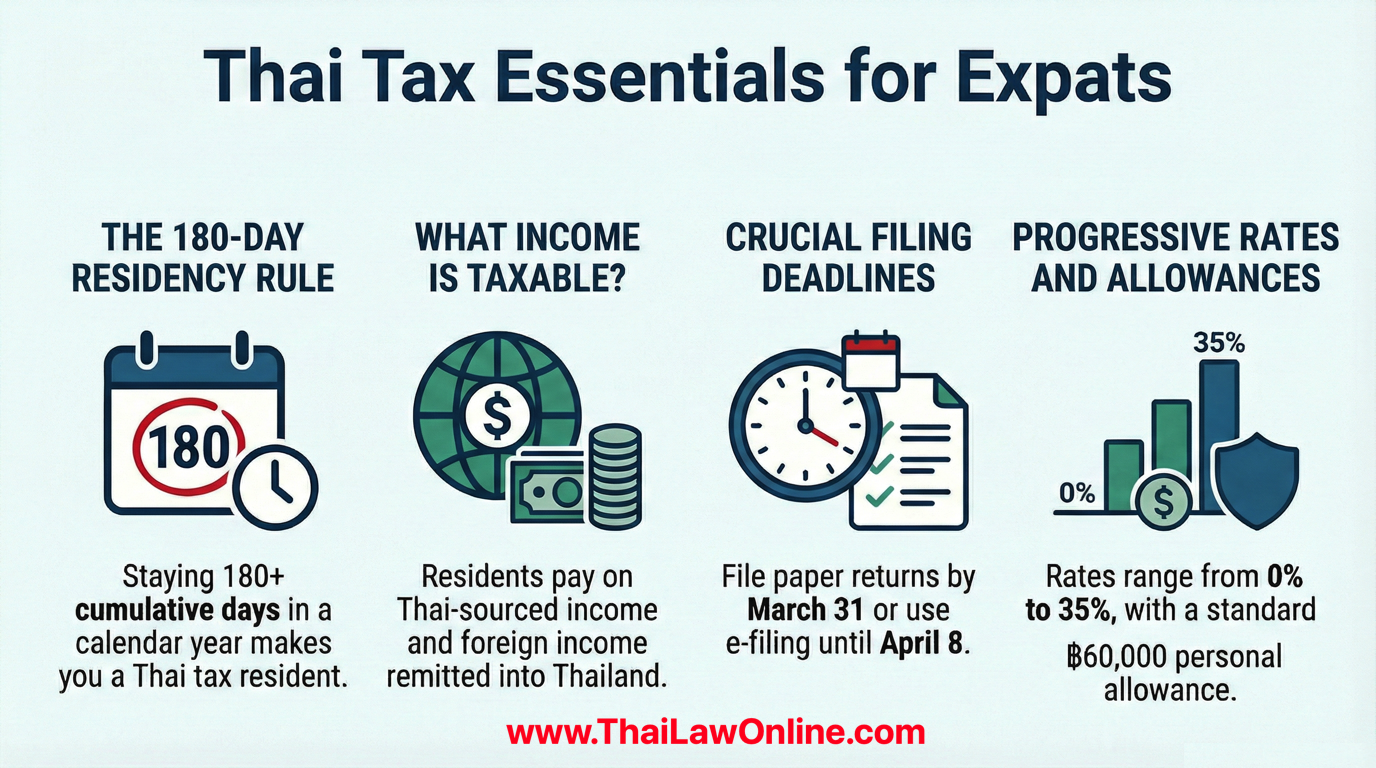
สถานะผู้มีถิ่นพำนักเพื่อเสียภาษีในประเทศไทยพิจารณาจากสถานะการพำนักจริงเท่านั้น ไม่ใช่จากประเภทวีซ่า สัญชาติ หรือสถานะการเข้าเมือง ตามมาตรา 41 แห่งประมวลรัษฎากรของไทย บุคคลใดก็ตามที่พำนักอยู่ในประเทศไทยเป็นเวลา... 180 วันขึ้นไป ผู้ที่มีถิ่นพำนักในประเทศไทยในช่วงปีปฏิทิน (1 มกราคม ถึง 31 ธันวาคม) จะถือว่าเป็นผู้มีถิ่นพำนักเพื่อเสียภาษีในประเทศไทย
การจัดประเภทนี้มีนัยสำคัญอย่างมาก:
- ผู้มีถิ่นที่อยู่ทางภาษี บุคคลเหล่านี้มีหน้าที่ต้องเสียภาษีเงินได้บุคคลธรรมดาสำหรับรายได้ทั้งหมดที่เกิดขึ้นในประเทศไทย และ บน รายได้จากแหล่งต่างประเทศ ถูกนำเข้ามาในประเทศไทย.
- ผู้ที่ไม่ใช่ผู้อยู่อาศัย เสียภาษีเฉพาะเงินได้ที่มีแหล่งที่มาในประเทศไทย เช่น เงินเดือนจากนายจ้างในประเทศไทย หรือค่าเช่าจากทรัพย์สินในประเทศไทย
The 180-day count does not need to be consecutive. Every day spent inside Thailand counts toward the threshold, regardless of the visa held. Teachers, retirees, business owners, and digital nomads who spend 180 days or more in Thailand in a tax year are all subject to the same residency rules.
สำคัญ
วีซ่าสิทธิพิเศษ (ระดับสูงสุด) ของประเทศไทยนั้น ไม่ ไม่มีการยกเว้นภาษีใดๆ โดยพื้นฐานแล้วมันคือวีซ่าท่องเที่ยวที่มีสิทธิพิเศษระดับวีไอพี ผู้ถือวีซ่าที่พำนักอยู่เกิน 180 วันจะยังคงเป็นผู้มีถิ่นที่อยู่ถาวรและเสียภาษีตามกฎมาตรฐาน
กฎระเบียบการโอนเงินรายได้จากต่างประเทศ ปี 2024 (ระเบียบเลขที่ 161/2566)
อะไรเปลี่ยนแปลงไปบ้างในวันที่ 1 มกราคม 2567
เมื่อวันที่ 15 กันยายน 2566 กรมสรรพากรของไทยได้ออกประกาศ คำสั่งกรมสรรพากร ที่ ป.161/2566ซึ่งเป็นการเปลี่ยนแปลงพื้นฐานเกี่ยวกับวิธีการเก็บภาษีรายได้จากต่างประเทศในประเทศไทย กฎระเบียบใหม่มีผลบังคับใช้ตั้งแต่วันที่ 1 มกราคม 2567, และเป็นการเปลี่ยนแปลงด้านภาษีที่สำคัญที่สุดสำหรับชาวต่างชาติในช่วงหลายทศวรรษที่ผ่านมา
ก่อนปี 2024: กรมสรรพากรถือว่าเงินได้จากแหล่งต่างประเทศต้องเสียภาษีเฉพาะเมื่อมีการนำเข้ามาในประเทศไทย ในปีปฏิทินเดียวกัน กับที่ได้รับเงินได้นั้น หลักการนี้อยู่ในแนวปฏิบัติของกรมและในคำตอบข้อหารือ ไม่ได้อยู่ในประมวลรัษฎากรเอง ซึ่งเป็นเหตุผลที่ข้อ 2 ของคำสั่ง ป.161/2566 สามารถยกเลิกหลักการนี้ได้ด้วยประโยคเดียว: ข้อดังกล่าวยกเลิกระเบียบ หลักเกณฑ์ คำสั่ง คำตอบข้อหารือ และแนวทางปฏิบัติใด ๆ ที่ขัดหรือแย้งกับคำสั่งนี้ทั้งหมด ผลในทางปฏิบัติคือกลยุทธ์การวางแผนที่เรียบง่าย: หารายได้ในต่างประเทศ รอจนถึงปีถัดไปจึงโอนเงิน แล้วเงินนั้นก็เข้ามาโดยไม่ต้องเสียภาษี
ตั้งแต่วันที่ 1 มกราคม 2567 เป็นต้นไป: เงินได้จากแหล่งต่างประเทศต้องเสียภาษีเมื่อผู้มีถิ่นที่อยู่ในประเทศไทยนำเงินได้นั้นเข้ามาในประเทศไทย ไม่ว่าจะนำเข้ามาในปีภาษีใด ข้อ 1 ของคำสั่ง ป.161/2566 กำหนดให้บุคคลซึ่งเป็นผู้อยู่ในประเทศไทยในปีภาษีที่เงินได้นั้นเกิดขึ้น และนำเงินได้นั้นเข้ามาในประเทศไทย ในปีภาษีใดก็ตาม, ต้องนำเงินได้นั้นไปรวมคำนวณภาษีตามมาตรา 48 สำหรับปีภาษีที่นำเงินได้นั้นเข้ามา ข้อ 3 กำหนดให้คำสั่งนี้ใช้บังคับกับเงินได้พึงประเมินที่นำเข้ามาในประเทศไทยตั้งแต่วันที่ 1 มกราคม 2024 เป็นต้นไป ดังนั้น ปีที่เงินเข้ามาในประเทศไทยเป็นตัวก่อให้เกิดภาระภาษี ไม่ใช่ปีที่ได้รับเงินได้นั้นในต่างประเทศ สิ่งที่คำสั่งนี้ไม่ได้ทำคือการมีผลย้อนหลัง และข้อยกเว้นที่ระบุเรื่องนี้อยู่ในหัวข้อถัดไป.
การคุ้มครองรายได้ก่อนปี 2024 (หมายเลข 162/2566)
เมื่อวันที่ 20 พฤศจิกายน 2566 กรมสรรพากรได้ออกประกาศ คำสั่งกรมสรรพากร ที่ ป.162/2566, ซึ่งทำเพียงอย่างเดียว คือเพิ่มวรรคสองในข้อ 1 ของคำสั่งกรมสรรพากรที่ ป. 161/2566 ซึ่งมีข้อความว่า ข้อนี้ “ไม่ใช้บังคับกับเงินได้พึงประเมินที่เกิดขึ้น ก่อนวันที่ 1 มกราคม พ.ศ. 2567 (2024)” ดังนั้น เงินได้ที่เกิดขึ้นก่อนวันดังกล่าวจึงอยู่นอกขอบเขตของหลักเกณฑ์ปี 2024 แม้จะมีการนำเข้ามาในประเทศไทยภายหลังก็ตาม คำสั่งทั้งสองฉบับเป็น คำสั่งกรมสรรพากร, ซึ่งเป็นคำสั่งของกรม และแต่ละฉบับระบุไว้ในอารัมภบทของตนเองว่าออกมาเพื่อให้เจ้าหน้าที่สรรพากรมีแนวทางปฏิบัติในการตรวจสอบและให้คำแนะนำแก่ผู้เสียภาษี คำสั่งเหล่านี้ไม่ใช่การแก้ไขเพิ่มเติมประมวลรัษฎากร เราได้อ่านคำสั่งทั้งสองฉบับเป็นภาษาไทยต้นฉบับบนเว็บไซต์ของกรมสรรพากรเอง: ป.161/2566 และ ป.162/2566.
เพื่อขอรับความคุ้มครองนี้ ชาวต่างชาติควรดำเนินการดังนี้:
- บำรุงรักษา บัญชีธนาคารแยกต่างหาก สำหรับเงินก่อนปี 2024 และเงินหลังปี 2024
- อนุรักษ์ รายการเดินบัญชีธนาคารตั้งแต่เดือนธันวาคม 2023 แสดงยอดบัญชีเป็นหลักฐาน
- เก็บหลักฐานการรับรายได้ (สลิปเงินเดือน ใบแจ้งหนี้ ใบแจ้งยอดเงินบำนาญ)
- อย่ายึดถือ FIFO (First-In, First-Out) เป็นสมมติฐาน แนวคิดที่มักใช้อธิบายสำหรับบัญชีที่มีเงินปะปนกันว่าเงินที่เข้ามาก่อนจะถือว่าถูกใช้ไปก่อนนั้น ไม่ปรากฏทั้งในคำสั่ง ป.161/2566 และ ป.162/2566 และไม่ใช่หลักเกณฑ์ที่มีการประกาศไว้ ให้ถือว่าเป็นแนวปฏิบัติทางบัญชีมากกว่ากฎหมาย และเก็บหลักฐานที่ระบุถึงเงินแต่ละก้อนได้โดยตรง
อะไรนับเป็นการ “โอนเงิน”
คำจำกัดความของการนำเงินเข้าประเทศนั้นกว้างกว่าที่ชาวต่างชาติหลายคนเข้าใจ วิธีการแต่ละอย่างต่อไปนี้ล้วนเป็นการนำเงินเข้าสู่ประเทศไทย ส่วนจะต้องเสียภาษีหรือไม่ขึ้นอยู่กับว่าเงินนั้นคืออะไร: เงินได้พึงประเมินจากต่างประเทศที่เกิดขึ้นตั้งแต่วันที่ 1 มกราคม 2024 เป็นต้นไป ในปีที่คุณเป็นผู้มีถิ่นที่อยู่ในประเทศไทยเพื่อการเสียภาษี ต้องเสียภาษีไม่ว่าเงินนั้นจะเข้ามาด้วยวิธีใด
| วิธีการโอนเงิน | ตัวอย่าง | นับเป็นการนำเงินเข้าประเทศหรือไม่? |
|---|---|---|
| การโอนเงินผ่านธนาคาร | การโอนเงินจากธนาคารในสหรัฐอเมริกา/สหราชอาณาจักรไปยังบัญชีธนาคารในประเทศไทย | ใช่ |
| การถอนเงินจากตู้ ATM | การใช้บัตรเดบิตต่างประเทศที่ตู้เอทีเอ็มในประเทศไทย | ใช่ |
| การชำระเงินด้วยบัตรเครดิต/เดบิต | การชำระค่าสินค้าในประเทศไทยด้วยบัตรเครดิตต่างประเทศ | ใช่ |
| เงินสด | การขนส่งเงินตราต่างประเทศข้ามพรมแดน | ใช่ |
| การแปลงสกุลเงินดิจิทัล | โอนคริปโตเคอร์เรนซีไปยังตลาดแลกเปลี่ยนของไทยและแปลงเป็นเงินบาทไทย | ใช่ |
| แพลตฟอร์มการชำระเงินออนไลน์ | การโอนเงินผ่าน PayPal หรือ Wise ไปยังบัญชีธนาคารไทย | ใช่ |
สิ่งที่ไม่อยู่ภายใต้กฎเกณฑ์การโอนเงิน:
- รายได้จากต่างประเทศถูกเก็บไว้ในต่างประเทศอย่างสมบูรณ์ (ไม่เคยนำเข้าประเทศไทย)
- รายได้ที่ได้รับก่อนวันที่ 1 มกราคม 2567 พร้อมเอกสารประกอบที่ถูกต้อง
- รายได้ที่เกิดขึ้นในปีภาษีที่บุคคลนั้น ไม่ เป็นผู้มีถิ่นที่อยู่ในประเทศไทยเพื่อการเสียภาษี กรมสรรพากรระบุไว้อย่างชัดเจนว่า บุคคลที่อยู่ในประเทศไทยน้อยกว่า 180 วันในปีที่เงินได้นั้นเกิดขึ้น ไม่ต้องเสียภาษีใด ๆ สำหรับเงินได้นั้น, แม้ว่าเงินนั้นจะถูกนำเข้ามาในภายหลัง ในขณะที่เป็นผู้มีถิ่นที่อยู่ในประเทศไทยแล้วก็ตาม.
ประเด็นหนึ่งมักจะถูกกล่าวในทางกลับกัน และเราไม่สามารถสนับสนุนได้. The Revenue Department’s test has two elements: the income must arise on or after 1 January 2024 in a tax year in which the person spent 180 days or more in Thailand, and the person must bring it in in that tax year or any later one. The residence test is attached to the year the income arose. Nothing in the two departmental instructions, in the Revenue Department Legal Division’s own eight-page question and answer paper on them, or in any reported ศาลฎีกา decision we can find, says that being non-resident in the year you remit makes an otherwise taxable remittance exempt. The Department has addressed the point directly, and not only by implication. The Legal Division’s paper sets out a table of four cases covering when the income arose, how long the taxpayer was in Thailand, and when the money was brought in. Its single residence column is headed time spent in Thailand in the tax year in which the assessable income arose. The table reaches a taxable or not taxable answer in all four cases without once asking whether the taxpayer was resident in the year of the remittance. In the first of those cases, income arising on or after 1 January 2024 in a year of 180 days or more and brought in on or after that date, the answer is that tax is due. Two limits are worth stating plainly. These are departmental instructions and departmental guidance, which bind revenue officers as their working rule but are not an amendment to the Revenue Code, and no reported Supreme Court decision has tested the question. So plan on the basis that income which arose in a resident year is taxable whenever you bring it in, and take advice before doing anything that depends on the opposite.
ข้อเสนอการยกเว้นภาษีเงินโอนเป็นเวลาสองปี (อยู่ระหว่างการพิจารณา)
In June 2025 the Revenue Department was reported to be drafting legislation to ease the foreign income tax burden. Under the proposal, foreign-sourced income earned from 2024 onward would be ได้รับการยกเว้นภาษีหากชำระภายในสองปีปฏิทิน, meaning in the year earned or the following year.
| สถานการณ์ | สถานะทางภาษี (หากมีการประกาศใช้) |
|---|---|
| รายได้ที่ได้รับในปี 2025 และโอนเข้าบัญชีในปี 2025 | Exempt |
| รายได้ที่ได้รับในปี 2025 และโอนเข้าบัญชีในปี 2026 | Exempt |
| รายได้ที่ได้รับในปี 2025 และโอนเข้าบัญชีในปี 2027 หรือหลังจากนั้น | Taxable at progressive rates |
A two-year window of that kind would have to be enacted before it applied to anyone, and it has not been. As of 4 September 2026, the Royal Decrees issued under the Revenue Code run to No. 807, published in the Royal Gazette on 23 August 2026, and none of those listed in the Revenue Department’s register concerns foreign-sourced income. The register shows no decree numbered 806. The most recent decrees cover extensions of the reduced ภาษีมูลค่าเพิ่ม rate, hotel refurbishment, domestic seminars, SME digitalisation, artists, a donation exemption and solar rooftops.
สถานะปัจจุบัน: ยังไม่ได้ประกาศใช้
As of 4 September 2026 the proposal has not been enacted. Nor has anything else moved the rule: no departmental instruction issued after Por.162/2566 touches Section 41, the series having reached Por.164/2568, which concerns the sale of goods outside the Kingdom, and the only two entries in it on Section 41 paragraph two are still Por.161/2566 and Por.162/2566. The Revenue Department’s own Manual for the Foreign Tax Credit Calculation Tool, published in November 2025, sets out the law governing foreign-sourced income as Sections 40, 41, 48 and 56 of the Revenue Code, Royal Decree (No. 18) B.E. 2505, Por.161/2566 and Por.162/2566, and lists nothing further. Until an exemption is published in the Royal Gazette, the rules described above are the rules that apply.
คำเตือน
ผู้เสียภาษีควร ไม่ rely on this proposal for their 2026 tax filings. Plan and file based on the current rules until the exemption is officially published in the Royal Gazette.
รายได้ที่ต้องเสียภาษี 8 ประเภทในประเทศไทย
ประมวลรัษฎากรของไทย (มาตรา 40) แบ่งรายได้ที่ต้องเสียภาษีออกเป็น แปดประเภท. Correctly classifying income is important because different categories allow different standard deduction percentages. Here are the categories for personal income tax in Thailand:
| หมวดหมู่ | ประเภทรายได้ | การหักลดหย่อนมาตรฐาน |
|---|---|---|
| 1 | รายได้จากการทำงาน: เงินเดือน ค่าจ้าง โบนัส เงินบำนาญ | 50% of income, max 100,000 THB |
| 2 | การว่าจ้างงาน/บริการ: ค่าคอมมิชชั่น ค่าธรรมเนียมตัวแทน ค่าธรรมเนียมกรรมการ | 50% of income, max 100,000 THB combined with category 1 |
| 3 | สิทธิ์และผลตอบแทนรายปี: ค่าความนิยม ลิขสิทธิ์ สัมปทาน | 50% of income, max 100,000 THB |
| 4 | รายได้จากการลงทุน: เงินปันผล ดอกเบี้ย กำไรจากส่วนต่างราคา คริปโตเคอร์เรนซี | No standard deduction |
| 5 | รายได้ค่าเช่า: อสังหาริมทรัพย์ ยานพาหนะ และสินทรัพย์อื่นๆ | 10% to 30% depending on asset type |
| 6 | บริการระดับมืออาชีพ: การแพทย์ กฎหมาย วิศวกรรม การบัญชี | 30% or 60% depending on profession |
| 7 | บริการก่อสร้างและสัญญาจ้างงาน | 60% of income |
| 8 | รายได้อื่นๆ: ธุรกิจ การค้า เกษตรกรรม การขนส่ง | 60% of income |
อัตราภาษีเงินได้บุคคลธรรมดาในประเทศไทย (ปี 2026)
ประเทศไทยใช้ระบบ ระบบภาษีแบบก้าวหน้า, meaning each portion of income is taxed at the rate for its respective bracket, not the entire income at a single rate. Both Thai nationals and foreign tax residents are subject to the same rate schedule.
Two instruments make up the table below, which is worth knowing if you ever check it against the statute. The rates come from the income tax rate schedule of the Revenue Code (banchi atra phasi ngoen dai, item 1), as replaced by the Revenue Code Amendment Act (No. 44) B.E. 2560 and applying from the 2560 tax year onward. Read alone that schedule taxes the first 300,000 baht at 5 per cent: the 0 to 150,000 exemption is not in it. The exemption is granted separately by Royal Decree No. 470 B.E. 2551, which exempts the first 150,000 baht of net income computed under section 48 (1) of the Code. So the first bracket in the table below comes from a Royal Decree, not the statute, and it is the one that would change most easily.
| รายได้สุทธิที่ต้องเสียภาษี (THB) | อัตราภาษี | อัตราภาษีสูงสุดในช่วงนี้ |
|---|---|---|
| 0-150,000 | ได้รับการยกเว้น | 0 THB |
| 150,001-300,000 | 5% | 7,500 THB |
| 300,001-500,000 | 10% | 20,000 THB |
| 500,001-750,000 | 15% | 37,500 THB |
| 750,001-1,000,000 | 20% | 50,000 THB |
| 1,000,001-2,000,000 | 25% | 250,000 THB |
| 2,000,001-5,000,000 | 30% | 900,000 THB |
| มากกว่า 5,000,000 | 35% | No cap |
หลักการทำงานของระบบภาษีแบบก้าวหน้า: ตัวอย่างเชิงปฏิบัติสำหรับภาษีเงินได้บุคคลธรรมดาในประเทศไทย
An expat earning a net taxable income of 500,000 THB does not pay 10% on the full amount. Instead:
- 150,000 บาทแรก → ยกเว้นภาษี = 0 บาท. No tax is due on this slice, but that does not remove the duty to file a return: see the filing thresholds below.
- Next 150,000 THB (150,001-300,000) → 5% = 7,500 บาท
- Next 200,000 THB (300,001-500,000) → 10% = 20,000 บาท
- ภาษีรวม: 27,500 บาท (อัตราประสิทธิผล 5.5%)
การหักลดหย่อนภาษีและค่าเผื่อภาษี
Maximizing legal deductions is the most effective way to reduce personal income tax in Thailand. The Revenue Code offers a wide range of personal allowances, insurance deductions, and investment incentives.
ค่าลดหย่อนส่วนบุคคลและครอบครัวสำหรับภาษีเงินได้บุคคลธรรมดาในประเทศไทย
| ประเภทการหักลดหย่อน | จำนวนเงินสูงสุด (บาท) |
|---|---|
| ค่าลดหย่อนส่วนบุคคล (ผู้เสียภาษี) | 60,000 |
| ค่าเบี้ยเลี้ยงคู่สมรส (กรณีคู่สมรสไม่มีรายได้) | 60,000 |
| เงินช่วยเหลือบุตร (ต่อบุตรหนึ่งคน) | 30,000 for each legitimate child, with no limit on how many. Adopted children are 30,000 each but no more than three children in total may be claimed, and if you already have three or more living legitimate children you cannot claim for an adopted child at all. Section 47 (1) (ค) allows the deduction only for a child who is a minor, or is under 25 and studying at university or another higher education institution, or has been declared incompetent or quasi-incompetent by a court and is in your care, and it is lost for a child who had assessable income of 30,000 baht or more in the tax year, not counting income exempt under section 42 |
| บุตรคนที่ 2 ขึ้นไป ที่เกิดในปี 2018 หรือหลังจากนั้น | 60,000 per child: the ordinary 30,000 plus a further 30,000 for the second and any later legitimate child born in or after 2018, added by the Revenue Code Amendment Act (No. 46) B.E. 2561 for tax year 2561 onwards. Watch how birth order is counted, because it decides whether a child is the second: for this extra allowance section 47 (1) (ค) counts every child you have had, whether living or not. The three-child limit in the row above is counted the other way, on living children only |
| Dependent parent, and the parents of a spouse as well | 30,000 per parent. The conditions are the ones in section 47 (1) (ญ) of the Revenue Code and they are not about where the parent lives: the parent must be 60 or over, must have income insufficient for subsistence, and must be in your care. The allowance is not available for a parent whose assessable income in the tax year exceeds 30,000 บาท, which is the test that disqualifies most claims |
| ผู้พิการหรือทุพพลภาพที่ต้องพึ่งพาผู้อื่น | 60,000 per person. Section 47 (1) (ฎ) reaches a parent, spouse, legitimate or adopted child, a spouse’s parent or child, or another person for whom you are the legal guardian. The same 30,000 baht income ceiling applies to the dependent |
| ค่าใช้จ่ายในการคลอดบุตร | Up to 60,000 per pregnancy |
| การยกเว้นภาษีสำหรับผู้เสียภาษีสูงอายุ (65 ปีขึ้นไป) | Up to 190,000. This is an additional income exemption, not a deduction. |
การหักลดหย่อนประกันภัยและการเกษียณอายุ
| ประเภทการหักลดหย่อน | จำนวนเงินสูงสุด (บาท) |
|---|---|
| เบี้ยประกันชีวิต (บริษัทประกันภัยของไทย) | 100,000 |
| เบี้ยประกันสุขภาพ | 25,000. Ministerial Regulation No. 365 (B.E. 2563), Royal Gazette 17 June 2020, raised this from the 15,000 set by Ministerial Regulation No. 334 and applies to premiums paid from 1 January 2020. The combined cap with life insurance in the row below is in the same instrument |
| วงเงินประกันรวม | 100,000 |
| ประกันสุขภาพของพ่อแม่ | 15,000. There is no age condition: each insured parent must have assessable income of not more than 30,000 baht in the tax year |
| เงินสมทบกองทุนสำรองเลี้ยงชีพ | 15% of income, max 500,000 |
| กองทุนรวมเพื่อการเกษียณ (RMF) | 30% of assessable income, capped at 500,000. Ministerial Regulation No. 357 (B.E. 2563), Royal Gazette 10 March 2020, raised the rate from 15% for income received from 1 January 2020. The units must be held at least five years from the first purchase and redeemed at 55 or older, or the relief is lost |
| Pension (annuity) life insurance | 15% of income, max 200,000 |
| กองทุนออมทรัพย์แห่งชาติ (NSF) | The amount actually paid in as savings, up to 500,000, and within the 500,000 combined retirement cap. That is clause 2 (90) of Ministerial Regulation No. 126, inserted by Ministerial Regulation No. 314 (B.E. 2559). The fund’s own annual ceiling is not fixed in the National Savings Fund Act: section 31 requires savings of at least 50 baht a month and no more than an amount prescribed by ministerial regulation, so check the current ceiling with the fund before relying on a figure |
| วงเงินสูงสุดสำหรับการเกษียณอายุรวม | 500,000 |
การหักลดหย่อนภาษีเงินได้บุคคลธรรมดาอื่นๆ ในประเทศไทย
| ประเภทการหักลดหย่อน | จำนวนเงินสูงสุด (บาท) |
|---|---|
| ดอกเบี้ยสินเชื่อบ้าน | 100,000 |
| เงินสมทบประกันสังคม | Actual amount contributed, up to 10,500 for 2026 (875 per month at the new Section 33 wage ceiling of 17,500). A reduced 3% rate applied from December 2025 to May 2026 in nine flood-hit southern provinces, so those employees deduct the lower amount actually paid. |
| Thai ESG Fund investment (2024-2026) | 30% of income, max 300,000 |
| การลงทุนในวิสาหกิจเพื่อสังคม | 100,000 per year |
| การบริจาคเพื่อการกุศล (ส่วนลด 100%/200%) | Up to 10% of subtotal net income. For gifts made from 1 January 2026, only donations recorded in the Revenue Department’s e-Donation system support the deduction |
Two temporary items that circulated in 2025 do not carry into 2026. The domestic tourism deduction (“Tiew Dee Mee Khuen”) under Ministerial Regulation No. 401 (B.E. 2568), published in the Royal Gazette on 19 November 2025, covered hotel, homestay and restaurant spending between 29 October and 15 December 2025 only: up to 10,000 THB on any tax invoice, a further 10,000 THB where the invoice was an e-Tax Invoice, and one and a half times those amounts for travel in the 55 listed secondary provinces. It belonged to the 2025 return, which was due on 31 March 2026, and no 2026 round has been approved as of 3 September 2026. The Thai ESG fund deduction (30% of assessable income, up to 300,000 THB, units held at least five years) applies to purchases made between 1 January 2024 and 31 December 2026 under Ministerial Regulation No. 395 (B.E. 2567), so 2026 is its final year unless it is extended. Deductions change every year, so check the current list before you file.
การหักลดหย่อนใดบ้างที่เปลี่ยนแปลงไปสำหรับปีภาษี 2026
Three changes apply to income earned in 2026 and filed by 31 March 2027 (8 April online). None of them comes from the deduction “reform” announced in October 2025, which is covered in the next section and is not law.
1. The ประกันสังคม deduction rose to a maximum of 10,500 THB. The Ministerial Regulation prescribing the minimum and maximum wages used as the base for Section 33 contributions, B.E. 2568, made under sections 7 and 46 of the Social Security Act B.E. 2533, given by the Minister of Labour on 11 December 2025, published in the Royal Gazette volume 142 part 81 Kor on 12 December 2025 and in force from 1 January 2026, raises the wage ceiling on which Section 33 contributions are calculated, in three steps. The employee rate stays at 5%, so the deductible amount rises with the ceiling:
| ช่วงเวลา | Monthly wage ceiling (THB) | Maximum employee contribution per month | Maximum deduction per year |
|---|---|---|---|
| Up to 31 December 2025 | 15,000 | 750 | 9,000 |
| 1 January 2026 to 31 December 2028 | 17,500 | 875 | 10,500 |
| 1 January 2029 to 31 December 2031 | 20,000 | 1,000 | 12,000 |
| From 1 January 2032 | 23,000 | 1,150 | 13,800 |
Employees in the nine southern provinces covered by the flood relief (Trang, Nakhon Si Thammarat, Narathiwat, Pattani, Phatthalung, Yala, Songkhla, Satun and Surat Thani) paid a reduced 3% rate from December 2025 to May 2026 and deduct what they actually paid.
2. Donations must go through e-Donation. In August 2025 the Director-General of the Revenue Department wrote to the National Office of Buddhism that, from 1 January 2026, a donation to a temple, foundation, association, fund or other approved donee supports a tax deduction only if it is recorded in the Department’s e-Donation system. A paper receipt or anumodana certificate can still be issued, but the Department has said it will not support the deduction. As of 3 September 2026 we have not found a Ministerial Regulation or Director-General’s notification in the Royal Gazette giving this effect, and the Department’s own letter described it as a change it would make to the law. In practice the point is settled anyway: the e-filing system pre-fills donations from e-Donation data, and a 2026 donation that exists only on paper should be expected to be refused. Give by scanning the donee’s e-Donation QR code, or through a bank channel that reports to the system, and check the entry on the Department’s e-Donation portal before you file. The double deduction for e-Donation เงินได้จากการรับให้ to schools, universities and sports bodies is the same story in reverse: the Cabinet approved on 16 June 2026 two draft Royal Decrees extending it to gifts made from 1 January 2025 to 31 December 2027, but neither had reached the Royal Gazette when we last checked the Revenue Department’s own register of royal decrees on 4 September 2026, whose most recent entry is No. 807 of B.E. 2569 and which lists no decree extending this relief. So it cannot yet be claimed.
3. The shopping and travel stimulus deductions expired. Easy E-Receipt 2.0 under Ministerial Regulation No. 397 (B.E. 2568), published on 10 January 2025, covered purchases from 16 January to 28 February 2025 and is claimed in the 2025 return, not the 2026 one. The tourism deduction closed on 15 December 2025. Nothing has replaced either for 2026 spending.
ประเทศไทยได้จำกัดเพดานการหักลดหย่อนภาษีในปี 2026 หรือไม่
No. There is no ceiling on total deductions in Thai law, and income earned in 2026 is governed by the tables above. What actually happened:
- 14 October 2025: Deputy Prime Minister and Finance Minister Ekniti Nitithanprapas said the deduction system was “scattered”, floated a single ceiling on total deductions, and promised an operational framework by November 2025. The Finance Ministry’s permanent secretary said the earliest application would be income earned in 2026, because the Revenue Code would have to be amended.
- November 2025: no framework was published as an instrument.
- 12 December 2025: the House of Representatives was dissolved, freezing the reform with the rest of the legislative programme.
- 8 February 2026: general election, followed by a new government under Anutin Charnvirakul.
- July 2026: the Finance Ministry’s ten-point tax reform plan schedules “a revision of the personal income tax structure and a review of selected deductions and allowances” for 2027. The Bangkok Post’s report of the plan puts the projected revenue at 50 billion THB a year; a figure of 45.8 billion THB appears in other coverage of the same review. The same plan lists the top-up tax and a 1,000 THB outbound travel levy for 2027, and a VAT increase to 8.5% for 2028.
Status, checked 3 September 2026 against the Revenue Department’s registers of subordinate legislation: the Ministerial Regulations under the Revenue Code run to No. 401 (Royal Gazette 19 November 2025) and the Royal Decrees to No. 807 (23 August 2026), and none of them, nor any amending Act, imposes a ceiling on deductions. A ceiling would need a Revenue Code amendment passed by Parliament, or a Royal Decree where the Code already delegates the power, and either must be published in the Royal Gazette before it binds anyone. On the ministry’s own timetable the earliest realistic effect is income earned in 2027 and filed in 2028. Nothing needs doing today beyond keeping receipts and e-Donation records.
มีโครงการ Easy E-Receipt สำหรับปี 2026 หรือไม่
No. On 3 September 2026 the Finance Minister said there is no plan to bring the measure back in the near term, citing leakage and the fact that the benefit goes mostly to higher earners. Easy E-Receipt 2.0 was the 2025 round: purchases from 16 January to 28 February 2025, up to 30,000 THB plus a further 20,000 THB on OTOP and community-enterprise goods, both requiring an e-Tax Invoice or e-Receipt. It is claimed in the 2025 return filed in early 2026 and does not apply to any 2026 spending. If a new round is approved it will come as a Ministerial Regulation under the Revenue Code and will appear in the Royal Gazette before it takes effect; this section will be updated when that happens.
ข้อตกลงการหลีกเลี่ยงการเก็บภาษีซ้ำซ้อน (DTAs)
ประเทศไทยได้ลงนามแล้ว Double Taxation Agreements with 61 countries เพื่อป้องกันไม่ให้รายได้ถูกเก็บภาษีซ้ำซ้อน สนธิสัญญาเหล่านี้มีความสำคัญยิ่งกว่าที่เคยภายใต้กฎการโอนเงินปี 2024
ข้อตกลงภาษีซ้อนช่วยปกป้องชาวต่างชาติได้อย่างไร
DTA ทำงานโดยหลักผ่านทาง วิธีการเครดิตภาษีต่างประเทศหากได้ชำระภาษีเงินได้ในประเทศต้นทางไปแล้ว สามารถนำจำนวนเงินดังกล่าวมาหักลบกับภาระภาษีเงินได้ของไทยสำหรับรายได้เดียวกันได้ โดยการหักลบจะจำกัดอยู่ที่จำนวนที่น้อยกว่าระหว่าง (ก) ภาษีที่ชำระจริงในต่างประเทศ หรือ (ข) ภาษีของไทยที่จะต้องชำระสำหรับรายได้นั้น
เมื่อวันที่ 6 มกราคม 2569 กรมสรรพากรของไทยได้ออกประกาศอย่างเป็นทางการ เครื่องมือคำนวณเครดิตภาษีต่างประเทศ. This helps residents correctly compute their allowable credits when filing PND 90 or PND 91 returns.
ประเทศที่มีข้อตกลงภาษีซ้ำซ้อนกับประเทศไทย
Thailand’s 61 DTA partners include:
ภูมิภาคเอเชียแปซิฟิก: ออสเตรเลีย, บังกลาเทศ, กัมพูชา, จีน, ฮ่องกง, อินเดีย, อินโดนีเซีย, ญี่ปุ่น, เกาหลี, ลาว, มาเลเซีย, เมียนมาร์, เนปาล, นิวซีแลนด์, ปากีสถานฟิลิปปินส์ สิงคโปร์ ศรีลังกา ไต้หวัน เวียดนาม
ยุโรป: อาร์เมเนีย ออสเตรีย เบลารุส เบลเยียมบัลแกเรีย, ไซปรัส, สาธารณรัฐเช็ก เดนมาร์กเอสโตเนีย, ฟินแลนด์, ฝรั่งเศส, เยอรมนีฮังการี ไอร์แลนด์ อิตาลี ลักเซมเบิร์ก เนเธอร์แลนด์นอร์เวย์ โปแลนด์ โรมาเนีย รัสเซีย, Slovenia, Spain, สวีเดน, สวิตเซอร์แลนด์ตุรกี ยูเครน สหราชอาณาจักร
ทวีปอเมริกา: แคนาดาชิลี สหรัฐอเมริกา
ตะวันออกกลางและแอฟริกา: Bahrain, Israel, Kuwait, Mauritius, Oman, Seychelles, South Africa, United Arab Emirates
Central Asia: Tajikistan, Uzbekistan
ข้อควรพิจารณาพิเศษเกี่ยวกับข้อตกลงภาษีซ้ำซ้อนสำหรับประเทศที่ชาวต่างชาติอาศัยอยู่เป็นจำนวนมาก
- ระบบประกันสังคมของสหรัฐอเมริกา: Generally taxable only in the US under the DTA, not in Thailand.
- เงินบำนาญของรัฐบาลแคนาดา (CPP/OAS): Typically taxable only in Canada.
- Australian pensions: Under Article 18 of the Australia-Thailand agreement, a pension paid to a Thai resident is taxable only in Thailand, and the Australian Taxation Office has applied that to a war veteran’s pension. Only a pension for Australian government service (Article 19) is generally taxable only in Australia.
- เงินบำนาญส่วนตัว/จากนายจ้าง: โดยปกติ เป็น เงินจำนวนนี้ต้องเสียภาษีในประเทศไทยหากโอนเข้ามา แต่สามารถขอคืนภาษีที่ประเทศต้นทางได้
- พลเมืองสหรัฐอเมริกา: Due to a “Savings Clause” in the US-Thailand DTA, Americans should primarily use US mechanisms (Foreign Tax Credit or FEIE) to mitigate double taxation.
วีซ่า LTR: การยกเว้นภาษีสำหรับรายได้จากต่างประเทศ
วีซ่าผู้พำนักระยะยาว (LTR) มอบสิทธิประโยชน์ทางภาษีที่ทรงพลังที่สุดสำหรับชาวต่างชาติที่มีคุณสมบัติครบถ้วน ภายใต้ Royal Decree No. 743 (B.E. 2565), published in the Royal Gazette on 23 May 2022, three of the four LTR categories receive a complete exemption from personal income tax on foreign-sourced income brought into Thailand. Section 5 of the decree frames it precisely: the exemption covers assessable income under section 40 of the Revenue Code arising in a previous tax year from employment or business carried on abroad, or from property situated abroad, and then brought into the country.
| ประเภทวีซ่า LTR | ภาษีเงินได้ต่างประเทศ | ความต้องการ |
|---|---|---|
| พลเมืองโลกผู้มั่งคั่ง | ได้รับการยกเว้น | USD 1M+ in assets, USD 500K+ Thai investment |
| ผู้รับบำนาญที่ร่ำรวย | ได้รับการยกเว้น | USD 80K+/year passive income |
| ผู้เชี่ยวชาญที่ทำงานจากประเทศไทย | ได้รับการยกเว้น | USD 80K+/year salary, established employer |
| ผู้เชี่ยวชาญที่มีทักษะสูง | Not exempt. Section 5 of the decree lists only the three categories above, so this category pays tax on foreign income brought in on the ordinary rules. What section 3 gives instead is a flat 17% on Thai employment income from a targeted-industry employer | Employment by a company in a targeted industry under the competitiveness-enhancement law, the investment promotion law or the Eastern Economic Corridor law |
การยกเว้นมีผลบังคับใช้ from the date the วีซ่า LTR is granted and remains valid while the visa is active. It does not apply retroactively to remittances made before visa approval. Those timing conditions are not in the decree itself: section 6 leaves the qualifications and conditions to a Director-General notification, which for this decree is Notification on Income Tax No. 427, and section 7 suspends the relief for any tax year in which the conditions are not met, for that year alone.
การเก็บภาษีสกุลเงินดิจิทัลและสินทรัพย์ดิจิทัล
ประเทศไทยได้ดำเนินการตามนโยบาย การยกเว้นภาษีเงินได้บุคคลธรรมดาห้าปี on gains from selling cryptocurrency and digital tokens (see our guide to ภาษีคริปโตเคอเรนซีในประเทศไทย), effective from 1 มกราคม 2025 ถึง 31 ธันวาคม 2029.
เงื่อนไขสำคัญสำหรับการยกเว้น:
- การซื้อขายจะต้องดำเนินการผ่าน ตลาดหลักทรัพย์ โบรกเกอร์ หรือตัวแทนจำหน่ายที่ได้รับอนุญาตจาก ก.ล.ต. ในประเทศไทย.
- การยกเว้นนี้ใช้ได้กับ เฉพาะบุคคลเท่านั้น. Companies remain subject to 20% ภาษีเงินได้นิติบุคคล.
- OTC or unlicensed platform transactions remain taxable under standard progressive rates.
Proper documentation of all digital asset transactions during the exemption period is essential for future compliance when the tax holiday expires.
Loss relief is a separate rule, and it is older. It does not come from the 2025 to 2029 exemption. Ministerial Regulation No. 380 (B.E. 2565), which added clause 2(104) to Ministerial Regulation No. 126 (B.E. 2509), exempts an amount of gain equal to the losses made on cryptocurrency or digital token transfers in the same tax year. It applies only to gains and losses on transfers carried out in a licensed digital asset exchange, it has run since 14 May 2018, and it has no end date. Two points follow that are easy to get wrong. The relief is capped at the amount of the losses, so it cannot produce a deductible net loss and nothing is carried forward to another year. And it is narrower than the exemption above: it covers the exchange only, not brokers or dealers.
The conditions sit in the Director-General’s Notification on Income Tax No. 424 of 24 March 2022. Gains and losses must be computed by a generally accepted accounting method, the same method must be used for the whole tax year, and the closing value at year end becomes the cost carried forward. The taxpayer must also keep an account of every transfer, showing at least the ticker, the date and time, the transaction type, the quantity, the price, the baht value, the transfer fee and the cost, and must be able to produce it to an assessment officer. While the 2025 to 2029 exemption is running it takes the whole gain on a licensed venue out of the computation, so the loss rule has little left to do; it matters for tax years before 2025 and after 2029.
วิธีขอหมายเลขประจำตัวผู้เสียภาษี (TIN) ของไทย
ชาวต่างชาติทุกคนที่ต้องยื่นภาษีจะต้องได้รับเอกสารต่อไปนี้ก่อน หมายเลขประจำตัวผู้เสียภาษี (TIN) from the Thai Revenue Department. Without a TIN, tax returns cannot be filed and certain banking or property transactions may be restricted.
ใครต้องการ TIN กันล่ะ
- Employees with Thai employers (typically arranged by the company).
- Retirees, digital nomads, and freelancers who are tax residents and remit income.
- Foreigners selling property in Thailand.
- Business owners bringing foreign profits into Thailand.
วิธีการสมัคร
- เตรียมเอกสาร: Passport, visa or entry stamp, proof of address matching the TM30 registration.
- กรอกแบบฟอร์ม LP 10.1 ให้ครบถ้วน with personal details, nationality, passport number, and Thai address.
- ไปที่สำนักงานสรรพากรประจำเขต responsible for the residential address.
- Submit the documents. Officers will verify and, if everything matches, issue the TIN. Processing can be same-day in many offices.
เคล็ดลับ
ใบสมัคร TIN คือ ฟรี at any Revenue Office and typically takes 20-30 minutes. Bringing a Thai speaker is helpful as not all offices have English-speaking staff.
การยื่นภาษีเงินได้บุคคลธรรมดาในประเทศไทย
Who must file. Under Section 56 of the Revenue Code the duty to file depends on gross assessable income for the year, not on whether any tax is due. A single person must file if assessable income exceeds 60,000 บาท, หรือ 120,000 THB where the only income is employment income under Section 40 (1). For a married couple the thresholds are 120,000 THB และ 220,000 THB on combined income. A person whose net income stays inside the 150,000 THB exempt band can therefore still be required to file a return showing no tax.
กำหนดเวลาการยื่นเอกสาร
| วิธีการยื่นเอกสาร | กำหนดเวลา | แบบฟอร์ม |
|---|---|---|
| การจัดเก็บเอกสาร | 31 มีนาคม ของปีถัดไป | PND 90 หรือ PND 91 |
| การยื่นแบบอิเล็กทรอนิกส์ (ออนไลน์) | 8 เมษายน of the following year (8-day extension) | PND 90 หรือ PND 91 |
| การยื่นภาษีครึ่งปี (รายได้ที่ไม่ใช่เงินเดือน) | สิ้นเดือนกันยายน | PND 94 |
PND 90 เทียบกับ PND 91
- PND 91 สำหรับผู้เสียภาษีที่มี รายได้จากการจ้างงานเท่านั้น under Section 40 (1), such as salary, wages and pensions, from one employer or several.
- พีเอ็นดี 90 สำหรับผู้เสียภาษีที่มี any other type of income, alone or alongside a salary: for example rental income, investment income, freelancing, or business income, whether earned in Thailand or remitted from abroad.
ชาวต่างชาติส่วนใหญ่ที่มีเงินโอนจากต่างประเทศจะต้องยื่นเอกสารดังกล่าว พีเอ็นดี 90.
วิธีการยื่นภาษีเงินได้บุคคลธรรมดาออนไลน์ (E-Filing) ในประเทศไทย
- ลงทะเบียนที่ efiling.rd.go.th โดยใช้หมายเลขประจำตัวผู้เสียภาษี (TIN) และข้อมูลส่วนบุคคล
- Log in and select the correct form (PND 90 or PND 91).
- Enter all income details for the tax year, including Thai-sourced and remitted foreign income.
- Input deductions: allowances, insurance premiums, donations, and retirement contributions.
- Review the tax calculation and submit.
- Pay any tax due via bank transfer, credit card, or QR code payment.
บทลงโทษสำหรับผู้ไม่ปฏิบัติตามกฎหมายภาษีเงินได้บุคคลธรรมดาในประเทศไทย
| การละเมิด | การลงโทษ |
|---|---|
| Failing to file | A criminal fine of ไม่เกิน 2,000 บาท. It is a single fine, not a monthly one, and it does not apply where you show the failure was unavoidable |
| การชำระเงินล่าช้า | A surcharge of 1.5% per month or part of a month on the tax, calculated on the tax alone and not on any penalty. It falls to 0.75% where the Director-General has approved an extension and you pay within it, and it can never exceed the amount of tax itself |
| Filing a return that understates the tax | A penalty of one times the tax payable, on top of the tax |
| Not filing at all, where the Department then assesses you | A penalty of two times the tax payable. This is the row most guides omit, and it is double the one above |
| การฉ้อโกง/การหลีกเลี่ยงภาษีโดยเจตนา | จำคุก 3 เดือนถึง 7 ปี and fines of 2,000-200,000 THB |
| Record keeping | Not a penalty but a duty: keep your records for อย่างน้อย 5 ปี |
กลยุทธ์การวางแผนภาษีสำหรับชาวต่างชาติในประเทศไทย
1. ใช้เงินทุนที่จัดสรรไว้ก่อนปี 2024 ก่อน
Remit from accounts holding savings earned before January 1, 2024. Keep those funds in an account that has taken nothing in since, so the source of the remittance can be identified from the statements rather than from an assumption about the order in which money is spent.
2. บริหารจัดการถิ่นที่อยู่เพื่อเสียภาษีอย่างมีกลยุทธ์
Spending fewer than 180 days in Thailand in a calendar year means you are not a Thai tax resident for that year, and foreign-sourced income arising in that year is outside the Thai net for good, whenever you bring it in. Monitor the day count carefully, especially when travelling in and out. Note the limit of this. It works on the year the income arises. On the Revenue Department’s stated position, dropping below 180 days in the year you remit money that arose in a resident year does not remove the charge. Its four-case table tests residence only in the year the income arose, and taxes the remittance whenever the money is brought in. Plan on the arising year, not the remittance year, and take advice before relying on any reading of the point that a court has not tested.
3. เพิ่มเครดิตภาษีต่างประเทศ DTA ให้ได้มากที่สุด
Claim credits for taxes paid in the home country using the Revenue Department’s Foreign Tax Credit Calculation Tool. Keep the evidence the Department asks for: the foreign tax return and proof of payment, any foreign withholding tax certificates, official receipts from the foreign tax authority, and bank records showing the remittance into Thailand.
4. เพิ่มการหักลดหย่อนภาษีของไทยให้มากที่สุด
Take full advantage of the 60,000 THB personal allowance, spouse and child allowances, insurance premiums, and retirement fund contributions. These can significantly reduce the effective tax rate. For 2026, give through e-Donation if you want the donation deduction, and note that the social security deduction now reaches 10,500 THB.
5. พิจารณาวีซ่า LTR
For expats who meet the financial thresholds, the LTR visa provides a complete exemption from tax on foreign income. This can save hundreds of thousands of baht annually for high-income retirees and remote professionals.
6. การโอนเงินแบบมีกำหนดเวลาสำหรับผู้เสียภาษีในอัตราที่ต่ำกว่า
In years with lower Thai-sourced income, larger remittances may fall into lower progressive tax brackets. Planning the timing of transfers can optimize the overall tax burden.
ข้อผิดพลาดทั่วไปที่ชาวต่างชาติที่มาอาศัยอยู่ในประเทศอื่นมักทำ
- การผสมผสานเงินทุนก่อนปี 2024 และหลังปี 2024 in a single account without documentation. The entire transfer may then be treated as taxable.
- Failing to trace funds used for ATM withdrawals and card payments. Check whether the transaction brings assessable foreign income into Thailand; do not treat all spending as income or assume a foreign card avoids the remittance rules.
- Assuming proposed tax changes are law. The two-year grace period has ไม่ ได้มีการประกาศใช้แล้ว จัดทำเอกสารโดยอิงตามกฎปัจจุบัน
- Not filing a return because no tax is due. The duty to file depends on gross assessable income (over 60,000 THB for a single person, or 120,000 THB if the only income is a salary), not on the 150,000 THB exempt band.
- Confusing the Thailand Privilege (Elite) visa with the LTR visa. Only the LTR visa provides a foreign income tax exemption.
- Ignoring Double Taxation Agreements. Many expats overpay by not claiming foreign tax credits they are legally entitled to.
ค่าธรรมเนียมของเรา
Talking to us
Tax questions that turn on your residency, your treaty position or the source of a remittance are worth an hour with a lawyer before you file. Consultations are 2,000 THB per hour and you get a written fee estimate before any further work. You can จองคิวปรึกษา directly.
ข้อควรจำสำหรับชาวต่างชาติที่มาอาศัยอยู่ในประเทศนี้
การจัดการภาษีเงินได้บุคคลธรรมดาในประเทศไทยจำเป็นต้องมีความรู้เกี่ยวกับกฎระเบียบการโอนเงินที่เปลี่ยนแปลงไปในปี 2024 การใช้ประโยชน์จากการหักลดหย่อนและข้อตกลงภาษีซ้อนอย่างมีกลยุทธ์ และการยื่นแบบแสดงรายการภาษีให้ทันเวลา ชาวต่างชาติควรขอหมายเลขประจำตัวผู้เสียภาษี (TIN) เข้าใจว่าประเภทรายได้ใดบ้างที่เกี่ยวข้อง จัดทำเอกสารเกี่ยวกับเงินทุนที่ได้รับก่อนปี 2024 อย่างรอบคอบ และอย่าคิดว่าร่างกฎหมายที่อยู่ระหว่างการพิจารณาได้กลายเป็นกฎหมายแล้ว การขอคำแนะนำด้านภาษีจากผู้เชี่ยวชาญที่เหมาะสมกับสถานการณ์ของแต่ละบุคคลยังคงเป็นวิธีที่ปลอดภัยที่สุดในการปฏิบัติตามกฎหมายและเพิ่มประสิทธิภาพด้านภาษี
คู่มือนี้จัดทำขึ้นเพื่อเป็นข้อมูลโดย ThaiLawOnline.com กฎหมายภาษีมีการเปลี่ยนแปลงบ่อยครั้ง โปรดปรึกษาผู้เชี่ยวชาญด้านภาษีที่มีคุณสมบัติเหมาะสมเพื่อขอคำแนะนำที่เฉพาะเจาะจงกับสถานการณ์ของคุณ
ลิงก์เกี่ยวกับภาษีเงินได้บุคคลธรรมดาในประเทศไทย:
- ภาษีเงินได้บุคคลธรรมดา (PIT) อธิบายโดยกรมสรรพากรของประเทศไทย
- วิธีการลงทะเบียนหมายเลขประจำตัวผู้เสียภาษีในประเทศไทย
คำถามที่พบบ่อย
ฉันต้องเสียภาษีไทยสำหรับเงินบำนาญจากต่างประเทศหรือไม่?
ขึ้นอยู่กับว่าเงินบำนาญนั้นได้รับเมื่อใด และมีอนุสัญญาภาษีซ้อน (DTA) ใช้บังคับหรือไม่ เงินบำนาญที่ได้รับตั้งแต่ปี 2024 เป็นต้นไปต้องเสียภาษีเมื่อนำเข้ามาในประเทศไทย อย่างไรก็ตาม เงินบำนาญที่ได้รับก่อนปี 2024 ได้รับความคุ้มครองตามคำสั่ง ป.162/2566 โดยทั่วไปแล้ว เงิน Social Security ของสหรัฐฯ และเงินบำนาญของรัฐแคนาดา (CPP/OAS) ต้องเสียภาษีเฉพาะในประเทศผู้จ่ายตาม DTA ที่เกี่ยวข้อง เงินบำนาญของออสเตรเลียแตกต่างออกไป: ยกเว้นเงินบำนาญจากการรับราชการแล้ว เงินบำนาญเหล่านี้ต้องเสียภาษีเฉพาะในประเทศไทยสำหรับผู้มีถิ่นที่อยู่ในประเทศไทย ส่วนเงินบำนาญภาคเอกชนโดยทั่วไปต้องเสียภาษี แต่อาจมีสิทธิได้รับเครดิตภาษีต่างประเทศ.
ฉันใช้บัตรเครดิตต่างประเทศซื้อสินค้าในประเทศไทย ต้องเสียภาษีหรือไม่?
ไม่ได้โดยอัตโนมัติ วิธีการชำระเงินเพียงอย่างเดียวไม่ได้ทำให้เกิดรายได้ที่ต้องเสียภาษี ให้ตรวจสอบแหล่งที่มาและปีของเงิน ถิ่นที่อยู่เพื่อการเสียภาษีในประเทศไทยในขณะที่รายได้จากต่างประเทศเกิดขึ้น จำนวนเงินที่นำเข้ามาในประเทศไทย และข้อยกเว้นหรือความคุ้มครองตามอนุสัญญาภาษีซ้อน รายได้จากต่างประเทศก่อนปี พ.ศ. 2567 ไม่อยู่ภายใต้การตีความใหม่นี้ ให้เก็บรายการเดินบัญชี (statement) ที่แสดงเส้นทางที่มาของเงิน และขอคำแนะนำว่าการชำระเงินด้วยบัตรหรือการถอนเงินนั้น ๆ มีการปฏิบัติทางภาษีอย่างไร อย่าด่วนสรุปว่าทุกการซื้อด้วยบัตรต้องเสียภาษี หรือการใช้บัตรต่างประเทศจะช่วยหลีกเลี่ยงการนำเงินเข้าได้.
PND 90 กับ PND 91 ต่างกันอย่างไร?
ภ.ง.ด.91 สำหรับบุคคลที่มีเงินได้จากการจ้างแรงงานเพียงอย่างเดียว (เงินเดือน) ภ.ง.ด.90 สำหรับบุคคลที่มีเงินได้ประเภทอื่น ๆ รวมถึงเงินที่นำเข้าจากต่างประเทศ ค่าเช่า การลงทุน หรือเงินได้จากธุรกิจ ชาวต่างชาติส่วนใหญ่ที่มีรายได้จากต่างประเทศจะยื่นแบบ ภ.ง.ด.90.
ฉันสามารถยื่นภาษีเป็นภาษาอังกฤษได้หรือไม่?
ระบบยื่นภาษีออนไลน์ของกรมสรรพากรที่ efiling.rd.go.th มีบริการแปลเป็นภาษาอังกฤษบางส่วน แต่ระบบอาจใช้งานยากในกรณีที่ซับซ้อน จึงแนะนำให้ชาวต่างชาติที่มีภาระผูกพันด้านรายได้จากต่างประเทศควรปรึกษาผู้เชี่ยวชาญด้านภาษีหรือใช้บริการยื่นภาษีในประเทศไทย.
วีซ่า Thailand Elite ให้สิทธิประโยชน์ทางภาษีอะไรบ้างหรือไม่?
ไม่ วีซ่า Thailand Privilege (เดิมชื่อ Elite) เป็นวีซ่าท่องเที่ยวที่มีบริการระดับ VIP ซึ่งให้สิทธิประโยชน์ต่างๆ ไม่มีการยกเว้นภาษี ไม่ว่ากรณีใดๆ หากผู้ถือวีซ่า Elite อยู่ในประเทศไทยนานกว่า 180 วัน พวกเขาจะถือเป็นผู้มีถิ่นที่อยู่ถาวรและต้องเสียภาษีตามกฎมาตรฐานเท่านั้น วีซ่า LTR ให้สิทธิประโยชน์ทางภาษีสำหรับรายได้จากต่างประเทศ
ถ้าผมหารายได้จากคริปโตเคอร์เรนซีในประเทศไทย จะเกิดอะไรขึ้น?
กำไรจากการขายสกุลเงินดิจิทัลและโทเค็นดิจิทัลคือ ได้รับการยกเว้นภาษีเงินได้บุคคลธรรมดา ตั้งแต่วันที่ 1 มกราคม 2568 ถึง 31 ธันวาคม 2572 ภายใต้กฎกระทรวงหมายเลข 399 การยกเว้นนี้ใช้ได้เฉพาะกับการซื้อขายผ่านแพลตฟอร์มที่ได้รับอนุญาตจาก SEC และเฉพาะบุคคลธรรมดาเท่านั้น หลังจากปี 2572 กำไรจากคริปโตเคอร์เรนซีจะกลับไปใช้ภาษีอัตราก้าวหน้ามาตรฐาน เว้นแต่จะมีการขยายการยกเว้นนี้ออกไป
ข้อตกลงการหลีกเลี่ยงการเก็บภาษีซ้ำซ้อนช่วยฉันได้อย่างไร?
อนุสัญญาภาษีซ้อน (DTA) ช่วยป้องกันไม่ให้เงินได้เดียวกันถูกเก็บภาษีในสองประเทศ หากชาวต่างชาติได้ชำระภาษีจากเงินได้นั้นในประเทศบ้านเกิดแล้ว ก็สามารถขอเครดิตภาษีต่างประเทศเพื่อหักออกจากภาระภาษีในประเทศไทยได้ ประเทศไทยมี DTA กับ 61 ประเทศ กรมสรรพากรได้เปิดตัวเครื่องมือคำนวณเครดิตภาษีต่างประเทศในเดือนมกราคม 2026 เพื่อช่วยให้ผู้เสียภาษีคำนวณเครดิตภาษีของตน.
ถ้าฉันอยู่ประเทศไทยน้อยกว่า 180 วันล่ะ?
บุคคลที่อยู่ในประเทศไทยเป็นระยะเวลาน้อยกว่า 180 วันในหนึ่งปีปฏิทิน ไม่ Thai tax residents. Non-residents are only taxed on income sourced within Thailand (e.g., a Thai employer salary). Foreign-sourced income that arises in a non-resident year is not taxed, even if it is brought into Thailand later. The reverse does not hold: on the Revenue Department’s position, income that arose in a year when you were resident stays taxable when you bring it in, even in a year when you are non-resident.
วันสุดท้ายของการยื่นภาษีสำหรับชาวต่างชาติคือเมื่อใด?
แบบแสดงรายการภาษีเงินได้บุคคลธรรมดาประจำปีจะต้องยื่นภายใน 31 มีนาคม สำหรับการส่งบทความหรือ 8 เมษายน สำหรับการยื่นแบบทางอิเล็กทรอนิกส์ผ่านระบบ e-filing ของกรมสรรพากร การยื่นแบบล่าช้าอาจถูกปรับทางอาญาสูงสุด 2,000 บาท ซึ่งเป็นค่าปรับครั้งเดียว ไม่ใช่ค่าปรับรายเดือน และภาษีที่ค้างชำระต้องเสียเงินเพิ่มอีก 1.5% ต่อเดือนหรือเศษของเดือน ซึ่งต้องไม่เกินจำนวนภาษีที่ต้องชำระ ภาษีตั้งแต่ 3,000 บาทขึ้นไปสามารถผ่อนชำระเป็นสามงวดรายเดือนเท่า ๆ กันโดยไม่มีดอกเบี้ย.
มีเกณฑ์รายได้ขั้นต่ำสำหรับการยื่นภาษีหรือไม่?
ใช่ และไม่ใช่ตัวเลข 150,000 บาท ตามมาตรา 56 แห่งประมวลรัษฎากร บุคคลที่ไม่มีคู่สมรสต้องยื่นแบบแสดงรายการหากเงินได้พึงประเมินในปีนั้นเกิน 60,000 บาท หรือ 120,000 บาท หากมีเงินได้จากการจ้างแรงงานเพียงอย่างเดียว สำหรับคู่สมรส เกณฑ์คือ 120,000 บาท และ 220,000 บาท โดยคิดจากเงินได้รวมกัน ตัวเลข 150,000 บาทคือช่วงเงินได้สุทธิที่ไม่ต้องเสียภาษี ดังนั้นอาจต้องยื่นแบบแสดงรายการแม้ไม่มีภาษีที่ต้องชำระก็ตาม.
ลดหย่อนส่วนตัว 60,000 บาท ยังคงมีในปี 2026 หรือไม่
ใช่ ค่าลดหย่อนส่วนตัว 60,000 บาท ค่าลดหย่อนคู่สมรส และค่าลดหย่อนบุตรยังคงไม่เปลี่ยนแปลงสำหรับเงินได้ที่ได้รับในปี 2026 ส่วนเพดานค่าลดหย่อนรวมที่มีการเสนอนั้นไม่เคยได้รับการตราเป็นกฎหมาย และขณะนี้มีกำหนดทบทวนเร็วที่สุดในปี 2027.
ใบเสร็จรับเงินบริจาคแบบกระดาษยังใช้หักลดหย่อนภาษีได้อยู่หรือไม่?
For donations made from 1 January 2026, the Revenue Department has said that only donations recorded in its e-Donation system support the deduction. A paper receipt or anumodana certificate is evidence of the gift but should not be relied on for tax. Scan the donee’s e-Donation QR code and check the record on the Department’s portal before filing.
ค่าลดหย่อน RMF จะถูกปรับลดหรือไม่?
ไม่ใช่สำหรับปี 2026 วงเงิน RMF ยังคงอยู่ที่ 30% ของเงินได้พึงประเมิน สูงสุดไม่เกิน 500,000 บาท ภายใต้เพดานรวมสำหรับการออมเพื่อการเกษียณ 500,000 บาท วงเงินด้านการเกษียณและ Thai ESG เป็นหนึ่งในรายการค่าลดหย่อนที่กระทรวงการคลังระบุว่าจะทบทวนสำหรับปี 2027 แต่ยังไม่มีการประกาศใช้ตราสารทางกฎหมายใด.
การปฏิรูปการหักลดหย่อนจะส่งผลต่อการยื่นแบบ 2026 ของฉันในปี 2027 หรือไม่?
No. The return filed in early 2027 covers income earned in 2026 and uses the deduction schedule on this page. Any reform must be published in the Royal Gazette first, and the ministry’s own timetable now points to income earned in 2027, filed in 2028.
ตรวจสอบกับคำพิพากษาศาลฎีกากว่า 77,000 คดี ฐานข้อมูล Vortex
Last reviewed: 3 October 2026. The deduction and allowance figures, the filing rules and the LTR exemption on this page were checked against the primary instruments: Ministerial Regulations No. 365 and No. 357 (B.E. 2563), section 47 (1) (ค) of the Revenue Code as amended by the Revenue Code Amendment Act (No. 46) B.E. 2561, clause 2 (90) of Ministerial Regulation No. 126, section 56 of the Code with the Ministry of Finance announcement on internet filing (No. 9), Royal Gazette 16 December 2025, and Royal Decree No. 743 (B.E. 2565). The treaty country list, the tax identification number and e-filing procedure, and the detailed LTR conditions in Director-General Notification No. 427 are general guidance and were not checked line by line against primary sources.
ข่าวสารกฎหมายไทย ฟรีทางอีเมล
อัปเดตข่าวสารเป็นภาษาอังกฤษที่เข้าใจง่ายเกี่ยวกับการเปลี่ยนแปลงของกฎหมายไทยที่ส่งผลกระทบต่อชาวต่างชาติ: อสังหาริมทรัพย์, วีซ่า, การสมรส, ธุรกิจ และพินัยกรรม จดหมายข่าวสั้นเพียงฉบับเดียวต่อเดือน จากสำนักงานกฎหมายที่ดำเนินงานมาตั้งแต่ปี 2549 ไม่มีการส่งสแปม ยกเลิกรับได้ทุกเมื่อ.