


Reviewed by ThaiLawOnline, a licensed Thai law firm practising in Thailand since 2006. Thai lawyer of record: Wichuda Atthamethakon, LL.M., Thai Bar Licence 3149/2556.
Last updated on
Foreign-income scope checked on 17 September 2026. The Revenue Department’s foreign-tax-credit guidance excludes foreign income earned before 1 January 2024 from the new remittance interpretation. Its foreign-income guidance explains the residence and remittance conditions. A transfer or payment must be traced to its source; spending and taxable income are not interchangeable.
Understanding personal income tax in Thailand is essential for every expatriate living in the Kingdom. Whether teaching English in Bangkok, running a business in Phuket, or retiring with a Thai spouse in Isaan, you need to know how the Thai tax system works, because it directly affects financial planning and legal compliance. This comprehensive guide covers everything from tax residency rules to the 2024 foreign income remittance changes, deductions, filing procedures, and tax-saving strategies.
Table of Contents
The rest of the Thai tax picture
Foreign income and the remittance rules
Getting a Thai tax ID
Property taxes
Inheritance and gift tax
Company taxes
Crypto and digital assets
What Is Tax Residency in Thailand?
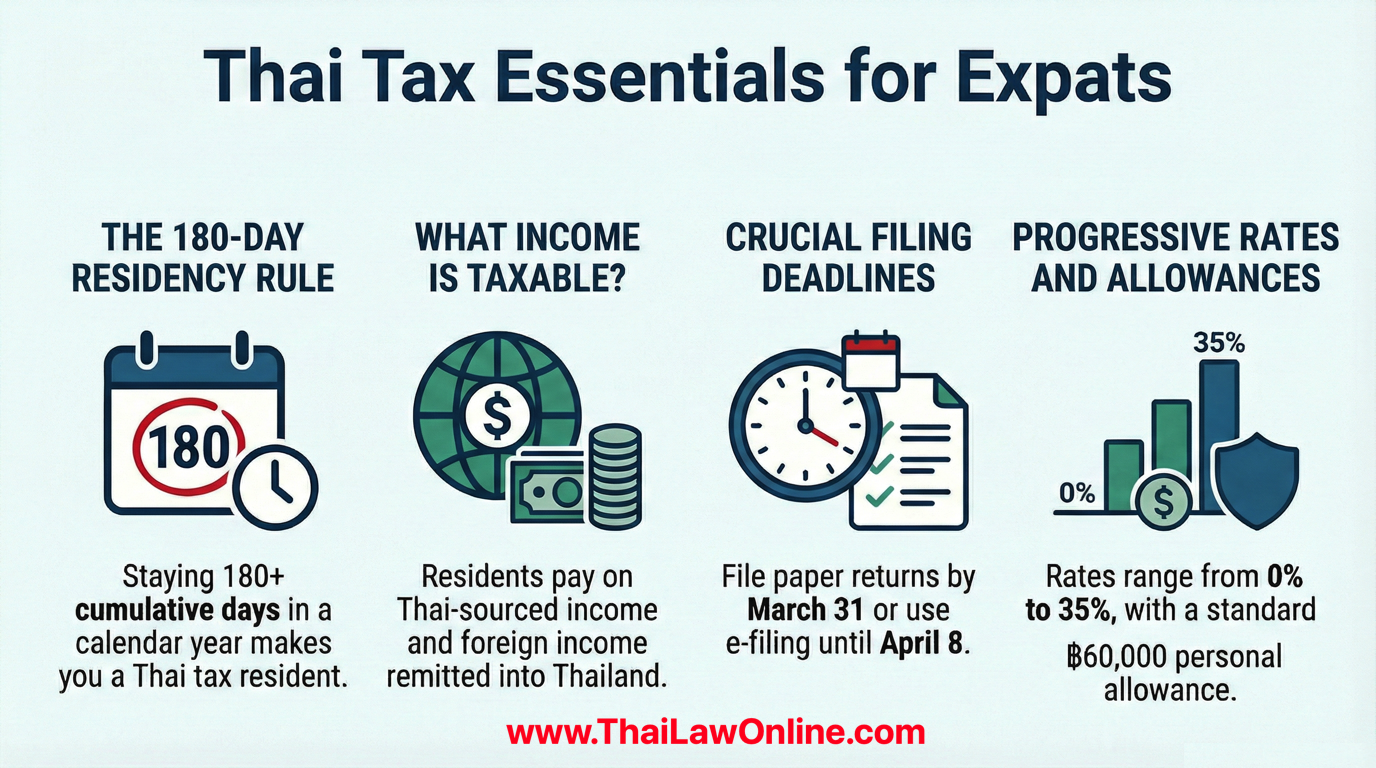
Tax residency in Thailand is determined solely by physical presence, not by visa type, nationality, or immigration status. Under Section 41 of the Thai Revenue Code, any individual who resides in Thailand for 180 days or more during a calendar year (January 1 to December 31) qualifies as a Thai tax resident.
This classification has major implications:
- Tax residents are liable for personal income tax on all Thai-sourced income and on foreign-sourced income remitted into Thailand.
- Non-residents are taxed only on income sourced within Thailand, such as salaries from Thai employers or rental income from Thai property.
The 180-day count does not need to be consecutive. Every day spent inside Thailand counts toward the threshold, regardless of the visa held. Teachers, retirees, business owners, and digital nomads who exceed 180 days are all subject to the same residency rules.
Important
The Thailand Privilege (Elite) visa does not provide any tax exemption. It is essentially a tourist visa with VIP benefits. Holders who stay 180+ days remain full tax residents under standard rules.
The 2024 Foreign Income Remittance Rule (Por.161/2566)
What Changed on January 1, 2024
On September 15, 2023, the Thai Revenue Department issued Departmental Instruction No. Por.161/2566, fundamentally changing how foreign-sourced income is taxed in Thailand. The new rules took effect on January 1, 2024, and represent the most significant tax change for expatriates in decades.
Before 2024: the Revenue Department treated foreign-sourced income as taxable only where it was remitted to Thailand in the same calendar year it was earned. That position sat in departmental practice and in replies to ruling requests rather than in the Revenue Code itself, which is why clause 2 of Por.161/2566 was able to sweep it away in a single sentence: it repeals every regulation, rule, order, reply to a ruling request and practice that conflicts with the order. The practical effect was a simple planning strategy: earn abroad, wait until the following year to transfer the money, and it arrived untaxed.
From January 1, 2024: foreign-sourced income is taxable when a Thai tax resident brings it into Thailand, in whichever tax year it is brought in. Clause 1 of Por.161/2566 requires a person who was a resident of Thailand in the tax year the income arose, and who brings that income into Thailand in any tax year, to include it in the Section 48 computation for the tax year in which it is brought in. Clause 3 applies the order to assessable income brought into Thailand from 1 January 2024 onwards. So the year the money enters Thailand triggers the tax, not the year it was earned abroad. What the order does not do is reach backwards, and the carve-out that says so is the next section.
Pre-2024 Income Protection (Por.162/2566)
On November 20, 2023, the Revenue Department issued Departmental Instruction No. Por.162/2566, which does one thing: it adds a second paragraph to clause 1 of Por.161/2566 reading that the clause “shall not apply to assessable income arising before 1 January B.E. 2567 (2024)”. Income that arose before that date is therefore outside the 2024 rule even when it is remitted afterwards. Both instructions are khamsang krom sanphakon, departmental instructions, and each says in its own preamble that it is issued so that revenue officers have a practice guideline for examining and advising taxpayers. They are not amendments to the Revenue Code. Both were read here in the original Thai on the Revenue Department’s own site: Por.161/2566 and Por.162/2566.
To claim this protection, expats should:
- Maintain separate bank accounts for pre-2024 and post-2024 funds.
- Preserve bank statements from December 2023 showing account balances as proof.
- Keep records of when income was earned (pay stubs, invoices, pension statements).
- Do not rely on a FIFO (First-In, First-Out) assumption. The idea commonly described for mixed accounts, that older funds are treated as spent first, appears in neither Por.161/2566 nor Por.162/2566 and is not a published rule. Treat it as accounting practice rather than law, and keep records that identify the funds directly.
What Counts as a “Remittance”
The definition of remittance is broader than many expats realize. Each of the following methods brings money into Thailand. Whether tax is then due depends on what the money is: assessable foreign income that arose on or after 1 January 2024, in a year in which you were a Thai tax resident, is taxable however it arrives.
| Remittance Method | Example | Counts as bringing money in? |
|---|---|---|
| Bank wire transfers | Sending money from a US/UK bank to a Thai bank account | Yes |
| ATM withdrawals | Using a foreign debit card at a Thai ATM | Yes |
| Credit/debit card payments | Paying for goods in Thailand with a foreign card | Yes |
| Physical cash | Carrying foreign currency across the border | Yes |
| Cryptocurrency conversion | Moving crypto to a Thai exchange and converting to THB | Yes |
| Online payment platforms | PayPal or Wise transfers to a Thai bank account | Yes |
What is NOT taxed under the remittance rule:
- Foreign income kept entirely offshore (never brought into Thailand).
- Income earned before January 1, 2024, with proper documentation.
- Income that arose in a tax year in which the individual was not a Thai tax resident. The Revenue Department states this plainly: a person who was in Thailand for fewer than 180 days in the year the income arose owes nothing on it, even if the money is later brought in while resident.
One point is often stated the other way round, and we cannot support it. The Revenue Department’s test has two elements: the income must arise on or after 1 January 2024 in a tax year in which the person spent 180 days or more in Thailand, and the person must bring it in in that tax year or any later one. The residence test is attached to the year the income arose. Nothing in the two departmental instructions, in the Revenue Department Legal Division’s own eight-page question and answer paper on them, or in any reported Supreme Court decision we can find, says that being non-resident in the year you remit makes an otherwise taxable remittance exempt. The Department has addressed the point directly, and not only by implication. The Legal Division’s paper sets out a table of four cases covering when the income arose, how long the taxpayer was in Thailand, and when the money was brought in. Its single residence column is headed time spent in Thailand in the tax year in which the assessable income arose. The table reaches a taxable or not taxable answer in all four cases without once asking whether the taxpayer was resident in the year of the remittance. In the first of those cases, income arising on or after 1 January 2024 in a year of 180 days or more and brought in on or after that date, the answer is that tax is due. Two limits are worth stating plainly. These are departmental instructions and departmental guidance, which bind revenue officers as their working rule but are not an amendment to the Revenue Code, and no reported Supreme Court decision has tested the question. So plan on the basis that income which arose in a resident year is taxable whenever you bring it in, and take advice before doing anything that depends on the opposite.
Proposed Two-Year Remittance Tax Exemption (Pending)
In June 2025 the Revenue Department was reported to be drafting legislation to ease the foreign income tax burden. Under the proposal, foreign-sourced income earned from 2024 onward would be exempt from tax if remitted within two calendar years, meaning in the year earned or the following year.
| Scenario | Tax Status (If Enacted) |
|---|---|
| Income earned in 2025, remitted in 2025 | Exempt |
| Income earned in 2025, remitted in 2026 | Exempt |
| Income earned in 2025, remitted in 2027 or later | Taxable at progressive rates |
A two-year window of that kind would have to be enacted before it applied to anyone, and it has not been. As of 4 September 2026, the Royal Decrees issued under the Revenue Code run to No. 807, published in the Royal Gazette on 23 August 2026, and none of those listed in the Revenue Department’s register concerns foreign-sourced income. The register shows no decree numbered 806. The most recent decrees cover extensions of the reduced VAT rate, hotel refurbishment, domestic seminars, SME digitalisation, artists, a donation exemption and solar rooftops.
Current Status: NOT Enacted
As of 4 September 2026 the proposal has not been enacted. Nor has anything else moved the rule: no departmental instruction issued after Por.162/2566 touches Section 41, the series having reached Por.164/2568, which concerns the sale of goods outside the Kingdom, and the only two entries in it on Section 41 paragraph two are still Por.161/2566 and Por.162/2566. The Revenue Department’s own Manual for the Foreign Tax Credit Calculation Tool, published in November 2025, sets out the law governing foreign-sourced income as Sections 40, 41, 48 and 56 of the Revenue Code, Royal Decree (No. 18) B.E. 2505, Por.161/2566 and Por.162/2566, and lists nothing further. Until an exemption is published in the Royal Gazette, the rules described above are the rules that apply.
Warning
Tax residents should not rely on this proposal for their 2026 tax filings. Plan and file based on the current rules until the exemption is officially published in the Royal Gazette.
Eight Categories of Assessable Income in Thailand
The Thai Revenue Code (Section 40) divides assessable income into eight categories. Correctly classifying income is important because different categories allow different standard deduction percentages. Here are the categories for personal income tax in Thailand:
| Category | Income Type | Standard Deduction |
|---|---|---|
| 1 | Employment income: salaries, wages, bonuses, pensions | 50% of income, max 100,000 THB |
| 2 | Hire of work/services: commissions, agent fees, director fees | 50% of income, max 100,000 THB combined with category 1 |
| 3 | Rights and annuities: goodwill, copyrights, franchises | 50% of income, max 100,000 THB |
| 4 | Investment income: dividends, interest, capital gains, crypto | No standard deduction |
| 5 | Rental income: property, vehicles, other assets | 10% to 30% depending on asset type |
| 6 | Professional services: medical, legal, engineering, accounting | 30% or 60% depending on profession |
| 7 | Construction services and contracts of work | 60% of income |
| 8 | Other income: business, commerce, agriculture, transport | 60% of income |
Personal Income Tax Rates in Thailand (2026)
Thailand applies a progressive tax system, meaning each portion of income is taxed at the rate for its respective bracket, not the entire income at a single rate. Both Thai nationals and foreign tax residents are subject to the same rate schedule.
Two instruments make up the table below, which is worth knowing if you ever check it against the statute. The rates come from the income tax rate schedule of the Revenue Code (banchi atra phasi ngoen dai, item 1), as replaced by the Revenue Code Amendment Act (No. 44) B.E. 2560 and applying from the 2560 tax year onward. Read alone that schedule taxes the first 300,000 baht at 5 per cent: the 0 to 150,000 exemption is not in it. The exemption is granted separately by Royal Decree No. 470 B.E. 2551, which exempts the first 150,000 baht of net income computed under section 48 (1) of the Code. So the first bracket in the table below comes from a Royal Decree, not the statute, and it is the one that would change most easily.
| Net Taxable Income (THB) | Tax Rate | Maximum Tax at This Bracket |
|---|---|---|
| 0-150,000 | Exempt | 0 THB |
| 150,001-300,000 | 5% | 7,500 THB |
| 300,001-500,000 | 10% | 20,000 THB |
| 500,001-750,000 | 15% | 37,500 THB |
| 750,001-1,000,000 | 20% | 50,000 THB |
| 1,000,001-2,000,000 | 25% | 250,000 THB |
| 2,000,001-5,000,000 | 30% | 900,000 THB |
| Over 5,000,000 | 35% | No cap |
How Progressive Taxation Works: A Practical Example for Personal Income Tax in Thailand
An expat earning a net taxable income of 500,000 THB does not pay 10% on the full amount. Instead:
- First 150,000 THB → Exempt = 0 THB. No tax is due on this slice, but that does not remove the duty to file a return: see the filing thresholds below.
- Next 150,000 THB (150,001-300,000) → 5% = 7,500 THB
- Next 200,000 THB (300,001-500,000) → 10% = 20,000 THB
- Total tax: 27,500 THB (effective rate of 5.5%)
Tax Deductions and Allowances
Maximizing legal deductions is the most effective way to reduce personal income tax in Thailand. The Revenue Code offers a wide range of personal allowances, insurance deductions, and investment incentives.
Personal and Family Allowances for Personal Income Tax in Thailand
| Deduction Type | Maximum Amount (THB) |
|---|---|
| Personal allowance (taxpayer) | 60,000 |
| Spouse allowance (if spouse has no income) | 60,000 |
| Child allowance (per child) | 30,000 for each legitimate child, with no limit on how many. Adopted children are 30,000 each but no more than three children in total may be claimed, and if you already have three or more living legitimate children you cannot claim for an adopted child at all. Section 47 (1) (ค) allows the deduction only for a child who is a minor, or is under 25 and studying at university or another higher education institution, or has been declared incompetent or quasi-incompetent by a court and is in your care, and it is lost for a child who had assessable income of 30,000 baht or more in the tax year, not counting income exempt under section 42 |
| 2nd+ child born in or after 2018 | 60,000 per child: the ordinary 30,000 plus a further 30,000 for the second and any later legitimate child born in or after 2018, added by the Revenue Code Amendment Act (No. 46) B.E. 2561 for tax year 2561 onwards. Watch how birth order is counted, because it decides whether a child is the second: for this extra allowance section 47 (1) (ค) counts every child you have had, whether living or not. The three-child limit in the row above is counted the other way, on living children only |
| Dependent parent, and the parents of a spouse as well | 30,000 per parent. The conditions are the ones in section 47 (1) (ญ) of the Revenue Code and they are not about where the parent lives: the parent must be 60 or over, must have income insufficient for subsistence, and must be in your care. The allowance is not available for a parent whose assessable income in the tax year exceeds 30,000 baht, which is the test that disqualifies most claims |
| Disabled or incapacitated dependent | 60,000 per person. Section 47 (1) (ฎ) reaches a parent, spouse, legitimate or adopted child, a spouse’s parent or child, or another person for whom you are the legal guardian. The same 30,000 baht income ceiling applies to the dependent |
| Childbirth expenses | Up to 60,000 per pregnancy |
| Senior taxpayer (65+ years) income exemption | Up to 190,000. This is an additional income exemption, not a deduction. |
Insurance and Retirement Deductions
| Deduction Type | Maximum Amount (THB) |
|---|---|
| Life insurance premiums (Thai insurance company) | 100,000 |
| Health insurance premiums | 25,000. Ministerial Regulation No. 365 (B.E. 2563), Royal Gazette 17 June 2020, raised this from the 15,000 set by Ministerial Regulation No. 334 and applies to premiums paid from 1 January 2020. The combined cap with life insurance in the row below is in the same instrument |
| Combined insurance cap | 100,000 |
| Parents’ health insurance | 15,000. There is no age condition: each insured parent must have assessable income of not more than 30,000 baht in the tax year |
| Provident fund contributions | 15% of income, max 500,000 |
| Retirement Mutual Fund (RMF) | 30% of assessable income, capped at 500,000. Ministerial Regulation No. 357 (B.E. 2563), Royal Gazette 10 March 2020, raised the rate from 15% for income received from 1 January 2020. The units must be held at least five years from the first purchase and redeemed at 55 or older, or the relief is lost |
| Pension (annuity) life insurance | 15% of income, max 200,000 |
| National Savings Fund (NSF) | The amount actually paid in as savings, up to 500,000, and within the 500,000 combined retirement cap. That is clause 2 (90) of Ministerial Regulation No. 126, inserted by Ministerial Regulation No. 314 (B.E. 2559). The fund’s own annual ceiling is not fixed in the National Savings Fund Act: section 31 requires savings of at least 50 baht a month and no more than an amount prescribed by ministerial regulation, so check the current ceiling with the fund before relying on a figure |
| Combined retirement cap | 500,000 |
Other Deductions for Personal Income Tax in Thailand
| Deduction Type | Maximum Amount (THB) |
|---|---|
| Home mortgage interest | 100,000 |
| Social security contributions | Actual amount contributed, up to 10,500 for 2026 (875 per month at the new Section 33 wage ceiling of 17,500). A reduced 3% rate applied from December 2025 to May 2026 in nine flood-hit southern provinces, so those employees deduct the lower amount actually paid. |
| Thai ESG Fund investment (2024-2026) | 30% of income, max 300,000 |
| Social enterprise investment | 100,000 per year |
| Charitable donations (100%/200% concession) | Up to 10% of subtotal net income. For gifts made from 1 January 2026, only donations recorded in the Revenue Department’s e-Donation system support the deduction |
Two temporary items that circulated in 2025 do not carry into 2026. The domestic tourism deduction (“Tiew Dee Mee Khuen”) under Ministerial Regulation No. 401 (B.E. 2568), published in the Royal Gazette on 19 November 2025, covered hotel, homestay and restaurant spending between 29 October and 15 December 2025 only: up to 10,000 THB on any tax invoice, a further 10,000 THB where the invoice was an e-Tax Invoice, and one and a half times those amounts for travel in the 55 listed secondary provinces. It belonged to the 2025 return, which was due on 31 March 2026, and no 2026 round has been approved as of 3 September 2026. The Thai ESG fund deduction (30% of assessable income, up to 300,000 THB, units held at least five years) applies to purchases made between 1 January 2024 and 31 December 2026 under Ministerial Regulation No. 395 (B.E. 2567), so 2026 is its final year unless it is extended. Deductions change every year, so check the current list before you file.
Which deductions changed for the 2026 tax year?
Three changes apply to income earned in 2026 and filed by 31 March 2027 (8 April online). None of them comes from the deduction “reform” announced in October 2025, which is covered in the next section and is not law.
1. The social security deduction rose to a maximum of 10,500 THB. The Ministerial Regulation prescribing the minimum and maximum wages used as the base for Section 33 contributions, B.E. 2568, made under sections 7 and 46 of the Social Security Act B.E. 2533, given by the Minister of Labour on 11 December 2025, published in the Royal Gazette volume 142 part 81 Kor on 12 December 2025 and in force from 1 January 2026, raises the wage ceiling on which Section 33 contributions are calculated, in three steps. The employee rate stays at 5%, so the deductible amount rises with the ceiling:
| Period | Monthly wage ceiling (THB) | Maximum employee contribution per month | Maximum deduction per year |
|---|---|---|---|
| Up to 31 December 2025 | 15,000 | 750 | 9,000 |
| 1 January 2026 to 31 December 2028 | 17,500 | 875 | 10,500 |
| 1 January 2029 to 31 December 2031 | 20,000 | 1,000 | 12,000 |
| From 1 January 2032 | 23,000 | 1,150 | 13,800 |
Employees in the nine southern provinces covered by the flood relief (Trang, Nakhon Si Thammarat, Narathiwat, Pattani, Phatthalung, Yala, Songkhla, Satun and Surat Thani) paid a reduced 3% rate from December 2025 to May 2026 and deduct what they actually paid.
2. Donations must go through e-Donation. In August 2025 the Director-General of the Revenue Department wrote to the National Office of Buddhism that, from 1 January 2026, a donation to a temple, foundation, association, fund or other approved donee supports a tax deduction only if it is recorded in the Department’s e-Donation system. A paper receipt or anumodana certificate can still be issued, but the Department has said it will not support the deduction. As of 3 September 2026 we have not found a Ministerial Regulation or Director-General’s notification in the Royal Gazette giving this effect, and the Department’s own letter described it as a change it would make to the law. In practice the point is settled anyway: the e-filing system pre-fills donations from e-Donation data, and a 2026 donation that exists only on paper should be expected to be refused. Give by scanning the donee’s e-Donation QR code, or through a bank channel that reports to the system, and check the entry on the Department’s e-Donation portal before you file. The double deduction for e-Donation gifts to schools, universities and sports bodies is the same story in reverse: the Cabinet approved on 16 June 2026 two draft Royal Decrees extending it to gifts made from 1 January 2025 to 31 December 2027, but neither had reached the Royal Gazette when we last checked the Revenue Department’s own register of royal decrees on 4 September 2026, whose most recent entry is No. 807 of B.E. 2569 and which lists no decree extending this relief. So it cannot yet be claimed.
3. The shopping and travel stimulus deductions expired. Easy E-Receipt 2.0 under Ministerial Regulation No. 397 (B.E. 2568), published on 10 January 2025, covered purchases from 16 January to 28 February 2025 and is claimed in the 2025 return, not the 2026 one. The tourism deduction closed on 15 December 2025. Nothing has replaced either for 2026 spending.
Did Thailand cap tax deductions in 2026?
No. There is no ceiling on total deductions in Thai law, and income earned in 2026 is governed by the tables above. What actually happened:
- 14 October 2025: Deputy Prime Minister and Finance Minister Ekniti Nitithanprapas said the deduction system was “scattered”, floated a single ceiling on total deductions, and promised an operational framework by November 2025. The Finance Ministry’s permanent secretary said the earliest application would be income earned in 2026, because the Revenue Code would have to be amended.
- November 2025: no framework was published as an instrument.
- 12 December 2025: the House of Representatives was dissolved, freezing the reform with the rest of the legislative programme.
- 8 February 2026: general election, followed by a new government under Anutin Charnvirakul.
- July 2026: the Finance Ministry’s ten-point tax reform plan schedules “a revision of the personal income tax structure and a review of selected deductions and allowances” for 2027. The Bangkok Post’s report of the plan puts the projected revenue at 50 billion THB a year; a figure of 45.8 billion THB appears in other coverage of the same review. The same plan lists the top-up tax and a 1,000 THB outbound travel levy for 2027, and a VAT increase to 8.5% for 2028.
Status, checked 3 September 2026 against the Revenue Department’s registers of subordinate legislation: the Ministerial Regulations under the Revenue Code run to No. 401 (Royal Gazette 19 November 2025) and the Royal Decrees to No. 807 (23 August 2026), and none of them, nor any amending Act, imposes a ceiling on deductions. A ceiling would need a Revenue Code amendment passed by Parliament, or a Royal Decree where the Code already delegates the power, and either must be published in the Royal Gazette before it binds anyone. On the ministry’s own timetable the earliest realistic effect is income earned in 2027 and filed in 2028. Nothing needs doing today beyond keeping receipts and e-Donation records.
Is there an Easy E-Receipt for 2026?
No. On 3 September 2026 the Finance Minister said there is no plan to bring the measure back in the near term, citing leakage and the fact that the benefit goes mostly to higher earners. Easy E-Receipt 2.0 was the 2025 round: purchases from 16 January to 28 February 2025, up to 30,000 THB plus a further 20,000 THB on OTOP and community-enterprise goods, both requiring an e-Tax Invoice or e-Receipt. It is claimed in the 2025 return filed in early 2026 and does not apply to any 2026 spending. If a new round is approved it will come as a Ministerial Regulation under the Revenue Code and will appear in the Royal Gazette before it takes effect; this section will be updated when that happens.
Double Taxation Agreements (DTAs)
Thailand has signed Double Taxation Agreements with 61 countries to prevent income from being taxed twice. These treaties have become more important than ever under the 2024 remittance rules.
How DTAs Protect Expats
DTAs work primarily through the foreign tax credit method: if tax has already been paid on income in the home country, that amount can be credited against the Thai tax liability on the same income. The credit is limited to the lesser of (a) the tax actually paid abroad, or (b) the Thai tax that would apply to that income.
On January 6, 2026, the Thai Revenue Department released an official Foreign Tax Credit Calculation Tool. This helps residents correctly compute their allowable credits when filing PND 90 or PND 91 returns.
Countries with a DTA with Thailand
Thailand’s 61 DTA partners include:
Asia-Pacific: Australia, Bangladesh, Cambodia, China, Hong Kong, India, Indonesia, Japan, Korea, Laos, Malaysia, Myanmar, Nepal, New Zealand, Pakistan, Philippines, Singapore, Sri Lanka, Taiwan, Vietnam
Europe: Armenia, Austria, Belarus, Belgium, Bulgaria, Cyprus, Czech Republic, Denmark, Estonia, Finland, France, Germany, Hungary, Ireland, Italy, Luxembourg, Netherlands, Norway, Poland, Romania, Russia, Slovenia, Spain, Sweden, Switzerland, Turkey, Ukraine, United Kingdom
Americas: Canada, Chile, United States
Middle East & Africa: Bahrain, Israel, Kuwait, Mauritius, Oman, Seychelles, South Africa, United Arab Emirates
Central Asia: Tajikistan, Uzbekistan
Special DTA Considerations for Common Expat Countries
- US Social Security: Generally taxable only in the US under the DTA, not in Thailand.
- Canadian state pensions (CPP/OAS): Typically taxable only in Canada.
- Australian pensions: Under Article 18 of the Australia-Thailand agreement, a pension paid to a Thai resident is taxable only in Thailand, and the Australian Taxation Office has applied that to a war veteran’s pension. Only a pension for Australian government service (Article 19) is generally taxable only in Australia.
- Private/employer pensions: Usually are taxable in Thailand if remitted, though credits for home-country tax may apply.
- US citizens: Due to a “Savings Clause” in the US-Thailand DTA, Americans should primarily use US mechanisms (Foreign Tax Credit or FEIE) to mitigate double taxation.
LTR Visa: Tax Exemption on Foreign Income
The Long-Term Resident (LTR) visa offers the most powerful tax benefit available to qualifying expatriates. Under Royal Decree No. 743 (B.E. 2565), published in the Royal Gazette on 23 May 2022, three of the four LTR categories receive a complete exemption from personal income tax on foreign-sourced income brought into Thailand. Section 5 of the decree frames it precisely: the exemption covers assessable income under section 40 of the Revenue Code arising in a previous tax year from employment or business carried on abroad, or from property situated abroad, and then brought into the country.
| LTR Visa Category | Foreign Income Tax | Requirements |
|---|---|---|
| Wealthy Global Citizens | Exempt | USD 1M+ in assets, USD 500K+ Thai investment |
| Wealthy Pensioners | Exempt | USD 80K+/year passive income |
| Work-from-Thailand Professionals | Exempt | USD 80K+/year salary, established employer |
| Highly-Skilled Professionals | Not exempt. Section 5 of the decree lists only the three categories above, so this category pays tax on foreign income brought in on the ordinary rules. What section 3 gives instead is a flat 17% on Thai employment income from a targeted-industry employer | Employment by a company in a targeted industry under the competitiveness-enhancement law, the investment promotion law or the Eastern Economic Corridor law |
The exemption applies from the date the LTR visa is granted and remains valid while the visa is active. It does not apply retroactively to remittances made before visa approval. Those timing conditions are not in the decree itself: section 6 leaves the qualifications and conditions to a Director-General notification, which for this decree is Notification on Income Tax No. 427, and section 7 suspends the relief for any tax year in which the conditions are not met, for that year alone.
Cryptocurrency and Digital Asset Taxation
Thailand has implemented a five-year personal income tax exemption on gains from selling cryptocurrency and digital tokens (see our guide to cryptocurrency tax in Thailand), effective from January 1, 2025, to December 31, 2029.
Key conditions for the exemption:
- Trades must be executed through SEC-licensed exchanges, brokers, or dealers in Thailand.
- The exemption applies to individuals only. Companies remain subject to 20% corporate income tax.
- OTC or unlicensed platform transactions remain taxable under standard progressive rates.
Proper documentation of all digital asset transactions during the exemption period is essential for future compliance when the tax holiday expires.
Loss relief is a separate rule, and it is older. It does not come from the 2025 to 2029 exemption. Ministerial Regulation No. 380 (B.E. 2565), which added clause 2(104) to Ministerial Regulation No. 126 (B.E. 2509), exempts an amount of gain equal to the losses made on cryptocurrency or digital token transfers in the same tax year. It applies only to gains and losses on transfers carried out in a licensed digital asset exchange, it has run since 14 May 2018, and it has no end date. Two points follow that are easy to get wrong. The relief is capped at the amount of the losses, so it cannot produce a deductible net loss and nothing is carried forward to another year. And it is narrower than the exemption above: it covers the exchange only, not brokers or dealers.
The conditions sit in the Director-General’s Notification on Income Tax No. 424 of 24 March 2022. Gains and losses must be computed by a generally accepted accounting method, the same method must be used for the whole tax year, and the closing value at year end becomes the cost carried forward. The taxpayer must also keep an account of every transfer, showing at least the ticker, the date and time, the transaction type, the quantity, the price, the baht value, the transfer fee and the cost, and must be able to produce it to an assessment officer. While the 2025 to 2029 exemption is running it takes the whole gain on a licensed venue out of the computation, so the loss rule has little left to do; it matters for tax years before 2025 and after 2029.
How to Get a Thai Tax Identification Number (TIN)
Every expat who needs to file taxes must first obtain a Tax Identification Number (TIN) from the Thai Revenue Department. Without a TIN, tax returns cannot be filed and certain banking or property transactions may be restricted.
Who Needs a TIN
- Employees with Thai employers (typically arranged by the company).
- Retirees, digital nomads, and freelancers who are tax residents and remit income.
- Foreigners selling property in Thailand.
- Business owners bringing foreign profits into Thailand.
How to Apply
- Prepare documents: Passport, visa or entry stamp, proof of address matching the TM30 registration.
- Complete Form L.P. 10.1 with personal details, nationality, passport number, and Thai address.
- Visit the district Revenue Office responsible for the residential address.
- Submit the documents. Officers will verify and, if everything matches, issue the TIN. Processing can be same-day in many offices.
Tip
The TIN application is free at any Revenue Office and typically takes 20-30 minutes. Bringing a Thai speaker is helpful as not all offices have English-speaking staff.
Filing Personal Income Tax in Thailand
Who must file. Under Section 56 of the Revenue Code the duty to file depends on gross assessable income for the year, not on whether any tax is due. A single person must file if assessable income exceeds 60,000 THB, or 120,000 THB where the only income is employment income under Section 40 (1). For a married couple the thresholds are 120,000 THB and 220,000 THB on combined income. A person whose net income stays inside the 150,000 THB exempt band can therefore still be required to file a return showing no tax.
Filing Deadlines
| Filing Method | Deadline | Form |
|---|---|---|
| Paper filing | March 31 of the following year | PND 90 or PND 91 |
| E-filing (online) | April 8 of the following year (8-day extension) | PND 90 or PND 91 |
| Half-year return (non-salary income) | End of September | PND 94 |
PND 90 vs. PND 91
- PND 91 is for taxpayers with employment income only under Section 40 (1), such as salary, wages and pensions, from one employer or several.
- PND 90 is for taxpayers with any other type of income, alone or alongside a salary: for example rental income, investment income, freelancing, or business income, whether earned in Thailand or remitted from abroad.
Most expats with foreign income remittances will need to file PND 90.
How to File Online (E-Filing) for Personal Income Tax in Thailand
- Register at efiling.rd.go.th using the TIN and personal details.
- Log in and select the correct form (PND 90 or PND 91).
- Enter all income details for the tax year, including Thai-sourced and remitted foreign income.
- Input deductions: allowances, insurance premiums, donations, and retirement contributions.
- Review the tax calculation and submit.
- Pay any tax due via bank transfer, credit card, or QR code payment.
Penalties for Non-Compliance with Personal Income Tax in Thailand
| Violation | Penalty |
|---|---|
| Failing to file | A criminal fine of not more than 2,000 THB. It is a single fine, not a monthly one, and it does not apply where you show the failure was unavoidable |
| Late payment | A surcharge of 1.5% per month or part of a month on the tax, calculated on the tax alone and not on any penalty. It falls to 0.75% where the Director-General has approved an extension and you pay within it, and it can never exceed the amount of tax itself |
| Filing a return that understates the tax | A penalty of one times the tax payable, on top of the tax |
| Not filing at all, where the Department then assesses you | A penalty of two times the tax payable. This is the row most guides omit, and it is double the one above |
| Intentional fraud/evasion | 3 months to 7 years imprisonment and fines of 2,000-200,000 THB |
| Record keeping | Not a penalty but a duty: keep your records for at least 5 years |
Tax Planning Strategies for Expats in Thailand
1. Use Pre-2024 Funds First
Remit from accounts holding savings earned before January 1, 2024. Keep those funds in an account that has taken nothing in since, so the source of the remittance can be identified from the statements rather than from an assumption about the order in which money is spent.
2. Manage Tax Residency Strategically
Spending fewer than 180 days in Thailand in a calendar year means you are not a Thai tax resident for that year, and foreign-sourced income arising in that year is outside the Thai net for good, whenever you bring it in. Monitor the day count carefully, especially when travelling in and out. Note the limit of this. It works on the year the income arises. On the Revenue Department’s stated position, dropping below 180 days in the year you remit money that arose in a resident year does not remove the charge. Its four-case table tests residence only in the year the income arose, and taxes the remittance whenever the money is brought in. Plan on the arising year, not the remittance year, and take advice before relying on any reading of the point that a court has not tested.
3. Maximize DTA Foreign Tax Credits
Claim credits for taxes paid in the home country using the Revenue Department’s Foreign Tax Credit Calculation Tool. Keep the evidence the Department asks for: the foreign tax return and proof of payment, any foreign withholding tax certificates, official receipts from the foreign tax authority, and bank records showing the remittance into Thailand.
4. Maximize Thai Deductions
Take full advantage of the 60,000 THB personal allowance, spouse and child allowances, insurance premiums, and retirement fund contributions. These can significantly reduce the effective tax rate. For 2026, give through e-Donation if you want the donation deduction, and note that the social security deduction now reaches 10,500 THB.
5. Consider the LTR Visa
For expats who meet the financial thresholds, the LTR visa provides a complete exemption from tax on foreign income. This can save hundreds of thousands of baht annually for high-income retirees and remote professionals.
6. Time Remittances for Lower Tax Brackets
In years with lower Thai-sourced income, larger remittances may fall into lower progressive tax brackets. Planning the timing of transfers can optimize the overall tax burden.
Common Mistakes Expats Make
- Mixing pre-2024 and post-2024 funds in a single account without documentation. The entire transfer may then be treated as taxable.
- Failing to trace funds used for ATM withdrawals and card payments. Check whether the transaction brings assessable foreign income into Thailand; do not treat all spending as income or assume a foreign card avoids the remittance rules.
- Assuming proposed tax changes are law. The two-year grace period has not been enacted. File based on current rules.
- Not filing a return because no tax is due. The duty to file depends on gross assessable income (over 60,000 THB for a single person, or 120,000 THB if the only income is a salary), not on the 150,000 THB exempt band.
- Confusing the Thailand Privilege (Elite) visa with the LTR visa. Only the LTR visa provides a foreign income tax exemption.
- Ignoring Double Taxation Agreements. Many expats overpay by not claiming foreign tax credits they are legally entitled to.
Our fees
Talking to us
Tax questions that turn on your residency, your treaty position or the source of a remittance are worth an hour with a lawyer before you file. Consultations are 2,000 THB per hour and you get a written fee estimate before any further work. You can book a consultation directly.
Key Takeaways for Expatriates
Navigating personal income tax in Thailand requires awareness of the 2024 remittance rule changes, strategic use of deductions and DTAs, and timely filing. Expats should secure a TIN, understand which income categories apply, document pre-2024 funds carefully, and never assume that pending legislative proposals are already law. Professional tax advice tailored to individual circumstances remains the safest approach to compliance and tax optimization.
This guide is provided for informational purposes by ThaiLawOnline.com. Tax laws change frequently. Consult a qualified tax professional for advice specific to your situation.
Links about Personal Income Tax in Thailand:
Frequently Asked Questions
Do I have to pay Thai tax on my foreign pension?
It depends on when the pension was earned and whether a DTA applies. Pension income earned from 2024 onward is taxable when remitted to Thailand. However, pre-2024 pension income is protected under Por.162/2566. US Social Security and Canadian state pensions (CPP/OAS) are generally taxable only in the paying country under their DTAs. Australian pensions are different: apart from government-service pensions, they are taxable only in Thailand for a Thai resident. Private pensions are generally taxable but may qualify for a foreign tax credit.
I use my foreign credit card for purchases in Thailand. Is that taxable?
Not automatically. A payment method alone does not establish taxable income. Check the source and year of the funds, Thai tax residence when the foreign income arose, the amount brought into Thailand, and any exemption or treaty protection. Pre-2024 foreign income is outside the new interpretation. Keep statements tracing the funds, and obtain advice on how the particular card payment or withdrawal is treated. Do not assume either that every card purchase is taxable or that using a foreign card avoids a remittance.
What is the difference between PND 90 and PND 91?
PND 91 is for individuals who only earn employment income (salary). PND 90 is for individuals with any other type of income, including foreign remittances, rental income, investments, or business income. Most expats dealing with foreign income will file PND 90.
Can I file my taxes in English?
The Revenue Department’s e-filing system at efiling.rd.go.th has some English translation available, but the system can be challenging to navigate for complex situations. Engaging a Thai tax professional or filing service is advisable for expats with foreign income obligations.
Does the Thailand Elite visa give me any tax benefits?
No. The Thailand Privilege (formerly Elite) visa is a tourist visa with VIP services. It provides no tax exemptions whatsoever. If an Elite visa holder stays in Thailand for 180+ days, they are a full tax resident subject to standard rules. Only the LTR visa provides tax benefits on foreign income.
What happens if I earn crypto income in Thailand?
Capital gains from cryptocurrency and digital token sales are exempt from personal income tax from January 1, 2025, to December 31, 2029, under Ministerial Regulation No. 399. This exemption applies only to trades through SEC-licensed platforms and only to individuals. After 2029, crypto gains will revert to standard progressive tax rates unless the exemption is extended.
How do Double Taxation Agreements help me?
DTAs prevent the same income from being taxed in two countries. If an expat has already paid tax on income in the home country, a foreign tax credit can be claimed against the Thai tax liability. Thailand has DTAs with 61 countries. The Revenue Department released a Foreign Tax Credit Calculation Tool in January 2026 to help taxpayers compute their credits.
What if I stay in Thailand less than 180 days?
Individuals who are physically present in Thailand for fewer than 180 days in a calendar year are not Thai tax residents. Non-residents are only taxed on income sourced within Thailand (e.g., a Thai employer salary). Foreign-sourced income that arises in a non-resident year is not taxed, even if it is brought into Thailand later. The reverse does not hold: on the Revenue Department’s position, income that arose in a year when you were resident stays taxable when you bring it in, even in a year when you are non-resident.
When is the tax filing deadline for expats?
The annual personal income tax return must be filed by March 31 for paper submissions or April 8 for electronic filings through the Revenue Department’s e-filing portal. Filing late can attract a criminal fine of up to 2,000 THB, which is a single fine and not a monthly one, and unpaid tax carries a surcharge of 1.5% per month or part of a month that can never exceed the tax itself. Tax of 3,000 THB or more can be paid in three equal monthly installments without interest.
Is there a minimum income threshold for filing?
Yes, and it is not the 150,000 THB figure. Under Section 56 of the Revenue Code a single person must file if assessable income for the year exceeds 60,000 THB, or 120,000 THB where the only income is employment income. For a married couple the thresholds are 120,000 THB and 220,000 THB on combined income. The 150,000 THB figure is the band of net income on which no tax is charged, so a return can be compulsory even when no tax is due.
Is the 60,000 THB personal allowance still available in 2026?
Yes. The personal allowance of 60,000 THB, the spouse allowance and the child allowances are unchanged for income earned in 2026. The proposed ceiling on total deductions was never enacted and is now scheduled for review in 2027 at the earliest.
Do paper donation receipts still work for the tax deduction?
For donations made from 1 January 2026, the Revenue Department has said that only donations recorded in its e-Donation system support the deduction. A paper receipt or anumodana certificate is evidence of the gift but should not be relied on for tax. Scan the donee’s e-Donation QR code and check the record on the Department’s portal before filing.
Is the RMF deduction being cut?
Not for 2026. The RMF limit is still 30% of assessable income up to 500,000 THB, within the combined 500,000 THB retirement cap. Retirement and Thai ESG limits are among the deductions the Finance Ministry has said it will review for 2027, but no instrument has been published.
Will the deduction reform affect my 2026 filing in 2027?
No. The return filed in early 2027 covers income earned in 2026 and uses the deduction schedule on this page. Any reform must be published in the Royal Gazette first, and the ministry’s own timetable now points to income earned in 2027, filed in 2028.
Checked against 77,000+ Supreme Court decisions, Vortex database
Last reviewed: 3 October 2026. The deduction and allowance figures, the filing rules and the LTR exemption on this page were checked against the primary instruments: Ministerial Regulations No. 365 and No. 357 (B.E. 2563), section 47 (1) (ค) of the Revenue Code as amended by the Revenue Code Amendment Act (No. 46) B.E. 2561, clause 2 (90) of Ministerial Regulation No. 126, section 56 of the Code with the Ministry of Finance announcement on internet filing (No. 9), Royal Gazette 16 December 2025, and Royal Decree No. 743 (B.E. 2565). The treaty country list, the tax identification number and e-filing procedure, and the detailed LTR conditions in Director-General Notification No. 427 are general guidance and were not checked line by line against primary sources.
Thai Law Updates, free by email
Plain-English updates on Thai law changes that affect foreigners: property, visas, marriage, business and wills. One short email a month from a firm practicing since 2006. No spam, unsubscribe anytime.