


Reviewed by ThaiLawOnline, a licensed Thai law firm practising in Thailand since 2006. Thai lawyer of record: Wichuda Atthamethakon, LL.M., Thai Bar Licence 3149/2556.
Last updated on
Cryptocurrency adoption in Thailand is growing fast, with more people investing, trading, and earning in digital assets. But how does this affect your cryptocurrency tax in Thailand? The Thai Revenue Department has clear rules about how to tax cryptocurrency. It is important to follow these tax rules in Thailand. As cryptocurrency tax in Thailand grows in importance, it’s essential to understand how it affects crypto investors and businesses. This includes knowing the tax rate.
Digital asset gains are assessable income, which is explained in context in our guide to personal income tax in Thailand.
Is Cryptocurrency Taxed in Thailand?
Last reviewed: 8 September 2026. The VAT and withholding positions on this page were checked against the royal decrees themselves, read from their Royal Gazette PDFs: Nos. 744 of B.E. 2565, 779 of B.E. 2566, and 788 and 789 of B.E. 2567. The Revenue Department decree register was enumerated end to end, 678 decrees numbered 9 to 807 and current to B.E. 2569, to confirm nothing later amends them. Not verified in this review: Securities and Exchange Commission and Ministry of Finance notifications made after B.E. 2563, which our sources do not hold, and the personal income tax bands and filing dates, which are general Revenue Code matters rather than digital asset ones.
Yes. Cryptocurrency is legally classified as a digital asset under the Digital Asset Business Decree B.E. 2561 (2018). This means the Securities and Exchange Commission (SEC) controls it. It is also taxed like other financial assets. Whether you’re trading Bitcoin, mining Ethereum, staking tokens, or receiving crypto payments, you have tax obligations to consider.

How Cryptocurrency Taxes Work in Thailand
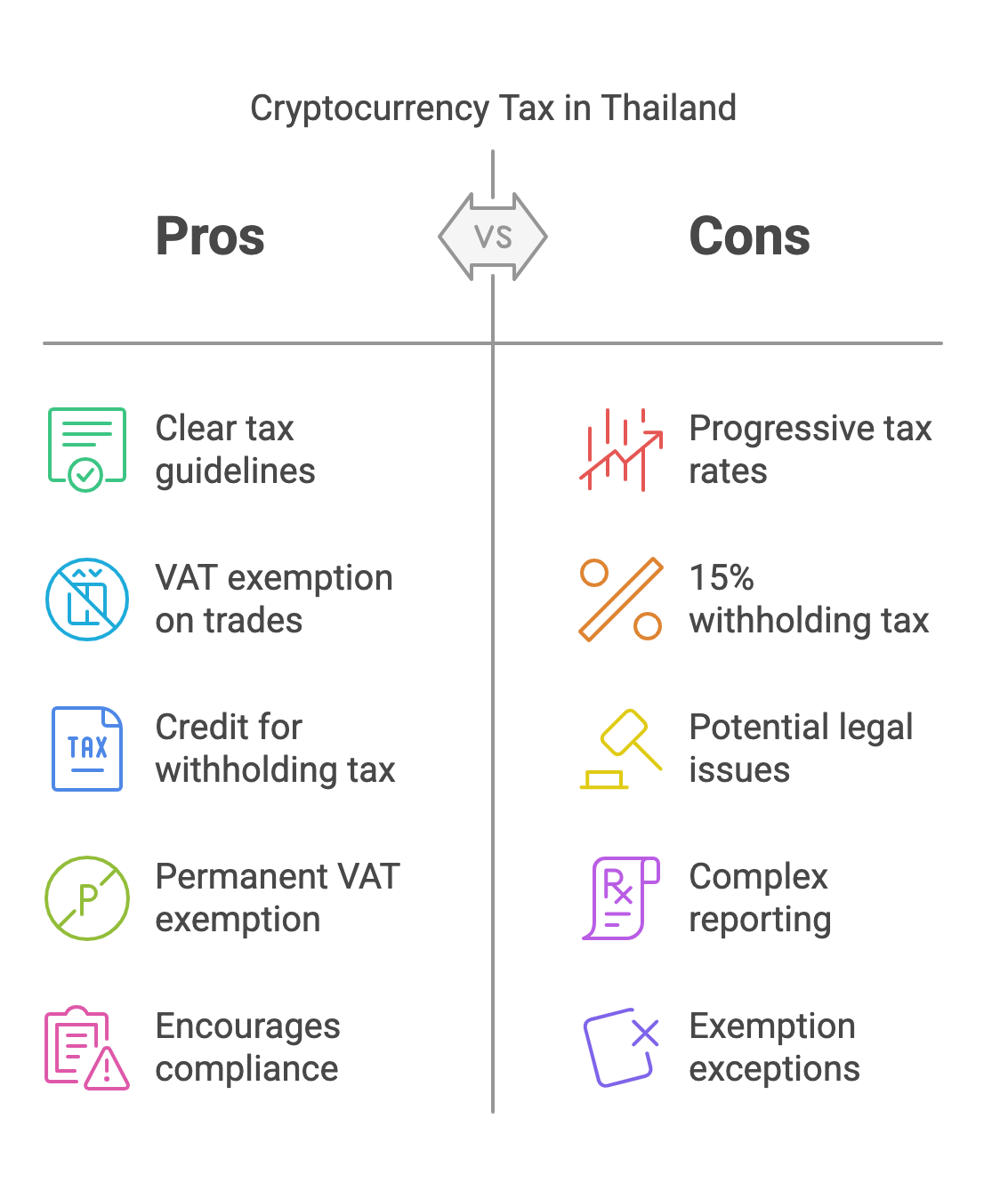
Thailand has two main types of taxes for cryptocurrency. The first is Personal Income Tax (PIT) on capital gains, and the second is Value Added Tax (VAT) on crypto transactions. The most important recent change: under Ministerial Regulation No. 399 (B.E. 2568), announced on 5 September 2025, capital gains from selling or transferring cryptocurrencies and digital tokens through an exchange, broker or dealer licensed by the Thai SEC are exempt from personal income tax from 1 January 2025 to 31 December 2029. Gains realised outside a licensed Thai platform, and foreign-sourced gains remitted into Thailand, are not covered by this exemption. Understanding cryptocurrency tax in Thailand can help you manage your investments efficiently.
1. Personal Income Tax (PIT) on Crypto Profits
If you make money from crypto, whether by selling, exchanging, or earning it through mining or staking, you must pay Personal Income Tax (PIT). Profits from selling or exchanging cryptocurrencies and digital tokens are taxable as part of your total income. Crypto gains are taxed at progressive rates from 5% to 35%, depending on your total income. For gains realised on an SEC-licensed Thai exchange such as Bitkub or Binance Thailand, the personal income tax exemption under Ministerial Regulation No. 399 applies for 2025 to 2029. Where tax is withheld it can be credited against your PIT when filing your return, preventing double taxation.
Consulting experts on cryptocurrency tax in Thailand can save you from unexpected liabilities. There is one exception: investment tokens (crypto assets linked to projects that generate dividends or interest). Where 15 per cent has already been withheld at source under section 50(2) of the Revenue Code, Decree No. 789 of B.E. 2567 lets you leave that profit share out of the annual income tax computation altogether, for amounts received from 1 January 2024. The condition is strict and is the part usually left out: it applies only if you do not reclaim or credit any part of the tax withheld, in whole or in part. Elect it and the 15 per cent becomes a final tax. This concerns investment tokens; it does not apply to ordinary cryptocurrencies such as Bitcoin or Ethereum.
2. Value Added Tax (VAT) on Cryptocurrency Transactions and the applicable tax rate are crucial for investors.
The relief comes from two royal decrees and it is worth being exact about them, because the current one is wider than the one most summaries still quote. Decree No. 744 of B.E. 2565 exempted VAT on transfers of cryptocurrency and digital tokens made on a licensed digital asset exchange, but only between 1 April 2022 and 31 December 2023, and it then lapsed. Decree No. 788 of B.E. 2567 replaced it from 1 January 2024 with no end date, and it reaches more than its predecessor did: transfers made on an exchange, through a digital asset broker, by a digital asset dealer, or to a dealer. So the 7 per cent does not fall on an ordinary trade through any of those channels, not only on an exchange. Now, individual traders do not have to worry about extra VAT when buying or selling crypto on legal exchanges.
Legal advice on cryptocurrency tax in Thailand is recommended for all digital asset holders.
How to Report Crypto Taxes in Thailand
Understanding cryptocurrency tax in Thailand can also enhance your investment strategy.
ThaiLawOnline can help you understand cryptocurrency tax in Thailand. We can guide you through your tax liability.
Many are seeking clarity about cryptocurrency tax in Thailand as regulations evolve.
We prioritize helping you navigate cryptocurrency tax in Thailand effectively.
Thailand’s tax year runs from January 1 to December 31, with tax returns due by March 31 (or April 8 for online filing). To stay compliant, you must track every crypto transaction. This includes purchases, sales, swaps, and mining rewards. You should convert all amounts to Thai Baht (THB) for reporting and calculating your taxes. Your crypto earnings should be declared as “Other Income” in your PND 90/91 tax return. Taxes owed must be paid by the deadline to avoid penalties.
The Thai Revenue Department has increased scrutiny on cryptocurrency transactions, making it crucial to report your earnings accurately. Failing to do so can result in fines and legal consequences.
Are There Any Crypto Tax Exemptions for cryptocurrencies and digital tokens?
Thailand has introduced some favorable tax rules for crypto traders. Transactions on licensed exchanges are VAT-free, reducing trading costs. From 1 January 2025 to 31 December 2029, capital gains from trades made through SEC-licensed Thai exchanges are exempt from personal income tax under Ministerial Regulation No. 399. Gains realised outside a licensed platform remain taxable, so keep records and check that your exchange is SEC-licensed. If you invest in security or investment tokens, you might get a tax benefit. This is true if the 15% withholding tax has already been taken from your cryptocurrency income.
What Happens If You Don’t Pay Crypto Taxes and fulfill your tax liability?
Ignoring crypto tax obligations can lead to significant consequences. The Thai Revenue Department keeps a close eye on digital asset transactions. If you do not report your income, you may face fines, penalties, or legal action. Traders who attempt to hide earnings or misreport their income risk severe repercussions, including restrictions on trading privileges. Staying compliant is the best way to protect both your assets and your financial future.
FAQS about Cryptocurrencies Tax in Thailand
How is cryptocurrency taxation managed in Thailand?
In Thailand, cryptocurrency and digital tokens have specific tax implications. The Thai Revenue Department sees cryptocurrencies as digital assets. Gains are subject to personal income tax; Thailand has no separate capital gains tax. Transactions are taxed based on their nature, trading, mining, or receiving cryptocurrency as payment. Since the rules have changed, especially with new laws starting on January 1, 2024, investors in Thailand should stay updated. They should know their responsibilities or talk to a tax advisor to follow local tax laws.
What is the capital gains tax for crypto in Thailand?
In Thailand, profits from cryptocurrency trading are taxed as personal income. The tax rates range from 0% to 35%, based on your income level. These gains are calculated as the difference between the selling price and the acquisition cost of the digital asset. Unlike some countries, Thailand does not have a separate capital gains tax rate specifically for crypto assets. Instead, profits from cryptocurrency investments are added to your annual taxable income. It’s important to maintain accurate records of all crypto exchange transactions to facilitate proper tax calculation.
Are cryptocurrencies and digital tokens subject to withholding tax?
Yes, cryptocurrencies and digital tokens in Thailand may be subject to withholding tax in certain scenarios. When a company or partnership pays for goods or services with cryptocurrency, they must withhold tax at the source. Rates differ by transaction: the 15 per cent under section 50(2) of the Revenue Code is the digital asset rate on a profit share or a benefit of the same kind, while the lower rates you may see quoted, 3 per cent among them, are the ordinary withholding on services and are not specific to crypto. Additionally, platforms facilitating the transfer of cryptocurrency may have withholding obligations. It’s important to note that even transactions between exchanges in Thailand can trigger withholding tax requirements.
How is cryptocurrency income reported for personal income tax purposes in 2024?
For 2024, cryptocurrency income must be reported on your personal income tax return in Thailand. You must declare all types of crypto income. This includes profits from trading, mining rewards, staking rewards, and payments in cryptocurrency. The tax filing deadline is typically March of the following year for individuals. You’ll need to report the Thai Baht value of your cryptocurrency at the time of receipt or transaction. Thailand’s Securities and Exchange Commission now requires exchanges to share transaction data with the Revenue Department. This change helps authorities track crypto income. Accurate reporting is important to avoid penalties.
Is value-added tax applicable to cryptocurrency and digital asset transactions?
Yes, value-added tax (VAT) can apply to cryptocurrency and digital asset transactions in Thailand. Businesses that take cryptocurrency as payment must include these transactions in their VAT calculations. The standard VAT rate in Thailand is 7%. Additionally, services provided by cryptocurrency exchanges may be subject to VAT. Buying and selling cryptocurrency itself is a settled exemption rather than a possibility: under Decree No. 788 of B.E. 2567 the transfer is exempt from VAT where it is made on a digital asset exchange, through a broker, or by or to a dealer. The tax treatment can change depending on the type of transaction. It is best to talk to a tax advisor for clear information on your VAT obligations.
Are there ways to reduce your taxable income from cryptocurrency in Thailand?
Yes, there are legitimate strategies to reduce your taxable income from cryptocurrency in Thailand. Outside the 2025 to 2029 exemption window, Ministerial Regulation No. 380 exempts gains up to the amount of your losses in the same tax year, but only for trades on a licensed Thai exchange, and nothing carries forward. You can also time your sales to spread income over different tax years. The main relief is the personal income tax exemption under Ministerial Regulation No. 399 for gains made through SEC-licensed Thai exchanges from 2025 to 2029. Additionally, properly documenting expenses related to acquiring or mining cryptocurrencies can help decrease your overall tax burden. For businesses dealing with crypto, certain operational expenses may be deductible. It is important to work with a qualified tax advisor. They should know about cryptocurrency and Thai tax laws. This will help make sure your strategies follow the current tax rules in Thailand.
How does the taxation of cryptocurrency differ for foreigners living in Thailand?
For foreigners residing in Thailand, the taxation of cryptocurrency depends on their tax residency status. If you are a tax resident, you usually stay 180 days or more in a year. This means you must pay taxes on all your cryptocurrency income from around the world. Non-residents are taxed only on income sourced within Thailand. One important point is that foreign income is taxed only when it is brought into Thailand. This includes crypto gains from overseas exchanges. Since 1 January 2024 (Revenue Department Instruction Por. 161/2566), this covers foreign income remitted in any later year, not only in the year it was earned; income that arose before 2024 stays outside the rule (Instruction Por. 162/2566). Foreigners should know about possible tax obligations in their home countries. Many nations tax their citizens on global income. This can lead to different tax rules. Careful planning is needed to avoid double taxation.
What documentation should I maintain for cryptocurrency tax filings in Thailand?
For proper cryptocurrency tax filings in Thailand, you should maintain comprehensive records including: transaction histories from all crypto exchanges you use (both Thai and international); dates, amounts, and counterparties for all crypto transactions; acquisition costs and dates for all digital assets; documentation of mining, staking, or airdrops received; records of cryptocurrency paid in cryptocurrency for goods or services; exchange rates to Thai Baht at the time of each transaction; and bank statements showing fiat currency conversions. These records should be kept for at least 5 years, as the Revenue Department may request this information during a tax audit. Using specialized crypto tax software can help organize this data and make tax calculation more accurate.
What are the penalties for not reporting cryptocurrency income in Thailand?
Failing to report cryptocurrency income in Thailand can incur significant penalties. If you do not report or file taxes on crypto income, you may face a 1.5% surcharge each month. This surcharge is capped at the amount of tax you owe. You could also get a penalty of up to 200% of the unpaid tax if you evade taxes. Additionally, criminal prosecution is possible for intentional tax evasion, potentially resulting in imprisonment. Now, Thailand’s Securities and Exchange Commission is sharing data with the Revenue Department. This means the chance of getting caught has increased significantly. Disclosing information before an investigation starts can lower penalties. It is wise to fix any past mistakes early. Also, talk to a tax advisor who knows about digital asset taxes.
Need Help with Crypto Taxes in Thailand?
Cryptocurrency taxation can be complex, especially with Thailand’s combination of PIT, withholding tax, and exemptions for digital tokens. If you’re unsure how to report your cryptocurrency income or optimize your tax strategy, expert assistance can help.
At ThaiLawOnline, we specialize in crypto tax compliance for individuals and businesses in Thailand. You might be a trader facing capital gains tax. You could also be a miner or staker earning crypto rewards. Or perhaps you run a business that accepts cryptocurrency payments. Our legal and tax experts can help you stay compliant. We can also help you optimize your tax obligations.
Contact Us Today
For personalized legal and tax support regarding Thailand cryptocurrency regulations, reach out to ThaiLawOnline. We can help you navigate Thailand’s crypto tax regulations with confidence. Contact us through our online consultation page and let’s get your taxes sorted.
Links: Bitkub (in English)
Thai Law Updates, free by email
Plain-English updates on Thai law changes that affect foreigners: property, visas, marriage, business and wills. One short email a month from a firm practicing since 2006. No spam, unsubscribe anytime.