


Reviewed by Wichuda Atthamethakon, LL.M., Thai Bar Licence 3149/2556, for ThaiLawOnline, a Thai law firm acting for foreigners since 2006.
Update log
- 4 November 2026: Added the statute box with Thai, English and French text and checked the page against the official text
Last reviewed: 26 September 2026. Read in Thai against section 1686 of the Civil and Commercial Code; the Inheritance Tax Act B.E. 2558, sections 2, 3, 12, 16 and 17; and Revenue Department Instructions Por.161/2566 and Por.162/2566. Not verified in this review: the gift tax thresholds, which come from the Revenue Code, the Trust for Transactions in Capital Market Act B.E. 2550, and the law of the foreign jurisdictions named. Re-checked on 5 October 2026: the gift-tax thresholds read in Thai in the Revenue Code consolidated to amendment No. 54 (sections 42(27), 42(28), 48(6) and 48(7)), and the Inheritance Tax Act sections 3, 16 and 17 re-read; the figures stand, and the 5 percent on the excess is now described as the recipient’s election. Re-checked on 10 October 2026: the Trust for Transactions in Capital Market Act B.E. 2550, sections 3, 8, 11 and 12, read in Thai on the government’s central law register; the page’s description matches, and the section 12 rule that only a juristic person may create such a trust has been added. The law of the foreign jurisdictions named remains unverified.
For expatriates in Thailand with assets in more than one country, estate planning gets complex. Trusts are common in the UK, US, Canada, and Australia. Thailand follows civil law and handles wealth protection and succession differently. Thai law gives a trust no effect unless a law authorises it, and the only such law covers capital-market trusts, not family estates.
Because Thailand does not recognise domestic trusts, a will does the work instead: see our guide to inheritance law in Thailand.

In common law, a trust separates legal ownership from beneficial interest. You, as settlor, transfer assets to a trustee. The trustee holds legal title and manages those assets for your beneficiaries.
Thailand does not recognize private trusts for family estate planning. A small exception applies to capital-market trusts. This is under the Trust for Transactions in Capital Market Act B.E. 2550 (2007). This act is supervised by the SEC. This regime serves REITs and securitization, not personal estates: under section 12 of that Act only a juristic person can create such a trust (a company issuing securities, the seller of assets in a securitisation, or another juristic person the SEC qualifies), so an individual cannot use it to hold family assets.
Table of Contents
What Is a Trust?
A trust is a legal arrangement that separates who owns an asset on paper from who benefits from it. The settlor gives assets to the trustee. The trustee holds the title and manages the assets for the beneficiaries.
Common types of trusts
- Revocable trusts: The settlor can change or end the trust while alive. These are often used for smooth estate transfers and to avoid probate.
- Irrevocable trusts: Harder to change. They can offer stronger asset protection and possible tax advantages.
- Discretionary trusts: The trustee has flexibility in how and when to distribute assets.
- Family trusts help manage cross-border wealth and support beneficiaries over generations. They are designed to support family members over generations and help keep family wealth together, especially for expats.
Key Benefits of Trusts
- Asset protection: Trusts can shield assets from certain claims, especially for expatriates navigating tax law.
- Estate planning efficiency: Trusts help avoid probate and keep your affairs private.
- Inheritance planning: Assets can pass smoothly across generations.
- Tax planning: Trusts may offer tax benefits, depending on the jurisdiction.
Trusts in Thailand: legal position
Thailand’s civil law system requires clear written rules for legal concepts. The Civil and Commercial Code does more than omit trusts: section 1686 provides that a trust created directly or indirectly by a will or by any other juristic act, taking effect during life or on death, has no effect unless it is created under a law that authorises trusts. In other words, Thailand does not recognize private trusts for personal estate planning under the Civil and Commercial Code. The only exception is the Trust for Transactions in Capital Market Act B.E. 2550 (2007). This act applies to capital-market uses regulated by the SEC. It does not apply to family or succession planning.
There have been discussions about reform. Practical reality today is simple. If you want to use a trust, you need to set it up in another country. Limit the foreign trust to non-Thai assets. Use Thai instruments for Thai-situated assets.
Trusts used for Thai family estates are therefore set up abroad and should hold only non-Thai assets. Do not attempt to place Thai immovable property under a foreign trust. Thai law provides no mechanism to register trustee title for that purpose. Use Thai instruments for Thai-situated assets.
Even though the law is the same across Thailand, officials in different districts or provinces might apply it differently. This can affect probate steps or document checks. Clear planning helps reduce delays.
The law behind this page
English
Section 1686
Full text
A trust created, whether directly or indirectly, by will or by any juristic act taking effect during lifetime or after death, has no effect, except by virtue of the provisions of a law enacted for the creation of trusts.
ThaiLawOnline translation
Section 37 Act on Conflict of Laws B.E. 2481
Full text
Succession, so far as it relates to immovable property, is governed by the law of the place where the property is situated.
ThaiLawOnline translation
Section 38 Act on Conflict of Laws B.E. 2481
Full text
As regards movable property, succession by statutory right or by will is governed by the law of the domicile of the deceased at the time of death.
ThaiLawOnline translation
Section 42 Revenue Code
Full text
The following types of assessable income shall be exempt and need not be included in the computation for income tax: (1) per diem allowances or travel expenses which an employee, or a person holding a duty or position, or a person performing work, has spent in good faith as necessary exclusively for the performance of his or her duties and has spent entirely for that purpose; (2) travel expenses and travelling per diem allowances at the rates fixed by the government under the Royal Decree on rates of travel expenses and travelling per diem allowances; (3) travelling money paid by an employer to an employee, only the portion which the employee has spent entirely as necessary for travelling from another locality to take up employment for the first time, or for returning to the place of origin when the employment has ended; but this exemption does not include travelling money received by the employee for returning to the place of origin and for taking up employment with the former employer within three hundred and sixty-five days from the date on which the previous employment ended; (4) where an employer and an employee entered into a contract in good faith before the Income Tax Act B.E. 2475 came into force, containing a provision that the employer would pay a gratuity, fee, commission or bonus to the employee in a lump sum when the employment ended, even if the full amount is paid after the provisions of this Part come into force, the part of the gratuity, fee, commission or bonus that is wages for work done before the Income Tax Act B.E. 2475 came into force need not be included in the computation for income tax; (5) special position allowances and housing allowances, or houses provided rent-free, for government officials of Thai embassies or consulates abroad; (6) income from the sale of, or discounts on the purchase of, government duty stamps or postage stamps; (7) meeting allowances for commission or committee members, or teaching fees and examination fees, paid by the government or a government educational institution; (8) the following interest: (a) interest on Government Savings Bank lottery bonds, or interest on Government Savings Bank deposits of the demand deposit type only; (b) interest on savings deposits received from a cooperative; (c) interest on savings deposits with banks in the Kingdom repayable on demand, only where the income earner receives such interest in a total amount not exceeding ten thousand baht throughout that tax year, in accordance with the rules, procedures and conditions prescribed by notification of the Director-General; (9) the sale of movable property that is inheritance, or of movable property acquired not for the purpose of trade or profit, but not including ships, vessels of six tons gross or more, steamships or motor vessels of five tons gross or more, or rafts; (10) income received from inheritance; (11) awards for education or scientific research, prizes from government lotteries or Government Savings Bank lottery bonds, prizes paid by the government in contests or competitions where the recipient is not a professional contestant or competitor, or rewards paid by the government for the purpose of suppressing offences; (12) special pensions, special gratuities, inherited pensions or inherited gratuities; (13) compensation for wrongful acts, money received from insurance or from funeral welfare schemes; (14) (repealed); (15) income of a farmer from the sale of rice produced by farming carried out by the farmer and/or his or her family; (16) income received from an estate which is subject to tax under section 57 bis; (17) income exempted as prescribed by Ministerial Regulation; (18) prizes from Thai Red Cross lotteries, and income from the sale of, or discounts on the purchase of, Thai Red Cross lottery tickets; (19) interest received under section 4 decies; (20) (repealed); (21) (repealed); (22) (repealed); (23) (repealed); (24) (repealed); (25) benefits received by an insured person from the Social Security Fund under the law on social security; (26) income from the transfer, without consideration, of ownership or possessory rights in immovable property to a legitimate child, not including an adopted child, only income from transfers to such legitimate child in the portion not exceeding twenty million baht per child throughout that tax year; (27) income received as maintenance or as a gift from an ascendant, descendant or spouse, only the portion not exceeding twenty million baht throughout that tax year; (28) income received as maintenance out of moral duty, or as a gift on the occasion of a ceremony or in accordance with custom and tradition, from a person who is not an ascendant, descendant or spouse, only the portion not exceeding ten million baht throughout that tax year; (29) income received as a gift where the donor declares an intention, or it is evident that the donor intends, that it be used for religious, educational or public-benefit purposes, in accordance with the rules and conditions prescribed in Ministerial Regulations.
ThaiLawOnline translation
Section 48 Revenue Code
Full text
Assessable income is subject to income tax as follows: (1) assessable income, after deductions under section 42 bis to section 47 or section 57 quinquies, leaves a balance that is net income, which is taxable at the rates in the income tax rate schedule at the end of this Chapter; (2) for a person with assessable income of 120,000 baht or more, the tax calculated under (1) shall be not less than 0.5 percent of the total assessable income. In counting assessable income under (2), assessable income under section 40 (1) is excluded; (3) an income earner may elect to pay tax at the rate of 15.0 percent of the income, without including it in the calculation of tax under (1) and (2), for the following income under section 40 (4) (a) and (g): (a) interest on bonds, interest on bank deposits in the Kingdom, interest on cooperative deposits, interest on debentures, interest on bills received from a company, a juristic partnership or another juristic person, interest on loans received from a company, a juristic partnership or another juristic person, and interest received from a financial institution established under a specific law of Thailand for lending to promote agriculture, commerce or industry; (b) the difference between the redemption price and the sale price of a bill or debt instrument issued by a company, a juristic partnership or another juristic person; (c) benefits received from the transfer of bonds, debentures, or bills or debt instruments issued by a company, a juristic partnership or another juristic person, only as to the amount valued in money in excess of the investment. An income earner who is a resident of Thailand may elect to pay tax at the rate of 10.0 percent of the income, without including it in the calculation of tax under (1) and (2), for income under section 40 (4) (b) received from a company or juristic partnership established under Thai law, or from a financial institution established under a specific law of Thailand for lending to promote agriculture, commerce or industry; (4) an income earner may elect to pay tax without including it in the calculation of tax under (1) and (2), only for income under section 40 (8) received from the sale of inherited immovable property or immovable property acquired without the object of trade or profit, as follows: (a) for income from the sale of inherited immovable property or immovable property received by gift, an expense of 50 percent of the income shall be deducted, the balance being net income, which is divided by the number of years of holding; tax is calculated on the result at the income tax rates, and the amount obtained is multiplied by the number of years of holding, the result being the tax payable; (b) for income from the sale of immovable property acquired other than under (a), expenses may be deducted as prescribed by royal decree, the balance being net income, which is divided by the number of years of holding; tax is calculated on the result at the income tax rates, and the amount obtained is multiplied by the number of years of holding, the result being the tax payable. Where tax is paid without inclusion in the calculation of tax under (1) and (2), the tax calculated shall not exceed 20 percent of the sale price. Where tax is paid with inclusion in the calculation of tax under (1) and (2), an expense of 50 percent of the income under (a), or as prescribed by royal decree under (b), as the case may be, shall be deducted, and the balance shall be included in the calculation of tax with other income. The term “number of years of holding” in (a) or (b) means the number of years counted from the year in which ownership or the right of possession of the immovable property was acquired to the year in which ownership or the right of possession of that immovable property is transferred; if it exceeds 10 years it shall be counted as 10 years only, and a fraction of a year shall be counted as 1 year; (4/1) an income earner may elect to pay tax at the rate of 5 percent of the income in excess of 20,000,000 baht, without including it in the calculation of tax under (1) and (2), for income under section 40 (8) from the transfer of ownership or the right of possession of immovable property without consideration to a legitimate child, excluding an adopted child, that is not exempt under section 42 (26); (5) an income earner may elect to pay tax without including it in the calculation of tax under (1) and (2), for assessable income under section 40 (1) and (2) that is money paid once by an employer by reason of leaving employment, calculated from the period of work and paid in accordance with the rules, procedures and conditions prescribed by the Director-General, by deducting from that assessable income an expense equal to 7,000 baht multiplied by the number of years of work, but not exceeding the assessable income, then deducting a further expense of 50 percent of the balance, and calculating the tax at the income tax rates. Where that assessable income is paid partly as a gratuity and partly as a pension, only the money paid as a gratuity shall be deemed money paid once by an employer by reason of leaving employment, and the expense of 7,000 baht shall be reduced to 3,500 baht. As to the number of years of work under paragraph one, in the case of a gratuity or any other money of the same nature paid by the government, the number of years used as the basis for calculating the gratuity or other money of the same nature under the laws, rules or regulations of the government shall be used. In calculating the number of years of work, other than in the case under paragraph three, a fraction of a year of 183 days or more shall be counted as 1 year, and a fraction of less than 183 days shall be disregarded; (6) an income earner may elect to pay tax at the rate of 5 percent of the income in excess of 20,000,000 baht, without including it in the calculation of tax under (1) and (2), for income under section 40 (8) received as support or by gift from an ascendant, a descendant or a spouse, that is not exempt under section 42 (27); (7) an income earner may elect to pay tax at the rate of 5 percent of the income in excess of 10,000,000 baht, without including it in the calculation of tax under (1) and (2), for income under section 40 (8) received as support under a moral duty or by gift on the occasion of a ceremony or in accordance with custom and tradition, from a person who is not an ascendant, a descendant or a spouse, that is not exempt under section 42 (28).
ThaiLawOnline translation
ไทย
มาตรา 1686
ข้อความเต็ม
อันว่าทรัสต์นั้น จะก่อตั้งขึ้นโดยตรงหรือโดยทางอ้อมด้วยพินัยกรรมหรือด้วยนิติกรรมใด ๆ ที่มีผลในระหว่างชีวิตก็ดีหรือเมื่อตายแล้วก็ดี หามีผลไม่ เว้นแต่โดยอาศัยอำนาจตามบทบัญญัติแห่งกฎหมายเพื่อการก่อตั้งทรัสต์เท่านั้น
ตรงตามข้อความในราชกิจจานุเบกษา / สำนักงานคณะกรรมการกฤษฎีกา (Verbatim from the Royal Gazette / Office of the Council of State)
มาตรา 37 พระราชบัญญัติว่าด้วยการขัดกันแห่งกฎหมาย พุทธศักราช 2481
ข้อความเต็ม
มรดกเท่าที่เกี่ยวกับอสังหาริมทรัพย์ ให้เป็นไปตามกฎหมายแห่งถิ่นที่ทรัพย์สินนั้นตั้งอยู่
ตรงตามข้อความในราชกิจจานุเบกษา / สำนักงานคณะกรรมการกฤษฎีกา (Verbatim from the Royal Gazette / Office of the Council of State)
มาตรา 38 พระราชบัญญัติว่าด้วยการขัดกันแห่งกฎหมาย พุทธศักราช 2481
ข้อความเต็ม
ในส่วนที่เกี่ยวกับสังหาริมทรัพย์ มรดกโดยสิทธิโดยธรรม หรือโดยพินัยกรรม ให้เป็นไปตามกฎหมายภูมิลำเนาของเจ้ามรดกในขณะที่เจ้ามรดกถึงแก่ความตาย
ตรงตามข้อความในราชกิจจานุเบกษา / สำนักงานคณะกรรมการกฤษฎีกา (Verbatim from the Royal Gazette / Office of the Council of State)
มาตรา 42 ประมวลรัษฎากร
ข้อความเต็ม
เงินได้พึงประเมินประเภทต่อไปนี้ ให้ได้รับยกเว้นไม่ต้องรวมคำนวณเพื่อเสียภาษีเงินได้ (๑) ค่าเบี้ยเลี้ยง หรือค่าพาหนะ ซึ่งลูกจ้าง หรือผู้รับหน้าที่หรือตำแหน่งงาน หรือผู้รับทำงานให้ได้จ่ายไปโดยสุจริตตามความจำเป็นเฉพาะในการที่ต้องปฏิบัติการตามหน้าที่ของตน และได้จ่ายไปทั้งหมดในการนั้น (๒) ค่าพาหนะและเบี้ยเลี้ยงเดินทางตามอัตราที่รัฐบาลกำหนดไว้โดยพระราชกฤษฎีกาว่าด้วยอัตราค่าพาหนะและเบี้ยเลี้ยงเดินทาง (๓) เงินค่าเดินทางซึ่งนายจ้างจ่ายให้ลูกจ้าง เฉพาะส่วนที่ลูกจ้างได้จ่ายทั้งหมดโดยจำเป็นเพื่อการเดินทางจากต่างถิ่นในการเข้ารับงานเป็นครั้งแรก หรือในการกลับถิ่นเดิมเมื่อการจ้างได้สิ้นสุดลงแล้ว แต่ข้อยกเว้นนี้มิให้รวมถึงเงินค่าเดินทางที่ลูกจ้างได้รับในการกลับถิ่นเดิมและในการเข้ารับงานของนายจ้างเดิมภายในสามร้อยหกสิบห้าวัน นับแต่วันที่การจ้างครั้งก่อนได้สิ้นสุดลง (๔) ในกรณีที่นายจ้างและลูกจ้างได้ทำสัญญากันโดยสุจริตก่อนใช้พระราชบัญญัติภาษีเงินได้ พุทธศักราช ๒๔๗๕ มีข้อกำหนดว่า นายจ้างจะชำระเงินบำเหน็จ เงินค่าธรรมเนียม เงินค่านายหน้า หรือเงินโบนัส ให้แก่ลูกจ้างเป็นจำนวนเดียวเมื่อการงานที่จ้างได้สิ้นสุดลงแล้ว แม้เงินเต็มจำนวนนั้นจะได้ชำระภายหลังที่ใช้บทบัญญัติในส่วนนี้ก็ดี เงินบำเหน็จ เงินค่าธรรมเนียม เงินค่านายหน้า หรือเงินโบนัส ส่วนที่เป็นค่าจ้างแรงงานอันได้ทำในเวลาก่อนใช้พระราชบัญญัติภาษีเงินได้ พุทธศักราช ๒๔๗๕ นั้น ไม่ต้องรวมคำนวณเพื่อเสียภาษีเงินได้ (๕) เงินเพิ่มพิเศษประจำตำแหน่ง และเงินค่าเช่าบ้าน หรือบ้านที่ให้อยู่โดยไม่ต้องเสียค่าเช่า สำหรับข้าราชการ สถานทูต หรือสถานกงสุลไทยในต่างประเทศ (๖) เงินได้จากการขาย หรือส่วนลดจากการซื้ออากรแสตมป์ หรือแสตมป์ไปรษณียากรของรัฐบาล (๗) เบี้ยประชุมกรรมาธิการหรือกรรมการ หรือค่าสอน ค่าสอบ ที่ทางราชการหรือสถานศึกษาของทางราชการจ่ายให้ (๘) ดอกเบี้ยดังต่อไปนี้ (ก) ดอกเบี้ยสลากออกสิน หรือดอกเบี้ยเงินฝากออมสินของรัฐบาลเฉพาะประเภทฝากเผื่อเรียก (ข) ดอกเบี้ยเงินฝากประเภทออมทรัพย์ที่ได้รับจากสหกรณ์ (ค) ดอกเบี้ยเงินฝากธนาคารในราชอาณาจักรที่ต้องจ่ายคืน เมื่อทวงถามประเภทออมทรัพย์ เฉพาะกรณีที่ผู้มีเงินได้ได้รับดอกเบี้ยดังกล่าวในจำนวนรวมกันทั้งสิ้นไม่เกินหนึ่งหมื่นบาทตลอดปีภาษีนั้น ทั้งนี้ ตามหลักเกณฑ์ วิธีการและเงื่อนไขที่อธิบดีประกาศกำหนด (๙) การขายสังหาริมทรัพย์อันเป็นมรดก หรือสังหาริมทรัพย์ที่ได้มาโดยมิได้มุ่งในทางการค้าหรือหากำไร แต่ไม่รวมถึงเรือกำปั่น เรือที่มีระวางตั้งแต่หกตันขึ้นไป เรือกลไฟหรือเรือยนต์ที่มีระวางตั้งแต่ห้าตันขึ้นไปหรือแพ (๑๐) เงินได้ที่ได้รับจากการรับมรดก (๑๑) รางวัลเพื่อการศึกษาหรือค้นคว้าในวิทยาการ รางวัลสลากกินแบ่งหรือสลากออมสินของรัฐบาล รางวัลที่ทางราชการจ่ายให้ในการประกวดหรือแข่งขันซึ่งผู้รับมิได้มีอาชีพในการประกวดหรือแข่งขัน หรือสินบนรางวัลที่ทางราชการจ่ายให้เพื่อประโยชน์ในการปราบปรามการกระทำความผิด (๑๒) บำนาญพิเศษ บำเหน็จพิเศษ บำนาญตกทอด หรือบำเหน็จตกทอด (๑๓) ค่าสินไหมทดแทนเพื่อละเมิด เงินที่ได้จากการประกันภัย หรือการฌาปนกิจสงเคราะห์ (๑๔) (ยกเลิก) (๑๕) เงินได้ของชาวนาที่ได้จากการขายข้าวอันเกิดจากกสิกรรมที่ตนและหรือครอบครัวได้ทำเอง (๑๖) เงินได้ที่ได้รับจากกองมรดกซึ่งต้องเสียภาษีตามความในมาตรา ๕๗ ทวิ (๑๗) เงินได้ตามที่จะได้กำหนดยกเว้นโดยกฎกระทรวง (๑๘) รางวัลสลากบำรุงกาชาดไทย เงินได้จากการขายหรือส่วนลดจากการซื้อสลากบำรุงกาชาดไทย (๑๙) ดอกเบี้ยที่ได้รับตามมาตรา ๔ ทศ (๒๐) (ยกเลิก) (๒๑) (ยกเลิก) (๒๒) (ยกเลิก) (๒๓) (ยกเลิก) (๒๔) (ยกเลิก) (๒๕) เงินประโยชน์ทดแทนที่ผู้ประกันตนได้รับจากกองทุนประกันสังคมตามกฎหมายว่าด้วยการประกันสังคม (๒๖) เงินได้จากการโอนกรรมสิทธิ์หรือสิทธิครอบครองในอสังหาริมทรัพย์โดยไม่มีค่าตอบแทนให้แก่บุตรชอบด้วยกฎหมายซึ่งไม่รวมถึงบุตรบุญธรรม เฉพาะเงินได้จากการโอนให้แก่บุตรชอบด้วยกฎหมายนั้น ในส่วนที่ไม่เกินยี่สิบล้านบาทต่อบุตรหนึ่งคนตลอดปีภาษีนั้น (๒๗) เงินได้ที่ได้รับจากการอุปการะหรือจากการให้โดยเสน่หาจากบุพการี ผู้สืบสันดาน หรือคู่สมรส เฉพาะเงินได้ในส่วนที่ไม่เกินยี่สิบล้านบาทตลอดปีภาษีนั้น (๒๘) เงินได้ที่ได้รับจากการอุปการะโดยหน้าที่ธรรมจรรยาหรือจากการให้โดยเสน่หาเนื่องในพิธีหรือตามโอกาสแห่งขนบธรรมเนียมประเพณี ทั้งนี้ จากบุคคลซึ่งมิใช่บุพการี ผู้สืบสันดาน หรือคู่สมรส เฉพาะเงินได้ในส่วนที่ไม่เกินสิบล้านบาทตลอดปีภาษีนั้น (๒๙) เงินได้ที่ได้รับจากการให้โดยเสน่หาที่ผู้ให้แสดงเจตนาหรือเห็นได้ว่ามีความประสงค์ให้ใช้เพื่อประโยชน์ในกิจการศาสนา กิจการศึกษา หรือกิจการสาธารณประโยชน์ ตามหลักเกณฑ์ และเงื่อนไขที่กำหนดในกฎกระทรวง
ตรงตามข้อความในราชกิจจานุเบกษา / สำนักงานคณะกรรมการกฤษฎีกา (Verbatim from the Royal Gazette / Office of the Council of State)
มาตรา 48 ประมวลรัษฎากร
ข้อความเต็ม
เงินได้พึงประเมินต้องเสียภาษีเงินได้ดังต่อไปนี้ (๑) เงินได้พึงประเมินเมื่อได้หักตามมาตรา ๔๒ ทวิ ถึงมาตรา ๔๗ หรือมาตรา ๕๗ เบญจ แล้ว เหลือเท่าใดเป็นเงินได้สุทธิ ต้องเสียภาษีในอัตราที่กำหนดในบัญชีอัตราภาษีเงินได้ท้ายหมวดนี้ (๒) สำหรับผู้มีเงินได้พึงประเมินตั้งแต่ ๑๒๐,๐๐๐ บาทขึ้นไป การคำนวณภาษีตาม (๑) ให้เสียไม่น้อยกว่าร้อยละ ๐.๕ ของยอดเงินได้พึงประเมิน การนับจำนวนเงินได้พึงประเมินตาม (๒) ไม่รวมถึงเงินได้พึงประเมินตามมาตรา ๔๐ (๑) (๓) ผู้มีเงินได้จะเลือกเสียภาษีในอัตราร้อยละ ๑๕.๐ ของเงินได้โดยไม่ต้องนำไปรวมคำนวณภาษีตาม (๑) และ (๒) ก็ได้ สำหรับเงินได้ตามมาตรา ๔๐ (๔) (ก) และ (ช) ดังต่อไปนี้ (ก) ดอกเบี้ยพันธบัตร ดอกเบี้ยเงินฝากธนาคารในราชอาณาจักร ดอกเบี้ยเงินฝากสหกรณ์ ดอกเบี้ยหุ้นกู้ ดอกเบี้ยตั๋วเงินที่ได้จากบริษัทหรือห้างหุ้นส่วนนิติบุคคลหรือนิติบุคคลอื่น ดอกเบี้ยเงินกู้ยืมที่ได้จากบริษัทหรือห้างหุ้นส่วนนิติบุคคลหรือนิติบุคคลอื่น ดอกเบี้ยที่ได้จากสถาบันการเงินที่มีกฎหมายโดยเฉพาะของประเทศไทยจัดตั้งขึ้นสำหรับให้กู้ยืมเงินเพื่อส่งเสริมเกษตรกรรม พาณิชยกรรม หรืออุตสาหกรรม (ข) ผลต่างระหว่างราคาไถ่ถอนกับราคาจำหน่ายตั๋วเงิน หรือตราสารแสดงสิทธิในหนี้ที่บริษัทหรือห้างหุ้นส่วนนิติบุคคลหรือนิติบุคคลอื่นเป็นผู้ออก (ค) ผลประโยชน์ที่ได้จากการโอนพันธบัตร หุ้นกู้ หรือตั๋วเงิน หรือตราสารแสดงสิทธิในหนี้ที่บริษัทหรือห้างหุ้นส่วนนิติบุคคลหรือนิติบุคคลอื่นเป็นผู้ออก ทั้งนี้ เฉพาะที่ตีราคาเป็นเงินได้เกินกว่าที่ลงทุน ผู้มีเงินได้ซึ่งเป็นผู้อยู่ในประเทศไทยจะเลือกเสียภาษีในอัตราร้อยละ ๑๐.๐ ของเงินได้โดยไม่ต้องนำไปรวมคำนวณภาษีตาม (๑) และ (๒) ก็ได้สำหรับเงินได้ตามมาตรา ๔๐ (๔) (ข) ที่ได้รับจากบริษัทหรือห้างหุ้นส่วนนิติบุคคลที่ตั้งขึ้นตามกฎหมายไทย หรือสถาบันการเงินที่มีกฎหมายโดยเฉพาะของประเทศไทยจัดตั้งขึ้นสำหรับให้กู้ยืมเงินเพื่อส่งเสริมเกษตรกรรม พาณิชยกรรม หรืออุตสาหกรรม (๔) ผู้มีเงินได้จะเลือกเสียภาษีโดยไม่ต้องนำไปรวมคำนวณภาษีตาม (๑) และ (๒) ก็ได้ เฉพาะเงินได้ตามมาตรา ๔๐ (๘) ที่ได้รับจากการขายอสังหาริมทรัพย์อันเป็นมรดกหรืออสังหาริมทรัพย์ที่ได้มาโดยมิได้มุ่งในทางการค้าหรือหากำไร ดังต่อไปนี้ (ก) เงินได้จากการขายอสังหาริมทรัพย์อันเป็นมรดกหรืออสังหาริมทรัพย์ที่ได้รับจากการให้โดยเสน่หา ให้หักค่าใช้จ่ายร้อยละ ๕๐ ของเงินได้ เหลือเท่าใดถือเป็นเงินได้สุทธิแล้วหารด้วยจำนวนปีที่ถือครองได้ผลลัพธ์เป็นเงินเท่าใด ให้คำนวณภาษีตามอัตราภาษีเงินได้ ได้เท่าใดให้คูณด้วยจำนวนปีที่ถือครองผลลัพธ์ที่ได้เป็นเงินภาษีที่ต้องเสีย (ข) เงินได้จากการขายอสังหาริมทรัพย์ที่ได้มาโดยทางอื่นนอกจาก (ก) ให้หักค่าใช้จ่ายได้ตามที่กำหนดโดยพระราชกฤษฎีกา เหลือเท่าใดถือเป็นเงินได้สุทธิ แล้วหารด้วยจำนวนปีที่ถือครอง ได้ผลลัพธ์เป็นเงินเท่าใด ให้คำนวณภาษีตามอัตราภาษีเงินได้ ได้เท่าใดให้คูณด้วยจำนวนปีที่ถือครอง ผลลัพธ์ที่ได้เป็นเงินภาษีที่ต้องเสีย ในกรณีที่เสียภาษีโดยไม่นำไปรวมคำนวณภาษีตาม (๑) และ (๒) เมื่อคำนวณภาษีแล้วต้องเสียไม่เกินร้อยละ ๒๐ ของราคาขาย ในกรณีที่เสียภาษีโดยนำไปรวมคำนวณภาษีตาม (๑) และ (๒) ให้หักค่าใช้จ่ายร้อยละ ๕๐ ของเงินได้ตาม (ก) หรือตามที่กำหนดโดยพระราชกฤษฎีกาตาม (ข) แล้วแต่กรณี เหลือเท่าใดนำไปรวมคำนวณภาษีกับเงินได้อย่างอื่น คำว่า “จำนวนปีที่ถือครอง” ใน (ก) หรือ (ข) หมายถึงจำนวนปีนับตั้งแต่ปีที่ได้กรรมสิทธิ์หรือสิทธิครอบครองในอสังหาริมทรัพย์ ถึงปีที่โอนกรรมสิทธิ์หรือสิทธิครอบครองในอสังหาริมทรัพย์นั้น ถ้าเกินสิบปีให้นับเพียงสิบปี และเศษของปีให้นับเป็นหนึ่งปี (๔/๑) ผู้มีเงินได้จะเลือกเสียภาษีในอัตราร้อยละ ๕ ของเงินได้ส่วนที่เกินยี่สิบล้านบาท โดยไม่ต้องนำไปรวมคำนวณภาษีตาม (๑) และ (๒) ก็ได้ สำหรับเงินได้ตามมาตรา ๔๐ (๘) ที่เป็นเงินได้จากการโอนกรรมสิทธิ์หรือสิทธิครอบครองในอสังหาริมทรัพย์โดยไม่มีค่าตอบแทนให้แก่บุตรชอบด้วยกฎหมายซึ่งไม่รวมถึงบุตรบุญธรรม ที่ไม่ได้รับยกเว้นตามมาตรา ๔๒ (๒๖) (๕) ผู้มีเงินได้จะเลือกเสียภาษีโดยไม่ต้องนำไปรวมคำนวณภาษีตาม (๑) และ (๒) ก็ได้ สำหรับเงินได้พึงประเมินตามมาตรา ๔๐ (๑) และ (๒) ซึ่งเป็นเงินที่นายจ้างจ่ายให้ครั้งเดียวเพราะเหตุออกจากงาน ซึ่งได้คำนวณจ่ายจากระยะเวลาที่ทำงานและได้จ่ายตามหลักเกณฑ์ วิธีการ และเงื่อนไขที่อธิบดีกำหนด โดยให้นำเงินได้พึงประเมินดังกล่าวหักค่าใช้จ่ายเป็นจำนวนเท่ากับ ๗,๐๐๐ บาท คูณด้วยจำนวนปีที่ทำงานแต่ไม่เกินเงินได้พึงประเมิน เหลือเท่าใดให้หักค่าใช้จ่ายอีกร้อยละ ๕๐ ของเงินที่เหลือนั้นแล้วคำนวณภาษีตามอัตราภาษีเงินได้ ในกรณีเงินได้พึงประเมินดังกล่าวจ่ายในลักษณะเงินบำเหน็จจำนวนหนึ่งและเงินบำนาญอีกจำนวนหนึ่ง ให้ถือว่าเฉพาะเงินที่จ่ายในลักษณะเงินบำเหน็จเป็นเงินซึ่งนายจ้างจ่ายให้ครั้งเดียวเพราะเหตุออกจากงานและให้ลดค่าใช้จ่ายจำนวน ๗,๐๐๐ บาท ลงเหลือ ๓,๕๐๐ บาท จำนวนปีที่ทำงานตามวรรคหนึ่ง ในกรณีเงินบำเหน็จหรือเงินอื่นใดในลักษณะเดียวกัน ที่ทางราชการจ่าย ให้ถือจำนวนปีที่ใช้เป็นเกณฑ์คำนวณเงินบำเหน็จหรือเงินอื่นในลักษณะเดียวกันนั้นตามกฎหมาย ระเบียบ หรือข้อบังคับของทางราชการ ในการคำนวณจำนวนปีที่ทำงาน นอกจากกรณีตามวรรคสาม เศษของปี ถ้าถึงหนึ่งร้อยแปดสิบสามวันให้ถือเป็นหนึ่งปี ถ้าไม่ถึงหนึ่งร้อยแปดสิบสามวันให้ปัดทิ้ง (๖) ผู้มีเงินได้จะเลือกเสียภาษีในอัตราร้อยละ ๕ ของเงินได้ส่วนที่เกินยี่สิบล้านบาท โดยไม่ต้องนำไปรวมคำนวณภาษีตาม (๑) และ (๒) ก็ได้ สำหรับเงินได้ตามมาตรา ๔๐ (๘) ที่ได้รับจากการอุปการะหรือจากการให้โดยเสน่หาจากบุพการี ผู้สืบสันดาน หรือคู่สมรส ที่ไม่ได้รับยกเว้นตามมาตรา ๔๒ (๒๗) (๗) ผู้มีเงินได้จะเลือกเสียภาษีในอัตราร้อยละ ๕ ของเงินได้ส่วนที่เกินสิบล้านบาท โดยไม่ต้องนำไปรวมคำนวณภาษีตาม (๑) และ (๒) ก็ได้ สำหรับเงินได้ตามมาตรา ๔๐ (๘) ที่ได้รับจากการอุปการะโดยหน้าที่ธรรมจรรยาหรือจากการให้โดยเสน่หาเนื่องในพิธีหรือตามโอกาสแห่งขนบธรรมเนียมประเพณี ทั้งนี้ จากบุคคลซึ่งมิใช่บุพการี ผู้สืบสันดาน หรือคู่สมรส ที่ไม่ได้รับยกเว้นตามมาตรา ๔๒ (๒๘)
ตรงตามข้อความในราชกิจจานุเบกษา / สำนักงานคณะกรรมการกฤษฎีกา (Verbatim from the Royal Gazette / Office of the Council of State)
Français
Article 1686
Un trust constitué directement ou indirectement par testament, ou par tout acte juridique produisant effet du vivant de son auteur ou après son décès, est sans effet, sauf s'il est constitué en vertu d'une disposition légale autorisant la création de trusts.
résumé non officiel
Article 37 Act on Conflict of Laws B.E. 2481
La succession immobilière est régie par la loi du lieu de situation du bien.
résumé non officiel
Article 38 Act on Conflict of Laws B.E. 2481
Pour les meubles, la succession légale ou testamentaire est régie par la loi du domicile du défunt au moment du décès.
résumé non officiel
Article 42 Revenue Code
Exonérés: frais de mission réels; indemnités publiques; certaines primes; intérêts d'épargne (bancaires jusqu'à 10 000 bahts par an); vente de biens meubles non commerciale; héritages; prix et loteries publics; indemnités et assurances; sécurité sociale; transmissions et dons familiaux (20 millions), coutumiers (10 millions) ou caritatifs; cas par règlement ministériel.
résumé non officiel
Article 48 Revenue Code
Revenu net au barème, minimum 0,5 % dès 120 000 bahts hors salaires. Options séparées, notamment 15 % sur intérêts, 10 % sur dividendes thaïlandais pour résidents, immobilier hérité ou non commercial plafonné à 20 % du prix, indemnité de départ, 5 % sur dons excédant 20 ou 10 millions.
résumé non officiel
Sources
- Civil and Commercial Code, Office of the Council of State, retrieved 31 October 2026
- Act on Conflict of Laws B.E. 2481, retrieved 31 October 2026
- Revenue Code, retrieved 2 November 2026
How People in Thailand Can Use Foreign Trusts
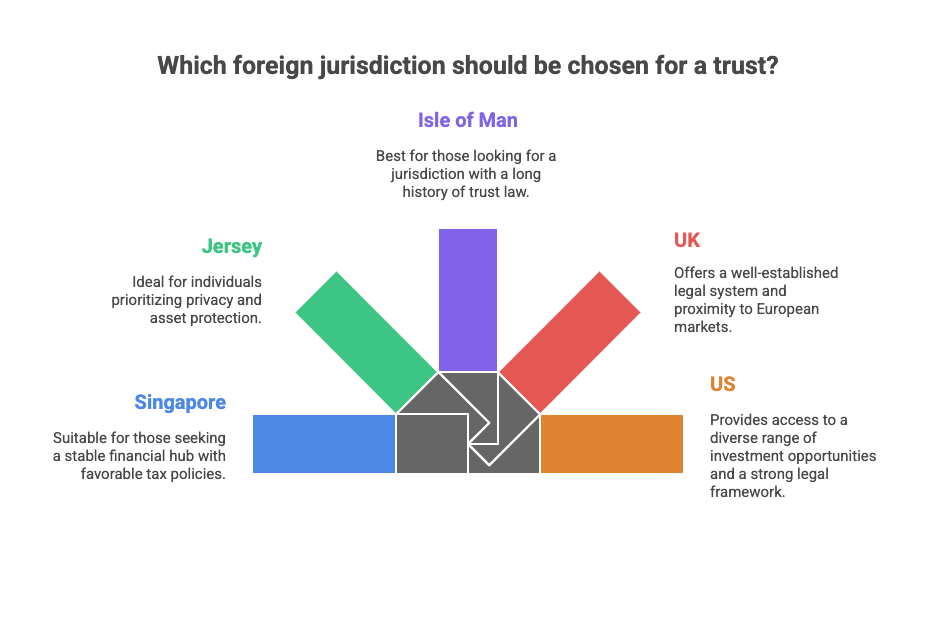
You can establish a trust in a trust-friendly jurisdiction and transfer non-Thai assets into it. Good options include Singapore, Jersey, the Isle of Man, the UK, or the US. Choose the place that fits your tax residence, asset types, and family goals while considering Thai tax implications.
Assets suitable for a foreign trust under Thai law can offer significant advantages.
- Bank accounts and investment portfolios held outside Thailand
- Real estate located abroad
- Shares in foreign companies and other business interests
- Intellectual property and royalties from outside Thailand
Benefits of a foreign trust paired with Thai tools
- Avoids multi-country probate and speeds up distributions
- Maintains continuity if the settlor becomes incapacitated
- Consolidates management of assets across borders for expats in Thailand.
Since 1 January 2024, foreign income that a Thai tax resident brings into Thailand is taxed in the year it is brought in, whichever later year that is. This applies only to income arising on or after 1 January 2024, in a year in which the person was resident in Thailand; income that arose before 2024 is outside the rule (Revenue Department Instructions Por.161/2566 and Por.162/2566, which are guidance to revenue officers rather than amendments to the Revenue Code). This affects trust distributions remitted to Thailand by Thai tax residents. You should classify distributions by their type when you can. Track remittances and create a withholding and reporting plan. Do this before the first remittance in 2024 or later.
Inheritance tax applies to the estates of people who died after the Inheritance Tax Act B.E. 2558 came into force in early 2016 (section 3(1)). Taxable amount is the portion over 100 million THB that each heir receives from each deceased (section 12). Rate is 10 percent, reduced to 5 percent for ascendants or descendants (section 16). What the spouse receives is exempt (section 3(2)). Filing is within 150 days of receiving the inheritance (section 17). Do note that gifts from ascendants, descendants, or spouse are exempt from personal income tax up to 20 million THB per tax year (Revenue Code section 42(27)); on the excess the recipient may elect a flat 5 percent instead of adding it to taxable income (section 48(6)). Gifts from others on customary occasions are exempt up to 10 million THB per year (section 42(28)), with the same 5 percent election on the excess (section 48(7)).
How ThaiLawOnline Can Help
At ThaiLawOnline, I help coordinate estate planning services. This ensures your foreign trust and Thai documents work well together.
Our support includes
- Jurisdiction analysis is important for expats to follow Thai tax and international laws. We help you choose the right trust jurisdiction and connect with foreign lawyers.
- International coordination: We work with trusted foreign lawyers and experts to set up the trust correctly.
- Thai legal documents for Thai assets:
- A tailored Thai will for assets in Thailand. See our page on Last Will and Testament in Thailand
- Usufruct agreements when appropriate for property use rights. See our deep analysis of usufruct agreement in Thailand.
- Prenuptial agreements when family planning is part of the goal. See our article about prenuptial agreement in Thailand.
- Company or property structures where needed can be essential for expats managing their assets. You can start with Property Lawyer in Bangkok.
We are not foreign lawyers. For the trust itself, we partner with qualified counsel in the chosen jurisdiction. This makes sure your trust deed follows local rules and coordinates with Thai documents.
Frequently asked questions
Can I create a trust in Thailand?
Not for family or estate planning. Section 1686 of the Civil and Commercial Code gives a trust no effect unless it is created under a law that authorises trusts. The only such law is the Trust for Transactions in Capital Market Act B.E. 2550, and under its section 12 only a juristic person can create such a trust.
Can a foreign trust hold Thai property?
Do not place Thai immovable property under a foreign trust. Thai law provides no mechanism to register trustee title for that purpose. Keep the foreign trust to non-Thai assets and use Thai instruments, such as a Thai will, for assets in Thailand.
Are trust distributions remitted to Thailand taxed?
They can be. Since 1 January 2024, foreign income that a Thai tax resident brings into Thailand is taxed in the year it is brought in. This applies to income arising on or after 1 January 2024, in a year in which the person was resident in Thailand.
Does Thailand have an inheritance tax?
Yes. It applies to the portion over 100 million THB that each heir receives from each deceased, at 10 percent, reduced to 5 percent for ascendants or descendants. What the spouse receives is exempt, and filing is within 150 days of receiving the inheritance.
Why Combine Foreign Trusts With Thai Estate Planning
Using a foreign trust for non-Thai assets and Thai tools for local assets gives full coverage.
- Complete jurisdiction fit: Each asset is managed under the correct law. This is important for expats to reduce inheritance tax.
- Fewer disputes: Clear documents reduce confusion for heirs.
- Tax awareness: Planning can lower overall taxes while staying compliant.
- Practical efficiency: Executors and trustees have clear roles and steps.
- Family security: Your plan supports loved ones across borders.
Real-life Examples
A person living in Bangkok owns a condo in Thailand, investment accounts in Singapore, and a house in the UK.
- A Singapore trust holds the non-Thai assets.
- A Thai will covers the condo and Thai bank accounts.
- Beneficiary designations match the overall plan.
- The team coordinates timing, tax reporting, and practical steps in each place.
If you live in Thailand and hold assets abroad, I can help you build a simple, lawful plan. Contact ThaiLawOnline to explore estate planning services tailored for expats in Thailand. Trusts in Thailand as a strategy using foreign trusts plus Thai estate tools. We will map your assets, choose a suitable jurisdiction, and prepare your Thai documents so everything works together.
Links: SEC in Thailand
Thai Law Updates, free by email
Plain-English updates on Thai law changes that affect foreigners: property, visas, marriage, business and wills. One short email a month from a firm practicing since 2006. No spam, unsubscribe anytime.