


A Thai law firm for foreigners since 2006. 5,000+ client matters. Thai lawyer of record: Wichuda Atthamethakon, LL.M., Thai Bar Licence 3149/2556. English, Thai and French. We answer within 24 hours.
Reviewed by ThaiLawOnline, a licensed Thai law firm practising in Thailand since 2006. Thai lawyer of record: Wichuda Atthamethakon, LL.M., Thai Bar Licence 3149/2556.
Last updated on
Looking for a reliable notary service in Thailand? At ThaiLawOnline, licensed Thai lawyers provide certified notarization accepted by embassies, courts, and international institutions, starting at just 950 THB. Not all Thai lawyers are authorized to notarize, so it’s essential to work with a lawyer officially registered with the Lawyers Council of Thailand.
Table of Contents
Need a document notarised?
Fixed fee, no surprises. You pay, upload your documents against a checklist, and read your draft within 3 business days. You can follow every step in your own client portal.
- Notarial services, per document฿950Notarisation and certification by a Thai lawyer registered as a Notarial Services Attorney. 950 baht per document. Change the quantity if you have more than one.See what is included
Not sure which one fits? Book a 2,000 baht consultation and we credit it against your fee if you go ahead.
Understanding Notarial Services in Thailand
In Thailand, the role equivalent to a “Notary Public” is performed by licensed Thai lawyers known as Notarial Services Attorneys (ทนายความผู้ให้บริการโนตารี). These professionals are authorized by the Lawyers Council of Thailand (สภาทนายความ) to certify documents, witness signatures, and perform other notarial acts.
Thailand deposited its instrument of accession to the Hague Apostille Convention on 30 June 2026, but the Convention does not enter into force for Thailand until 28 February 2027. Until that date the existing route still applies, so documents notarized in Thailand often require further legalization by the Ministry of Foreign Affairs (กรมการกงสุล) and the respective foreign embassy for international use.
How to Find a Notary Public in Thailand
Finding a qualified notary public in Thailand can be done through several channels. Here are the most common options:
- Legal Firms: Many law firms in major cities like Bangkok offer notarial services. You can contact them directly to inquire about their licensed notarial attorneys and services.
- Online Directories & Legal Websites: Search online legal directories or websites specializing in Thai law for listings of notarial services attorneys.
- Online Notary Services: For convenience, consider online notary services like ThaiLawOnline. We provide licensed Thai notaries who can handle notarization remotely via video conference after receiving your documents by mail, serving clients anywhere.
- Embassy/Consulate: Your home country’s embassy or consulate in Thailand may offer limited notarial services, primarily for documents intended for use in your home country. Check their website for availability, fees, and appointment requirements.
- Expat Community Recommendations: Sometimes, asking within local expat forums or groups can yield recommendations for reliable notaries.
Regardless of the method, always ensure the lawyer providing the service is properly licensed by the Lawyers Council of Thailand to perform notarial acts.
In Bangkok, a variety of law firms provide extensive notarial services catering to different needs. These services include document verification, signature authentication, and certification of copies. Specialized attorneys, trained as Notarial Services Attorneys, often deliver these services. Some firms offer mobile notary services for convenience. This lets clients get documents notarized in Thailand without traveling.
Common Notarial Acts & Documents We Notarize
In Thailand, documents that usually need notarization include contracts, affidavits, and property deeds. This also applies to any official document needed for legal matters or international use, like those involving foreign affairs.
We charge 950 baht to notarise one document. A Notarial Services Attorney in Thailand normally performs the following acts:
- Certifying True Copies of Documents
- Witnessing Signatures on Contracts, Agreements, etc.
- Administering oaths (การทำคำสาบาน)
- Taking Affidavits and Statutory Declarations
- Verifying Identity / Attesting Photos
- Notarizing Power of Attorney (POA) documents
- Certifying Translations (if performed by a qualified translator)
- Confirming Addresses or Birthdays (based on provided proof)
- Certifying the status of a juristic person (การรับรองสถานะของนิติบุคคล)
- Drawing up a formal protest (การทำคำคัดค้าน)
These are the act types the Lawyers Council itself names. Its mandatory training syllabus for Notarial Services Attorneys, at ข้อ 15(๒) of the 2567 Regulation as substituted in 2569, lists certifying copies, certifying signatures, administering oaths, certifying the status of a juristic person, certifying a person’s identity, drawing up protests, and the method of certification and seal. If someone offers you a notarial act that is not on that list, ask them which rule it comes from.
Notarization Process in Thailand
The notarization process in Thailand typically involves several steps. First, you must gather the documents that require notarization and ensure they are complete. Next, you need to set up an appointment with a Notarial Services Attorney. They will check your documents for authenticity. During the appointment, the attorney will verify your identity and witness your signature. Finally, the attorney will affix their seal and signature to the documents, completing the notarization process.
During the notarization process, you can expect to present your identification documents and the documents that need notarization. The Notarial Services Attorney will verify your identity and review the documents to ensure they are complete. You will then be required to sign the documents in the presence of the attorney, who will act as a witness. Following this, the attorney will affix their signature and seal to the documents, providing the necessary certification.
Notarial services are often needed for marriage documents in Thailand. This is especially true for foreign nationals who want to marry there. This may include notarizing documents like certificates of no impediment to marriage. These certificates confirm that there are no legal barriers to the marriage. It is important to have these documents notarized.
Foreign nationals or expats in Thailand may require notarial services for various purposes, including visa applications, property transactions, and legal agreements. Notarial Services Attorneys can assist in authenticating documents for use in their home countries or for transactions within Thailand. Foreign nationals must make sure their notarized documents follow Thai law and the rules of their home country when engaging with a notary public in Thailand.
The legal framework governing notarial services in Thailand is primarily established by the Lawyers Act B.E. 2528. This legislation outlines the role of Notarial Services Attorneys, who are responsible for providing notarial services legally as notary public in Thailand. To provide these services, attorneys must complete special training and certification. This ensures they meet the standards set by the Lawyers Council of Thailand, which oversees their qualifications and behavior.
Thailand acceded to the Hague Convention on the Legalization of Foreign Public Documents on 30 June 2026, but it does not enter into force for Thailand until 28 February 2027, which matters for notarised documents in the meantime. Until that date, documents notarized in Thailand may require further legalization by the Ministry of Foreign Affairs for use abroad. Conversely, foreign documents must also undergo a similar legalization process in Thailand. This understanding is essential for foreign nationals and businesses operating within the legal framework of Thailand.
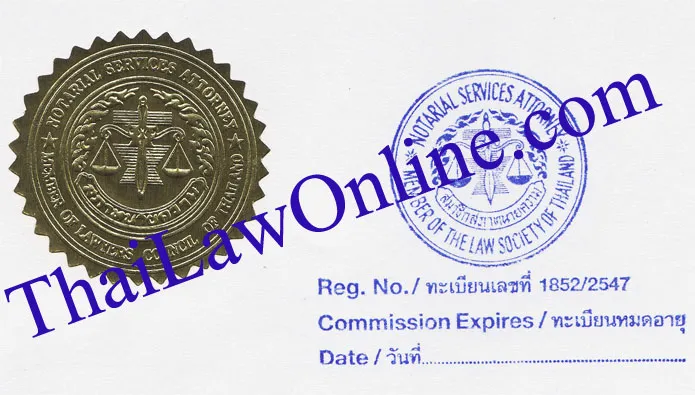
The public notary stamp and certification process is a critical aspect of notarization in Thailand. After verifying the authenticity of documents and the signatories’ identities, Notarial Services Attorneys affix their official stamp and signature, certifying the document’s validity. This notary stamp is important for accepting documents in legal and administrative processes. It shows that the notarization follows Thai law and standards.
Businesses registered with the Board of Investment (BOI) in Thailand often require notarial services for various legal documents, including investment promotion applications and contracts. These services are important for making sure that documents are verified and follow Thai rules. This helps keep the benefits of BOI registration. Notarial Services Attorneys play an essential role in this process, providing the necessary legal support.
Why Choose Online Notarization in Thailand?
Online notarization offers a convenient, secure, and efficient solution for individuals in Thailand needing notary services. Traditional notarization can be time-consuming, often requiring in-person visits and manual processes, which can be streamlined by a notary public in Bangkok. With online notarization, you can verify important documents from home or the office. This saves time and cuts down on travel.
Comparing Your Options for a Notary in Thailand
| Feature/Criteria | ThaiLawOnline | Local Law Firms (Traditional) | Embassy/Consulate Notarization |
|---|---|---|---|
| Availability | Online & nationwide | Limited to office hours & locations | Only major cities, limited appointments |
| Languages Offered | English, French, Thai | Mostly Thai could be English | Mostly English |
| Price Transparency | Fixed at 950 THB/document | Often not clearly listed. Can be up to 5K. Rarely under 1,500 baht. | Varies (some are free, some costly) |
| Convenience | 100% online option available | Requires in-person visit | Long wait times, limited slots, sometimes appointment. |
| Legal Validity in Thailand | Yes, licensed Notarial Services Attorney | Yes | Yes |
| Legal Validity Abroad | Yes (for most countries) | Yes (for most countries if notary) | Yes |
| Document Preparation Help | Yes, included if needed | Sometimes | Rare |
| Extra Services (Translation, POA) | Available as add-ons | Rarely | Not offered |
| Speed | Often same day but with postage, maybe 1 week without any transport needed. | 1-3 days, you must go on location. | Varies |
This service is particularly beneficial for expats, business professionals, and remote workers who may face difficulties accessing physical notary offices. Online notarization uses secure video conferencing. It provides the same legal validity and authenticity as in-person notarization. This method meets international standards for document verification.
For those in Thailand seeking flexibility and efficiency, online notarial services for Thailand simplify legal processes and helps meet pressing deadlines without compromising security. Embrace a modern, convenient approach to notarization that keeps you connected to essential services no matter where you are.
How does it work to notarize online for Thailand?
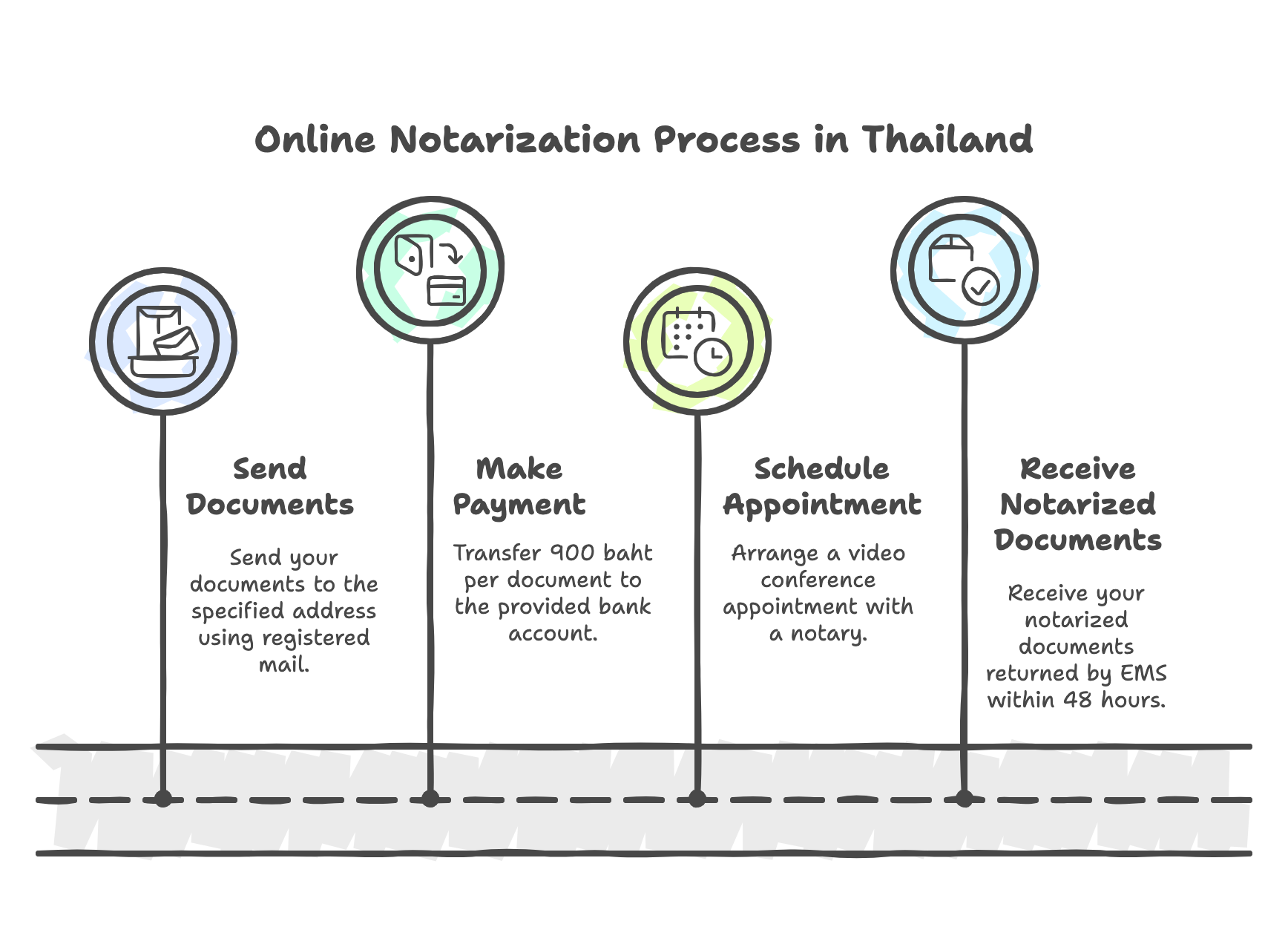
- Post the original document to our office. ThaiLawOnline Co., Ltd., Udom Suk Hub, 32 Sukhumvit 101/2 Alley, Bang Na Nuea, Bang Na, Bangkok 10260, Thailand. Phone +66 87 414 9288 (Thai and English) or +66 87 225 1340 (English and French). Use EMS at any Thai post office, or DHL, FedEx or TNT from abroad, so the parcel is tracked. Include a clear copy of your passport photo page.
- Sign and date the document first, exactly as we instruct you. Tell us what the document is before you post it and we will tell you where and how to sign. Do not have it witnessed by anyone else on the way: the point of the video conference is that you confirm the signature to the notary yourself.
- Pay 950 baht per document, in advance. Use the payment button on this page, or write to info@thailawonline.com and we send you the transfer details with your confirmation. The fee covers the certification, the video conference and return postage inside Thailand.
- Take the video conference. Once your document and your payment have both arrived, Khun Wichuda arranges a call at a time you agree. On camera she checks your identity against your passport, confirms that you understand what the document says, and confirms that the signature on it is yours. Only then does she certify it. This step is what makes the result a notarial act, and it is why we cannot simply stamp a document that arrives in the post.
- We send the notarised original back. By EMS anywhere in Thailand, normally within 48 hours of the call and included in the fee. If it has to go abroad, tell us the address and we will quote the courier separately. Allow three to five business days for the whole process once your document reaches us.
We return your ID copy along with the notarised document. If you are not sure whether your document needs a notarial certification at all, or whether it will then need legalisation as well, send us a scan first and ask. It costs you nothing and it is the question people most often get wrong before paying.
And there it is: Online Notarial Services in Thailand. Cheap, fast, efficient and professional. Having a reliable notary in Thailand is important. This ensures that your documents meet local and international legal standards. Online notarial services for Thailand providing expats with a convenient and secure way to complete necessary notarizations efficiently.
Using a Thai Notarisation Abroad
A few years ago, Thai lawyers were permitted to certify documents for their clients without standardized procedures. Mr. Dejudom Krairuek used to be the President of The Thai Lawyer’s Council and is a notable figure in the notary public in Thailand, advocating for better legal services. He recognized the need for consistent standards in notarizing documents. Consequently, the Lawyers association decided to regulate the notarization process in Thailand to ensure that all legal services are compliant.
A certification by a Notarial Services Attorney is prepared for documents that will be used outside Thailand. Whether a particular foreign authority accepts it is governed by that country’s own rules, which Thai law cannot settle, so we do not promise universal recognition. What we can tell you is the route: the certification is the first step, and the document is then legalised by the Ministry of Foreign Affairs and, where the destination requires it, by that country’s embassy or consulate.
Thailand acceded to the 1961 Hague Apostille Convention on 30 June 2026 and the Convention enters into force for Thailand on 28 February 2027. From that date an apostille replaces the consular leg of the chain for documents going to other Contracting States. It is not a universal passport either: under Article 12 an existing Contracting State may object to Thailand’s accession, and the Convention then does not apply between Thailand and that state. Until 28 February 2027 the consular route remains the only one. See our guide to legalisation of documents in Thailand.
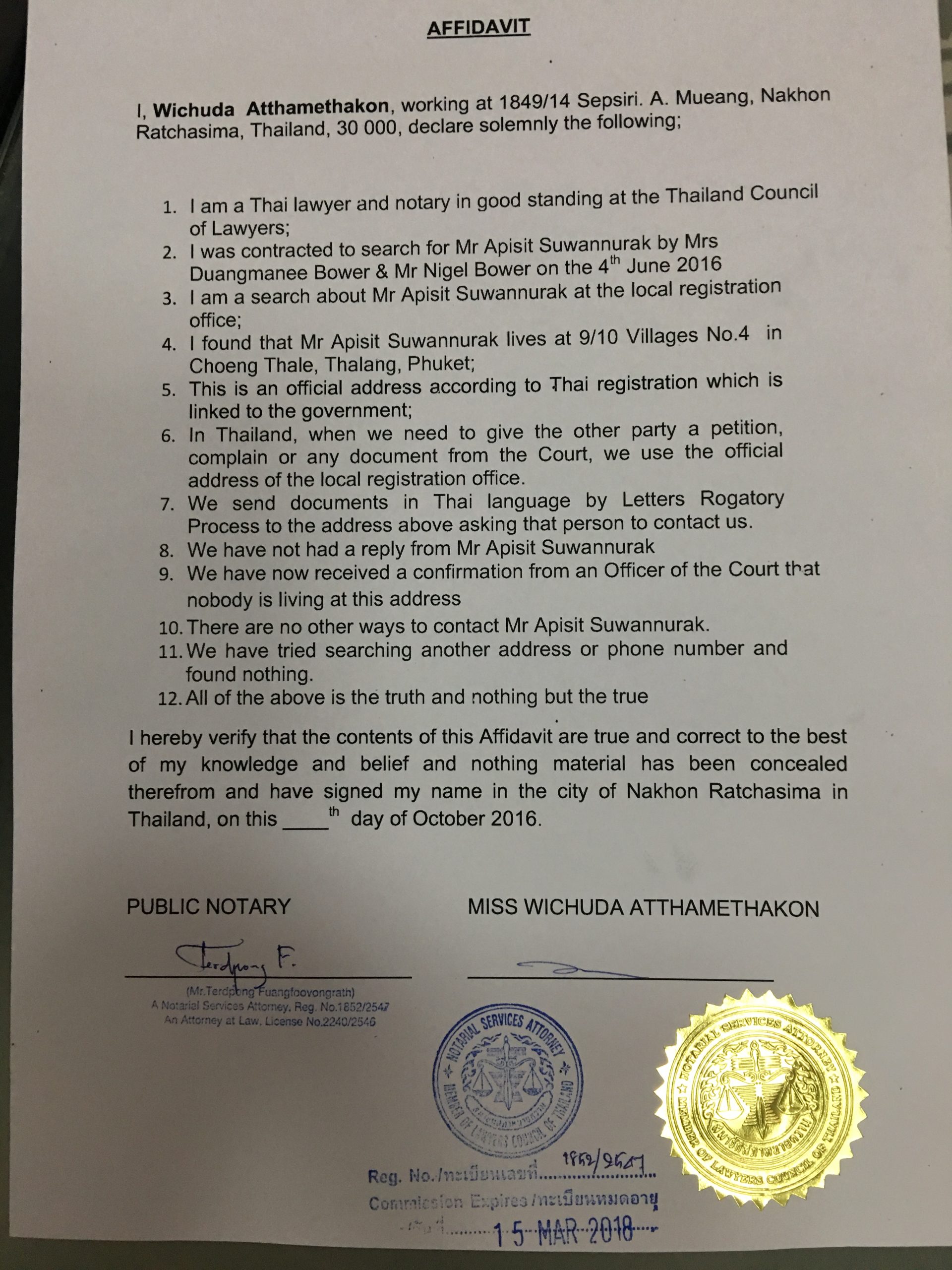
Affidavit by one of our Thai notary notarized by another notary in 2018
Notarization for International Use (Embassies & Legalization)
Generally, embassies normally do these services but might be more expensive. Some countries do not have embassies in Bangkok. Some will require a previous appointment. It is recommended to seek a notary in Thailand for notarization requirements unless Thai notaries might not be recognized in your country. Always look at what is required to know if you can use a Thai notary or not.
The Hague Convention helped eliminate the need for foreign public documents to be legalized by recognized notaries. It was signed on October 5, 1961, and is important in Private International Law. Thailand has since acceded to it. The instrument of accession was deposited on 30 June 2026 and the Convention does not enter into force for Thailand until 28 February 2027, so until that date the legalisation route described above still applies.
Notarization serves as a vital mechanism for attesting the authenticity of signatures and documents in Thailand, helping to prevent fraudulent activities. It serves as a neutral witness to confirm that the documents are real. It also ensures that the signers have the authority to sign them. Certain legal documents must be notarized to be recognized as binding, making this process essential in various legal contexts.
Legal Authority for Notarial Services in Thailand
Notarial services in Thailand are governed by the Lawyers Council of Thailand (สภาทนายความ) under the Lawyers Act B.E. 2528. Two instruments are current, and a lot of what is written online still cites a third that was repealed.
- ข้อบังคับสภาทนายความ ว่าด้วยการขึ้นทะเบียนทนายความผู้ทำคำรับรองลายมือชื่อและเอกสาร พ.ศ. 2566, the Lawyers Council Regulation on the registration of attorneys who certify signatures and documents, B.E. 2566. Signed 20 March 2567 and published in the Royal Thai Government Gazette, เล่ม ๑๔๑ ตอนพิเศษ ๑๓๒ ง หน้า ๕๗, on 13 May 2567. Its ข้อ 3 repeals the B.E. 2551 version that most English-language pages still quote.
- ระเบียบสภาทนายความ ว่าด้วยการขึ้นทะเบียนทนายความผู้ทำคำรับรองลายมือชื่อและเอกสาร พ.ศ. 2567, signed 14 May 2567, which sets up the registry office, the mandatory course, registration and renewal, the certification register and the fees. Its ข้อ 15, the course syllabus, was substituted by an amending Regulation signed 9 March 2569, which is where the current list of notarial act types sits and which added electronic certification (E-Notary) to the syllabus for the first time.
To register, a Thai lawyer must hold a current practising licence, complete the Council’s notarial course, pass it, and stay in good standing. Registration runs for three years and has to be renewed. The Council keeps the register, and a false certification is a ground for being struck off it (ข้อบังคับ 2566 ข้อ 12(3), and ระเบียบ 2567 ข้อ 25(4) for a certification made in breach of either instrument).
One detail worth knowing if you are posting a document to a notary: ข้อ 28 of the 2567 Regulation requires the certification register to record the date the document was received and the date the certification was made as two separate entries, and ข้อ 29 requires that register to be kept available for inspection for five years.
Thai Terminology for Notary Services
There is no “Notary Public” in the exact same form as in common law jurisdictions. However, Thailand’s version is the Notarial Services Attorney, known officially in Thai as:
ทนายความผู้ทำคำรับรองลายมือชื่อและเอกสาร
In practice, other common Thai terms used are:
- ทนายรับรองเอกสาร, lawyer certifying documents
- ทนายความโนตารี, notary lawyer
- โนตารี พับลิค, transliteration of “Notary Public”
Where a Notarial Certification Is Used, and Where It Is Not
This is where most of the confusion sits. A Notarial Services Attorney certification is prepared for documents that will be used outside Thailand, and the Apostille Convention governs how a document is authenticated for use between countries. Neither of those settles what a Thai court or a Thai government office will require of a Thai document, which those bodies determine under their own rules. If your document is for use inside Thailand, ask the office that will receive it what it actually requires before paying for a certification.
For use overseas, the document is legalised by the Ministry of Foreign Affairs (กรมการกงสุล) and then, where the destination requires it, verified by the relevant foreign embassy or consulate.
This “chain of authentication” is particularly important in cases where foreign authorities require official proof that the document was signed, witnessed, or certified properly in Thailand.
Ministry of Foreign Affairs Legalization
The Department of Consular Affairs under the Ministry of Foreign Affairs (MFA) is the official body that legalizes notarized documents in Thailand. Their legalization service is offered at the MFA office on Chaeng Wattana Road, Bangkok.
The Thai term for legalization is:
การรับรองเอกสาร, document authentication
Knowing this term will be helpful when speaking with Thai officials or navigating their website. The MFA’s website provides guidance in both Thai and English on required documents, fees, and processing times.
Official MFA Website: consular.mfa.go.th
Verification with the Lawyers Council of Thailand
If you want to confirm that your notary lawyer is properly authorized, you can verify their credentials through the Lawyers Council of Thailand. This body maintains a register of certified Notarial Services Attorneys, and publishes updates on newly registered attorneys, training sessions, and requirements.
So that you can do that with us: our Notarial Services Attorney is Wichuda Atthamethakon, Notarial Services Attorney registration 576/2566, Thai Bar Licence 3149/2556. Those are the two numbers to quote if a foreign authority, or the Lawyers Council, asks who certified your document.
Official website (Thai): https://www.lawyerscouncil.or.th
Official Regulation for Notarial Services
You do not have to take our word for any of this. The Lawyers Council publishes the instruments itself, and both of these links were checked and served a PDF on 29 August 2026:
- ข้อบังคับฯ พ.ศ. 2566 (PDF, Lawyers Council), the registration Regulation now in force.
- ระเบียบแก้ไขเพิ่มเติม พ.ศ. 2569 (PDF, Lawyers Council), the 2569 amendment that substituted the syllabus at ข้อ 15.
The Royal Thai Government Gazette hosts the official publication at ratchakitcha.soc.go.th, but its search does not accept requests from other websites, so a link from here would not open for you. The Gazette reference for the 2566 Regulation is เล่ม ๑๔๑ ตอนพิเศษ ๑๓๒ ง หน้า ๕๗, dated 13 May 2567, if you want to look it up there yourself.
FAQS About Notary in Thailand
How can I find a notary in Thailand?
You can get notary services in Thailand from a qualified Thai lawyer or an authorized notary officer. You can also contact law firms specializing in notarial services attorney in Thailand to get assistance.
Are there notary services available at airports in Thailand?
Notary services are typically not available at airports in Thailand. It is a good idea to set up these services ahead of time. You can do this through a notary or a lawyer in cities like Bangkok and Phuket.
What should I do if I need a notary for business purposes in Thailand today?
If you need a notary for business, reach out to a notary in Thailand. You can also contact a legal firm that provides notary services. They can certify your documents promptly as required in Thailand. We might be able to help even on weekends or Thai holidays.
How does the Hague Convention on Legalization affect notarial services in Thailand?
Thailand acceded to the Hague Apostille Convention on 30 June 2026, and it enters into force for Thailand on 28 February 2027. Until that date, documents still need the full Ministry of Foreign Affairs and embassy legalisation chain. This means documents from Thailand may need extra certification. They may require approval from Thailand’s foreign affairs or the relevant foreign embassy before being recognized internationally.
What We Need From You
- The original document to be notarised, signed and dated as we instruct you.
- A clear copy of the signatory’s passport or Thai ID card.
- Any supporting document the main one refers to.
- An email address and a phone number we can reach you on to set up the video call.
Turnaround is three to five business days from the moment your document reaches Nakhon Ratchasima, and most of that is postage.
Need a Document Notarized in Thailand?
Our notarial service runs online, at 950 baht per document. Khun Wichuda is a licensed Thai lawyer registered with the Lawyers Council of Thailand as a Notarial Services Attorney. Send us a scan of what you need certified and we will tell you whether a notarial certification is the right step, and whether it will also need legalisation, before you pay anything.
Contact us now to book your appointment or learn more. (info@thailawonline.com)
👍 Facebook 💬 Messenger 📱 WhatsApp 📸 Instagram 📧 Email Us
Our notarial fee
| Service | Fixed fee | What is included | Timeline |
|---|---|---|---|
| Notarial services | 950 THB per document | Notarization by a licensed Notarial Services Attorney. Remote by video conference, originals returned by courier or EMS. | 3 to 5 business days |
Government disbursements are charged at cost unless the service says they are included.
Book a consultation Answer within 24 hours EN · FR · TH
These fees come from one source and are the same everywhere on this site. See all our fees.
In the northeast we also notarise documents in Ubon Ratchathani: see notary services in Ubon Ratchathani.
Last reviewed: 5 September 2026. No corrections were needed. The Apostille position is current: Thailand deposited its instrument of accession on 30 June 2026 and the Convention enters into force for Thailand on 28 February 2027, with the Article 12 objection point stated correctly, so the Ministry of Foreign Affairs and embassy chain still applies today. Both of our attorney’s numbers are the right ones for their purposes, the notarial registration and the Bar licence. The 950 baht per document fee matches the fee source and every other page that quotes it, and all thirty-eight links resolve, including the two Lawyers Council regulation PDFs.
Thai Law Updates, free by email
Plain-English updates on Thai law changes that affect foreigners: property, visas, marriage, business and wills. One short email a month from a firm practicing since 2006. No spam, unsubscribe anytime.