


Reviewed by ThaiLawOnline, a licensed Thai law firm practising in Thailand since 2006. Thai lawyer of record: Wichuda Atthamethakon, LL.M., Thai Bar Licence 3149/2556.
Last updated on
Deportation from Thailand is not one procedure. It’s four. Most foreigners find that out too late, usually while sitting in a holding cell trying to work out who to call. This guide separates the four tracks. It explains the deportation regulation that came into force on 28 August 2026. And it sets out the appeal deadlines that actually exist in law. Some of those deadlines are 48 hours. One is 7 days. Miss them and the decision becomes final.
Status, 5 September 2026. The Regulation of the Office of the Prime Minister on Deportation, B.E. 2569 was published in the Royal Gazette on 27 August 2026 (vol. 143, special part 205 Ngor) and came into force on 28 August 2026. It is Thailand’s first standing deportation regulation. The Deportation Act B.E. 2499 and the Immigration Act B.E. 2522 continue to apply alongside it. It was signed on 26 August 2026 by Prime Minister Anutin Charnvirakul under section 11(8) of the State Administration Act B.E. 2534.
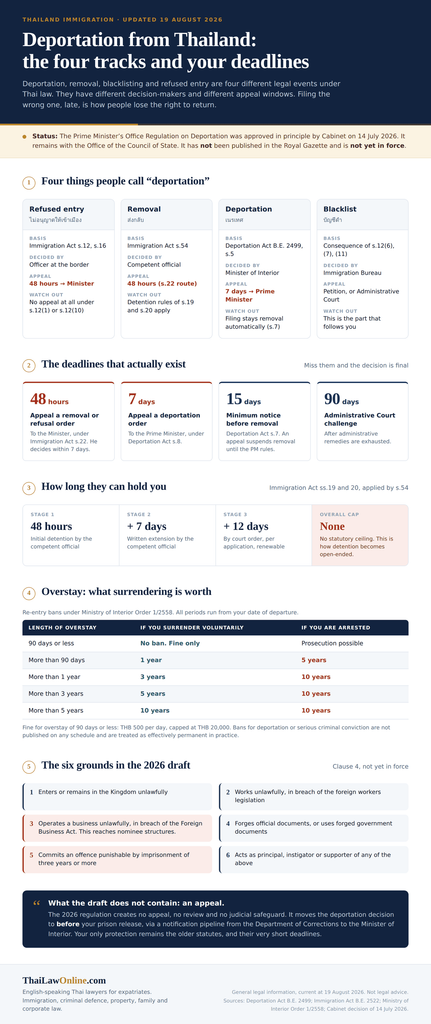
Table of Contents
Four different things people call “deportation”
Here’s the confusion that costs clients money. English-language commentary treats deportation, removal, blacklisting and refused entry as one topic. Thai law treats them as four separate events, with different decision-makers and different appeal routes.
Get the wrong one and you file the wrong appeal, to the wrong official, after the wrong deadline.
| What happens | Thai term | Legal basis | Who decides | Appeal route |
|---|---|---|---|---|
| Refused entry at the airport or border | ไม่อนุญาตให้เข้าเมือง | Immigration Act B.E. 2522, s.12 and s.16 | Immigration officer at the port of entry | s.22 appeal to the Minister, within 48 hours. No appeal at all for s.12(1) or s.12(10) |
| Removal after you’re already inside and your stay is unlawful | ส่งกลับ | Immigration Act B.E. 2522, s.54 | Competent official (Immigration Bureau) | s.22 route in practice. Detention rules of s.19 and s.20 apply |
| Deportation proper, on public order or morals grounds | เนรเทศ | Deportation Act B.E. 2499, s.5 | The Minister of Interior | Appeal to the Prime Minister, within 7 days (s.8). Removal is stayed until he rules (s.7) |
| Blacklisting, the re-entry ban | บัญชีดำ | Consequence of s.12(6), (7), (11) and s.16 | Immigration Bureau, administratively | No single statutory route. Petition, or Administrative Court |
Two points from that table matter more than anything else on this page.
First, a real deportation order is signed by the Minister of Interior, and the appeal goes to the Prime Minister. Not to the Minister of Interior. Not to Immigration. We see this stated incorrectly on competitor sites and in expat forums constantly. Section 8 of the Deportation Act is explicit, and the window is 7 days.
Second, the blacklist is the part that follows you. A deportation order under section 5 runs for a fixed period and the Minister can revoke it. But section 12(11) of the Immigration Act makes anyone previously deported a prohibited alien. That’s the disability that outlasts everything else.
What the new 2026 deportation regulation actually does
The Regulation of the Office of the Prime Minister on Deportation, B.E. 2569 (ระเบียบสำนักนายกรัฐมนตรี ว่าด้วยการเนรเทศ พ.ศ. ๒๕๖๙) was published in the Royal Gazette on 27 August 2026 and took effect the following day. The Cabinet had approved it in principle on 14 July 2026, on a proposal by Deputy Prime Minister Pakorn Nilprapunt and following a Cabinet resolution of 16 June 2026 directing that removal procedures be streamlined. The gazetted text differs from the draft that was reported at that stage, and the differences matter.
Read the press coverage and you’d think Thailand had passed a new deportation law. It hasn’t. This is subordinate administrative machinery. It sits on top of two existing statutes: section 5 of the Deportation Act B.E. 2499 and section 54 of the Immigration Act B.E. 2522. No new power to deport is created. What changes is the plumbing, and the plumbing is where cases are won or lost.
The six grounds for referral
The regulation creates two distinct routes, and press coverage has run them together. Clause 4 is the conduct route. Where a foreign national behaves in a way contrary to public order, good morals or the welfare of the public, the Permanent Secretary for Interior, or a person the Permanent Secretary assigns, reports the case to the Interior Minister, who decides whether to order removal. It reaches anyone who instigates or supports that conduct as well, and it requires no conviction.
Clause 5 is the post-sentence route, and it is narrower than the headlines suggest. It applies only once the person has served a final judgment in full and has been released from prison. In those cases the Interior Minister may order deportation where the foreign national:
- Enters or remains in the Kingdom unlawfully
- Works unlawfully, in breach of the foreign workers legislation
- Operates a business unlawfully, in breach of the Foreign Business Act
- Forges official documents, or uses forged government documents
- Commits an offence punishable by imprisonment of five years or more
- Acts as principal, instigator or supporter of any of the above
The mechanics matter as much as the grounds. The Director-General of the Department of Corrections must pass the person’s name, nationality and case file to the Permanent Secretary for Interior at least fifteen days before release, and the Permanent Secretary then reports to the Minister without delay. The Minister’s order may also fix a period during which the person may not re-enter Thailand. Where a court passes a custodial sentence but suspends it, or imposes a fine instead, the Office of the Judiciary notifies the Permanent Secretary directly.
Ground 3 deserves a hard look if you run a company here. It reaches Foreign Business Act breaches directly. That includes nominee shareholding arrangements, which the DBD has been enforcing aggressively through 2026. Say you’re a foreign director sitting on a structure you’ve been meaning to clean up. The new regulation turns that corporate compliance problem into an immigration problem. Our note on Thai nominee shareholders and the current crackdown covers the underlying exposure.
Ground 4 is the one that catches people who never intended to break anything. A forged bank letter, employment letter or lease filed in support of a visa application is a forged document, and the applicant is the person who filed it. If an agent prepared your paperwork, read what a visa agent may and may not lawfully do before you assume the file is clean.
Ground 5 needs care too, and it is where the draft and the gazetted text part company. The Cabinet draft used three years. The gazetted text says โทษจำคุกตั้งแต่ห้าปีขึ้นไป, five years or more. Reports still circulating with the three-year figure are describing the draft. The wording points to the statutory penalty range of the offence, not the sentence actually imposed, so an offence carrying a five-year maximum can qualify even where the court fined the defendant or suspended the sentence. Clause 5 handles those cases through a separate route: the Office of the Judiciary notifies the Permanent Secretary directly, rather than the Department of Corrections doing so on release.
The pre-release pipeline
This is the operational core of the regulation, and it’s genuinely new:
- The Department of Corrections must notify the Permanent Secretary for the Interior of foreign inmates convicted of the clause 5 offences and their details, at least 15 days before release.
- The Permanent Secretary submits the case to the Minister of Interior.
- The Minister may order deportation once the sentence is served and the person released.
- Removal is to the country of nationality. If nationality can’t be determined, to the last country of residence declared before entering Thailand.
- Third-country transfers go through diplomatic channels. They require the deportee’s written consent, and the receiving state or organisation must agree to bear all care and transport costs.
Under the old practice, a foreign prisoner finished a sentence and then entered a slow, ad hoc process. Sometimes that meant release. Sometimes it meant months at the Immigration Detention Centre while nobody moved the file. The regulation closes that gap by making Corrections send the file up before the sentence ends, so that the Minister can order deportation once you are released.
Here’s what that means in practice. If you’re defending a foreign national in a Thai criminal matter, the immigration consequence is no longer something to deal with later. It’s now part of the sentencing strategy. We’ve said for years that criminal defence for foreigners in Thailand is really two cases running in parallel. The regulation makes that literal.
What the regulation does not contain
An appeal.
That’s not an oversight on our part. The regulation contains no appeal, no review, and no judicial safeguard. Formichella & Sritawat flagged it as “notably absent.” Asylum Access Thailand’s central submission asks the government to confirm that existing statutory appeal rights will still apply, precisely because the regulation doesn’t say.
So the appeal architecture stays where it was: section 7 and section 8 of the Deportation Act, and section 22 of the Immigration Act. Whether the regulation intends those to survive a “streamlined” process is an open question. Until it’s answered, assume your only protection is the old law, and act on the old law’s deadlines.
Two claims the gazetted text settles
Two claims circulated widely from draft coverage. Both can now be answered from the gazetted text rather than left open:
- The “30 days after sentence completion” deadline does not exist. It is repeated across English-language coverage from early August 2026, and it is not in the regulation. Clause 5 requires the Permanent Secretary to report to the Minister without delay (โดยไม่ชักช้า) once Corrections has given notice, and it sets no outer limit at all. The only thirty-day period in the instrument is in clause 8, and it governs something else entirely: where another state or an international organisation asks Thailand to send the person to a third country, that transfer must be completed within thirty days of the request, extendable by the Minister twice, by no more than thirty days each time. Anyone planning around a thirty-day post-sentence clock is planning around the draft.
- “The Thai state now pays for removals” is not what the text says. Clause 9 does not allocate the cost to anyone. It provides that the expenses of deportation are to follow a regulation which the Ministry of Interior will issue with the approval of the Ministry of Finance, so the cost rules are delegated to an instrument that has not been made yet. Section 55 of the Immigration Act is untouched and still in force: it puts the cost of removal on the carrier that brought you in, failing which on the person who brought you in or harboured you (sections 63 and 64), while section 54 makes the detained alien pay the cost of detention. In the clause 8 third-country route the requesting state or organisation must undertake in writing to bear both the care costs and the transfer costs. So on the gazetted text there is no general state-funded removal.
The Deportation Act B.E. 2499: the law that signs the order
The Deportation Act is seventy years old and very much alive. It was amended in B.E. 2507 and B.E. 2521, and it’s the parent statute for the 2026 regulation. Four sections matter to you.
Section 5: the Minister’s power
The Minister may order the deportation of an alien where it’s necessary in the interest of public order or good morals (ความสงบเรียบร้อยหรือศีลธรรมอันดี). He sets the period. He may also revoke his own order.
Two things follow. The grounds are extremely broad, which is the point of the section. And because the Minister can revoke, a deportation order is not automatically permanent. Revocation is a real remedy, and it’s underused.
Section 5 does not apply to a person who has held Thai nationality by birth. That carve-out mirrors the constitutional position that a Thai national cannot be deported from the Kingdom.
Section 7: fifteen days, and an automatic stay
You’re entitled to a minimum of 15 days’ notice before deportation is carried out. And if you appeal, deportation is suspended until the Prime Minister rules. That stay is automatic. You don’t apply for it.
That single sentence is the most valuable thing in this article. An appeal filed in time stops the plane.
Section 8: seven days, to the Prime Minister
The appeal against a section 5 order goes to the Prime Minister, within 7 days. He may revoke the order, vary it, or substitute a work-placement order.
Be honest about the odds. This is a discretionary political remedy, not a court. But the stay under section 7 is worth having on its own, because it buys the time to run everything else. In our experience, the clients who do badly are the ones who spend the first week arguing with immigration officers. Argue later. File first.
Sections 9 bis to 11: the offences
Escaping from custody pending deportation carries up to three years, or five if it involves breaking out, force or three or more people (section 9 bis). Freeing a detainee carries up to five years, increased by half where force is used (section 9 ter). Harbouring an escapee carries up to three years (section 9 quater). Returning to Thailand before the order expires is up to one year in prison, then re-deportation under section 10. There’s no clever workaround here. Don’t try one.
The Immigration Act B.E. 2522: removal, refusal and the 48-hour clock
Section 12 and the eleven prohibited categories
Section 12 lists eleven categories of alien who may not enter. The ones that bite expats are:
- s.12(6): prior imprisonment, with minor and negligent offences excepted
- s.12(7): conduct suggesting you’d be a danger to public safety or national security
- s.12(10): persons prohibited by the Minister under section 16
- s.12(11): persons deported by Thailand or by a foreign government, or whose right of stay has been revoked
Section 12(11) is why deportation and blacklisting are welded together. Once a deportation order exists, you’re a statutorily prohibited alien unless the Minister grants a case-specific exemption. The same limb also covers anyone removed at the Thai government’s expense. Not because someone typed your name into a database, but because the statute says so.
Section 16 is the discretionary catch-all. The Minister may exclude an alien for national welfare, public peace, culture, morality or welfare. Note what section 22 says about that below.
Section 22: the 48-hour appeal, and its two blind spots
Where an officer finds you fall within section 12, he orders you in writing to leave the Kingdom. If you’re not satisfied:
- You appeal to the Minister, filing with the competent official within 48 hours of receiving the order (ภายในสี่สิบแปดชั่วโมง).
- If the Minister has not decided within 7 days of the appeal, you are deemed not to be a prohibited alien under section 12.
- Removal is stayed pending the decision.
- The Minister’s order is final.
Now the two blind spots. There is no appeal under section 12(1) or section 12(10). No valid passport or visa, no appeal. Excluded by the Minister under section 16, no appeal. Those are the cases where the administrative route is closed at the door and the Administrative Court becomes the only option.
Forty-eight hours is brutal. It runs while you’re in a holding area, usually without your phone, often without a translator. If you’re detained at an airport, the single most useful thing you can do is get a lawyer’s number to someone outside. Our guide on what to do when a foreigner is arrested in Thailand sets out the first-hours checklist.
Section 54: removal, and the detention it authorises
Section 54 covers anyone who entered without permission, or whose permission expired or was revoked. The competent official deports them.
The important part is the cross-reference. Section 54 applies sections 19 and 20 mutatis mutandis. That’s where the detention power lives, and it’s why people end up held for long periods without anything that looks like a sentence. We deal with the timings in the next section.
Section 54 also lets the official release you instead, on security, or on security and bond, with reporting conditions. That option exists. Ask for it.
Section 55: who pays
The cost of removal falls first on the owner or master of the conveyance that brought you in. If there is none, section 55 puts it on whoever committed the offences of bringing you in or harbouring you (sections 63 and 64), not on you. What you do pay is the cost of your own detention while you wait for removal, which section 54 puts on the detained alien. With permission you can arrange your own departure at your own expense. That’s usually the better outcome. You keep some control over timing and destination.
Section 81 and 82: the penalties
Overstay under section 81 is imprisonment of up to two years, or a fine of up to THB 20,000, or both. The familiar THB 500 per day capped at THB 20,000 is the administrative settlement applied on departure, not the section 81 penalty. They’re different things, and conflating them is how people talk themselves into thinking overstay is a parking ticket.
Section 82 punishes evading an order made under the Immigration Act with a fine of up to THB 5,000. Evading an order to leave the Kingdom is up to two years and a fine of up to THB 20,000.
Detention pending removal: how long can they actually hold you?
There’s a clear statutory structure, and then there’s what happens.
| Stage | Maximum | Who authorises |
|---|---|---|
| Initial detention | 48 hours | Competent official |
| First extension | Up to 7 days in total | Competent official, in writing |
| Further extensions | 12 days per application | The Court |
| After a removal order | As long as necessary | Competent official (s.54 para 3) |
Read that last row again. The 48-hour, 7-day and 12-day limits apply while the case is still being investigated (s.20, applied by s.54 para 2). Once a removal order has been made, s.54 para 3 lets the official detain you for as long as necessary pending removal, with no court involvement. That’s the mechanism by which detention at the Immigration Detention Centre becomes open-ended.
What the IDC is actually like
We’re not going to soften this. The Global Detention Project’s profile of the Bangkok IDC at Suan Phlu records a stated capacity of 1,100 and documents severe overcrowding. Former detainees have described cells shared with 200 to 250 people, with roughly half a square metre each. Assessments in 2023 and 2024 found cells below the 3 m² per detainee minimum standard, with no beds, tables or chairs. Healthcare was reported as deficient, with no doctor on duty in 2024. Nine deaths have been documented at the facility.
For a straightforward overstay where you’re paying your own way out, detention is usually short. Days. The long detentions happen when there’s no travel document, no country willing to accept the person, or an unresolved criminal matter. UN experts noted in 2024 that some detainees had been held for ten years.
Bail from the IDC
Temporary release is available. Based on UNHCR Thailand’s published guidance, the practice is:
- Bail is usually THB 50,000.
- You need a Thai guarantor, or a foreigner with legal residence.
- You must give the address where you’ll live after release.
- You report to the IDC monthly, with your guarantor. Miss it and bail is revoked.
Separately, section 54 itself lets the official release you on security or bond. If you’re dealing with a parallel criminal case, the mechanics differ again, and our guide to bail in Thailand for foreign nationals covers that side.
The blacklist: how long it lasts and how to get off it
Overstay bans: the official schedule
These come from Ministry of Interior Order 1/2558, in force since 20 March 2016. All ban periods run from your date of departure.
| Length of overstay | If you surrender voluntarily | If you’re arrested |
|---|---|---|
| 90 days or less | No ban. Fine only (THB 500/day, max THB 20,000) | 5 years (overstay up to 1 year), plus prosecution |
| More than 90 days | 1 year | |
| More than 1 year | 3 years | 10 years (overstay over 1 year) |
| More than 3 years | 5 years | |
| More than 5 years | 10 years |
The gap between the two columns is the entire argument for walking into immigration yourself. A four-year overstay surrendered voluntarily is a five-year ban. The same overstay discovered on arrest is ten. We go through the tactics in detail on our page about Thailand visa overstay, criminal charges and blacklists.
Deportation and criminal conviction bans
There’s no published schedule for these, and you should be sceptical of anyone who gives you a confident number. Practitioners report entries in the immigration system running up to 100 years, which is effectively permanent. That’s a description of what appears in the database, not a statutory period. Serious convictions, particularly narcotics, violence, fraud and anything touching national security, are treated as lifetime exclusions in practice. If your matter involves narcotics specifically, see our page on Thailand drug laws, penalties and defence.
Three routes off the list
There is no single codified de-blacklisting procedure. There are three practical routes, and they’re very different animals.
| Route | Deadline | Decided by | Status | Realistic use |
|---|---|---|---|---|
| Appeal to the Prime Minister (Deportation Act s.8) | 7 days | Prime Minister | Statutory | Against a Ministerial deportation order. Triggers an automatic stay under s.7 |
| Appeal to the Minister (Immigration Act s.22) | 48 hours | Minister | Statutory. Decision is final | Against a refusal or leave-the-Kingdom order. Not available for s.12(1) or s.12(10) |
| Revocation of the order (Deportation Act s.5) | No deadline | Minister of Interior | Statutory power, discretionary use | Underused. Worth pursuing where circumstances have genuinely changed |
| Petition for blacklist removal | No deadline. Commonly attempted after about 5 years | Immigration Bureau | Practice, not law | Needs evidence of rehabilitation and a compelling reason to return |
| Administrative Court challenge | Generally 90 days | Administrative Court | Statutory | After administrative remedies are exhausted. Needs procedural error or unlawful application |
A note on that fourth row. The “five years and then petition” formula circulates widely on law-firm websites. We could find no published regulation or Immigration Bureau order establishing it. Treat it as observed practice, not as a right you can insist on.
The Administrative Court route is the one most people overlook, and it’s the correct forum. A deportation order and a blacklist entry are administrative acts. That’s also why you won’t find much Supreme Court authority on them. We searched the Dika databases for 2568 and 2569 decisions on เนรเทศ and found nothing on point. If you want the background on how the court tiers fit together, see our explainer on criminal appeals and Supreme Court process in Thailand.
What to do in the first 48 hours
Order matters here. This is the sequence we give clients.
- Get the order in writing, and photograph it. You cannot appeal what you can’t identify. You need to know whether it’s a section 22 order, a section 54 removal, or a Ministerial deportation order under section 5. The deadline depends entirely on which one it is.
- Note the exact time you received it. The 48-hour clock under section 22 runs from receipt, not from arrest.
- Get a message out. A lawyer’s phone number to any person outside the facility is worth more than an argument inside it.
- Contact your embassy. They can’t stop a deportation. They can confirm your whereabouts, help with a travel document, and create a record that someone is watching.
- File something in time, even if it’s short. A brief written appeal filed on day one beats a polished one filed on day three. Under section 7 of the Deportation Act, filing is what stops the removal.
- Do not sign anything you can’t read. Ask for a translation. If a document is put in front of you in Thai only, that’s the moment to slow down.
- Ask about release on bond. Section 54 permits it. Officials don’t always offer it.
Who’s newly exposed under the 2026 rules
In practice, the risk of deportation from Thailand isn’t spread evenly. The six grounds map onto some populations much more heavily than others.
- Foreign directors and shareholders in nominee structures. Ground 3 reaches Foreign Business Act breaches. This is the group whose risk profile changes most, and most of them don’t know it yet.
- Anyone working without the right permit. Ground 2. That includes remote workers and consultants who’ve convinced themselves that a laptop and a foreign client aren’t “work in Thailand.” See our page on work permit violations, penalties and deportation risk.
- Foreign nationals finishing a prison sentence. The pre-release notification pipeline is aimed squarely at you. Your file now reaches the Minister before you walk out, and the order can follow as soon as you are released.
- Long overstayers. Ground 1. Unchanged in substance, faster in execution.
- Anyone with a document problem. Ground 4 covers forged official documents. In practice this catches people who bought a “service” to solve a visa or licence problem and never asked how it worked.
A Thai spouse or Thai children won’t give you an automatic defence. But it’s material. It matters to a section 5 revocation request, and to a section 8 appeal to the Prime Minister. Family circumstances are exactly what a discretionary remedy exists to weigh. Our overview of spouse and dependent visas covers the status side, and Thai family law covers the rest.
Frequently asked questions
Can I be deported from Thailand without a criminal conviction?
Yes. Section 5 of the Deportation Act B.E. 2499 allows deportation on public order or good morals grounds alone. No conviction is required. That’s a broad discretionary power held by the Minister of Interior.
How long do I have to appeal a deportation order in Thailand?
Seven days, to the Prime Minister, under section 8 of the Deportation Act. Filing suspends the deportation until he rules. A refusal or leave-the-Kingdom order under the Immigration Act is different: 48 hours, to the Minister.
Is deportation from Thailand permanent?
The order itself runs for the period the Minister sets, and he can revoke it. The lasting problem is section 12(11) of the Immigration Act, which makes a previously deported person a prohibited alien.
How long can Thai immigration detain me before deportation?
While the case is investigated, 48 hours, extendable to 7 days in total with reasons recorded, then by court order in blocks of up to 12 days. Once a removal order is made, section 54 lets the official detain for as long as necessary pending removal, which is how indefinite detention happens.
Can I get bail from the Immigration Detention Centre?
Usually yes. Bail is typically THB 50,000 and you need a Thai guarantor plus a fixed address. You then report monthly with your guarantor or bail is revoked.
Does the new 2026 deportation regulation apply yet?
Yes. It was published in the Royal Gazette on 27 August 2026 (vol. 143, special part 205 Ngor) and has been in force since 28 August 2026.
What’s the difference between being deported and being blacklisted?
Deportation is the physical removal, ordered by the Minister of Interior. Blacklisting is the re-entry ban recorded by the Immigration Bureau. A deportation almost always produces a blacklist entry. A blacklist entry can exist without a deportation.
Can I get off the Thailand immigration blacklist?
Sometimes. Three routes exist. A statutory appeal if you’re still inside the deadline. A discretionary petition to the Immigration Bureau. Or an Administrative Court challenge, generally within 90 days.
Will overstaying get me deported?
Overstay of 90 days or less is a fine, with no ban, if you leave voluntarily. Longer overstays trigger re-entry bans of 1 to 10 years. Being arrested instead produces a 5-year ban for up to 1 year of overstay and a 10-year ban beyond that.
How ThaiLawOnline can help
Deportation from Thailand is time-critical work in a way most legal matters aren’t. The difference between keeping your life in Thailand and losing it is often a document filed on a Tuesday instead of a Thursday.
We act on urgent appeals against removal and deportation orders. We handle applications for release from immigration detention, section 5 revocation requests, blacklist removal petitions and Administrative Court challenges. We also advise on the immigration fallout of a pending criminal matter. Under the 2026 regulation, that has to be handled at the start of a case rather than at the end.
If you or someone you know is currently detained, contact our team. Tell us the date and time the order was served. That’s the first thing we need.
Key takeaways
- Deportation, removal, blacklisting and refused entry are four different legal events. Identify which one you’re facing before you do anything else.
- A deportation order under the Deportation Act B.E. 2499 is signed by the Minister of Interior. The appeal goes to the Prime Minister within 7 days, and filing it stays the removal automatically.
- An Immigration Act order to leave carries a 48-hour appeal window. There’s no appeal at all under s.12(1) or s.12(10).
- Detention has no overall statutory cap. Once a removal order exists, s.54 lets the official hold you for as long as necessary pending removal.
- Section 12(11) is what makes deportation stick. It converts you into a prohibited alien by operation of statute, unless the Minister grants a case-specific exemption.
- The 2026 regulation creates no new appeal rights. It sends your file to the Minister at least 15 days before your prison release, and the Minister’s power to order deportation arises on release.
- The regulation has been in force since 28 August 2026. Press reports of a 30-day removal clock and state-funded removals describe the Cabinet draft, not the gazetted text, so do not plan around them.
- Surrendering voluntarily on an overstay means a ban of 0 to 10 years by length of overstay; being arrested means 5 years (up to 1 year of overstay) or 10 years.
Last reviewed: 27 September 2026. Read in Thai: Deportation Act B.E. 2499 as amended, sections 5 to 11 (current consolidated text on law.go.th); Immigration Act B.E. 2522, sections 12, 19, 22, 54, 55, 81 and 82. The regulation of the Office of the Prime Minister on deportation B.E. 2569 was read against the Royal Gazette text by an earlier review. The overstay ban schedule, IDC conditions and bail practice come from published secondary sources and practice.
Thai Law Updates, free by email
Plain-English updates on Thai law changes that affect foreigners: property, visas, marriage, business and wills. One short email a month from a firm practicing since 2006. No spam, unsubscribe anytime.