


Révisé par ThaiLawOnline, un cabinet d'avocats thaïlandais agréé exerçant en Thaïlande depuis 2006. Avocate thaïlandaise responsable : Wichuda Atthamethakon, LL.M., licence du barreau thaïlandais 3149/2556.
Dernière mise à jour :
Expulsion Au total, il n’y a pas une seule procédure en Thaïlande. Ce sont quatre procédures. La plupart des étrangers le découvrent trop tard, généralement alors qu'ils sont assis dans une cellule d'arrêt en train de réfléchir à qui appeler. Cette guide divise les quatre voies. Elle explique la réglementation de déportation entrée en vigueur le 28 août 2026. Elle fixe les délais d'appel qui existent réellement en droit. Certains de ces délais sont de 48 heures. L'un est de 7 jours. Manque-t-il, et la décision devient définitive.
État, 5 septembre 2026. Le règlement de l’Office du Premier ministre sur l’expulsion, B.E. 2569, a été publié dans la Gazette royale le 27 août 2026 (vol. 143, partie spéciale 205 Ngor) et est entré en vigueur le 28 août 2026. Il s’agit de la première réglementation permanente sur l’expulsion en Thaïlande. La loi sur l’expulsion B.E. 2499 et la loi sur l’immigration B.E. 2522 continuent d’appliquer en même temps. Elle a été signée le 26 août 2026 par le Premier ministre Anutin Charnvirakul en vertu de l’article 11(8) de la loi sur l’administration de l’État B.E. 2534.
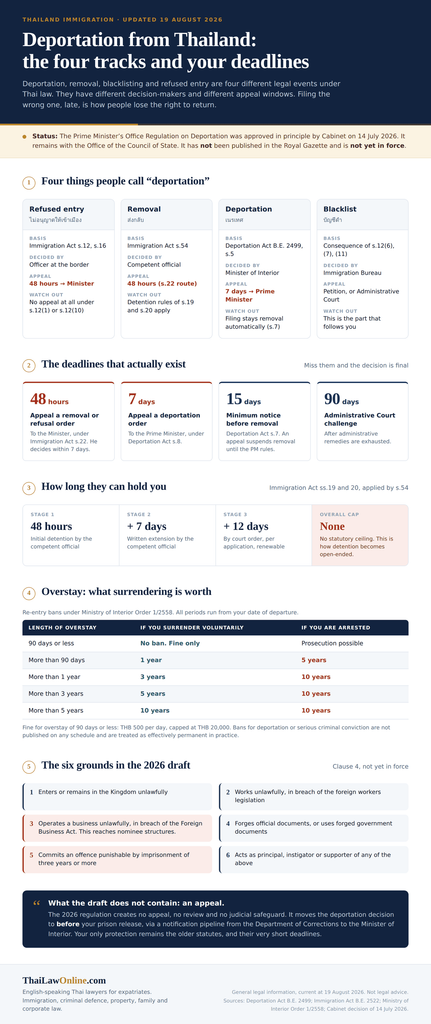
Table des matières
Quatre choses différentes que les gens appellent “ déportation ”
Voici la confusion qui coûte de l'argent aux clients. Les commentaires en langue anglaise traitent de la déportation, du retrait, mise sur liste noire et ont refusé leur admission en tant que sujet distinct. La législation thaïlandaise considère ces cas comme quatre événements distincts, avec des décideurs différents et des voies de recours différentes.
Si vous faites une demande incorrecte, vous devrez présenter une demande auprès du responsable incorrect et dans le délai incorrect.
| Ce qui se produit | Terme thaïlandais | Base juridique | Qui décide | Rôle de recours |
|---|---|---|---|---|
| Refus d'entrée à l'aéroport ou à la frontière | ไม่อนุญาตให้เข้าเมือง | Loi sur l’immigration B.E. 2522, art. 12 et art. 16 | Agent d'immigration au port d'entrée | s.22 – Appel au ministre, dans un délai de 48 heures. Aucune autre procédure n’est prévue pour les articles s.12(1) ou s.12(10). |
| Suppression après que vous y ayez déjà été et que votre séjour y soit illégal | ส่งกลับ | Loi sur l’immigration B.E. 2522, art. 54 | Agent compétent (Bureau de l'immigration) | La route prévue à l’article 22 est en pratique respectée. Les règles relatives à la détention énoncées aux articles 19 et 20 s’appliquent. |
| Expulsion approprié, en raison de l’ordre public ou de la moralité | เนรเทศ | Loi sur l’expulsion B.E. 2499, art. 5 | Le ministre de l'Intérieur | Appel au Premier ministre, dans un délai de 7 jours (par. 8). Le retrait est suspendu jusqu’à ce qu’il statue (par. 7) |
| Inscription sur liste noire, l’interdiction de réadmission | บัญชีดำ | Consequence de l’article 12(6), (7), (11) et de l’article 16 | Bureau de l'immigration, au niveau administratif | Pas de voie légale unique. Requête ou Tribunal administratif |
Deux points de cette table comptent plus que tout autre chose sur cette page.
Tout d'abord, Une véritable ordonnance de déportation est signée par le ministre de l’Intérieur, et l’appel est adressé au Premier ministre.. Pas au ministre de l’Intérieur. Pas à l’immigration. Nous constatons que cela est indiqué incorrectement sur les sites concurrents et sur les forums d’expat. L’article 8 de la loi sur l’expulsion est explicite et la période de préavis est de 7 jours.
Deuxièmement, La liste noire est la partie qui vous suit. Une ordonnance de déportation en vertu de l’article 5 est valable pour une période déterminée et le ministre peut la révoquer. Mais l’article 12(11) de la Loi sur l’immigration qualifie toute personne déjà déportée de « personne interdite d’entrée ». C’est cette condition qui perdure après tout.
Ce que fait réellement la nouvelle réglementation sur l'expulsion de 2026
Le Règlement de l’Office du Premier ministre concernant l’expulsion, B.E. 2569 (Règlement du Cabinet du Premier ministre relatif à l’expulsion, 2026) a été publié dans la Royal Gazette le 27 août 2026 et est entré en vigueur le lendemain. Le Cabinet l’avait approuvé en principe le 14 juillet 2026, sur proposition du vice-Premier ministre Pakorn Nilprapunt et suite à une résolution du Cabinet du 16 juin 2026 ordonnant la rationalisation des procédures d’expulsion. Le texte publié dans le journal officiel diffère du projet qui avait été présenté à cette étape, et les différences sont importantes.
En lisant les articles de presse, on pourrait croire que la Thaïlande a adopté une nouvelle loi sur la déportation. Ce n'est pas le cas. Il s'agit d'une structure administrative subsidiaire qui s'appuie sur deux lois existantes : article 5 de la loi sur la déportation de l’année 2499 et article 54 de la loi sur l’immigration B.E. 2522. Aucune nouvelle autorité pour l’expulsion n’est créée. Ce qui change, c’est la structure administrative, et c’est là que les affaires sont gagnées ou perdues.
Les six motifs de renvoi
Le règlement crée deux voies distinctes, et les médias les ont présentées ensemble. Clause 4 c’est la voie de conduite. Lorsque le ressortissant étranger se comporte d’une manière contraire à l’ordre public, bonnes mœurs ou le bien-être du public, le Secrétaire permanent à l’Intérieur, ou une personne que le Secrétaire permanent désigne, rapporte l’affaire au Ministre de l’Intérieur, qui décide s’il doit ordonner la déportation. Cela s’applique également à toute personne qui incite ou soutient cette conduite, et il n’est pas nécessaire d’être condamné pour cela.
Article 5 c’est la procédure post-sentence, et elle est plus restrictive que laissent entendre les titres. Elle s’applique uniquement une fois que la personne a été condamnée définitivement et libérée de prison. Dans ces cas, le ministre de l’Intérieur peut ordonner la déportation lorsque le ressortissant étranger :
- Entre ou reste dans le Royaume de manière illégale
- Travaille illégalement, en violation de la législation relative aux travailleurs étrangers
- Opère une entreprise de manière illégale, en violation de la Loi sur les activités commerciales des étrangers
- Faites produire des documents officiels ou utilisez des documents officiels falsifiés
- Commette une infraction passible d’une peine d’emprisonnement de cinq ans ou plus
- Agissant en qualité de chef, instigateur ou partisan de l’une des actions susmentionnées
Les détails techniques sont tout aussi importants que les conditions de détention. Le directeur général du Département des Peines de Prison doit transmettre le nom, la nationalité et le dossier du détenu au secrétaire permanent de l’Intérieur au moins quinze jours avant sa libération ; le secrétaire permanent en informe alors immédiatement le ministre. L’ordre du ministre peut également fixer un délai pendant lequel la personne ne pourra plus entrer en Thaïlande. Dans le cas où un tribunal prononce une peine de détention mais la suspend, ou en impose l’exécution sous forme d’amende, le Bureau du juge informe directement le secrétaire permanent.
Le point 3 mérite un examen approfondi si vous dirigez une entreprise ici. Il concerne directement les violations de la loi sur les entreprises étrangères. Cela inclut prête-nom les modalités de détention des actions, que le DBD Cette réglementation est appliquée de manière agressive jusqu'en 2026. Supposons que vous soyez un administrateur étranger occupant un poste que vous aviez l'intention de nettoyer. La nouvelle réglementation transforme ce problème de conformité corporate en problème d'immigration. Notre note sur le sujet Les actionnaires thaïlandais et la répression actuelle couvre l’exposition sous-jacente.
Le formulaire 4 est celui qui attire les personnes qui n’ont jamais l’intention de faire de la fraude. Une lettre de banque falsifiée, une lettre d’emploi ou un bail déposés en support d’une demande de visa sont des documents falsifiés, et le demandeur est la personne qui les a déposés. Si un agent a préparé vos documents, lisez ce qu'un agent de visas peut et ne peut pas faire légalement Avant de supposer que le fichier est propre.
Le chapitre 5 nécessite également des soins ; c’est là que se trouvent le projet et le texte publié. Le projet du Cabinet a nécessité trois ans. Le texte publié indique : โทษจำคุกตั้งแต่ห้าปีขึ้นไป, cinq ans ou plus. Les rapports circulant encore avec la mention de trois ans décrivent le projet. Les termes employés laissent entendre que plafond légal de la peine pour cette infraction, Pas la peine de prison effectivement infligée, donc une infraction sanctionnée par une peine maximale de cinq ans peut être qualifiée même lorsque le tribunal a infligé une amende à l’accusé ou a suspendu la peine. L’article 5 traite de ces cas par une procédure distincte : le Bureau du juge notifie directement au secrétaire permanent, plutôt que le Département des peines de prison de le faire lors de la libération.
Le pipeline de préversion
C’est le cœur opérationnel de la réglementation, et c’est vraiment nouveau :
- Le Direction des services pénitentiaires Il doit en informer Secrétaire permanent à l'Intérieur of foreign inmates convicted of the clause 5 offences and their details, at least 15 days avant la sortie.
- Le Secrétaire permanent soumet l'affaire au Ministre de l'Intérieur.
- Le ministre may order deportation once the sentence is served and the person released.
- La procédure de retrait s’effectue dans le pays de nationalité. Si la nationalité ne peut pas être déterminée, dans le dernier pays de résidence déclaré avant l’entrée en Thaïlande.
- Les transferts vers des pays tiers se font par les voies diplomatiques. Ils nécessitent l’accord du déporté. consent écrit, et l’État ou l’organisation recevant doit accepter de supporter tous les frais de soins et de transport.
Under the old practice, a foreign prisoner finished a sentence and then entered a slow, ad hoc process. Sometimes that meant release. Sometimes it meant months at the Immigration Detention Centre while nobody moved the file. The regulation closes that gap by making Corrections send the file up avant the sentence ends, so that the Minister can order deportation once you are released.
Voici ce que cela signifie dans la pratique. Si vous défendez un ressortissant étranger dans une affaire pénale thaïlandaise, la conséquence en matière d’immigration n’est plus quelque chose avec laquelle vous devrez faire face plus tard. Elle fait désormais partie de la stratégie de détermination de la peine. Nous disons depuis des années que Défense pénale pour les étrangers en Thaïlande Il s'agit vraiment de deux affaires qui se déroulent en parallèle. La réglementation le stipule clairement.
Ce que la réglementation ne contient pas
Une requête.
Ce n’est pas une négligence de notre part. La réglementation ne prévoit ni recours, ni réexamen, ni garantie judiciaire. Formichella & Sritawat l’a signalée comme “ notablement absente ”. La demande principale d’Asylum Access Thailand demande au gouvernement de confirmer que les droits existants en matière d’appel légal resteront en vigueur, précisément parce que la réglementation ne le stipule pas.
Ainsi, l’architecture de l’appel reste inchangée : les articles 7 et 8 de la loi sur la déportation, ainsi que l’article 22 de la loi sur l’immigration. La question de savoir si cette réglementation entend que ces dispositions subsistent après un processus “ simplifié ” reste ouverte. Jusqu’à ce que cette question soit élucidée, il faut présumer que votre seule protection réside dans la loi ancienne et respecter les délais prévus par cette loi.
Deux prétentions que le texte publié dans le journal règle
Deux allégations circulent largement dans les projets de reportages. Elles peuvent désormais être éclaircies dans le texte officiel plutôt que laissées sans réponse :
- Le délai de “ 30 jours après l’exécution de la peine ” n’existe pas. Cela se retrouve dans les reportages en langue anglaise depuis le début d'août 2026, et il n'est pas prévu dans le règlement. L'article 5 exige que le secrétaire permanent rende compte au ministre. sans délai (Sans tarder) une fois que la Couronne a donné son avis, et sans aucune limite extérieure. La seule période de trente jours prévue dans le texte se trouve à l’article 8, et elle régit quelque chose de tout à fait différent : lorsque l’État ou une organisation internationale demande à la Thaïlande d’envoyer la personne vers un pays tiers, cette remise doit être effectuée dans les trente jours suivant la demande, prorogeable deux fois par le ministre, pour une durée maximale de trente jours chacun. Toute personne qui compte sur un délai de trente jours après la condamnation compte sur le projet de loi.
- “ L’État thaïlandais paie désormais les expulsions ” n’est pas ce que le texte dit. L’article 9 ne répartit pas les frais entre les parties. Il prévoit que les frais de déportation seront fixés par un règlement que le ministère de l’Intérieur établira avec l’approbation du ministère des Finances ; les règles relatives aux frais sont donc déléguées à un instrument qui n’a pas encore été élaboré. L’article 55 de la loi sur l’immigration reste inchangé et en vigueur : il impose le remboursement des frais de déportation au transporteur qui vous a amené, ou, en cas de refus, à la personne qui vous a amené ou hébergé (articles 63 et 64), tandis que l’article 54 oblige l’étranger détenu à supporter les frais de détention. Dans l’article 8 concernant la route vers un pays tiers, l’État ou l’organisation requérant doit s’engager par écrit à assumer les frais de prise en charge et les frais de transfert. Ainsi, le texte publié ne prévoit pas de déportation financée par l’État générale.
L. Loi sur l'expulsion de B.E. 2499 : la loi qui signe l'ordre
La loi sur les déportations a septante ans et est très vivante. Elle a été amendée en 2507 et en 2521 et constitue le cadre juridique de la réglementation de 2026. Quatre articles sont importants pour vous.
Article 5 : Les pouvoirs du ministre
Le ministre peut ordonner la déportation d’un étranger lorsque cela est nécessaire dans l’intérêt de l’ordre public ou de la morale générale (ordre public ou moralité). Il fixe la durée. Il peut également annuler sa propre ordonnance.
Deux choses en résultent. Les motifs sont extrêmement larges, c’est l’objectif de cette section. Et parce que le ministre peut annuler une décision de déportation, une ordonnance de déportation n’est pas automatiquement permanente. L’annulation est un véritable recours qui n’est pas suffisamment utilisé.
L'article 5 ne s'applique pas à une personne qui a détenu nationalité thaïlandaise par naissance. Cette exception reflète la position constitutionnelle selon laquelle un ressortissant thaïlandais ne peut être expulsé du Royaume.
Article 7 : quinze jours et un sursis automatique
Vous avez droit à un minimum de Un préavis de 15 jours avant que l’expulsion ne soit effectuée. Et si vous vous plaignez, l’expulsion se produit. Suspendu jusqu'à ce que le Premier ministre décide. Cette prolongation est automatique. Vous n’en faites pas la demande.
Cette seule phrase est la chose la plus précieuse de cet article. Une requête déposée en temps utile empêche l’avion de décoller.
Article 8 : sept jours, au Premier ministre
Le recours contre une ordonnance de article 5 est en cours. au Premier ministre, dans un délai de 7 jours. Il peut annuler l'ordre, le modifier ou substituer un ordre de placement professionnel.
Soyez honnête quant aux probabilités. C’est un recours politique discrétionnaire, pas un recours judiciaire. Mais la suspension prévue à l’article 7 vaut la peine d’être appliquée en soi, car elle permet de gagner du temps pour faire face à tout le reste. Selon notre expérience, les clients qui ont de mauvaises expériences sont ceux qui passent la première semaine à se disputer avec les agents de l’immigration. Ils se disputent ensuite et déposent ensuite une demande.
Articles 9 bis à 11 : les infractions
Le refus d’obéissance à une ordonnance de déportation peut entraîner jusqu’à trois ans de prison, ou cinq ans si l’acte de refus implique la force ou la participation de trois personnes ou plus (article 9 bis). Le libération d’un détenu peut entraîner jusqu’à cinq ans de prison, doublés de la moitié si la force est utilisée (article 9 ter). Le soutien d’un fugitif peut entraîner jusqu’à trois ans de prison (article 9 quater). Le retour en Thaïlande avant l’expiration de l’ordonnance entraîne jusqu’à un an de prison, puis une nouvelle déportation en vertu de l’article 10. Il n’existe pas de solution astucieuse à cette situation. Ne pas essayer.
La loi sur l'immigration B.E. 2522 : expulsion, refus d'entrée et le délai de 48 heures
L'article 12 et les onze catégories interdites
L’article 12 énumère onze catégories d’étrangers qui ne peuvent pas entrer dans le pays. Les personnes qui mordent les expatriés sont :
- s.12(6): une peine d'emprisonnement antérieure, sauf pour les infractions mineures et négligentes
- s.12(7)Des faits qui indiqueraient que vous constituez un danger pour la sécurité publique ou la sécurité nationale
- s.12(10): personnes interdites par le ministre en vertu de l’article 16
- s.12(11): les personnes déportées par la Thaïlande ou par un gouvernement étranger, ou dont le droit de séjour a été révoqué
Section 12(11) is why deportation and blacklisting are welded together. Once a deportation order exists, you’re a statutorily prohibited alien unless the Minister grants a case-specific exemption. The same limb also covers anyone removed at the Thai government’s expense. Not because someone typed your name into a database, but because the statute says so.
L’article 16 est la disposition générale discrétionnaire. Le ministre peut exclure un étranger pour des raisons de bien-être national, de paix publique, de culture, de moralité ou de bien-être. Notez ce que l’article 22 dit à ce sujet ci-dessous.
Article 22 : l'appel de 48 heures et ses deux angles morts
Si un agent constate que vous êtes concerné par l’article 12, il vous ordonne par écrit de quitter le Royaume. Si vous n’êtes pas satisfait :
- Vous vous plaignez au ministre, déposé auprès de l’autorité compétente dans les 48 heures de la réception de la commande (ภายในสี่สิบแปดชั่วโมง).
- Si le ministre n'a pas décidé dans les 7 jours En vertu de l’article 12, vous êtes réputé ne pas être un étranger interdit d’entrée.
- La suppression est suspendu en attendant la décision.
- L’ordre du ministre est final.
Maintenant, les deux points faibles. Il n’existe pas de recours en vertu de l’article 12(1) ou de l’article 12(10). Pas de passeport ou de visa valide, pas de recours. Exclus par le ministre en vertu de l'article 16, pas de recours. Ces sont les cas où la voie administrative se termine à la porte et le Tribunal administratif devient la seule option.
Quarante-huit heures sont une période très rude. Elles se déroulent alors que vous êtes dans une zone d’attente, généralement sans votre téléphone, et souvent sans un traducteur. Si vous êtes détenu à l’aéroport, la chose la plus utile que vous puissiez faire est d’obtenir le numéro d’un avocat auprès de quelqu’un de l’extérieur. Notre guide sur ce que faire lorsque un étranger arrêté en Thaïlande Définition de la liste de contrôle des premières heures.
Article 54 : l'éloignement et la rétention qu'il autorise
L’article 54 s’applique à toute personne qui est entrée sans autorisation, ou dont l’autorisation a expiré ou a été révoquée. L’officier compétent les déporte.
La partie la plus importante est la référence croisée. L’article 54 s’applique. articles 19 et 20, mutatis mutandis. C’est là que réside le pouvoir de détention, et c’est pourquoi les personnes finissent par être détenues pendant de longues périodes sans que rien ne ressemble à une peine. Nous traitons des délais dans la section suivante.
L’article 54 permet également de procéder à une libération officielle, soit en matière de sécurité, soit en matière de sécurité et de caution, avec des conditions de notification. Cette option existe. Demandez-la.
Article 55 : qui paie
Le coût de l’expulsion incombe tout d’abord au propriétaire ou au maître de la personne qui vous a amené. Si celui-ci n’existe pas, l’article 55 le charge de celui qui a commis l’infraction consistant à vous amener ou à vous accueillir (articles 63 et 64), et non de vous. Ce que vous payez est le coût de votre propre détention pendant que vous attendrez l’expulsion, somme que l’article 54 attribue à l’étranger détenu. Avec votre permission, vous pouvez organiser votre propre départ à vos frais. C’est généralement la meilleure solution. Vous conservez un certain contrôle sur le moment et le lieu de votre départ.
Articles 81 et 82 : les sanctions
Dépassement de la durée de séjour autorisée Selon l'article 81, une peine d'emprisonnement pouvant aller jusqu'à deux ans ou une amende de jusqu'à 20 000 THB, ou les deux. La somme de 500 THB par jour, plafonnée à 20 000 THB, est une somme forfaitaire appliquée lors du départ, et non une pénalité prévue à l'article 81. Ce sont des choses différentes, et confondre les deux est la façon dont les gens se convainquent que le dépassement de la durée de séjour est un ticket de stationnement.
Section 82 punishes evading an order made under the Immigration Act with a fine of up to THB 5,000. Evading an order to leave the Kingdom is up to two years et une amende pouvant atteindre 20 000 THB.
Rétention en vue d'un éloignement : combien de temps peut-on réellement vous retenir ?
Il existe une structure légale bien définie, et puis il y a ce qui se passe ensuite.
| Étape | Maximum | Qui autorise |
|---|---|---|
| Arrêt provisoire | 48 heures | Agent compétent |
| Premier prolongement | Up to 7 days in total | Officier compétent, par écrit |
| Extensions supplémentaires | 12 jours par demande | La Cour |
| After a removal order | As long as necessary | Competent official (s.54 para 3) |
Read that last row again. The 48-hour, 7-day and 12-day limits apply while the case is still being investigated (s.20, applied by s.54 para 2). Once a removal order has been made, s.54 para 3 lets the official detain you for as long as necessary pending removal, with no court involvement. That’s the mechanism by which detention at the Immigration Detention Centre becomes open-ended.
Ce que l'IDC est réellement
Nous n’allons pas minimiser cette situation. Le profil du projet Global Detention Project concernant l’IDC de Bangkok à Suan Phlu indique une capacité déclarée de 1 100 personnes et documente une situation de surpopulation grave. Des anciens détenus ont décrit des cellules partagées par 200 à 250 personnes, avec environ un demi-mètre carré chacun. Des évaluations de 2023 et 2024 ont révélé des cellules inférieures au minimum de 3 m² par détenu, sans lits, tables ni chaises. Les soins de santé étaient signalés comme insuffisants, avec aucun médecin en service en 2024. Neuf décès ont été documentés dans le centre.
Dans les cas de sursis simple, où vous payez vous-même les frais de votre détention, la durée de cette dernière est généralement courte. Des jours. Les longues détention surviennent lorsque le détenteur n’a aucun document de voyage, aucun pays n’est prêt à l’accueillir ou lorsque le problème en question n’a pas été résolu. En 2024, des experts de l’ONU ont noté que certains détenus étaient détenus pendant dix ans.
Caution du centre de rétention administrative
Une libération temporaire est possible. Conformément aux directives publiées par l’UNHCR en Thaïlande, la pratique est la suivante :
- La caution est habituellement 50 000 THB.
- Vous avez besoin d'un Garant thailandais, ou un étranger ayant le statut de résident légal.
- Vous devez indiquer l’adresse où vous vivrez après votre libération.
- Vous vous présentez auprès de l'IDC mensuellement, avec votre garant. Si vous la manquez, votre mise en liberté est annulée.
Par ailleurs, l’article 54 lui-même permet de libérer l’officier chargé de la procédure sous caution ou sous cautionnement. Si vous êtes impliqué dans une affaire pénale parallèle, les procédures diffèrent à nouveau, et notre guide pour La détention à huis clos en Thaïlande pour les ressortissants étrangers ce côté-là est couvert.
La liste noire : combien de temps elle dure et comment en sortir
Interdictions de dépassement de séjour : le calendrier officiel
Ces dispositions sont issues de l’arrêté du ministère de l’Intérieur n° 1/2558, en vigueur depuis le 20 mars 2016. Tous les périodes de bannissement s’appliquent à partir de votre date de naissance. date de départ.
| Durée du dépassement de séjour | Si vous vous rendez volontairement | Si vous êtes arrêté |
|---|---|---|
| 90 jours ou moins | Pas d'interdiction. Seule amende (THB 500/jour, maximum THB 20 000) | 5 years (overstay up to 1 year), plus prosecution |
| Plus de 90 jours | 1 an | |
| Plus d'un an | 3 ans | 10 years (overstay over 1 year) |
| Plus de 3 ans | 5 ans | |
| Plus de 5 ans | 10 ans |
La différence entre les deux colonnes est tout l’argument en faveur d’une présentation spontanée à l’immigration. Un dépassement de séjour de quatre ans suivi d’une reddition volontaire entraîne une interdiction de territoire de cinq ans. Le même dépassement découvert lors d’une arrestation en entraîne une de dix ans. Nous détaillons les tactiques sur notre page intitulée Excès de durée de séjour au titre du visa thaïlandais, accusations pénales et inscriptions sur les listes noires.
Interdiction de séjour et condamnation pénale
Il n'existe pas de calendrier officiel pour ces procédures, et vous devriez être sceptique envers toute personne qui vous donne un chiffre fiable. Les praticiens rapportent que les inscriptions dans le système d'immigration peuvent durer jusqu'à 100 ans, ce qui est en fait permanent. C'est la description de ce qui apparaît dans la base de données, et non une durée légale. Les condamnations graves, notamment pour les stupéfiants, la violence, la fraude et tout ce qui touche à la sécurité nationale, sont en pratique traitées comme des exclusions à vie. Si votre affaire concerne spécifiquement les stupéfiants, consultez notre page sur Les lois thaïlandaises sur les drogues, les sanctions et la défense.
Trois itinéraires retirés de la liste
Il n’existe pas de procédure codifiée unique pour la dé-blanchiment des noms. Il existe trois voies pratiques, et elles sont très différentes les unes des autres.
| Itinéraire | Date limite | Décidé par | Statut | Utilisation réaliste |
|---|---|---|---|---|
| Appel au Premier ministre (Loi sur la déportation, art. 8) | 7 jours | Premier ministre | Statutaire | Contre une ordonnance de déportation ministérielle. Cela déclenche une suspension automatique en vertu de l’article 7. |
| Appel au ministre (Loi sur l’immigration, art. 22) | 48 heures | Ministre | Statutaire. La décision est définitive | Contre une ordonnance de refus ou de départ du Royaume. Non disponible pour l’article 12(1) ou l’article 12(10). |
| Annulation de l’ordonnance (Loi sur la déportation, art. 5) | Pas de délai précis | Ministre de l'Intérieur | Pôles de pouvoir légal, utilisation discrétionnaire | Inutilisé. Valeur d’être étudié lorsque les circonstances ont réellement changé |
| Pétition pour la suppression de la liste noire | Pas de délai précis. Généralement tenté après environ 5 ans | Bureau de l'immigration | La pratique, et non la loi | Il faut des preuves de réadaptation et une raison convaincante pour le retour. |
| Contre-mesure devant le tribunal administratif | En général 90 jours | Tribunal administratif | Statutaire | Après que les recours administratifs ont été épuisés. Il y a besoin d’une erreur procédurale ou d’une application illégale. |
Une précision concernant cette quatrième ligne. La formule “ cinq ans puis demande ” circule largement sur les sites web des cabinets d’avocats. Nous n’avons trouvé aucune réglementation publiée ni aucun arrêté du Bureau de l’immigration établissant cette pratique. Nous considérons cela comme une pratique observée, et non comme un droit que vous pouvez imposer.
La voie judiciaire auprès du Tribunal administratif est celle que la plupart des personnes ignorent, et c’est le forum approprié. Une ordonnance de déportation et une inscription sur une liste noire sont des actes administratifs. C’est aussi pourquoi vous ne trouverez pas beaucoup d’autorité de la Cour suprême concernant ces questions. Nous avons recherché dans les bases de données Dika les décisions n° 2568 et 2569 sur la déportation et n’avons trouvé aucune information à ce sujet. Si vous souhaitez en savoir plus sur la manière dont les différents organes de justice s’entendent, consultez notre explication sur Les recours pénaux et le système judiciaire de la Cour suprême en Thaïlande.
Que faire dans les premières 48 heures
Les commandes sont traitées ici. Voici la procédure que nous proposons aux clients.
- Obtenez l'ordre par écrit et prenez une photo de celui-ci. On ne peut pas faire appel de ce qui n’est pas identifiable. Il faut savoir si c’est une ordonnance de article 22, une ordonnance de retrait de la nationalité conformément à l’article 54 ou une ordonnance de déportation ministérielle en vertu de l’article 5. Le délai dépend entièrement de la catégorie d’ordonnance.
- Notez l'heure exacte à laquelle vous l'avez reçu. L’horloge de 48 heures prévue à l’article 22 commence à compter de la réception de la marchandise, et non de son arrestation.
- Envoyez un message. Le numéro de téléphone d’un avocat pour toute personne située en dehors de l’établissement vaut plus que tout argument qui y serait avancé.
- Contactez votre ambassade. Ils ne peuvent pas empêcher une expulsion. Ils peuvent confirmer votre localisation, vous aider à obtenir un document de voyage et créer un enregistrement indiquant que quelqu’un surveille votre activité.
- Générez des documents à temps, même si celui-ci est court. Une requête écrite succincte déposée dès le premier jour est préférable à une requête élaborée avec soin déposée le troisième jour. Conformément à l’article 7 de la loi sur l’expulsion, c’est la présentation de la requête qui empêche l’expulsion.
- Ne signez rien que vous ne pouvez pas lire. Demandez une traduction. Si un document vous est présenté uniquement en thaï, c’est le moment de ralentir.
- Demandez des informations concernant la libération sous caution. L’article 54 le permet. Les autorités ne le proposent pas toujours.
Qui est nouvellement soumis aux règles de 2026 ?
En pratique, le risque d’expulsion de la Thaïlande n’est pas réparti uniformément. Les six motifs de cette mesure touchent beaucoup plus certaines populations que d’autres.
- Directeurs et actionnaires étrangers dans des structures nominatives. Ground 3 atteint des violations de la loi sur les entreprises étrangères. C’est le groupe dont le profil de risque change le plus, et la plupart d’entre eux ne le savent pas encore.
- Tout le monde qui travaille sans le permis requis. Étape 2. Cela inclut les travailleurs à distance et les consultants qui se sont convaincus qu'un ordinateur portable et un client étranger ne sont pas “ du travail en Thaïlande ”. Consultez notre page sur Violations des permis de travail, sanctions et risque d’expulsion.
- Des ressortissants étrangers en fin de peine de prison. The pre-release notification pipeline is aimed squarely at you. Your file now reaches the Minister before you walk out, and the order can follow as soon as you are released.
- Longs retards d'arrivée. Terrain 1. Invariable en substance, plus rapide en exécution.
- Tout le monde ayant un problème avec un document. Le chapitre 4 couvre les faux documents officiels. En pratique, cela concerne les personnes qui ont acheté un “ service ” pour résoudre un problème de visa ou de licence et qui n’ont jamais demandé comment cela fonctionnait.
Un conjoint ou des enfants thaïlandais ne vous apporteront pas automatiquement une défense. Mais cela compte. Cela importe pour une demande de révocation au titre de l’article 5 et pour un appel au Premier ministre au titre de l’article 8. Les circonstances familiales sont précisément ce que le recours discrétionnaire permet de prendre en considération. Notre synthèse visas pour conjoint et personnes à charge répond au côté statutaire, et droit de la famille thaïlandais Cela couvre le reste.
Foire aux questions
Puis-je être expulsé de Thaïlande sans condamnation pénale ?
Oui. L’article 5 de la loi sur l’expulsion de 1956 autorise l’expulsion pour des seuls motifs d’ordre public ou de bonnes mœurs. Aucune condamnation n’est requise. C’est un pouvoir discrétionnaire large qui appartient au ministre de l’Intérieur.
Combien de temps ai-je pour faire appel d'une mesure d'expulsion en Thaïlande ?
Sept jours, au Premier ministre, en vertu de l’article 8 de la loi sur la déportation. La requête suspend la déportation jusqu’à ce que le ministre statue. Une décision de refus ou de non-retour au Royaume-Uni en vertu de la loi sur l’immigration est différente : 48 heures, au ministre.
L'expulsion de la Thaïlande est-elle définitive ?
L’ordonnance elle-même s’applique pendant la période fixée par le ministre, qui peut la révoquer. Le problème persistant est l’article 12(11) de la loi sur l’immigration, qui fait de la personne déjà expulsée un étranger interdit.
Combien de temps l'immigration thaïlandaise peut-elle me détenir avant mon expulsion ?
While the case is investigated, 48 hours, extendable to 7 days in total with reasons recorded, then by court order in blocks of up to 12 days. Once a removal order is made, section 54 lets the official detain for as long as necessary pending removal, which is how indefinite detention happens.
Puis-je obtenir une libération sous caution du centre de détention pour immigrants ?
Souvent, oui. La caution est généralement de 50 000 THB et vous avez besoin d’un garant thaïlandais ainsi que d’une adresse fixe. Vous faites ensuite un rapport mensuel avec votre garant ou la caution est révoquée.
Le nouveau règlement sur l'expulsion de 2026 est-il déjà applicable ?
Oui. Il a été publié dans la Royal Gazette le 27 août 2026 (vol. 143, partie spéciale 205 Ngor) et est en vigueur depuis le 28 août 2026.
Quelle est la différence entre être déporté et être inscrit sur une liste noire ?
La déportation est le déplacement physique ordonné par le ministre de l’Intérieur. La mise sur liste noire est l’interdiction de réadmission enregistrée par le Bureau de l’immigration. Une déportation entraîne presque toujours une inscription sur la liste noire. Une inscription sur la liste noire peut exister sans déportation.
Puis-je être retiré de la liste noire de l'immigration thaïlandaise ?
Parfois. Il existe trois voies de recours : un recours statutaire si vous êtes encore dans le délai fixé ; une requête discrétionnaire auprès du Bureau de l’immigration ; ou une action devant le Tribunal administratif, généralement dans un délai de 90 jours.
Le fait de rester trop longtemps m'entraînera-t-il dans une procédure de déportation ?
Overstay of 90 days or less is a fine, with no ban, if you leave voluntarily. Longer overstays trigger re-entry bans of 1 to 10 years. Being arrested instead produces a 5-year ban for up to 1 year of overstay and a 10-year ban beyond that.
Comment ThaiLawOnline peut vous aider
L’expulsion d’un ressortissant thaïlandais est un travail très urgent, contrairement à la plupart des affaires juridiques. La différence entre rester en Thaïlande et le perdre réside souvent dans un document déposé un mardi plutôt qu’un jeudi.
Nous intervenons en cas d’appel urgent contre des ordonnances d’expulsion et de déportation. Nous traitons les demandes de libération de la détention d’immigration, les demandes de révocation de l’article 5, les recours contre la liste noire et les recours devant le Tribunal administratif. Nous conseillons également sur les répercussions de l’immigration dans le cadre d’une affaire pénale en cours. Conformément à la réglementation de 2026, cette question doit être traitée au début de l’affaire, et non à la fin.
Si vous ou une personne que vous connaissez êtes actuellement détenus, contactez notre équipe. Veuillez nous indiquer la date et l’heure à laquelle la commande a été livrée. C’est la première information dont nous avons besoin.
Points clés à retenir
- La déportation, le retrait de la nationalité, l’inscription sur une liste noire et l’interdiction d’entrée sont quatre situations juridiques distinctes. Identifiez celle qui vous concerne avant de procéder à tout autre action.
- Une ordonnance de déportation en vertu de la loi de 2499 sur la déportation est signée par Ministre de l'Intérieur. Le recours s’adresse à Premier ministre dans les 7 jours, et le dépôt de la demande de retrait demeure automatique.
- Une ordonnance d’immigration exigeant le départ entraîne des conséquences 48-heures délai de recours. Il n’existe aucun délai de recours en vertu de l’article 12(1) ou de l’article 12(10).
- Detention has no overall statutory cap. Once a removal order exists, s.54 lets the official hold you for as long as necessary pending removal.
- Section 12(11) is what makes deportation stick. It converts you into a prohibited alien by operation of statute, unless the Minister grants a case-specific exemption.
- Le règlement de 2026 crée Aucun nouveau droit d'appel. It sends your file to the Minister at least 15 days before your prison release, and the Minister’s power to order deportation arises on release.
- Le règlement est en vigueur depuis le 28 août 2026. Les informations diffusées par la presse concernant un délai de retrait de 30 jours et les expulsions financées par l’État décrivent le projet du Cabinet, et non le texte publié dans le journal officiel, il ne faut donc pas s’y conformer.
- Surrendering voluntarily on an overstay means a ban of 0 to 10 years by length of overstay; being arrested means 5 years (up to 1 year of overstay) or 10 years.
La dernière révision : 27 septembre 2026. Lire en thaï : Loi sur l’expulsion B.E. 2499 telle que modifiée, articles 5 à 11 (texte consolidé actuel sur law.go.th) ; Loi sur l’immigration B.E. 2522, articles 12, 19, 22, 54, 55, 81 et 82. La réglementation du Bureau du Premier ministre sur l’expulsion B.E. 2569 a été lue à la lumière du texte de la Royal Gazette par une révision antérieure. Les dispositions relatives à l’interdiction de séjour prolongé, les conditions de l’IDC et la pratique en matière de cautionnement proviennent de sources secondaires et de la pratique publiées.
Actualités juridiques thaïlandaises, gratuites par courriel
Des mises à jour en anglais simple sur les changements législatifs thaïlandais concernant les étrangers : propriété, visas, mariage, affaires et testaments. Un court courriel par mois, envoyé par un cabinet d’avocats établi depuis 2006. Zéro spam, désabonnement possible à tout moment.