


Révisé par ThaiLawOnline, un cabinet d'avocats thaïlandais agréé exerçant en Thaïlande depuis 2006. Avocate thaïlandaise en charge du dossier : Wichuda Atthamethakon, LL.M., licence du barreau thaïlandais 3149/2556.
Dernière mise à jour :
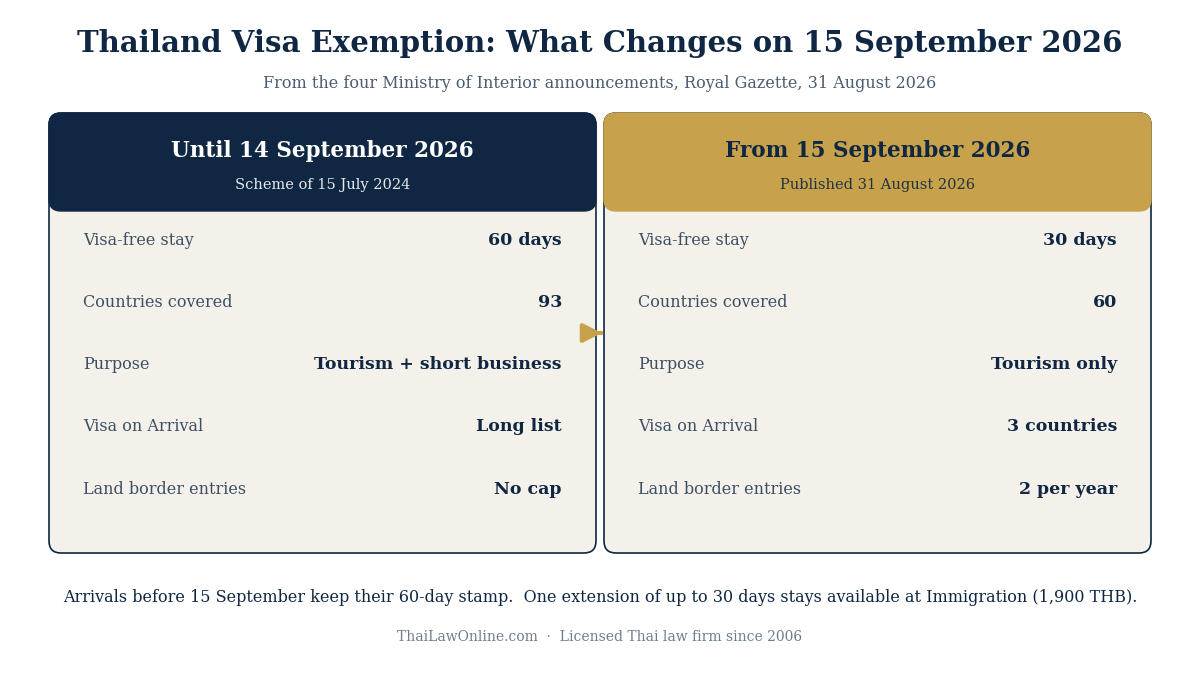
Pour la Thaïlande, la nouvelle exemption de visa de 30 jours a désormais force de loi. Le 31 août 2026, la Gazette royale a publié les quatre annonces du ministère de l'Intérieur qui mettent fin à l'exemption de visa de 60 jours pour 93 pays et la remplacent par une exemption de 30 jours pour 60 pays et territoires. Les directives officielles de voyage thaïlandaises indiquent que les nouvelles règles d'entrée s'appliquent à partir de 15 septembre 2026. Les voyageurs admis avant cette date conservent le séjour de 60 jours tamponné dans leur passeport. Cette page lit les instruments publiés eux-mêmes, corrige le décompte des pays qui a circulé toute l'année et explique ce que perdent les voyageurs d'affaires qu'aucun site de voyage n'a mentionné.
Table des matières
Ce que la Gazette royale a publié le 31 août 2026
Quatre annonces du ministère de l'Intérieur ont paru simultanément dans la Gazette royale (Volume 143, Partie spéciale 207 Ngor), datées chacune du 26 août 2026 et signées par le Premier ministre et ministre de l'Intérieur Anutin Charnvirakul. Lisez-les vous-même ; aucun résumé ne remplace la source :
- L'instrument d'abrogation: annule la mesure d’exemption de visa de 60 jours du 15 juillet 2024 qui couvrait 93 pays et territoires.
- La liste des exemptions de 30 jours: 60 pays et territoires, tourisme uniquement, 30 jours par entrée. Il abroge également les annonces précédentes de 30 jours du 4 mars 2019 et du 21 juin 2022 (n° 2).
- L'instrument du visa à l'arrivée: réduit la liste du visa à l'arrivée à l'Azerbaïdjan, la Biélorussie et la Serbie.
- L'exemption de 15 jours: un séjour sans visa plus court pour l'île Maurice et les Seychelles.
L’article 12(1) de la loi sur l’immigration B.E. 2522 (1979) exige un visa pour l’entrée sauf dans les cas prévus. L’abrogation a été apportée en vertu de l’article 17 de la loi. Les listes de 30 et 15 jours ont été établies en vertu de l’article 13, et la liste « Visa on Arrival » en vertu de l’article 6, paragraphe deux, du règlement ministériel de 2002 relatif à l’inspection des visas, à l’exonération et au changement de catégorie de visa, le même cadre qui a présidé au projet de 2024.
La dernière mise à jour : 27 septembre 2026. Les quatre annonces ont été lues à partir des images des pages de la Royal Gazette. Elles prennent effet au bout de quinze jours à compter de la publication ; le ministère des Affaires étrangères et l’Autorité du tourisme de Thaïlande indiquent cette date comme le 15 septembre 2026, et cette page suit leur exemple. Les déclarations de l’ambassade sont celles publiées le 14 septembre 2026, et les informations relatives aux accords bilatéraux restent des informations de pratique, non reprises dans cette revue.
Quand commence la règle des 30 jours ? Le compte à rebours de 15 jours expliqué
Les annonces du ministère de l'Intérieur ont été publiées dans la Gazette royale le 31 août 2026. Les conseils de voyage officiels thaïlandais identifient 15 septembre 2026 comme le début des nouveaux arrangements d'exemption de visa. Pour la planification du voyage, utilisez la date d'entrée en Thaïlande, et non la date de réservation ou la date de départ de votre vol. Lisez l'annonce officielle.
La règle de transition protège les arrivées, et la logique est simple : le cachet fixe le droit à l'entrée. Un voyageur admis le 14 septembre 2026 reçoit 60 jours et les conserve tous. L'instrument d'abrogation ne contient aucune disposition raccourcissant un séjour déjà accordé ; il ne comporte que deux clauses, l'abrogation et l'entrée en vigueur. Un voyageur atterrissant le 15 septembre 2026 reçoit 30 jours. Ce qui compte, c'est la date d'admission, et non la date de réservation ou de départ.
La liste complète des exemptions de visa de 30 jours : 60 pays et territoires
Les chiffres entre 54 et 93 ont circulé toute l'année parce que les briefings ont changé entre mai et juillet. La liste publiée l'établit exactement à 60. Voici la liste finale tirée du texte de la Gazette, dans l'ordre officiel :
| 1. Australie | 21. Islande | 41. Oman |
| 2. Autriche | 22. Indonésie | 42. Philippines |
| 3. Bahreïn | 23. Inde | 43. Pologne |
| 4. Belgique | 24. Irlande | 44. Portugal |
| 5. Bulgarie | 25. Israël | 45. Qatar |
| 6. Bhoutan | 26. Italie | 46. Roumanie |
| 7. Brunei Darussalam | 27. Japon | 47. Arabie saoudite |
| 8. Canada | 28. Jordanie | 48. Singapour |
| 9. Croatie | 29. Koweït | 49. Slovaquie |
| 10. Chypre | 30. Kirghizistan | 50. Slovénie |
| 11. République tchèque | 31. Lettonie | 51. Afrique du Sud |
| 12. Danemark | 32. Liechtenstein | 52. Espagne |
| 13. Estonie | 33. Lituanie | 53. Suède |
| 14. Fidji | 34. Luxembourg | 54. Suisse |
| 15. Finlande | 35. Malte | 55. Taïwan |
| 16. France | 36. Malaisie | 56. Turquie |
| 17. Géorgie | 37. Maldives | 57. Ukraine |
| 18. Allemagne | 38. Pays-Bas | 58. Émirats arabes unis |
| 19. Grèce | 39. Nouvelle-Zélande | 59. Royaume-Uni |
| 20. Hongrie | 40. Norvège | 60. États-Unis |
La liste couvre les 27 États membres de l'UE ainsi que le Royaume-Uni, les États-Unis, le Canada, l'Australie, la Nouvelle-Zélande et le Japon. La Croatie, la Bulgarie, Chypre, Malte et les Maldives se sont ajoutés par rapport aux versions précédentes.
L'Inde a progressé, et non reculé
La position de l'Inde a changé trois fois au cours du cycle de rédaction et la réponse finale a surpris les agrégateurs. Les premiers briefings proposaient de faire passer les titulaires de passeports indiens au régime de visa à l'arrivée uniquement. Les textes publiés font le contraire : l'Inde figure sur la liste des exemptions de 30 jours, totalement exclue de la voie du visa à l'arrivée. À compter du 15 septembre 2026, un touriste indien entre sans visa pour une durée de 30 jours, prolongeable une fois auprès des services d'immigration. Les ressortissants indiens prévoyant des séjours plus longs ou des voyages non touristiques doivent lire notre guide sur le exigences de visa pour la Thaïlande applicables aux ressortissants indiens.
Qui a perdu l'accès sans visa et que faire à la place
Environ un tiers de l'ancienne liste de 93 pays n'a pas survécu, y compris la Chine, la Russie, le Cambodge, le Laos, le Viêt Nam, Hong Kong, Macao, la Mongolie, le Kazakhstan, le Mexique, le Guatemala, Cuba et les pays sud-américains ajoutés en 2024. Le fait d'être retiré ne signifie pas automatiquement qu'un visa est requis, car les accords bilatéraux ne sont pas touchés par la réforme. La Corée du Sud, le Brésil, l'Argentine, le Chili et le Pérou conservent 90 jours par traité. La Chine et la Russie conservent 30 jours en vertu de leurs accords, tout comme Hong Kong, Macao, le Laos, le Viêt Nam et la Mongolie selon les leurs, tandis que le Cambodge et le Myanmar conservent 14 jours (le Myanmar par voie aérienne uniquement). L'architecture repose sur un pays, un droit : consultez d'abord la liste des exemptions, puis le traité, et enfin demandez un visa.
Les ressortissants d'un pays retiré sans accord bilatéral doivent faire une demande via le système de visa électronique thaïlandais, normalement pour le visa touristique de 60 jours (TR). Notre Recherche de visa thaïlandais répond à la question concernant votre nationalité le jour de votre voyage, et notre Guide du visa touriste pour la Thaïlande détaille la demande de visa TR.
Le visa à l'arrivée est désormais limité à trois pays seulement
La liste des visas à l'arrivée se réduit, passant d'une longue liste à exactement trois nationalités : l'Azerbaïdjan, la Biélorussie et la Serbie. Tous les autres qui utilisaient le guichet des visas à l'arrivée, y compris les 17 nationalités ajoutées en 2024, ont désormais besoin soit d'un droit bilatéral, soit d'un e-Visa avant d'embarquer.
L'exemption de 15 jours : Maurice et Seychelles
Une annonce distincte accorde à Maurice et aux Seychelles un séjour sans visa de 15 jours, un niveau qui leur est propre en dessous de la liste des 60 pays. Les deux pays figuraient sur la liste d'exemption générale avant la réforme.
Frontières terrestres : le plafond de deux fois par année civile fait son retour
Les entrées sans visa par les points de passage frontaliers terrestres sont limitées à deux par année civile, et le décompte est réinitialisé le 1er janvier. Les ressortissants de la Malaisie, du Brunei Darussalam, de l'Indonésie et de Singapour sont exemptés de cette limite, et le ministre de l'Intérieur pourrait désigner d'autres pays ultérieurement. Les arrivées dans les aéroports internationaux ne sont pas soumises à cette règle. Cette limite rétablit la situation d'avant 2024 et met fin à la sortie du territoire (border run) en tant que stratégie de résidence pour tous les autres ; nous couvrons l'effet pratique dans notre article sur limites des allers-retours frontaliers en Thaïlande. N'oubliez pas que dépassement de séjour comporte des amendes, de la détention et mise sur liste noire, expliqué dans notre guide sur dépassement de visa en Thaïlande.
Tourisme uniquement : pourquoi les visiteurs d'affaires ne peuvent plus utiliser l'exemption
Voici le changement que les sites de voyage ont omis. Le dispositif de 2024 couvrait expressément le tourisme ainsi que certaines activités professionnelles urgentes et de travail à court terme. La nouvelle exemption de 30 jours indique que son objectif est le tourisme. Un consultant venant en avion pour des réunions avec des clients, un directeur assistant à une réunion du conseil d'administration, un acheteur inspectant une usine : chacun d'eux s'est fié à l'ancienne formulation, et cette formulation a disparu.
La conséquence pratique à partir du 15 septembre 2026 : un visiteur d'affaires d'un pays exempté entre toujours sans visa, mais l'entrée est accordée à des fins touristiques, et l'exercice d'activités professionnelles ne correspond pas à l'objet déclaré du séjour. Les voies légales sont les Visa d'affaires Non-B pour le travail et les activités professionnelles prolongées, ou une entrée avec un visa de touriste pour de véritables vacances, une réunion accessoire étant limitée à ce que tolère la pratique des services d'immigration. Les entreprises qui font venir du personnel ou des visiteurs fréquents doivent considérer le 15 septembre comme une date de mise en conformité, et non comme une simple actualité en matière de voyage. Notre bureau conseille sur la bonne catégorie avant le voyage, ce qui coûte moins cher que de discuter à l'aéroport.
Ce que les ambassades thaïlandaises ont publié après la Gazette : prolongation, fonds et la question des affaires
Entre le 2 et le 10 septembre 2026, les missions thaïlandaises à l'étranger ont réécrit leurs pages sur l'exemption de visa, et elles ne disent pas toutes la même chose. Nous avons consulté les pages de Washington, Londres et Copenhague le 14 septembre 2026, parallèlement au point de presse du ministère des Affaires étrangères du 3 septembre 2026 et à l'avis de l'Autorité du tourisme de Thaïlande du 1er septembre 2026. Quatre points comptent pour les voyageurs.
L'extension est réelle et discrétionnaire. Le Ambassade royale de Thaïlande à Washington (page mise à jour le 10 septembre 2026) indique qu'un séjour exempté de visa peut être prolongé pour une nouvelle période ne dépassant pas 30 jours et que cette prolongation relève entièrement de la discrétion de l'agent d'immigration. La Ambassade Royale de Thaïlande à Londres indique que les voyageurs peuvent demander une prolongation de séjour pouvant aller jusqu'à 30 jours. La description exacte est donc de 30 jours à l'entrée, avec une prolongation discrétionnaire pouvant aller jusqu'à 30 jours, déposée auprès d'un bureau d'immigration pour 1 900 THB. Nul n’a droit d’office à 60 jours.
Munissez-vous d'un justificatif de ressources financières, d'un hébergement et d'un titre de transport pour la suite du voyage. Washington exige un montant de liquidités adéquat, égal à 20 000 bahts par personne ou 40 000 bahts par famille. Londres exige la preuve d’un apport suffisant de 20 000 bahts par personne, la preuve d’un logement et un transport vers l’étranger dans un délai de 30 jours. Ces contrôles sont appliqués plus fréquemment aux voyageurs récidivants que aux touristes occasionnels, donc les voyageurs fréquents devraient avoir tous les trois ces documents à disposition au guichet. Le chiffre de l’ambassade est plus élevé que l’instrument légal qui le sous-tend : l’annonce du ministère de l’Intérieur du 8 mai 2000 (2000) fixe 10 000 bahts par personne ou 20 000 bahts par famille pour l’entrée sans visa, et ne s’applique pas aux enfants de moins de douze ans. Les deux sources ne sont pas identiques, et l’immigration n’a pas publié de règle depuis la réforme, donc prenez le chiffre de l’ambassade plus élevé.
L'objectif autorisé est décrit de manière incohérente. Le Point de situation du Ministère des Affaires étrangères, l'avis de la TAT et Londres décrivent l'exemption comme étant pour le tourisme, Londres ajoutant les mots à des fins touristiques uniquement. Washington la décrit comme étant aux fins du tourisme, d'engagements professionnels, de travail urgent ou de travail ponctuel, et Copenhague (mis à jour le 2 septembre 2026) indique le tourisme et les affaires de courte durée. Il s'agit d'une contradiction entre sources officielles, et non entre commentateurs. Tant que le Bureau de l'immigration ne publie pas une seule interprétation, la page Web d'une ambassade n'offre aucune protection contre un avis contraire à l'aéroport, dans un bureau d'immigration provincial ou lors d'une inspection sur le lieu de travail. Toute personne assistant à des réunions ou effectuant un travail urgent devrait utiliser le Visa d'affaires Non-B ou l’autorisation de travail appropriée.
La limite de deux entrées est énoncée de deux manières. Le Avis de TAT et les annonces du ministère de l'Intérieur limitent le plafond de deux entrées par année civile aux points de contrôle terrestres. Londres affirme, sans réserve, que les détenteurs de passeports éligibles ne sont autorisés à entrer dans le cadre du programme que deux fois par année civile. Ne considérez pas une règle nationale de deux entrées comme acquise, mais attendez-vous à ce qu'une troisième entrée sans visa au cours de la même année soit remise en question à n'importe quel point de contrôle, et munissez-vous d'un visa si des entrées répétées font partie de votre projet.
Liste de contrôle pratique pour chaque entrée dispensée de visa à compter du 15 septembre 2026 : passeport valide six mois, une Carte d'arrivée numérique Thaïlande, un billet de continuation daté dans les 30 jours, une réservation d’hébergement et 20 000 THB par personne en espèces ou sur un relevé de carte accessible (le montant publié par les ambassades ; l’annonce ministérielle de 2000 prévoit 10 000 THB par personne). Notre Recherche de visa thaïlandais applique ces règles à votre nationalité et à vos dates de voyage.
Comment rester plus de 30 jours
La prolongation unique survit à la réforme. Une entrée sans visa peut être prolongée une seule fois, jusqu'à 30 jours supplémentaires, auprès d'un bureau d'immigration pour 1 900 THB. Cette prolongation repose sur le cadre des prolongations de séjour en vertu de l'article 35 de la loi sur l'immigration, et elle reste discrétionnaire. Faites le calcul : 30 jours à l'entrée plus 30 jours de prolongation équivalent à peu près aux 60 jours offerts par l'ancien système, pour un coût de 1 900 THB et une matinée au service de l'immigration. Un touriste déterminé perd en commodité, pas en temps passé dans le pays.
Pour tout ce qui est plus long, les itinéraires établis restent inchangés : le visa touristique de 60 jours (TR) prolongeable de 30 jours, le Visa DTV pour les télétravailleurs et les activités de puissance douce, les visas de non-immigrant suivis de prolongations fondées sur la retraite ou de mariage, et le visa LTR pour résidents de longue durée. Notre Recherche de visa thaïlandais fait correspondre votre situation au bon itinéraire, et notre page sur le Changements de visa en 2026 suit comment DTV s'intègre dans le nouveau paysage.
Historique : le dispositif des 60 jours (du 15 juillet 2024 au 14 septembre 2026)
Pour mémoire, c'est le régime que la règle des 30 jours remplace. À compter du 15 juillet 2024, la Thaïlande a autorisé les ressortissants de 93 pays et territoires à entrer sans visa pour une durée de 60 jours, une augmentation par rapport aux 30 jours précédents pour 57 nationalités, conçue pour stimuler la reprise du tourisme. Une autorisation de voyage électronique a été annoncée en même temps pour décembre 2024, reportée à plusieurs reprises et jamais lancée. La formalité d'arrivée réellement utilisée est la Carte d'arrivée numérique de Thaïlande (TDAC), obligatoire depuis le 1er mai 2025. Ce chapitre se ferme le 14 septembre 2026. Notre page des mises à jour sur l'immigration enregistre chaque modification dès qu'elle est intégrée, et le Aperçu de la réforme des visas inscrit cette réforme dans la longue durée.
Foire aux questions
Mon tampon de 60 jours est-il écourté au 15 septembre 2026 ?
Non. Le tampon fixe votre droit à l'entrée. Si l'immigration vous a admis avant le 15 septembre 2026 avec un séjour de 60 jours, vous en conservez chaque jour. L'instrument d'abrogation supprime le régime pour les arrivées futures et ne raccourcit pas les séjours déjà accordés.
Les Indiens sont-ils désormais exemptés de visa pour la Thaïlande ?
Oui. À compter du 15 septembre 2026, les titulaires d'un passeport indien entrent sans visa pour une durée de 30 jours dans le cadre de la liste d'exemption publiée. Les propositions antérieures visant à faire passer l'Inde au visa à l'arrivée n'ont pas été retenues dans les textes finaux.
Combien de fois puis-je entrer en Thaïlande sans visa par une frontière terrestre ?
Deux fois par année civile, à compter du 1er janvier. Le plafond s'applique uniquement aux points de contrôle terrestres ; les arrivées par aéroport ne sont pas soumises à un plafond. Les ressortissants de la Malaisie, de Brunei, de l'Indonésie et de Singapour sont exemptés du plafond.
Puis-je assister à des réunions d'affaires dans le cadre de l'exemption de 30 jours ?
Les actes de la Gazette royale, le point de presse du ministère des Affaires étrangères et l'ambassade de Londres décrivent l'exemption comme étant destinée au tourisme, et le libellé de l'ancien régime concernant les affaires de courte durée n'a pas été repris. La page de l'ambassade de Washington (10 septembre 2026) mentionne néanmoins les activités professionnelles et le travail urgent ou ponctuel, et Copenhague indique les affaires de courte durée. En raison de la contradiction entre les sources officielles, la solution la plus sûre pour les réunions, les négociations ou la participation à un conseil d'administration est d'obtenir un visa d'affaires Non-B, ou de demander conseil pour votre activité spécifique avant le voyage.
Puis-je quand même obtenir 60 jours en Thaïlande d'une manière ou d'une autre ?
Oui, de deux manières. Prolonger l'entrée exempte de visa de 30 jours d'une durée maximale de 30 jours supplémentaires auprès de l'Immigration pour 1 900 THB, ou demander le visa touristique de 60 jours (TR) via le système de visa électronique, qui peut lui-même être prolongé de 30 jours. Les séjours plus longs nécessitent une catégorie de visa adaptée à votre situation.
Combien d'argent dois-je justifier pour l'exemption de visa de 30 jours ?
Les ambassades thaïlandaises à Washington et à Londres indiquent toutes deux 20 000 THB par personne, et Washington ajoute 40 000 THB par famille, en espèces ou en équivalent. Londres liste également la preuve d’hébergement et de transport vers un autre pays dans un délai de 30 jours. L’annonce du ministère de l’Intérieur de 2000 établit un montant inférieur pour l’entrée sans visa, soit 10 000 THB par personne ou 20 000 THB par famille, donc gardez le chiffre de l’ambassade plus élevé jusqu’à ce que l’immigration publie une nouvelle réglementation. Les agents ne demandent pas à tous les touristes, mais ils peuvent le faire, et les visiteurs récidivistes sont plus souvent interrogés.
Le séjour de 30 jours dispensé de visa peut-il être prolongé ?
Oui, une fois, jusqu'à 30 jours, dans un bureau de l'immigration pour 1 900 THB. Les pages des ambassades de Washington et de Londres confirment toutes deux la prolongation et Washington précise que cela relève de la seule discrétion de l'agent de l'immigration. Prévoyez 30 jours et considérez la prolongation comme une demande, et non comme un droit.
Conclusion
L'exemption de visa de 30 jours est une loi publiée avec une date de début fixe. Les touristes des 60 pays de la liste ne perdent pas grand-chose à part la commodité : moitié moins de séjour à l'entrée, récupérable par une seule extension. Les véritables changements se cachent dans les détails que les agrégateurs ont omis : l'objectif purement touristique qui exclut les voyageurs d'affaires de l'exemption, la limite aux frontières terrestres qui met fin aux allers-retours répétés à la frontière, et une liste de visas à l'arrivée réduite à trois pays. Si vos voyages, votre séjour ou vos affaires en Thaïlande touchent à l'un de ces aspects, réserver une consultation et obtenez la bonne catégorie avant le 15 septembre.
Actualités juridiques thaïlandaises, gratuites par courriel
Des informations claires et concises sur les changements législatifs thaïlandais concernant les étrangers : propriété, visas, mariage, affaires et testaments. Un court courriel par mois, envoyé par un cabinet d’avocats établi depuis 2006. Zéro spam, désabonnement possible à tout moment.