


Révisé par ThaiLawOnline, un cabinet d'avocats thaïlandais agréé exerçant en Thaïlande depuis 2006. Avocate thaïlandaise en charge du dossier : Wichuda Atthamethakon, LL.M., licence du barreau thaïlandais 3149/2556.
Dernière mise à jour :
Les lois thaïlandaises sur les stupéfiants sont notoirement strictes ; un faux pas peut signifier des années de prison, voire pire. En tant d'expatrié, les comprendre n'est pas une option, c'est essentiel. La possession d'un seul comprimé peut vous envoyer en prison, tandis que le trafic à grande échelle reste passible de la peine de mort.. Des réformes récentes ont ajusté les limites et ajouté des options de réhabilitation. Le point principal est clair. La vente ou l'utilisation de drogues illégales est traitée comme une menace grave pour la sécurité nationale. Il est important de comprendre les lois sur les drogues en Thaïlande si vous vivez dans le pays ou le visitez. Si vous êtes Si vous êtes étranger et avez été arrêté en Thaïlande, cliquez sur ce guide.
Table des matières
Pour savoir comment une affaire de drogue s'inscrit dans le processus global, consultez notre aperçu de droit pénal en Thaïlande.
Voici un guide détaillé à l'intention des expatriés et des résidents de longue durée. Il explique le fonctionnement de la loi et les sanctions encourues. Il aborde également les moyens de défense reconnus et l'importance de faire appel à un avocat spécialisé en droit des stupéfiants à Bangkok en cas d'arrestation.
Ce guide sur la législation relative aux stupéfiants en Thaïlande vous aidera à vous y retrouver dans ce système juridique complexe. Accusé(e) ? Contactez-nous pour bénéficier de l’assistance d’un avocat spécialisé dans les affaires de stupéfiants à Bangkok.
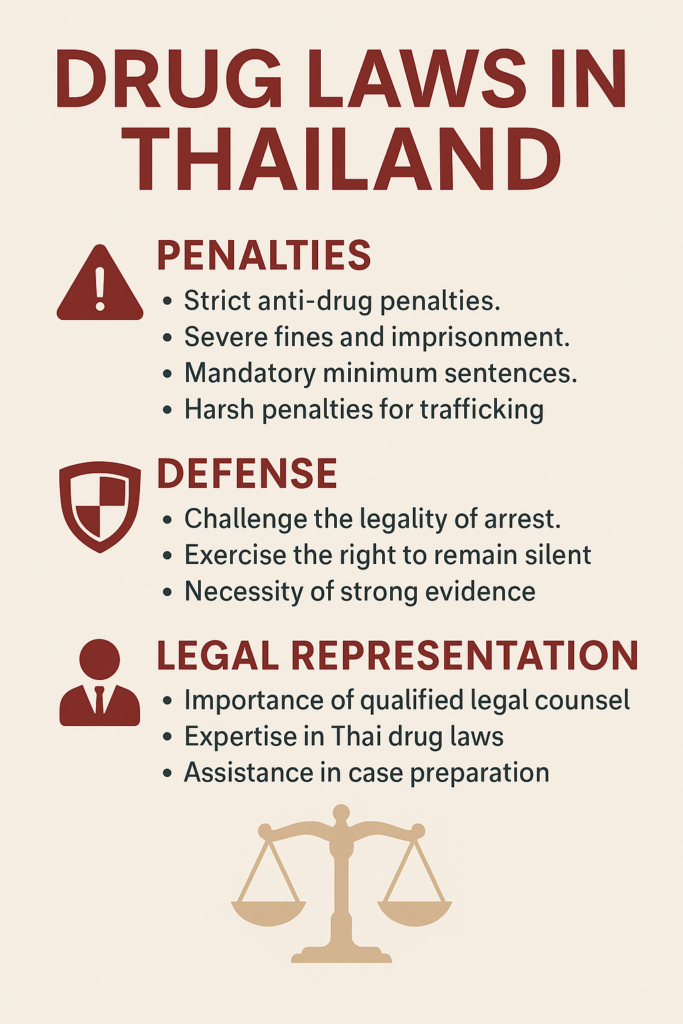
Vous cherchez les tableaux des pénalités ? Les échelles de peines par catégorie et quantité de drogue, la présomption d'intention de fourniture et les modifications de 2024 à 2026 sont exposées en détail dans notre guide de référence sur Lois thaïlandaises sur les drogues, peines et infractions liées au trafic. Cette page explique quoi faire lorsqu'une personne a effectivement été arrêtée.
1. Comprendre la législation sur les drogues en Thaïlande
Le régime thaïlandais de lutte contre les stupéfiants repose sur trois piliers : l'usage personnel, le trafic et la possession en vertu de la loi thaïlandaise.
- La loi sur les stupéfiants de B.E. 2522 (1979) et la loi sur les substances psychotropes de B.E. 2559 (2016) ont été abrogées, ainsi que dix-neuf autres instruments, par l'article 4 de la loi portant promulgation du Code des stupéfiants. Les deux sujets relèvent désormais d'un seul et unique Code des stupéfiants, le “Code des stupéfiants BE 2564 (2021)”La loi a été publiée le 8 novembre 2021 et est entrée en vigueur le lendemain ; le code qui y est annexé est entré en vigueur trente jours plus tard, le 9 décembre 2021.
- Cinq catégories de stupéfiants en vertu de l'article 29, de la catégorie I à la catégorie V, et un régime distinct de quatre catégories de substances psychotropes en vertu de l'article 30. Le Code ne donne que des exemples : la substance nommée qui se trouve dans quelle catégorie, et tout déplacement entre les catégories, est fixé par notification du ministre de la Santé publique, et non par le Code.
- Des infractions parallèles sont prévues pour la possession, l'usage, la fabrication, l'importation/exportation et le trafic de stupéfiants en Thaïlande, chacune entraînant des peines fortement progressives, y compris des années d'emprisonnement.
Principales mises à jour 2024-25
- La quantité de méthamphétamine présumée détenue pour consommation personnelle a été réduite de cinq unités de dosage à une, par le règlement ministériel (n° 2) B.E. 2567 du 17 juin 2024. Un comprimé entre dans le cadre de cette présomption et n'en est pas exclu ; en transporter davantage ne fait que supprimer cette présomption, et l'accusation doit alors prouver à quelles fins la drogue était destinée.
- Cannabis was removed from Category V in 2022 and has not been re-listed. Since 26 June 2025 the flower is a controlled herb: a licensed shop may sell it only to another licence holder or to a buyer holding a prescription, under the Ministry of Public Health controlled-herb notification B.E. 2568. That is not a narcotics charge, although extracts above 0.2 per cent THC remain Category V narcotics. Smoke or odour in public is a separate matter under the Public Health Act. See Is marijuana legal in Thailand?
- De nouvelles tranches de peines permettent aux juges de réduire les durées d'emprisonnement. Cela est possible si l'infraction est “ grave ” mais non “ aggravée ” au sens du Code de 2021.
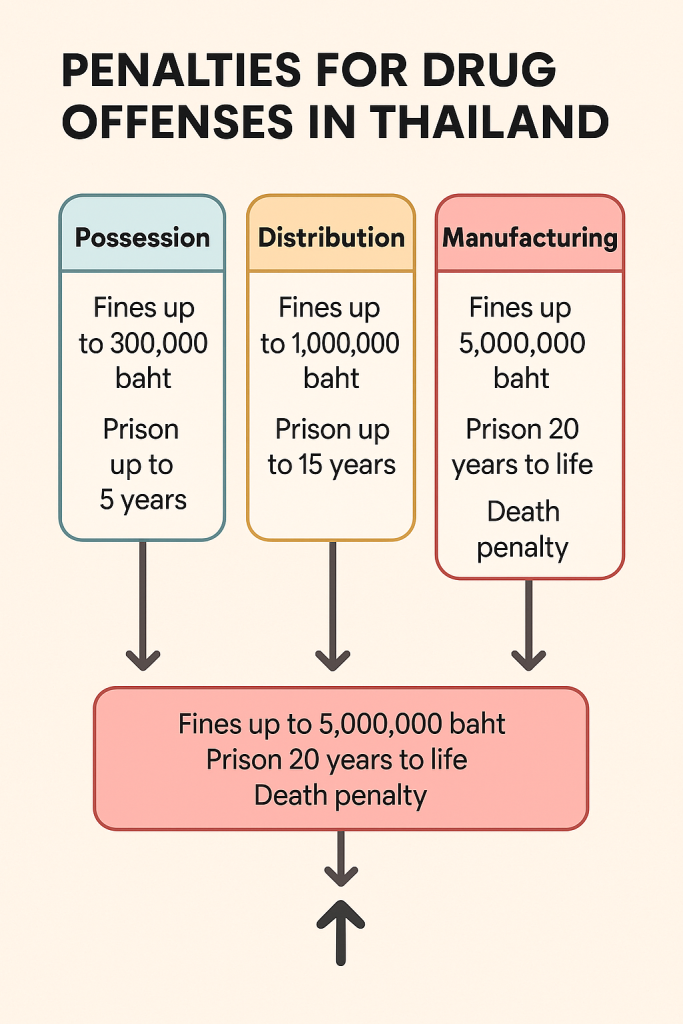
2. Pénalités par catégorie relatif aux lois sur les drogues en Thaïlande
| Catégories et sections de codes | La produire, l'importer, l'exporter, l'éliminer ou la détenir, peine de base | Lorsque l'acte est commis à des fins commerciales ou est par ailleurs aggravé | Notes |
| I, stupéfiants dangereux. L'article 29(1) nomme l'héroïne ; la méthamphétamine et la MDMA y sont inscrites par notification, et non par le Code. Infraction art. 90, peine art. 145 | Emprisonnement n'excédant pas 15 ans ET une amende ne dépassant pas 1 500 000 THB | 2 à 20 ans et une amende de 200 000 à 2 000 000 de THB. Lorsque l'auteur est un chef, une personne ayant le pouvoir de donner des ordres ou une personne exerçant un pouvoir de direction au sein d'une organisation criminelle, ou lorsque l'acte porte atteinte à la sécurité de l'État ou à la sécurité du grand public : 5 ans à la réclusion à perpétuité et une amende de 500 000 à 5 000 000 de THB, ou la peine de mort | Détenir une drogue de catégorie I pour sa propre consommation constitue une infraction distincte et beaucoup moins grave. Voir le paragraphe situé sous le tableau. |
| II, stupéfiants généraux. L'article 29, paragraphe 2, nomme la morphine, la cocaïne, la codéine et l'opium officinal. IV, produits chimiques utilisés pour produire un stupéfiant de catégorie I ou II, art. 29, par. 4 nommant l'anhydride acétique. Infraction art. 91, peine art. 146 | Emprisonnement n'excédant pas 10 ans et amende n'excédant pas 1 000 000 de THB | 1 à 15 ans d'emprisonnement et une amende de 100 000 à 1 500 000 THB, pour la catégorie II uniquement. L'article 146 ne prévoit aucune tranche aggravée pour la catégorie IV. | Les catégories II et IV partagent une disposition relative aux infractions et une peine de base. La catégorie IV n'est pas traitée plus clémentement que la catégorie II au niveau de base |
| III, préparations contenant un stupéfiant de catégorie II, par ex. mélanges à base de codéine. Infraction art. 92, peine art. 147 | Emprisonnement n'excédant pas 3 ans et amende n'excédant pas 300 000 THB | Aucun. L'article 147 ne comporte pas de niveau aggravé | L'article 92 n'interdit pas la possession. Il concerne uniquement la production, l'importation, l'exportation et l'élimination, de sorte que la simple détention d'une préparation de catégorie III ne constitue pas une infraction à ce titre. |
| V, stupéfiants ne relevant pas des catégories I à IV, art. 29(5) désignant le pavot à opium. Infraction art. 93, peine art. 148 | Un emprisonnement n'excédant pas 5 ans et une amende n'excédant pas 500 000 THB | 1 à 15 ans et une amende de 100 000 à 1 500 000 THB | Le cannabis ne figure plus dans cette catégorie : il a été retiré par la notification du ministère de la Santé publique du 9 juin 2022 prise en application de l'article 29, deuxième alinéa. Voir Le cannabis est-il légal en Thaïlande ? |
*Lisez le tableau en ayant à l'esprit quatre éléments, tous tirés du Code lui-même. D'abord, l'amende est cumulative, non alternative. Les articles 145 à 148 se lisent chacun ainsi : “ emprisonnement […] ET une amende ”, de sorte qu'une condamnation prononcée par un tribunal en vertu de l'une d'elles inflige les deux. Deuxièmement, les circonstances aggravantes sont les mêmes six aux articles 145, 146 et 148l'acte est commis dans un but lucratif ; il entraîne la propagation de la drogue auprès du public ; la drogue est cédée à une personne âgée de dix-huit ans au plus ; elle est cédée dans un établissement d'enseignement, un lieu de culte ou un lieu gouvernemental ; la force ou la menace de la force est utilisée ; ou le contrevenant est armé ou utilise une arme. Seul l'article 145 ajoute le troisième niveau indiqué ci-dessus. Troisièmement, le Code note selon la conduite et le rôle de l'auteur, et non selon le poids. Il n'y a de seuil de quantité nulle part dans les articles 145 à 148, et la quantité importe en tant que preuve de la destination de la drogue plutôt qu'en tant que tranche de peine. Quatrièmement, l'article 165 enjoint au tribunal, dans ces cas, de faire primer l'aide au prévenu pour qu'il cesse de consommer des stupéfiants par le biais d'un traitement sur sa punition, et de condamner chaque prévenu individuellement, même lorsqu'ils ont commis des infractions ensemble.
Deux infractions plus légères se trouvent en dehors du tableau, et ce sont celles auxquelles la plupart des expatriés sont réellement confrontés. La consommation d'un stupéfiant de catégorie I, II ou V, ou d'une substance psychotrope de catégorie I ou II, constitue une violation de l'article 104 et est passible de sanctions en vertu de article 162 d'un emprisonnement n'excédant pas un an, ou a amende ne dépassant pas 20 000 THB, ou les deux. En posséder un pour votre propre consommation constitue une violation de l'article 107 et est punissable en vertu de section 164 d'un emprisonnement n'excédant pas deux ans, ou une amende ne dépassant pas 40 000 THB, ou les deux. L'article 107, deuxième alinéa, prévoit une quantité inférieure au montant fixé par arrêté ministériel. presumed to be held for consumption. In these two provisions the fine is an alternative to prison, which is the opposite of sections 145 to 148.
Psychotropic substances are a separate scheme with four categories, not five. Section 30 divides them by medical use and abuse potential, and section 94 prohibits producing, importing, exporting, disposing of, possessing or transiting them without a licence. Section 149 sets the penalties: Category 1, imprisonment not exceeding 10 years and a fine not exceeding 1,000,000 THB; Category 2, not exceeding 7 years and 700,000 THB; Categories 3 and 4, not exceeding 5 years and 500,000 THB. For Categories 1 and 2 the same six aggravating limbs raise it to 1 to 15 years and 100,000 to 1,500,000 THB.
3. Que se passe-t-il réellement après une arrestation ?
3.1 Phase policière (0-48 h)
- La police peut perquisitionner sans mandat si elle invoque des circonstances exceptionnelles ; contestez rapidement les perquisitions illégales.
- La culture des aveux est très présente ; restez poli mais exercez votre droit au silence jusqu'à l'arrivée de votre avocat.
- Caution for minor drug offences can be paid at the station. Serious drug charges need a Tribunal pénal Une audition et une caution élevée.
3.2 Enquête et détention provisoire (Jour 3, Jour 84)
- Les juges peuvent prolonger la détention par tranches de 12 jours jusqu'à 84 jours avant que les procureurs ne déposent des accusations.
- Pendant ce temps, votre équipe de défense devrait examiner les preuves, effectuer des analyses médico-légales et interroger les témoins. Elle devrait déjà être en train de mettre à l'épreuve les éléments de preuve de l'accusation.
3.3 Procès et condamnation
- Pas de système de jury ; des collèges de juges professionnels statuent sur les faits et le droit.
- Pour les accusations passibles de ≥5 ans, les juges doivent exiger preuve corroborante même après avoir plaidé coupable.
- Les circonstances atténuantes lors de la détermination de la peine comprennent : la coopération, la première infraction, la toxicomanie avérée, le piège, la contrainte, la perquisition irrégulière ou la violation des procédures légales.
- Les recours doivent être déposés dans un délai de 30 jours ; de nouveaux éléments de preuve sont parfois admissibles en appel.
4. Défenses communes et stratégies d'atténuation
- Absence de connaissances/possession non prouvée, Utile lorsque des drogues en Thaïlande sont trouvées dans un logement partagé ou dans des véhicules.
- Piège ou livraison contrôlée qui a mal tourné, De plus en plus pertinent avec les opérations d'infiltration en ligne.
- Duress / Necessity (Penal Code §67), Fréquent dans les scénarios de “ passeurs de drogue ” impliquant de l'opium.
- Violations de procédure, Unlawful search, unsigned inventory, absence of translator during interrogation.
- Dépendance et réadaptation, En vertu du Code de 2021, les petits consommateurs peuvent demander un traitement obligatoire au lieu d'une peine de prison.
- Négociation de plaidoyer avec la police , les procureurs thaïlandais ne disposent pas du pouvoir de négociation de peine de style américain. Les discussions sur la réduction des charges ont lieu pendant la phase d'enquête policière.
5. Risques particuliers pour les étrangers
- Blacklists & Dépassement de la durée de séjour autorisée, Any drug conviction triggers expulsion and up to a lifetime re-entry ban.
- Transferts de prisonniers, Le transfèrement vers le pays d'origine n'est possible qu'après avoir purgé un tiers (ou quatre ans) de la peine et acquitté toutes les amendes.
- Extradition, la Thaïlande extradera des étrangers pour trafic de drogue en vertu de traités bilatéraux, mais ne remettra pas de ressortissants thaïlandais.
- Saisie d'actifs, le Code des stupéfiants impose la saisie agressive des voitures, des appartements en copropriété et des cryptomonnaies soupçonnés d'être des produits de la drogue.
- Affaires passibles de la peine de mort, Foreign nationals have been condemned. The Malaysian national Ong Gim Wah was sentenced to death on 4 March 2025, following a 2023 seizure in Ratchaburi of 998 kilograms of crystal methamphetamine. That was a sentence of a tribunal de première instance and is subject to appeal, so it is not a final sentence. Executions are rare under a de facto moratorium, but the penalty remains on the books.
6. Choisir un avocat spécialisé dans les affaires de drogue à Bangkok
- Expérience linguistique et judiciaire, Les avocats nommés d'office manquent souvent de maîtrise de l'anglais et d'expérience approfondie des procès. Choisissez un avocat ayant des antécédents dans les affaires de drogue à fort enjeu et un soutien d'interprètes.
- Engagement précoce, Les 48 premières heures sont cruciales pour les options de libération sous caution et la formulation des charges. Un retard peut entraîner des peines plus sévères en matière de infractions liées aux drogues.
- Stratégie de libération sous caution, l'avocat doit concevoir contrats de cautionnement (espèces, titres fonciers) et arguments relatifs au risque de fuite adaptés aux étrangers
- Capacité d'analyse des preuves en vertu du droit thaïlandais., L'accès à des laboratoires et des experts indépendants pour contester les niveaux de pureté et les poids peut réduire considérablement les peines potentielles.
- Avocat en matière d'appel et d'expulsion, Le même cabinet devrait être en mesure de traiter les requêtes en réduction de peine, les demandes de transfèrement de prisonniers et d'assurer la liaison avec votre ambassade.
7. Conseils pratiques de conformité pour les expatriés
- Voyager avec des ordonnances pour des médicaments à usage personnel., Obtenez au préalable les autorisations de la FDA pour tout médicament contenant de la codéine, du diazépam ou des ingrédients réglementés similaires.
- La règle de la pilule unique, one dosage unit, or a net weight of 100 mg, or 20 mg where the drug is in flakes, powder or crystals, is the quantity presumed to be held for consumption. Carrying more does not make you a presumed seller and does not close off treatment: it removes the presumption, so the purpose becomes a matter of proof.
- Cannabis Is Not a Free Pass, the flower is no longer a narcotic, but it is a controlled herb: a shop may lawfully sell it to you only on a prescription, and extracts above 0.2 per cent THC are still Category V narcotics. Smoke or odour in public is a nuisance under the Public Health Act, and ignoring an official’s order to stop can bring a fine or jail. See our cannabis guide.
- Lieux branchés de la vie nocturne, des tests de dépistage aléatoires de drogues par urine sont souvent pratiqués dans les clubs et les fêtes privées. Un résultat positif peut entraîner des poursuites judiciaires.
- Empreinte numérique : la police utilise de plus en plus les applications de chat et les données des services de livraison dans le cadre d'opérations antidrogue. Pour vous protéger, chiffrez et effacez vos appareils ou, mieux encore, évitez de les utiliser.
- Dossiers de traçabilité des avoirs dans les affaires de consommation et de trafic de drogue., Les transferts importants non justifiés provenant de l'étranger peuvent être gelés dans l'attente d'enquêtes sur le blanchiment d'argent lié aux stupéfiants.
8. FAQ sur la législation relative aux stupéfiants en Thaïlande
Quelles sont les lois sur les drogues en Thaïlande concernant les substances psychotropes ?
Les substances psychotropes ne sont plus régies par la loi sur les stupéfiants B.E. 2522, que l'article 4 de la loi portant promulgation du Code des stupéfiants a abrogée, ni par la loi sur les substances psychotropes B.E. 2559, abrogée par le même article. Elles figurent dans le Code des stupéfiants B.E. 2564, qui les divise en quatre catégories en vertu de l'article 30. L'article 94 interdit d'en produire, importer, exporter, céder, posséder ou transiter sans licence, et l'article 149 fixe la peine : jusqu'à 10 ans d'emprisonnement et une amende pouvant aller jusqu'à 1 000 000 THB pour la catégorie 1, jusqu'à 7 ans et 700 000 THB pour la catégorie 2, et jusqu'à 5 ans et 500 000 THB pour les catégories 3 et 4. La consommation d'une substance psychotrope de catégorie 1 ou 2 constitue une infraction distincte en vertu de l'article 104, punissable selon l'article 162 d'une peine pouvant aller jusqu'à un an d'emprisonnement, ou d'une amende pouvant aller jusqu'à 20 000 THB, ou des deux.
Quelles sont les peines encourues pour les infractions liées à la drogue en Thaïlande ?
En Thaïlande, les peines pour infractions liées à la drogue peuvent être sévères et se traduire souvent par des années d'emprisonnement. Pour les crimes graves comme le trafic, la peine peut aller jusqu'à la prison à vie, voire la peine de mort. Cela dépend du type et de la quantité de drogue. La possession de drogue pour usage personnel est également passible d'une peine de prison, dont la durée varie selon la nature de la drogue.
Comment la loi classe-t-elle les drogues en Thaïlande ?
Il existe deux régimes, et aucun d'eux ne comporte deux catégories. L'article 29 du Code des stupéfiants divise les stupéfiants en cinq catégories : I, les stupéfiants dangereux, l'article citant l'héroïne ; II, les stupéfiants généraux, citant la morphine, la cocaïne, la codéine et l'opium médicinal ; III, les préparations contenant un stupéfiant de catégorie II ; IV, les produits chimiques utilisés pour produire un stupéfiant de catégorie I ou II, citant l'anhydride acétique ; et V, les stupéfiants ne relevant d'aucune autre catégorie, citant la plante d'opium. L'article 30 divise séparément les substances psychotropes en quatre catégories selon leur usage médical et leur potentiel d'abus. La substance nommée figurant dans telle ou telle catégorie est fixée par notification du ministre de la Santé publique, et non par le Code.
Quelles sont les conséquences du trafic de drogue en Thaïlande ?
Le trafic de drogue est considéré comme une infraction grave en Thaïlande, passible de peines sévères, notamment de de longues peines d'emprisonnement. Les lois sont conçues pour dissuader les activités de trafic, et le gouvernement a adopté des mesures pour réprimer les délinquants en matière de stupefiants. L'importation et l'exportation ne sont pas classées séparément dans le Code des stupéfiants : les articles 90 à 93 les énumèrent aux côtés de la production, de la cession et de la détention, de sorte que la peine est celle prévue pour la catégorie. Pour un stupéfiant de catégorie I, la peine peut aller jusqu'à 15 ans d'emprisonnement et une amende pouvant atteindre 1 500 000 THB en vertu de l'article 145, pour atteindre 2 à 20 ans lorsque l'acte est commis à des fins commerciales et, pour un chef de réseau ou lorsque la sécurité de l'État est menacée, 5 ans à la réclusion à perpétuité ou la peine de mort. Ils s'exposent également à des amendes et à la confiscation de l'argent provenant du trafic de drogue.
Les services juridiques en Thaïlande peuvent-ils aider en cas d'infractions liées à la drogue ?
Oui, des services juridiques en Thaïlande, comme ceux proposés par ThaiLawOnline, peuvent aider les personnes accusées d'infractions liées à la drogue. Ces services offrent une assistance et des conseils juridiques. Ils s'attachent à expliquer la complexité de la législation relative à la possession, au trafic et aux autres infractions liées à la drogue. Il est fortement conseillé de consulter un avocat si vous êtes soupçonné d'être impliqué dans une affaire de drogue.
Quelles sont les conséquences de la possession de drogue pour usage personnel ?
La possession de stupéfiants pour usage personnel demeure illégale en Thaïlande. Les personnes interpellées en possession de stupéfiants s'exposent à de lourdes sanctions. Même de petites quantités peuvent entraîner une peine d'emprisonnement et des amendes, témoignant de la fermeté du pays en matière de lutte contre la drogue. Il est donc essentiel de connaître cette législation afin d'éviter de graves conséquences juridiques.
Que dois-je savoir sur les tests de dépistage de drogues en Thaïlande ?
En Thaïlande, les tests de dépistage de drogues sont fréquents dans divers contextes, notamment sur les lieux de travail et lors de contrôles policiers. Un test positif aux drogues illégales peut entraîner des poursuites judiciaires, telles que des amendes ou une peine d'emprisonnement, selon la situation et la drogue. Il est essentiel pour toute personne résidant ou voyageant en Thaïlande de connaître la législation en vigueur sur les stupéfiants.
9. Comment la Cour suprême a appliqué le Code des stupéfiants de 2021
Two Cour suprême decisions govern how the 2021 Code changed sentencing, and they are worth reading together because they cut in opposite directions. Neither is a general promise of leniency. Both are rulings about which law applies to conduct that straddles the Code’s commencement on 9 December 2021, which is the question that decides a great many drug cases still moving through the courts.
- Decision 272/2565, the Supreme Court sitting as a Grand Chamber: quantity is no longer the criterion. The Court held that the former Narcotics Act B.E. 2522, section 15 with section 66, imposed a heavier penalty by taking the quantity of the drug alone as decisive, whereas section 145 of the Code imposes a heavier penalty by reference to the offender’s conduct in committing the offence and their role and duty in it, and no longer takes quantity as the old law did, although a greater quantity may itself indicate that conduct and role. The consequence the Court drew is exact: where the quantity reaches the old section 66 paragraph two or three but the offender has none of the conduct or role described in section 145 paragraph two or three, the court may convict only under section 145 paragraph one.
- The same decision holds the other half, and it is the half a defendant is more likely to be hurt by. Section 21 paragraph one of the Act promulgating the Code keeps the old presumption of possession for sale in force for any case in which the trial court gave judgment before the Code commenced, until that case becomes final. So a defendant sentenced at first instance before 9 December 2021 still faces the old section 15 presumption, under which possessing a Category I narcotic in the specified quantity, for amphetamine 375 milligrams or more calculated as pure substance, is presumed to be possession for sale.
- Decision 4302/2567: for consumption offences the more favourable law applies, and it is the Code. Penal Code section 3 decides which law governs conduct committed before a change. Consuming methamphetamine was an offence under section 57 of the 1979 Act, punished by its section 91 with 6 months to 3 years, or a fine of 10,000 to 60,000 baht, or both. The same conduct is now section 104 of the Code, punished by section 162 with not more than 1 year, or a fine of not more than 20,000 baht, or both. Section 162 is more favourable, so it governs. Because section 157/1 paragraph two of the Road Traffic Act B.E. 2522 raises the narcotics penalty by one third for a driver who has consumed, the ceiling there works out at 1 year 4 months, or a fine of 26,666.66 baht, or both. On that count the defendant was sentenced to 3 months, suspendu pour 2 ans.
What this does and does not mean for you. Section 165 of the Code directs a court hearing these offences to weigh helping the defendant stop using narcotics through treatment above punishing them, and to sentence each defendant individually even where they offended together. That is a real instruction to the court and it is why mitigation, treatment and a clear account of your role matter more under the Code than they did under the 1979 Act. It is not a guarantee, and for anyone whose case began before December 2021 the old presumption in 272/2565 may still be the thing that decides it.
These outcomes show that while drug laws remain strict, outcomes can improve with evidence-based defenses. At ThaiLawOnline, our team is led by Sebastien H. Brousseau. We have avocats thaïlandais agréés, like Garn (barrister), JJ, and Wichuda (who has a master’s degree). We have used similar cases to help secure reductions, acquittals, and rehabilitation options. Don’t navigate this alone. Contact us at info@thailawonline.com pour des conseils personnalisés sur la façon dont ces décisions pourraient s'appliquer à votre situation.
Dernière révision : 5 septembre 2026. The penalty table and the classification statements on this page were read against the Code des stupéfiants B.E. 2564 itself, from the Royal Gazette publication of 8 November 2021 (volume 138, part 73 Kor, page 1), which carries the Act bringing the Code into force and the Code annexed to it. The sections read in full are ss.29 and 30 (classification of narcotics and of psychotropic substances), the prohibitions ss.90 to 94, s.104 (consumption) and s.107 (possession for consumption and the quantity presumption), and the penalties ss.145 to 149, s.162, s.164 ET s.165. Every figure in the five-row penalty table was wrong against those sections and all of them have been replaced, along with three FAQ answers that repeated the same errors in the page’s structured data. The published table gave Category IV a five-year maximum where s.146 provides ten years and a fine of 1,000,000 Baht, took Category III to life imprisonment where s.147 caps it at three years and 300,000, and wrote every penalty as prison ou a fine where ss.145 to 148 all say ET. The figures here now match our fuller reference guide to Thailand drug laws and penalties section for section; the two pages previously disagreed on Categories I and V.
What this review does not cover, said plainly. Which named substance falls in which category is fixed by notification of the Minister of Public Health under section 29 paragraph two, and those notifications were pas read here. Section 29 itself names heroin, morphine, cocaine, codeine, medicinal opium, acetic anhydride and the opium plant, and those seven are quoted from the Code; every other substance named on this page, methamphetamine and MDMA included, comes from a notification we have not read. The cannabis position is taken from our own cannabis guide, reviewed against the controlled-herb notification on 4 September 2026, and the status of kratom is not asserted here either way. Nothing on this page about the conduct of an arrest, remand in twelve-day blocks, bail practice, evidence of corroboration after a guilty plea, prisoner transfer, extradition or deportation was verified against the Criminal Procedure Code or the transfer legislation.
Updated the same day. The final section previously described five Supreme Court outcomes with no case numbers of any kind. None could be produced from either of our stores, so they have been replaced by the two decisions that can be: 272/2565, read verbatim including the Grand Chamber passage and the section 21 transitional holding, and 4302/2567, read to its disposition. The death-penalty example was checked rather than removed: the sentence on Ong Gim Wah of 4 March 2025 is reported consistently by several independent outlets and is correctly stated, with the addition that it is a first-instance sentence and appealable.
Actualités juridiques thaïlandaises, gratuites par courriel
Des informations claires et concises sur les changements législatifs thaïlandais concernant les étrangers : propriété, visas, mariage, affaires et testaments. Un court courriel par mois, envoyé par un cabinet d’avocats établi depuis 2006. Zéro spam, désabonnement possible à tout moment.