


Révisé par ThaiLawOnline, un cabinet d'avocats thaïlandais agréé exerçant en Thaïlande depuis 2006. Avocate thaïlandaise en charge du dossier : Wichuda Atthamethakon, LL.M., licence du barreau thaïlandais 3149/2556.
Dernière mise à jour :
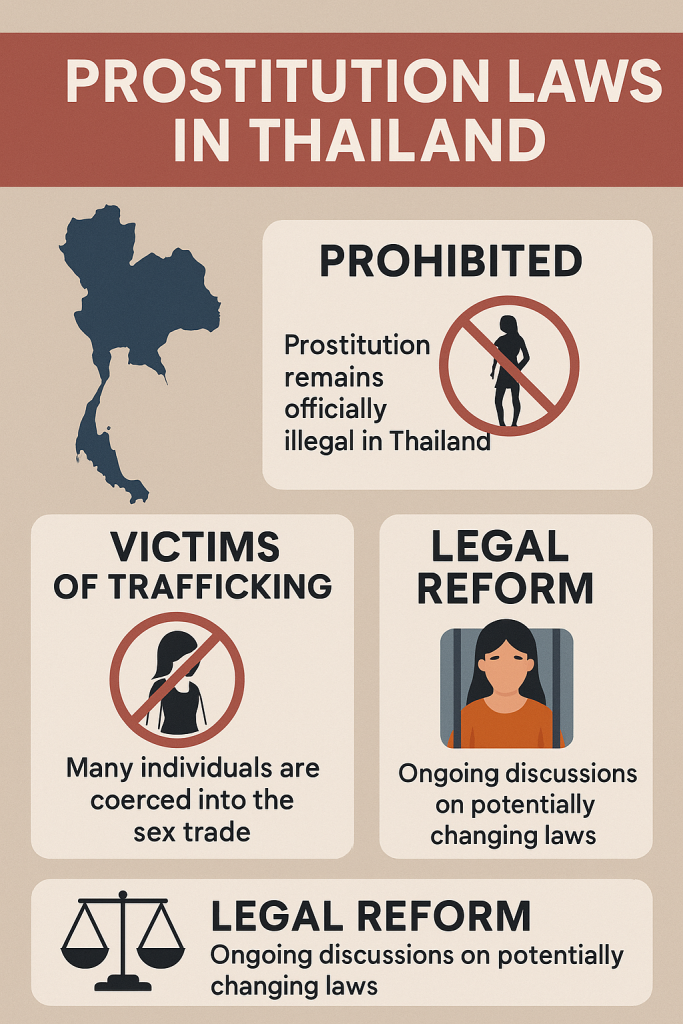
TL;DR La prostitution est illégale en Thaïlande sur le papier, mais largement tolérée dans les faits. La loi vise le racolage et la traite des personnes, tandis que le travail du sexe privé et consenti reste souvent impuni. Un projet de loi de 2023 vise à dépénaliser et à réglementer ce secteur pour les adultes de plus de 20 ans.


L’essentiel à retenir
- Illégal mais toléré: le travail du sexe prospère malgré les lois qui l'interdisent, notamment dans les bars et les salons de massage.
- Des lois strictes sur le papier: des peines sévères sont prévues pour le proxénétisme, les maisons closes, la traite des êtres humains et les activités impliquant des mineurs.
- Actes privés généralement ignorés: le travail du sexe consenti entre adultes est rarement poursuivi en justice.
- Réforme en cours: un projet de loi de 2023 propose de légaliser le travail du sexe pour les personnes de 20 ans et plus.
- Travailleurs vulnérables: la législation actuelle ne laisse aux travailleuses du sexe que peu de protection et de soutien juridique.
🎧 Écoutez notre guide sur les lois relatives à la prostitution en Thaïlande
Vous voulez mieux comprendre le fonctionnement des lois sur la prostitution en Thaïlande ? Cliquez ci-dessous pour écouter notre court podcast qui en explique les points clés.
Ces dernières années, la Thaïlande a acquis une certaine notoriété en tant que plaque tournante majeure pour trafic sexuel. La prostitution reste illégale en Thaïlande, mais cela pourrait bientôt changer. Ce commerce illicite a fait de nombreuses victimes, thaïlandaises et étrangères, et constitue une grave violation des droits humains. Le gouvernement thaïlandais a mis en œuvre diverses mesures pour lutter contre le trafic sexuel, mais le problème demeure très répandu dans le pays. La prostitution y est toujours illégale, mais largement pratiquée.
La traite sexuelle consiste à recruter, à déplacer ou à maintenir des personnes contre leur volonté. Cela se fait par la force, fraude, ou la pression pour une exploitation sexuelle. De nombreuses victimes sont attirées par de fausses promesses d'emplois. Elles croient obtenir de meilleures conditions de vie, mais finissent par se retrouver piégées dans le commerce du sexe.
This is why there are laws to protect the victims. Is prostitution illegal in Thailand? How does this affect the legal status of sex workers?Well, this is not a black-and-white issue. An act can be illegal but still tolerated. The legality of an act can change from country to country and over time. For instance, cannabis was taken off Thailand’s narcotics list in 2022, and its rules have changed again since. And how are the prostitution laws in Thailand evolving to address the complexities of sex workers’ occupational rights?
Thailand’s location, economic gaps, and tourism industry attract sex trafficking networks. Vulnerable people like women, children, and migrants are often targeted by traffickers who take advantage of their difficult situations. Here is how Thailand’s prostitution laws work.
Table des matières
Wording corrected: 3 October 2026, not a re-review. Two sentences still described soliciting as a fine and the 1996 Act as criminalising prostitution without the section 5 conversion to a civil penalty; three garbled sentences were rewritten.
Dernière révision : 3 septembre 2026. The Prevention and Suppression of Prostitution Act B.E. 2539 was read in Thai in full, from the Royal Gazette text (vol. 113 part 54 Kor page 1, 22 October 1996), and every penalty on this page for sections 5 to 13 was taken from it. The Act on Conversion of Fines to Civil Penalties B.E. 2565 (vol. 139 part 66 Kor page 22, 25 October 2022) was read for sections 7, 9, 10, 34, 39, 41, 46 and 47 and for its Schedule 1, in which this Act is listed without any section qualifier. Penal Code sections 277, 279, 282, 283, 285 and 286 were checked against our own annotated Code. Not verified here, and said rather than implied: the Entertainment Places Act B.E. 2509 (read since, see the re-check note below); the estimates of how many people sell sex in Thailand, which are estimates and not official figures; the enforcement practice described throughout, which is practice and not statute; and whether any bill to decriminalise adult sex work has advanced since the March 2023 reports. Re-checked on 6 October 2026: the Entertainment Places Act B.E. 2509 was read in Thai in its consolidated text on the government’s central law register (as amended to No. 5 B.E. 2560, with the 2022 conversion of fine-only offences to civil penalties), sections 3, 4, 6, 16, 16/1, 21, 22, 26, 27 and 28/3; the venue section now states what the Act itself provides instead of saying the text could not be obtained.
La prostitution est-elle illégale en Thaïlande ? Quelles sont les lois relatives à la prostitution en Thaïlande ?
Yes, it remains illegal, but it is widely tolerated and rarely punished between consenting adults. The current government wishes to amend the laws in collaboration with international organizations. The Thai government has implemented various laws and initiatives to address sex trafficking. The Prevention and Suppression of Prostitution Act of 1996, for instance, prohibits prostitution and punishes related activities, although soliciting under section 5 has carried only a civil penalty since 26 October 2023. It focuses mainly on abuse and sex trafficking of children. Section 8 punishes the buyer. Having sexual intercourse with, or committing any other act for sexual gratification on, a person over fifteen but not over eighteen inside a prostitution establishment carries one to three years and a amende de 20 000 à 60 000 bahts, que la personne ait consenti ou non. Dans le cas où l’enfant n’a pas atteint l’âge de quinze ans, la peine est de deux à six ans d’emprisonnement et une amende de 40 000 à 120 000 bahts. Le consentement ne constitue une défense dans aucun des deux cas.
| Aspect juridique | Explication |
|---|---|
| La prostitution est-elle légale ? | Techniquement, le statut juridique du travail du sexe en Thaïlande est complexe et souvent sujet à débat. Elle est illégal en vertu de la loi sur la prévention et la répression de la prostitution B.E. 2539 (1996). |
| Problèmes courants d'application de la loi | L'application de la loi est souvent incohérente. De nombreux établissements opèrent en toute discrétion, notamment ceux impliqués dans la prostitution sur la voie publique. |
| Sanction pour la vente de services sexuels | Racolage dans une rue ou un lieu public, de manière ouverte et impudique ou de manière à causer une nuisance : une sanction civile pinai d’un montant maximal de 1 000 bahts, qui ne constitue pas une infraction pénale et n’entraîne aucune inscription au casier judiciaire, depuis le 26 octobre 2023 (article 5, converti par la loi sur la conversion des amendes en sanctions civiles B.E. 2565). Rassemblement dans un établissement de prostitution aux fins de la prostitution : jusqu’à un mois, ou jusqu’à 1 000 bahts, ou les deux (article 6), sans aucune infraction lorsque la personne a agi sous la contrainte ou sous l’emprise d’une autorité à laquelle elle ne pouvait se soustraire. |
| Sanction pour l'achat de services sexuels | La loi de 1996 ne crée aucune infraction générale consistant à acheter du sexe à un adulte consentant. L’achat de sexe dans un établissement de prostitution auprès d’une personne âgée de plus de 15 ans mais pas plus de 18 ans est passible d’une peine de 1 à 3 ans d’emprisonnement et d’une amende de 20 000 à 60 000 bahts ; lorsque l’enfant n’a pas plus de 15 ans, la peine est de 2 à 6 ans d’emprisonnement et de 40 000 à 120 000 bahts (article 8). Pour le reste, un client présent dans un établissement visé par une descente relève de l’article 6. |
| Propriétaires ou exploitants de maisons closes | Propriétaire, superviseur ou gestionnaire d’un établissement ou d’une entreprise de prostitution, ou responsable des personnes qui y travaillent : De 3 à 15 ans et une amende de 60 000 à 300 000 bahts (article 11). 60 000 bahts est l’amende minimale, pas la maximale, et l’emprisonnement n’est pas une alternative à l’amende. Dans le cas où une personne âgée de plus de 15 ans mais moins de 18 ans travaille là-bas, la peine est de 5 à 15 ans et 100 000 à 300 000 bahts ; dans le cas où un enfant âgé de moins de 15 ans le fait, la peine est de 10 à 20 ans et de 200 000 à 400 000 bahts. |
| Implications en matière de traite des êtres humains | Peines sévères en vertu de lois distinctes sur la traite des êtres humains (Loi anti-traite des êtres humains BE 2551). |
| Âge du consentement | L'âge légal du consentement sexuel est de 15 ans, mais le commerce du sexe ne doit impliquer aucune personne de moins de 18 ans. |
| Conséquences touristiques | Les étrangers impliqués dans des relations sexuelles avec des mineurs ou dans la traite des êtres humains peuvent être expulsés ou inscrits sur une liste noire. |
| Pratique en situation réelle | Malgré la loi, le travail du sexe est répandu dans des endroits comme Pattaya, Bangkok, Phuket, etc. |
| Efforts de réforme | Des débats sont en cours concernant la dépénalisation et l'amélioration des droits des travailleuses du sexe, notamment en ce qui concerne la lutte contre le trafic sexuel. |
La loi de 1996 a abrogé la loi de 1960 sur la répression de la prostitution et constitue désormais le texte législatif central sur le sujet. Ses principales critiques sont que cette loi ne distingue pas le travail sexuel consensuel entre adultes de trafic d'êtres humains. One statute carries a civil penalty of up to 1,000 baht for soliciting and ten to twenty years for coercing someone into prostitution, and the person selling sex can be processed as an offender under section 5 or section 6 before anyone has asked whether they were coerced.
Des efforts ont été déployés pour renforcer les forces de l'ordre et améliorer la protection des victimes. Des unités de police spécialisées luttent contre la traite des êtres humains et la prostitution, un fléau qui perdure depuis des générations. Des initiatives centrées sur les victimes apportent soutien et assistance aux personnes rescapées de l'exploitation sexuelle. Par ailleurs, le gouvernement a mis en œuvre des campagnes de sensibilisation et des programmes éducatifs afin d'informer le public sur la traite des êtres humains à des fins d'exploitation sexuelle et ses conséquences. Contrairement aux idées reçues, la prostitution des mineurs est relativement rare en Thaïlande. Les autorités ont pris de nombreuses mesures pour réduire la traite des êtres humains à des fins d'exploitation sexuelle dans le pays.
Les infractions que la plupart des guides passent sous silence
La loi de 1996 est généralement résumée comme comprenant trois infractions : la vente, l’achat et la tenue d’un établissement. Elle contient plusieurs autres infractions, et celles qui sont omises sont celles qui entraînent les peines les plus lourdes. Chaque chiffre ci-dessous est repris du texte thaïlandais de la loi.
Proxénétisme (fait de procurer) : article 9, et le consentement n’y change rien
Article 9 est la disposition qui s’applique aux agents, aux recruteurs et à toute personne qui organise la fourniture de personnes. Elle sanctionne le fait de procurer, d’attirer ou d’emmener toute personne afin qu’elle se livre à la prostitution, et elle dit deux choses qui comptent davantage que la peine affichée. Le consentement de la personne ne constitue pas une défense: l’article s’applique “ même si cette personne consent ”. Et elle a une portée extraterritoriale, indépendamment du fait que les actes constituant l’infraction aient été commis dans le Royaume ou à l’extérieur de celui-ci.
La sanction est de 1 à 10 ans et une amende de 20 000 à 200 000 bahts. Lorsque la personne procurée a plus de quinze ans mais pas plus de dix-huit ans, la peine est portée à de 5 à 15 ans et de 100 000 à 300 000 bahts, et lorsque la personne est un enfant âgé de quinze ans au plus, à de 10 à 20 ans et de 200 000 à 400 000 bahts. Le quatrième paragraphe ajoute ensuite une aggravation qui est facile à déclencher : lorsque l’acte a été commis par tromperie, menace, violence, influence indue ou toute autre forme de contrainte, la peine est aggravée d’un tiers.
Article 10 étend cette règle à la famille. Un parent ou tuteur d'une personne de moins de dix-huit ans qui a connaissance d'une infraction prévue à l'article 9 commise contre la personne dont il a la charge et qui la tolère est passible d'une peine de 4 à 20 ans et de 80 000 à 400 000 bahts.
La contrainte : article 12, la peine la plus lourde prévue par la loi
Article 12 consiste à retenir ou confiner une autre personne, à la priver de liberté, à lui infliger des lésions corporelles ou à menacer de violences afin de la contraindre à la prostitution. La peine est de 10 à 20 ans et de 200 000 à 400 000 bahts. Si la victime subit des lésions corporelles graves, la peine est emprisonnement à vie; si la victime meurt, c'est la peine de mort ou l'emprisonnement à perpétuité. La personne qui appuie l’infraction est punie comme le principal auteur de l’infraction.
Le paragraphe que personne ne cite est le dernier. Lorsque l'auteur de l'infraction ou la personne qui lui apporte son soutien est un fonctionnaire de l’administration ou de la police, ou un agent d’un refuge principal ou d’un centre de protection et de développement professionnel relevant de la présente loi, la peine devient de 15 à 20 ans et 300 000 à 400 000 bahts. La loi prévoit que les personnes qui gèrent le système de protection peuvent être celles-là mêmes qui l’exploitent, et les sanctionne plus lourdement pour cela.
Publicité : article 7
Section 7 punit la publicité ou l’acceptation de publicité, ainsi que la sollicitation ou la présentation par document, imprimé ou par tout autre moyen, de manière susceptible d’être considérée comme une sollicitation ou un contact à des fins de prostitution, pour son propre compte ou pour celui d’autrui. La peine est de 6 mois à 2 ans, ou une amende de 10 000 à 40 000 bahts, ou les deux. Les mots “ par tout moyen ” sont ce qui étend la disposition aux annonces en ligne et aux applications de messagerie, où ce comportement a désormais lieu.
Une conséquence échappe entièrement à l’échelle des peines. En vertu de l’ article 13, lorsque le parent ou le tuteur d'une personne qui commet une infraction aux articles 5, 6 ou 7 a toléré sa prostitution, le ministère public peut demander, à la demande du Comité de la protection et du développement professionnel, le retrait, à ce parent ou à ce tuteur, de son pouvoir parental et la nomination d’un tuteur de remplacement, conformément aux dispositions relatives à la tutelle du Code civil et commercial s’appliquant à cette nomination.
Code pénal et lois sur la prostitution en Thaïlande
Le fait de vivre de l’argent provenant de la prostitution est traité par article 286 du Code pénal. L’article tout entier a été abrogé et remplacé par la Loi de modification du Code pénal (n° 27) B.E. 2562, Journal officiel royal volume 136 partie 69 Kor, 27 mai 2019, entrée en vigueur le 28 mai 2019. Elle répertorie désormais sept manières distinctes de commettre l’infraction, et la peine pour chacune d’entre elles est une peine d’emprisonnement d’une durée maximale de vingt ans et une amende d’un montant maximal de quatre cent mille bahts, ou une peine d’emprisonnement à perpétuité.
Les sept modalités sont les suivantes : aider, faciliter ou protéger la prostitution d’autrui ; recevoir un avantage, sous quelque forme que ce soit, de la prostitution d’autrui ou d’une personne qui se livre à la prostitution ; contraindre, menacer, tromper ou influencer indûment une autre personne, ou engager une autre personne à son service, à des fins de prostitution ; organiser la prostitution entre une personne qui se livre à la prostitution et un client ; dissimuler ou déguiser l’origine des revenus ou des biens provenant de la prostitution ; vivre ou fréquenter habituellement une ou plusieurs personnes qui se livrent à la prostitution sans pouvoir justifier de l’origine des revenus dont on vit ; et entraver l’action d’un organisme chargé de prévenir ou de contrôler la prostitution, ou d’aider ou d’éduquer les personnes qui y sont impliquées. Le dernier alinéa exclut toute personne qui reçoit un avantage auquel elle a droit en vertu de la loi ou d’une obligation morale, ce qui maintient la famille à charge d’une travailleuse du sexe hors du champ de la deuxième modalité.
Deux choses concernant l’article 286 sont importantes en pratique. La quatrième modalité, l’organisation de la prostitution entre un professionnel du sexe et un client, est celle qui atteint un intermédiaire, un booker ou un établissement qui met les deux en contact, et il n’est pas nécessaire que de l’argent passe entre les mains de cette personne pour qu’elle s’applique. Et la formulation ancienne, qui punissait une personne âgée de plus de seize ans qui vivait de l’argent d’une prostituée, ainsi que les présomptions liées à la vie avec ou à l’association habituelle avec une prostituée, n’est plus en vigueur depuis le 28 mai 2019. Tout résumé en anglais qui cite encore une peine de sept à vingt ans selon l’article 286 cite une disposition abrogée.
Le Code pénal contient une règle générale interdisant toute acte indécent avec un enfant âgé de moins de 15 ans. Cette règle inclut la prostitution des enfants. Article 279 du Code pénal dispose :
“Whoever commits an indecent act on a child not over fifteen years of age, whether or not such child consents, shall be punished with imprisonment not exceeding ten years, or fined not exceeding two hundred thousand Baht, or both.” Children are clearly protected by Thailand’s prostitution and sex trafficking laws.
Actes indécents et âge du consentement
Le Code pénal en Thaïlande ne définit pas ce qui constitue un “ acte indécent ”.
L’article 279 prévoit des peines plus lourdes lorsque l’enfant n’a pas atteint l’âge de treize ans : une peine d’emprisonnement de un à dix ans, une amende de 20 000 à 200 000 bahts, ou les deux. Un troisième alinéa du même article la relève encore, à un à quinze ans ou une amende de 20 000 à 300 000 bahts, ou les deux, lorsque l’acte a été commis par une menace de quelque nature que ce soit, par la violence, alors que l’enfant se trouvait dans un état où il ne pouvait résister, ou en faisant croire à l’enfant que l’auteur était quelqu’un d’autre.
L’article 277 du Code pénal érige en infraction le rapport sexuel avec un enfant âgé de quinze ans au plus qui n’est pas le conjoint de l’auteur de l’infraction, que l’enfant consente ou non. La peine est de cinq à vingt ans d’emprisonnement et une amende de 100 000 à 400 000 bahts (Article 277 du Code pénal). Cette disposition est neutre en matière de genre depuis la loi de modification du Code pénal (n° 27) B.E. 2562, qui a également inséré la définition de la relation sexuelle à l’article 1(18). Les textes anglais qui continuent d’utiliser le terme “ fille ” citent la version antérieure à 2019.
Lorsque l’enfant n’a pas atteint l’âge de treize ans, la peine est portée à un emprisonnement de sept à vingt ans et une amende de 140 000 à 400 000 bahts, ou à l’emprisonnement à perpétuité. Deux paragraphes supplémentaires la rehaussent encore : de dix à vingt ans d’emprisonnement, ou à perpétuité, lorsque l’auteur a fait croire au mineur qu’il portait une arme à feu ou un explosif ; ou à perpétuité, lorsqu’une arme a été portée ou utilisée, ou lorsque deux ou plusieurs auteurs ont agi ensemble.
L'exemption fondée sur le mariage n'existe plus. Jusqu’en 2019, un auteur pouvait échapper à la sanction prévue par l’article 277 lorsque le tribunal l’autorisait à épouser un enfant âgé de plus de treize ans mais pas plus de quinze ans. La loi portant modification du Code pénal (n° 27) B.E. 2562 a purement et simplement abrogé cet alinéa et l’a remplacé par une règle différente : lorsque l’auteur a lui-même au plus dix-huit ans et que l’enfant avait plus de treize ans mais pas plus de quinze ans et était consentant, le Tribunal des mineurs et Tribunal de la famille peut ordonner des mesures de protection sociale en vertu de la loi sur la protection de l’enfance plutôt que d’imposer des sanctions ; si ces mesures sont infructueuses, le tribunal peut néanmoins condamner la personne à une peine inférieure au minimum légal. Le mariage n’est pas une voie de sortie d’une procédure en vertu de l’article 277 et, depuis le 23 janvier 2025, cela ne peut plus être le cas, car article 1448 du Code civil et commercial exige désormais que les deux parties aient atteint l’âge de dix-huit ans.
En Thaïlande, l’ âge du consentement est de quinze ans. L’article en question est l’article 277, et non l’article 279 : l’article 277 concerne les rapports sexuels, tandis que l’article 279 concerne les actes indécents, et les deux dispositions s’appliquent que l’enfant ait consenti ou non. Au-delà de quinze ans, le consentement ne règle pas la question. Les articles 282 et 283 punissent le fait de procurer, d’attirer ou d’enlever d’une personne de tout âge à des fins indécentes afin de satisfaire un tiers, avec une peine plus lourde lorsque la personne a plus de quinze ans mais moins de dix-huit ans et encore plus lorsque celle-ci n’est pas âgée de plus de quinze ans. L’article 285 ajoute un tiers à la peine lorsque la victime est un ascendant, un descendant, un élève sous la garde de l’auteur de l’infraction ou toute personne placée sous sa tutelle, sa garde ou son autorité. Et le sexe commercial avec une personne de moins de dix-huit ans constitue également une infraction en vertu de l’article 8 de la loi de 1996, quel que soit l’âge du consentement.
Il est important de savoir que l'âge du consentement est de 15 ans. Cependant, d'autres lois peuvent également s'appliquer. Ces lois contribuent à protéger les mineurs et à prévenir leur exploitation.
Voici quelques articles importants concernant la législation sur les travailleuses du sexe, la traite des êtres humains et la prostitution en Thaïlande.
- Code pénal thaïlandais, article 279: acte indécent envers un enfant âgé de moins de quinze ans, avec ou sans consentement de celui-ci. L’article 279 n’est pas la disposition relative aux rapports sexuels ; c’est l’article 277.
- Code pénal thaïlandais, article 277: rapports sexuels avec un enfant âgé de moins de quinze ans. “ Toute personne qui a des rapports sexuels avec un enfant âgé de moins de quinze ans, qui n’est ni sa propre épouse ni son propre mari, quelle que soit la volonté de l’enfant, est passible d’une peine d’emprisonnement de cinq à vingt ans et d’une amende de cent mille à quatre cent mille bahts. Lorsque le délit visé au paragraphe premier est commis contre un enfant âgé de moins de treize ans, l’auteur est passible d’une peine d’emprisonnement de sept à vingt ans et d’une amende de cent quarante mille à quatre cent mille bahts, ou d’une peine d’emprisonnement à perpétuité. ” La contrainte contre une personne âgée de plus de quinze ans n’est pas une infraction au sens de l’article 277 : elle relève de l’article 276 ou des articles 282 et 283 lorsque la personne a été procurée pour la satisfaction d’autrui.
- Loi sur la protection de l'enfance (2003) section 4. “Child” means a person below 18 years of age, but does not include those who have attained majority through marriage.
- Loi anti-traite des personnes BE 2551 (2008), article 4 : “ Enfant ” désigne toute personne âgée de moins de dix-huit ans. ”
- Code civil de Thaïlande, dispose que la majorité est fixée à 20 ans (article 19), tandis que le mariage exige que les deux parties aient atteint l’âge de dix-huit ans (article 1448). Un tribunal peut autoriser un mariage plus précoce lorsqu’un motif approprié le justifie, et un mineur qui se marie doit obtenir le consentement des personnes énumérées à l’article 1436 (article 1454). L’âge minimum était de dix-sept ans jusqu’au 23 janvier 2025.
Qui vend des services sexuels en Thaïlande, et sous quelles pressions
Les lois sur la prostitution en Thaïlande n'ont pas permis de réduire le travail du sexe commercial. Cela nous aide à comprendre les conséquences pour les travailleuses et travailleurs du sexe. Nombre d'entre eux choisissent cette profession ou s'y adonnent par nécessité financière. Ils travaillent souvent dans des lieux publics et des maisons closes. Les travailleuses et travailleurs du sexe en Thaïlande sont confrontés à de nombreux défis, d'ordre social, économique et juridique, qui influencent leur dépendance à la prostitution. Ce problème persiste depuis de nombreuses années. Une grande partie de la population s'accorde à dire que les lois sur la prostitution en Thaïlande doivent être réformées. La législation actuelle ne correspond pas à l'opinion publique.
La prostitution reste très répandue, malgré la législation thaïlandaise en vigueur. Nombreuses sont les personnes qui choisissent le travail du sexe pour des raisons économiques ou par choix personnel. C'est notamment le cas à Pattaya, où la prostitution, ancrée depuis des décennies, est une réalité. Les difficultés rencontrées par les travailleuses et travailleurs du sexe en Thaïlande sont liées à divers facteurs sociaux, économiques et juridiques. Beaucoup de Thaïlandais sont favorables à une réforme de la législation sur la prostitution. Ils souhaitent que les lois reflètent l'opinion publique sur le travail du sexe, y compris les professions d'escorte et de prostituée dans les bars.
Les facteurs économiques influencent fortement la décision des individus de se prostituer. La pauvreté, le manque d'opportunités d'emploi et la nécessité de subvenir aux besoins de leur famille poussent souvent des personnes vers ce commerce. La perspective d'une rémunération plus élevée que dans d'autres secteurs est une des principales raisons qui poussent de nombreuses personnes à se prostituer.
La stigmatisation sociale entourant le travail du sexe commercial crée des problèmes pour les personnes qui exercent dans ce secteur. Elle leur rend difficile la satisfaction des besoins sexuels de leurs clients en toute sécurité. Les travailleurs du sexe en Thaïlande font souvent face à l'ostracisme, à la discrimination et à un accès limité aux soins de santé et aux services sociaux. La marginalisation des travailleurs du sexe exacerbe leur vulnérabilité à l'exploitation, à la violence et aux abus. N'oubliez pas que la religion peut façonner les croyances et le comportement d'un pays. Les lois sur la prostitution en Thaïlande peuvent être très différentes de celles d'autres pays. Elles peuvent également changer d'une année à l'autre.
Action policière, réforme et situation des travailleuses du sexe
La législation sur la prostitution en Thaïlande pose un problème complexe aux travailleuses du sexe. Elles évoluent dans une zone grise juridique et sont souvent victimes de harcèlement et de corruption policière. Il est parfois difficile de déterminer si une personne se prostitue par choix ou sous la contrainte. Les travailleuses du sexe ont besoin d'aide et de soutien si elles sont maltraitées ou exploitées.
Vendre du sexe a cessé d’être un crime en 2023, et presque personne ne l’a remarqué
L’article 5 n’est plus une infraction pénale. La loi sur la conversion des amendes en sanctions civiles B.E. 2565 (Journal officiel vol. 139 partie 66 Kor, page 22, 25 octobre 2022) inscrit la loi de 1996 à son annexe 1, et l’article 39 de cette loi transforme chaque infraction pénale passible uniquement d’une amende, prévue par une loi de l’annexe 1, en une infraction pinai , c’est-à-dire passible d’une sanction civile, une fois écoulé un délai de 365 jours à compter de la publication. La conversion est donc entrée en vigueur le 26 octobre 2023. Le plafond de 1 000 bahts reste inchangé, car l’article 39 considère le taux de l’ancienne amende pénale comme le nouveau taux civil, mais presque tout le reste est différent : un fonctionnaire de l’État ou le tribunal fixe le montant en fonction des faits, y compris les circonstances économiques de la personne (article 9). les organismes de l’État ont l’interdiction de l’inscrire dans un casier judiciaire (article 34) ; aucune détention ne peut remplacer le paiement ; et toute personne ayant commis une infraction en raison de la grave pauvreté ou de la nécessité absolue peut demander une peine inférieure à celle prévue par la loi, une peine de travaux communautaires ou un simple avertissement sans aucune amende (article 10). L’article 6 n’est pas converti car il prévoit une peine d’emprisonnement d’un mois en guise de peine de substitution et l’article 41(1) exclut toute infraction passible d’emprisonnement.
Le changement a également un effet rétroactif. L’article 46 stipule que toute personne condamnée en vertu d’un jugement définitif pour une infraction convertie en vertu de l’article 39 cesse d’être une infractrice et est considérée comme n’ayant jamais été reconnue coupable de cette infraction ; toute détention en substitution de l’amende prend fin, et l’amende impayée s’éteint. L’article 47 annule alors lui-même le casier judiciaire : il ne peut être utilisé contre la personne, et les organismes qui le détiennent sont tenus de supprimer l’inscription dans un délai de 365 jours après la conversion. Un ressortissant thaïlandais ayant une ancienne condamnation en vertu de l’article 5 a droit à son effacement.
Ce que cette réforme ne fait pas, c’est légaliser le travail du sexe. Les comportements visés à l’article 5 restent interdits et punissables, et toutes les autres infractions de la loi conservent leur caractère criminel, leurs peines de prison et leurs amendes. Ce qui a changé, c’est la procédure appliquée à la seule infraction dont le travailleur du sexe est effectivement accusé.
La prostitution est interdite depuis la loi de 1960 sur la répression de la prostitution, remplacée par la loi actuelle en 1996. Le chiffre de “ jusqu’à 20 ans ” qui circule en ligne ne représente pas la peine que subit une travailleuse du sexe. Vendre du sexe en sollicitant des clients en public entraîne une sanction civile allant jusqu’à 1 000 bahts et rien de plus, et depuis le 26 octobre 2023, ce n’est plus une infraction pénale. Les peines longues prévues par la loi s’appliquent au proxénétisme, à la gestion de l’établissement et à la coercition, c’est-à-dire envers les personnes qui entourent la travailleuse du sexe plutôt que envers elle-même. Les estimations quant au nombre de personnes qui vendent du sexe en Thaïlande varient entre environ 100 000 et 400 000, et il n’existe pas de chiffres officiels.
Des groupes et des militants s'efforcent de protéger les droits des travailleuses du sexe en Thaïlande. Ils souhaitent mettre fin à la stigmatisation, améliorer leurs conditions de travail, leur fournir des soins de santé et garantir leur protection juridique.
Bien que le gouvernement s'efforce de lutter contre le trafic sexuel, celui-ci demeure un problème majeur en Thaïlande. Il est essentiel que la police collabore avec les organisations internationales pour endiguer ce fléau. Des réformes sont nécessaires pour traiter les enjeux économiques, sociaux et juridiques liés à la prostitution en Thaïlande.
Licences des lieux de divertissement : là où l’application de la loi se joue réellement
Presque tous les articles anglais sur ce sujet se limitent à la loi de 1996 et au Code pénal. Ce n’est pas là que les bars, les salons de massage ou les salles de karaoké risquent réellement des problèmes. Intenter une action en justice contre un travailleur du sexe entraîne une sanction civile allant jusqu’à 1 000 bahts et aucun casier judiciaire. Ce qui ferme une entreprise, c’est sa licence.
Un lieu de divertissement, en thaïlandais sathan borikan, est agréé en vertu de la Loi sur les lieux de divertissement B.E. 2509 (1966), et les réglementations ministérielles prises en application de celle-ci fixent les catégories de lieux et les heures d’ouverture autorisées. La dernière d’entre elles, la réglementation ministérielle prescrivant les horaires d’ouverture et de fermeture des lieux de divertissement (No 2) B.E. 2566, signée le 21 août 2023 et publiée le 26 août 2023, autorise les établissements situés dans la zone de promotion de l’Eastern Aviation City à ouvrir vingt-quatre heures sur vingt-quatre.
Au-dessus de ce régime de licences se trouve Ordonnance du chef du Conseil national pour la paix et l'ordre n° 22/2558, daté du 22 juillet 2015, Gazette royale volume 132 partie spéciale 171 Ngor, page 7, modifié par l’ordonnance n° 46/2559, Gazette royale volume 133 partie spéciale 169 Ngor, page 4. Il est toujours en vigueur. Il ne figure pas parmi les ordonnances abrogées par la loi abrogeant certaines annonces et ordonnances du Conseil national pour la paix et l’ordre B.E. 2568, dont l’annexe vise les ordonnances 3, 4, 5, 23, 29 et 36 de 2558, mais pas l’ordonnance 22.
L’article 4 interdit à l’exploitant d’un lieu de divertissement, ou de tout lieu qui fonctionne de manière similaire à un lieu de divertissement, de faire l’une des choses suivantes :
- permettre à toute personne âgée de moins de vingt ans d’utiliser les locaux ;
- vendre de l'alcool à toute personne âgée de moins de vingt ans ;
- ouvrir au-delà des heures autorisées par la loi ;
- vendre de l’alcool au-delà des heures permises par la loi ;
- permettre l’introduction d’armes, d’explosifs ou de stupéfiants dans les locaux ;
- permettre la commission d’une infraction de traite des êtres humains dans les locaux ;
- permettre les jeux d'argent dans les locaux.
La conséquence est une partie qui mérite d'être lue à deux reprises. Dans le cas où cela se produit, l'autorité compétente peut révoquer la licence ou ordonner la fermeture des locaux et interdire à tout lieu de divertissement d’opérer à nouveau sur cette adresse pendant cinq ans. Une demande de renouvellement en cours est refusée, et aucune nouvelle licence ne peut être délivrée à cet exploitant pendant cinq ans. Dans les cas où le lieu se situe près d’une école ou d’un foyer d’étudiants, l’interdiction est permanente, et la licence de vente de boissons alcoolisées est retirée en même temps. La clause 4 prévoit alors que l’ordonnance est définitive, de sorte qu’il n’existe aucun recours contre elle. La réouverture pendant la période d’interdiction de cinq ans constitue une infraction distincte au titre de la clause 6/1, punissable d’une peine d’emprisonnement allant jusqu’à un an ou d’une amende allant jusqu’à 20 000 bahts, ou des deux.
Deux choses s’appliquent à toute personne qui exploite ou investit dans un lieu de divertissement. L’expression établissements qui fonctionnent de manière similaire à un lieu de divertissement est délibérée : l’absence de licence ne place pas un bar hors du champ de l’ordonnance, elle le prive seulement de la protection qu’offre une licence. Et la clause 4(1) retient l’âge de vingt ans, ni dix-huit ans ni l’âge du consentement. Un établissement qui accueille un client âgé de dix-neuf ans a commis le manquement qui entraîne la fermeture de cinq ans, que des actes sexuels y aient eu lieu ou non.
En parallèle, l’article 11 de la loi de 1996 s’adresse personnellement au propriétaire, superviseur ou dirigeant d’un établissement de prostitution, avec une peine de trois à quinze ans d’emprisonnement et une amende de 60 000 à 300 000 bahts, et l’article 286(1) et (4) du Code pénal s’applique à toute personne qui aide, facilite ou protège la prostitution d’une autre personne ou qui organise cette activité entre une travailleuse du sexe et un client. Ce sont les dispositions en vertu desquelles c’est la direction, et non l’établissement, qui est poursuivie.
What the Entertainment Places Act B.E. 2509 itself says, read in its consolidated Thai text (as amended to No. 5 B.E. 2560, with the fine-only offences converted to civil penalties by the 2022 Act on Conversion of Fines to Civil Penalties). Section 3 defines an entertainment place: a dance hall; a venue selling food or drink with hostesses to attend customers; a bath, massage or sauna establishment with staff serving customers, other than a licensed medical or health establishment; a venue where singers, performers or staff sit with customers, karaoke with staff singing with customers, or dancing on stage or at the tables; a venue with music or shows that closes after midnight; and any other place a ministerial regulation adds. Opening one without a licence, operating it while the licence is suspended, or running it outside the licensed category is punishable by up to one year, a fine of up to 60,000 baht, or both (section 26). A licensee may not employ anyone under eighteen (section 16(1)), and may not let anyone under twenty who does not work there in during opening hours, which means checking photo identification at the door (section 16/1); each of those is now a civil penalty of up to 50,000 baht (section 27), and either can cost the licence, since the official may refuse renewal, suspend or revoke it for any breach of the Act (section 21). Allowing an obscene show is up to three years, a fine of up to 60,000 baht, or both (section 28/3). A suspension or revocation can be appealed within fifteen days, to the national police chief in Bangkok and to the Permanent Secretary of the Interior elsewhere, and that decision is final (section 22). Order 22/2558 sits on top of all this and is the heavier instrument for a venue.
FAQ concernant les lois sur la prostitution en Thaïlande
La prostitution est-elle illégale en Thaïlande ?
Oui, en vertu de la loi sur la prévention et la répression de la prostitution B.E. 2539 (1996). Ce qui est réellement puni par cette loi est plus restrictif que ce que la plupart des lecteurs s’attendent à voir. La sollicitation en public est passible d’une sanction civile allant jusqu’à 1 000 bahts en vertu de l’article 5, qui a cessé d’être une infraction pénale le 26 octobre 2023, et il n’existe pas d’infraction générale d’achat de services sexuels auprès d’un adulte consentant. Les lourdes sanctions s’appliquent au proxénétisme, à la gestion de l’établissement et à tout ce qui concerne une personne âgée de moins de dix-huit ans.
Quelle sanction encourt une travailleuse ou un travailleur du sexe ?
Article 5, racolage ouvertement et de manière impudique dans une rue ou un lieu public, ou de manière à causer une nuisance au public : une sanction civile pinai d’un montant maximal de 1 000 bahts. Depuis le 26 octobre 2023, ce n’est plus une infraction pénale, donc il n’y a pas de casier judiciaire ni de peine d’emprisonnement, et une personne qui ne peut pas payer peut demander à effectuer des travaux d’intérêt général à la place. Article 6 : réunion dans un établissement de prostitution à des fins de prostitution : jusqu’à un mois, ou jusqu’à 1 000 bahts, ou les deux. L’article 6, paragraphe 2 stipule qu’il n’y a pas d’infraction si la personne agissait sous la contrainte ou sous l’emprise d’une autorité à laquelle elle ne pouvait ni se soustraire ni résister.
Quelle sanction risque un propriétaire de maison close ?
Article 11 : de trois à quinze ans d’emprisonnement et une amende de 60 000 à 300 000 bahts. L’amende est minimale, pas maximale, et la peine de prison n’est pas une alternative à l’amende. Lorsqu’une personne âgée de plus de quinze ans mais moins de dix-huit ans travaille là-bas, la peine est de cinq à quinze ans et 100 000 à 300 000 bahts, et lorsqu’un enfant âgé de moins de quinze ans travaille là-bas, la peine est de dix à vingt ans et 200 000 à 400 000 bahts.
Un étranger peut-il être poursuivi ?
Oui. Rien dans la loi de 1996 ni dans les dispositions du Code pénal qui traitent de cette question ne dépend de la nationalité. Un client étranger dans un lieu visé par une descente est exposé aux sanctions prévues à l’article 6, et à l’article 8 si l’autre personne avait moins de dix-huit ans. Une condamnation peut également entraîner des conséquences en matière d’immigration, mais celles-ci sont régies par la loi sur l’immigration et non par ces dispositions.
Quel est l’âge du consentement, et suffit-il à régler la question du sexe tarifé ?
L'âge du consentement est de quinze ans, selon article 277 du Code pénal, et il ne règle pas la question du sexe tarifé. L’article 8 de la loi de 1996 érige en infraction l’achat de sexe dans un établissement de prostitution auprès de toute personne âgée de moins de dix-huit ans : de un à trois ans et 20 000 à 60 000 bahts si la personne a plus de quinze ans, et de deux à six ans et 40 000 à 120 000 bahts si l’enfant n’a pas plus de quinze ans. Par ailleurs, l’article 4(1) de l’ordonnance 22/2558 interdit à toute personne âgée de moins de vingt ans d’entrer dans un lieu de divertissement.
Le travail du sexe a-t-il été dépénalisé ?
Non. Une proposition de loi visant à abroger la loi de 1996 et à réglementer le secteur de la prostitution des adultes a été présentée en mars 2023. Elle n’a pas été adoptée. La loi de 1996 reste en vigueur telle que décrite sur cette page.
Pourquoi la loi semble non appliquée ?
Parce que l’essentiel de l’application effective est administratif plutôt que pénal. L’ordonnance 22/2558 permet à une autorité de retirer la licence d’un établissement et d’interdire tout lieu de divertissement à cette adresse pendant cinq ans, sans possibilité de recours, ce qui est plus rapide et plus lourd que de poursuivre des individus en vertu de la loi de 1996. Une rue qui semble tolérée peut se trouver dans un district qui ferme des établissements.
Sources et lectures complémentaires
Les articles cités ci-dessus sont reproduites intégralement, avec des commentaires, dans notre Code pénal annoté, et la Cour suprême a appliqué l’article 277 dans les deux jugements ci-dessous.
- Article 277 du Code pénal, rapports sexuels avec un enfant âgé de quinze ans au plus
- Article 279 du Code pénal, acte indécent envers un enfant âgé de moins de quinze ans
- Article 286 du Code pénal, le fait de vivre des revenus de la prostitution
- Arrêt de la Cour suprême n° 6336/2557, sur ce qui constitue un acte relevant de l’article 277, alinéa deux
- Arrêt de la Cour suprême n° 2417/2540, sur la distinction entre la tentative de viol et l’acte indécent selon l’intention de l’auteur dès le départ
- Âge du consentement en Thaïlande, qui définit les règles d’âge auxquelles ces sections se réfèrent
- Le trafic d'êtres humains selon la loi thaïlandaise, l’infraction la plus souvent reprochée en parallèle avec celles mentionnées sur cette page
- Le droit pénal en Thaïlande, sur le déroulement réel d'une poursuite judiciaire
- Projet de loi visant à dépénaliser le travail du sexe, présenté en mars 2023. Il n’a pas été promulgué.
Actualités juridiques thaïlandaises, gratuites par courriel
Des informations claires et concises sur les changements législatifs thaïlandais concernant les étrangers : propriété, visas, mariage, affaires et testaments. Un court courriel par mois, envoyé par un cabinet d’avocats établi depuis 2006. Zéro spam, désabonnement possible à tout moment.