


Obtenir un devis à forfait
Un cabinet d'avocats thaïlandais pour étrangers depuis 2006. Plus de 5 000 dossiers clients. Avocate thaïlandaise inscrite : Wichuda Atthamethakon, LL.M., barreau thaïlandais n° 3149/2556. Anglais, thaï et français. Nous répondons sous 24 heures.
Révisé par ThaiLawOnline, un cabinet d'avocats thaïlandais agréé exerçant en Thaïlande depuis 2006. Avocate thaïlandaise en charge du dossier : Wichuda Atthamethakon, LL.M., licence du barreau thaïlandais 3149/2556.
Dernière mise à jour :
DBD filing becomes fully online on 1 November 2026
From 1 November 2026, the Department of Business Development will accept every application concerning partnerships and private limited companies only through DBD Biz Regist. Paper walk-in filing ends not only for new incorporations, which already moved online on 1 July 2026, but also for amendments and later registrations, including directors and signing authority, registered office, capital, objects, dissolution and liquidation. This is an official DBD filing procedure, not an amendment to substantive company law. Read the l'annonce officielle du DBD et utilisez le Portail DBD Biz Regist.
Clients facing a filing deadline should prepare exact passport spelling, current email and mobile details, identity verification and the required signing method before submission. The announcement states no general paper-filing exception.
Siège social : les justificatifs de l’adresse
L’ordonnance n° 4/2568 du Bureau central d’enregistrement des sociétés de personnes et sociétés s’applique depuis le 1er janvier 2026. Lors d’une constitution ou d’un changement de siège social, le greffier vérifie le code du logement, son numéro et les indications de localisation au regard des données du registre civil. Lorsque cinq sociétés ou sociétés de personnes, ou davantage, sont déjà enregistrées dans les mêmes locaux, le demandeur doit également fournir le consentement écrit de la personne habilitée à en autoriser l’usage et des copies des justificatifs de ce droit. Il s’agit d’une exigence documentaire supplémentaire, non d’une interdiction des bureaux virtuels ni d’un plafond de cinq sociétés par adresse.
Avant de payer une formule de domiciliation, demandez combien d’entités utilisent déjà les locaux et si le prestataire fournira le consentement et les justificatifs nécessaires. L’enregistrement au DBD ne confirme pas, à lui seul, que l’adresse convient pour l’immatriculation à la TVA, un permis de travail ou une autorisation sectorielle. Lire l’ordonnance officielle n° 4/2568.
Échéance de paie : Fonds de prévoyance des employés
Fonds de protection des salariés : cinq étapes pour préparer la paie d’octobre
Avant la paie d'octobre 2026, les entreprises employant dix salariés ou plus doivent déterminer quels salariés relèvent du fonds de prévoyance des employés (Employee Welfare Fund) et lesquels bénéficient d'un fonds de prévoyance éligible ou d'une autre exemption réglementaire. Les cotisations commencent le 1er octobre 2026, initialement à 0,25% de salaire de l'employé et 0,25% de l'employeur. Le délai de versement ordinaire est le 15 du mois suivant. Voir le décret d'entrée en vigueur et les directives relatives à la couverture et à la masse salariale dans notre Guide du droit du travail thaïlandais.
Créer une entreprise en Thaïlande peut être une formidable opportunité. Cependant, la procédure d'immatriculation exige une attention particulière aux règles et démarches légales. Il est essentiel de connaître les étapes à suivre et les problèmes potentiels. Cela permettra à votre entreprise de bien démarrer et d'éviter des retards coûteux ou des litiges lors de l'immatriculation.
MODÈLE RÉDIGÉ PAR UN AVOCAT · ฿890
Contrat de prestation de services / Contrat d'entreprise (Bilingue anglais et thaïlandais)
Paiements basés sur les livrables, procédure de recette et de reprise, cession de propriété intellectuelle, retenue à la source de 3% gérée, et test du statut d'entrepreneur indépendant versus salarié expliqué pour que personne ne réclame indemnité de licenciement plus tard. Word + PDF, mis à jour en août 2026. Contrat de louage d'ouvrage bilingue
L'inscription est une étape du processus plus large couvert dans notre guide sur créer une entreprise en Thaïlande.
Dernière révision : 30 août 2026. Les articles 1096, 1097, 1098, 1105, 1107, 1108, 1110, 1111, 1111/1 et 1112 du Code civil et commercial ont été comparés au texte thaïlandais dans notre propre code annoté. Les articles 14 et 36 de la loi sur l'entreprise étrangère B.E. 2542 ont été lus dans la version originale en thaï, et les articles 94, 96, 97 et 98 de la Code foncier dans le texte du Conseil d'État. Cour suprême Decisions 6412/2560, 1038/2538 and 2252/2560 were each read in full in Thai. The government fees are those in the Department of Business Development’s current registration guide, and the Thai actionnaire les exigences en matière de justificatifs ont été lues dans le texte original de l’Ordonnance du registraire central 2/2569. Les délais fiscaux de l’étape 5 n’ont pas été revérifiés au regard du Code des impôts lors de cette révision ; confirmez-les donc auprès du Département des impôts au moment de vos déclarations. Relu le 5 octobre 2026 : l’étape 5 n’indique plus qu’une nouvelle société doit demander séparément un numéro d’identification fiscale (son numéro d’immatriculation DBD est son numéro fiscal) ; le délai de sept jours de la liste des échéances se situe désormais avant l’assemblée statutaire, comme le prévoit l’article 1107 ; deux FAQ (l’ordre des étapes et la licence au titre de la loi sur les activités commerciales des étrangers dont a besoin un bureau de représentation) ont été corrigées ; les arrêts de la Cour suprême n° 159/2566 et 17923/2557 ont été lus dans le corpus et correspondent à ce que la page en dit.

Table des matières
Comprendre les bases : Structure d'une société à responsabilité limitée thaïlandaise
La structure commerciale la plus populaire pour les étrangers en Thaïlande est la société privée à responsabilité limitée société à responsabilité limitée (Société à responsabilité limitée). Cette structure offre une protection à responsabilité limitée aux actionnaires tout en offrant de la flexibilité dans les opérations et la possibilité d'obtenir permis de travail pour les employés étrangers.
Exigences clés pour les sociétés à responsabilité limitée thaïlandaises :
- Minimum de 2 actionnaires, de toute nationalité. L'article 1097 du Code civil et commercial exigeait trois promoteurs jusqu'à ce que la loi portant modification du Code civil et commercial (n° 23) B.E. 2565, publiée au Journal officiel, vol. 139, 69e partie Kor, le 8 novembre 2022 et entrée en vigueur le 7 février 2023, ne le modifie pour le libeller ainsi : “ deux personnes ou plus ”. Le Code n'exige pas qu'aucun d'entre eux soit de nationalité thaïlandaise.
- Au moins 1 directeur (peut être de nationalité thaïlandaise ou étrangère)
- Il vous en faut assez capital social pour votre entreprise. En général, cela représente 2 millions de bahts pour une permis de travail. Ce montant est plus élevé sous le Traité d'amitié
- Adresse professionnelle en Thaïlande (les bureaux virtuels sont autorisés mais TVA l'enregistrement nécessite un bureau physique
Règles relatives à la propriété étrangère et exigences en matière de capital
L'un des aspects les plus importants à comprendre pour les étrangers concerne les restrictions de propriété en Thaïlande. En vertu de la Loi sur les activités commerciales des étrangers (FBA), la propriété étrangère est généralement limitée à 49% d'actions in most sectors. Thai nationals must own the other 51%. However, there are legal pathways to achieve majority or even 100% foreign ownership through:
- Promotion du Conseil d'investissement (BOI)
- Licence commerciale étrangère (FBL)
- Traité d'amitié (Réservé aux citoyens américains)
- Certaines activités commerciales non restreintes sont nécessaires aux sociétés à responsabilité limitée en Thaïlande.
Besoins en capitaux par type d'entreprise
Les besoins en capitaux varient considérablement en fonction de la structure de votre entreprise et de vos plans de dotation en personnel :
- entreprise à majorité thaïlandaisePas de minimum légal, mais en pratique au moins 100 000 THB
- Entreprises employant des étrangers: Minimum 2 millions de THB par employé étranger
- Entreprises à majorité étrangèreExigences minimales de 2 à 3 millions de THB plus FBL
Le capital social n'est pas la même chose que l'argent liquide en banque le premier jour. L'article 1105 du Code civil et commercial fixe le minimum : le premier versement sur chaque action doit être d'au moins 25% de son montant nominal, et en vertu de l'article 1110, les administrateurs doivent exiger ce versement avant de demander l'immatriculation de la société. Le solde pourra être appelé ultérieurement. Ce que le montant du capital détermine immédiatement, c'est ce que la société peut faire, raison pour laquelle il est préférable de régler les montants relatifs au permis de travail et à la loi sur les entreprises étrangères mentionnés ci-dessus avant le dépôt des statuts plutôt qu'après.
Étape par étape Procédure d'enregistrement d'une société en Thaïlande
Étape 1 : Réservation du nom de l'entreprise (1 à 3 jours ouvrables)
La procédure d'immatriculation commence par la réservation du nom de votre entreprise auprès du Département du développement des entreprises (DBD). Points clés à retenir :
- Soumettre 3 noms alternatifs classés par préférence
- Le nom de l'entreprise doit se terminer par “ Limited ” (จำกัด)
- Les noms doivent être différents de ceux des sociétés déjà enregistrées.
- L'approbation prend généralement de 1 à 3 jours ouvrables.
- Moment critiqueLes noms approuvés ne sont valables que pour un certain temps. 30 jours sans possibilité de prolongation
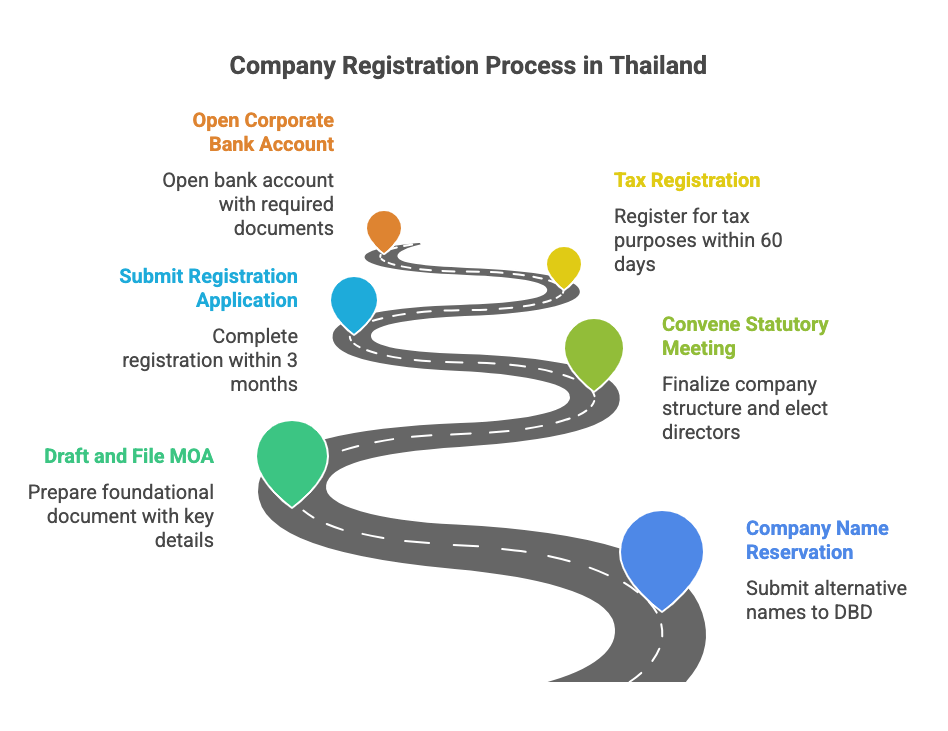
Étape 2 : Rédiger et déposer les statuts (1 à 2 jours)
Le mémorandum d'association (MOA) sert de document constitutif à votre entreprise et doit inclure :
- Nom de l'entreprise approuvé
- Province où sera situé le siège social
- Objectifs commerciaux détaillés
- Montant du capital social et structure du capital social
- Noms, adresses et coordonnées de tous les promoteurs
- Frais d'enregistrement du mémorandum : consultez la liste des taxes gouvernementales à l'étape 4. Il s'agit de montants fixes fixés par arrêté ministériel, et non d'un pourcentage de votre capital social ; veuillez donc confirmer le barème actuel auprès du DBD lors du dépôt.
Étape 3 : Convoquer une réunion statutaire (préavis minimum de 7 jours)
Cette réunion formelle est cruciale pour finaliser la structure de votre entreprise :
Activités requises pour enregistrer une entreprise en Thaïlande :
- Adoption des statuts
- Élection des premiers administrateurs et commissaires aux comptes
- Ratification des dépenses du promoteur
- Approbation de la répartition et de la structure des actions
- Détermination des pouvoirs et responsabilités des administrateurs
Ce que sont réellement les sept jours. L'article 1107 du Code civil et commercial exige que les promoteurs envoient à chaque souscripteur un rapport statutaire certifié au moins sept jours avant le jour de la réunion. Il s'agit de l'avis de convocation à la réunion, et non pas d'un délai d'attente entre la réunion et votre dépôt, et une copie de ce même rapport est envoyée au greffier dès qu'elle a été adressée aux souscripteurs.
La falaise des trois mois. En vertu de l'article 1112, si l'enregistrement n'a pas lieu dans les trois mois suivant la réunion constitutive, la société n'est pas du tout constituée, et chaque baht reçu des souscripteurs doit être remboursé en totalité et sans déduction. Les administrateurs qui détiennent encore cet argent trois mois après la réunion sont solidairement tenus de le rembourser avec intérêts.
Vous pouvez souvent ignorer complètement les sept jours. L'article 1111/1 permet aux administrateurs d'enregistrer les statuts et d'immatriculer la société le jour même où les fondateurs signent les statuts, à condition que quatre formalités soient accomplies ce jour-là : des souscripteurs ont été trouvés pour l'intégralité des actions que la société doit enregistrer ; une réunion constitutive en vertu de l'article 1108 est tenue en présence des fondateurs et de tous les souscripteurs, tous approuvant son activité ; les fondateurs remettent l'intégralité de l'activité aux administrateurs ; et les administrateurs exigent le paiement des actions en vertu de l'article 1110, deuxième alinéa, et ce paiement est effectué. Lorsque tous les actionnaires sont disponibles et que l'argent est prêt, c'est ce qui transforme une immatriculation de plusieurs semaines en un dépôt unique. C'est la disposition que la plupart des guides en anglais sur l'immatriculation des sociétés en Thaïlande omettent.
Étape 4 : Soumettre la demande d'enregistrement de l'entreprise (1 à 7 jours)
L'inscription définitive doit être effectuée dans un délai imparti. 3 mois de la réunion statutaire. Le système d'e-Registration de la Thaïlande a été retiré le 16 janvier 2025 et remplacé par “ DBD Biz Regist ”, de sorte que la plateforme a fonctionné pendant environ dix-huit mois avant la fermeture du guichet. Le temps nécessaire pour effectuer un dépôt dépend des personnes qui composent l'entreprise plutôt que de la plateforme. Section 1111/1 du Code civil et commercial permet aux administrateurs d'enregistrer les statuts et la société au le jour même les promoteurs signent le mémorandum, à condition que chaque action que la société enregistrera soit souscrite, que l'assemblée constitutive se tienne en présence de tous les promoteurs et souscripteurs et avec leur accord, que les promoteurs aient remis l'entreprise aux administrateurs et que le capital social appelé en vertu de l'article 1110 ait effectivement été payé. Et pour toute société ayant un actionnaire étranger ou un administrateur autorisé étranger, la charge de la preuve est devenue plus lourde le 1er août 2026 en vertu de l'ordonnance 2/2569.
Frais gouvernementaux. Le Département du développement des entreprises les publie dans son propre guide d'immatriculation des sociétés. Les frais de constitution s'élèvent à montant forfaitaire et ne varie pas en fonction de votre capital social, qui est le point le plus souvent mal compris :
- Immatriculation de l'entreprise : 5 000 THB
- Certificat d'immatriculation : 100 THB par copie
- Attestation de société : 40 THB par article certifié
- Copie certifiée conforme d'un document déposé : 50 THB par page
- Dépôt du mémorandum : 500 THB, et droit de timbre : 200 THB. Aucun de ces deux montants ne figure sur la liste du DBD ci-dessus, veuillez donc les considérer comme indicatifs et les confirmer lors de votre dépôt.
⚠️ Une ancienne grille tarifaire circule toujours en ligne et elle n'est plus à jour. Il facture la constitution en société sur une base dégressive, 500 THB pour chaque tranche de 100 000 THB de capital social avec un plafond de 250 000 THB, donc selon ce tableau, une entreprise dotée d'un capital de 10 millions de THB paierait 50 000 THB. La copie que nous avons trouvée porte une date de dossier du 2014. Le guide actuel du DBD indique le montant fixe de 5 000 THB ci-dessus, quel que soit votre capital. Si le devis qui vous est fourni varie en fonction de votre capital enregistré, demandez sur quel barème il se base.
Étape 5 : Inscription fiscale (dans un délai de 60 jours)
Une société ne demande plus séparément de numéro d’identification fiscale : son numéro d’immatriculation DBD à 13 chiffres lui sert aussi de numéro d’identification aux impôts dès le jour de son immatriculation. Ce qu’il reste à faire :
- Utilisez le numéro d’enregistrement de l’entreprise sur les déclarations de revenus, les certificats de retenue d’impôts et les factures.
- L'immatriculation à la TVA est obligatoire si le chiffre d'affaires annuel dépasse 1,8 million de THB
- L'inscription à la TVA doit être effectuée dans les délais impartis. 30 jours de dépassement du seuil
Étape 6 : Ouverture d’un compte bancaire d’entreprise (1 à 5 jours)
Ouvrir un compte bancaire professionnel est devenu de plus en plus difficile en raison du durcissement de la réglementation bancaire. Les exigences comprennent :
- Présence des administrateurs habilités qui signeront sur le compte
- Documents d'immatriculation de société complets
- Un permis de travail peut être requis pour les signataires étrangers.
- Une lettre de recommandation d'un prestataire de services juridiques est souvent utile.
Quelles erreurs causent des retards lors de l'enregistrement d'une entreprise en Thaïlande ?
Problèmes de traduction et de certification de documents
Une mauvaise qualité de traduction ou une certification inadéquate est l'une des causes les plus fréquentes de retards d'enregistrement. Les dossiers déposés auprès du DBD sont en thaï, de sorte que chaque document en langue étrangère doit être accompagné d'une traduction en thaï, et un document émis à l'étranger doit également comporter la légalisation requise par son propre organisme émetteur et l'ambassade ou le consulat de Thaïlande. La plupart des retards que nous constatons proviennent de la traduction plutôt que de la légalisation.
Problèmes de traduction courants entraînant des retards :
- Romanisation des noms incohérente dans les documents
- Usage incorrect de la terminologie juridique
- L'absence de sceaux et de cachets officiels dans les traductions peut compliquer l'enregistrement d'une entreprise en Thaïlande.
- Recourir à des traducteurs non agréés dont le travail est rejeté par les autorités
Les conséquences d'une traduction incorrecte peuvent être graves, pouvant rendre l'enregistrement entier juridiquement invalide et nécessiter une nouvelle soumission complète.
Documentation financière des actionnaires thaïlandais
Depuis 1er août 2026, l'Ordre du Registraire des partenariats et des sociétés centrales N° 2/2569 exige qu'une société ou un partenariat ayant un actionnaire ou un associé étranger à moins de 50 pour cent, ou ayant un directeur autorisé étranger, documente que chaque actionnaire ou associé thaïlandais a versé le capital qu'il a souscrit à partir de son propre compte. Elle abroge expressément deux ordres antérieurs, le n° 2/2568 du 1er décembre 2568 et le n° 1/2569 du 16 mars 2569, et elle est plus vaste que chacun d'eux : elle couvre les demandes de modification ainsi que l'enregistrement initial.
Constitution : champ d’application des articles 2 et 3. Les justificatifs de première immatriculation sont exigés dans l’une ou l’autre des situations suivantes :
- Un actionnaire ou associé étranger détient moins de 50% du capital social.
- Il y a aucun actionnaire étranger, mais un administrateur étranger détient le pouvoir exclusif ou conjoint d'engager la société par sa signature. C'est la condition à laquelle les candidats ne s'attendent presque jamais.
Constitution : pièces à déposer. La lettre explicative d’investissement prescrite doit être accompagnée des relevés des comptes de paiement des investisseurs thaïlandais et des justificatifs du compte recevant les fonds décrits ci-dessous :
- Relevés bancaires couvrant la les trois mois précédant la souscription, affichant les retraits qui correspondent à la cotisation.
- Déclarations de compte bénéficiaire, montrant l'argent provenant de chaque actionnaire.
- Le prescrit Lettre d'explication d'investissement, traçant le flux des fonds.
L’ordonnance n° 2/2569 prescrit des documents et des justificatifs de paiement. Elle n’impose pas elle-même le rejet immédiat de toute discordance sans possibilité de régularisation. Rapprochez les pièces avant le dépôt et répondez aux demandes du registraire.
Une modification utilise un formulaire différent. L’article 4 exige une attestation d’investissement pour les modifications visées introduisant une participation étrangère ou un signataire étranger parmi des signataires auparavant tous thaïlandais. L’article 5 ajoute une lettre explicative d’investissement et des justificatifs bancaires du capital libéré uniquement si l’entité a été constituée à compter du 1er août 2026 et si la modification concernée est déposée dans l’année suivant sa constitution. Lire les articles 2 à 5 et les formulaires annexés.
Le fait de ne pas fournir suffisamment de documents peut entraîner des contrôles pour arrangements illégaux de prête-nom. L'article 36 de la loi sur les entreprises étrangères de 2542 (1999) s'applique aux deux parties de cet arrangement : le ressortissant thaïlandais ou la société à majorité thaïlandaise qui détient des actions pour le compte d'un étranger, et l'étranger qui le leur permet. La peine est un emprisonnement n'excédant pas trois ans, ou une amende de 100 000 à 1 000 000 de bahts, ou les deux. La partie qui est généralement omise est ce qui suit la phrase : le tribunal doit également ordonner la dissolution de la participation ou de l'entreprise conjointe, et le non-respect de cet ordre entraîne une amende supplémentaire de 10 000 à 50 000 bahts. pour chaque jour la brèche continue. Consultez notre guide sur campagne 2026 de lutte contre les prête-noms.
Gestion du temps et des échéances
Le processus d'inscription comporte plusieurs échéances strictes dont le non-respect peut vous obliger à recommencer certaines étapes du processus :
- Réservation de nomValable 30 jours seulement, sans prolongation.
- Rapport statutaire aux souscripteurs: au moins 7 jours avant la réunion statutaire (article 1107), sauf si tout est fait dans une seule journée en vertu de l’article 1111/1
- soumission d'inscription: Dans les 3 mois suivant l'assemblée statutaire
- Immatriculation à la TVA: dans les 30 jours suivant le dépassement du chiffre d’affaires de 1,8 million de bahts
Conformité en matière de capital et d'emploi
Erreur de calcul besoins en capitaux est une erreur fréquente qui peut empêcher l'embauche d'employés étrangers ou l'obtention de permis de travail. Le chiffre à prévoir est de 2 millions de bahts de capital social pour chaque employé étranger que vous avez l'intention de mettre sur un permis de travail, ainsi que le ratio d'employés thaïlandais par rapport aux étrangers. C'est l'erreur la plus fréquente lors de l'enregistrement, car le capital est fixé lors de la création de l'entreprise et l'augmenter par la suite nécessite une résolution distincte des actionnaires et un dépôt distinct auprès du DBD. Une entreprise enregistrée avec un capital symbolique parce que personne n'a posé de questions sur les permis de travail doit être modifiée avant de pouvoir embaucher son premier étranger.
DBD Biz Regist: New Companies Since 1 July, All Applications From 1 November 2026
The channel changed in two stages. New partnerships and private limited companies became online-only on 1 July 2026. From 1 November 2026, every application type concerning those entities must be submitted through DBD Biz Regist, including later amendments, dissolution and liquidation filings.
The Two-Stage Closure of Walk-In Filing
The “DBD Biz Regist” platform has been the only route for establishing a new partnership or private limited company since 1er juillet 2026. Le later DBD announcement completes the transition on 1 November 2026: all application types for partnerships and private limited companies must then be filed through the platform. Paper walk-in filing will no longer be available for changes to directors or signing authority, registered office, capital or objects, or for dissolution and liquidation registrations. The platform allows:
- Vérification d'identité à distance, pour un fondateur étranger : l'application DBD e-Service effectue un e-KYC à partir d'une photo de votre visage et de votre passeport. L'alternative est de se présenter en personne devant un agent. Ce sont les deux seuls canaux répertoriés par le département pour un ressortissant étranger
- Signature électronique, pour un fondateur étranger via l'application DBD e-Service ou un nom d'utilisateur, un mot de passe et un OTP. Un ressortissant thaïlandais peut également utiliser ThaID ou Paotang, et dispose de quatre canaux de vérification au lieu de deux.
Une consigne du département prend les gens au dépourvu, et elle s'applique aussi bien aux fondateurs thaïlandais qu'étrangers : quiconque s'inscrit pour utiliser le système doit vérifier sa propre identité, et la vérification ne peut en aucun cas être déléguée à quelqu'un d'autre. Un avocat ou un comptable peut faire les démarches pour vous ; personne ne peut être vous lors de l'étape de vérification.
L'annonce elle-même est plus restreinte que la plupart des résumés en anglais qui en ont été faits. Le bureau du commerce de la province de Lopburi a reproduit l'avis du département sur 29 mai 2026 en ces termes
DBD ยุติการรับจดทะเบียนจัดตั้งห้างหุ้นส่วนบริษัทแบบ Walk-in (ยื่นกระดาษ) ทั่วประเทศ (เฉพาะจดทะเบียนจัดตั้งใหม่)
In translation, the May notice ended paper walk-in filing nationwide only for establishing new partnerships and companies. The later DBD announcement removes that limitation from 1 November 2026 and covers every application type for partnerships and private limited companies. The change concerns the filing channel. It is an official administrative requirement, not an amendment to the Civil and Commercial Code or the Foreign Business Act.
La date qui a changé trois fois, et pourquoi les anciens guides sont en désaccord
Des guides rédigés à différents moments en 2025 et 2026 donnent des dates différentes pour ce changement, et la plupart d'entre eux avaient raison au moment de leur rédaction. Le ministère a déplacé l'échéance à trois reprises, et chaque annonce a été reproduite par les bureaux provinciaux du commerce au fur et à mesure de sa publication :
- 17 mars 2025: un compte à rebours avant la fermeture des guichets physiques d'enregistrement des entreprises à l'échelle nationale d'ici 1er juillet 2025, avec des guichets ouverts pour conseiller sur les documents et sur la complétion des formulaires électroniques.
- 17 juin 2025dépôt physique prolongé jusqu'à fin 2025, Biz Regist devenant le seul canal à partir de 1er janvier 2026. Le même avis a supprimé le dépôt inter-districts des nouveaux établissements à compter du 1er juillet 2025, de sorte qu'une nouvelle entité devait être enregistrée dans la province de son siège social ou en ligne.
- 26 juin 2025le ministère a confirmé cette prolongation dans ses propres termes, déplaçant la date du canal unique du 1er juillet 2025 au 1er janvier 2026.
- 29 mai 2026: le dépôt sur place des demandes d'immatriculation des nouveaux établissements prend fin dans tout le pays le 1er juillet 2026.
So a guide that tells you the switch happened on 1 January 2026 is quoting an earlier extension. New establishments became online-only on 1 July 2026, and DBD’s latest announcement extends the online-only rule to all application types from 1 November 2026. File through the Portail DBD Biz Regist. Notre entrée de glossaire pour le Département du développement des affaires porte les mêmes dates sous forme abrégée.
Ce que disait l'ancien règlement et ce que cela signifie pour un étranger
Le département n'a pas publié de règlement pour l'enregistrement des entreprises DBD que nous pouvons lire. Ce qu'il a publié est le règlement régissant le système que l'enregistrement des entreprises a remplacé, et sa lecture montre quelle porte s'est ouverte pour les fondateurs étrangers et laquelle s'est fermée.
Le Règlement du registraire central concernant l'enregistrement des sociétés de personnes et des sociétés par actions par le biais du système électronique d'enregistrement des personnes morales (e-Registration) de B.E. 2564 (2021) est entré en vigueur le 8 mars 2021. Il a été pris en vertu des articles 3 et 4 du règlement ministériel de B.E. 2549, qui constitue le pouvoir habilitant de chaque règlement et ordre du Registraire central de cette famille, y compris l'ordre 2/2569 susmentionné. Son article 10 prévoit quatre méthodes de vérification de l'identité :
- En personne devant un fonctionnaire muni d'une carte d'identité thaïlandaise en cours de validité, ou pour un étranger d'un passeport en cours de validité ou d'un document d'identité délivré par un organisme gouvernemental thaïlandais (article 10(1.1)).
- e-KYC par le système, et la clause 10(1.2) limitait cet itinéraire à ressortissants thaïlandais, en utilisant une carte d'identité thaïlandaise et rien d'autre.
- Un certificat électronique délivré par une autorité de certification (clause 10(1.3)).
- Une procuration confié à une personne physique thaïlandaise pour effectuer la vérification à la place (clause 10(1.4)).
Comparez cela à ce que le ministère publie pour l'enregistrement des entreprises et vous constaterez que deux éléments ont évolué dans des directions opposées. Un fondateur étranger peut désormais effectuer la vérification via une application, ce que l'article 10(1.2) ne permettait pas. Et personne ne peut faire effectuer sa vérification par un tiers, ce que l'article 10(1.4) permettait expressément. La voie a été ouverte pour le fondateur et fermée pour l'intermédiaire.
À la signature, l'article 4 du même règlement définit la signature comme la création d'une signature numérique en vertu de la loi sur les transactions électroniques, soit par le nom d'utilisateur et le mot de passe émis en vertu du règlement, soit par la propre vérification d'identité du système. C'est la raison pour laquelle un mot de passe et un code à usage unique vous lient à ce qui a été déposé en votre nom.
Considérez le règlement 2564 comme de l'histoire plutôt que comme les règles actuelles. L'e-Enregistrement a été retiré le 16 janvier 2025. Qu'il s'agisse de savoir si le département a depuis émis une réglementation positive pour l'enregistrement des entreprises, ou si la plateforme fonctionne sous le régime de la réglementation générale du registre central de B.E. 2561 que l'article 6 de la réglementation de B.E. 2564 érige en solution de repli, nous n'avons pas été en mesure de l'établir à partir d'une source publiée, et cette page ne fera pas de suppositions.
Qui peut faire une demande pour vous et ce que personne ne peut faire pour vous
En vertu du règlement 2564, un fondateur pouvait nommer un représentant pour effectuer le dépôt : remplir la demande, la déposer, se conformer aux ordres du greffier, payer les frais et certifier que ce qui avait été déposé correspondait à l'intention du fondateur. La clause 4 désignait six catégories de personnes pouvant exercer cette fonction : un teneur de livres, le dirigeant d'un cabinet d'expertise comptable agréé, un certificateur de signature pour les sociétés anonymes, un agent de sécurité, un expert-comptable agréé et un membre ordinaire ou extraordinaire du barreau thaïlandais.
C'est la disposition qui importe à un fondateur étranger, car c'est celle qui confie le dépôt à un avocat ou à un comptable thaïlandais. Ce qu'aucun représentant ne pouvait faire alors, et ce que le département affirme que personne ne peut faire de toute façon aujourd'hui, c'est vérifier votre identité à votre place. Lues ensemble, ces deux règles donnent la réponse pratique. Votre avocat peut s'occuper des formalités administratives, et vous devez tout de même vous présenter en personne, sur l'application ou devant un agent. Notre guide sur créer une entreprise en Thaïlande en tant qu'étranger couvre les choix qui précèdent le dépôt, et la nomination et la révocation d'un administrateur couvre qui finit par détenir la signature par la suite.
Où s'inscrit l'ordre 2/2569 et pourquoi un dépôt lié à l'étranger n'est pas l'affaire d'un jour
L'ordonnance 2/2569 du registraire central des partenariats et des sociétés a été signée le 15 juillet 2026 et est entrée en vigueur le 1er août 2026, quatre semaines après la fermeture du guichet. Son champ d'application et ses documents sont exposés ci-dessus. Ce qui importe pour la chaîne, c'est que ces documents soient téléchargements: la Lettre d'Explication des Investissements et les relevés bancaires sont intégrés dans la plateforme avec la demande. C'est ce qui transforme les permis de la section 1111/1 pour l'enregistrement le jour même en une démarche plus longue pour une entreprise ayant un actionnaire étranger ou un administrateur autorisé étranger, et c'est la raison pour laquelle le calendrier dépend des personnes qui composent l'entreprise plutôt que du logiciel. Le l'ordre en soi est publié par le département, et notre page sur le Répression des prête-noms de 2026 le remet dans son contexte.
Ne voyez pas le déploiement numérique comme un assouplissement général. Pour les dossiers liés à l'étranger, l'année 2026 a évolué dans l'autre sens. L'ordonnance 2/2569, en vigueur depuis le 1er août 2026, ajoute l'historique des relevés bancaires sur trois mois, les relevés du compte destinataire et la lettre d'explication des investissements décrits ci-dessus. L'ordonnance prescrit des documents et n'attache aucune conséquence à une divergence : ses clauses ne contiennent aucun libellé de rejet ni aucun libellé de renvoi. Les rapports indiquant qu'une non-correspondance entre les transferts déclarés et réels fait l'objet d'un refus net décrivent la manière dont l'exigence est appliquée dans la pratique, et non ce que dit l'ordonnance.
Ce que prouve le registre, et ce qu'il ne prouve pas
La plateforme enregistre la structure que vous y saisissez. Elle n'approuve pas cette structure, et deux dispositions du Code civil et commercial en fixent les limites.
Article 1023 prévoit que tant que les mentions enregistrées ne sont pas publiées, les associés, la société en nom collectif ou la société ne peuvent pas les invoquer à l'encontre d'un tiers, tandis qu'un tiers peut s'en prévaloir. L'asymétrie est délibérée : l'immatriculation existe pour la protection des personnes qui traitent avec la société, et non pour la convenance de la société elle-même. Article 1023/1 ferme l'issue évidente, en prévoyant qu'un partenariat ou une société ne peut invoquer l'article 1023 à l'encontre d'un tiers agissant de bonne foi afin d'échapper à sa responsabilité en allégant qu'un associé, le partenariat, la société ou un administrateur n'avait pas le pouvoir d'agir.
Deux décisions de la Cour suprême montrent ce que cela signifie en pratique.
Dans Dika 159/2566 Un créancier a poursuivi une société sur le fondement d'un cautionnement signé par son administrateur autorisé. L'objet social de la société inscrit dans ses statuts n'incluait pas le fait de garantir la dette d'autrui. La juridiction a jugé qu'en vertu de l'article 66, un représentant ne engage une personne morale qu'en agissant dans les limites de son objet social, de sorte que le cautionnement n'engageait pas la société. Elle a également rejeté l'argument selon lequel la signature de l'administrateur valait ratification en soi : par nature, la ratification intervient après l'acte, et si la signature pouvait valoir sa propre ratification, alors tout acte accompli en dehors de l'objet social engagerait la société et conférerait aux personnes morales un objet social dénué de toute utilité. L'action intentée contre cette société a été rejetée. Les objets que vous saisissez sur la plateforme ne sont pas des clauses standard.
Dans Dika 17923/2557 Deux acheteurs étrangers ont acheté un terrain et ont demandé au tribunal d'ordonner au vendeur de le transférer à une société à responsabilité limitée thaïlandaise qui le détiendrait en son nom pour leur compte. La Cour a jugé que l'objet du contrat était expressément interdit par l'article 86 du Code foncier, une disposition d'ordre public assortie d'une sanction en vertu de l'article 111, de sorte que la vente était nulle en vertu de l'article 150 du Code civil et commercial. Elle a infirmé l'arrêt de la Cour d'appel et rejeté la demande. La société était dûment enregistrée. Cela n'a pas rendu l'achat légal.
Aucune des deux décisions ne concerne le dépôt électronique, et c'est bien là le point. Le registre montre ce qui a été déposé. Ce qui a été déposé doit tout de même être légal, c'est pourquoi l'actionnariat, l'objet social et le pouvoir de signature méritent plus de réflexion que la plateforme elle-même. Une fois la société créée, la prochaine échéance est fiscale : voir l'enregistrement d'un numéro d'identification fiscale, et si vous êtes américain, le Traité d'amitié route change la question de la propriété du tout.
Si votre entreprise doit un jour détenir des terres, la règle des 49% n'est pas le seul test.
La plupart des gens optent pour une répartition du capital de 49/51 en raison de la loi sur les entreprises étrangères. Si l'entreprise doit un jour acheter des terres, une deuxième loi, plus stricte, s'applique et n'utilise pas le même critère.
L'article 97 du Code foncier traite une société à responsabilité limitée comme un étranger en matière foncière dans soit dans deux cas : les étrangers détiennent plus de 49% du capital social, ou Les étrangers représentent plus de la moitié des actionnaires. Ce deuxième volet est celui qui piège les gens. Une entreprise comptant deux actionnaires étrangers détenant ensemble 49% et un actionnaire thaïlandais détenant 51% respecte la limite de capital et est néanmoins considérée comme étrangère en matière foncière, car deux de ses trois actionnaires sont étrangers et l'un ou l'autre des volets de l'article 97 suffit à lui seul.
L'article 98 étend cette disposition à toute la chaîne : si une société étrangère au sens de l'article 97 détient des actions dans une autre société, cette seconde société est également considérée comme étrangère. Par conséquent, une société holding thaïlandaise ne permet pas d'effacer cette situation.
La conséquence se trouve à l'article 94. Les terres acquises par un étranger de manière illégale ou sans autorisation doivent être aliénées dans un délai fixé par le Directeur général, qui ne peut être inférieur à 180 jours ni supérieur à un an. En cas de dépassement, le Directeur général vend lui-même les terres. L'article 96 applique le même mécanisme à toute personne s'avérant détenir des terres en qualité de propriétaire pour le compte d'un étranger ou d'une société relevant de l'article 97 ou de l'article 98, ce qui constitue le pendant foncier de l'infraction de prête-nom décrite ci-dessus.
Comment les tribunaux ont réellement tranché cette question. Trois décisions de la Cour suprême, lues dans leur version originale en thaï, fixent les limites mieux que ne le ferait tout résumé de la règle :
- Dika 6412/2560. L'article 86 ne constitue pas un obstacle absolu. Un étranger peut demander au ministre de l'Intérieur l'autorisation de posséder des terres et, même sans autorisation, conserve le droit d'en disposer dans le délai fixé par le directeur général en vertu de l'article 94. Le tribunal a tiré la conséquence que la plupart des guides en anglais oublient : un étranger a donc le capacité de conclure un contrat d'achat de terrain, et le contrat n'a pas besoin de préciser l'intention de demander l'autorisation ministérielle. Un tel contrat n'est pas un acte juridique ayant un objet illicite.
- Dika 1038/2538. Un acheteur néerlandais a fait détenir un titre par un ressortissant thaïlandais pour son compte. Même si l'acquisition contrevenait à l'article 86, paragraphe 1, l'article 94 signifie que la décision de disposition appartient à l'étranger puis au Directeur général, de sorte que le titulaire enregistré avait aucun pouvoir de vendre le terrain de sa propre initiative. La vente à un tiers constituait une violation des droits de l'étranger et celui-ci avait qualité pour agir en vertu de l'article 55 du Code de procédure civile. Une acquisition nulle n'est pas la même chose qu'une absence totale de droit.
- Dika 2252/2560. L'affaire de la primauté de la réalité sur le registre. Une entreprise figurait sur son registre des actions avec des participations étrangères inférieures à la moitié, mais la partie étrangère avait apporté plus de la moitié du capital réel. La Cour a estimé que l'entreprise et l'étranger exerçaient une activité de négoce de terres, une activité de la Liste Une, avec pour conséquence que le plaignant étranger n'était pas une partie lésée légitime et ne pouvait en aucun cas poursuivre en justice. Le registre est le point de départ de l'enquête, et non son terme.
Qu'est-ce qui a changé au comptoir en mai 2026. Le Département des Terres a émis des circulaires à destination de chaque bureau provincial des terres, menées par la lettre n° Mor Tor 0515.2/Wor 10722 du 15 mai 2026, signée par le Directeur général, ordonnant un examen plus approfondi des terres détenues par des sociétés où la participation thaïlandaise pourrait être nominale. Il s'agit de directives d'application interne : elles ne créent aucune nouvelle loi ni aucune nouvelle obligation déclarative pour le public. Ce qu'elles modifient, c'f'est la rigueur avec laquelle une règle existante est appliquée lorsqu'une entreprise enregistre une acquisition.
Rien de tout cela n'empêche une entreprise liée à l'étranger de fonctionner. Cela signifie que l'actionnariat que vous choisissez lors de l'enregistrement, ainsi que le nombre d'actionnaires et les pourcentages, déterminent si l'entreprise pourra jamais posséder des terres en son nom propre. Si cela fait partie du plan, dites-le avant que les statuts ne soient déposés plutôt qu'après. Notre page sur restructuration d'une société thaïlandaise détentrice de biens immobiliers couvre ce qu'il faut pour le défaire plus tard.
L'importance d'une assistance juridique spécialisée Créer une entreprise en Thaïlande
Comprendre les complexités de la langue thaïlandaise est essentiel lorsqu'on tente de s'inscrire en Thaïlande.
L'administration thaïlandaise fonctionne principalement en thaï, et même de petites erreurs de traduction peuvent compromettre la procédure d'enregistrement. Les professionnels du droit spécialisés en droit des sociétés thaïlandais apportent une aide précieuse :
- Garantir la traduction exacte de tous les documents juridiques
- Comprendre des exigences réglementaires nuancées qui ne sont pas évidentes pour les entrepreneurs étrangers
- Remplir le formulaire sous la forme attendue par le greffier, ce qui évite réellement un rejet et une seconde soumission
- Éviter les erreurs coûteuses qui pourraient nécessiter de recommencer l'ensemble du processus
Comprendre les nuances culturelles et administratives
La culture d'entreprise thaïlandaise met l'accent sur la hiérarchie, les procédures établies et le développement des relations. Des conseillers juridiques expérimentés aident les entrepreneurs étrangers à s'adapter à ces attentes culturelles tout en veillant au respect d'une réglementation complexe et susceptible d'évoluer rapidement.
Atténuation des risques et conformité
L'assistance juridique professionnelle devient particulièrement cruciale lorsqu'il s'agit de :
- Conformité des actionnaires: S'assurer que les actionnaires thaïlandais répondent aux véritables exigences d'investissement
- Conformité à la loi sur les entreprises étrangèresDéterminer si vos activités commerciales nécessitent des licences supplémentaires
- Obligations continues: Respecter les obligations de déclaration annuelle et maintenir une bonne réputation
Considérations relatives aux coûts et planification Créer une entreprise en Thaïlande
Au-delà des frais d'inscription de base, les entrepreneurs doivent prévoir un budget pour l'ensemble des coûts d'installation :
Frais d'enregistrement initiaux pour la création d'une entreprise en Thaïlande :
Les frais de DBD pour la création d’une société sont de 5 000 THB, indépendamment du montant de votre capital social, plus les frais de l’acte constitutif et les droits de timbre indiqués à l’étape 4. Notre forfait de création d’entreprise coûte un montant forfaitaire de 45 000 THB et comprend également ces frais d’enregistrement administratifs. Voir page des frais de création d'entreprise pour ce qui est et ce qui n'est pas inclus.
Coûts annuels d'entretien :
Permis de travail : 3 000 THB par employé étranger et par an
Services comptables : un budget mensuel de plus de 5 000 THB est indispensable pour les entreprises étrangères opérant en Thaïlande.
Audit obligatoire : 20 000 à 50 000 THB par an
Impôt sur les sociétés : 20% des bénéfices nets
FAQ concernant l'enregistrement d'une société en Thaïlande
Quelles sont les premières étapes pour enregistrer une entreprise en Thaïlande ?
Pour créer une entreprise en Thaïlande, vous devez d'abord choisir sa forme juridique et lui donner un nom unique. Ensuite, vous devez enregistrer les statuts. Enfin, vous devez déposer une demande d'enregistrement auprès du Département du développement des entreprises.
Quelle est la différence entre une société thaïlandaise à responsabilité limitée et les autres types d'entités commerciales ?
Une société à responsabilité limitée thaïlandaise est une société dont le capital est divisé en actions. L'article 1096 du Code civil et commercial fixe cette limite avec précision : la responsabilité d'un actionnaire est limitée au montant, le cas échéant, encore non libéré des actions qu'il détient. Elle n'est pas limitée au nombre d'actions qu'il possède. Une fois qu'une action est entièrement libérée, son titulaire ne doit plus rien à la société et les créanciers de la société n'ont aucun droit sur ses biens personnels.
Combien d'actionnaires thaïlandais sont nécessaires pour enregistrer une entreprise en Thaïlande ?
Aucun. L'article 1097 du Code civil et commercial dispose que deux personnes ou plus peuvent promouvoir et constituer une société à responsabilité limitée, et il ne dit rien sur la nationalité. Une entreprise entièrement détenue par des étrangers est enregistrée exactement selon les mêmes dispositions. La question de l'actionnariat thaïlandais relève d'une autre loi qui répond à une autre question : la loi sur les entreprises étrangères ne régit pas qui peut constituer une société, mais quelles activités cette société peut exercer. Lorsque l'activité est restreinte, les réponses légales sont l'obtention de la promotion du BOI, une licence d'entreprise étrangère ou le traité d'amitié avec les États-Unis. Mettre des noms thaïlandais sur le registre des actions pour atteindre 51 % sans que ces personnes n'investissent réellement est la seule solution qui constitue une infraction pénale, en vertu de l'article 36 de cette loi.
Quelle est la procédure d'enregistrement d'une entreprise en Thaïlande ?
Réservez le nom de l'entreprise, enregistrez l’acte constitutif, convoquez l'assemblée statutaire qui adopte les statuts et désigne les administrateurs, puis présentez la demande d'enregistrement de l'entreprise. Conformément à l'article 1111/1, tout cela peut être fait en une seule journée si toutes les actions sont souscrites et payées et si tous les promoteurs et les souscripteurs sont présents. L'enregistrement de la TVA suit si le chiffre d'affaires dépasse 1,8 million de bahts.
Puis-je enregistrer un bureau de représentation en Thaïlande ?
Oui, mais un bureau de représentation d'une société étrangère est une activité de services relevant de la liste 3 de la loi sur les activités commerciales des étrangers ; il nécessite donc une licence délivrée par le Département du développement des entreprises, et il ne peut exercer que les activités non génératrices de revenus autorisées par cette licence.
Existe-t-il des exigences particulières pour les administrateurs de la société ?
Oui, les administrateurs de la société doivent être des personnes physiques responsables de sa gestion. Ils peuvent être de nationalité thaïlandaise ou étrangère, mais il est essentiel qu'ils respectent les lois et réglementations locales.
Quels sont les frais d'enregistrement d'une entreprise en Thaïlande ?
Les frais gouvernementaux sont des montants fixes plutôt qu'un pourcentage de votre capital social, et ils sont fixés par règlement ministériel. Veuillez donc confirmer le barème actuel auprès du DBD lors du dépôt. Nos propres frais tout compris, qui couvrent déjà les frais gouvernementaux, sont publiés sur notre page des frais de création d'entreprise.
Est-il nécessaire d'ouvrir un compte bancaire en Thaïlande lors de la création d'une entreprise ?
Vous n'avez pas besoin d'ouvrir un compte bancaire professionnel avant d'enregistrer votre entreprise. Cependant, il est important d'en avoir un. Cela vous permet d'effectuer les transactions financières de l'entreprise une fois qu'elle commence ses activités.
Les entreprises situées hors de Thaïlande peuvent-elles également enregistrer une société en Thaïlande ?
Oui. Une entreprise ou un particulier résidant à l'étranger peut créer une entreprise thaïlandaise. L'article 1097 du Code civil et commercial exige deux fondateurs ou plus et ne dit rien sur leur nationalité ou leur résidence, il n'y a donc aucune obligation légale de nommer un administrateur thaïlandais, et aucune obligation de participation thaïlandaise au capital ne surgit au stade de l'enregistrement. Ce qui s'applique, c'est la loi sur les entreprises étrangères (Foreign Business Act), qui régit les activités que l'entreprise peut ensuite exercer, ainsi que les exigences pratiques : un siège social en Thaïlande, des documents étrangers déposés avec une traduction en thaï et toute légalisation requise par l'autorité émettrice, et la preuve prévue par l'Ordre 2/2569 décrite ci-dessus lorsqu'un étranger détiendra des actions ou signera pour l'entreprise.
Puis-je enregistrer une entreprise thaïlandaise sans venir en Thaïlande ?
Vous pouvez effectuer le dépôt depuis l'étranger et vous ne pouvez pas déléguer à quelqu'un d'autre le soin de prouver qui vous êtes. Le Département du développement des entreprises (DBD) propose deux canaux de vérification d'identité pour un ressortissant étranger : l'e-KYC via l'application DBD e-Service, qui lit une photographie de votre visage et de votre passeport, ou la comparution en personne devant un agent. La vérification ne peut en aucun cas être déléguée à une tierce personne, qu'elle soit de nationalité thaïlandaise ou étrangère. La signature s'effectue via la même application ou à l'aide d'un nom d'utilisateur, d'un mot de passe et d'un code à usage unique, et un avocat ou un comptable thaïlandais peut préparer et déposer la demande pour vous. Ce qui nécessite encore une présence sur place, c'est l'ouverture du compte bancaire de l'entreprise ainsi que tout document étranger qui doit être traduit ou légalisé avant d'être déposé.
L'enregistrement d'une société-écran est-il toujours possible en Thaïlande ?
For new establishments, no. New partnerships and private limited companies have been online-only since 1 July 2026. From 1 November 2026, the DBD will accept every application type concerning partnerships and private limited companies only through DBD Biz Regist. Paper walk-in filing will also end for amendments, director and signing-authority changes, registered-office changes, capital and object changes, dissolution and liquidation registrations.
Est-ce que le service d'enregistrement commercial du DBD vérifie l'origine des fonds de mes actionnaires thaïlandais ?
La plateforme est l'endroit où les preuves sont déposées. Depuis le 1er août 2026, l'ordonnance 2/2569 du registraire central des partenariats et des sociétés exige une lettre d'explication des investissements et des relevés bancaires chaque fois qu'un actionnaire étranger détient moins de 50% du capital social, ou qu'il n'y a pas d'actionnaire étranger mais qu'un directeur étranger peut signer pour l'entreprise. Chaque actionnaire thaïlandais dépose trois mois de relevés du compte à partir duquel l'argent des actions a été payé, et l'associé gérant ou le directeur dépose les relevés du compte qui l'a reçu. Ces documents sont téléchargés avec la demande. L'ordonnance prescrit les documents; elle ne dit rien sur ce qui se passe s'ils ne correspondent pas.
Conclusion
L'immatriculation d'une société en Thaïlande exige une grande rigueur, une documentation complète et le respect de délais stricts. Bien que les systèmes numériques aient simplifié la procédure, la réglementation thaïlandaise demeure complexe. Les erreurs pouvant avoir de graves conséquences, il est essentiel de se faire accompagner d'un avocat.
The key to successful registration lies in thorough preparation, understanding cultural expectations, and ensuring all documentation meets Thai legal standards. With good planning and expert help, foreign entrepreneurs can start their Thai companies. They can also navigate the company registration process easily. They can start building successful businesses in one of Southeast Asia’s most active economies.
N'oubliez pas que l'immatriculation de votre entreprise n'est que le point de départ. Vous devez également respecter vos obligations courantes. La compréhension des exigences fiscales est également importante. La maîtrise du droit du travail est essentielle à la réussite à long terme de votre entreprise en Thaïlande.
Combien ça coûte? Voir la version complète Répartition des coûts d'immatriculation des sociétés (2026) ou tous nos frais fixes sur le page sur les frais juridiques.
Nos frais d'immatriculation d'entreprise
| Service | Forfait | Ce qui est inclus | Délai |
|---|---|---|---|
| enregistrement de société thaïlandaise | 45 000 THB | Service de formation complet, tout compris : les frais d'enregistrement gouvernementaux auprès du DBD sont inclus dans les frais de 45 000 THB. | 14 à 21 jours ouvrés |
Les débours administratifs (frais versés aux administrations) sont facturés au coût réel, sauf si le service indique qu'ils sont inclus.
Prendre rendez-vous Réponse sous 24 heures EN · FR · TH
Ces frais proviennent d'une seule source et sont les mêmes partout sur ce site. Voir tous nos frais.
Prêt à obtenir un tarif fixe pour cela ?
Dites-nous ce dont vous avez besoin. Un avocat thaïlandais agréé le lit et répond avec un tarif fixe, et non une estimation horaire.
Actualités juridiques thaïlandaises, gratuites par courriel
Des informations claires et concises sur les changements législatifs thaïlandais concernant les étrangers : propriété, visas, mariage, affaires et testaments. Un court courriel par mois, envoyé par un cabinet d’avocats établi depuis 2006. Zéro spam, désabonnement possible à tout moment.