


Révisé par ThaiLawOnline, un cabinet d'avocats thaïlandais agréé exerçant en Thaïlande depuis 2006. Avocate thaïlandaise responsable : Wichuda Atthamethakon, LL.M., licence du barreau thaïlandais 3149/2556.
Dernière mise à jour :
Les familles nous posent la même question chaque mois : “ Mon père avait un testament américain conforme. Pourquoi la banque de Bangkok ne libère-t-elle pas son compte ? ” La réponse détermine des mois de leur vie. Procédure successorale d’un testament étranger en Thaïlande, et plus précisément la procédure d’homologation d’un testament étranger en Thaïlande , est possible, et la loi thaïlandaise reconnaît votre testament américain, britannique, canadien ou australien comme valable en la forme dans la plupart des cas.
Mais aucune banque thaïlandaise, aucun bureau foncier, et aucun registre des véhicules ne procédera à cette inscription, ni à aucune ordonnance étrangère de succession, tant qu’un tribunal thaïlandais n’aura pas désigné un administrateur de succession . ThaiLawOnline a guidé les familles étrangères homologation et administration des successions en Thaïlande depuis 2006. Ce guide passe en revue les textes de loi qui rendent cela possible, la procédure judiciaire étape par étape, ainsi que les chiffres honnêtes sur la durée et le coût.
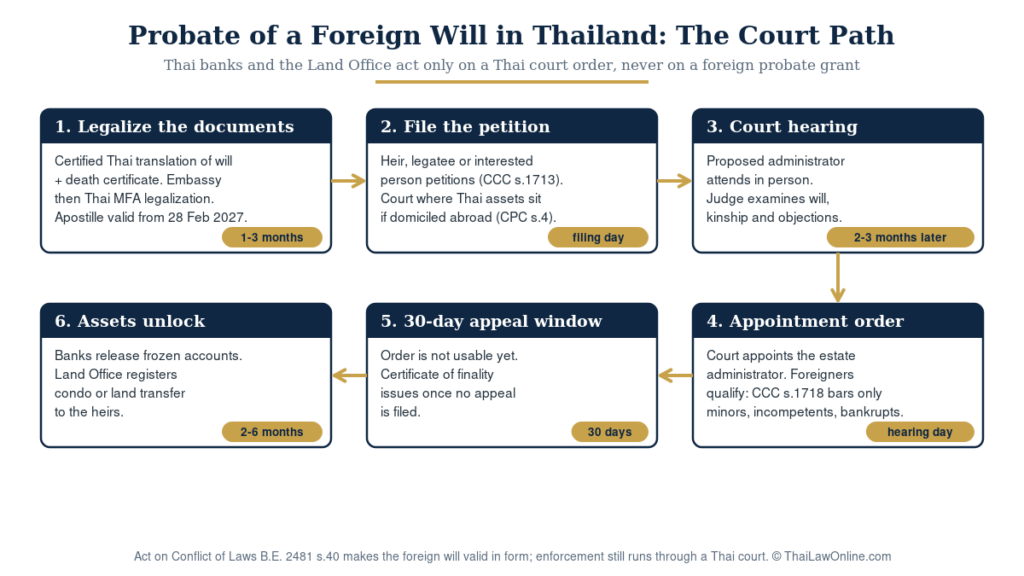
Table des matières
La réponse courte : valide en principe, inutile sans une décision de justice thaïlandaise
Deux questions distinctes se cachent derrière “ Mon testament fonctionne-t-il en Thaïlande ?”
Premièrement, la validité. La loi sur les conflits de lois B.E. 2481 (1938) répond à cette question, et la réponse est généralement oui. Un testament signé à Londres selon les formalités anglaises, ou au Texas selon les formalités texanes, satisfait aux exigences de forme thaïlandaises en vertu de l’article 40 de cette loi.
Deuxièmement, l’exécution. Les banques thaïlandaises agissent uniquement sur la base d’une ordonnance judiciaire thaïlandaise nommant un administrateur de succession (ผู้จัดการมรดก), suivie du certificat attestant qu’aucun appel n’a été interjeté. L’article 81 du Code foncier permet certes à un héritier de demander directement l’enregistrement des terres héritées, mais, avec un testament étranger et des documents étrangers, le Bureau foncier exige en pratique la même ordonnance judiciaire. Un Grant of Probate britannique ou des Letters Testamentary américaines n’ont aucune force ici. Les autorités thaïlandaises n’exécutent pas les décisions judiciaires étrangères en matière de succession. Votre famille doit saisir un tribunal thaïlandais, déposer le testament étranger accompagné de traductions certifiées et attendre la nomination.
C’est dans cet écart entre validité et exécution que se logent les retards, les comptes bloqués et les frais juridiques. Il commence dès l’ouverture de la succession : en vertu de l’ Article 1599 du Code civil et commercial, la succession revient aux héritiers au moment de la mort, et Article 1600 définit cette succession comme l’ensemble des biens, droits, obligations et dettes du défunt. Les droits existent immédiatement. L’accès à ceux-ci, non.
La loi : les articles 37 à 42 de la loi sur les conflits de lois expliqués
La loi sur le conflit de lois B.E. 2481 (1938) contient les six articles qui décident de toutes les affaires relatives aux successions étrangères. Les guides comparatifs les regroupent en “ traduire et légaliser ”. La loi fait bien plus que cela. Vous pouvez lire les codes auxquels ces règles s’appliquent dans notre guide gratuit. Bibliothèque juridique thaïlandaise.
Forme du testament (article 40) : loi nationale ou loi du lieu de rédaction
L’article 40 valide un testament quant à sa forme s’il est conforme soit à la loi nationale du testateur, soit à la loi du pays où le testament a été établi. Un citoyen britannique qui a signé un testament en Angleterre selon les formalités du Wills Act 1837 satisfait deux fois à ce critère. Un Américain qui a signé un testament en Thaïlande y satisfait si le testament respecte soit les formalités d’un État américain (nationalité), soit les formalités thaïlandaises.
Les formes thaïlandaises figurent au Livre VI du Code civil et commercial: le testament écrit ordinaire avec deux témoins prévu à l’ Article 1656, le testament olographe Selon le Article 1657, et le testament par acte public établi au bureau de district prévu à l’ Article 1658. C’est grâce à cette double voie d’accès que les tribunaux thaïlandais rejettent rarement des testaments étrangers pour vice de forme.
Satisfaire au critère de forme ne suffit pas. Quand un tribunal thaïlandais peut encore écarter une clause, ce qui se passe si votre famille ne parvient pas à prouver la loi étrangère, et pourquoi un binational thaïlandais est traité différemment : ces questions sont traitées dans mon testament anglais est-il valable en Thaïlande ?
Si vous envisagez un testament au titre de l’article 1658 auprès du bureau de district, sachez que la procédure a changé. Le règlement ministériel sur l’établissement des testaments B.E. 2569 est en vigueur depuis 24 mars 2026 et a remplacé le règlement de 1960. Vous pouvez désormais vous présenter à tout amphur ou Bangkok khet bureau plutôt qu'uniquement auprès de celui dont relève votre enregistrement de domicile, les frais sont de 250 baht (auparavant 50) et un double du testament coûte 50 baht (il y avait dix), et vos deux témoins doivent être présents et signer devant l’officier, qui, lorsqu’il y a des raisons de douter que vous n’ayez que quinze ans ou que vous soyez d’esprit sain, examine la situation et consigne les motifs et le résultat dans le registre (article 7). La réglementation ne donne pas à l’officier le pouvoir de refuser un testament et ne dit rien de la contrainte. La réforme est procédurale : elle ne touche pas aux règles relatives aux conflits de lois évoquées ici, et elle ne change pas qui héritera. Son attrait pratique pour un étranger est que le testament thaïlandais établi de cette manière évite complètement le processus de testament étranger décrit sur cette page.
Un piège subsiste malgré cette voie d’accès. Article 1653 empêche l’auteur du testament et toute personne qui l’a signé en tant que témoin, ainsi que leurs conjoints, de recevoir quoi que ce soit en vertu de celui-ci, et Article 1705 rend une telle donation nulle et non avenue. Si la juridiction de votre domicile tolère la présence d’un témoin intéressé, la juridiction thaïlandaise ne le fera pas.
Signification et effet (article 41) : la loi de votre domicile détermine
La forme est une chose. Le sens du testament en est une autre. L’article 41 soumet les effets, l’interprétation et la nullité d’un testament (ou de toute clause de celui-ci) à la loi du domicile du testateur au moment de son décès. Si votre père a vécu ses dernières années à Manchester, le droit anglais détermine ce que couvre “ mon patrimoine résiduel ” et si une donation Il a expiré. L’article 42 transmet la révocation à la loi du domicile du testateur lors de la réalisation de la révocation, et la lapse à la loi du domicile au décès ; tandis que l’article 39 transmet la capacité de rédiger un testament à la loi de la nationalité du testateur au moment de la réalisation ; cette loi thaïlandaise traite séparément de cette question. article 1693. C’est l’analyse en deux temps que la plupart des guides omettent : l’article 40 pour la forme, l’article 41 pour le fond, et les deux peuvent désigner des pays différents.
Attention à une clause en particulier. Article 1686 prive d’effet en Thaïlande toute fiducie (trust) créée par testament. Les testaments anglo-américains transfèrent couramment des biens dans une fiducie testamentaire, et ce mécanisme ne produit aucun effet sur la part thaïlandaise de la succession. Nous expliquons les solutions de contournement dans notre note sur les fiducies et juridictions étrangères.
Terres et appartements thaïlandais (article 37) : loi thaïlandaise, aucune exception
L’article 37 soumet la succession immobilière à la loi du lieu où se trouve le bien. Un condominium à Bangkok est transmis selon la loi thaïlandaise, quoi que dise un testament ou une loi étrangère. L’article 38 soumet les biens meubles (comptes bancaires, véhicules, actions) à la loi du domicile du défunt au moment de son décès. En pratique : le testament étranger peut désigner les bénéficiaires, mais le Code foncier thaïlandais régit la manière dont les biens immobiliers thaïlandais sont transférés, y compris les restrictions à la propriété étrangère qui subsistent après le décès. Un héritier étranger qui hérite d’un terrain thaïlandais reste soumis aux limites décrites dans notre guide pour hériter d'un bien immobilier en Thaïlande en tant qu'héritier étranger, et l’héritage d’un condominium se heurte, dans l’immeuble, au quota d'étrangers, abordé à la page achat d'un condominium en Thaïlande.
Étape par étape : l'homologation d'un testament étranger devant un tribunal thaïlandais
Documents : certificat de décès, testament, traductions, légalisation
Le dossier judiciaire commence par des documents, et ces documents prennent plus de temps que ne le prévoient la plupart des familles. Il vous faut le testament étranger original (ou une copie certifiée délivrée par le greffe successoral étranger), le certificat de décès, la preuve de la parenté ou du droit à succéder, ainsi qu’un inventaire des biens thaïlandais : titres de propriété, livrets bancaires, certificats d’actions, certificats d’immatriculation des véhicules.
Tous les documents étrangers doivent être traduits en thaïlandais par un traducteur agréé. En matière de légalisation, les règles changent : La Thaïlande a déposé son instrument d’adhésion à la Convention Apostille de La Haye le 30 juin 2026, et la Convention entrera en vigueur pour la Thaïlande le 28 février 2027. Jusqu’à cette date, une apostille seule ne produit aucun effet ici.
Les documents étrangers suivent la chaîne traditionnelle décrite dans notre guide sur la légalisation des documents en Thaïlande: la certification dans le pays d’origine, l’authentification par l’ambassade ou le consulat de Thaïlande sur place, puis la légalisation par le Département des affaires consulaires du ministère thaïlandais des Affaires étrangères. À compter du 28 février 2027, une apostille unique délivrée par un pays membre devrait remplacer cette chaîne pour les actes publics. Prévoyez des semaines dans les deux cas, et commencez les démarches avant tout dépôt.
Qui présente une demande et où (CCC, art. 1713, CPC, art. 4 quater)
Article 1713 du Code civil et commercial énumère les personnes qui peuvent demander au tribunal de nommer un administrateur de succession : un héritier, un légataire Aux termes du testament, une personne intéressée ou le procureur, dans les cas énumérés dans cette section, notamment lorsque l'héritier réside à l'extérieur de la Thaïlande ou que l'enfant est mineur, ou lorsque l'administration ou la répartition du patrimoine rencontre un obstacle. Le lieu de compétence dépend d'un autre code. Article 4 quater du Code de procédure civile détermine le tribunal compétent selon le domicile du défunt au moment du décès et, lorsque le défunt n’avait pas de domicile en Thaïlande, selon le lieu où se trouvent les biens successoraux. Un retraité décédé en Floride qui possédait un condo à Phuket relève du tribunal provincial de Phuket. La Cour suprême a appliqué cette règle strictement : les successions de proches domiciliés ailleurs ne peuvent pas être regroupées dans une seule requête simplement parce que les héritiers se recoupent.
L’audience, la période d’appel d’un mois, le certificat final
Le tribunal fixe une audience, généralement deux à trois mois après le dépôt de la requête. L’administrateur proposé devrait y assister en personne. Les tribunaux veulent voir la personne qu’ils nomment, l’interroger au sujet de la succession et s’assurer qu’aucun héritier ne s’y oppose. Si vous n’avez jamais vu une salle d’audience thaïlandaise, lisez ce qu'il faut savoir avant de se présenter devant un tribunal en Thaïlande en premier. Si le juge accepte la requête, l’ordonnance de nomination n’est pas immédiatement utilisable. Un délai d’appel court d’abord, et il dure un mois à compter du jour où l’ordonnance est lue, et non trente jours (article 229 du Code de procédure civile). Une fois ce délai expiré sans appel, le tribunal délivre le certificat de caractère définitif (souvent appelé « certificat de non-appel »), et c’est ce document que les banques et le bureau foncier acceptent réellement.
Qui peut être administrateur de succession, y compris les étrangers
Article 1711 et suivants régissent les administrateurs : nomination, pouvoirs, obligations et révocation. Article 1718 disqualifie trois catégories : les personnes n’ayant pas la pleine capacité (mineurs), les personnes atteintes de troubles mentaux ou déclarées quasi-incapables, et les personnes déclarées en faillite.
Les étrangers ne figurent nulle part sur cette liste. Les tribunaux thaïlandais nomment régulièrement des administrateurs étrangers, y compris l’exécuteur désigné dans le testament étranger. Les difficultés pratiques tiennent à la langue et à la présence : la procédure se déroule en thaï, et l’administrateur doit signer des documents auprès des banques et du bureau foncier après sa nomination. De nombreux exécuteurs testamentaires étrangers accordent une procuration à un avocat thaïlandais pour les formalités, tout en assistant eux-mêmes à l’audience.
Ce travail comporte des obligations réelles. En vertu de l' article 1719 l’administrateur doit exécuter le testament et gérer la succession, et Article 1728 exige que l’inventaire soit commencé dans les quinze jours suivant l’entrée en fonctions, et l’ Article 1729 Il exige que cette procédure soit terminée dans un délai d’un mois, prorogeable par le tribunal, devant deux témoins ayant un intérêt dans la succession. Un administrateur qui ne gère pas correctement la succession peut être destitué sur requête en vertu de Article 1727.
Ce que cela coûte et combien de temps cela prend
Une procédure successorale thaïlandaise simple, avec un testament thaïlandais et sans litige, dure de quatre à six mois entre le dépôt et la délivrance du certificat. Un testament étranger ajoute la chaîne de traduction et de légalisation, et souvent un affidavit de droit étranger, ce qui ajoute ensemble six à douze mois dans les cas courants. Les successions contestées durent des années. Après la délivrance du certificat, le transfert des biens eux-mêmes (enregistrement au bureau foncier, déblocage des fonds bancaires, transferts d’actions) prend encore deux à six mois, et les taxes et frais de transfert deviennent exigibles à ce moment-là.
Où passe le temps : légalisation des documents avant le dépôt (un à trois mois), attente de la date d’audience (deux à trois mois), délai d’appel d’un mois, puis transfert des biens un par un. Les frais de dépôt pour une requête non contestée s’élèvent à quelques centaines de bahts, les frais de justice connexes dépassant rarement quelques milliers. La traduction certifiée, la légalisation et les honoraires d’avocat constituent le véritable coût, qui augmente avec le nombre de documents étrangers. Comparez cela avec le coût de simplement rédiger un testament thaïlandais, qui commence à moins de 4 000 bahts.
Une échéance que votre famille ne peut pas manquer : Article 1754 fait obstacle à l’action successorale d’un héritier un an après le décès, ou après que l’héritier légal en a eu connaissance ou aurait dû en avoir connaissance, et à l’action fondée sur un testament un an après que le bénéficiaire a eu connaissance ou aurait dû avoir connaissance du droit prévu par le testament ; aucune action n’est recevable dix ans après le décès. Attendre la clôture d’une procédure successorale (probate) étrangère avant d’engager la procédure en Thaïlande consume ce délai.
L'affidavit de droit étranger : quand les tribunaux thaïlandais ont besoin de la preuve de votre droit national
Les juges thaïlandais appliquent d’eux-mêmes le droit thaïlandais. Le droit étranger, ils le traitent comme un fait, et les faits doivent être prouvés. Lorsque l’article 41 soumet l’interprétation du testament au droit anglais ou californien, le demandeur doit prouver ce droit, généralement au moyen d’un affidavit de droit étranger : une déclaration sous serment d’un avocat habilité dans le pays d’origine expliquant les règles applicables.
Sans lui, le tribunal ne peut pas appliquer le droit étranger, et le droit thaïlandais comble la lacune par défaut. Vous avez besoin de l’affidavit lorsque le sens du testament, les pouvoirs de l’exécuteur ou le droit d’un bénéficiaire dépendent du droit du pays d’origine. Vous pouvez vous en passer lorsque le testament est simple, que les héritiers sont d’accord et que la succession se compose d’un compte bancaire et d’un condominium transmis de toute façon selon la loi thaïlandaise.
Pourquoi un testament thaïlandais séparé reste la meilleure option (et quand ce n'est pas le cas)
Les textes de loi expliquent le conseil que donne tout avocat thaïlandais. Un testament étranger fonctionne grâce à l’article 40, mais il entraîne la succession dans la traduction, la légalisation et la preuve du droit étranger. Un testament thaïlandais ne couvrant que les biens thaïlandais, établi dans la forme thaïlandaise, évite ces trois étapes. Le tribunal le lit directement. La procédure successorale est raccourcie de plusieurs mois et le budget de légalisation disparaît.
Conservez les deux testaments, rédigés de sorte qu’aucun ne révoque l’autre : le testament thaïlandais pour les biens thaïlandais, le testament du pays d’origine pour tout le reste. L’exception : si vos avoirs thaïlandais sont minimes ou si vous êtes en plein déménagement, un testament unique couvrant tous vos biens dans le monde peut être plus simple, et l’article 40 en assurera la validité. Notre testament en Thaïlande rédige en version bilingue le testament couvrant les biens thaïlandais, afin que votre famille et le tribunal lisent le même document, et vous pouvez commandez-le en ligne en quelques minutes. Si vous planifiez l’ensemble de la situation plutôt qu’un seul document, commencez par la droit des successions thaïlandais.
Ce que la Cour suprême a jugé
La Cour suprême (Dika Court) statue sur les questions de testaments depuis près d’un siècle, et ses décisions encadrent l’analyse ci-dessus : ce qui constitue la validité formelle, quand les tribunaux constatent la nécessité justifiant la nomination d’un administrateur, et comment les documents étrangers contestés sont appréciés. Nous tenons à jour une analyse de plus de 75 décisions de la Cour suprême relatives aux testaments thaïlandais de 1936 à 2025, et une collection plus large de arrêts de la Cour suprême (Dika) sélectionnés, classés par thème. Pour le cadre qui s’applique en cas de caducité d’un testament, voir notre guide successoral pour les étrangers.
Dernière révision : 27 septembre 2026. Les articles 37 à 42 de la loi sur le conflit des lois B.E. 2481, les articles 1599, 1600, 1653, 1656 à 1658, 1686, 1693, 1705, 1713, 1718, 1719, 1727 à 1729 et 1754 du Code civil et commercial, ainsi que les articles 4 quater et 229 du Code de procédure civile, ont été lus en thaï. Les estimations de temps et de coût sont des chiffres de pratique. Vérification effectuée à nouveau le 10 octobre 2026 : article 81 du Code foncier lu en thaï et le paragraphe relatif à l’exécution a été adapté en conséquence.
Foire aux questions
Mon acte de succession britannique peut-il être utilisé en Thaïlande ?
Non. Les autorités thaïlandaises ne reconnaissent ni n’exécutent les ordonnances successorales étrangères. Le Grant sert de preuve (il montre que le testament a été homologué dans le pays d’origine), mais votre famille doit toujours demander à un tribunal thaïlandais de nommer un administrateur thaïlandais avant que le moindre bien thaïlandais ne soit transféré.
Est-il possible d’être administrateur depuis l’étranger sans avoir à voyager ?
Vous pouvez lancer la procédure depuis l’étranger au moyen d’une procuration donnée à un avocat thaïlandais, qui prépare et dépose la requête. Prévoyez d’assister en personne à l’audience ; les juges s’attendent à voir l’administrateur proposé, et les tribunaux ne dispensent que rarement de comparution. Après la nomination, une procuration couvre la plupart des démarches auprès de la banque et du bureau foncier.
Qu’advient-il de mon compte bancaire thaïlandais à mon décès ?
La banque gèle le compte lorsqu’elle est informée du décès. Elle débloque les fonds sur présentation de l’ordonnance du tribunal thaïlandais nommant l’administrateur, accompagnée du certificat confirmant l’expiration du délai d’appel d’un mois. Aucun document étranger ne peut s’y substituer, et les cotitulaires perdent également l’accès. Notre guide sur le décès d'un étranger en Thaïlande couvre les premières étapes pratiques pour la famille.
La Thaïlande impose-t-elle un impôt sur les successions sur les biens homologués ?
La Thaïlande impose les successions supérieures à 100 millions de bahts par héritier en vertu de la loi sur l’impôt sur les successions B.E. 2558 (2015) : 5 % pour les ascendants et les descendants, 10 % pour les autres, les conjoints étant exonérés. La plupart des successions étrangères restent sous ce seuil. Détails dans notre impôt sur les successions en Thaïlande guide.
Et si le testament étranger était rédigé dans une langue autre que l’anglais ?
La règle est la même pour les testaments en allemand, en français ou en japonais : traduction certifiée en thaï plus légalisation (aujourd’hui la chaîne ambassade et ministère des Affaires étrangères ; une apostille une fois que la Convention sera entrée en vigueur pour la Thaïlande le 28 février 2027). L’article 40 apprécie la validité selon la loi nationale du testateur ou la loi du lieu de signature, de sorte que la langue du testament ne l’invalide jamais. La qualité de la traduction compte davantage, car le tribunal thaïlandais ne lit que le texte thaï.
Et s'il n'y avait aucun testament ?
La succession est dévolue ab intestat. Article 1620 la transmet aux héritiers légaux, classés dans les six ordres de l’ Article 1629, le conjoint survivant recevant une part en vertu de l’ Article 1635. Le tribunal thaïlandais nomme toujours un administrateur sur demande. Voir ce qui se passe si vous mourez sans testament en Thaïlande.
Conclusion
La procédure successorale d’un testament étranger en Thaïlande suit un parcours légal bien précis : l’article 40 de la loi sur les conflits de lois fait franchir à votre testament le cap de la validité, les articles 37, 38 et 41 déterminent quelle loi régit chaque bien et chaque clause, et le Code civil et commercial confie l’exécution à un administrateur nommé par un tribunal thaïlandais.
Le processus fonctionne. Simplement, il est lent, se déroule en thaï et uniquement devant un tribunal thaïlandais. Si vous détenez aujourd’hui des biens en Thaïlande, un testament thaïlandais bilingue coûte une fraction de ce que la chaîne de légalisation coûtera plus tard à votre famille. Si vous êtes déjà confronté à une succession thaïlandaise avec un testament étranger, lancez dès maintenant la légalisation des documents et faites déposer la requête. ThaiLawOnline traite les deux côtés de ce calendrier depuis vingt ans. Prendre rendez-vous pour une consultation ou contacter le cabinet pour discuter de votre succession ou d’une procédure successorale en cours.
Actualités juridiques thaïlandaises, gratuites par courriel
Des mises à jour en anglais simple sur les changements législatifs thaïlandais concernant les étrangers : propriété, visas, mariage, affaires et testaments. Un court courriel par mois, envoyé par un cabinet d’avocats établi depuis 2006. Zéro spam, désabonnement possible à tout moment.