


Reviewed by Wichuda Atthamethakon, LL.M., Thai Bar Licence 3149/2556, for ThaiLawOnline, a Thai law firm acting for foreigners since 2006.
Update log
- 4 November 2026: Added the statute box with Thai, English and French text and checked the page against the official text
Families ask us the same question every month: “My father had a proper American will. Why won’t the Bangkok bank release his account?” The answer decides months of their lives. Probate of a foreign will in Thailand, specifically the probate foreign will thailand process, is possible, and Thai law accepts your US, UK, Canadian, or Australian will as formally valid in most cases. Our full guide: last will in Thailand.
But no Thai bank, no Land Office, and no vehicle registry will act on that will, or on any foreign probate order, until a Thai court appoints an estate administrator. ThaiLawOnline has guided foreign families through probate and estate administration in Thailand since 2006. This guide walks through the statutes that make it work, the court procedure step by step, and the honest numbers on time and cost.
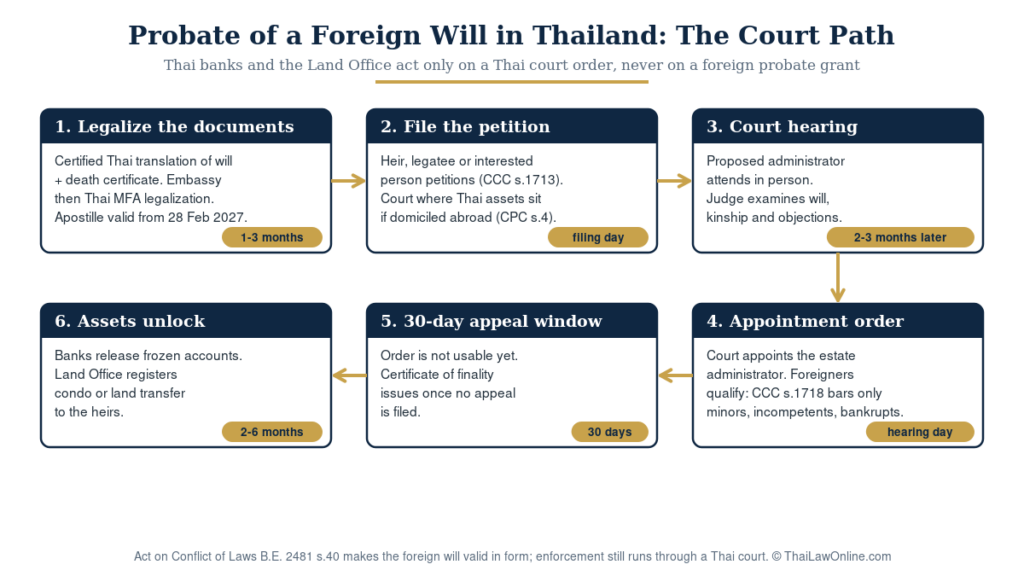
Table of Contents
The short answer: valid in principle, useless without a Thai court order
Two separate questions hide inside “does my will work in Thailand?”
First, validity. The Act on Conflict of Laws B.E. 2481 (1938) answers this, and the answer is usually yes. A will signed in London under English formalities, or in Texas under Texas formalities, satisfies Thai form requirements through Section 40 of that Act.
Second, enforcement. Thai banks act only on a Thai court order appointing an estate administrator (ผู้จัดการมรดก), followed by the certificate confirming no appeal was filed. Section 81 of the Land Code does let an heir apply to register inherited land directly, but with a foreign will and foreign documents the Land Office in practice asks for the same court order. A UK Grant of Probate or a US Letters Testamentary carries no force here. Thai authorities do not execute foreign court orders in succession matters. Your family must petition a Thai court, file the foreign will with certified translations, and wait for the appointment.
That gap between validity and enforcement is where the delays, the frozen accounts, and the legal fees live. It starts the moment succession opens: under Section 1599 of the Civil and Commercial Code, the estate devolves on the heirs at the instant of death, and Section 1600 defines that estate as all property, rights, duties, and liabilities of the deceased. The rights exist immediately. Access to them does not.
The law behind this page
English
Section 40 Act on Conflict of Laws B.E. 2481
Full text
A person may make a will in the form prescribed by the law of his or her nationality, or in the form prescribed by the law of the country in which the will is made.
ThaiLawOnline translation
Section 41 Act on Conflict of Laws B.E. 2481
Full text
The effect and interpretation of a will, and the nullity of a will or of a testamentary disposition, shall be governed by the law of the domicile of the testator at the time of the testator's death.
ThaiLawOnline translation
Section 37 Act on Conflict of Laws B.E. 2481
Full text
Succession, so far as it relates to immovable property, is governed by the law of the place where the property is situated.
ThaiLawOnline translation
Section 38 Act on Conflict of Laws B.E. 2481
Full text
As regards movable property, succession by statutory right or by will is governed by the law of the domicile of the deceased at the time of death.
ThaiLawOnline translation
Section 8 Act on Conflict of Laws B.E. 2481
Full text
Where a foreign law is to be applied, if that law is not proved to the satisfaction of the court, the internal law of Thailand shall apply.
ThaiLawOnline translation
Section 1713
An heir, an interested person or the public prosecutor may apply to the court to appoint an administrator where a statutory heir or legatee has disappeared, is outside the Kingdom or is a minor; where the administrator or an heir is unable or unwilling to act, or there is an impediment to administering or distributing the estate; or where the clause of the will appointing an administrator cannot take effect.
Full text
An heir, an interested person, or the public prosecutor may apply to the court for the appointment of an administrator of the estate in the following cases: (1) where, on the death of the deceased, a statutory heir or a beneficiary under the will has disappeared, is outside the Kingdom, or is a minor; (2) where the administrator of the estate or an heir is unable or unwilling to administer the estate, or where there is an impediment to its administration or distribution; (3) where a provision of the will appointing an administrator of the estate is for any reason unenforceable. As to the appointment, if the will contains a provision on the point the court appoints in accordance with it; if it does not, the court appoints such person as it thinks fit for the benefit of the estate in the circumstances, having regard to the intention of the deceased.
ThaiLawOnline translation
Section 4 quater
A petition to appoint an administrator of a deceased person's estate must be filed in the court where the deceased was domiciled when they died. If the deceased had no home in Thailand, it is filed where the estate property is located.
Full text
A petition for the appointment of an estate administrator shall be submitted to the court within whose territorial jurisdiction the deceased had domicile at the time of death. Where the deceased had no domicile in the Kingdom, it shall be submitted to the court within whose territorial jurisdiction the estate property is located.
ThaiLawOnline translation
Section 1754
An inheritance claim is barred one year after the death, or after the statutory heir knew or ought to have known of the death. A claim under a will is barred one year after the legatee knew or ought to have known of the right. Subject to Section 193/27 (which preserves a secured creditor's right to enforce against the mortgaged, pledged or retained property), a creditor whose claim against the deceased has a prescription period longer than one year must sue within one year after he knew or ought to have known of the death. In every case no claim may be brought more than ten years after the death.
Full text
No action concerning an estate may be brought after one year from the death of the deceased, or from the time when the statutory heir knew or ought to have known of the death of the deceased. An action claiming under a provision of a will may not be brought after one year from the time when the legatee knew or ought to have known of the right that the legatee has under the will. Subject to section 193/27 of this Code, where a creditor's claim against the deceased has a prescription period longer than one year, that creditor may not bring an action after one year from the time when the creditor knew or ought to have known of the death of the deceased. In any event, the claims referred to in the preceding paragraphs may not be brought after ten years from the death of the deceased.
ThaiLawOnline translation
ไทย
มาตรา 40 พระราชบัญญัติว่าด้วยการขัดกันแห่งกฎหมาย พุทธศักราช 2481
ข้อความเต็ม
บุคคลจะทำพินัยกรรมตามแบบที่กฎหมายสัญชาติกำหนดไว้ก็ได้ หรือจะทำตามแบบที่กฎหมายของประเทศที่ทำพินัยกรรมกำหนดไว้ก็ได้
ตรงตามข้อความในราชกิจจานุเบกษา / สำนักงานคณะกรรมการกฤษฎีกา (Verbatim from the Royal Gazette / Office of the Council of State)
มาตรา 41 พระราชบัญญัติว่าด้วยการขัดกันแห่งกฎหมาย พุทธศักราช 2481
ข้อความเต็ม
ผลและการตีความพินัยกรรมก็ดี ความเสียเปล่าแห่งพินัยกรรม หรือข้อกำหนดพินัยกรรมก็ดี ให้เป็นไปตามกฎหมายภูมิลำเนาของผู้ทำพินัยกรรมในขณะที่ผู้ทำพินัยกรรมถึงแก่ความตาย
ตรงตามข้อความในราชกิจจานุเบกษา / สำนักงานคณะกรรมการกฤษฎีกา (Verbatim from the Royal Gazette / Office of the Council of State)
มาตรา 37 พระราชบัญญัติว่าด้วยการขัดกันแห่งกฎหมาย พุทธศักราช 2481
ข้อความเต็ม
มรดกเท่าที่เกี่ยวกับอสังหาริมทรัพย์ ให้เป็นไปตามกฎหมายแห่งถิ่นที่ทรัพย์สินนั้นตั้งอยู่
ตรงตามข้อความในราชกิจจานุเบกษา / สำนักงานคณะกรรมการกฤษฎีกา (Verbatim from the Royal Gazette / Office of the Council of State)
มาตรา 38 พระราชบัญญัติว่าด้วยการขัดกันแห่งกฎหมาย พุทธศักราช 2481
ข้อความเต็ม
ในส่วนที่เกี่ยวกับสังหาริมทรัพย์ มรดกโดยสิทธิโดยธรรม หรือโดยพินัยกรรม ให้เป็นไปตามกฎหมายภูมิลำเนาของเจ้ามรดกในขณะที่เจ้ามรดกถึงแก่ความตาย
ตรงตามข้อความในราชกิจจานุเบกษา / สำนักงานคณะกรรมการกฤษฎีกา (Verbatim from the Royal Gazette / Office of the Council of State)
มาตรา 8 พระราชบัญญัติว่าด้วยการขัดกันแห่งกฎหมาย พุทธศักราช 2481
ข้อความเต็ม
ในกรณีที่จะต้องใช้กฎหมายต่างประเทศบังคับ ถ้ามิได้พิสูจน์กฎหมายนั้นให้เป็นที่พอใจแก่ศาล ให้ใช้กฎหมายภายในแห่งประเทศไทย
ตรงตามข้อความในราชกิจจานุเบกษา / สำนักงานคณะกรรมการกฤษฎีกา (Verbatim from the Royal Gazette / Office of the Council of State)
มาตรา 1713
ข้อความเต็ม
ทายาทหรือผู้มีส่วนได้เสียหรือพนักงานอัยการจะร้องต่อศาลขอให้ตั้งผู้จัดการมรดกก็ได้ ในกรณีดังต่อไปนี้ (๑) เมื่อเจ้ามรดกตาย ทายาทโดยธรรมหรือผู้รับพินัยกรรมได้สูญหายไป หรืออยู่นอกราชอาณาเขต หรือเป็นผู้เยาว์ (๒) เมื่อผู้จัดการมรดกหรือทายาทไม่สามารถ หรือไม่เต็มใจที่จะจัดการ หรือมีเหตุขัดข้องในการจัดการ หรือในการแบ่งปันมรดก (๓) เมื่อข้อกำหนดพินัยกรรมซึ่งตั้งผู้จัดการมรดกไว้ไม่มีผลบังคับได้ด้วยประการใด ๆ การตั้งผู้จัดการมรดกนั้น ถ้ามีข้อกำหนดพินัยกรรมก็ให้ศาลตั้งตามข้อกำหนดพินัยกรรม และถ้าไม่มีข้อกำหนดพินัยกรรม ก็ให้ศาลตั้งเพื่อประโยชน์แก่กองมรดกตามพฤติการณ์ และโดยคำนึงถึงเจตนาของเจ้ามรดก แล้วแต่ศาลจะเห็นสมควร
ตรงตามข้อความในราชกิจจานุเบกษา / สำนักงานคณะกรรมการกฤษฎีกา (Verbatim from the Royal Gazette / Office of the Council of State)
มาตรา 4 จัตวา
ข้อความเต็ม
คำร้องขอแต่งตั้งผู้จัดการมรดก ให้เสนอต่อศาลที่เจ้ามรดกมีภูมิลำเนาอยู่ในเขตศาลในขณะถึงแก่ความตายในกรณีที่เจ้ามรดกไม่มีภูมิลำเนาอยู่ในราชอาณาจักร ให้เสนอต่อศาลที่ทรัพย์มรดกอยู่ในเขตศาล
ตรงตามข้อความในราชกิจจานุเบกษา / สำนักงานคณะกรรมการกฤษฎีกา (Verbatim from the Royal Gazette / Office of the Council of State)
มาตรา 1754
ข้อความเต็ม
ห้ามมิให้ฟ้องคดีมรดกเมื่อพ้นกำหนดหนึ่งปี นับแต่เมื่อเจ้ามรดกตาย หรือนับแต่เมื่อทายาทโดยธรรมได้รู้ หรือควรได้รู้ถึงความตายของเจ้ามรดก คดีฟ้องเรียกตามข้อกำหนดพินัยกรรม มิให้ฟ้องเมื่อพ้นกำหนดหนึ่งปีนับแต่เมื่อผู้รับพินัยกรรมได้รู้หรือควรได้รู้ถึงสิทธิซึ่งตนมีอยู่ตามพินัยกรรม ภายใต้บังคับแห่งมาตรา ๑๙๓/๒๗ แห่งประมวลกฎหมายนี้ ถ้าสิทธิเรียกร้องของเจ้าหนี้อันมีต่อเจ้ามรดกมีกำหนดอายุความยาวกว่าหนึ่งปี มิให้เจ้าหนี้นั้นฟ้องร้องเมื่อพ้นกำหนดหนึ่งปีนับแต่เมื่อเจ้าหนี้ได้รู้ หรือควรได้รู้ถึงความตายของเจ้ามรดก ถึงอย่างไรก็ดี สิทธิเรียกร้องตามที่ว่ามาในวรรคก่อน ๆ นั้น มิให้ฟ้องร้องเมื่อพ้นกำหนดสิบปีนับแต่เมื่อเจ้ามรดกตาย หมายเหตุ: [เลขมาตรา ๑๙๓/๒๗ แก้ไขเพิ่มเติมโดยมาตรา ๑๕ แห่งพระราชบัญญัติให้ใช้บทบัญญัติบรรพ ๑ แห่งประมวลกฎหมายแพ่งและพาณิชย์ที่ได้ตรวจชำระใหม่ พ.ศ. ๒๕๓๕]
ตรงตามข้อความในราชกิจจานุเบกษา / สำนักงานคณะกรรมการกฤษฎีกา (Verbatim from the Royal Gazette / Office of the Council of State)
Français
Article 40 Act on Conflict of Laws B.E. 2481
Une personne peut faire son testament selon la forme prescrite par la loi de sa nationalité, ou selon la forme prescrite par la loi du pays où le testament est fait.
résumé non officiel
Article 41 Act on Conflict of Laws B.E. 2481
Les effets et l'interprétation d'un testament, ainsi que la nullité d'un testament ou d'une disposition testamentaire, sont régis par la loi du domicile du testateur au moment de son décès.
résumé non officiel
Article 37 Act on Conflict of Laws B.E. 2481
La succession immobilière est régie par la loi du lieu de situation du bien.
résumé non officiel
Article 38 Act on Conflict of Laws B.E. 2481
Pour les meubles, la succession légale ou testamentaire est régie par la loi du domicile du défunt au moment du décès.
résumé non officiel
Article 8 Act on Conflict of Laws B.E. 2481
Lorsqu'une loi étrangère doit être appliquée et que cette loi n'est pas prouvée à la satisfaction du tribunal, c'est le droit interne de la Thaïlande qui s'applique.
résumé non officiel
Article 1713
Un héritier, une personne intéressée ou le ministère public peut demander au tribunal la nomination d'un administrateur de la succession dans les cas suivants : (1) lorsque, au décès du de cujus, un héritier légal ou un légataire a disparu, se trouve hors du Royaume ou est mineur ; (2) lorsque l'administrateur de la succession ou un héritier ne peut pas ou ne veut pas administrer, ou qu'un empêchement fait obstacle à l'administration ou au partage de la succession ; (3) lorsque la disposition testamentaire désignant un administrateur de la succession est, pour quelque cause que ce soit, dépourvue d'effet. Pour la nomination de l'administrateur de la succession, s'il existe une disposition testamentaire, le tribunal nomme conformément à celle-ci ; à défaut, le tribunal nomme, dans l'intérêt de la succession, selon les circonstances et en tenant compte de l'intention du de cujus, comme il le juge approprié.
résumé non officiel
Article 4 quater
La requête en nomination d'un administrateur de succession est présentée au tribunal dans le ressort duquel le défunt avait son domicile au moment de son décès. Si le défunt n'avait pas de domicile dans le Royaume, elle est présentée au tribunal dans le ressort duquel se trouvent les biens successoraux.
résumé non officiel
Article 1754
Aucune action successorale ne peut être intentée après l'expiration d'un délai d'un an à compter du décès du de cujus, ou à compter du moment où l'héritier légal a eu connaissance ou aurait dû avoir connaissance du décès du de cujus. L'action fondée sur une disposition testamentaire ne peut être intentée après l'expiration d'un délai d'un an à compter du moment où le légataire a eu connaissance ou aurait dû avoir connaissance du droit qu'il tient du testament. Sous réserve de l'article 193/27 du présent Code, lorsque la créance d'un créancier contre le de cujus est soumise à un délai de prescription supérieur à un an, ce créancier ne peut agir en justice après l'expiration d'un délai d'un an à compter du moment où il a eu connaissance ou aurait dû avoir connaissance du décès du de cujus. En tout état de cause, les droits visés aux alinéas précédents ne peuvent être exercés en justice après l'expiration d'un délai de dix ans à compter du décès du de cujus.
résumé non officiel
Sources
- Act on Conflict of Laws B.E. 2481, retrieved 4 November 2026
- Civil and Commercial Code, Office of the Council of State, retrieved 31 October 2026
- Civil Procedure Code, Office of the Council of State, retrieved 31 October 2026
The law: Conflict of Laws Act sections 37 to 42 explained
The Act on Conflict of Laws B.E. 2481 (1938) contains the six sections that decide every foreign-will case. Competing guides collapse these into “translate and legalize it.” The statute does more work than that. You can read the codes these rules interact with in our free Thai Law Library.
Form of the will (Section 40): nationality law or place of execution
Section 40 validates a will as to form if it complies with either the law of the testator‘s nationality or the law of the country where the will was made. A British citizen who signed a will in England under the Wills Act 1837 formalities passes this test twice over. An American who signed a will in Thailand passes if the will meets either US state formalities (nationality) or Thai formalities.
The Thai forms sit in Book VI of the Civil and Commercial Code: the ordinary written will with two witnesses under Section 1656, the handwritten holographic will under Section 1657, and the District Office public-document will under Section 1658. This double gateway is why Thai courts rarely reject foreign wills on form.
Passing the form test is not the end of it. When a Thai court can still set a clause aside, what happens if your family cannot prove the foreign law, and why a Thai dual national is treated differently, are answered in is my English will valid in Thailand?
If you are weighing a Section 1658 will at the District Office, the procedure changed. The Ministerial Regulation on the Making of Wills B.E. 2569 has been in force since 24 March 2026 and replaced the 1960 regulation. You may now attend any amphur or Bangkok khet office rather than only the one holding your house registration, the fee is 250 baht (it was 50) and a duplicate counterpart of the will is 50 baht (it was 10), and your two witnesses must be present and sign in front of the officer, who, where there is reason to doubt that you are fifteen or of sound mind, looks into it and records the grounds and the result in the register (clause 7); the regulation gives the officer no power to refuse a will and says nothing about coercion. The reform is procedural: it does not touch the Conflict of Laws rules discussed here, and it does not change who inherits. Its practical attraction for a foreigner is that a short Thai will made this way keeps your Thai assets out of the foreign-will process described on this page altogether.
One trap survives the gateway. Section 1653 bars the writer of the will and anyone who signed it as a witness, and their spouses, from taking under it, and Section 1705 makes such a gift void. If your home jurisdiction tolerated an interested witness, the Thai court will not.
Meaning and effect (Section 41): the law of your domicile decides
Form is one thing. What the will means is another. Section 41 sends the effects, interpretation, and nullity of a will (or any clause in it) to the law of the testator’s domicile at death. If your father lived his last years in Manchester, English law governs what “my residuary estate” captures and whether a gift lapsed. Section 39 sends capacity to make a will to the testator’s nationality law at the time of making. Section 42 sends revocation to the law of the testator’s domicile when the revocation was made, and lapse to the domicile at death. Thai law’s own rule that a testator may revoke a will at any time is in Section 1693. This is the two-track analysis most guides skip: Section 40 for form, Section 41 for substance, and the two can point to different countries.
Watch one clause type in particular. Section 1686 strips any trust created by will of effect in Thailand. Anglo-American wills routinely pour assets into a testamentary trust, and that machinery does nothing for the Thai portion of the estate. We explain the workarounds in our note on trusts and foreign jurisdictions.
Thai land and condos (Section 37): Thai law, no exceptions
Section 37 governs succession to immovable property by the law of the place where the property sits. A Bangkok condo passes under Thai law regardless of what any foreign will or foreign statute says. Section 38 sends movable property (bank accounts, vehicles, shares) to the law of the deceased’s domicile at death. In practice: the foreign will can name the beneficiaries, but the Thai Land Code controls how Thai real estate transfers, including the foreign-ownership restrictions that survive death. A foreign heir inheriting Thai land still faces the limits described in our guide on inheriting property in Thailand as a foreign heir, and a condo inheritance runs into the building’s foreign quota, covered in buying a condominium in Thailand.
Step-by-step: probating a foreign will in a Thai court
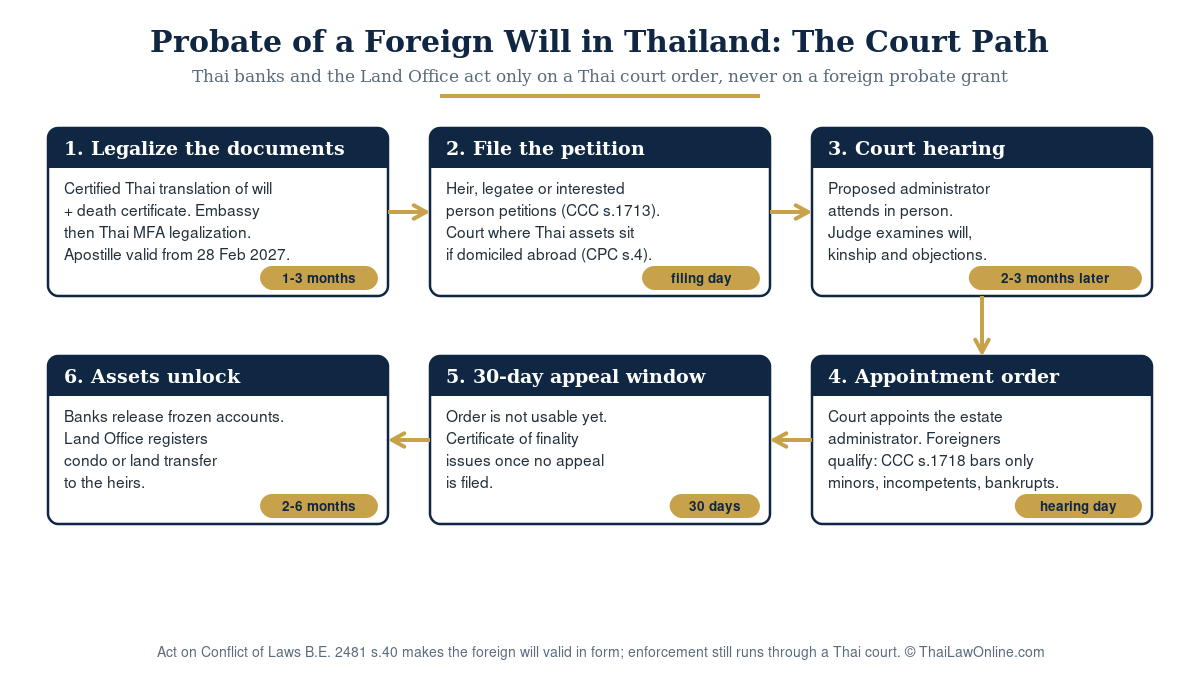
Documents: death certificate, will, translations, legalization
The court file starts with paper, and the paper takes longer than most families expect. You need the original foreign will (or a certified copy from the foreign probate registry), the death certificate, proof of kinship or entitlement, and an inventory of the Thai assets: title deeds, bank books, share certificates, vehicle registration.
Every foreign document must be translated into Thai by a certified translator. On legalization, the rules are changing: Thailand deposited its accession to the Hague Apostille Convention on 30 June 2026, and the Convention enters into force for Thailand on 28 February 2027. Until that date, an apostille alone does nothing here.
Foreign documents go through the traditional chain covered in our guide to legalization of documents in Thailand: certification in the home country, authentication by the Thai embassy or consulate there, then legalization by the Department of Consular Affairs of the Thai Ministry of Foreign Affairs. From 28 February 2027, a single apostille from a member country should replace that chain for public documents. Budget weeks either way, and start the paperwork before filing anything.
Who petitions and where (CCC s.1713, CPC s.4 quater)
Section 1713 of the Civil and Commercial Code lists who may ask the court to appoint an estate administrator: an heir, a legatee under the will, an interested person, or the public prosecutor, in the cases the section lists, including where an heir is outside Thailand or a minor, or where administering or dividing the estate meets an obstacle. Venue comes from a different code. Section 4 quater of the Civil Procedure Code fixes the court by the deceased’s domicile at the moment of death, and where the deceased had no Thai domicile, by the location of the estate property. A retiree who died in Florida owning a Phuket condo answers to the Phuket Provincial Court. The Supreme Court has enforced this strictly: estates of relatives domiciled elsewhere cannot be bundled into one petition just because the heirs overlap.
The hearing, the one-month appeal window, the final certificate
The court schedules a hearing, typically two to three months after filing. The proposed administrator should attend in person. Courts want to see the person they are appointing, question them about the estate, and confirm no heir objects. If you have never seen a Thai courtroom, read what to know before you go to court in Thailand first. If the judge grants the petition, the appointment order does not become usable immediately. An appeal window runs first, and it is one month from the day the order is read, not thirty days (Civil Procedure Code section 229). Once it closes with no appeal, the court issues the certificate of finality (often called the Certificate of No Appeal), and this is the document banks and the Land Office actually honor.
Who can be estate administrator, including foreigners
Section 1711 onward governs administrators: appointment, powers, duties, and removal. Section 1718 disqualifies three groups: persons not sui juris (minors), persons of unsound mind or adjudged quasi-incompetent, and persons adjudged bankrupt.
Foreigners appear nowhere on that list. Thai courts appoint foreign administrators regularly, including the executor named in the foreign will. The practical friction is language and presence: proceedings run in Thai, and the administrator must sign documents at banks and the Land Office after appointment. Many foreign executors grant a power of attorney to a Thai lawyer for the paperwork while attending the hearing themselves.
The job carries real duties. Under Section 1719 the administrator must carry out the will and manage the estate, and Section 1728 requires the inventory to be started within fifteen days of taking office and Section 1729 requires it to be completed within one month, extendable by the court, before two witnesses who have an interest in the estate. An administrator who mismanages the estate can be removed on petition under Section 1727.
What it costs and how long it takes
Straightforward Thai probate, with a Thai will and no dispute, runs four to six months from filing to certificate. A foreign will adds the translation and legalization chain, and often an affidavit of foreign law, which together add six to twelve months in typical cases. Contested estates run years. After the certificate issues, transferring the assets themselves (Land Office registration, bank releases, share transfers) takes another two to six months, and the transfer taxes and fees fall due at that point.
Where the time goes: document legalization before filing (one to three months), waiting for the hearing date (two to three months), the one-month appeal window, then the asset-by-asset transfer work. The court filing fee for an uncontested petition runs a few hundred baht, with related court expenses rarely passing a few thousand. Certified translation, legalization, and legal fees form the real cost, and they scale with the number of foreign documents. Compare that with the cost of simply making a Thai will, which starts under 4,000 baht.
One deadline your family cannot miss: Section 1754 bars an heir’s inheritance claim one year after the death, or after the statutory heir knew or should have known of it, and a claim under a will one year after the beneficiary knew or should have known of the right under the will; no claim survives ten years after the death. Waiting for a foreign probate to conclude before starting in Thailand burns that clock.
The affidavit of foreign law: when Thai courts need proof of your home law
Thai judges apply Thai law on their own. Foreign law they treat as fact, and facts need evidence. When Section 41 makes English or Californian law govern the interpretation of the will, the petitioner proves that law, usually through an affidavit of foreign law: a sworn statement by a lawyer qualified in the home jurisdiction explaining the relevant rules.
Without it, the court cannot apply the foreign law, and Thai law fills the gap by default. You need the affidavit when the will’s meaning, the executor’s authority, or a beneficiary’s entitlement turns on home-country law. You can skip it when the will is simple, the heirs agree, and the estate is a bank account plus a condo passing under Thai law anyway.
Why a separate Thai will is still the better route (and when it is not)
The statutes explain the advice every Thai lawyer gives. A foreign will works through Section 40, but it drags the estate through translation, legalization, and foreign-law proof. A Thai will covering only Thai assets, drafted in Thai form, skips all three. The court reads it directly. Probate shortens by months and the legalization budget disappears.
Keep both wills, scoped so neither revokes the other: the Thai will for Thai assets, the home will for everything else. The exception: if your Thai holdings are trivial or you are mid-move, one worldwide will may be simpler, and Section 40 will carry it. Our last will in Thailand service drafts the Thai-side will bilingually so your family and the court read the same document, and you can order it online in minutes. If you are planning the whole picture rather than one document, start with Thai inheritance law.
What the Supreme Court has ruled
The Supreme Court (Dika Court) has decided wills questions for nearly a century, and its rulings bind the analysis above: what counts as formal validity, when courts find the necessity that justifies appointing an administrator, and how contested foreign documents are weighed. We maintain an analysis of more than 75 Supreme Court decisions on Thai wills from 1936 to 2025, and a broader collection of curated Dika rulings by topic. For the framework that applies when a will fails, see our inheritance guide for foreigners.
Last reviewed: 27 September 2026. The Act on Conflict of Laws B.E. 2481 sections 37 to 42, Civil and Commercial Code sections 1599, 1600, 1653, 1656 to 1658, 1686, 1693, 1705, 1713, 1718, 1719, 1727 to 1729 and 1754, and Civil Procedure Code sections 4 quater and 229 were read in Thai. Time and cost estimates are practice figures. Re-checked on 10 October 2026: Land Code section 81 read in Thai and the enforcement paragraph qualified accordingly.
Frequently asked questions
Can my UK Grant of Probate be used in Thailand?
No. Thai authorities do not recognize or execute foreign probate orders. The Grant helps as evidence (it shows the will was proved at home), but your family still petitions a Thai court for a Thai administrator appointment before any Thai asset moves.
Can I be administrator from abroad without travelling?
You can start the process from abroad through a power of attorney to a Thai lawyer, who prepares and files the petition. Plan to attend the court hearing in person; judges expect to see the proposed administrator, and courts only rarely excuse attendance. After appointment, a power of attorney covers most of the bank and Land Office work.
What happens to my Thai bank account when I die?
The bank freezes the account when notified of the death. It releases funds against the Thai court’s administrator appointment order plus the certificate confirming the one-month appeal window closed. No foreign document substitutes, and joint signatories lose access too. Our guide to the death of a foreigner in Thailand covers the first practical steps for the family.
Does Thailand have inheritance tax on probated assets?
Thailand taxes inheritances above 100 million baht per heir under the Inheritance Tax Act B.E. 2558 (2015): 5% for ascendants and descendants, 10% for others, with spouses exempt. Most foreign estates fall under the threshold. Details in our inheritance tax in Thailand guide.
What if the foreign will is in a language other than English?
The rule is the same for German, French, or Japanese wills: certified Thai translation plus legalization (the embassy-and-MFA chain today; an apostille once the Convention takes effect for Thailand on 28 February 2027). Section 40 tests validity against the testator’s nationality law or the place of signing, so the language of the will never invalidates it. Translation quality matters more, because the Thai court reads only the Thai text.
What if there is no will at all?
The estate passes by intestacy. Section 1620 sends it to the statutory heirs, ranked in the six classes of Section 1629, with the surviving spouse taking a share under Section 1635. The Thai court still appoints an administrator on petition. See what happens if you die without a will in Thailand.
Conclusion
Probate of a foreign will in Thailand follows a clear statutory path: Section 40 of the Conflict of Laws Act carries your will through the validity gate, Sections 37, 38, and 41 decide which country’s law governs each asset and each clause, and the Civil and Commercial Code hands enforcement to a Thai-court-appointed administrator.
The process works. It just works slowly, in Thai, and only through a Thai courtroom. If you hold Thai assets today, a bilingual Thai will costs a fraction of what the legalization chain will cost your family later. If you are already facing a Thai probate with a foreign will, start the document legalization now and get the petition filed. ThaiLawOnline has handled both sides of that timeline for twenty years. Book a consultation or contact the firm to talk through your estate or an ongoing probate.
Thai Law Updates, free by email
Plain-English updates on Thai law changes that affect foreigners: property, visas, marriage, business and wills. One short email a month from a firm practicing since 2006. No spam, unsubscribe anytime.