


Last updated on
Reviewed by ThaiLawOnline, a licensed Thai law firm practising in Thailand since 2006. Thai lawyer of record: Wichuda Atthamethakon, LL.M., Thai Bar Licence 3149/2556.
Table of Contents
Last reviewed: 3 September 2026. The treaty statements on this page were read against primary sources rather than against secondary summaries. The Convention of 5 October 1961 was read in full for Articles 2, 5, 6 and 12: Article 2 and Article 5 are what limit both a legalisation and an apostille to the signature, the capacity of the signatory and the identity of the seal, and Article 12 is the arithmetic behind 28 February 2027, namely that an accession takes effect only as regards Contracting States raising no objection within six months of the depositary notification under Article 15(d), with entry into force on the sixtieth day after that period expires. The Hague Conference status table for the Convention was parsed row by row rather than read around the word Thailand: Thailand’s row is 30-VI-2026, accession, 28-II-2027, it carries no notification link of any kind, and the table lists 130 States. Tunisia’s notifications record was read directly for the four Article 12 objections quoted below and for the date the Convention finally entered into force between Tunisia and Belgium. The Article 6 designation was read from the depositary’s own list of competent authorities. The Lawyers Act B.E. 2528 section 27(3) was read from the consolidated Thai text, and the Lawyers Council registration regulation from our own captured copy of the Gazette publication. Re-checked on 4 October 2026: Thailand’s row in the status table still carries no notification, so no objection has been recorded; the fee figures in the frequently asked questions were aligned with the table, which charges per legalisation stamp, and the appointment lead time was made consistent across the page.
This review does not certify three things and says so rather than implying otherwise. It does not certify the Ministry fee schedule set out below: the Ministry’s published page is a script-rendered shell that serves no fee data to a plain fetch, so those figures are reported as practice and were not checked against a primary. It does not certify the office addresses, telephone numbers or opening hours, which are administrative practice and change without notice. And it does not certify which countries will object to Thailand’s accession, because the objection window does not close until 30 December 2026; as at today the depositary records none.
Legalization of documents in Thailand is the step where the Ministry of Foreign Affairs confirms that a signature, a seal or a stamp on your document is genuine. Marriage registration needs it. Visa and work permit applications need it. Probate, company registration and property transfers need it. Since the Ministry moved to an appointment-only system, the queue runs two to three weeks, and the calendar for the current month is often full.
This page sets out both directions of travel: foreign documents coming into Thailand, and Thai documents going abroad. It also answers the question that now arrives with almost every enquiry, which is what Thailand’s accession to the Apostille Convention does and does not change.
Apostille status, checked 4 October 2026. Thailand deposited its instrument of accession to the Hague Apostille Convention on 30 June 2026. The Convention enters into force for Thailand on 28 February 2027. Until that date, the consular chain described below is the only route. After that date it remains the route for any country that objects during the window closing on 30 December 2026. As of today the depositary records no objection to Thailand’s accession.
What legalisation certifies, and what it does not
Most rejected documents fail because the applicant expected the stamp to do something it never does.
The Apostille Convention gives the tightest available definition, and Thai practice follows the same logic. Article 2 of the Convention defines legalisation as the formality by which diplomatic or consular agents certify three things: the authenticity of the signature, the capacity in which the person signing acted, and where relevant the identity of the seal or stamp. Article 5 applies the same three-part limit to the apostille itself.
Read what that leaves out. The Ministry does not certify that the contents of your document are true. It does not certify that the facts recorded in it still hold. It does not certify that a translation attached to it is accurate as a matter of law, and after February 2027 an apostille will not cover a translation either. A legalised marriage certificate proves that a Thai district office issued it and that the officer who signed it held that office. It proves nothing about whether you are still married.
That distinction decides what you have to prepare. If a foreign authority questions the substance of your document, another stamp will not answer them.
Booking the MFA appointment
Every legalisation service now runs on an advance online appointment, booked through the official portal at qlegal.consular.go.th. You choose the date, time and office, and the system confirms by email. It runs in Thai and English.
Book as far ahead as you can. Slots go quickly, the calendar for the current month is often fully booked, and two to three weeks of lead time is normal, and more in peak periods. Turning up without an appointment does not work.
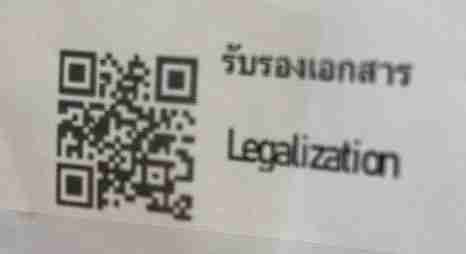
Scan to open the MFA appointment portal.
Where the Department of Consular Affairs handles legalisation
Bangkok, main office. Department of Consular Affairs, 3rd floor, 123 Chaeng Watthana Road, Bangkok 10210. Tel 0 2575-1056 to 1059. Hours 08:30 to 11:30 and 13:00 to 14:30.
Bangkok, city centre. The Pathum Wan office at MBK Center opened in March 2023. A second central facility at Central World opened in November 2024. Both offer extended hours.
Chiang Mai and other regional offices apply the same service standards and processing times as Bangkok. All of them require an online appointment.
Phuket. Central Phuket Festival, B Floor (old side), 75 Vichitsongkram Road, Wichit, Mueang Phuket 83000. Tel +66 76 222 080, +66 76 222 081, +66 76 222 083. The Nationality and Legal Affairs Division handles legalisation on +66 85 911 4193. Monday to Friday except public holidays; legalisation usually runs 10:00 to 15:30.
Fees and processing times
The Ministry publishes a fixed schedule. The fee depends on the service, not on who submits the document for you.
| Service | Fee | Processing time |
|---|---|---|
| Regular legalisation | 200 THB per legalisation stamp | 2 working days after submission (getting an appointment slot can take longer) |
| Same-day service | 400 THB per legalisation stamp | Same day |
| Certified translation | 200 THB for up to 100 words | Longer documents cost more |
| Translation verification | 200 THB per legalisation stamp | Required for every translated document |
| Postal return (Thailand Post EMS) | 60 THB | Adds 1 to 2 days |
| Through a private agent | Agent’s own fee on top of the above | Some complete the whole process in 2 to 3 days |
Where a representative submits on your behalf under a power of attorney, the Ministry includes that in the standard fee.
On private agents. Agents who work with the Ministry regularly can compress two to three weeks into two to three days, which matters when a court date or a flight fixes your deadline. Expect around 8,000 baht per person. Not every agent is reliable or transparent about what they charge, so ask what the 8,000 baht covers before you hand over originals. We can put you in touch with agents we have used before. They work independently of this firm, the 8,000 baht is their fee and not ours, and neither we nor the Ministry can guarantee a turnaround an agent quotes you.
Embassy fees are separate and each embassy sets its own. Most sit between USD 15 and USD 50. South Korea charges 22,000 KRW. Check the embassy’s own published schedule rather than a third-party summary.
Foreign documents for use in Thailand: the inbound chain
The chain starts in the issuing country and finishes at the Thai Ministry. Skipping a link is the most common reason documents come back.
- Authenticate in the country of origin. A United States document goes to the Secretary of State for the issuing state, then to the US Department of State.
- Legalise at the Thai Embassy or Consulate in that country.
- Translate into Thai. A certified translator must do this. The Ministry offers translation, and it accepts properly credentialed private translators.
- Legalise at the Thai MFA. The Department of Consular Affairs applies the final certification.

An embassy seal on an affirmation of freedom to marry.
The Ministry’s stamp changed in 2025. The green stamp has gone, replaced by a QR code and a transparent security seal that allows instant verification.
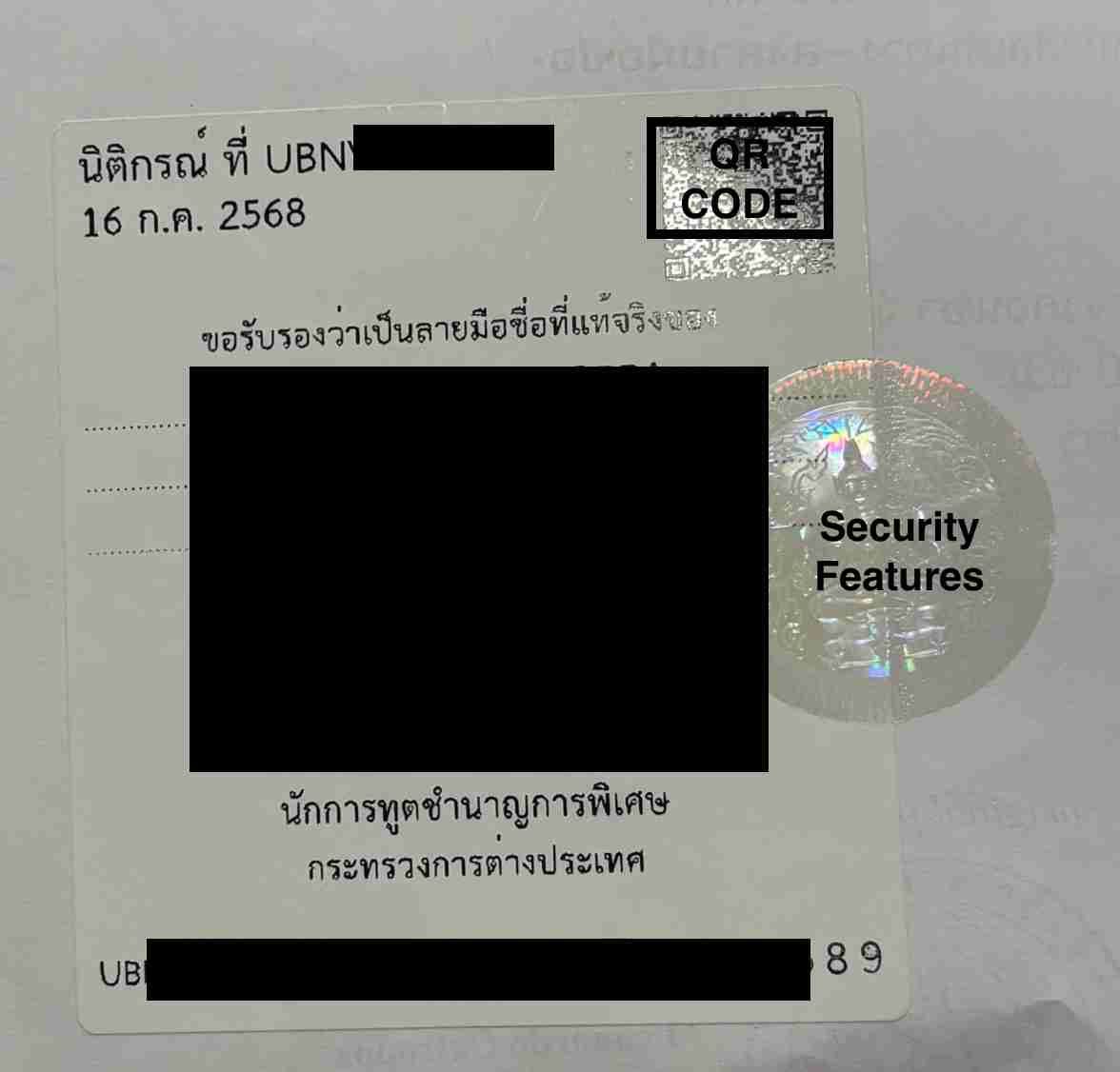
The current MFA stamp, on a document dated 16 July 2025.
Thai documents for use abroad: the outbound chain
This direction gets less attention and causes more trouble, because the first step is the one people skip.
Thailand has no notary public. The office does not exist here. The Lawyers Council of Thailand instead licenses a Notarial Services Attorney, a Thai lawyer who has completed the Council’s training and examination and holds a separate registration to certify signatures and documents. The Council issues that registration under section 27(3) of the Lawyers Act B.E. 2528 (1985), which empowers its committee to make regulations, through ข้อบังคับสภาทนายความ ว่าด้วยการขึ้นทะเบียนทนายความผู้ทำคำรับรองลายมือชื่อและเอกสาร พ.ศ. 2566, the Lawyers Council regulation on the registration of attorneys who certify signatures and documents, published in the Royal Gazette เล่ม ๑๔๑ ตอนพิเศษ ๑๓๒ ง หน้า ๕๗ on 13 May 2567. Its ข้อ 3 repeals the B.E. 2551 version that most English-language pages still quote. A lawyer without that registration cannot perform the act, whatever their letterhead says. Our own notary and legalisation service explains what falls inside that scope.
The outbound chain then runs in three steps:
- Notarial Services Attorney certifies the signature, or certifies a copy against the original. A private document, a contract or a personal declaration, cannot carry a stamp on its own. The attorney’s certificate placed on it is what the later steps certify.
- MFA Department of Consular Affairs legalises the document, together with any Thai or English translation.
- The receiving country’s embassy in Thailand applies the final authentication, until 28 February 2027 and after that date for any country that objects to Thailand’s accession.
Documents issued by a Thai government body, a marriage certificate, a birth certificate, a court order, a company registration, already qualify as public documents and start at step two.
What this looks like for the documents we handle most
- Marriage certificate for a foreign authority: district office original, certified translation, MFA legalisation, then the receiving embassy. See marriage in Thailand and registering a marriage in Bangkok.
- Divorce registration for a foreign court or registry: the divorce certificate, then the same chain. Where the marriage was registered abroad, read divorce in Thailand with a foreign marriage first, because the recognition question comes before the stamping question.
- Will or probate paperwork: a Thai will used in a foreign estate, or Thai court documents for probate and estate administration, follow the full chain including the notarial step where the document is private.
- Power of attorney signed in Thailand for use abroad: notarial certificate first, always. See powers of attorney for Thailand.
- Police clearance certificate for a visa or residence application overseas: issued by the Royal Thai Police, then legalised. See the police clearance certificate.
- Company documents for a foreign transaction or subsidiary: DBD certified copies, translation, MFA, embassy. See business setup in Thailand.
Translation: who may translate, and the trap
The Ministry certifies documents in Thai and English. It does not require you to translate an outbound Thai document into the language of the destination country, and many receiving authorities accept English.
Here is the trap. The receiving authority decides what language it wants, not the Thai Ministry. Ask the embassy or the foreign registry that will read the document before you pay for a translation into a third language. People routinely buy a certified German or Japanese translation, have it verified, and then discover the receiving office wanted English, or wanted its own sworn translator to do the work after arrival.
For inbound documents the rule runs the other way: anything not already in Thai or English needs a Thai translation by a certified translator, and that translation needs its own verification at 200 THB.
What the apostille changes on 28 February 2027
Thailand becomes the 130th Contracting Party to the Convention of 5 October 1961 Abolishing the Requirement of Legalisation for Foreign Public Documents. From the date it enters into force, a single apostille replaces the embassy step for documents travelling between Thailand and other contracting states.
Two things about that sentence get published wrongly across the English-language web, and both matter to anyone planning around the date.
Where the date comes from
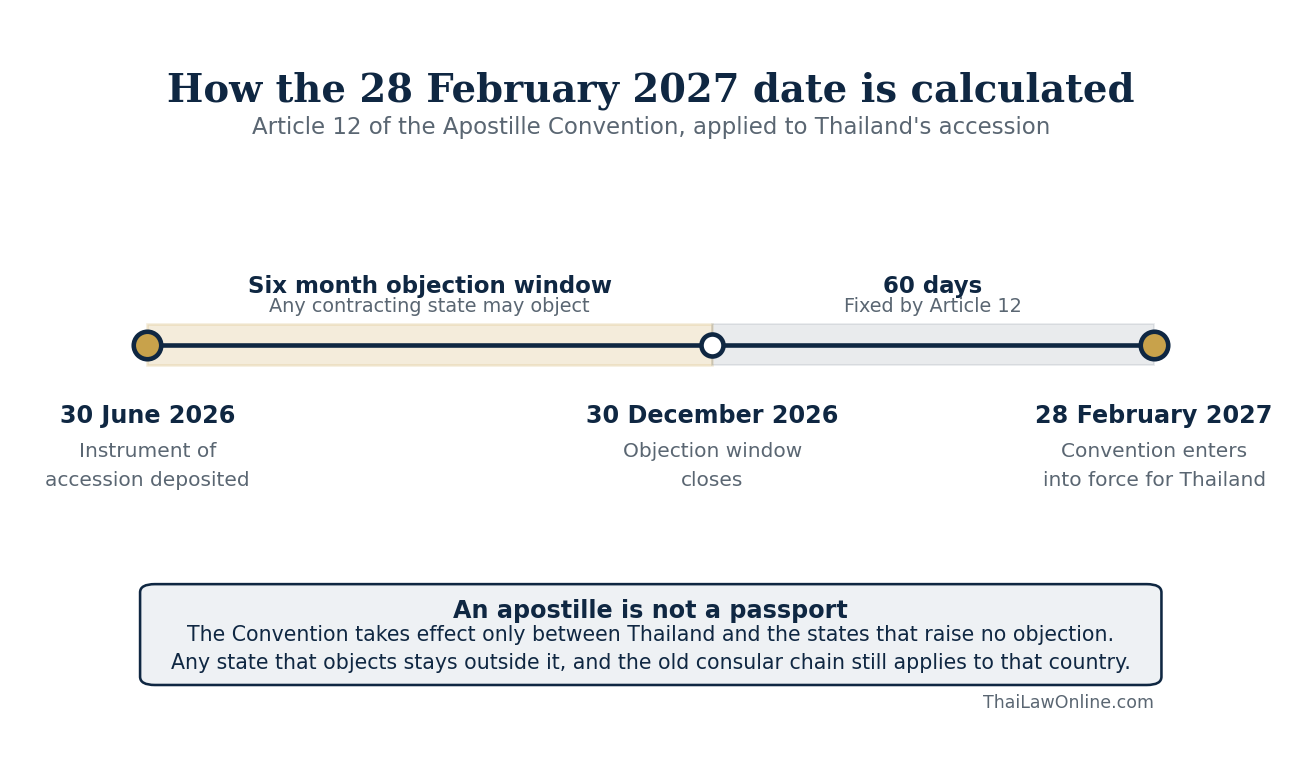
Article 12 sets out the arithmetic. An acceding state’s accession takes effect only as regards those Contracting States which raise no objection within six months after receipt of the notification that the depositary sends under Article 15(d). The Convention then enters into force between the acceding state and the non-objecting states on the sixtieth day after the expiry of that six month period.
Apply it. Thailand deposited on 30 June 2026. Six months from the depositary’s notification closes the objection window on 30 December 2026. Sixty days after that is 28 February 2027, which is the date the Hague Conference publishes. The date is a treaty computation, not administrative discretion and not a preparation period.
Several law firm websites currently publish the rule as entry into force six months after deposit. That confuses the objection window with entry into force and lands on 30 December 2026, two months early, on the only date a business planning a transaction actually needs.
Why an apostille is not a passport
The second and larger error, repeated on several law firm websites, is the claim that Thai apostilles will be recognised automatically by all other Convention states. Article 12 says the opposite for an acceding state. The Convention takes effect only between Thailand and the states that raise no objection. A state that objects stays outside the arrangement with Thailand, and the old consular chain continues to apply to that country until it changes its mind.
This is not a theoretical risk. Tunisia acceded, and four Contracting States objected under Article 12: Germany on 1 December 2017, Austria on 12 January 2018, Greece on 25 January 2018 and Belgium on 26 January 2018. Belgium withdrew its objection years later, and the depositary record states the consequence in plain terms: the objection meant “the Convention did not enter into force between Tunisia and Belgium”. It finally entered into force between them on 11 June 2025, seven years after the objection.
So the honest answer to “will my Thai apostille work in my country” is that it depends on your country, and nobody can confirm it until the window closes on 30 December 2026. We will publish the objection list in the first week of January 2027.
Who will issue Thai apostilles
Article 6 requires each Contracting State to designate the authority competent to issue the certificate. Thailand has designated the Department of Consular Affairs of the Ministry of Foreign Affairs, and the depositary publishes it: the Hague Conference lists Thailand under Competent Authority (Art. 6) with that designation, on a record last updated 1 July 2026, the day after the instrument was deposited. Article 6 requires the notice to be given at the time of deposit, and it was. What has not yet been published is the operational detail: the fee, the form of the certificate, which office issues it and whether the regional offices will. Expect the Ministry to publish implementation guidance nearer the date.
One detail worth noticing: the Thai delegation at The Hague included the Commissioner and Deputy Commissioner of the Immigration Bureau. Immigration does not usually attend treaty depositions. Their presence suggests that verifying inbound documents for visa and residence applications is driving the accession, which is the situation most readers of this page are in.
Why documents get rejected
Wrong sequence. Applicants send documents to Thai authorities before finishing the authentication chain at home. Each link certifies the one before it, so a missing link invalidates everything after it.
Translation problems. Terminology errors and partial translations both cause rejection. A translator who knows legal vocabulary and MFA formatting saves a second appointment.
Age of the document. Many receiving authorities want documents issued within the last six months, and some set a shorter limit; ask the one that will read yours. Order fresh copies before you start rather than legalising an old certificate.
Physical condition. The Ministry rejects laminated documents outright. Poor photocopies cause delays. Bring clean originals and legible copies.
Practical points. Arrive fifteen minutes early. Bring exact change. Where a matter involves several documents or an unusual chain, a firm that handles MFA procedures regularly will cost you money and save you a rejected batch.
Frequently asked questions
Does Thailand accept apostilles right now?
No. Thailand deposited its instrument of accession on 30 June 2026, but the Convention does not enter into force for Thailand until 28 February 2027. Until then, the consular chain on this page is the only route, both for foreign documents used in Thailand and for Thai documents used abroad.
When exactly does the apostille take effect, and where does that date come from?
28 February 2027. Article 12 gives Contracting States six months from the depositary’s notification to object, closing the window on 30 December 2026, and the Convention enters into force on the sixtieth day after that. The date is a treaty computation, not an administrative choice.
Will a Thai apostille be accepted in every Apostille Convention country?
No. Under Article 12 an accession takes effect only between Thailand and the states that raise no objection. Any state that objects before 30 December 2026 stays outside the arrangement, and the embassy chain still applies to it. When Tunisia acceded, four states objected.
How much does MFA legalisation cost?
200 THB per legalisation stamp for regular service and 400 THB per stamp for same-day service. Certified translation costs 200 THB for up to 100 words, translation verification 200 THB per stamp, and postal return by EMS 60 THB. These are Ministry fees and do not vary by who submits the document.
How long does it take to get an appointment?
Two to three weeks is normal under the appointment system, and the current month is often fully booked. Book through qlegal.consular.go.th as far ahead as you can, and further out during peak periods. Private agents can compress the process to two or three days.
Does a legalisation stamp certify that my document is true?
No. It certifies the authenticity of the signature, the capacity in which the signatory acted, and the identity of the seal or stamp. It says nothing about whether the contents are accurate or still current. An apostille will carry exactly the same three-part limit after February 2027.
Do I still need a certified translation after February 2027?
Yes, where the receiving authority requires one. An apostille certifies the signature and seal on the underlying document; it does not extend to a translation attached to it. The receiving authority decides what language it accepts and whether it wants its own translator to do the work.
Who issues apostilles in Thailand?
The Department of Consular Affairs of the Ministry of Foreign Affairs. Thailand made the Article 6 designation at the time of deposit, and the Hague Conference publishes it on its list of competent authorities for the Convention, last updated 1 July 2026. What is still unpublished is the operational detail: the fee, the form of the certificate and which offices will issue it.
Where to go from here
Two rules cover most of the trouble on this page. Work out which direction your document is travelling before you book anything, because the inbound and outbound chains share only the MFA step. Then ask the authority that will read the document what it actually requires, because it decides the language, the age limit and whether it wants an embassy stamp, and the Thai Ministry does not.
Legalised documents come up most often around marriage registration, marriage visas and extensions, citizenship applications and estate matters. Our Thai Law Library holds the underlying statutes if you want to read them directly.
If your matter has a deadline attached, tell us the deadline first. It usually decides whether the regular route works or whether you need same-day service and an agent.
Thai Law Updates, free by email
Plain-English updates on Thai law changes that affect foreigners: property, visas, marriage, business and wills. One short email a month from a firm practicing since 2006. No spam, unsubscribe anytime.