


Reviewed by ThaiLawOnline, a licensed Thai law firm practising in Thailand since 2006. Thai lawyer of record: Wichuda Atthamethakon, LL.M., Thai Bar Licence 3149/2556.
Last updated on
Between 15 and 25 May 2026 the Department of Lands issued three consecutive circulars marked most urgent to every Provincial Land Office, addressing land held for foreigners through Thai proxies. The lead reference is MT 0515.2/W 10722, dated 15 May 2026, signed by Director-General Phornphot Phenphas. These are administrative circulars. They create no new law and impose no new reporting duty on the public. They consolidate existing Land Code powers into a single enforcement framework, which means the legal exposure of a nominee arrangement is unchanged while the likelihood of it being examined has risen sharply. Last verified: 31 July 2026.
It’s a question every expatriate and investor asks: “Can I truly own my dream house in Thailand?” The short answer is yes, you can absolutely own a house in Thailand. However, and this is the crucial distinction, you generally cannot own the land it stands on.
The restriction comes from the Land Code itself: see Chapter 8, sections 86 to 96, on foreigners’ right in land.
The building and the land are treated separately, which we cover in our guide to property in Thailand.
Thai law clearly separates the ownership of a building from the land it sits on, which is crucial for foreign land ownership. This rule provides safe ways for foreigners to legally own a home. Whether you are building a villa in Phuket or buying a family house in Chiang Mai, it is important to know your options. This knowledge helps protect your investment.
At ThaiLawOnline, we have guided hundreds of foreigners through this exact process since 2006. This guide will break down the complexities of property transfer into simple, actionable advice. We will look at the best legal structures, highlight recent legal changes, and show you how to avoid common and expensive mistakes.
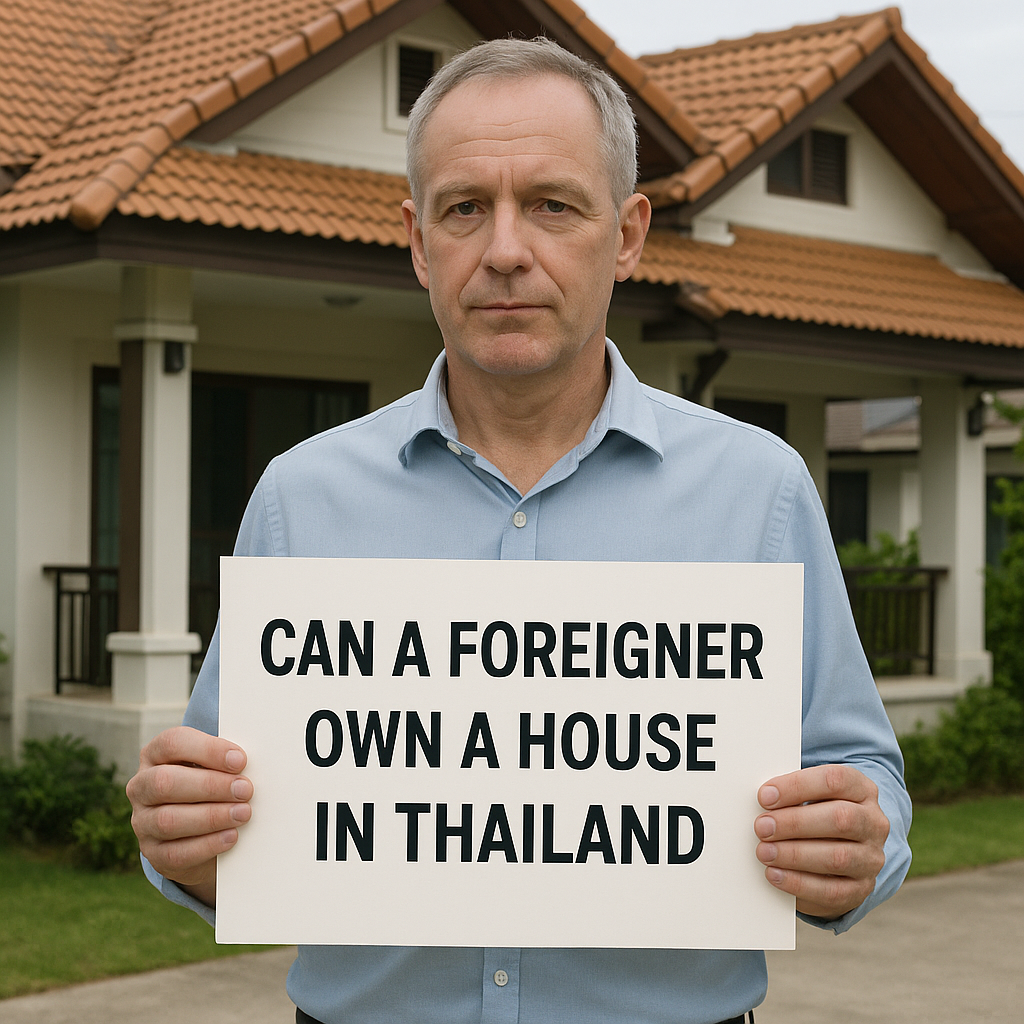
Table of Contents
Last reviewed: 17 September 2026. The statements on this page were read in Thai against the Civil and Commercial Code (sections 139 and 456 on selling a house, 538 and 540 on the 30-year lease, 1403, 1410 to 1416 on superficies, 1418 and 1422 on usufruct), Supreme Court decision 4655/2566 read in full, and section 21 of the Building Control Act B.E. 2522. On 6 October 2026 sections 1411 and 1412 were read in Thai and the superficies lines now note that a superficies granted for the holder’s lifetime is not inherited; the nominee warning no longer implies that a written agreement or a loan makes the arrangement lawful; and the condominium quota is stated on the combined area of the units. The May 2026 circular box above was verified separately on 31 July 2026. The Land Code sections cited (86, 61, 94, 96, 97 and 100) were read in Thai on 6 October 2026 in the Council of State consolidated text and match the page. Not verified here: the registration fees and stamp duty. The news section was re-checked on 27 September 2026: the 30-year cap in section 540 is unchanged, the 99-year and 75% proposals are still proposals, and DBD Order 2/2569 was checked against its Thai text.
Understanding the Core Legal Principle: Separating House and Land
The cornerstone of property ownership in Thailand is straightforward: buildings are considered separate assets from the land. Here’s what the law says:
- Foreigners Cannot Own Land: Section 86 of the Thai Land Code says most foreigners cannot own land. Marrying a Thai national does not change this. Where a Thai spouse buys land, the Land Department requires both spouses to sign a declaration that the money used is the Thai spouse’s personal property (sin suan tua), and the land is registered in the Thai spouse’s name alone. Trying to get around this by using Thai “nominees” is against the law. It can result in serious penalties, like losing assets and going to jail.
- Foreigners can own buildings: The regulations surrounding land ownership in Thailand must be understood. Civil and Commercial Code lets people own a building separately from the land it sits on. This means you can register your name as the legal owner of the house, ensuring clear ownership of a house. A Thai national or a company can hold the land title deed (Chanote).
To make the legal separation official, it needs to be recorded. This should be done with a registered agreement. You must go to the correct Land Department office.
Step 1: The Crucial Role of Due Diligence
Before considering which legal structure to use, a thorough due diligence process is non-negotiable. This is the single most important step in protecting your investment. Rushing into a deal without it can lead to financial disaster.
A comprehensive due diligence investigation, a service essential for understanding land ownership in Thailand. ThaiLawOnline provides, should always include clauses addressing property transfer and ownership restrictions.
- Title Deed Verification: Check that the land has a valid Chanote (Nor Sor 4 Jor). This is the only title deed that gives full ownership rights, crucial for property transfer. We verify its authenticity at the Land Department.
- Checking for Encumbrances: We examine the title deed. This helps us find any registered liens, mortgages, leases, or other legal claims. These claims could impact your rights when attempting to buy a property in Thailand.
- Verifying Ownership and Seller’s Rights: We check that the person selling or leasing the land is the legal owner. They must have the right to make this agreement.
- Access and Zoning Review: We verify that you have legal access to the property. This is important for foreign land ownership. We also check for zoning rules that might prevent you from building or using the house as you wish. This helps foreigners live comfortably in Thailand.
Skipping due diligence is like building a house on a foundation of sand; it is a risk you should never take.
Key Legal Pathways for Foreigners to Secure Land Use
Once due diligence is complete, you can choose a legal structure to secure your right to use the land. The three primary options offer varying degrees of security and flexibility.
Option 1: The 30-Year Lease (Hire of Property)
The most common method is a long-term lease, legally termed “Hire of Property” under the Civil and Commercial Code. This allows you to lease the land from a Thai owner for up to 30 years and own a house on that land.
- Duration: The maximum initial term is 30 years. Renewals can happen, but a key Thai Supreme Court decision (No. 4655/2566) shows the limit. A promise made when the lease was signed, to renew for two further 30-year terms on the original rent and conditions with that rent paid in advance, was void as an attempt to get around the 30-year maximum in Section 540 of the Civil and Commercial Code, and the Court refused to enforce it even as a personal contract between the parties (foreign ownership of land itself is prohibited by Section 86 of the Land Code, with no time element). However, renewals via new agreements are still possible (e.g., a fresh 30-year lease upon expiration under section 540). On other facts, the Supreme Court has accepted reciprocal agreements, which is a different question from a renewal promise.
- Registration is Important for acquiring land in Thailand. Any lease longer than three years must be registered at the local Land Department. This must be legally enforceable for the whole term. This is stated in Section 538 of the Civil and Commercial Code. An unregistered 30-year lease is only valid for three years.
- House Ownership: The lease agreement must explicitly state that you, the lessee, will own any structures built on the land.
Option 2: The Right of Superficies (A Stronger Form of Ownership)
A Right of Superficies (Sitthi Nuea Phuen Din สิทธิเหนือพื้นดิน) is a strong legal tool that allows foreigners to acquire land rights. It is governed by Sections 1410-1416 of the Civil and Commercial Code. This right allows you to own buildings on land that belongs to someone else.
- True Ownership of the Structure: A registered superficies legally separates the house from the land. This makes you the clear owner of the building.
- Transferable and Inheritable: A superficies is different from a standard lease. Unless the deed that creates it says otherwise, you can sell or transfer it and it passes to your heirs (section 1411). A superficies granted for your own lifetime, though, ends when you die, so choose a fixed term if inheritance is the point.
- Duration: It can be granted for a fixed term, or for the life of the landowner or of the superficiary. A fixed term cannot exceed 30 years, and may be renewed for up to 30 years from the renewal (sections 1412 and 1403 of the Civil and Commercial Code).
Option 3: The Right of Usufruct (Right of Use for Life)
A usufruct (Sitthi Kep Kin สิทธิเก็บกิน) is defined in Sections 1417-1428 of the Civil and Commercial Code. It gives a person the right to use and enjoy a property for their whole life.
- Lifetime Security: It provides the peace of mind of knowing you have a home for life.
- Non-Inheritable: This is the primary drawback when considering the complexities of owning land in Thailand. The usufruct right expires upon the death of the holder and cannot be passed on to heirs.
- Ideal for: Retirees or anyone looking for a safe home for life. No need to plan for inheritance.
Comparing Your Options: Lease vs. Superficies vs. Usufruct
| Feature | 30-Year Lease (Hire of Property) | Right of Superficies | Right of Usufruct |
| Primary Right | Right to USE the land | The right to OWN a building on the land is particularly important for foreigners in Thailand. | Right to USE and benefit from the property |
| Max Duration | 30 years (renewal by new agreement) | 30 years or for life (renewable) | Lifetime of the holder |
| Is it Inheritable? | No, unless specifically structured in the contract | Yes, can be passed to heirs, unless granted for the holder’s lifetime or the deed excludes it | No, expires upon death |
| Can it be Sold/Transferred? | Only with the landowner’s permission | Yes, the right and the house can be sold | The right stays with the holder and ends at death (section 1418), but unless the grant says otherwise the holder may transfer the exercise of it to someone else (section 1422). |
| Best For | General long-term residence, commercial ventures. | Foreigners wanting clear, inheritable ownership of the house. | Retirees seeking a secure home for their lifetime. |
Scenarios: Choosing the Right Option for Your Situation
Depending on your goals, one structure may suit better than others. For young families planning to stay long-term, a Right of Superficies provides inheritability and resale value. This is great for passing a Phuket villa to children. Retirees without heirs might prefer a Usufruct for lifetime security without renewal hassles. If you are an investor looking at commercial use, like a guesthouse in Chiang Mai, a 30-year lease offers flexibility. However, it needs strong renewal clauses. In mixed marriages, a prenuptial agreement can help protect your assets. Make sure to adjust it for your visa status and family situation.
Step 2: Formally Establishing House Ownership
Securing rights to the land is only half the process. You must also take formal steps to prove you own the house itself.
For New Builds: The Building Permit
If you are constructing a new house, the Building Permit is your foundational ownership document.
- Issuance: The permit is issued by the local official, in practice the municipality (Tessaban) or the Subdistrict Administrative Organization (Or Bor Tor), not the Land Office (section 21 of the Building Control Act B.E. 2522).
- Ownership Evidence: Crucially, the permit can be issued in the foreigner’s name with the landowner’s consent. This shows that you built and own the structure. It is an important document for any future dispute.
For Existing Houses: The House Sale Agreement & Registration
If you are buying a pre-existing house, a formal transfer process is required.
- Official Sale Agreement: A formal “House Sale Agreement” or “Agreement for the Sale of a Structure” must be created. This agreement should clearly separate the sale of the building from any land rights.
- Registration at the Land Department: A sale of immovable property, which includes a house, is void unless it is made in writing and registered with the competent official (sections 139 and 456 of the Civil and Commercial Code). An officer will record the transfer of the structure’s ownership to you. This registration provides an official, government-backed record of your ownership, making it extremely difficult to challenge later.
Without these formal registration steps, your claim to the house remains weak and vulnerable.
Costs and Tax Implications
Costs and Taxes of Owning a House in Thailand as a Foreigner The laws provide some protection. However, it is important to consider the related costs. Expect to pay:
- Registration Fees: For a 30-year lease, 1% of the total rent. For superficies, 1% plus 0.5% stamp duty on the consideration declared in the contract. Where no consideration is declared, which is common between family members, the Land Office charges its no-capital-value rate of 50 baht per parcel, more or less 100 baht in total. Usufruct registration is similar unless done for free (which is about 100 baht)
- Stamp Duty and Taxes: Lease agreements incur 0.1% stamp duty. If instead the house is bought outright in the name of a Thai spouse or another Thai national, the transaction attracts the normal 2% transfer fee, currently cut to 0.01% until 30 June 2027 on residential property where the sale price and the appraised value are both 7 million baht or less
- Legal and Due Diligence Fees: Professional services like those from ThaiLawOnline start at THB 19,900-49,900, depending on complexity.
- Ongoing Costs: Annual land taxes (paid by the landowner but often passed to you via contract) and maintenance.
Foreigners should also consider currency exchange risks, funds must often be transferred via Thai banks to comply with regulations. Talking to a tax advisor early can help reduce taxes.
Common Pitfalls and How to Avoid Them
- Using Illegal Nominee Structures: do not put land in a Thai person’s name with your money, whether on a verbal promise, a written side agreement or a loan secured on the land. Holding land for a foreigner is unlawful however it is documented, the side agreement is void under section 150 of the Civil and Commercial Code, and the land can be ordered sold under the Land Code (see the company route below).
- Relying on Unregistered Agreements: An unregistered 30-year lease is only a 3-year lease in the eyes of the law. Always register your agreements at the Land Department.
- Ignoring Marital Property Rules:If you are married to a Thai citizen, the land is theirs on the register. The Land Office registers it in the Thai spouse’s name alone, on a declaration that the purchase money was that spouse’s personal property. To protect your investment in the house, it is important to secure your rights. You can do this with a registered lease, superficies, or usufruct. These arrangements can be reinforced within a prenuptial agreement in thailand
The company route, and why it is not a shortcut to the land
Some agents will suggest a Thai limited company buys the land while you take the house. If the company genuinely trades and its Thai shareholders genuinely funded their own shares, that is a business that happens to hold property. If it exists to put your money into Thai land behind Thai names, it is a nominee arrangement and an offence under section 36 of the Foreign Business Act.
The May 2026 circulars described above apply to company purchases as much as to individual ones. Land officers are instructed to look past the shareholder list to the source of each Thai shareholder’s funds and to the person who actually uses the land. Section 97 of the Land Code already treats a company as foreign above 49 per cent of registered capital, or where foreign shareholders outnumber Thai ones by headcount. The circulars tell officers to look for real control on top of that arithmetic, so a 51/49 split proves nothing on its own.
If a nominee holding is established, the sale is not simply undone and the matter closed. The registration can be annulled under section 61 of the Land Code, following an enquiry and a thirty day objection period. Separately, under sections 94, 96 and 100, the Director-General orders the land sold within 180 days to one year and sells it himself if you do not. The arrangement is also void under section 150 of the Civil and Commercial Code, so you have nothing to enforce against the nominee either.
Since 1 August 2026 the DBD’s Order 2/2569 also requires a company with a foreign shareholder below 50 per cent, or with a foreign authorised director, to file bank statements showing that each Thai shareholder paid their subscribed capital from their own account. Read what registering a Thai company now involves and the 2026 nominee crackdown before anyone proposes this structure to you.
Superficies, usufruct and a registered lease are the routes that survive this scrutiny, and they are set out above.
In the News: Recent Developments in Thai Property Law (2026)
Two reforms have been discussed since 2024: extending the maximum leasehold term to 99 years, and raising the foreign share of a condominium building from 49% to 75%. As at our review on 27 September 2026, neither has become law. A lease of land is still capped at 30 years by section 540 of the Civil and Commercial Code, and the condominium foreign quota is still 49%. Our page on the condominium foreign ownership quota tracks where both proposals stand.
The change that did happen in 2026 runs the other way. Since 1 August 2026, the Department of Business Development’s Order 2/2569 requires a company whose foreign shareholding is below 50 per cent, or which has a foreign authorised director, to file bank statements showing that each Thai shareholder paid their subscribed capital from their own account. That matters to anyone told to hold a house and its land through a Thai company: see the company route under Common Pitfalls above, and the 2026 nominee crackdown for the full compliance picture.
How ThaiLawOnline Secures Your Dream Home
Navigating Thai property law requires expertise. At ThaiLawOnline, we provide:
- Personalized Strategy: We analyze your unique situation to recommend the most secure and beneficial ownership structure.
- Ironclad Contracts: Our team creates and checks bilingual agreements. These agreements protect your rights under Thai law, especially for foreigners in Thailand.
- Complete Due Diligence: We conduct meticulous due diligence, including title deed searches and verification of all legal documentation. This ensure that your investment is safe.
- Land Department Registration: We take care of the whole registration process for your land and house ownership. We make sure everything is recorded correctly and officially.
- Multilingual Support: Our team is fluent in English, Thai, and French, ensuring clear communication throughout the process.
Frequently Asked Questions (FAQ)
What is the main difference between owning a condo and owning a house in Thailand?
Foreigners can own a condominium unit “freehold” in their own name (foreign owners together may hold no more than 49% of the combined area of all the units in the building). For a house, you can own the structure, but not the land. You must secure rights to the land via a lease, superficies, or usufruct.
Can my children inherit my house in Thailand?
Yes, if you own the house through a Right of Superficies. A standard lease (unless it has clauses about it) or usufruct is not inheritable.
What happens to my house after my 30-year lease expires?
Unless you successfully negotiate a renewal, the lease ends. Your contract should state what happens to the house (e.g., the landowner buys it from you). Without a clear clause, the building could revert to the landowner.
Is it safe to buy a house in a developer’s project?
It can be, with proper due diligence. Have an independent lawyer like ThaiLawOnline review all contracts before you sign.
Can foreigners buy property in Thailand?
Yes, foreigners can buy property in Thailand, but there are specific regulations in place. Foreigners can usually buy condominiums. However, foreign ownership in the building cannot be more than 49% of the floor space of all units. However, purchasing landed properties, such as houses or villas, is more complex. Foreigners can own a house that is separate from the land. However, they cannot own the land itself. They secure the land instead through a registered lease, superficies or usufruct; a company used to hold land for a foreigner is a nominee arrangement. Understanding the nuances of property ownership in Thailand is crucial for a successful investment.
What are the requirements for buying real estate in Thailand as a foreigner?
When buying real estate in Thailand as a foreigner, there are several requirements to consider. First, it is important to have enough money in foreign currency. You must send the money to Thailand through a bank except for foreigners with permanent residency. For other rights, buildings, or leases, there are no strict requirements. However, some offices may ask for long-term visas. They might also require proof of funds transfer.
Does the 2026 nominee crackdown affect buying a house through a Thai company?
Yes, if the company holds the land for you. Since 1 August 2026, DBD Order 2/2569 requires a company with a foreign shareholding below 50 per cent, or with a foreign authorised director, to file bank statements showing that each Thai shareholder paid for their own shares. A company whose Thai shareholders did not put up their own money is exposed by that filing, and a nominee arrangement is void under section 150 of the Civil and Commercial Code. A registered lease, superficies or usufruct is the safer route.
Your Next Step: Secure Your Investment
Owning a house in the Land of Smiles is an achievable dream, but it must be built on a solid legal foundation. The right legal partner can make all the difference.
Don’t leave your dream to chance. Protect your future and your assets with professional legal guidance.
Book a Consultation with ThaiLawOnline Today
Our team is ready to answer your questions and help you structure your property ownership securely and effectively. Contact us to ensure your piece of paradise is legally yours.
The house is the easy part, the land is not. For the one thing a foreigner can own outright, see condo purchase with a lawyer.
Thai Law Updates, free by email
Plain-English updates on Thai law changes that affect foreigners: property, visas, marriage, business and wills. One short email a month from a firm practicing since 2006. No spam, unsubscribe anytime.