


Reviewed by ThaiLawOnline, a licensed Thai law firm practising in Thailand since 2006. Thai lawyer of record: Wichuda Atthamethakon, LL.M., Thai Bar Licence 3149/2556.
Last updated on
Thai courts have enforced special reciprocal agreements protecting tenants who finance construction or provide another agreed benefit beyond ordinary rent. Section 540 of the Civil and Commercial Code also permits lease renewal. The central questions are what the parties actually agreed, when a further lease came into existence, and whether the arrangement respects the statutory limit.
Supreme Court decision 4655/2566 makes those distinctions essential. A prearranged 90-year transaction cannot be secured simply by calling its later periods “renewals.” However, earlier decisions uphold construction-based occupation rights and particular renewal promises. These authorities need to be read together.
Last reviewed: 27 September 2026. All thirteen Supreme Court decisions below were read in their Thai text, to the disposition; 1627/2505 survives only as a published headnote. Sections 150, 168 to 172, 360, 361, 368, 369, 538, 540, 541, 560, 569, 1410 to 1412 and 1754 of the Civil and Commercial Code are cited as they stand in our annotated Code.
Table of Contents
What is a reciprocal agreement?
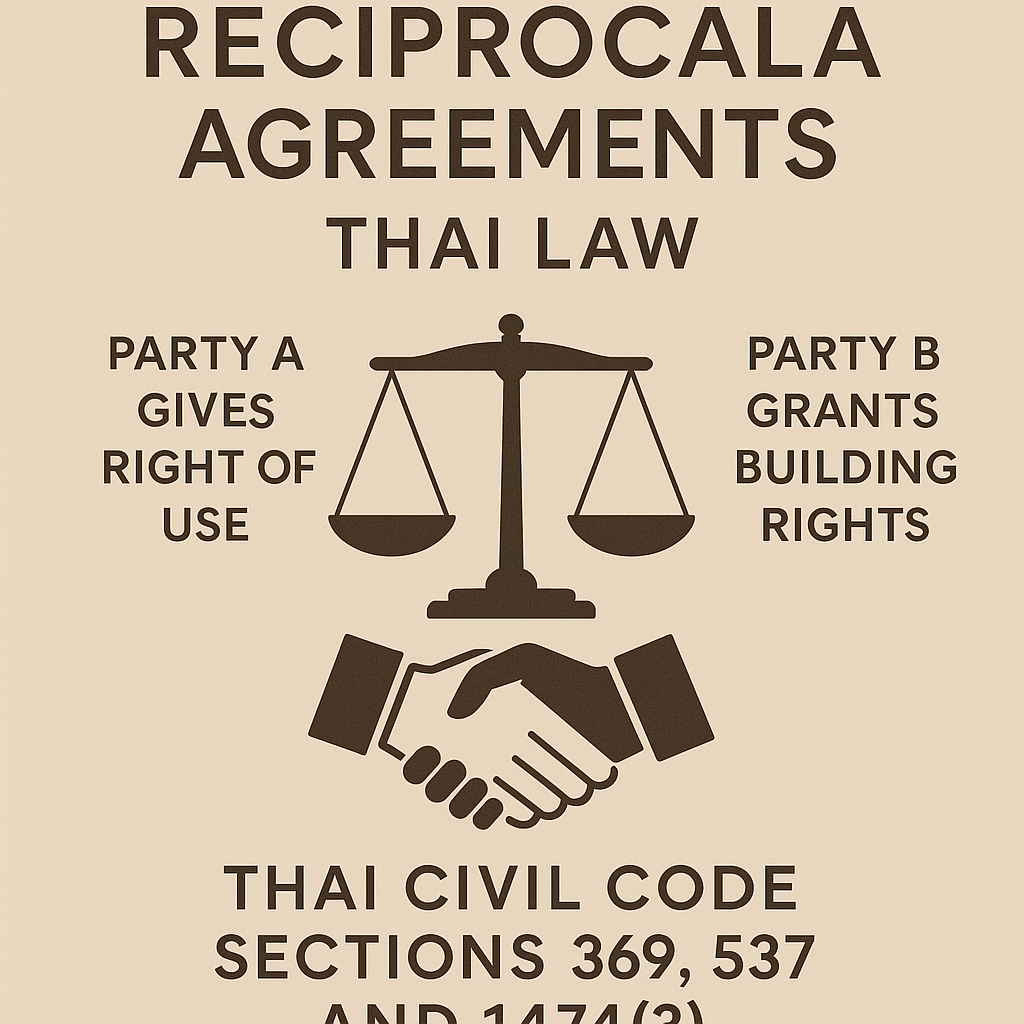
A reciprocal contract, or สัญญาต่างตอบแทน, involves obligations on both sides. An ordinary lease already fits this description: the landlord provides use of the property and the tenant pays rent. Adding the word “reciprocal” does not create a new property right.
CCC section 369 generally allows one party to withhold performance until the other performs or offers to perform. This rule does not apply where the other party’s obligation is not yet due. The provision governs performance of existing obligations; it does not create a right to renew a lease.
Sections 369 to 376 form the broader chapter on the effects of contracts. They also address matters such as impossibility of performance and third-party benefits. They are not a statutory scheme authorising extended leases.
What makes a lease a special reciprocal contract?
Thai case law recognises สัญญาต่างตอบแทนพิเศษยิ่งกว่าสัญญาเช่าธรรมดา, commonly described in English as a special reciprocal contract going beyond an ordinary lease. The distinction depends on the substance of the bargain.
A typical example is an agreement under which the tenant finances and constructs a building for the landowner in exchange for an agreed period of occupation. The building’s ownership and the timing of its transfer form part of the agreed exchange.
Spending money on decoration, maintenance or improvements for the tenant’s own convenience does not automatically establish this type of contract. Courts examine the agreed obligations, the benefit promised to the owner and evidence of performance. There is no universal investment amount which guarantees recognition.
The practical protection is substantial: courts have enforced the agreed occupation period despite missing formalities and, in appropriate cases, against the landlord’s estate. Decisions 8534/2542, 3279/2524 and 2526/2531 provide concrete examples. “Super lease” is an informal description, not a separate statutory category with an automatic entitlement to additional decades.
Registration, the 30-year limit and renewal
For an ordinary lease of immovable property, section 538 requires written evidence signed by the party against whom enforcement is sought. A lease exceeding three years, or for a person’s lifetime, must be made in writing and registered to be enforceable beyond three years.
Under section 540, an ordinary fixed-term lease of immovable property is limited to 30 years. The section expressly permits renewal for a further period of up to 30 years from renewal. A valid future renewal must be distinguished from an arrangement intended from the outset to secure a prohibited longer term.
In Supreme Court decision 4655/2566, the parties combined an initial 30-year lease with two further 30-year promises made on the same day, prepaid the later periods and retained the original rental terms. The Court treated the renewal promises as an attempt to evade section 540 and held those portions void.
Section 538 concerns evidence and registration; section 540 concerns duration and renewal. A judicial exception concerning the first issue does not, without further authority, establish an exception to the second. In 4655/2566, the Court also rejected enforcement of the extension promises as personal obligations. Relabelling the same prohibited arrangement would not resolve that defect.
The 30-year statement also needs context. Section 541 permits a lease for the lifetime of the landlord or tenant. Separately, the 1999 Act on leases for commercial and industrial purposes provides for qualifying registered leases exceeding 30 years and up to 50 years, subject to its requirements. Neither exception arises merely because a residential tenant invests in construction.
Could a genuine later renewal be valid?
Yes. Section 540 expressly allows renewal for a further period not exceeding 30 years from renewal. A fresh lease agreed after expiry has a statutory basis. It does not require special construction obligations merely to be valid; ordinary rent and use of the property already create reciprocal obligations.
There is also authority for a new lease arising through acceptance of a valid earlier promise. In 1925/2517, the original three-year lease promised another three years if the tenant gave written notice within one month after expiry. The tenant did so. The Court held that acceptance created the new lease immediately, without needing another contract document. This is direct authority for a later renewal, although it did not concern an attempt to secure more than 30 years.
In 4872/2539, the Court upheld a further three-year term following an initial 15-year lease. The original arrangement specified a rent benchmark and renewal fee. The Court rejected the argument that the repeated-renewal provision offended public order on those facts. This authority deserves consideration alongside 4655/2566; neither case should be reduced to a slogan about all renewal clauses.
The proposed distinction is therefore more precise than “automatic renewals are invalid, later renewals are valid.” In 4655/2566, the clause already depended on the tenant wishing to continue, yet the same-day documents and advance payments disclosed a 90-year arrangement from the outset. Conversely, 1925/2517 shows that an earlier promise can produce an enforceable later short-term lease when properly accepted.
For special reciprocal agreements, 1627/2505 provides a further positive example. A construction contribution supported an agreed total occupation period of 14 years, expressed through successive three-year periods. The published digest records that the tenant could enforce that bargain and seek registration. This was completion of the originally agreed total term, not a new entitlement beyond 30 years.
A different result followed in 379/2511. The original six-year construction-based arrangement expired; the subsequent tenancy was ordinary despite another lump-sum payment. Our inference is that special reciprocal status for a later term requires evidence of the qualifying exchange for that term. The earlier investment does not automatically provide it.
For example, after expiry the parties might agree a new lawful term in exchange for rent and substantial, specified reconstruction benefiting the owner. The argument would rest on section 540 for renewal and the construction cases for the character of the new exchange. That combined argument is a reasoned application of the authorities, not a holding in the cited cases approving a new 30-year special reciprocal renewal after an initial 30 years.
The later bargain must also be sufficiently definite. In 3801/2555, wording about fairly adjusting rent or duration did not establish an enforceable commitment, and the tenant’s later proposal was not accepted. New works, revised rent or a later signature are relevant evidence; none alone guarantees validity.
Declaration of intention: sections 168, 169 and 171
Section 168 addresses when a declaration to a person present takes effect: when that person becomes aware of it. It includes telephone and similar immediate communication. Section 169 generally governs a declaration to an absent recipient, effective when it reaches that recipient. For a renewal notice, the communication method, recipient and evidence of receipt therefore matter.
Section 171 requires interpretation according to true intention rather than literal wording alone. Section 368 adds good faith and ordinary usage when interpreting contracts. Read the original lease, side agreements, correspondence, payment records and construction obligations together. A later document may evidence a new bargain or merely repeat the original arrangement; its date and label do not settle that question.
Communication and contract formation are related but distinct. Section 361 generally places formation between absent parties at the time acceptance reaches the offeror. Decision 1925/2517 illustrates the operative step: timely written acceptance of a sufficiently definite renewal promise. A wish to stay, without a corresponding lawful commitment, cannot supply all the missing terms.
Death before acceptance requires further analysis. In 1213/2517, the Grand Bench refused to enforce a renewal promise which had not been accepted before the landlord died, where the tenant knew of the death before acceptance. The judgment applied section 360 and the Code’s then-existing numbering. It should not be described as a decision applying current section 168.
By contrast, in 4872/2539, it was not established that the tenant knew of the death before acceptance. The Court applied section 169, paragraph two, with section 360, and upheld the renewal obligation against the heir. These contrasting outcomes show why a precise chronology of declaration, receipt, acceptance and knowledge matters.
Finally, sections 150 and 172 address invalidity: an unlawful juridical act may be void, and a void act cannot be ratified. A genuinely new lawful transaction must be distinguished from an attempted confirmation of a void extension. Sections 168 and 169 determine the effectiveness of a declaration; they do not validate an unlawful object.
What the Supreme Court decisions establish
The following references separate enforceable construction bargains, renewal by acceptance and limits on enforcement. Links lead to ThaiLawOnline case summaries, which include links to the Thai judgment texts or published digests used as sources. Case years use the Buddhist Era.
| Supreme Court decision | What the decision supports | Scope or qualification |
|---|---|---|
| 4655/2566 | Same-day promises for two further 30-year terms, with advance payment, were void as an evasion of section 540. | Does not abolish renewal under section 540. |
| 1627/2505 | Construction contributions supported a total 14-year bargain expressed through successive three-year periods. | Enforcement of the agreed total term; not an extension beyond 30 years. |
| 1925/2517 | Timely written acceptance of a renewal promise created a new three-year lease without another contract document. | Direct support for renewal by acceptance; the case concerned short terms. |
| 4872/2539 | A further three-year term following a 15-year lease was upheld against an heir; sections 169(2) and 360 mattered. | The Court rejected the public-order objection on those facts, not a prepaid 90-year structure. |
| 8534/2542 | The tenant’s construction obligation supported enforcement of an agreed 20-year occupation period despite missing writing and registration. | The remaining period formed part of the original exchange. |
| 3279/2524 | A 30-year construction arrangement, with buildings passing to the owner at expiry, bound the owner’s estate. | The Court upheld protection for the agreed 30 years. |
| 2526/2531 | An agreed 20-year construction-based arrangement bound heirs; the estate’s eviction claim failed. | The separate counterclaim for registration failed under the inheritance limitation period. |
| 379/2511 | After a six-year construction arrangement expired, the subsequent tenancy was ordinary despite another lump-sum payment. | Special reciprocal status does not automatically continue into a later term. |
| 412/2511 | An 11-year construction arrangement qualified for special treatment, but termination for non-payment remained available. | Special status does not remove the tenant’s rental duties. |
| 2759/2534 | The car-park construction arrangement’s own duration controlled; an invitation to discuss further renting was not an offer. | Investment and a separate building lease did not establish a longer car-park term. |
| 3801/2555 | Vague wording about fair rent and duration did not establish an enforceable renewal commitment. | An unaccepted later proposal could not fill the gap. |
| 1213/2517 | The Grand Bench rejected enforcement of an unaccepted renewal promise where the tenant knew of the landlord’s death before acceptance. | Distinguish an existing contractual obligation from a promise still awaiting acceptance. |
| 4208/2567 | The Supreme Court vacated and remitted because the appeal court had not fully decided the counterclaim. | The appeal court’s special-contract finding was not a final Supreme Court merits ruling. |
Does the agreement bind heirs or a buyer?
The authorities support more than a general statement that reciprocity improves negotiating power. In 3279/2524, tenants built on the land under a 30-year arrangement, with the buildings to pass to the owner at expiry. The Supreme Court upheld dismissal of the estate’s eviction action because the agreed period had not ended.
In 2526/2531, a 110,000-baht construction contribution supported a 20-year agreement including permission to sublet. The Court held that the special reciprocal rights and duties passed to heirs and rejected eviction. However, the tenant’s separate registration counterclaim was time-barred under section 1754, paragraph three, having been brought more than one year after knowledge of the landlord’s death. Protection against eviction and success on a registration claim were separate outcomes.
An existing obligation under such a contract must be distinguished from an unaccepted renewal promise, as the contrasting results in 1213/2517 and 4872/2539 demonstrate. An “heirs and successors” clause should accompany an analysis of the actual obligation, its formation and the applicable inheritance rules.
A sale raises another issue. Section 569 preserves an immovable-property lease on transfer of ownership and passes the transferor’s lease rights and duties to the transferee. It does not establish that every separate construction, repayment or renewal promise automatically binds any buyer. Identify what passes by law and what requires an express assumption of obligations, together with appropriate registration.
How to protect a genuine construction investment
Start with a lawful lease term and register the lease at the Land Office where required. A court argument about special reciprocity is a possible remedy after a dispute, not a sensible reason to leave a long-term investment unregistered.
Record the agreed works, plans, completion dates, approved costs and evidence of payment. Specify who owns the buildings during occupation and at expiry, and what happens following early termination, damage, abandonment or a sale.
The owner’s obligations should be equally clear: delivery of possession, cooperation with registration and permits, access and agreed services. Address default notices and an opportunity to remedy breaches. Where appropriate, provide a lawful compensation formula for an unfulfilled obligation or early termination.
For a renewal provision, identify the property, term, rent or workable calculation, acceptance deadline, notice address, method of delivery and registration obligations. Distinguish a binding promise from an agreement to negotiate. For a proposed later construction exchange, specify the additional work and the corresponding occupation right. Section 369 helps govern performance of an existing reciprocal obligation; it does not create an extra term by itself.
Do not assume prepaid renewal money is either automatically lost or automatically recoverable. Any repayment claim requires its own analysis of the contract, the reason for invalidity, restitution rules, time limits and the recipient’s ability to pay.
Other protections and their limits
Superficies. Under sections 1410 to 1412, this right allows separate ownership of buildings, structures or plantations on or under another person’s land. It requires proper creation and registration. Its duration may be a fixed period or the lifetime of the landowner or right-holder, subject to the applicable rules. It is not simply another name for a lease or sap ing sith. Coordinate its term and termination provisions with the lease.
Sap ing sith. This is a distinct registered right under the 2019 legislation, with its own rules on use, transfer, inheritance and mortgage. Its maximum term is 30 years. It does not convert a residential lease into guaranteed 90-year occupation.
Mortgage security. A properly registered mortgage may secure a genuine, legally enforceable debt, such as a documented repayment obligation. Its value depends on the secured obligation, ranking, property value and enforcement. A mortgage does not grant continued occupation or validate a void renewal promise.
Guarantees and companies. A guarantee requires careful drafting around a lawful obligation. Neither a guarantor nor a company guarantees lease renewal. A company holding the lease remains subject to applicable lease rules and does not remove restrictions on foreign land ownership.
Before signing at the Land Office
Check the title deed, ownership, existing mortgages and other registered burdens. Confirm signing authority, necessary consents, lawful access and the intended building use before paying substantial sums. Where a mortgage already exists, assess the effect of enforcement on the proposed lease and construction rights.
Prepare consistent Thai and English documents for the parties and the registration process. A private agreement is not invalid merely because it is written in English. However, Land Office registration requires the appropriate Thai instruments and supporting documentation; a translation alone does not register a right.
Our approach is to secure the lawful occupation period, document the construction exchange and establish how any later lease will arise. The cases demonstrate that special reciprocal agreements can provide enforceable protection. A sound renewal analysis also addresses section 540, the effectiveness of acceptance and the distinction between a new lawful term and a prohibited longer arrangement fixed from the outset.
ThaiLawOnline reviews lease agreements, construction obligations, title and encumbrance checks and related security arrangements. Contact our property team before committing funds to a long-term lease.
Statutory references
CCC sections 150, 168 to 172, 360 to 361 and 368: validity, communication, interpretation and formation. Section 369 and the effects-of-contract chapter: reciprocal performance. Sections 538, 540, 541, 560 and 569: lease formalities, duration and renewal, lifetime leases, non-payment and transfer of ownership. Section 1754 paragraph three (a creditor’s claim against an estate, one year from knowing of the death), applied in 2526/2531, is relevant to the time limit for the estate claim in that case.
The linked English Code text is a translation; the Thai statutory text controls. The separate commercial and industrial regime is addressed by the 1999 Act published through the Department of Lands.
Read the annotated Code alongside these decisions: section 168; section 169; section 171; section 360; section 361; section 369; section 538; section 540; section 560; section 569; section 1599; section 1600; section 1754. The lease case notes explain the relevant holdings and qualifications.
Thai Law Updates, free by email
Plain-English updates on Thai law changes that affect foreigners: property, visas, marriage, business and wills. One short email a month from a firm practicing since 2006. No spam, unsubscribe anytime.