


Reviewed by ThaiLawOnline, a licensed Thai law firm practising in Thailand since 2006. Thai lawyer of record: Wichuda Atthamethakon, LL.M., Thai Bar Licence 3149/2556.
Last updated on
The 100 Million THB Capital Exemption is an important but often unused way for foreign investors. It allows them to have full ownership of trading company in Thailand. This legal rule is in the Foreign Business Act’s List 3, items (14) for retail and (15) for wholesale. It allows foreign-owned companies to avoid the usual Foreign Business License requirements. They can do this by meeting a certain capital amount. This exemption offers a simple and legal way for 100% foreign ownership in wholesale and retail businesses. Unlike other business structures, it does not need Thai majority ownership or complicated licensing processes.
Trading activities are restricted for foreigners, which we cover in our guide to business setup in Thailand.
For foreign entrepreneurs and investors looking to establish trading operations in Thailand, this exemption offers compelling advantages over traditional approaches. The process usually takes weeks, not months. It removes the need for Thai shareholders or nominees. You can start operations right after registration is complete.
- The requirement is 100 million THB in registered capital.
- And the cash has to be real. List 3 items (14) and (15) set a minimum capital, and the Council of State has advised that minimum capital means capital actually paid in, not registered capital left partly unpaid (Council of State opinion 73/2553).
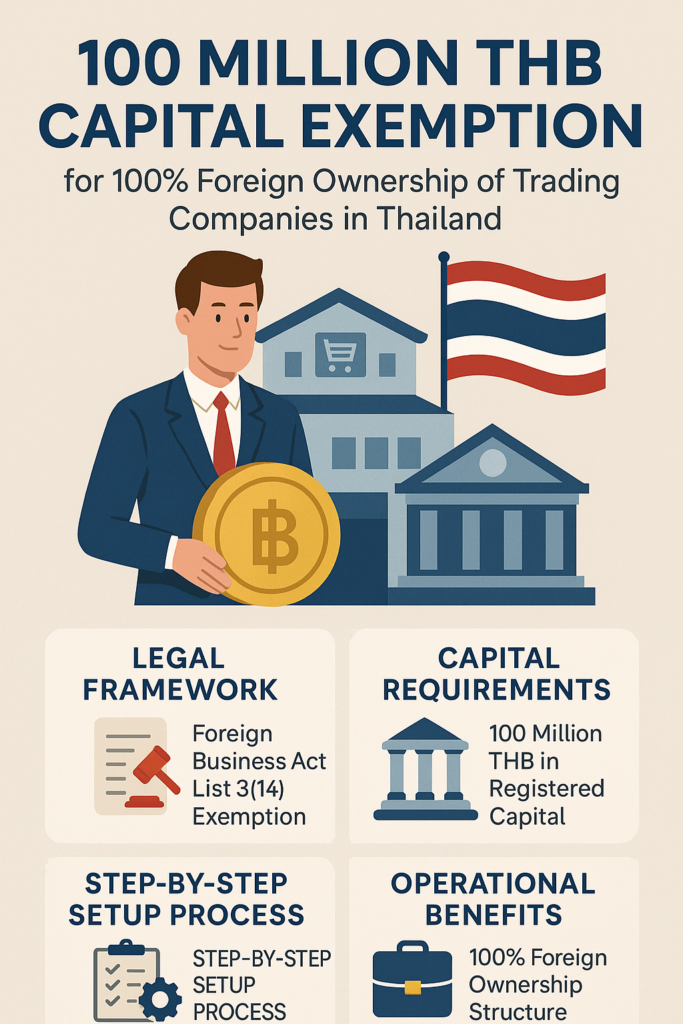
Table of Contents
Understanding the Legal Framework
Foreign Business Act List 3(14) and 3(15) Exemption
The legal basis for this exemption is in the Foreign Business Act B.E. 2542 (1999). It is found in List 3, which includes businesses where “Thai nationals are not yet ready to compete with foreigners.” Usually, wholesale and retail trading need Foreign Business Licenses. However, the law has an exception for companies that meet the capital requirements.
Under List 3(15), wholesale businesses with at least 100 million THB in capital per store do not need a Foreign Business License. Under List 3(14), for retail businesses, the exemption applies if the total capital is at least 100 million THB. Each retail outlet must have a minimum capital of 20 million THB. A retail company with 100 million THB in registered capital can run up to five different retail locations.
Capital Requirements: The Minimum Must Be Paid In
The most misunderstood aspect of this exemption is the capital injection. Thai company law lets a limited company register capital with only 25% of each share paid, and some advisers apply that here. The Council of State has advised the Ministry of Commerce that it does not work: the Foreign Business Act defines minimum capital separately from registered capital, List 3 items (14) and (15) set a minimum capital per store, and minimum capital therefore means real money invested, not the registered figure (opinion 73/2553). The Department of Business Development had already changed its own practice to require full payment.
In practice, plan for the full minimum capital actually paid into the company’s Thai bank account: 100 million THB for each wholesale store, and for retail 100 million THB in total with at least 20 million THB for each store, supported by the bank evidence the Department of Business Development asks for.
Do not rely on leaving part of the minimum unpaid. A company whose paid-in capital falls short of the minimum is outside the exemption, and a foreigner carrying on a List 3 business without a Foreign Business Licence commits an offence under the Act.
Step-by-Step Setup Process
Phase 1: Company Incorporation
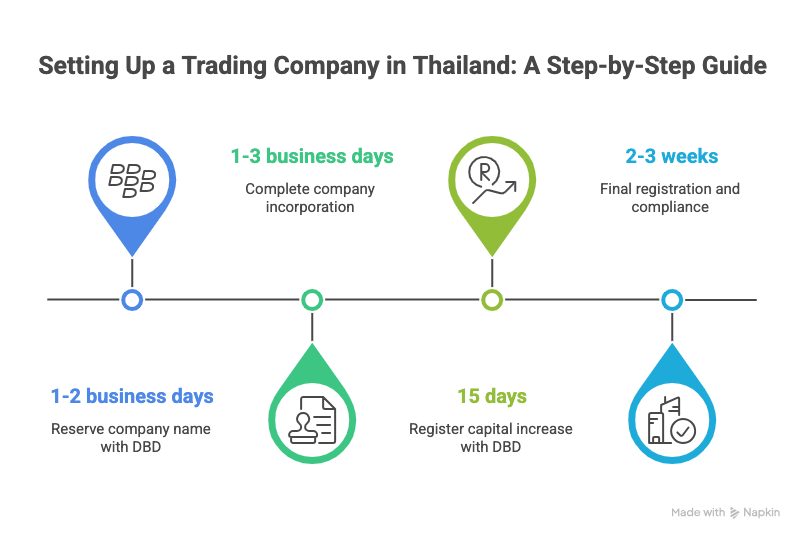
The process begins with standard Thai company incorporation procedures. The first step is to reserve a company name with the Department of Business Development. The name should match the planned business activities and include suitable Thai language elements. This typically takes 1-2 business days.
Next, the company must prepare its Memorandum and Articles of Association. These documents should include wholesale and/or retail trading in the business goals. The initial registered capital is usually set at 2 million THB to meet basic incorporation requirements. The incorporation documents are filed with the Department of Business Development. They usually finish registration in 1 to 3 business days.
Phase 2: Capital Increase Resolution
After the company is successfully set up, the shareholders need to pass a special resolution. This resolution will raise the company’s registered capital from 2 million THB to 100 million THB. This needs formal minutes from a shareholder meeting. These minutes should show the decision to increase capital and how the funds will be used for trading operations.
The special resolution increasing the capital must be registered with the Department of Business Development within 14 days of the date it is passed (Civil and Commercial Code section 1228).
Phase 3: Capital Injection and Verification
The most critical phase is transferring the capital to the company’s bank account and obtaining formal bank certification confirming receipt of the funds as payment for share subscriptions. The certificate should state that the funds were received as payment for shares.
Recent regulatory changes under DBD Order No. 1/2567 have affected trading companies in Thailand. The order, in force since 1 July 2024, introduced additional documentation requirements for capital verification. Where the registered capital after the increase exceeds 5 million THB and the shares are paid in money, the application to register the increase must be filed together with a bank document certifying that the company received the new share money actually paid, and a letter from the company, signed by its authorised director, confirming that this amount is share payment. The money therefore has to be in the company’s account before the increase is filed.
Phase 4: Final Registration and Compliance
The final step involves submitting all documentation to complete the capital increase registration. This includes the shareholder resolution minutes, the bank certification, the company’s confirmation letter, and the updated share register reflecting the new capital structure.
Upon successful registration, the company limited immediately gains the legal right to commence wholesale and retail trading operations without requiring any Foreign Business License. The entire process, from initial incorporation to operational capability, typically takes 2-3 weeks when properly managed.
Operational Benefits and Business Scope
100% Foreign Ownership Structure
Unlike traditional business structures requiring Thai majority ownership, the capital exemption allows complete foreign control without nominee arrangements. This eliminates the legal risks associated with nominee shareholders and provides genuine operational control over business decisions, profit distribution, and strategic direction.
Foreign investors can own all shares directly. They can also appoint only foreign directors. They have full control over intellectual property, trade secrets, and business relationships. This structure particularly benefits established international companies seeking to establish Thai operations while maintaining global operational standards.
Trading Business Scope
The exemption covers comprehensive wholesale and retail trading activities. Wholesale operations can include importing goods for distribution to Thai retailers, exporting Thai products internationally, and domestic wholesale distribution. The capital requirement of 100 million THB typically supports one wholesale operation or distribution center.
For retail operations, the structure allows up to five stores under one 100 million THB investment. Each store must get at least 20 million THB in funding. This allows for significant retail expansion while maintaining cost efficiency compared to multiple separate business licenses.
Operational Flexibility
Companies under this exemption have the same flexibility as Thai-registered companies. They can enter contracts, own assets, hire staff, and do banking. The structure supports both B2B and B2C trading models, e-commerce operations, and traditional brick-and-mortar retail formats.
The exemption also permits international trading activities, including import/export operations, cross-border e-commerce, and regional distribution hub functions. This makes the structure particularly attractive for companies seeking to establish Thailand as a regional trading base.
Financial Considerations and Planning
Actual Investment Requirements
The financial reality of this structure is the full minimum capital, paid in and evidenced by bank documentation. Once paid in, the funds are the company’s working capital for legitimate business purposes.
Companies can structure their capital utilization to support actual business needs. For example, the paid-up capital can fund initial inventory purchases, office setup, marketing expenses, staff salaries, or technology infrastructure. Do not plan on lending the capital straight back to the shareholders. Money that returns to the investor is hard to present as capital actually invested in the business, which is the point the Council of State made in opinion 73/2553, and a round trip of that kind is what the 2026 nominee screening looks for.
Cost-Benefit Analysis
Compared to Foreign Business License routes, the capital exemption offers significant cost advantages despite the higher capital requirement. FBL applications usually have legal fees between 200,000 and 500,000 THB. There are also government fees and ongoing compliance costs. The processing time is 3 to 6 months, and approval outcomes can be uncertain.
The capital exemption route involves higher upfront capital commitment but eliminates ongoing licensing compliance, reduces legal complexity, and provides immediate operational capability. For companies with serious trading ambitions in Thailand, the total cost of ownership often favors the capital exemption approach.
Cash Flow Management
Treat the minimum capital as money that stays invested in the business, not as a figure on the company register.
Recent Regulatory Changes and Compliance
DBD Order No. 1/2567 Impact
DBD Order No. 1/2567 (Central Partnership and Company Registrar Order, signed 27 May 2024, in force 1 July 2024) sets the evidence of capital payment. It applies when a company is formed with registered capital over 5 million THB, and when a capital increase takes the old and new registered capital together over 5 million THB. These changes directly affect the 100 million THB capital exemption structure, requiring additional documentation to prove genuine capital injection.
For a capital increase paid in money, the company files, with its application to register the increase, a bank document certifying that it received the new share money actually paid and a letter from the company confirming that the amount is share payment. There is no 15-day grace period for a capital increase. The order allows 15 days after registration only to a newly formed company or partnership whose managing partners or directors are all foreigners, or which holds BOI or IEAT promotion; if that evidence is not filed in time, the registrar notes on the company certificate that payment of the registered capital has not been evidenced.
Digital Registration Requirements
Since 1 July 2026, new company registrations must be completed through the “DBD Biz Regist” digital platform. This change particularly benefits foreign investors by enabling complete remote registration, including identity verification and digital signatures through the DBD e-Service application.
The digital transformation allows foreign investors to establish companies entirely online without requiring physical presence in Thailand. This development significantly reduces setup complexity and timeline for international investors seeking to establish trading operations.
Nominee Structure Crackdowns
Recent enforcement actions by Thai authorities against illegal nominee structures make the capital exemption route increasingly attractive. The Department of Business Development now shares data with the Department of Lands, the Revenue Department and the enforcement agencies under a memorandum signed by twenty-one agencies on 29 April 2026, and since 1 August 2026 its Order 2/2569 requires bank evidence that each Thai shareholder paid in their own capital where a company has a foreign shareholder below 50 per cent.
Companies that use the 100 million THB capital exemption avoid these compliance risks. They do this by keeping 100% foreign ownership structures. This legal certainty provides significant risk mitigation compared to structures relying on nominee arrangements.
Strategic Considerations for Implementation
Business Model Alignment
The capital exemption structure works best for trading companies with genuine trading operations requiring significant working capital. Importers, exporters, distributors, and multi-channel retailers can use their capital for business operations. This helps them gain legal status as trading companies.
Companies should align their capital utilization with documented business plans showing how the paid-up capital supports trading activities. This documentation proves beneficial during routine compliance reviews and demonstrates genuine business substance rather than merely meeting technical requirements.
Market Entry Strategy
For international companies entering the Thai market, the capital exemption provides a stable platform for market development without complex partnership arrangements. The structure supports gradual market penetration while maintaining complete operational control and strategic flexibility.
Companies can use the early period to build market relationships and develop supplier networks. They can also grow their customer bases. They can keep the option to expand operations by getting more capital or registering additional businesses.
Exit Strategy Planning
The 100% foreign ownership structure offers great flexibility for future exit strategies. This includes selling to strategic buyers, going public, or restructuring for trading companies. Foreign investors retain complete control over exit timing and terms without requiring Thai partner approvals or complex shareholding unwinding.
Risk Management and Legal Compliance
Regulatory Risk Mitigation
The capital exemption structure provides robust protection against Foreign Business Act violations since companies meeting the capital criteria are explicitly exempted from licensing requirements. This legal clarity eliminates the ongoing compliance uncertainty associated with Foreign Business License maintenance.
Companies should maintain proper documentation showing capital adequacy, business substance, and compliance with trading regulations. Regular legal reviews ensure continued qualification for the exemption and identify any changes in regulatory requirements.
Operational Risk Management
The structure removes risks from the Foreign Business Act. However, companies must still follow other rules. This includes tax requirements, labor laws, and regulations specific to their industry. The 100% foreign ownership structure may require additional attention to visa and work permit requirements for foreign management.
Companies should establish robust corporate governance frameworks documenting decision-making processes, capital utilization, and business operations. This documentation supports regulatory compliance and demonstrates quality legitimate business operations if questions arise during government reviews.
Financial Risk Considerations
The primary financial risk involves the committed capital requirement and its impact on company cash flow. Companies should plan how they use their capital. This helps ensure that the money invested earns enough returns. It is also important to keep enough cash available for daily operations.
Keep the evidence that the minimum capital was paid in and remains invested, because that is what places the company within the exemption.
How does the exemption work for wholesale vs. retail, capital per outlet, store limits, and scope?
Wholesale businesses need at least 100 million THB in capital for each store. This removes the FBL requirement for that wholesale operation. Retail businesses qualify if they have at least 100 million THB in registered capital. Each retail outlet must have a minimum of 20 million THB. A company can have up to five stores under one 100-million structure. The company can import and export goods. It can also sell wholesale within the country. Additionally, it can operate physical stores or online shops. Finally, it can run a regional distribution center. The framework supports B2B and B2C, cross-border e-commerce, and omnichannel trading while maintaining full foreign director control.
How much cash do I actually need: registered capital or paid-in capital?
The minimum capital must actually be paid in. Thai company law lets a company register capital with only 25% of each share paid, but the Council of State has advised that for this Foreign Business Act exemption minimum capital means real money invested, not registered capital (opinion 73/2553). Plan for 100 million THB paid in for each wholesale store, and for retail 100 million THB in total with at least 20 million THB for each store.
What’s the step-by-step setup process and realistic timeline for 100% foreign ownership of a trading company?
First, reserve the company name. Then, incorporate as a limited company. Include a Memorandum and Articles of Association that state wholesale and retail goals. This process usually takes a few business days. Next, pass a special resolution from shareholders to raise the capital to 100 million THB. Then pay the new share money into the company’s account and get a bank certificate confirming receipt. The resolution must be registered with the Department of Business Development (DBD) within 14 days of being passed (Civil and Commercial Code section 1228), and the application must include the minutes, the bank certificate, a letter from the company confirming that the money is share payment, and the updated share register. After this, trading can start right away without an FBL. When properly managed, end-to-end incorporation through operational readiness typically completes in weeks rather than months.
What new compliance rules apply, DBD Order No. 1/2567, capital verification, and digital registration?
DBD Order No. 1/2567 (starting July 2024) has stricter rules for capital verification. This applies to companies with registered capital over 5 million THB, including trading companies that use this exemption. For a capital increase, a bank document certifying that the company received the new share money and a letter from the company confirming it is share payment must be filed with the application to register the increase. Only a newly formed company whose directors are all foreigners, or which is BOI- or IEAT-promoted, may file the bank evidence within 15 days after registration. Authorities are now paying more attention to nominee structures. They are sharing data with the Revenue Department. Because of this, having clear 100% foreign ownership is now the safer option. Since 1 July 2026 the DBD has accepted the establishment of a new partnership or limited company only through “DBD Biz Regist”, its counters having closed to walk-in applications for new juristic persons. The platform allows remote identity checks and e-signatures through the DBD e-Service, which makes it easier for overseas founders while still following KYC and AML rules.
What operational benefits do I gain, trading scope, management control, visas/work permits, and ongoing compliance?
You keep full control over directors, IP, contracts, and banking. You can run import/export, domestic wholesale, retail stores, and online sales all under one entity. The structure supports fast inventory financing, supplier onboarding, and regional logistics while keeping governance clean (no Thai nominee shareholders). Routine obligations still apply. This includes VAT (PP20) when needed, corporate income tax, and withholding tax. You need to think about social security. You should also consider labor laws. Additionally, check the work permits or visas, such as Non-B, for foreign executives. Good housekeeping, capital verification files, board minutes, share register updates, and documented business substance, minimizes regulatory risk during inspections or data-driven reviews.
Conclusion and Strategic Recommendations
The 100 Million THB Capital Exemption is a strong tool for foreign investors. It lets a trading company operate in Thailand with full foreign ownership, but the capital must be real: the full minimum, paid in. Where that is too much, a Foreign Business Licence or a Board of Investment route may suit better.
Success with this structure for trading companies requires careful planning, proper legal execution, and genuine business operations that justify the capital investment. Companies should see the capital requirement as working capital for real trading activities in the trading companies category. It should not just be about meeting legal rules.
Last reviewed: 27 September 2026. The Foreign Business Act B.E. 2542 List 3 items (14) and (15) (Krisdika consolidation), Council of State opinion 73/2553 on minimum capital, Civil and Commercial Code sections 1110, 1111, 1220 to 1222 and 1228, and DBD Central Registrar Order No. 1/2567 were read in Thai. Fee and timing estimates are practice figures, not law. Re-checked on 6 October 2026: Foreign Business Act List 3 items (14) and (15) re-read in Thai; removed advice to lend the paid-in capital back to the shareholders, which contradicted opinion 73/2553, and replaced an unsourced claim about real-time data integration with the April 2026 data-sharing memorandum and DBD Order 2/2569; the DBD Biz Regist account was not re-verified.
For foreign investors who want to trade in Thailand, the capital exemption makes it easier. It provides a clear way for trading companies to enter the market. It offers legal certainty, operational flexibility, and strategic control. The new registration processes and rules are making this business structure easier. It is also more attractive for international trading companies and investors.
The key to successful implementation for trading companies is proper planning and structure. It also requires good capital management. You must follow all rules and regulations. This helps you gain the full benefits of 100% foreign ownership in Thailand’s active trading market.
LINKS: Department of Business Development
Thai Law Updates, free by email
Plain-English updates on Thai law changes that affect foreigners: property, visas, marriage, business and wills. One short email a month from a firm practicing since 2006. No spam, unsubscribe anytime.