


Reviewed by ThaiLawOnline, a licensed Thai law firm practising in Thailand since 2006. Thai lawyer of record: Wichuda Atthamethakon, LL.M., Thai Bar Licence 3149/2556.
Last updated on
Last reviewed: 25 September 2026. The three Supreme Court decisions cited below, 7189/2562, 7364/2558 and 15649-15650/2558, were read in Thai to their dispositions, with the provisions they apply: Civil and Commercial Code sections 379, 383 and 583, Labour Protection Act B.E. 2541 sections 14/1 and 119, and Unfair Contract Terms Act B.E. 2540 section 5. Not verified in this review: the Trade Secrets Act B.E. 2545, the drafting advice, and the section on NDAs abroad, which is general guidance rather than Thai law. Re-checked on 6 October 2026: read in Thai the Trade Secrets Act B.E. 2545 as amended in 2558, sections 3, 6, 7, 8, 13 and 33; added its definition, infringement test and remedies to the section on how binding NDAs are; the drafting advice and the section on NDAs abroad remain general guidance.
NDA Agreements in Thailand (Non Disclosure Agreements) are important legal contracts that protect confidential business information from being improperly disclosed or misused. In Thailand, NDAs find their legal basis primarily in the Civil and Commercial Code, which governs contracts generally. NDAs are valid when they adhere to basic contract principles. These principles include having legal objectives, mutual consent, and the capacity to enter into a contract.
NDAs are usually the first contract a new company signs: see our guide to setting up a business in Thailand.
NDA Agreements in Thailand are commonly used by companies in various industries to protect confidential information such as trade secrets, data, strategies, and sensitive information.
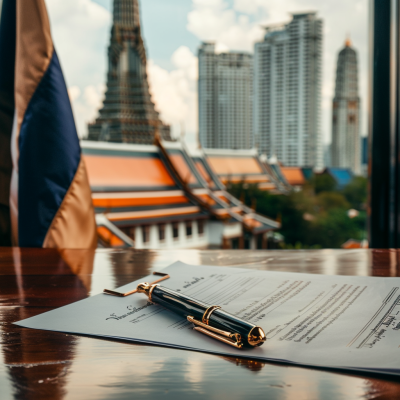
Cases related to NDA Agreements in Thailand
Non-Disclosure Agreements (NDAs) are extensively utilized by companies in Thailand across various sectors such as technology, manufacturing, finance, and more. They serve to protect trade secrets, proprietary data, business strategies, and other confidential information.. A few high-profile examples of NDA Agreements in Thailand decisions include:
- The Supreme Court adjudicated a case where an employee was terminated from their job after forwarding confidential work-related information to their personal email account (Supreme Court Decision No. 7189/2562). The court ruled that the employer’s decision to dismiss the employee was fair and lawful under the circumstances. The employer was not obligated to provide advance notice or warning to the employee prior to terminating their employment. Furthermore, the employee was not entitled to receive any compensation or severance pay upon termination. The employee had signed a confidentiality undertaking, and the document concerned described the employer’s business and management and was one the employer was contractually bound not to copy or disclose. Sending it to a personal email account made it easy to pass on or take away beyond the employer’s control, which the Court treated as dishonest performance of duty and a serious breach of the work rules. The dismissal therefore needed no severance pay (Labour Protection Act section 119(2) and (4)) and no notice (Civil and Commercial Code section 583), and it was not an unfair dismissal. The Supreme Court reversed the lower court and dismissed the employee’s claim.
Supreme Court Decision 7364/2558 is the leading case on the restrictions that often travel with an NDA. A cosmetics maker’s production supervisor had agreed not to work for a competitor for one year after leaving. The Court held one year a reasonable period, so the restriction did not burden the employee more than could normally be expected and was fair under section 5 of the Unfair Contract Terms Act B.E. 2540. The agreed 500,000 baht for breach was a penalty (Civil and Commercial Code section 379), which the court may reduce if it is excessive (section 383), and the case went back to the Central Labour Court to fix the amount. Decision 15649-15650/2558, sometimes cited alongside it, is not an NDA case: it concerns confidential information supplied to the authorities in an anti-dumping inquiry under the Anti-Dumping and Countervailing Act B.E. 2542.
Content of NDA Agreements in Thailand
- While following general contractual principles, well-drafted NDAs should have several key components:
- Definition of Confidential Information: Clearly specifying what information is covered, such as technical data, business processes, financial records, etc. Broad definitions are preferable.
- Receiving Party Obligations: Detailing requirements for the party receiving confidential information, such as limiting disclosure, maintaining safeguards, and permissible uses of the data.
- Exclusions: Carving out exceptions for information already public, independently developed, or legally required to be disclosed.
- Duration: Setting a reasonable time period for confidentiality obligations to remain in effect.
- Permitted Disclosures: Identifying circumstances like disclosures to employees, advisors, or regulators where sharing confidential information is allowed.
- Remedies: Outlining remedies like injunctions or monetary damages if a party breaches confidentiality.
- Choice of Law: Specifying that the NDA is governed by Thai law.
Non-Disclosure Agreements in Thailand (NDAs) are commonly employed; however, disputes may surface regarding their enforceability when crucial components are absent or unclear. Therefore, it is advisable for Thai enterprises to engage proficient legal advisors to meticulously craft and assess NDAs. These agreements should be customized to suit the unique circumstances at hand.
Do NDAs work internationally?
Non-Disclosure Agreements (NDAs) can be effective internationally, but their enforceability across borders depends on various factors, including the jurisdictions involved, the specific terms of the NDA, and the local laws governing contracts and confidentiality. An NDA signed in one country may not be automatically enforceable in another due to differences in legal systems, particularly between common law and civil law jurisdictions. To enhance enforceability, international NDAs often include clauses specifying the governing law and jurisdiction for dispute resolution. Additionally, they may stipulate mechanisms for arbitration or mediation to resolve conflicts outside traditional court systems, which can simplify enforcement in multiple jurisdictions.
Despite these measures, challenges can arise if the receiving party’s country does not recognize or uphold certain confidentiality protections. Some countries have limited enforcement options for NDAs, especially if the information disclosed does not fall under intellectual property protections or trade secrets recognized by local law. For businesses operating internationally, it is often advisable to seek legal guidance to ensure that NDA terms comply with relevant local regulations and to consider incorporating protective measures like intellectual property registration or localized legal agreements for more comprehensive protection.
How legally binding are NDA Agreements in Thailand?
In Thailand, Non-Disclosure Agreements (NDAs) are legally binding contracts governed primarily by the Thai Civil and Commercial Code. An NDA, or confidentiality agreement, typically establishes obligations on parties to protect and not disclose specified sensitive or proprietary information. As in many jurisdictions, NDAs in Thailand must meet standard contractual requirements to be enforceable, which include mutual agreement, lawful purpose, and the parties’ clear intent to be legally bound by the terms.

Thai law allows for both unilateral and mutual NDAs, where one or both parties agree to keep certain information confidential. Courts in Thailand generally uphold NDAs as enforceable, provided they are specific in scope, define the confidential information clearly, and have reasonable terms that do not impose overly broad or indefinite restrictions on the receiving party. In cases of a breach, remedies under Thai law may include monetary damages or injunctive relief to prevent further disclosure. The Trade Secrets Act B.E. 2545 adds a statutory layer on top of the contract. Information is a trade secret only if it is not generally known, has commercial value because it is secret, and its controller has taken appropriate measures to keep it secret (section 3), and a signed NDA is one of the clearest such measures. Disclosing, taking or using a trade secret without consent contrary to honest commercial practice, including by breach of contract or of confidence, is an infringement (section 6). The controller may ask the court for a temporary order stopping the infringement, even before suing, and then sue for a prohibition and damages (section 8); the court may add the infringer’s profits to the damages and, for wilful infringement that destroys the secret, award up to twice the damages again as punitive damages (section 13). Deliberately publishing another’s trade secret to harm their business is also a crime, punishable by up to one year’s imprisonment, a fine of up to 200,000 baht, or both (section 33). A clause that restricts the other party’s work or trade, such as a non-compete, is enforceable only to the extent that is fair and reasonable in the circumstances (Unfair Contract Terms Act B.E. 2540, section 5), and an agreed sum for breach can be reduced by the court if it is disproportionate (Civil and Commercial Code section 383), as in Decision 7364/2558.
How to have strong NDA Agreements in Thailand
By establishing a robust non disclose agreement in Thailand (NDA), organizations can securely exchange sensitive data, foster collaborations, spur creativity, and uphold their edge in the market. It is essential to note that NDA Agreements hold legal weight and are recognized as valid instruments within the legal framework of Thailand. Thus, investing in well-structured NDAs can safeguard businesses and fortify their position in the competitive landscape.
Links:
- Templates of NDA Agreements by ThaiLawOnline (download for Silver or Gold members)
Thai Law Updates, free by email
Plain-English updates on Thai law changes that affect foreigners: property, visas, marriage, business and wills. One short email a month from a firm practicing since 2006. No spam, unsubscribe anytime.