


Reviewed by ThaiLawOnline, a licensed Thai law firm practising in Thailand since 2006. Thai lawyer of record: Wichuda Atthamethakon, LL.M., Thai Bar Licence 3149/2556.
Last updated on
Short answer: yes, and Thai law treats release as the entitlement rather than the favour. On an application for provisional release, the officer or the court must order without delay, and every accused or defendant is entitled to be released on the criteria the Code sets out (Criminal Procedure Code section 107). Release can be refused only where there is reasonable ground to believe one of five things: that the person will abscond, will tamper with the evidence, will cause other danger, that the applicant or the security is not trustworthy, or that release would obstruct the inquiry or the trial. A refusal must state its reasons and be given in writing without delay (section 108/1). Where the maximum penalty exceeds ten years a bond is required and security may be asked for as well; in other cases a person may be released with no bond at all, and what is demanded must not exceed what is reasonable for the case (section 110). What follows is how that works in practice for a foreign defendant, including the amounts courts actually ask for and the forms of security they accept.
TL;DR
Bail in Thailand allows defendants, including foreigners, to remain free while awaiting trial, based on legal and judicial evaluation. The process involves submitting an application with proper documentation and security, with eligibility depending on factors like offense severity, flight risk, and available sureties. Recent updates include electronic monitoring and video hearings, which can ease the procedure, especially for low-risk cases.
Key Takeaways
- Bail is allowed in Thailand, even for foreigners, but depends on the crime, flight risk, and sureties.
- Common bail amounts range from 10,000 to 2,000,000 THB, higher for serious or drug-related cases.
- Accepted guarantees include cash, land, deposits, or insurance bonds, cash is usually best for foreigners.
- Court may deny bail if you lack ties to Thailand or have overstay history.
- Always use a lawyer and prepare full documents like passport, visa, and proof of address.
Table of Contents
Legal Framework for Bail in Thailand
Constitutional and Code-Based Rights
Under Thailand’s Constitution and Criminal Procedure Code (CPC), every individual is presumed innocent until proven guilty. Section 29 of the Constitution of Thailand (B.E. 2560) carries both halves of what matters here. It states the presumption of innocence, it limits the detention of an accused to what is necessary to prevent flight, and in its own words a bail application must be considered and security must not be demanded in excess of the case, any refusal being as provided by law.
- Section 106 (CPC): Allows provisional release at any legal stage.
- Section 107 (CPC): on receiving an application the officer or the court must decide it promptly, and every accused should be granted provisional release, on the basis set out in sections 108, 108/1 and 109 to 113/1. This is the presumption in favour of bail and it is the most useful rule on this page.
- Section 108 (CPC): the seven matters that must be weighed on an application:
- the gravity of the charge
- the weight of the evidence so far
- the circumstances of the case
- how far the applicant for bail, or the security, can be relied on
- whether the accused is likely to flee
- the danger or damage that release might cause
- where the accused is held on a court warrant, any objection by the inquiry official, the prosecutor, the plaintiff or the injured person
- Section 108/1 (CPC): the grounds on which release may be refused, namely that the accused will flee, will interfere with the evidence, will cause other danger, that the applicant or the security is not reliable, or that release would obstruct the investigation or the proceedings. A refusal must state its reasons.
- Section 110 (CPC): where the maximum penalty exceeds ten years the released person must give a bail bond, with or without security as well; in other cases release may be granted with no bond at all, on a bond alone, or on a bond with security. Security must not be demanded in excess of the case.
- Section 114 (CPC): the three kinds of security, namely cash, other property, or a person who stands as surety by showing property.
- Section 119 (CPC): where the bond is breached before the court, the court may enforce it without a separate suit, and may waive or reduce the sum having regard to the surety’s efforts to find the accused.
Judges can deny bail if there is a strong chance the accused might run away, disrupt justice, or cause more harm.

Recent Developments in Thailand’s Bail System
Recent Changes in Thailand’s Bail SystemThailand’s bail system has changed in recent years. It now includes technology and focuses on human rights. The Criminal Procedure Code lets a court attach an electronic monitoring device as a condition of release, which can reduce the need for physical security. The power sits in section 108 itself, and it requires the released person’s consent; for anyone under 18 it may be ordered only where their conduct could seriously endanger others, or for other good reason. Section 108/2 is a different provision: it lets a material witness object to a release that would put them in danger.
During the COVID-19 pandemic, courts increasingly granted bail via video hearings to minimize detention risks. The 2024 Immigration Bureau guidelines say that foreigners can get faster bail processing for overstay cases. This is true if they have valid repatriation plans. However, stricter enforcement against flight risks has led to more passport surrenders. Staying informed of these changes is crucial. Don’t navigate Thailand’s bail system alone: risks like prolonged detention or denied applications can be minimized with expert help. At ThaiLawOnline, we offer a reasonably priced consultation for foreigners. Protect your freedom today: 📞 Call 08 7225 1340 | 📧 Email info@thailawonline.com | 🌐 Book online at ThaiLawOnline.com/consultation.
Custodial Timeline and Deadlines
Understanding key custodial timelines can enhance the chance of securing bail:
| Timeline | Authority | Duration |
|---|---|---|
| Initial Police Custody | Police | Up to 48 hours |
| Court-approved extensions | Court | Section 87 sets three tiers, by the maximum penalty for the offence charged. Where that maximum is six months or less, or a fine of 500 baht or less, the court may order detention once only and for up to 7 days. Where it is more than six months but under ten years, detention may be ordered repeatedly, each time for up to 12 days, to a total of 48 days. Where it is ten years or more, the same 12-day periods run to a total of 84 days, and once 48 days have been served the prosecutor or the inquiry official must show the court a necessity and prove it before any further detention is ordered. These maxima apply to the pre-charge investigation phase only; detention after charges are filed is a separate question. |
| Statutory maximum, investigation phase | Court, under section 87 | 84 days where the offence carries ten years or more; 48 days where the maximum is under ten years; 7 days for the most minor offences |
Eligibility and Application Process
Bail applications can be submitted by the accused, relatives, employers, or lawyers at different stages:
| Stage | Competent Authority | Venue |
| Police Inquiry | Investigating Officer | Police Station |
| Remand & Trial | Trial Judge | Bail applications during a trial are usually filed with the court’s clerk or registrar. It refers to CPC Section 107 for accuracy. |
| Appeal | Court of Appeal | Litigation Unit |
| Supreme Court | Supreme Court Registrar | Supreme Court Litigation Section |
Forms and Quantum of Bail in Thailand
Acceptable Security Forms
- Cash (preferred for foreigners)
- Land title deeds in Thailand
- Fixed deposits
- Government bonds or cashier’s cheques
- Freedom insurance certificates are now called “bail insurance” or “surety bonds.” These are provided by licensed insurers. The Code’s own list of acceptable security is in section 114, which recognises cash, other property, and a person standing as surety by showing property; section 108/1 is a different provision, setting out the grounds on which release may be refused.
- Personal sureties are usually Thai citizens. Foreigners can sometimes be sureties if they have strong ties, like being long-term residents. However, Thai nationals are preferred because it is easier to enforce
Key Steps in the Bail Application Process in Thailand
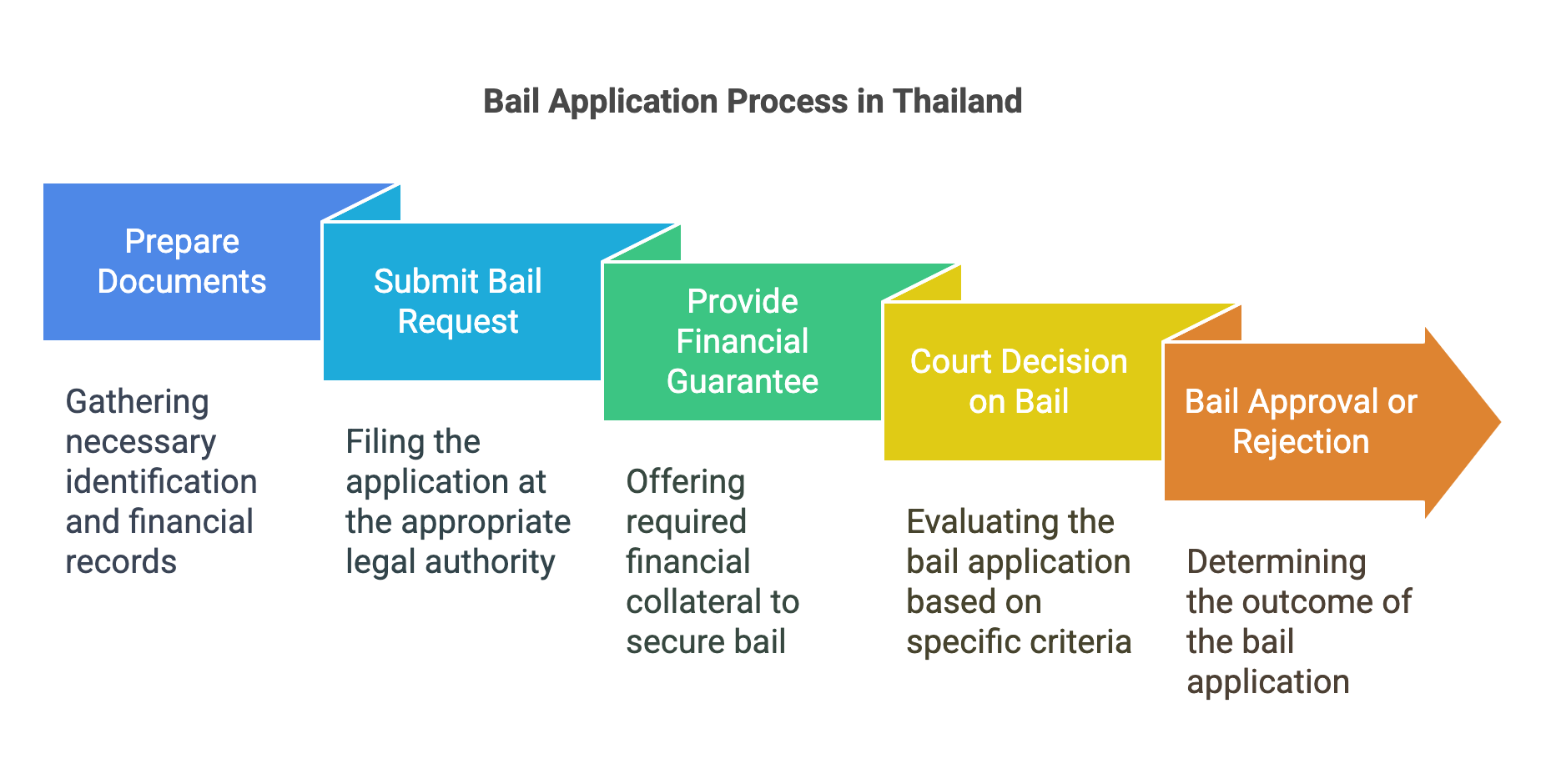
Key Steps in the Bail Application Process in Thailand
Securing bail involves a structured process under the Criminal Procedure Code (CPC). Here’s a step-by-step guide different than our infographic above:
- Consult Legal Counsel: Engage a lawyer immediately after arrest to assess eligibility (CPC Section 107).
- Gather Documentation: Prepare items from the Practical Filing Checklist, including a bail memorandum addressing Section 108 criteria.
- File the Application: Submit to the competent authority (e.g., police station or court clerk). For foreigners, include proof of ties to Thailand to mitigate flight risk.
- Court Hearing: Attend a bail hearing (often within 48 hours), where the judge evaluates risks. Electronic submissions are now possible post-2023 amendments.
- Post Bail and Comply: If approved, provide security and follow conditions like reporting. Common Pitfalls: Delays from missing documents or not addressing flight risk can lead to denial. Foreigners often forget to translate documents into Thai, as court rules require.
Bail in Thailand for Specific Offenses
Bail for Specific Offenses in Thailand Bail eligibility varies by offense category under the Penal Code. For non-violent crimes like theft or fraud, bail is often granted if evidence is weak. Violent offenses (e.g., assault under Section 295) or those involving national security may face higher scrutiny. Drug-related charges are governed by the Narcotics Code B.E. 2564. Section 4 of the Act for the Promulgation of the Narcotics Code B.E. 2564 repealed the Narcotics Act B.E. 2522 together with all of its amendments and put the Code in its place, and the Supreme Court has applied that repeal when re-sentencing cases decided under the old Act. They usually need high bail amounts because of flight risks. For possession, bail can start at 20,000 THB. For trafficking, it can go over 1 million THB. Immigration violations (e.g., overstay under Immigration Act Section 81) are handled separately, with bail possible but often conditional on resolving visa issues promptly.
Typical Bail Amounts
| Offense | Bail Amount Range (THB) |
| Simple theft | 50,000-200,000 |
| Attempted murder | 200,000-1,000,000 |
| Drug use/possession | 10,000-50,000 |
| Drug trafficking | Up to 2,000,000 |
| Forging documents | Section 264 can vary widely (50,000-500,000 THB depending on severity). |
| Overstay/Illegal stay | 40,000 THB and up; immigration offenses can reach 100,000+ THB if combined with other charges. |
Foreigners should anticipate higher bail amounts due to flight risk.
Passport & Immigration Alerts
If granted bail in Thailand, the passport is usually retained by the court, and immigration is notified. Leaving Thailand without permission triggers an arrest warrant. Courts may allow alternatives like electronic monitoring for low-risk cases, per recent judicial guidelines.
Practical Filing Checklist
- Completed bilingual application form
- Passport and valid Thai visa
- ID and house registration of the surety
- Collateral documents (translated to Thai)
- Concise bail memorandum (addressing CPC §108)
- Certified interpreter if needed
Strategies for Foreign Defendants in Bail in Thailand
- Demonstrate stable residency (lease agreements, work permits in Thailand)
- Nominate credible Thai sureties
- Prepare local collateral (cash, property, or insurance)
- Maintain valid visa status
Case Studies for Foreign Defendants
In a 2023 court case in Bangkok, a European expat was charged with minor drug possession. Bail was set at 30,000 THB. The expat provided a work permit, lease agreement, and a surety from a Thai employer. These documents showed strong local ties and reduced the risk of fleeing. In a 2024 Pattaya case, a tourist was denied bail for assault. This was because he had no local address and a history of overstaying. This shows how important it is to be prepared. These examples underscore that proactive documentation can tip the scales in your favor.
If Bail is Denied
A refusal can be appealed: an order of the court of first instance to the Court of Appeal, and an order of the Court of Appeal to the Supreme Court (section 119 bis). Where the Court of Appeal upholds a refusal its order is final, but a fresh bail application can still be made, answering the reasons given for the refusal and the seven matters in section 108. Courts may also grant release on stricter conditions rather than refuse it.
Role of Legal and Consular Assistance
Legal counsel significantly impacts bail outcomes. Bilingual lawyers navigate procedures effectively, while consular assistance under the Vienna Convention ensures fair treatment and monitoring.
FAQs About Bail in Thailand
What is the bail process in Thailand?
The bail process in Thailand involves submitting an application for bail to the court. This process is governed by Thai law and includes a review of the criminal charge against the accused. The court will look at how serious the crime is. They will also consider the defendant’s connections to the community. Finally, they will think about how likely it is that the defendant will flee. If approved, the amount of bail is stipulated, and the accused can be temporarily released while awaiting trial.
What types of bail are available in Thailand?
In Thailand, there are several types of bail, including cash bail, surety bonds, and property bonds. Cash bail means the accused must pay a set amount in baht. A bail bond involves a guarantor from a third party. Property bonds allow individuals to use their property as collateral. The type chosen may depend on the circumstances of the case and the discretion of the court.
How much is the amount of bail in Thailand?
The amount of bail in Thailand varies widely based on the nature of the criminal offense and the severity of the crime. For minor offenses, bail may be relatively low, while serious charges can lead to significantly higher amounts. Factors such as the defendant’s criminal history and flight risk also influence the bail amount set by the court.
What happens if I cannot post bail in Thailand?
If you cannot pay bail in Thailand, the accused will stay in jail. They will remain there until the trial ends or until a bail application is approved later. This can result in prolonged pre-trial detention. It is important to talk to a Thai lawyer. They know the local legal system and can help with the bail process.
Can foreigners apply for bail in Thailand?
Best to have a legal representative who knows Thai criminal procedure. This will help ensure that the rights of the foreign national are protected during the bail proceedings.
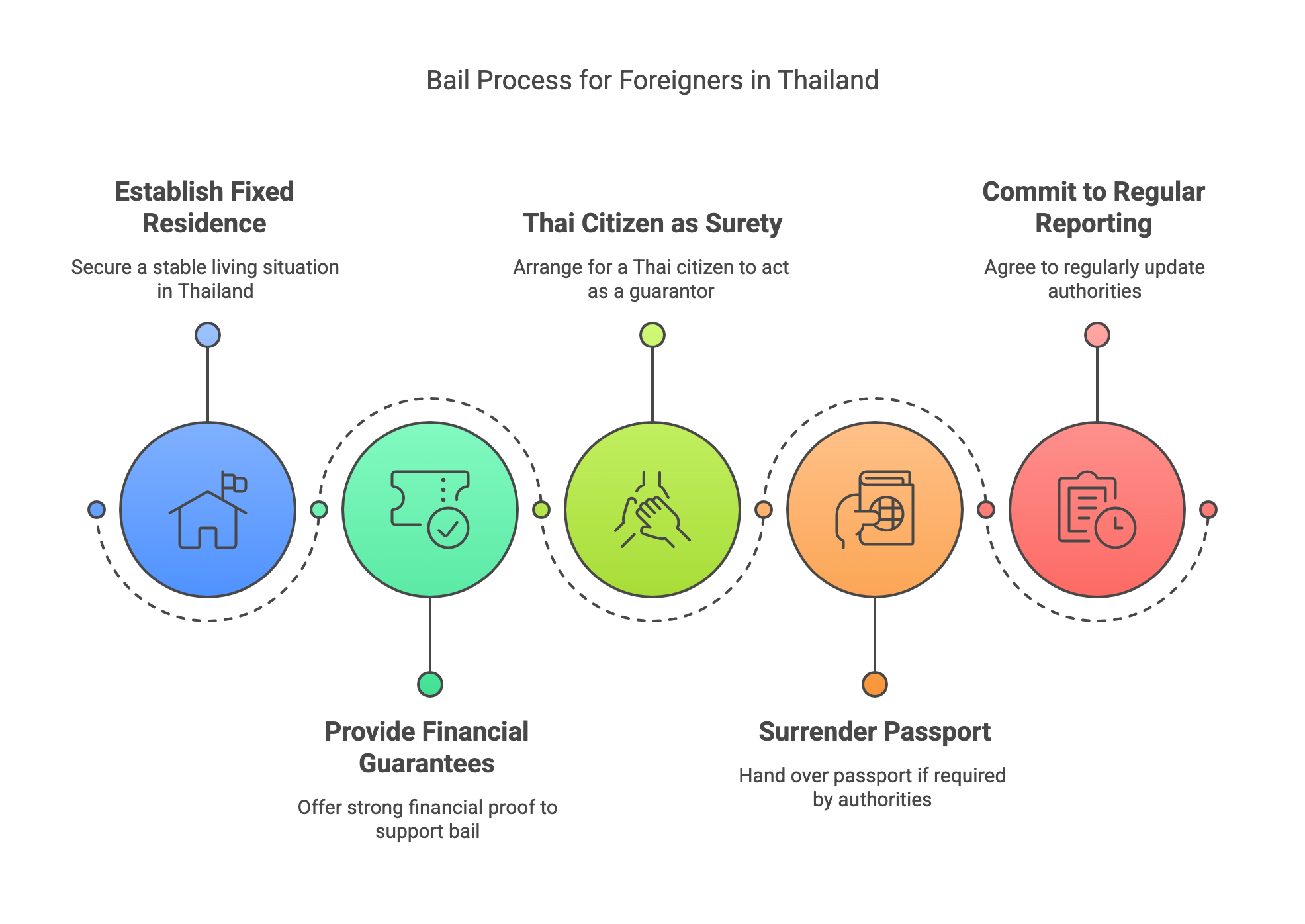
To improve their chances, they should:
, Have a fixed residence in Thailand.
, Provide strong financial guarantees.
, Have a Thai citizen act as a surety.
, Surrender their passport if required.
, Commit to regular reporting to the authorities.
, Hiring a skilled Thai lawyer greatly improves your chances of getting bail. They know how to present the best case to the court.
What are bail bonds in Thailand?
Bail bonds in Thailand are agreements made by a third party. This is usually a bail bondsman. The bondsman guarantees the court that the accused will show up for their court dates. This option is often used when the defendant cannot afford the full bail amount. The bail bondsman typically charges a fee, and the accused must adhere to the terms set forth in the agreement. Thailand doesn’t have a widespread “bail bondsman” industry like the US. Bail bonds are more like bail bonds backed by security under section 114 of the Criminal Procedure Code, often provided through insurers.
How does the Thai legal system handle bail for criminal charges?
The Thai legal system handles bail for criminal charges by allowing defendants to seek temporary release while awaiting trial. The decision to grant bail depends on several factors. These include the type of charges, the defendant’s background, and any risk of fleeing. The core principle is to balance the rights of the accused with public safety and the integrity of the legal process.
What Are the Risks of Violating Bail Conditions in Thailand?
Violating bail conditions, such as failing to report or attempting to leave the country, can result in the security being enforced and in arrest. Under section 119 of the Criminal Procedure Code, where the bond is breached before the court, the court may enforce it without bringing a separate suit, though it may waive or reduce the sum having regard to the surety’s efforts to find the accused. Under section 117, where the accused flees or is about to flee, an administrative or police officer may arrest them. Under section 115 the officer or the court may instead raise the sum, require better security, or tighten the conditions. For foreigners, this often triggers immigration blacklisting and deportation proceedings under the Immigration Act B.E. 2522. In severe cases, it may lead to additional charges for obstruction of justice. To avoid this, adhere strictly to court orders and maintain communication with your legal representative.
Conclusion about bail in Thailand especially related to foreigners and expats
Successfully securing bail in Thailand requires strategic preparation, thorough documentation, and a clear understanding of judicial expectations. Engaging experienced local counsel early dramatically improves outcomes.
How ThaiLawOnline Can Assist You
At ThaiLawOnline, our dedicated legal team specializes in navigating the complexities of bail applications in Thailand. Our services include:
✅ Comprehensive bail applications and representation
✅ Expert negotiation with authorities
✅ Step-by-step legal guidance for criminal defense
✅ Specialized support for foreign nationals
Act swiftly to protect your rights and freedom.
📞 Contact ThaiLawOnline Today: 08 7225 1340 | 📧 info@thailawonline.com
Hiring a skilled Thai lawyer greatly improves your chances of getting bail. They understand how to present the best case to the court. ThaiLawOnline can help you.
LINKS:
Last reviewed: 5 September 2026 against the Criminal Procedure Code in wp_tcca_sections, the Constitution of Thailand B.E. 2560, and two Supreme Court judgments. Nine corrections were made, five of them wrong section attributions. Section 108/1 is the list of grounds on which release may be refused, not the provision on insurance bonds; section 108/2 is a material witness’s right to object to a release that would endanger them, not electronic monitoring, which sits in section 108 itself and requires the released person’s consent; section 114 is the three kinds of security, cash, other property, or a person standing as surety by showing property, and not revocation; section 193 is the general right of appeal on fact and law and says nothing about bail; and section 134 is the provision on informing a suspect of the charge, not a detention extension. The criteria in section 108 number seven, not five, and one of the five given belonged to section 108/1.
The custodial timeline was rebuilt from section 87, which sets three tiers by the maximum penalty and whose middle tier, 48 days for offences carrying under ten years, was missing altogether. There is no separate seven-day extension for prosecutors: the seven days is the single detention allowed for the least serious tier. Two constitutional citations were replaced by one that is correct and more useful, because section 29 of the Constitution carries the presumption of innocence and, in the same section, the guarantee that a bail application must be considered and that security must not be demanded in excess of the case. Section 107, which says every accused should be granted provisional release, was added: it is the presumption in favour of bail and the page had reduced it to a procedural label.
Drug offences were being referred to a repealed statute. Section 4 of the Act for the Promulgation of the Narcotics Code B.E. 2564 repealed the earlier narcotics Act and all of its amendments, which two Supreme Court judgments state in terms when re-sentencing cases decided under it. The superseded Act is still named once on this page, deliberately: that sentence records the repeal, and a repeal cannot be stated without naming what was repealed. Not verified and therefore not relied on: the typical bail figures in the table below are practice ranges rather than statutory amounts, and no statute fixes them; and the reference to 2024 Immigration Bureau guidance on overstay cases could not be traced to a published instrument.
Thai Law Updates, free by email
Plain-English updates on Thai law changes that affect foreigners: property, visas, marriage, business and wills. One short email a month from a firm practicing since 2006. No spam, unsubscribe anytime.