


Reviewed by ThaiLawOnline, a licensed Thai law firm practising in Thailand since 2006. Thai lawyer of record: Wichuda Atthamethakon, LL.M., Thai Bar Licence 3149/2556.
Last updated on
Inheritance law in Thailand is mainly governed by Book VI of the Civil and Commercial Code (CCC). It covers Sections 1599 to 1755. It is also governed by the Inheritance Tax Act B.E. 2558 (2015). For foreigners who own property, bank accounts, or business interests in Thailand, these laws matter. Understanding them is essential to protect your family and assets.
This guide was written by ThaiLawOnline’s legal team. We have 20 years of experience in Thai law. This guide explains what you need to know about Thai succession. It covers what happens if you die without a will.It also explains how to make a valid Thai will. You will learn about the probate process.It also covers tax duties. It explains special rules for foreign nationals who inherit land.
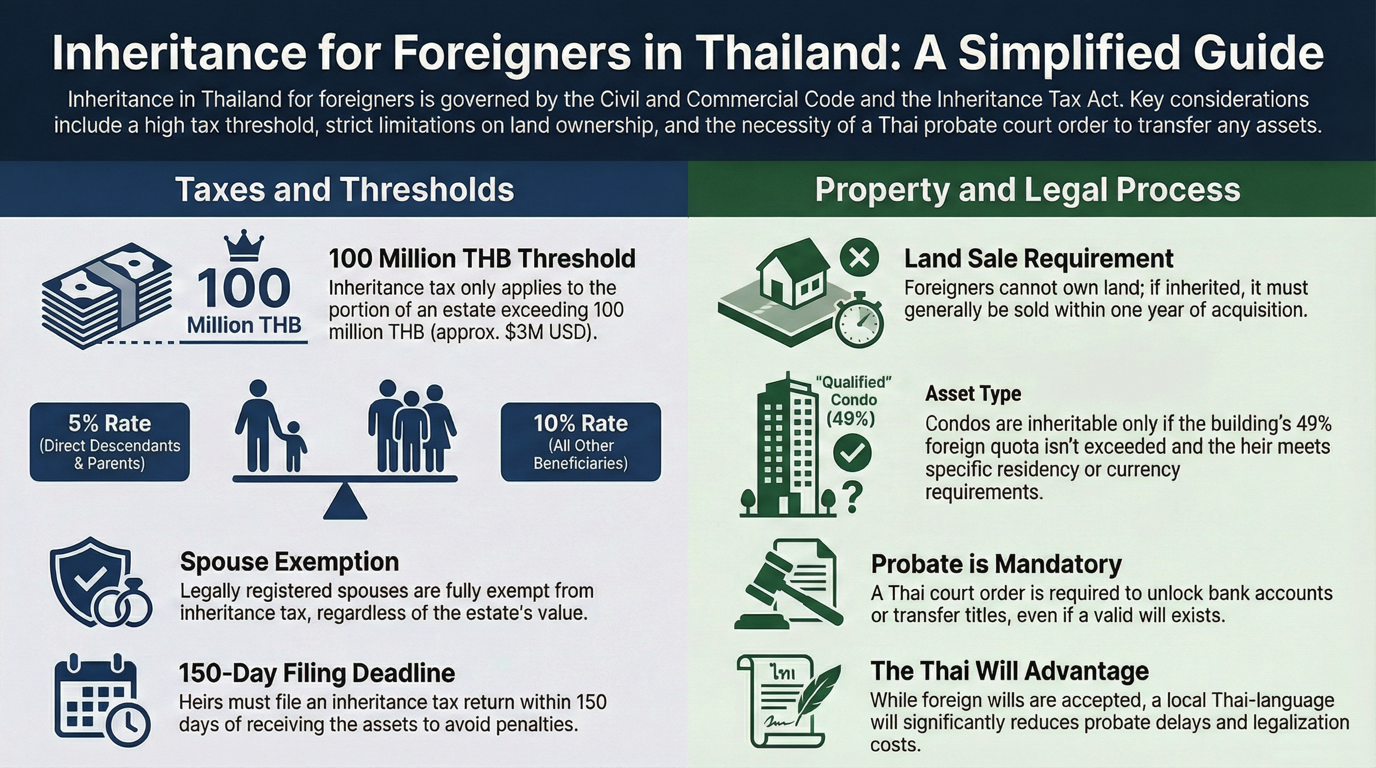
Table of Contents
The rest of the estate planning library
Making the will
Dying without one
Probate and administration
Property, land and the foreign heir problem
Tax, trusts and death abroad
How Thai Succession Law Works
Thai succession law determines how a deceased person’s estate is distributed. The governing framework is Book VI of the Civil and Commercial Code, which has applied uniformly since 1935. There are two paths:
- Testate succession, the deceased left a valid will (Sections 1646, 1694 CCC)
- Intestate succession, there is no will, so the estate passes to heirs set by law.This follows a fixed order under Sections 1629, 1631 CCC
For an estate with foreign connections, the applicable law depends on the asset. Under sections 37 and 38 of Thailand’s Conflict of Laws Act B.E. 2481, succession to immovable property follows the law of its location; succession to movable property follows the law of the deceased’s domicile at death. Thai succession law therefore governs a condominium in Bangkok, while bank accounts and other movable assets require a domicile assessment. The place of death alone does not settle the question.
A separate Thai will is often practical for Thai assets, but is not universally compulsory. A foreign will requires assessment of its validity, scope and interaction with other wills. Sections 39 and 40 of the Conflict of Laws Act address testamentary capacity and form. Thai proceedings may require translations, authentication and other supporting evidence. Coordinate the documents so a later will does not unintentionally revoke an earlier one.
Who Inherits? The Six Classes of Statutory Heirs
Under Section 1629 of the CCC, Thai law recognises six classes of statutory heirs. An earlier class generally excludes later classes, subject to representation. Section 1630 paragraph two makes an important exception: each surviving parent receives a child’s share alongside descendants. The surviving spouse has a special status and inherits alongside whichever class applies (Section 1635 CCC).
| Class | Heirs | CCC Section | Key Rule |
|---|---|---|---|
| 1 | Descendants (children, grandchildren) | §1629(1) | Includes adopted and legitimised children; excludes illegitimate children unless acknowledged by the father. Adopted children inherit equally to biological ones (CCC Section 1627). A child born outside marriage whom the father acknowledged also qualifies under Section 1627 for inheritance purposes; formal legitimation under Section 1547 is not always required. |
| 2 | Parents | §1629(2) | Each surviving parent receives a child’s share alongside descendants under §1630 paragraph two; without descendants, parents inherit subject to any surviving spouse’s share |
| 3 | Brothers and sisters (full blood) | §1629(3) | Inherit only where no descendants and no parents survive, and while they survive the half-blood class takes nothing (§1630) |
| 4 | Half-blood brothers and sisters | §1629(4) | Only inherit if no full-blood siblings survive |
| 5 | Grandparents | §1629(5) | Paternal and maternal grandparents share equally |
| 6 | Uncles and aunts | §1629(6) | Last resort before estate escheats to the Crown |
How the Surviving Spouse Shares the Estate
The surviving spouse’s share depends on which class of heir co-inherits. Under Section 1635 CCC:
| Co-inheriting Class | Spouse’s Share | Heirs’ Share |
|---|---|---|
| Class 1 (Descendants) | Equal share with each child | Equal share with spouse |
| Parents where no descendants survive, or full siblings where neither descendants nor parents survive | 50% of the estate | 50% divided among heirs |
| Class 4 (Half siblings), Class 5 (Grandparents), or Class 6 (Uncles/aunts) | Two-thirds (⅔) of the estate | One-third (⅓) divided among heirs |
| No statutory heirs | 100% of the estate | , |
Important: Only a legally registered spouse qualifies. Under Thai law, a marriage must be registered at the local amphur (district office) per Section 1457 CCC. Ceremonial or religious marriages alone confer no inheritance rights. This catches many foreign couples off guard.
A second, bigamous marriage gives no spouse’s share, and the children can say so. A marriage registered while an earlier marriage still exists is prohibited by Section 1452 and void under Section 1495, and Section 1497 lets any interested person ask the court to declare it void. In Supreme Court Decision 2984/2569 a daughter born outside marriage, whom her father had acknowledged, sued to annul his later registered marriage after the second wife had herself appointed estate administrator (Section 1713). The Court held that an acknowledged child is a descendant under Section 1627 and a statutory heir under Section 1629(1); because the void spouse would otherwise take a share under Section 1635(1) and cut into hers, she was an interested person with standing under Section 1497, and the marriage was declared void. The practical lesson for contested estates is that the inheritance calculation may depend on a marriage-validity judgment first, so gather every marriage record, Thai and foreign, divorce evidence and proof of acknowledgment at intake. Source note: the decision text was read on 14 September 2026 in the summary published by the Office of Judicial Assistants as reproduced by a private aggregator; the official database at deka.supremecourt.or.th was unreachable that day and the text should be confirmed there before it is relied on in court.
What Happens If You Die Without a Will in Thailand?
If a foreigner dies without a valid will, first determine which succession law governs each asset. Where Thai intestate succession law applies, the statutory-heir rules above govern distribution. The following points require attention:
- Check the applicable law for each asset. Thai immovable property follows Thai succession law. For movable assets, the deceased’s domicile at death determines the applicable succession law under section 38 of the Conflict of Laws Act.
- Unmarried partners inherit nothing. Thai law does not recognise cohabiting partners or common-law spouses.
- Minor children need a court-appointed guardian. The probate court must appoint a guardian to manage their share, which can take months.
- If no heirs are found, the estate goes to the Thai government (escheat to the Crown under Section 1753 CCC).
Example: An unmarried partner has no automatic share under Thai intestate succession rules. A valid will could provide for that partner. If the deceased left a foreign will, assess its validity, scope and applicable law before treating the Thai assets as intestate. Each foreign will must be assessed individually.
Disinheritance and Renouncing an Inheritance
Two formal acts sit either side of the estate: the deceased cutting an heir out, and an heir refusing what is left to them. Both have to be done a particular way, and both are handled at the district office under the same B.E. 2569 forms described above.
Disinheriting a Statutory Heir (Section 1608)
Section 1608 allows a testator to disinherit a statutory heir only by an express declaration of intention, made either in a will or in a writing deposited with the competent official. The identity of the disinherited heir must be clearly stated, so a vague reference to “my relatives” will not do the work.
The same section contains the rule most people actually rely on without knowing it: where a testator disposes of the whole estate by will, every statutory heir who takes nothing under that will is deemed to be disinherited. An exhaustive will therefore disinherits by operation of law, with no separate declaration needed.
Revocation is governed by Section 1609, and it is not symmetrical. A disinheritance made by will can be revoked only by will. But one made by writing deposited with the official can be revoked by either route. It is worth knowing which form you used.
Renouncing an Inheritance (Sections 1612 to 1619)
An heir who does not want an inheritance must renounce it formally. Under Section 1612 that means an express declaration in writing deposited with the competent official, or a contract of compromise. Nothing informal counts.
Section 1613 makes the act deliberately rigid: a renunciation cannot be partial, cannot be made subject to a condition or a time clause, and cannot be revoked. Section 1619 blocks the other common idea, renouncing in advance: nobody can renounce or dispose of rights they might one day have in the estate of a person who is still alive.
Once made, Section 1615 backdates the effect to the moment of death, and where a statutory heir renounces, that heir’s own descendants step up in their own right and take the share that would have gone to the renouncer. Renouncing does not push the estate sideways to your siblings if you have children.
Creditors are protected. Under Section 1614, an heir who renounces knowing it prejudices a creditor can have the renunciation cancelled on the creditor’s application, and the court may then authorise the creditor to accept the inheritance in that heir’s place, up to what is owed. Where the renunciation was gratuitous, the heir’s own knowledge is enough; there is no need to show the person who benefited knew anything.
One trap for parents and guardians. Renouncing on behalf of a minor is not the guardian’s to decide alone. In Supreme Court Decision 1649/2567 the Court held that renunciation falls within the acts listed in Section 1574 which a guardian or person exercising parental power may not perform for a minor without prior court approval, because it extinguishes rights the child already holds. A renunciation made without that approval is open to challenge.
How Do You Make a Will in Thailand as a Foreigner?
A foreigner may make a will in Thailand. For an ordinary written will under Thai law, the requirements are: in writing, dated, and signed by the testator before at least two witnesses who are present together and sign at the same time (Section 1656 CCC). No nationality, residence or visa condition attaches to making one. A will that fails those requirements is void.
Requirements for an Ordinary Written Thai Will
- The testator must be at least 15 years old (Section 1703 CCC)
- The testator must be of sound mind at the time of signing (Section 1704 CCC)
- The will must be dated (day, month, year)
- The will must be signed by the testator
- At least two competent witnesses must sign (Section 1656 CCC), they cannot be beneficiaries, spouses of beneficiaries, or minors
What Should a Thai Will for Foreigners Include?
Beyond the legal minimums, a well-drafted Thai will for foreigners should address:
- A clear statement of domicile to avoid jurisdictional disputes
- A clause limiting the will’s scope to Thai assets only, so it does not conflict with wills in your home country
- Appointment of a Thai executor who can appear in Thai courts (appointing a foreign executor causes significant delays)
- Specific identification of assets, condo unit numbers, bank account numbers, company registration numbers
- Instructions for land (foreigners usually cannot own land, so you must say if it should be sold and the proceeds shared. Or, say if it should be transferred to a Thai national.)
- A bilingual version (English and Thai) with both versions declared equally authoritative
5 Types of Thai Wills Compared
Thai law recognises five forms of will under Sections 1656-1672 CCC. Each has different requirements and levels of protection:
| Type of Will | CCC Section | Witnesses Required | Best For | Risk Level |
|---|---|---|---|---|
| Ordinary Will (written) | §1656 | 2 | Most foreigners, standard, reliable, widely accepted | Low |
| Holographic Will (handwritten) | §1657 | 0 | Emergency situations, written entirely by hand, dated and signed | Medium (forgery risk) |
| Public Document Will | §1658 | 2 | High-value estates, made before the Amphur (district) officer, filed officially | Very Low |
| Secret Will | §1660 | 2 | When confidentiality is paramount, sealed and signed before Amphur officer | Low |
| Oral Will | §§1663 and 1664 | At least 2 | Exceptional circumstances preventing another prescribed form. Witnesses must report to the district officer without delay. The will loses effect one month after the testator becomes able to make another prescribed form. | Very High |
Our Recommendation: For most foreign nationals, a standard Ordinary Will (Section 1656) is the safest, most cost-effective choice. Draft it in two languages. A Public Document Will offers the highest security for large estates but requires more time and formality. As of 24 March 2026, the new Ministerial Regulation on Wills B.E. 2569 (2026) standardises will procedures and introduces mandatory official forms at district offices (amphur) nationwide, strengthening the Public Document and Secret Will options in particular. See the dedicated section below for what changed, or read the official Government Gazette text.
Living Will vs Last Will, Two Different Documents
These are often confused. A last will decides who receives your assets after you die. A living will is an advance healthcare directive: it records the treatment you would refuse if you were still alive but no longer able to speak for yourself. Living wills in Thailand rest on a different law entirely, Section 12 of the National Health Act B.E. 2550, and a last will does nothing to cover medical decisions. Most foreigners settling in Thailand need both. See our full guide to the living will in Thailand.
The New Will Regulation (B.E. 2569): What Changed at the District Office
On 22 January 2026, Thailand published the Ministerial Regulation on the Making of Wills or the Expression of Intent Regarding Inheritance, B.E. 2569 (กฎกระทรวงการทำพินัยกรรมหรือการแสดงเจตนาเกี่ยวกับมรดก พ.ศ. ๒๕๖๙) in the Royal Gazette (Vol. 143, Part 4 Kor, p. 17). Issued under Section 1672 of the Civil and Commercial Code, clause 1 brings it into force when sixty days have elapsed from the date of publication, that is on 24 March 2026. Clause 2 expressly repeals both the original Ministry of Interior regulation issued under Section 1672 and Ministerial Regulation No. 2 (B.E. 2503 / 1960), making it the first modernisation of district-office will procedures in over six decades. It was signed by the Minister of Interior on 13 January 2026.
What it changes, and what it does not. This is a procedural reform, not a rewrite of who inherits. The six classes of statutory heirs, the spouse’s share and disinheritance remain governed by Book VI of the CCC. The THB 100 million inheritance-tax threshold comes from section 12 of the Inheritance Tax Act B.E. 2558. What the regulation standardises is how a will or inheritance declaration made through a government office is prepared, witnessed, recorded and stored, using identical official forms and safeguards in every amphur and Bangkok khet nationwide.
Standardised official forms at every district office
To make the process uniform across the country, the regulation carries its own set of standardised forms, annexed to the regulation and published in the Royal Gazette with it, numbered Phor Kor 1 to Phor Kor 8 and used at every district and Bangkok khet office. The same templates govern the application to make a public will, the record the officer draws up, the deposit of a secret (sealed) will, the will register, the receipt, and formal declarations of disinheritance, revocation of disinheritance, or renunciation of inheritance. Because the forms are annexed to the regulation itself, their wording is fixed by the regulation and not by a departmental circular.
Three practical changes matter most for anyone making a public (district-office) will from 24 March 2026 onward:
- Register anywhere. You are no longer limited to the district where your name appears on the house registration (tabien baan). A public will can now be made at any amphur, king amphur, or Bangkok khet office in the country.
- The office keeps the will unless you ask for it back. Clause 10 requires the district office to keep a will it has registered. Under clause 11 the testator may collect it at any time on producing the receipt, and for a public document will the officer takes a certified copy and keeps that before handing the original over. While you are alive, clause 12 forbids the officer from disclosing the will to anyone but you. After your death, clause 13 allows the estate administrator, a statutory heir, a legatee or another person with an interest in the estate to request a copy or certified copy of the public-document will held under clause 11, at the office where the will was made. This copy procedure specifically concerns public-document wills.
- A new fee schedule. For the first time since 1960 the fees were rewritten. Clause 19 sets them: 250 baht to make a public document will at the district office, 500 baht if the officer comes to you somewhere else in the district, 250 baht for a secret will, 100 baht for a declaration of disinheritance, revocation of disinheritance or renunciation, and 50 baht for the duplicate copy of the will made at the same time. Clause 20 waives them for Thai nationals affected by a declared public disaster.
Every will is entered in an official register, assigned a registration number, and cross-referenced, creating a verifiable chain of custody that is invaluable when the will is later produced in probate.
Which wills this affects. The reform touches only wills and declarations made in front of a district officer, the public document will (Section 1658 CCC), a secret will deposited at the office (Section 1660), an emergency oral will recorded there (Section 1663), and formal declarations of disinheritance or renunciation. An ordinary written will (Section 1656) you sign at home or at a lawyer’s office, or a fully handwritten holographic will (Section 1657), is completely unchanged.
Stricter checks on age, capacity and identity
Clause 7 requires the district officer, where there are grounds to suspect that the testator has not yet completed fifteen years of age or is of unsound mind, to investigate as far as is necessary and to record both the grounds for the doubt and the result of that investigation in the remarks column of the will register. Fifteen, not twenty, is the threshold: under Section 25 of the Civil and Commercial Code a minor may make a will once fifteen years of age is complete. Clause 5 fixes who may witness: at least two people who are sui juris, not of unsound mind, not adjudged quasi-incompetent, and not deaf, mute or blind in both eyes. If you cannot bring witnesses, or cannot bring enough of them, you may ask the district officer to help find them, and where you or your witnesses cannot communicate in Thai the regulation requires an interpreter.
The district-office record provides evidence of the formalities followed. The officer does not guarantee the will against a later challenge. Questions about capacity, consent or compliance with the law remain for the court to decide if disputed.
What it means for foreigners
- Evidence for estate proceedings. A public-document will records the formal steps taken before the district officer. The record may help resolve a dispute, but does not guarantee capacity, prevent a challenge or determine how long court proceedings take.
- The forms and reading-aloud are in Thai. Use a bilingual lawyer or a qualified interpreter so that what the officer records genuinely matches your intentions, a mismatch is the one risk this system does not solve for you.
- You do not need a Thai identity card. Clause 5 deals with this expressly: where the applicant is a foreigner who cannot produce a Thai identity card or a civil-registration document, the district officer is to examine other documents or evidence capable of proving identity. Bring your passport and anything else that ties you to the address you give.
- Your existing will is still valid. A will validly made before 24 March 2026 does not become void. For a significant or cross-border estate, though, it is worth reviewing whether re-executing as a Public Document Will would strengthen it, see our Last Will service.
- No online wills, yet. The regulation is built around in-person procedures, written and sealed documents, and recorded emergency oral wills. Thailand has not introduced an electronic or online will system; that would require separate legislation.
Read the primary source: the full text is available in the official Royal Gazette (PDF, 23 pages, Thai). The Department of Provincial Administration also publishes an official operating manual for district officers (DOPA Bureau of Registration Administration), and the Government Public Relations Department summarised the changes for the public.
Key Takeaway: The B.E. 2569 regulation standardises district-office procedures for the Public Document Will (Section 1658) and the other official procedures covered by the regulation. The appropriate form depends on the estate and the testator’s circumstances. For a straightforward estate, a well-drafted bilingual Ordinary Will (Section 1656) remains perfectly valid and is usually faster to arrange.
The Thai Probate Process Step by Step
Probate in Thailand is the legal process of validating a will, appointing an estate administrator, and distributing assets. All probate matters are heard by the Thai Civil Court with jurisdiction over the deceased’s assets or last domicile.
Step 1: Obtain a Death Certificate
Register the death at the local district office (amphur) within 24 hours. For foreigners, you will also need to notify your embassy or consulate.
Step 2: Locate the Will and Gather Documents
Collect the original will, death certificate, marriage certificate (if applicable), identification documents, and proof of assets (title deeds, bank statements, company share certificates).
Step 3: File a Probate Petition
A petition must be filed with the Thai Court to appoint an estate administrator. Under Section 1711 CCC, any interested party can file.This includes the executor named in the will, an heir, or a creditor.
Step 4: Court Hearing
The court schedules a hearing (typically 1-3 months after filing). The court reviews the will’s validity, hears any objections, and appoints the estate administrator. A notice is published in a local newspaper to inform potential creditors.
Step 5: Estate Administration
The appointed administrator gathers the person’s assets.They pay the person’s debts and taxes.They then distribute the estate based on the will or state intestate rules. Under Section 1732 CCC, the administrator must complete the administration and the account of it within one year of taking office, unless the will, a majority of the heirs or the court sets a different period.
Step 6: Final Accounting and Discharge
The administrator files a final report with the court. They account for all assets and distributions. They request discharge from their duties.
Typical Probate Timeline
| Stage | With Thai Will | Without Thai Will | With Foreign Will Only |
|---|---|---|---|
| Document gathering | 2-4 weeks | 4-8 weeks | 8-16 weeks (translation + legalisation) |
| Court petition to hearing | 1-3 months | 2-4 months | 3-6 months |
| Asset distribution | 2-4 months | 4-8 months | 6-12 months |
| Total estimated time | 3-6 months | 8-16 months | 12-24+ months |
| Estimated legal cost | 50,000-150,000 THB | 100,000-300,000 THB | 200,000-500,000+ THB |
Inheritance Tax in Thailand
Thailand introduced an inheritance tax in 2016 under the Inheritance Tax Act B.E. 2558. Here is what you need to know:
Who Pays Inheritance Tax?
Tax is payable by the heir (not the estate) when what that heir receives from one deceased exceeds 100 million Thai Baht, counted after deducting the debts that come with the inheritance. The tax applies only to the amount above that threshold. What a spouse inherits is outside the Act altogether (section 3), and charities, religious bodies and educational institutions are exempt. A foreigner holding a Thai residence permit is taxed on inherited assets wherever they are; a foreigner without one is taxed only on assets located in Thailand.
Tax Rates
| Heir Category | Tax Rate | Example: an heir who receives 150M THB |
|---|---|---|
| Ascendants or descendants (parents, children) | 5% | 5% × 50M = 2.5M THB |
| All other heirs (siblings, partners, friends) | 10% | 10% × 50M = 5M THB |
Key Exemptions
- An heir who receives 100 million THB or less from one deceased pays nothing
- Legally registered spouses are fully exempt from inheritance tax
- Inheritance received by charitable organisations, religious institutions, or educational bodies is exempt
- The tax must be filed within 150 days of receiving the assets
Practical implication: The 100 million THB threshold (approximately USD 2.8 million) means most foreign heirs in Thailand receive far less than that and pay no inheritance tax. However, there are separate transfer fees and taxes when transferring real property, the Land Office registration fee on an inheritance transfer is 0.5% of the appraised value where the heir is a descendant, an ascendant or the spouse of the deceased, and 2% for any other heir (Ministerial Regulation No. 47 (B.E. 2541), clause 2(7)). Stamp duty and specific business tax are charges on a sale, so they arise if the heir later sells. The reduced 0.01% transfer fee that runs to 30 June 2027 applies only to purchases by individual Thai nationals and does not apply to an inheritance transfer.
Gift Tax on Lifetime Transfers
Inheritance tax is not the only charge on passing wealth to your family. Thailand also taxes large lifetime gifts, so giving assets away before death is not automatically a way around the rules. Gifts above the statutory thresholds are treated as assessable income of the recipient rather than as inheritance. If you are considering transferring property or substantial sums to a spouse or child during your lifetime, take advice on the gift-tax position first, the treatment differs depending on your relationship to the recipient.
Can Foreigners Inherit Land in Thailand?
This is one of the most common questions we receive, and the answer involves an important distinction.
Under the Land Code Act B.E. 2497 (1954), Section 86, foreigners are generally prohibited from owning land in Thailand. However, a foreigner can inherit land, the legal process is as follows:
- The Thai probate court recognises the foreigner as a rightful heir
- The heir must apply to the Minister of Interior for permission to own the land
- If permission is denied (which is common), the foreigner has one year to sell the land and keep the proceeds (Section 93, Land Code)
- If the foreigner fails to sell within one year, the Director-General of the Land Department may order a forced sale
Key Takeaway: Foreigners can inherit land in Thailand and receive the monetary value : they just cannot keep ownership long-term. A practical option is to add a sale instruction to your Thai will. You can also structure ownership through a Thai spouse, usufruct, or long-term lease during your lifetime. There is also a limited, “indefinite” ownership right for inherited land. It allows up to 1 rai for residential use.It requires Minister approval under Land Code Section 93.
What Foreigners CAN Directly Own and Inherit
- Condominiums, Condominiums: Freehold ownership possible if the building’s foreign quota is under 49% (Condominium Act Section 19 bis). For inheritance, unqualified foreign heirs must dispose within 1 year; qualified ones (e.g., permanent residents) can retain.
- Bank accounts, fully inheritable with a court order
- Company shares, including shares in companies that hold land (subject to Foreign Business Act restrictions)
- Vehicles, personal property, and investments
Estate Planning Strategies for Expats in Thailand
Effective estate planning for foreigners in Thailand goes beyond simply drafting a will. Consider these strategies:
1. Maintain Separate Wills for Separate Jurisdictions
Draft a Thai will covering Thai assets and a home-country will covering non-Thai assets. Ensure each will has a clause that limits its scope.This helps prevent the wills from accidentally revoking each other. Section 1697 CCC says a later will revokes an earlier one only if they conflict.
2. Who Can Be an Executor in Thailand, and How Do You Choose One?
Almost any adult can be an executor: Thai law disqualifies only three groups, namely a person who has not reached majority, a person of unsound mind or adjudged quasi-incompetent, and an undischarged bankrupt (Section 1718 CCC). Nationality is not on that list, so a foreigner can serve. The practical question is whether the person can act in Thailand: a foreign executor who does not live here faces major practical barriers. They may not be able to appear in court. They may not be able to access Thai banks. They may not be able to communicate with Thai officials. Appointing a Thai lawyer or trusted person as executor avoids these delays.
3. Consider a Usufruct for Property
A usufruct (Sections 1417-1428 CCC) grants the right to use and benefit from land without owning it. A common strategy: the Thai spouse or child owns the land, while the foreign partner holds a usufruct registered on the title deed. This survives changes in ownership but ends upon the usufructuary’s death.
4. Register Your Marriage in Thailand
If you are married, ensure the marriage is registered at a Thai amphur. Foreign marriages may be recognized, but they need proof. A Thai-registered marriage gives clear legal status for inheritance.
5. Joint Bank Account Considerations
A joint bank account in Thailand does not automatically pass to the surviving holder after death. This differs from some Western countries. The deceased’s share becomes part of the estate. To simplify things, keep a moderate amount in a joint account. Make sure the will names bank assets clearly.
6. Review Your Will Every 3-5 Years
Thai law does not require regular will updates.But life changes can make an old will outdated. New assets, marriage, divorce, or a child’s birth can create unintended results.
7 Common Mistakes Foreigners Make with Thai Inheritance
- Relying solely on a foreign will, It can work, but translation, legalization, and validation can add 6-18 months. It can also add significant cost.
- Not registering their Thai marriage, A ceremonial-only marriage gives zero inheritance rights under Thai law.
- Using beneficiaries as will witnesses, The gift to that witness, or to the witness’s spouse, is void (Section 1705 CCC). Witnesses cannot be beneficiaries or their spouses (Section 1653 CCC).
- Failing to address land ownership, If the instructions are not clear, land inherited by a foreigner can get tied up in bureaucracy.
This can take years to resolve. - Appointing a foreign-only executor, An executor who cannot appear in Thai court or communicate in Thai creates unnecessary delays and costs.
- Assuming joint accounts pass automatically, Thai law does not recognise “right of survivorship” on most joint accounts.
- Ignoring sin somros (marital property) rules, Under Sections 1474-1476 CCC, property acquired during marriage is joint marital property. Only the deceased’s half enters the estate, the other half already belongs to the surviving spouse.
Our fees
Working with us
A bilingual Thai will drafted by a lawyer is 3,900 THB, and we store the original at our office for 1,000 THB. Probate and estate administration are quoted individually, because the work depends on the assets and on whether the heirs agree. To talk it through, book a consultation at 2,000 THB per hour.
The will itself is one of the services you can order and pay for online, in three versions depending on whether you also want a living will or hold assets outside Thailand. You then follow the drafting in your own client portal. See all our fixed-fee services.
Sources & Official References
This guide is maintained by ThaiLawOnline’s licensed Thai lawyers and is grounded in the following primary and official sources:
- Ministerial Regulation on the Making of Wills or the Expression of Intent Regarding Inheritance, B.E. 2569 (2026), Royal Gazette, Vol. 143, Part 4 Kor, pp. 17-23 (22 January 2026). Official text (PDF).
- Civil and Commercial Code, Book VI (Succession), including s. 1629 (statutory heirs), s. 1635 (spouse’s share), ss. 1656-1672 (forms of wills) and s. 1672 (enabling provision for the new regulation). See our annotated CCC Book VI.
- Supreme Court Decision 2984/2569 (acknowledged child has standing under s. 1497 to annul the father’s bigamous second marriage; ss. 1452, 1495, 1627, 1629(1), 1635(1), 1713). Summary read 14 September 2026 via a private aggregator of Office of Judicial Assistants summaries; to be confirmed at deka.supremecourt.or.th. See our note on the decision.
- Inheritance Tax Act, B.E. 2558 (2015), inheritance-tax threshold, rates and exemptions.
- Land Code Act, B.E. 2497 (1954), ss. 86 & 93, foreign inheritance of land.
Related ThaiLawOnline guides: Making a Last Will · Dying Without a Will · Probate & Estate Administration · Inheriting Property (Foreign Heirs) · Living Wills.
This article provides general legal information, not legal advice. For advice on your specific circumstances, consult a qualified Thai lawyer.
Protect Your Legacy, Talk to a Thai Inheritance Lawyer
Estate planning is very important. Many foreigners in Thailand do not do it. This is true even if they live in Thailand or own assets there. The difference between having a valid Thai will and not having one can mean months of delay. It can also mean costs of hundreds of thousands of baht. Your assets could even go to the wrong people.
ThaiLawOnline has helped thousands of foreign nationals with wills, probate, and estate planning across Thailand for 20 years. Our office is in Bangkok and we act for clients throughout Thailand, including Chiang Mai, Phuket and Pattaya. You can schedule a consultation now.
Thai succession law only decides who inherits when you have not decided yourself. If you own anything in Thailand, the practical next step is making a will in Thailand: a bilingual, lawyer-drafted Thai will is a fixed 3,900 THB and takes your estate out of the statutory order entirely.
Frequently Asked Questions: Inheritance & Wills in Thailand
Do I really need a separate Thai will if I already have one from my home country?
You are not legally required to have a Thai will, but it is strongly recommended. A foreign will may be effective in Thailand, depending on its validity, scope and the applicable law. Thai proceedings may require translation, authentication and supporting evidence. Coordinated Thai and foreign wills often simplify administration, but no fixed delay or cost follows merely from using a foreign will.
Can a foreigner inherit land in Thailand?
Yes, a foreigner can be named an heir to land. However, under Section 86 of the Land Code, they cannot hold ownership long-term. After inheriting, they must apply to the Minister of Interior for ownership permission. If denied (which is usual), they have one year to sell the land and retain the proceeds. They can inherit the full monetary value, just not keep the land itself.
What happens if a foreigner dies in Thailand without a will?
Thai immovable property follows Thai succession law; movable property follows the law of the deceased’s domicile at death. Where Thai intestacy rules apply, section 1629 sets the heir classes, section 1630 allows parents to share alongside descendants, and section 1635 determines the surviving spouse’s share. Under Thai intestate succession law, an unmarried partner has no statutory share merely from cohabitation.
Is there inheritance tax in Thailand?
Yes, since 2016. The tax falls on each heir who receives more than 100 million THB (about USD 2.8 million) from one deceased, and only on the excess. The rate is 5% for descendants and ascendants, and 10% for all other heirs. Legally registered spouses are fully exempt. Most foreign heirs in Thailand receive far less than that.
How much does it cost to make a Thai will?
A professionally drafted Thai will typically costs between 5,000 and 25,000 THB, depending on the complexity of the estate and whether bilingual drafting is required. This is a small investment compared to the potential cost of probate without a will, which can exceed 300,000 THB.
Can I write my own will in Thailand without a lawyer?
Yes. Thai law allows holographic wills. The testator must handwrite the full will. It must be dated and signed. No witnesses are needed under Section 1657 of the CCC. However, handwritten wills are more easily challenged on grounds of forgery or capacity. For foreigners with significant assets, professional drafting is strongly recommended.
Does a Thai will override my will from my home country?
Not if both wills are properly drafted. Best practice is to include a clause in each will stating it applies only to assets in that specific jurisdiction. Without this clause, a later Thai will could unintentionally revoke an earlier foreign will under Section 1697 CCC.
How long does probate take in Thailand?
With a valid Thai will and a local executor, the typical timeline is 3 to 6 months. Without a Thai will or with a foreign will only, expect 12-24 months. Complex estates involving land, company shares, or contested claims can take longer.
What is the role of the estate administrator in Thailand?
The estate administrator is appointed by the court under Section 1711 CCC. The administrator has the legal power to collect the estate’s assets. They can pay debts. They can file tax returns. They can distribute the estate. They must complete administration within one year unless the court extends the period. The executor named in the will is often appointed as the administrator. But the court can appoint someone else if there are valid objections.
Can I disinherit a family member in Thailand?
Yes. Thai law does not impose “forced heirship” rules like some civil law countries (e.g., France). You have full testamentary freedom to leave your Thai assets to anyone you wish, provided the will is valid. However, if you disinherit a statutory heir, they may challenge the will. So, keep clear records of your intent and mental capacity.
Does the new B.E. 2569 will regulation change who inherits my estate?
No. The Ministerial Regulation B.E. 2569, in force since 24 March 2026, is a procedural reform of how wills and inheritance declarations are made at district offices, it introduces standardised official forms annexed to the regulation itself, and stricter checks on the age and mental capacity of the testator. Who your statutory heirs are, what shares they receive, and how disinheritance works all remain governed by Book VI of the Civil and Commercial Code. Wills validly made before 24 March 2026 stay valid, though a review is sensible for larger estates. See The New Will Regulation (B.E. 2569) above.
Can a child challenge a parent’s second marriage to protect an inheritance?
Yes, when the second marriage was registered while the first still existed. Such a marriage is void (Sections 1452 and 1495) and any interested person may ask the court to declare it so (Section 1497). In Supreme Court Decision 2984/2569 a child acknowledged by her father, and therefore his statutory heir, was held to have standing because the void spouse would otherwise have taken a share of the estate and had obtained appointment as estate administrator. The nullity case and the estate proceedings are usually run together.
Targeted corrections reviewed on 30 September 2026: district-office evidentiary limits and clauses 7 and 13; ordinary and oral will formalities; acknowledged children and the parents’ exception; inheritance-tax authority; and conflict-of-laws rules for foreign estates. This was a focused correction, not a fresh audit of every statement or fee on this page. Earlier review, 5 September 2026. The Ministerial Regulation on the Making of Wills or the Expression of Intent Regarding Inheritance B.E. 2569 was read in full in Thai from the Royal Gazette, volume 143, part 4 Kor, pages 17 to 23, together with sections 25, 1656, 1657, 1658, 1660, 1663 and 1672 of the Civil and Commercial Code. Eight statements about that regulation were corrected and one was added. It was published on 22 January 2026, not 23 January. A registered will stays at the district office unless the testator asks for it back, which is the reverse of what this page said. Clause 19 sets five fees rather than two, and the 50 baht charge is for the duplicate copy made at the time, not for a certified copy obtained later. The official forms are annexed to the regulation itself as Phor Kor 1 to Phor Kor 8 and are not fixed by a departmental circular. The regulation gives a district officer no power to suspend or refuse and says nothing about coercion or undue influence; clause 7 is about age and unsound mind, and the age it uses is fifteen years complete, matching section 25. The clause written for foreigners who cannot produce a Thai identity card has been added. This review covered that regulation and those code sections. It did not cover the probate timings, the Land Code sections on inheritance of land by foreigners, or this page’s own fee table. The inheritance-tax section was read separately on 19 to 20 September 2026 against the Inheritance Tax Act B.E. 2558 (sections 3, 12 and 16) and the Land Office fee schedule in Ministerial Regulation No. 47 (B.E. 2541), clause 2(7).
Checked against 77,000+ Supreme Court decisions, Vortex database
Expat Legal Health Check Free
Ten minutes on your property, family, visa and will. You get a written report naming the exact gaps and what each one costs to fix.
Take the Legal Health CheckThai Law Updates, free by email
Plain-English updates on Thai law changes that affect foreigners: property, visas, marriage, business and wills. One short email a month from a firm practicing since 2006. No spam, unsubscribe anytime.