


Last updated on August 8, 2026
Quick answer: A Thai prenuptial agreement (สัญญาก่อนสมรส, sanya kon somros) is a property contract that must be registered together with the marriage at the District Office (Amphur) on the same day. ThaiLawOnline drafts a bilingual EN/FR plus Thai prenup, arranges witnesses, and accompanies you to the Amphur for registration. Flat fee: 8,900 THB. Typical timeline: 2 to 3 weeks. Governing law: Sections 1465, 1466 and 1467 of the Thai Civil and Commercial Code.
A prenuptial agreement only makes sense against the default rules, which are summarised in our overview of family law in Thailand.
Download the bilingual Prenuptial Agreement · ดาวน์โหลดสัญญาก่อนสมรสสองภาษา
Under Section 1466 of the Civil and Commercial Code, a prenuptial agreement must be registered at the same time as your marriage at the District Office (Amphur) and noted on the Marriage Register (Kor Ror 2) — otherwise it is void against third parties. This bilingual template comes with our step-by-step registration instructions so you get it right.
ตามมาตรา 1466 สัญญาก่อนสมรสต้องจดแจ้งพร้อมการจดทะเบียนสมรสที่สำนักงานเขต/อำเภอ และบันทึกใน คร.2 มิฉะนั้นเป็นโมฆะต่อบุคคลภายนอก แม่แบบนี้มาพร้อมคู่มือการจดแจ้งทีละขั้นตอน
Ready to put your prenuptial agreement in place?
Fixed fee, no surprises. You pay, upload your documents against a checklist, and read your draft within 3 business days. You can follow every step in your own client portal.
- Prenuptial agreement, drafted by our lawyers฿8,900A prenuptial agreement that is actually valid in Thailand, which means registered with the marriage. Bilingual Thai and English, drafted before your registration date.See what is included
Not sure which one fits? Book a 2,000 baht consultation and we credit it against your fee if you go ahead.
Prefer it fully lawyer-prepared, witnessed and registered at the Amphur? Our flat fee is ฿8,900. This is a document-preparation template, not legal advice. · ต้องการให้ทนายจัดเตรียมและจดแจ้งให้ครบ ค่าบริการ 8,900 บาท
If you are a foreigner about to marry in Thailand, or a foreigner marrying a Thai national, a Thai prenuptial agreement is the single most important document you will sign. Drafted properly and registered at the same time as your marriage, it protects your foreign-country assets, your business interests, your future inheritance rights, and the property you bring into the marriage. Drafted wrongly, or signed at the wrong time, it is worth nothing in a Thai court.
This guide answers every question we receive on Thai prenuptial agreements: cost (8,900 THB), the legal requirements under Thai law, how to register a prenup at the Amphur, what voids a Thai prenup, how it interacts with inheritance and tax, the rules for same-sex couples after the 2024 marriage equality amendments, and the difference between a Thai prenup and an international prenup. ThaiLawOnline has prepared bilingual prenuptial agreements for foreign clients since 2006.
What Is a Prenuptial Agreement Under Thai Law? (สัญญาก่อนสมรส)
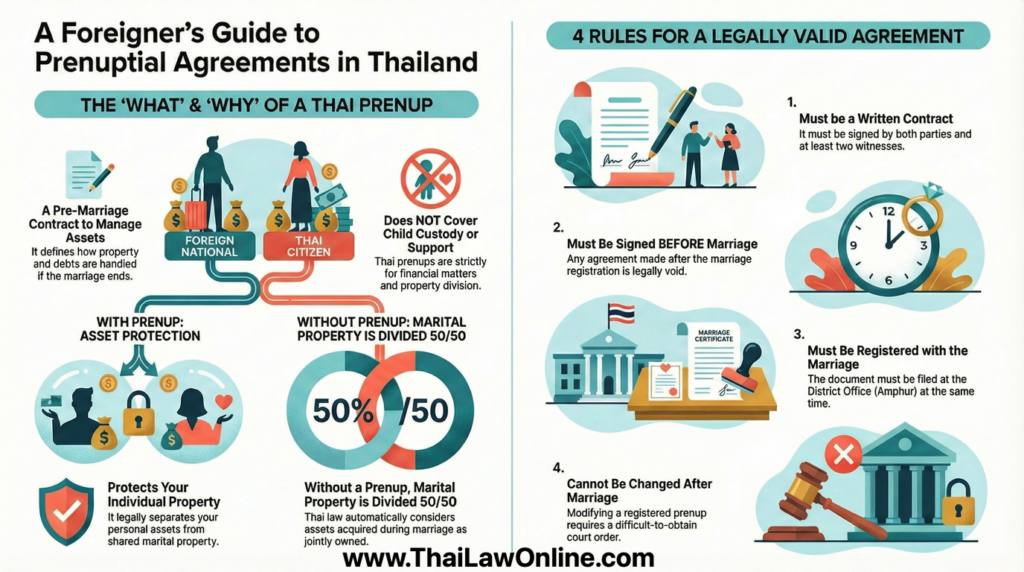
A Thai prenuptial agreement (สัญญาก่อนสมรส, sometimes written as สัญญาแต่งงาน, marriage contract) is a property contract signed by an engaged couple before they register their marriage at the District Office (ที่ว่าการอำเภอ, the Amphur). It defines what is each spouse’s separate property (สินส่วนตัว, sin suan tua) and what is marital property (สินสมรส, sin somros), and how each is managed during and after the marriage.
Three sections of the Thai Civil and Commercial Code govern Thai prenuptial agreements: Sections 1465, 1466 and 1467. Our companion article, Supreme Court Decisions on Prenuptial Agreements in Thailand, covers them in full legal detail with over 30 Deka decisions. The short version:
- Section 1465. A prenup may govern property only. It cannot regulate behaviour, fidelity, division of household duties, religion, or anything that violates Thai public policy.
- Section 1466. To be valid, the prenup must be (a) in writing, (b) signed by both spouses and at least two witnesses, and (c) registered together with the marriage (ทะเบียนสมรส) at the Amphur on the same day.
- Section 1467. Once registered, a prenup cannot be modified except by court order.
Section 1466 is the trap. A prenup signed before the wedding but not registered at the Amphur on the day of the marriage is void. Don’t let that happen.
Thai Marriage With a Prenup vs Without a Prenup
Thailand’s default rule for couples without a prenuptial agreement is set by Sections 1470 to 1474 of the Civil and Commercial Code: everything earned or acquired during the marriage is sin somros, marital property, split 50/50 in a divorce regardless of which spouse earned or paid for it. A properly drafted prenup changes this default. The table below shows what happens to common asset types in each case.
| Asset | Without Prenup (default Thai law) | With Prenup (typical clause) |
|---|---|---|
| Foreign property owned before marriage | Stays separate, but income from it during marriage becomes marital | Property and all income from it stay separate |
| Foreign salary earned during marriage | Marital property, 50/50 in divorce | Can be carved out as separate |
| Thai company shares bought before marriage | Stay separate, dividends become marital | Shares and dividends stay separate |
| Thai company shares bought during marriage | Marital, 50/50 | Can be designated separate |
| Inheritance received during marriage | Stays separate (Section 1471) | Same, plus income from it can be ringfenced |
| Gift from one spouse to the other | Stays separate | Same, plus traceability rules can be added |
| Pension or retirement account | Contributions made during marriage are marital | Can be designated entirely separate |
| Business started during marriage | Marital, 50/50 | Can be carved out, with profit-sharing terms |
| Trading account gains during marriage | Marital, 50/50 | Can be designated separate |
| Future inheritance after death of spouse | Per Sections 1635 to 1638 of CCC | Prenup does not override probate, but supports inheritance planning |
Who Needs a Prenup in Thailand?
Sign a Thai prenuptial agreement if any of these apply:
- You bring assets into the marriage from abroad: a property in your home country, a pension, business shares, retirement savings, a future inheritance.
- You own a Thai company, a condominium, or an investment portfolio in Thailand before marriage.
- This is a second marriage, or either of you has children from a previous relationship.
- There is a significant age, wealth, or income disparity between you and your fiancé(e).
- You and your fiancé(e) hold different nationalities and want clarity on which country’s law governs which assets.
- You operate a business that you want to keep separate from any future divorce settlement.
- You have signed a foreign prenuptial agreement abroad and need a Thai-registered counterpart.
Prenuptial Agreement Cost in Thailand: 8,900 THB Flat Fee
A standard ThaiLawOnline prenuptial agreement is drafted, translated, witnessed and registered for a flat fee of 8,900 THB. This includes:
- Initial consultation, online or in person.
- Bilingual drafting in Thai and English, or Thai and French.
- Two witnesses provided by us at signing.
- Accompaniment to the Amphur on the wedding day for registration.
- One round of revisions after your independent review.
Complex situations (international cross-border assets across more than one foreign jurisdiction, holding-company structures, prenups attached to existing trusts) may incur additional fees. We quote upfront before you commit. We do not bill by the hour for a prenuptial agreement.
How to Register a Prenup in Thailand: Step by Step
- Initial consultation, 30 to 60 minutes. We map your assets and goals.
- First draft delivered within 5 to 7 working days, in English (or French) and Thai.
- Independent review by you and your fiancé(e). We strongly recommend each side has independent legal advice. We will not represent both.
- Final draft signed in front of two witnesses, who we provide.
- Amphur registration on the wedding day. We accompany you to the District Office and present the prenup with the marriage registration. The registrar attaches it to the marriage record.
From first call to registered prenup: typically two to three weeks. Urgent cases can be compressed to one week.
What ThaiLawOnline Does for You
- Bilingual drafting. Thai is the only language the Amphur accepts. The English (or French) version is what you will rely on years later. Both must say exactly the same thing. Cheap translations cause expensive disputes.
- Asset inventory. We catalogue your separate property at the date of marriage, with valuations and documentary evidence, so it is unambiguously identified as sin suan tua later.
- Cross-border drafting. If you own assets in another jurisdiction, we draft choice-of-law and choice-of-forum clauses that hold up under both Thai and foreign court scrutiny. See Deka No. 1523/2565 for a recent Thailand to Sweden cross-border case.
- Avoidance of voidable clauses. Thai courts have voided dozens of prenups for clauses that try to regulate behaviour or apply foreign law. Our drafts steer clear of every category. See: What Not to Include in a Thai Prenuptial Agreement.
- Amphur attendance. We go with you to the District Office on the wedding day, hand over the documents, and deal with any registrar question on the spot. No translation gaps, no missing signatures, no rejected filings.
Prenuptial Agreements for Same-Sex Couples in Thailand
Thailand legalised same-sex marriage on 22 January 2025 (effective 23 January 2025) with the Marriage Equality Act, which amended Section 1448 of the Civil and Commercial Code to use the gender-neutral term “two persons” in place of “man and woman”. The same amendment touched the prenuptial agreement provisions: Sections 1465, 1466 and 1467 now apply identically to same-sex couples. Same-sex couples in Thailand can sign and register a Thai prenuptial agreement at the Amphur on the day of their marriage, on identical terms to opposite-sex couples. The 8,900 THB flat fee, the bilingual drafting, the witness requirements and the Amphur registration are unchanged. Sebastien’s firm has prepared prenups for the first wave of same-sex marriages registered in Bangkok in 2025.
What a Prenup Can Do About Gifts and Asset Transfers
Most people think of a prenuptial agreement as a document about what happens at divorce. Its more useful function is often what it does during the marriage — specifically, controlling who can move what.
The default rule you are varying
Without a prenup, CCC section 1476 governs. It lists the dealings with marital property (sin somros) that spouses must manage jointly or with the other’s consent — selling, exchanging, mortgaging, granting leases over three years, lending money, and, at subsection (5), making gratuitous gifts (hai doy sanaeha). A gift escapes the consent requirement only if it is both for charitable purposes, for social purposes, or in accordance with moral obligation, and proportionate to the family’s station in life.
If a spouse breaches this, section 1480 gives the other spouse the right to ask the court to revoke the transaction. That right is lost if the spouse ratifies the deal, if the third party acted in good faith and for value, or — critically — if more than one year passes from the date the spouse learned of the grounds, or ten years from the transaction.
Section 1476/1 is the important one for our purposes. It provides that spouses may manage marital property differently from section 1476, in whole or in part, only if they have made a prenuptial agreement under sections 1465 and 1466 — in which case management follows the agreement. Where the agreement covers only part of section 1476, the rest continues to be governed by section 1476. In other words, the prenup is the only instrument that can vary the consent regime, and it must exist before the marriage is registered.
What we can build into your agreement
- Notification and consent thresholds. A defined baht value above which any transfer, gift or disposal requires the other spouse’s written consent, regardless of how the asset is classified.
- Clear classification of assets. The single largest driver of these disputes is argument about whether an asset was sin suan tua or sin somros in the first place. A schedule of pre-marital assets, properly annexed, removes that argument.
- A defined meaning for “reasonable to the family’s station in life.” This phrase is the escape hatch in section 1476(5), and left undefined it is litigated. Agreeing a figure in advance is far cheaper than arguing it later.
- Disclosure obligations covering accounts and holdings, which shorten the evidence-gathering stage if a claim ever becomes necessary.
Why this is worth doing now
The Supreme Court’s decision in 139/2569 shows what the default regime costs when it is relied on. A wife recovered THB 1,431,731 that her husband had given away — but only after two levels of appeal, and interest ran only from the date of the first-instance judgment rather than from the transfer. The remedy exists; it is slow and it is incomplete. A prenup that defines consent thresholds up front is a cheaper instrument than a revocation action.
Note also that a Thai prenuptial agreement must be registered at the district office (Amphur) at the same time as the marriage. It cannot be added afterwards.
Talk to us about a prenuptial agreement before your registration date.
Common Pitfalls That Void a Thai Prenup
- Signed but not registered. Section 1466 is strict. Registration must happen at the same Amphur, on the same day as the marriage registration. Signing the day before is fine. Trying to add the prenup the day after is not.
- Wrong number of witnesses. Two witnesses, both signing in person, both physically present.
- Behaviour or fidelity clauses. “If my wife has an affair, she gets nothing” is unenforceable. Thai courts apply Section 1465 strictly: property only.
- Foreign-law clauses. “This agreement is governed by California law” is ignored. Thai courts apply Thai law to assets located in Thailand and to marriages registered in Thailand. Cross-border drafting handles this through narrower scope clauses.
- Post-marriage agreements. A property contract signed after the marriage is registered is a postnuptial agreement, not a prenup. Different rules apply, and most are unenforceable without court approval.
- Prenup translations done in-flight. Translation done at the Amphur on the wedding day, by a translator who has not seen the legal context, is the single most common cause of an unenforceable Thai prenup we see. Always translate in advance, with a lawyer reviewing both versions.
Tax Treatment of a Thai Prenuptial Agreement
A prenuptial agreement itself is not a taxable event in Thailand. Signing one does not trigger gift tax, stamp duty (other than nominal Amphur fees), or income tax. The agreement is filed alongside your marriage registration and incurs no separate tax filing.
Where tax does come into play: if your prenup involves transferring an asset (a property, shares) from one spouse to the other at the time of marriage, that transfer may be subject to Thai gift tax (5% above 20 million baht of the gift value, or 5% above 10 million for non-relatives) and possibly transfer registration fees if real property is involved. We flag this in the consultation and structure the prenup to minimise unnecessary tax exposure.
Prenuptial Agreement and Inheritance in Thailand
A Thai prenuptial agreement governs property during the marriage and at divorce. It does not, on its own, override Thai inheritance law. When a spouse dies, the surviving spouse’s rights are governed by Sections 1629, 1635 to 1638 and 1750 of the Civil and Commercial Code. The prenup interacts with inheritance in three ways: it identifies what was the deceased’s separate property at the date of death (so it is included in their estate, not divided 50/50 first), it can be referenced in a Thai will to ensure consistent treatment, and it removes ambiguity for foreign-law estates that involve Thai assets.
For a complete inheritance plan, pair your prenup with a Thai will. See our guide: Inheritance Law in Thailand: Complete Guide for Foreigners. We typically draft both documents in the same engagement.
International and Cross-Border Prenuptial Agreements
Common cross-border scenarios we draft for: a US citizen marrying a Thai national in Bangkok, with a US prenup already signed; an EU couple resident in Thailand who want one document covering Thai and EU assets; an Australian or UK national marrying in Thailand and intending to retire in their home country. In each case the structure is the same: a Thai prenup registered at the Amphur, mirrored by a foreign-law prenup signed in the home jurisdiction, with explicit cross-references so neither contradicts the other. The Thai Supreme Court has upheld this approach (Deka No. 1523/2565, Thailand to Sweden case). A foreign-only prenup, with no Thai counterpart, is unlikely to be enforced by a Thai court for assets in Thailand.
Why ThaiLawOnline
- 5,000+ client matters handled for expats and Thais since 2006.
- Founded and led by Sébastien H. Brousseau, LL.B., B.Sc., a Canadian lawyer admitted to the Bar of Quebec and the International Bar Association, living and working in Thailand since 2004. Founder of Isaan Lawyers (2007 to 2022) and one of the first foreign lawyers in Isaan.
- Trilingual team: English, French, Thai.
- All Thai legal advice and representation delivered through licensed members of the Lawyers Council of Thailand.
- 500+ published legal articles over the firm’s history. Author of the TM30 reform petition (BBC, Bangkok Post coverage).
Frequently Asked Questions
Is a prenuptial agreement legally enforceable in Thailand?
Yes, when properly drafted, witnessed, signed and registered at the Amphur on the day of the marriage. Sections 1465 to 1467 of the Thai Civil and Commercial Code recognise prenuptial agreements, and dozens of Thai Supreme Court decisions have upheld valid ones. The risk is procedural defects, not legal recognition.
How much does a prenuptial agreement cost in Thailand?
ThaiLawOnline charges a flat 8,900 THB for a standard bilingual prenup including drafting, witnesses, and Amphur registration. Complex international structures may add to the fee. We quote before you commit.
Do I need a lawyer to sign a prenuptial agreement in Thailand?
The law does not require a lawyer. The reality does. The Amphur accepts only Thai-language documents, the registration timing is unforgiving, and the list of clauses that void a prenup is not obvious from reading the Civil Code. A self-drafted or generic-template prenup is more likely to be void than valid. Independent legal advice for each spouse is best practice.
Can I change my prenuptial agreement after marriage?
Only by court order. Section 1467 makes prenups immutable once the marriage is registered, except where a Thai court approves modification. The path for changing arrangements after marriage is a separate postnuptial agreement, which is more limited in scope.
Is a prenuptial agreement made abroad valid in Thailand?
If you marry in Thailand, the prenup must be Thai-registered to be enforceable in a Thai court. A US, UK or other foreign prenup is evidence but not automatically enforceable. The safer route is a Thai prenup that mirrors your foreign agreement and is registered at the Amphur.
Can same-sex couples sign a prenup in Thailand after the 2024 marriage equality amendments?
Yes. The 2024 Marriage Equality Act amended Section 1448 of the Civil and Commercial Code to recognise marriage between two persons regardless of gender, and Sections 1465 to 1467 (governing prenuptial agreements) apply identically. Same-sex couples register their prenup at the Amphur on the wedding day, with the same requirements as opposite-sex couples. Effective from 23 January 2025.
Does a prenuptial agreement need to be in Thai?
The version registered at the Amphur must be in Thai. We always provide a parallel English (or French) text, both signed and equally authoritative between the spouses.
How many witnesses are required?
Two. Both must sign the document and be physically present at registration. We provide them.
What if my fiancé(e) refuses to sign a prenup?
That is a conversation, not a legal problem. We have helped clients explain prenups to skeptical Thai families, usually framed as inheritance protection for children from a previous marriage, or asset clarity for an existing business. A Thai-language explanation, drafted by a Thai lawyer on our team, often turns “no” into “yes”.
Can a prenup protect my Thai company shares?
Yes, with the right drafting. Shares in a Thai company you owned before marriage stay separate by default, but dividends paid during the marriage become marital property. A prenup can ringfence both the shares and the dividends. Shares acquired during the marriage are marital by default and need a specific prenup clause to be designated as separate.
What is the difference between a Thai prenup and an international prenup?
A Thai prenup is registered at a Thai Amphur and governs Thai-located assets and a Thai-registered marriage. An international prenup is signed in another jurisdiction and may govern assets there. For a couple marrying in Thailand with assets abroad, the right answer is usually both: a Thai prenup at the Amphur, mirrored by a foreign prenup signed in the home country, with cross-references so they do not contradict.
Get Your Prenuptial Agreement Drafted: 8,900 THB
If you are getting married in Thailand within the next few months, start now. Two to three weeks of lead time is comfortable. One week is workable. The day before is too late.
- Phone (English / Français): +66 87 225 1340
- Phone (ภาษาไทย): +66 87 414 9288
- Email: info@thailawonline.com
- Or: book a consultation online
Related reading:
- Supreme Court Decisions on Prenuptial Agreements in Thailand: full legal analysis with 30+ Deka decisions cited.
- What Not to Include in a Thai Prenuptial Agreement: clauses that void your prenup.
- Postnuptial Agreements in Thailand: if you are already married.
- Divorce in Thailand: Legal Process, Costs and Guide.
- Inheritance Law in Thailand: Complete Guide for Foreigners.
- Same-Sex Marriage in Thailand: Rights, Registration & the Marriage Equality Act.
Our fee for a prenuptial agreement
| Service | Fixed fee | What is included | Timeline |
|---|---|---|---|
| Prenuptial agreement | 8,900 THB | Bilingual agreement, lawyer-prepared, witnessed and registered at the Amphur. | 5 working days |
VAT (7%) excluded unless stated. Government disbursements charged at cost.
Book a consultation Answer within 24 hours EN · FR · TH
These fees come from one source and are the same everywhere on this site. See all our fees.
Try it yourself first, free
You do not have to book anything to get started. These run in your browser, and you only pay us if you decide you want a lawyer involved.
Legal Document Maker Gold members
Ten bilingual documents from a guided questionnaire, in the firm's own wording.
Open the toolAsk our AI assistant Free
Trained on Thai law and 84,000+ Supreme Court decisions. Ask anything, free.
Thai Law Updates, free by email
Plain-English updates on Thai law changes that affect foreigners: property, visas, marriage, business and wills. One short email a month from a firm practicing since 2006. No spam, unsubscribe anytime.