



Last updated on
Is Gay Marriage Legal in Thailand? Yes, Thailand legalized same-sex marriage on January 23, 2025. This makes Thailand the first Southeast Asian nation to grant marriage equality, and the third in Asia (after Taiwan and Nepal). If you’re planning to marry a same-sex partner in Thailand, relocate as a couple, or understand your rights here, this guide covers everything from the law itself to property rights, adoption, and cross-border recognition.
Table of Contents
Last reviewed: 30 September 2026. Read in Thai: Civil and Commercial Code sections 1448, 1453, 1461, 1465, 1466, 1514, 1515, 1536, 1598/19, 1598/25, 1598/26, 1630 and 1635; the Civil and Commercial Code Amendment Act (No. 24) B.E. 2567, sections 14 and 67; Nationality Act sections 9 to 11. The registration statistics, legislative vote counts, home-country recognition and the Apostille dates are reported, not read in a primary.
Selected registration, inheritance, medical-consent and fee statements were checked against official sources on 18 September 2026. This correction does not certify every older statement on the page. For registration documents and charges, consult the current DOPA guide.
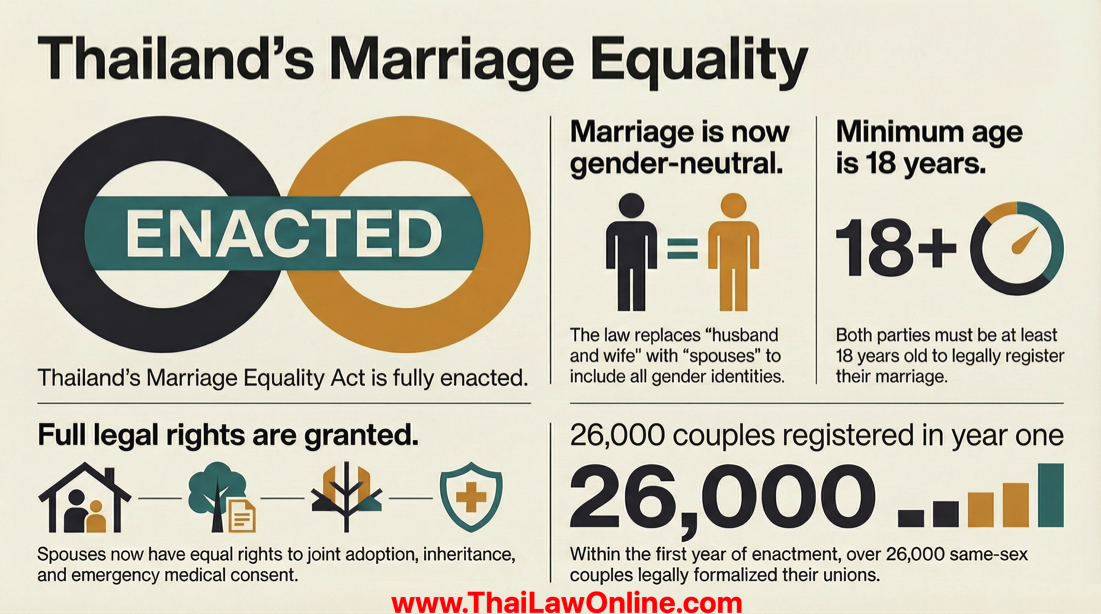
Thailand’s Marriage Equality Act: What Changed on January 23, 2025
The Marriage Equality Act B.E. 2567 (Amendment No. 24 to the Civil and Commercial Code) became law on September 24, 2024, and took effect on January 23, 2025. On that first day alone, 1,754 same-sex couples registered marriages. By January 2026, the number had reached 26,287.
Here’s what actually changed in the law. The Thai Civil and Commercial Code once defined marriage as between “husband and wife.” Those gendered terms excluded same-sex couples. The new law replaced those gendered terms with gender-neutral language throughout 60+ sections. “Spouses” replaced “husband and wife.” “Individuals” replaced “men and women.” The result is that Thai marriage law now applies equally regardless of the gender of either person.
The amendment touched seven core areas: marriage formation, marital property rights, inheritance and succession, spousal maintenance, parental power and adoption, divorce, and legitimacy of children. Most gendered wording was replaced, but not all of it, and the exceptions matter. Section 1453, the 310-day bar on remarriage, still reads as a rule about a woman whose male spouse has died remarrying a man. The presumption-of-paternity sections, 1536 to 1545, still speak of the man who is or was a spouse. Those provisions were not overlooked. The Act rewrote them and kept the sex-specific rule on purpose: section 14 of the Act replaced Sections 1452 and 1453 together, and nine of the ten sections from 1536 to 1545 were replaced as well, every one except 1540. What the rewrite did was put “the man who is, or was, a spouse” where the Code used to say “husband”, while leaving the rule itself addressed to a woman and a man. The gendering is a legislative choice rather than a drafting oversight, which is why some questions about a same-sex couple and a child born during the marriage do not yet have a clean statutory answer.
The Legislative Journey
This didn’t happen overnight. The House of Representatives voted 400 to 10 to pass the bill on March 27, 2024. The Senate voted 130 to 4 on June 18, 2024. It received Royal assent on August 12, 2024, and appeared in the Royal Gazette on September 24, 2024. That publication was the official trigger for implementation.
The registration date matters: a ceremony or cohabitation alone does not create the legal status of a registered spouse.
Rights Same-Sex Couples Now Have in Thailand
Property Rights (Sin Somros and Sin Suan Tua)
Thai law distinguishes two types of property in marriage: communal property (sin somros) and separate property (sin suan tua). This distinction matters for anyone buying property in Thailand as a couple.
Property classification depends on its source and the Civil and Commercial Code, not only the name on a deed. Salary savings acquired during marriage generally form marital property. Property received by inheritance or gift is generally separate, subject to the statutory exceptions; income from separate property is generally marital property. A valid prenuptial agreement also needs to be considered.
Sin suan tua is property owned before the marriage or inherited or gifted during the marriage. This stays separate. Same-sex spouses have the same right to keep sin suan tua separate as opposite-sex spouses.
On divorce, identify each spouse’s separate property, marital property and relevant debts before calculating the division. Section 1533 provides equal division of marital property. Any agreement relied on must be valid and applicable; a prenuptial agreement does not automatically validate every proposed arrangement.
We recommend a prenuptial agreement for any couple (same-sex or opposite-sex) who want to define property division differently. It must be registered at the district office to be valid.
Inheritance and Succession
Thai law gives spouses a statutory share of a deceased spouse’s estate, and a surviving same-sex spouse inherits exactly what any surviving spouse inherits. The size of that share is set by Section 1635, which was not amended because it already spoke of a surviving spouse rather than a husband or a wife. Section 1625 is the neighbouring rule and does a different job: it governs how the couple’s own property is divided between the deceased and the survivor before the estate is distributed at all.
Under Section 1635, the surviving spouse shares as a child where descendants inherit. Each surviving parent also shares as a child under Section 1630. The spouse takes one half where parents inherit without descendants, or where full siblings inherit; two thirds where the qualifying relatives are half siblings, grandparents or uncles and aunts; and the whole estate if no statutory relative qualifies. Establish the family tree before calculating shares. These intestacy rules do not create a compulsory share against a valid will.
Statutory inheritance follows a valid registered marriage and the applicable succession rules. A will helps specify beneficiaries and an estate administrator. Separate the survivor’s own share of marital property from the deceased’s estate before applying the will or intestacy rules.
Adoption
Section 1598/25 requires spousal consent where the prospective adopter or adoptee is married, subject to the court-permission exception. Section 1598/26 deals separately with a minor who already has an adoptive parent: a second adoption is permitted where the second adopter is the first adopter’s spouse. These are distinct rules. See Section 1598/25 and the DOPA adoption-registration guide.
For adoption of a minor, obtain the required Child Adoption Board approval before applying for registration. A district-office visit alone does not replace the child-adoption procedure. The adopter must be at least 25 and at least 15 years older than the adoptee; the required consents and other conditions also apply. Confirm the domestic or intercountry route before preparing documents.
Adoptive children have the same rights to inheritance, legitimacy, and family status as biological children. If you adopt a child and then divorce, both parents retain rights and obligations to the child. Same rules as opposite-sex couples.
Healthcare and Medical Decisions
A spouse has a recognised family relationship, but marriage does not give unlimited authority over the other spouse’s treatment. Section 8 of the National Health Act centres on the patient’s informed decision and provides exceptions for urgent or incapacity situations. Ask the treating hospital which consent and representation documents apply.
Record treatment wishes and emergency contacts in advance. A living will under Section 12 of the National Health Act concerns refusal of specified end-of-life treatment; it is not a general power to make every medical decision for another person. Read the National Health Act.
Spousal Visa and Immigration
For an extension based on marriage to a Thai national, prepare proof of the relationship, the Thai spouse’s nationality and the applicable financial evidence. The order distinguishes a Thai marriage record (Kor Ror 2) from a foreign marriage supported by a Thai family-status record (Kor Ror 22). A spouse’s recorded statement is part of the evidence; a generic consent letter is not a complete checklist. Check the relevant visa or extension procedure before filing.
The financial test differs by category. Clause 2.18(6) addresses a foreign husband in a marriage between a man and a woman; clause 2.18(7) allows either spouse or both combined to meet the test for a marriage between persons of diverse genders. This is not a universal advantage over every opposite-sex couple. See the table annexed to Immigration Bureau Order 12/2568, printed pages 14 to 15.
So the money does not have to be the foreign spouse’s. It can be the Thai spouse’s, or the two of you combined. The test itself is an average income over the year of not less than 40,000 THB a month, or 400,000 THB on deposit in a Thai commercial bank or a specialised state financial institution held throughout the two months before the application, or income and deposit added together reaching 400,000 THB for one year’s expenses. A couple who would fail on the foreign spouse’s finances alone may well pass on the pair of them, and that route exists only because sub-clause (7) was written for these marriages.
A visa and permission to stay are different documents. A qualifying spouse of a Thai national applies for an extension under the applicable immigration criteria; marriage does not itself grant a one-year stay. Check the current permission-to-stay stamp, eligibility and required evidence before applying.
Before and After the Marriage Equality Act
| Right | Before January 23, 2025 | After January 23, 2025 |
|---|---|---|
| Legal Marriage Registration | Not allowed for same-sex couples | Allowed; full marital rights apply |
| Communal Property (Sin Somros) | No legal recognition | Equal to opposite-sex spouses; 50/50 division on divorce |
| Inheritance Rights | No statutory share for same-sex partners | Surviving spouse inherits same share as opposite-sex surviving spouse |
| Adoption | Not available to same-sex couples | Available; same process as opposite-sex couples |
| Medical Decision-Making | Limited; no automatic spousal authority | Spousal relationship recognised; patient consent, capacity and applicable medical law still govern |
| Spousal Visa | Not available | Available; Non-Immigrant O visa on spousal basis |
| Spousal Maintenance | No obligation between same-sex partners | Equal obligation to provide maintenance (Section 1461) |
| Child Legitimacy | Limited rights for children of same-sex couples | Marriage is gender-neutral, but Sections 1536-1545 retain sex-specific paternity presumptions referring to the male spouse or former spouse. Parentage for a child born to one spouse during a same-sex marriage is not fully resolved by those sections; joint adoption by married spouses is separately available. |
| Divorce and Asset Division | No legal marriage to dissolve | Same divorce process and asset division as opposite-sex couples |
| Tax and Succession Planning | No spousal tax deductions or exemptions | Access to spousal succession rights and joint asset planning |
Spouse benefits: current entitlement and proposed alignment
Registered spouses of every gender qualify for Social Security survivor benefits on the same legal basis, subject to the conditions for the particular benefit. The Government’s August 2026 guidance covers death assistance, funeral expenses and the old-age lump sum. Keep the marriage certificate and beneficiary designation records current. Read the official Social Security guidance.
A separate Cabinet decision on 18 August 2026 approved in principle draft state-enterprise rules aligning spouse terminology for compensation, medical care and funeral benefits. Cabinet approval alone does not establish commencement. Before making a claim, check the final instrument and the employer’s applicable scheme. Read the Cabinet announcement.
Which Rights Did Not Follow the Certificate: Section 67
The Act that opened marriage did not rewrite every other statute. It handles them in one sweep. Section 67 paragraph 1 says that where any law, rule, regulation, by-law, requirement, local ordinance, notification, order or cabinet resolution refers to a husband, a wife, or husband and wife, that reference is read as covering spouses registered under the amended Civil and Commercial Code. Paragraph 2 then carves out the cases that matter most to a mixed-nationality couple:
“ความในวรรคหนึ่งมิให้นำมาใช้บังคับแก่กรณีที่บทบัญญัติแห่งกฎหมาย กฎ ระเบียบ ข้อบังคับ ข้อกำหนด ข้อบัญญัติ ประกาศ คำสั่ง หรือมติคณะรัฐมนตรีกำหนดสิทธิ หน้าที่ สถานะทางกฎหมาย หรือเรื่องอื่นใดที่เกี่ยวข้องกับสามี ภริยา หรือสามีภริยาไว้แตกต่างกัน”
Section 67 paragraph 2, Civil and Commercial Code Amendment Act (No. 24) B.E. 2567
In plain terms: the first paragraph does not apply where the older provision gives a husband and a wife different rights, duties or legal status. So the test is asymmetry. Where the old law treats spouses alike, a same-sex spouse is now inside it. Where it deliberately treats a husband differently from a wife, it stays as it was until the responsible ministry amends it. Two consequences are worth knowing before you plan around them.
Thai nationality through marriage is not one of the rights that transferred
The Nationality Act treats a husband and a wife differently, which is exactly what paragraph 2 preserves. Section 9 lets a foreign woman married to a Thai national apply for Thai nationality, with the Minister deciding. A foreign husband has no equivalent route: section 11(4), added by the Nationality Act (No. 4) B.E. 2551, only exempts him from two of the ordinary naturalisation requirements in section 10, the five years of continuous domicile and the Thai language test, so he still applies as a naturalisation case.
Neither provision is written for a same-sex spouse, and section 67 paragraph 2 does not carry either across. A foreign spouse in a same-sex marriage therefore applies for Thai nationality the ordinary way, under section 10, or builds towards permanent residence first. Our guide to Thai citizenship sets out both routes. A draft amendment that would make sections 9 to 11 gender-neutral was put to public consultation by the Department of Provincial Administration from 22 May to 21 June 2026. By the department’s own account on 14 June 2026 it had not gone to the government or Parliament, and it is not law.
The marriage extension applies its money test differently, and here that helps
The criteria annexed to Immigration Bureau Order 12/2568 of 23 January 2025 treat the two cases separately. Under clause 2.18(6), in a marriage between a man and a woman, the test falls on the alien husband: average income of at least 40,000 baht a month, or at least 400,000 baht held in a Thai bank for the two months before the application. A foreign wife of a Thai man faces no such test of her own.
Clause 2.18(7) covers a marriage between persons of diverse genders and sets the same figures, but lets either spouse alone, or both spouses combined, meet them. So a same-sex couple is tested where a foreign wife would not be, and may pool income or savings to pass. Anyone quoting the money test as falling on “the foreign applicant” is reading clause (6) at a couple that clause (7) governs. The marriage visa guide covers the rest of the requirements.
How Foreigners Can Register a Same-Sex Marriage in Thailand
If you’re a foreign national wanting to marry a Thai citizen or another foreigner in Thailand, the process is straightforward but document-heavy. We’ve written a detailed same-sex marriage registration guide as well. Here’s the step-by-step breakdown.
Step 1: Affidavit of Freedom to Marry
You need an affidavit from your home country proving you’re free to marry. That means you’re not already married, not underage, and not barred by law. This is called a Certificate of No Impediment or Freedom to Marry affidavit.
Check your embassy’s published procedure before booking. Requirements and appointments depend on nationality. For example, the British Embassy procedure involves an online application followed by an appointment with original documents. Do not assume every embassy offers a walk-in service.
Confirm the issuing authority and document language accepted for your nationality with the district office. Complete the required Thai translation and legalisation. An apostille is not a substitute for the current route before the Convention enters into force for Thailand.
Step 2: Translation and Legalization
Foreign documents used for marriage registration normally need a Thai translation and the authentication or legalization steps required for that document and nationality. District-office practice varies, so confirm the required form with the amphur before filing. Translation prices vary by provider.
The authentication route depends on the issuing country and document. Thailand deposited its instrument of accession to the Apostille Convention on 30 June 2026, but the Convention does not enter into force for Thailand until 28 February 2027. Until then, documents for use at a Thai district office generally remain subject to the applicable embassy and Ministry of Foreign Affairs legalization route. Confirm the current procedure with the district office and the Department of Consular Affairs before filing.
Allow time for embassy appointments, translations, legalisation and the registrar’s document checks. Confirm each appointment before fixing the registration date.
Step 3: District Office Registration
Once you have the translated, legalized affidavit (and your Thai partner’s ID and household registration if applicable), go to the district office where you want to marry.
Bring the identity and marital-status documents required for both parties, the translations and legalisations, and two witnesses. The ordinary minimum marriage age is 18, with a court-permission exception; minors also require the applicable consent. Foreign nationality requires a separate capacity and document check. A general health certificate is not on DOPA’s standard marriage-document list.
Once the district office accepts the registration, it issues the Thai marriage registration documents. An English translation is a separate step if you need one for use abroad. Government fees are nominal and local practice can differ.
Required Documents Checklist
- Passport (valid)
- Affidavit of Freedom to Marry from your embassy
- Translation of affidavit to Thai (certified translator)
- Legalisation required for the document and nationality under the current procedure
- Birth certificate (original or certified copy; may be required)
- Any additional document requested for a specific legal condition, confirmed with the registrar
- Marriage registration form (provided by district office)
- Thai spouse’s ID card and household registration (if marrying Thai citizen)
- Two witnesses, with the identity documents accepted by the registrar
Arrange an appointment after the registrar confirms the document set. Embassy appointments, legalisation and verification of foreign documents affect the total timetable; registration speed should not be promised before those steps are complete.
Prenuptial Agreements for Same-Sex Couples
A prenuptial agreement is optional. Use it to record property arrangements that Thai law permits, with advice on the proposed terms before marriage. Signing a document alone does not satisfy the registration formalities.
Under Section 1465, terms contrary to public order or good morals, or specifying foreign law for the property relationship, are void. Section 1466 requires the terms to be entered in the marriage register, or a written agreement signed by both parties and at least two witnesses to be annexed and recorded there, at marriage registration. Assess the substance as well as the form; a prenup is not blanket permission to override every property rule.
A prenuptial agreement is especially valuable if one spouse is significantly wealthier, if one has children from a previous relationship, if both own property before marrying, or if you’re concerned about creditor claims.
We draft prenuptial agreements for 8,900 THB. We review your assets, discuss your concerns, and draft language that protects both of you fairly. The agreement is then registered at the district office.
Same-Sex Divorce in Thailand
Same-sex divorce follows the exact same legal process as opposite-sex divorce. We cover the full process in our divorce in Thailand guide. There are two routes: mutual agreement divorce and contested divorce.
Divorce by mutual consent requires a written agreement signed by both spouses and at least two witnesses (Section 1514). For a couple married by registration, the divorce takes effect only when it is registered at the district office (Section 1515); signing the agreement alone does not end the marriage. Resolve property, debts and arrangements for children in the agreement. Do not assume the registrar settles a disputed claim or that every case will finish in a fixed number of minutes.
A contested divorce requires a court judgment on an applicable legal ground under Section 1516. Disagreement over money alone does not establish a ground for divorce. Property, parental authority and support require their own claims and evidence; neither the outcome nor the timetable is guaranteed.
On divorce, Section 1533 provides equal division of marital property. Separate property and relevant debts must be identified first. A prenuptial agreement needs a separate validity and scope check; its existence alone does not settle the division. Child arrangements require their own assessment.
For disputed property or child arrangements, obtain a written scope of work and fee quote before instructing a lawyer. Document preparation, negotiation and court representation are different services.
Broader LGBTQ+ Rights in Thailand
Gender Equality Act B.E. 2558 (2015)
Section 17 of the Gender Equality Act prohibits unfair gender discrimination by public bodies, private organisations and individuals. The Act has defined scope and exceptions; it is not an unconditional guarantee that every disputed decision is unlawful.
A discrimination complaint requires examination of the conduct, evidence and applicable statutory rules. Keep the decision, correspondence, dates and witness details. Do not assume the same remedy applies to an employment dispute, school admission and a refusal of service.
The Department of Women’s Affairs and Family Development receives complaints for the committee responsible for unfair gender discrimination. Court proceedings affect the available complaint route. Check the procedure before filing parallel claims. Read the Gender Equality Act translation.
Gender Recognition and Identity Documents
Marriage registration and changing the sex marker on identity documents are separate procedures. A marriage certificate is not itself an amendment to the identity register.
Before relying on a proposed gender-recognition reform, check the enacted text, commencement date and the issuing authority’s procedure. An older report about a bill does not establish the current rule for an identity card or passport.
Workplace Protections
An employment dispute requires separate review of labour rights, the employer’s stated reason and any evidence of unfair gender discrimination. Preserve the employment contract, dismissal notice and relevant messages before deciding which claim to bring.
For workplace complaints, contact the Department of Labour Protection and Welfare or obtain advice on the correct labour and discrimination procedures.
Will Your Same-Sex Marriage Be Recognized Back Home?
This is critical to understand before marrying in Thailand. Thai law recognizes your marriage, but your home country might not.
Countries that typically recognize Thai same-sex marriages: Canada, Australia, New Zealand, most of Western Europe (UK, France, Germany, Netherlands, Scandinavia), and many others. If you’re from one of these countries, your Thai same-sex marriage should be recognized. We still recommend checking with your embassy to be sure.
Countries with limited or no recognition: Some countries don’t recognize same-sex marriage at all (parts of Asia, Africa, Middle East). Some recognize it conditionally. Some recognize it for immigration purposes but not tax/inheritance purposes.
What you should do: Before marrying in Thailand, check with your home country’s embassy in Bangkok. Ask explicitly whether a Thai same-sex marriage will be recognized. Some countries recognize it automatically; others require registration or a court order. Get it in writing.
If your marriage won’t be recognized back home, consider what that means for inheritance, taxes, immigration, and property ownership in your home country. You might need separate legal documents (power of attorney, will, healthcare directive) in your home country to protect your spouse.
Do You Still Need a Will?
A will is optional. Without one, statutory succession rules apply. Consider a will if you want different beneficiaries or wish to nominate an estate administrator.
Thai inheritance law gives a surviving spouse a statutory share, but that share might not be what you want. If you have children from a previous relationship, if you own separate property you want to go to specific people, or if you want to ensure your spouse gets the most, a will is essential.
A will lets you override the statutory shares, name your spouse as executor, specify funeral wishes, and distribute specific items. Without a will, your estate goes through intestacy succession under Thai family law, which can take months and create family disputes.
We draft last wills for 3,900 THB. A standard private will is signed with the formalities required by Thai law and kept safely by the testator or another trusted person; district-office registration is not required for an ordinary private will. After death, the executor normally presents the will in the probate process.
Costs and Fees
DOPA states that marriage and divorce registration at a registry office carry no registration fee. Marriage registration outside the office has a 200-baht fee plus applicable travel costs; certified copies have separate charges. Embassy, translation, legalisation and legal-service charges are separate. Obtain a written quote identifying the service and whether representation is included. Read the official registration guide.
Frequently Asked Questions Is Gay Marriage Legal in Thailand
Is gay marriage legal everywhere in Thailand?
Yes. The Marriage Equality Act applies nationwide. Every district office in Thailand can register same-sex marriages. No district has an exemption.
What if my partner and I already cohabited before the law changed? Do we get automatic marriage rights?
No. Cohabitation (even for 20 years) does not create marriage rights in Thai law. You must formally register at a district office to be married. Even if you’d planned to marry eventually, register now to get the legal benefits.
Can we marry if one of us is not legally an adult in our home country but is 18 in Thailand?
The ordinary minimum under Thai law is 18, with a court-permission exception. A minor also needs the required consent. For a foreign national, marriage capacity and supporting documents require a nationality-specific check; age 18 alone does not settle every requirement.
Do we need witnesses to marry in Thailand?
Yes. DOPA’s standard marriage-document list requires two witnesses. Confirm their identity documents and any interpreter arrangements with the chosen district office. Do not assume office staff will be available to act as witnesses.
If we divorce, do we split everything 50/50?
Section 1533 provides equal division of marital property on divorce. First classify the assets and relevant debts: separate property does not enter the same division. Consider any valid applicable agreement and the statutory exceptions rather than assuming everything acquired during marriage is shared.
Can unmarried partners jointly adopt the same child?
An unmarried couple cannot jointly become two adoptive parents of the same minor under Section 1598/26. A person’s eligibility to adopt individually is a separate question, subject to the adoption law and approval process.
What if one spouse is Thai and the other is a foreigner? Does that change anything?
Registered spouses have the same marital status regardless of gender. Foreign nationality still affects matters such as land ownership, immigration, marriage capacity and documents. Marriage to a Thai national does not remove those separate restrictions.
Is there a marriage registry or public record showing we’re married?
The district office keeps marriage records and issues certificates or certified extracts through its procedures. Ask the registrar what identity, authority and supporting documents are required for a copy; do not assume any member of the public has unrestricted access.
Does a surviving spouse receive a compulsory share if a will leaves everything elsewhere?
No general compulsory spousal share overrides a valid will disposing of the estate. Section 1608 permits exclusion of statutory heirs. The survivor’s own marital-property entitlement must first be separated from the estate under Section 1625. A will might still be challenged on a recognised legal ground, such as defective form or lack of capacity; being omitted is not by itself proof of invalidity.
Can we get married in Thailand and then move back to our home country with that marriage recognized?
It depends on your home country. Many will recognize it; others won’t. Always check with your embassy before marrying. If recognition is uncertain, bring your Thai marriage certificate and have it officially registered or recognized in your home country when you arrive.
How ThaiLawOnline Can Help
We assist couples with marriage-registration documents, prenuptial agreements, wills, divorce and related immigration questions. The required work depends on nationality, documents, property and family circumstances. Agree the scope and fees before instructing us.
Here’s what we offer:
- Marriage Registration Assistance: We prepare your documents, translate and legalize them, and accompany you to the district office.
- Prenuptial Agreement Drafting: 8,900 THB. We draft a tailored agreement, register it, and explain your options.
- Last Will and Testament: 3,900 THB. We draft a will ensuring your spouse is protected and your wishes are clear.
- Divorce Support: Fees quoted for the agreed scope. We draft the divorce agreement or represent you in court if contested.
- Spousal Visa Assistance: We guide you through the Non-Immigrant O visa process.
All of our work is reviewed by Thai-qualified lawyers. We handle marriage equality cases confidently and professionally. Contact us at info@thailawonline.com or call +66 8 7225 1340.
Thai Law Updates, free by email
Plain-English updates on Thai law changes that affect foreigners: property, visas, marriage, business and wills. One short email a month from a firm practicing since 2006. No spam, unsubscribe anytime.