


Reviewed by Wichuda Atthamethakon, LL.M., Thai Bar Licence 3149/2556, for ThaiLawOnline, a Thai law firm acting for foreigners since 2006.
Update log
- 4 November 2026: Added the statute box with Thai, English and French text and checked the page against the official text
Thailand attracts thousands of foreigners each year. Many are retirees from the US and UK. Others are digital nomads from Europe. Some are entrepreneurs from Asia. Families also move there to start a new life. But behind the beautiful beaches and low cost of living, there is a legal system that works very differently.
LAWYER-DRAFTED TEMPLATE · ฿390
Vehicle Sale Agreement (Bilingual English & Thai)
Blue book checks, finance payoff at the counter, the DLT transfer deadline, and who pays fines before and after delivery, with the foreigner registration route explained. Word + PDF, updated August 2026. สัญญาซื้อขายรถ ฉบับสองภาษา
This guide covers what you need to know about living in Thailand as a foreigner. It explains which visa fits your situation. It covers how property ownership works. It explains what happens to your money and assets. It also explains how Thai family, business, and criminal law affect you. Every section links to our detailed guides so you can go as deep as you need.
Whether you are moving to Thailand for the first time, retiring as an expat, or starting a business, this page is your legal roadmap.
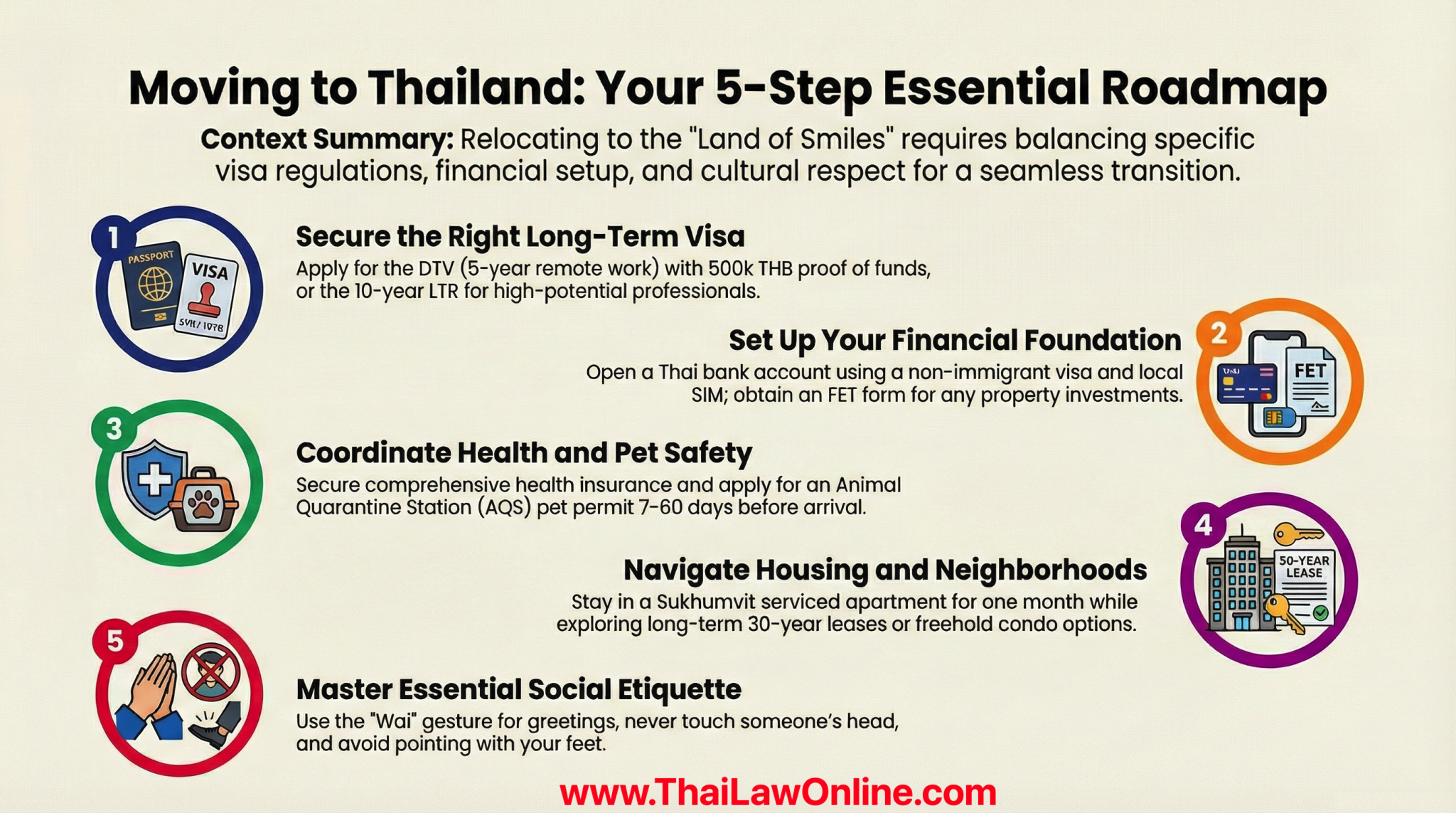
Table of Contents
Visas and Immigration, Finding the Right Way to Stay in Thailand
First Steps: What to Do Before You Move
The first question every foreigner faces is: “Which visa do I need?” Thailand offers more options than most people realize, and choosing the wrong one can cost you time, money, and legal headaches. Here is an overview of every major visa category, who it is for, and what it requires.
Tourist Visas and Short-Term Entry
For a short visit you may not need a visa. Citizens of many countries get a visa exemption on arrival, and it is 30 days for entries from 15 September 2026 (it was 60 days for entries up to 14 September 2026). For longer tourist stays, Thailand offers a dedicated tourist visa.
- Thailand Tourist Visa Guide, eligibility, duration, extensions, and costs
- Thailand Electronic Travel Authorization (ETA), the new digital entry system
- Thailand Digital Arrival Card, replacing the old TM.6 paper form
- Border Runs and Limits in Thailand, what happens if you overstay or do back-to-back entries
Long-Term Visas for Expats
For foreigners who plan to live in Thailand long term, there are several visa types. These depend on your situation, like retirement, work, marriage, investment, or remote work.
| Visa Type | Who It’s For | Duration | Key Requirement | Guide |
|---|---|---|---|---|
| Retirement Visa (O-A / O-X) | Foreigners aged 50+ | 1 year (renewable) | 800,000 THB in Thai bank or 65,000 THB/month income | Retirement Extension Guide |
| Thailand Privilege (Elite) Visa | Anyone with budget | 5-20 years | 650,000 THB (Bronze, 5 years) to 5,000,000 THB (Reserve, 20 years), one-time membership fee | Thailand Privilege Visa Guide |
| Long-Term Resident (LTR) Visa | High earners, retirees, specialists | 10 years | Income or investment thresholds | Thailand LTR Visa |
| Destination Thailand Visa (DTV) | Digital nomads, remote workers | 5 years multiple-entry; 180 days per entry, extendable once to 360 days | Proof of remote work or freelance income | DTV Requirements |
| Non-Immigrant B (Business) | Employees, business owners | 90 days → 1 year extension | Job offer or company sponsorship | Non-B Business Visa |
| Marriage/Spouse Visa (O) | Married to a Thai national | 1 year (renewable) | 400,000 THB in Thai bank or 40,000 THB/month | Spouse and Dependent Visas |
| Student Visa (ED) | Enrolled in Thai institution | Duration of studies | Enrollment confirmation | Student Visa in Thailand |
| Volunteer Visa | Volunteer workers | Duration of program | Sponsorship from Thai organization | Volunteer Visas |
Which visa is right for you? Use our Thai Visa Finder Tool for a personalized recommendation based on your age, income, nationality, and purpose.
Permanent Residency and Thai Citizenship
If you plan to stay in Thailand indefinitely, you may eventually want permanent residency or citizenship. Both are possible but require several years of legal residence, Thai language ability, and meeting financial thresholds.
- How to Get Permanent Residency in Thailand, requirements, quotas, and the application process
- Thai Citizenship, naturalization requirements, dual citizenship rules, and the application timeline
Essential Immigration Admin
Once you live in Thailand on a long-term visa, you must meet ongoing reporting and compliance rules. Many foreigners miss them.
- 90-Day Reporting, mandatory address reporting every 90 days for foreigners who stay longer than 90 days
- TM30 Notification, your landlord’s obligation to report your address within 24 hours
- TM30 History and Regulation, why this rule exists and how enforcement has changed
- Re-Entry Permit, you need one of these before leaving Thailand or your visa extension is canceled
- Latest Immigration Updates, new rules, policy changes, and enforcement trends
- Thailand Visa Reform 2025, recent overhaul of the visa system
- New Visa Rules in Thailand, what changed and what it means for expats
The law behind this page
English
Section 34 Immigration Act B.E. 2522
Full text
An alien who may enter the Kingdom temporarily must enter for the following purposes: (1) performing diplomatic or consular duties; (2) performing official government duties; (3) tourism; (4) sports; (5) business; (6) investment approved by the relevant ministries, sub-ministries and departments; (7) investment or other activities relating to investment, subject to the law on investment promotion; (8) transit through the Kingdom; (9) acting as the person in charge of, or as crew of, a conveyance arriving at a port, station or locality in the Kingdom; (10) study or observation visits; (11) performing mass media duties; (12) religious missionary work approved by the relevant ministries, sub-ministries and departments; (13) scientific research or training and teaching in a research institution or educational institution in the Kingdom; (14) performing work as a skilled craftsman or expert; (15) other purposes prescribed in ministerial regulations.
ThaiLawOnline translation
Section 37 Immigration Act B.E. 2522
Full text
An alien permitted to stay in the Kingdom temporarily must comply with the following: (1) not engage in an occupation or work for hire, unless permitted under the law on foreign business or the law on the management of alien employment; (2) reside at the place notified to the competent official, except that where there is reasonable cause preventing residence at the notified place, the alien shall notify the competent official of the change of residence within 24 hours from the time of taking up residence; (3) notify a police officer at the local police station where the alien resides within 24 hours from the time of moving, in case of a change of residence, and if the new residence is in a different locality from the original local police station, the alien must also notify a police officer at the local police station of the new residence within 24 hours from the time of arrival; (4) if travelling to any province and staying in that province for more than 24 hours, notify a police officer at the local police station within 48 hours from the time of arrival; (5) if staying in the Kingdom for more than 90 days, notify the competent official at the Immigration Division in writing of the alien's place of residence without delay upon completing the 90-day period, and do the same every 90 days thereafter. In a locality where an immigration office is located, the notification may be made to the competent official at that immigration office. Whether (3) and (4) shall not apply to any case under section 34, and on what conditions, shall be as the Director-General prescribes. A notification under this section may be made by the alien in person or in writing to the competent official, in accordance with rules prescribed by the Director-General.
ThaiLawOnline translation
Section 39 Immigration Act B.E. 2522
Full text
If an alien permitted to stay in the Kingdom temporarily travels out of the Kingdom, that permission is deemed to have ended. However, if before leaving the Kingdom the alien obtained permission from the competent official to re-enter the Kingdom, and the alien re-enters the Kingdom without being a prohibited person under section 12, then, if any of the permitted period of stay remains, the alien may stay in the Kingdom for the remaining period. To apply for permission to re-enter the Kingdom, the alien shall file an application in the prescribed form and pay the fee at the rate and under the rules prescribed in ministerial regulations.
ThaiLawOnline translation
Section 86 Limitation of Aliens Right in Land
Full text
An alien may acquire land only by virtue of the provisions of a treaty which provides that ownership of immovable property may be held, and subject also to the provisions of this Code. Subject to section 84, such an alien may acquire land for residential, commercial, industrial, agricultural, cemetery, public charity or religious purposes only in accordance with the conditions and procedure prescribed by ministerial regulation, and permission must be obtained from the Minister.
Unofficial translation by the Office of the Council of State
Section 19 bis Condominium Act B.E. 2522
Full text
In each condominium, the units held in ownership by the aliens or juristic persons specified in section 19 must not, taken together, exceed 49 percent of the area of all the units in that condominium at the time the application to register the condominium under section 6 is made.
ThaiLawOnline translation
Section 8 Emergency Decree on Managing the Work of Foreigners B.E. 2560
Full text
An alien is prohibited from working without a work permit, or from doing work beyond what the alien has the right to do, in violation of this Emergency Decree.
ThaiLawOnline translation
Section 1466
Full text
A prenuptial agreement is void unless either: (a) the terms agreed as the prenuptial agreement are entered in the marriage register at the time the marriage is registered; or (b) it is made in writing, signed by the spouses and by at least two witnesses, and annexed to the marriage register, and an entry stating that the agreement is annexed is made in the marriage register at the time the marriage is registered.
ThaiLawOnline translation
Section 1629
There are only six classes of statutory heirs, entitled in this order, subject to Section 1630 paragraph 2: (1) descendants; (2) parents; (3) full-blood siblings; (4) half-blood siblings; (5) grandparents; (6) uncles and aunts. The surviving spouse is also a statutory heir, subject to the special provisions of Section 1635.
Full text
There are only six classes of statutory heirs and, subject to section 1630 paragraph two, each class is entitled to inherit in the following order of priority: (1) descendants; (2) parents; (3) brothers and sisters of the full blood; (4) brothers and sisters of the half blood; (5) grandparents; (6) uncles and aunts. The surviving spouse is also a statutory heir, subject to the special provisions of section 1635.
ThaiLawOnline translation
ไทย
มาตรา 34 พระราชบัญญัติคนเข้าเมือง พ.ศ. 2522
ข้อความเต็ม
คนต่างด้าวซึ่งจะเข้ามาในราชอาณาจักรเป็นการชั่วคราวได้จะต้องเข้ามาเพื่อการดังต่อไปนี้ (๑) การปฏิบัติหน้าที่ทางทูตหรือกงสุล (๒) การปฏิบัติหน้าที่ทางราชการ (๓) การท่องเที่ยว (๔) การเล่นกีฬา (๕) ธุรกิจ (๖) การลงทุนที่ได้รับความเห็นชอบจากกระทรวงทบวงกรมที่เกี่ยวข้อง (๗) การลงทุนหรือการอื่นที่เกี่ยวกับการลงทุนภายใต้บังคับกฎหมายว่าด้วยการส่งเสริมการลงทุน (๘) การเดินทางผ่านราชอาณาจักร (๙) การเป็นผู้ควบคุมพาหนะหรือคนประจำพาหนะที่เข้ามายังท่าสถานี หรือท้องที่ในราชอาณาจักร (๑๐) การศึกษาหรือดูงาน (๑๑) การปฏิบัติหน้าที่สื่อมวลชน (๑๒) การเผยแพร่ศาสนาที่ได้รับความเห็นชอบจากกระทรวงทบวงกรมที่เกี่ยวข้อง (๑๓) การค้นคว้าทางวิทยาศาสตร์หรือฝึกสอนในสถาบันการค้นคว้าหรือสถาบันการศึกษาในราชอาณาจักร (๑๔) การปฏิบัติงานด้านช่างฝีมือหรือผู้เชี่ยวชาญ (๑๕) การอื่นตามที่กำหนดในกฎกระทรวง
ตรงตามข้อความในราชกิจจานุเบกษา / สำนักงานคณะกรรมการกฤษฎีกา (Verbatim from the Royal Gazette / Office of the Council of State)
มาตรา 37 พระราชบัญญัติคนเข้าเมือง พ.ศ. 2522
ข้อความเต็ม
คนต่างด้าวซึ่งได้รับอนุญาตให้อยู่ในราชอาณาจักรเป็นการชั่วคราว ต้องปฏิบัติดังต่อไปนี้ (๑) ไม่ประกอบอาชีพหรือรับจ้างทำงาน เว้นแต่จะได้รับอนุญาตตามกฎหมายว่าด้วยการประกอบธุรกิจของคนต่างด้าวหรือกฎหมายว่าด้วยการบริหารจัดการการทำงานของคนต่างด้าว (๒) พักอาศัย ณ ที่ที่ได้แจ้งต่อพนักงานเจ้าหน้าที่ เว้นแต่ในกรณีที่มีเหตุผลสมควรไม่สามารถพักอาศัย ณ ที่ที่ได้แจ้งต่อพนักงานเจ้าหน้าที่ ให้แจ้งการเปลี่ยนที่พักอาศัยต่อพนักงานเจ้าหน้าที่ภายในยี่สิบสี่ชั่วโมงนับแต่เวลาที่เข้าพักอาศัย (๓) แจ้งต่อเจ้าพนักงานตำรวจ ณ สถานีตำรวจท้องที่ที่คนต่างด้าวผู้นั้นพักอาศัยภายในยี่สิบสี่ชั่วโมงนับแต่เวลาที่ย้ายไป ในกรณีเปลี่ยนที่พักอาศัย และถ้าที่พักอาศัยใหม่อยู่ต่างท้องที่กับสถานีตำรวจท้องที่เดิม คนต่างด้าวผู้นั้นต้องแจ้งต่อเจ้าพนักงานตำรวจ ณ สถานีตำรวจท้องที่ที่ไปพักอาศัยใหม่ภายในยี่สิบสี่ชั่วโมงนับแต่เวลาที่ไปถึงด้วย (๔) ถ้าเดินทางไปจังหวัดใดและอยู่ในจังหวัดนั้นเกินยี่สิบสี่ชั่วโมง ให้คนต่างด้าวผู้นั้นแจ้งต่อเจ้าพนักงานตำรวจ ณ สถานีตำรวจท้องที่ภายในสี่สิบแปดชั่วโมงนับแต่เวลาที่ไปถึง (๕) ถ้าอยู่ในราชอาณาจักรเกินเก้าสิบวัน คนต่างด้าวผู้นั้นต้องมีหนังสือแจ้งให้พนักงานเจ้าหน้าที่ ณ กองตรวจคนเข้าเมืองทราบถึงที่พักอาศัยของตนโดยมิชักช้าเมื่อครบระยะเก้าสิบวัน และต่อไปให้กระทำเช่นเดียวกันทุกระยะเก้าสิบวัน ถ้าท้องที่ใดมีที่ทำการตรวจคนเข้าเมืองตั้งอยู่ จะแจ้งต่อพนักงานเจ้าหน้าที่ ณ ที่ทำการตรวจคนเข้าเมืองแห่งนั้นก็ได้ ความใน (๓) และ (๔) จะมิให้ใช้บังคับแก่กรณีใดตามมาตรา ๓๔ โดยเงื่อนไขอย่างใด ให้เป็นไปตามที่อธิบดีกำหนด การแจ้งตามมาตรานี้ คนต่างด้าวอาจไปแจ้งด้วยตนเองหรือมีหนังสือแจ้งต่อพนักงานเจ้าหน้าที่ก็ได้ ทั้งนี้ ตามระเบียบที่อธิบดีกำหนด
ตรงตามข้อความในราชกิจจานุเบกษา / สำนักงานคณะกรรมการกฤษฎีกา (Verbatim from the Royal Gazette / Office of the Council of State)
มาตรา 39 พระราชบัญญัติคนเข้าเมือง พ.ศ. 2522
ข้อความเต็ม
คนต่างด้าวซึ่งได้รับอนุญาตให้อยู่ในราชอาณาจักรเป็นการชั่วคราว หากเดินทางออกไปนอกราชอาณาจักร ให้ถือว่าการได้รับอนุญาตให้อยู่ในราชอาณาจักรเป็นการชั่วคราวดังกล่าวเป็นอันสิ้นสุด แต่ถ้าก่อนเดินทางออกไปนอกราชอาณาจักร ได้รับอนุญาตจากพนักงานเจ้าหน้าที่ให้กลับเข้ามาในราชอาณาจักรได้อีก และคนต่างด้าวนั้นได้กลับเข้ามาในราชอาณาจักรโดยไม่เป็นผู้ต้องห้ามตามมาตรา ๑๒ ถ้าระยะเวลาที่ได้รับอนุญาตให้อยู่ในราชอาณาจักรยังมีเหลืออยู่ ให้อยู่ในราชอาณาจักรต่อไปได้เท่าระยะเวลาที่ยังเหลืออยู่นั้น การขออนุญาตเพื่อกลับเข้ามาในราชอาณาจักรอีก ให้คนต่างด้าวยื่นคำขอตามแบบและเสียค่าธรรมเนียมตามอัตราและหลักเกณฑ์ที่กำหนดในกฎกระทรวง
ตรงตามข้อความในราชกิจจานุเบกษา / สำนักงานคณะกรรมการกฤษฎีกา (Verbatim from the Royal Gazette / Office of the Council of State)
มาตรา 86
ข้อความเต็ม
คนต่างด้าวจะได้มาซึ่งที่ดินก็โดยอาศัยบทสนธิสัญญาซึ่งบัญญัติให้มีกรรมสิทธิ์ในอสังหาริมทรัพย์ได้ และอยู่ในบังคับบทบัญญัติแห่งประมวลกฎหมายนี้ด้วย ภายใต้บังคับมาตรา ๘๔ คนต่างด้าวดังกล่าวจะได้มาซึ่งที่ดินเพื่อใช้เป็นที่อยู่อาศัย ประกอบกิจการในทางพาณิชยกรรม อุตสาหกรรม เกษตรกรรม การสุสาน การกุศลสาธารณะ หรือการศาสนา ต้องเป็นไปตามเงื่อนไขและวิธีการซึ่งกำหนดโดยกฎกระทรวง และต้องได้รับอนุญาตจากรัฐมนตรี
ตรงตามข้อความในราชกิจจานุเบกษา / สำนักงานคณะกรรมการกฤษฎีกา (Verbatim from the Royal Gazette / Office of the Council of State)
มาตรา 19 ทวิ พระราชบัญญัติอาคารชุด พ.ศ. 2522
ข้อความเต็ม
อาคารชุดแต่ละอาคารชุดจะมีคนต่างด้าวหรือนิติบุคคลตามที่ระบุไว้ในมาตรา ๑๙ ถือกรรมสิทธิ์ในห้องชุดได้เมื่อรวมกันแล้วต้องไม่เกินอัตราร้อยละสี่สิบเก้าของเนื้อที่ของห้องชุดทั้งหมดในอาคารชุดนั้นในขณะที่ขอจดทะเบียนอาคารชุดตามมาตรา ๖
ตรงตามข้อความในราชกิจจานุเบกษา / สำนักงานคณะกรรมการกฤษฎีกา (Verbatim from the Royal Gazette / Office of the Council of State)
มาตรา 8 พระราชกำหนดการบริหารจัดการการทำงานของคนต่างด้าว พ.ศ. 2560
ข้อความเต็ม
ห้ามคนต่างด้าวทำงานโดยไม่มีใบอนุญาตทำงานหรือทำงานนอกเหนือจากที่มีสิทธิจะทำได้อันเป็นการฝ่าฝืนพระราชกำหนดนี้
ตรงตามข้อความในราชกิจจานุเบกษา / สำนักงานคณะกรรมการกฤษฎีกา (Verbatim from the Royal Gazette / Office of the Council of State)
มาตรา 1466
ข้อความเต็ม
สัญญาก่อนสมรสเป็นโมฆะ ถ้ามิได้จดแจ้งข้อตกลงกันเป็นสัญญาก่อนสมรสนั้นไว้ในทะเบียนสมรสพร้อมกับการจดทะเบียนสมรส หรือมิได้ทำเป็นหนังสือลงลายมือชื่อคู่สมรสและพยานอย่างน้อยสองคนแนบไว้ท้ายทะเบียนสมรส และได้จดไว้ในทะเบียนสมรสพร้อมกับการจดทะเบียนสมรสว่าได้มีสัญญานั้นแนบไว้
ตรงตามข้อความในราชกิจจานุเบกษา / สำนักงานคณะกรรมการกฤษฎีกา (Verbatim from the Royal Gazette / Office of the Council of State)
มาตรา 1629
ข้อความเต็ม
ทายาทโดยธรรมมีหกลำดับเท่านั้น และภายใต้บังคับแห่งมาตรา ๑๖๓๐ วรรคสอง แต่ละลำดับมีสิทธิได้รับมรดกก่อนหลังดังต่อไปนี้ คือ (๑) ผู้สืบสันดาน (๒) บิดามารดา (๓) พี่น้องร่วมบิดามารดาเดียวกัน (๔) พี่น้องร่วมบิดาหรือร่วมมารดาเดียวกัน (๕) ปู่ ย่า ตา ยาย (๖) ลุง ป้า น้า อา คู่สมรสที่ยังมีชีวิตอยู่นั้นก็เป็นทายาทโดยธรรม ภายใต้บังคับของบทบัญญัติพิเศษแห่งมาตรา ๑๖๓๕
ตรงตามข้อความในราชกิจจานุเบกษา / สำนักงานคณะกรรมการกฤษฎีกา (Verbatim from the Royal Gazette / Office of the Council of State)
Français
Article 34 Immigration Act B.E. 2522
L'étranger ne peut entrer temporairement dans le Royaume que pour les motifs énumérés, notamment fonctions diplomatiques ou officielles, tourisme, sport, affaires, investissement approuvé, transit, études, médias, recherche, missions religieuses approuvées, travaux de spécialiste, ou tout autre motif fixé par règlement ministériel.
résumé non officiel
Article 37 Immigration Act B.E. 2522
L'étranger en séjour temporaire ne peut travailler sans autorisation, doit résider à l'adresse déclarée, signaler tout changement sous 24 heures, tout séjour de plus de 24 heures dans une province sous 48 heures, et déclarer sa résidence tous les 90 jours, en personne ou par écrit.
résumé non officiel
Article 39 Immigration Act B.E. 2522
Quitter le territoire met fin au séjour temporaire. Si l'étranger a obtenu avant son départ une autorisation de retour et revient sans être frappé d'interdiction selon l'article 12, il peut rester pour la durée restante.
résumé non officiel
Article 86
Un étranger ne peut acquérir un terrain qu'en vertu des dispositions d'un traité qui permet d'avoir la propriété d'un bien immobilier, et sous réserve également des dispositions du présent Code. Sous réserve de l'article 84, cet étranger ne peut acquérir un terrain à usage d'habitation, d'activité commerciale, industrielle ou agricole, de cimetière, de bienfaisance publique ou de culte que conformément aux conditions et à la procédure fixées par règlement ministériel, et il doit obtenir l'autorisation du Ministre.
résumé non officiel
Article 19 bis Condominium Act B.E. 2522
Dans chaque immeuble en copropriété, les lots détenus par les étrangers ou personnes morales de l'article 19 ne peuvent excéder au total 49 % de la superficie de tous les lots, calculée au moment de la demande d'enregistrement prévue à l'article 6.
résumé non officiel
Article 8 Emergency Decree on Managing the Work of Foreigners B.E. 2560
Il est interdit à l'étranger de travailler sans permis de travail ou au-delà de ce qu'il a le droit de faire, en violation du présent décret.
résumé non officiel
Article 1466
Le contrat de mariage est nul, à moins que les stipulations convenues à titre de contrat de mariage n'aient été inscrites au registre des mariages lors de l'enregistrement du mariage, ou qu'il n'ait été établi par écrit, signé par les époux et par au moins deux témoins, annexé au registre des mariages, et que mention de cette annexe n'ait été portée au registre des mariages lors de l'enregistrement du mariage.
résumé non officiel
Article 1629
Il n'existe que six ordres d'héritiers légaux et, sous réserve de l'article 1630, alinéa deux, chaque ordre est appelé à la succession selon le rang de priorité suivant : (1) les descendants ; (2) les père et mère ; (3) les frères et sœurs germains ; (4) les frères et sœurs consanguins ou utérins ; (5) les grands-parents paternels et maternels ; (6) les oncles et tantes. Le conjoint survivant est également héritier légal, sous réserve des dispositions particulières de l'article 1635.
résumé non officiel
Supreme Court decisions
Sources
- Immigration Act B.E. 2522, retrieved 31 October 2026
- Land Code, Office of the Council of State, retrieved 31 October 2026
- Condominium Act B.E. 2522, retrieved 31 October 2026
- Emergency Decree on Managing the Work of Foreigners B.E. 2560, retrieved 31 October 2026
- Civil and Commercial Code, Office of the Council of State, retrieved 31 October 2026
- deka.supremecourt.or.th, Supreme Court of Thailand decisions database (copy held in our library), retrieved 19 February 2026
Property and Real Estate, Can Foreigners Own Property in Thailand?
The short answer is: foreigners cannot own land in Thailand directly. The Land Code (Section 86) restricts land ownership to Thai nationals. But there are several legal options that give foreigners secure property rights. You just need to know which one fits you.
Buying a Condominium
Foreigners can own condominiums in their own name under the Condominium Act B.E. 2522. The building must maintain at least 51% Thai ownership, so the remaining 49% is available for foreign freehold purchase.
- Buying a Condominium in Thailand, legal requirements, foreign quota, and the purchase process
- Buying Property in Thailand, broader overview including houses, villas, and commercial property
- Property Guide for Foreigners, step-by-step guide from search to transfer
Buying a House or Land
Foreigners cannot own land. They can own a building (house) on the land. They can also get long-term land rights through a lease, usufruct, or similar legal option.
- Buying a House in Thailand, how to structure the purchase legally
- Can Foreigners Own a House in Thailand?, the legal reality explained plainly
- Foreigners Buying Land in Thailand, why you cannot, and what alternatives exist
- Foreign Ownership Restrictions, the complete legal framework
Leases, Usufructs, and Land Rights
If you are not buying a condo, you should know the legal tools that give foreigners long-term security over land and property.
| Structure | Duration | Inheritable? | Registrable? | Best For | Guide |
|---|---|---|---|---|---|
| Lease | Up to 30 years (renewable) | Generally no; it ends on the lessee’s death unless the contract provides for heirs | Yes, at Land Office | Renting long-term | Lease Agreement |
| Usufruct | Lifetime of holder, or a fixed term of up to 30 years | No | Yes | Living in a house you don’t own | Usufruct Agreement |
| Sap-Ing-Sith | Up to 30 years | Yes, for the remaining term | Yes, Land Office | Long-term use of Chanote land or a condo without owning the land; transferable and inheritable, unlike a usufruct | Sap-Ing-Sith Act B.E. 2562 |
| Superficies | Up to 30 years, or for life | Varies | Yes | Building on someone else’s land | Superficies |
| Right of Habitation | Lifetime, or a fixed term of up to 30 years | No | Yes | Basic personal right to live in a property; not transferable and it ends on the holder’s death | Right of Habitation |
- Lease, Usufruct, and Sap Ing Sith Compared, side-by-side comparison
- 90-Year Lease: Myth vs. Reality, why “3 × 30-year leases” are not enforceable
- Usufruct Cost for Foreigners, fees and registration costs
Property Due Diligence and Transfers
Before you sign anything, due diligence is essential. Thailand has no MLS system, no standardized disclosure, and title deed fraud does happen.
- Due Diligence in Thailand, what to check before buying
- Title Deeds in Thailand, Chanote, Nor Sor 3, Nor Sor 3 Gor, which ones are safe to buy
- How to Read a Title Deed, understanding what the document actually says
- Transferring Property, the Land Office process, taxes, and fees
- Property Taxes in Thailand, what you owe after you buy
- Building Permits as Proof of Ownership
- Property Legal Packages, Flat Fees
Family Law, Marriage, Divorce, Custody, and Wills
Family law in Thailand follows the Civil and Commercial Code (CCC). It is very different from common law systems in the US, UK, Canada, and Australia. If you are married to a Thai national, or plan to be, you should know these differences. This helps protect you and your family.
Getting Married in Thailand
Marriage in Thailand requires registration at a local district office (Amphur). A religious or traditional ceremony alone has no legal effect. Foreigners must provide an affidavit of freedom to marry from their embassy, translated and certified.
- Marriage in Thailand, full legal process and document requirements
- Marriage Registration Service in Bangkok, we handle the paperwork for you
- Buddhist Marriage in Thailand, the ceremony vs. the legal registration
- Same-Sex Marriage in Thailand, Thailand’s landmark 2024 legislation
- Same-Sex Marriage Registration, how to register under the new law
- Consequences of Marriage in Thailand, how marriage affects your property, assets, and legal rights
- Dowry (Sin Sod) in Thailand, cultural expectations and legal implications
- Marital Property Under Thai Law, what is shared and what is personal
Prenuptial Agreements
A prenuptial agreement (prenup) under Thai law is made before the marriage. It must either be entered in the marriage register when the marriage is registered, or be made in writing, signed by both spouses and at least two witnesses, and noted in the register as annexed at that time. If not, it is void (CCC Section 1466). Once married, you cannot change or cancel it without the court’s permission (Section 1467).
- Prenuptial Agreement in Thailand, legal requirements, enforceability, and drafting tips
- What NOT to Include in a Thai Prenup, clauses that Thai courts will strike down
Divorce in Thailand
Thailand recognizes two types of divorce. One is an administrative divorce by mutual consent at the Amphur. The other is a contested divorce through the court system. Foreigners divorcing in Thailand face unique challenges around jurisdiction, asset division, and child custody.
- Divorce in Thailand, comprehensive guide covering both types
- Contested Divorce, when you cannot agree and must go to court
- Divorce with a Foreign Marriage, what happens if you married abroad
- Separation of Assets, how courts divide property
- Divorce Certificate, obtaining and using the official document
- Divorce Lawyer in Bangkok
- Divorce Lawyer in Chiang Mai
Child Custody
Under Thai law, an unmarried father has no automatic parental rights. A child born to parents who are not married is the legal child of the mother only (CCC Section 1546). The father becomes a legal parent only if the parents later marry, if he registers the child as his with the consent of the mother and child, or by a court judgment (Sections 1547 and 1548). This surprises many foreign fathers.
- Child Custody in Thailand, legal framework, types of custody, and the court process
- Child Custody Lawyer in Bangkok
- Legalization of Father’s Rights, how an unmarried father can establish legal custody
- Child Abduction in Thailand, Hague Convention and Thai law
- Thailand Adoption Guide, domestic and international adoption process
- Parental Alienation
- Domestic Violence in Thailand, protection orders and legal remedies
Wills, Inheritance, and Estate Planning
If you die without a will in Thailand, your assets are divided under CCC Sections 1629-1631. This may not match your wishes. This is more likely if you have assets in several countries. It is also more likely if you have a blended family.
- Last Will in Thailand, how to make a legally valid Thai will
- If You Die Without a Will in Thailand, intestate succession rules
- Thailand Inheritance Guide for Foreigners, what happens to a foreigner’s assets
- Inheriting Property as a Foreign Heir, land, condos, and bank accounts
- Inheritance Tax in Thailand, thresholds and rates
- Probate and Estate Administration
- Thai inheritance law
- Trusts in Thailand and Foreign Jurisdictions
- Living Will Regulation
- Death of a Foreigner in Thailand, legal process, repatriation, and estate handling
- Last Will Drafting Service, a bilingual Thai will drafted by a Thai lawyer
Business and Corporate Law, Setting Up and Running a Company in Thailand
Thailand welcomes foreign investment, but the legal framework is more restrictive than many expats expect. The Foreign Business Act B.E. 2542 limits foreign majority ownership in most businesses unless you qualify for specific exemptions.
Company Formation
- Register a Company in Thailand, the step-by-step process for a Thai Limited Company
- Benefits of Starting a Company in Thailand
- Trading Company in Thailand, import/export structures
- Franchise Business in Thailand
- business law in Thailand, company types, governance, and shareholder rights
- Company Director Appointment and Removal
Foreign Business Act and BOI
- Foreign Business Act (Full Text), the law that governs foreign ownership
- Foreign Business Act, Table of Contents
- Foreign Business Act, Search Tool
- Foreign Business in Thailand: BOI vs. FBL, which path is right for you
- How to Apply for BOI in Thailand
- BOI Tax Incentives
- Treaty of Amity, special rules for American companies
- Thai Nominee Shareholders, the legal risks and recent crackdowns
- Recent Crackdowns on Nominees
Work Permits and Employment
If you are working in Thailand, whether for your own company or someone else’s, you need a work permit. Working without one is a criminal offence under the Emergency Decree on Managing the Work of Aliens B.E. 2560.
- Thailand’s New Electronic Work Permit System
- Self-Sponsoring Your Work Permit
- Work Permit Penalties
- Prohibited Jobs for Foreigners
- Unskilled Jobs for Foreigners
- Legal Guide for Digital Nomads
Tax
- Personal Income Tax in Thailand
- Corporate Tax in Thailand
- VAT Registration in Thailand
- Register a Tax ID Number
- Tax Evasion and Money Laundering
- Cryptocurrency Tax in Thailand
- Moving Money to Thailand from Abroad, tax implications of international transfers
Criminal Law, What Every Foreigner Should Know
Thai criminal law is based on the Thai Penal Code, not common law. There is no jury system, judges decide both fact and law. Bail rules, detention periods, and sentencing often work differently than most Westerners expect. Foreigners are often at a disadvantage due to language barriers and unfamiliarity with the system.
- Criminal Law in Thailand, overview of the system
- Criminal Law Knowledge Base, essential concepts
- Criminal Procedure Code
- Murder and Homicide Law, Penal Code analysis
- Corporate Criminal Liability
- Extradition from Thailand
- What to Know Before Going to Court
- Legal Interpreters in Thai Courtrooms
Annotated Thai Legal Codes
We provide the only English annotated versions of Thailand’s main legal codes.They include section-by-section notes, cross-references, and plain-English explanations.
- Annotated Criminal Code of Thailand, bilingual Thai-English with legal commentary
- Annotated Civil and Commercial Code of Thailand, the foundational law governing contracts, property, family, and inheritance
- Thai Penal Code
- Civil and Commercial Code, Book 1
- Civil and Commercial Code Amendment Act No. 24
Daily Life in Thailand, Practical Guides for Foreigners
Beyond the legal basics, daily life in Thailand means dealing with systems and paperwork. This can frustrate even long-term residents.
Documents and ID
- Thai Pink ID Card for Foreigners, what it is and why you want one
- Where to Apply for Pink ID
- Thai Yellow House Book (Tabien Baan), household registration for foreigners
- Certificate of Residence
- Police Clearance Certificate
- Legalization of Documents
- Power of Attorney
Money, Banking, and Cost of Living
- Opening a Bank Account in Thailand, as a foreigner, which banks accept you
- Cost of Living in Thailand
- Cost to Retire in Thailand (2026)
- Moving Money to Thailand from Abroad
- Social Security in Thailand
Driving, Transport, and Lifestyle
- How to Get a Thai Driving License
- Boat License in Thailand
- Transfer a Motorcycle
- Legal Advice After an Accident
- Thailand’s Alcohol Regulations
- Blood Donation Benefits in Thailand
- Measurements in Thailand
- Cryptocurrency Laws
- Casino Law in Thailand
- Airbnb and Thai Law
Legal Tools and Resources
We have built several free tools to help foreigners navigate Thai law more easily:
| Tool | What It Does | Link |
|---|---|---|
| Thai Visa Finder | Answer questions about your situation and get a personalized visa recommendation | Try the Visa Finder → |
| Thai Will Template | Download a free bilingual Thai will sample and signing checklist | Get the Template → |
| AI Legal Assistant | Ask questions about Thai law and get instant AI-powered answers | Ask a Legal Question → |
| Legal Health Check | A comprehensive review of your legal situation in Thailand, visas, property, wills, and more | Get Your Legal Health Check → |
| Foreign Business Act Search | Search whether your business activity is restricted for foreigners | Search the FBA → |
Legal Templates and Documents
Save time and money with our professionally drafted legal templates, adapted for Thai law:
- NDA Templates for Thailand
- Employment Agreement Template
- Loan Agreement Template
- Confirmation Letter Guide
Choosing the Right Lawyer in Thailand
Not all law firms in Thailand are equal, and the market is full of unregulated “legal consultants” who are not licensed to practice law.
- Choosing a Lawyer in Thailand: Costs and Expertise
- How to Choose a Lawyer in Thailand
- Ethical Code for Thai Lawyers
- Online Consultation with a Thai Lawyer
- Book a Consultation
Frequently Asked Questions About Moving to Thailand
Can a foreigner buy property in Thailand?
Foreigners can own a condominium unit in their own name under the Condominium Act.Foreign ownership is limited to 49% of a building’s total area. Foreigners cannot own land directly. Alternatives for houses include long-term leases for up to 30 years.They also include usufruct agreements that can last for life.Another option is buying through a Thai company.However, nominee structures have serious legal risks. See our Property Guide for Foreigners.
Do I need a work permit to freelance or work remotely in Thailand?
Technically, yes. Under the Emergency Decree on Managing the Work of Aliens B.E. 2560, any work done in Thailand needs a work permit. This includes remote work for a foreign employer. The new Destination Thailand Visa (DTV) and LTR Visa offer some relief in a gray area.But the law has not changed in a formal way. Read our Legal Guide for Digital Nomads and DTV Requirements.
What happens to my assets if I die without a will in Thailand?
Thai intestate succession law (CCC Sections 1629-1631) gives your assets to legal heirs in a set order. The order is descendants, parents, siblings, and then more distant relatives. Your surviving spouse also inherits alongside them under Section 1635: the same share as a child if you leave descendants, half if you leave parents or full siblings, two-thirds with more distant relatives, and everything if there are no other heirs. This often produces results that are very different from what you intended. Read If You Die Without a Will in Thailand.
How long can I stay in Thailand without a visa?
Citizens of most Western countries receive a 30-day visa exemption on arrival for entries from 15 September 2026 (it was 60 days from July 2024 until 14 September 2026). You can ask a local immigration office to extend it by up to 30 days for 1,900 THB; the extension is at the officer’s discretion. For longer stays, you need a proper visa. See our Tourist Visa Guide.
Can I open a Thai bank account as a foreigner?
Yes, but it has become more difficult in recent years. Most banks require a valid long-term visa (not a tourist visa), a certificate of residence, and your passport. Bangkok Bank and Kasikorn Bank are generally the most foreigner-friendly. See Opening a Bank Account in Thailand.
What is the cost of living in Thailand for a retiree?
A comfortable retirement in Thailand costs 40,000-80,000 THB per month ($1,100, $2,200 USD).Your lifestyle and location affect the total cost. Bangkok is more expensive than Chiang Mai or Isan. See our Cost to Retire in Thailand (2026) for a detailed breakdown.
Is prenuptial agreement enforceable in Thailand?
Yes, but only if it meets strict legal requirements.It must be made before the marriage and recorded in the marriage register at the district office (Amphur) when the marriage is registered, either written into the register or as a signed document with two witnesses annexed to it. Otherwise it is void under CCC Section 1466. An agreement on property signed after the wedding is not a prenup: under CCC Section 1469 either spouse can cancel it at any time during the marriage or within one year after it ends. See Prenuptial Agreement in Thailand.
Can same-sex couples get married in Thailand?
Yes. Thailand passed the Marriage Equality Act in 2024. This made it the first Southeast Asian country to legalize same-sex marriage. Foreign same-sex couples can also register their marriage in Thailand. See Same-Sex Marriage in Thailand and Registration Guide.
What are the penalties for working without a work permit?
Working without a valid work permit is an offence. Under section 101 of the Emergency Decree on Managing the Work of Aliens B.E. 2560, as amended in 2561 (2018), the worker is fined 5,000 to 50,000 baht, is deported once the fine is paid (section 101), and cannot be granted a work permit until two years after the penalty has been served (section 64/1). There is no prison term for the worker; the up-to-five-years figure still quoted widely online was in the 2560 original and was removed by the 2561 amendment. The employer is separately liable under section 102 for 10,000 to 100,000 baht per person employed. Your employer can also face penalties. See Work Permit Penalties.
How do I get permanent residency in Thailand?
You must have held a Non-Immigrant visa for at least three years in a row.You must meet the income limits.You must apply during the yearly quota window.Immigration announces the window, usually towards the end of the year, and some years it has opened in September. Thailand grants only ~100 permanent residency permits per nationality per year. See Permanent Residency Guide.
Last reviewed: 22 September 2026. Read end to end. The statements of law on this page were checked against the Civil and Commercial Code (sections 1466, 1467, 1469, 1546 to 1548, 1629 to 1631 and 1635), the Emergency Decree on Managing the Work of Aliens as amended in 2018 (sections 5, 101 and 102), the Condominium Act and the settled visa-exemption dates, and the visa, Privilege and permanent residence figures against our own reviewed guides linked above. Visa rules and fees change; follow the linked guide for the detail. Re-read on 5 October 2026: the visa-exemption line put in the past tense and the extension described as up to 30 days at the officer’s discretion, as the Thai embassies state (see our 30-day rule page); nothing else changed.
Get Started, Talk to a Lawyer and Expert
If you are planning to move to Thailand, already living here, or dealing with a legal issue as a foreigner, we can help. ThaiLawOnline provides legal services in Bangkok and across Thailand, with English-speaking lawyers who specialize in expat legal matters.
Start here:
- Book a Consultation, immigration, family law, or property
- Legal Health Check for Expats, a full review of your legal situation
- Start Your Case
- Contact ThaiLawOnline
- Immigration Bureau of Thailand
Thai Law Updates, free by email
Plain-English updates on Thai law changes that affect foreigners: property, visas, marriage, business and wills. One short email a month from a firm practicing since 2006. No spam, unsubscribe anytime.