


Reviewed by ThaiLawOnline, a licensed Thai law firm practising in Thailand since 2006. Thai lawyer of record: Wichuda Atthamethakon, LL.M., Thai Bar Licence 3149/2556.
Last updated on
BOI reporting and tax changes: September 2026
Reporting requirements checked on 17 September 2026. BOI Announcement No. 8/2569 and Office Announcement No. Por. 8/2569 require project progress reports through e-Monitoring within 30 days after each quarter ends. This applies from issue of the promotion certificate until permission to commence operations. A certificate issued during a quarter starts reporting in the following reporting quarter. For projects already subject to reporting, the quarter ending 30 September 2026 therefore has a 30 October 2026 deadline under the published rule. Projects with permission to commence operations continue to file the separate annual performance report in July. The former February and July progress-reporting schedule has been replaced. See the BOI reporting notice and current BOI instructions.
BOI tax holidays have not been abolished. BOI has confirmed existing exemptions and reductions remain available. Its proposed Qualified Refundable Tax Credit (QRTC) is an additional policy tool for affected multinational groups. Do not price an investment on the assumption a QRTC refund is already available: check the enacted rules and the project’s approval terms. See BOI’s clarification on tax incentives and QRTC.
A tax holiday does not settle Pillar Two exposure. Thailand’s top-up tax applies for accounting periods beginning on or after 1 January 2025 to in-scope multinational groups with consolidated revenue of at least EUR 750 million in at least two of the preceding four accounting periods. A BOI exemption can reduce the Thai entity’s effective tax rate and create additional exposure under the 15% minimum-tax rules. Obtain a group-level calculation before comparing incentive packages. See the Revenue Department’s commencement and scope notice.
Land ownership needs separate permission. Section 27 of the Investment Promotion Act permits land ownership for approved promoted activities within the area BOI allows. Promotion alone does not authorise every land purchase, mortgage or later sale. Check the project certificate, land-use plan and required BOI permission before registration at the Land Office. See BOI’s land-ownership procedure.
Last reviewed: 27 September 2026. Sections 4, 8, 12 and 21 of the Foreign Business Act were read in the Thai text. The 2025 BOI rules on land and foreign staff (Announcements No. 16/2567, Por. 8/2567, Por. 9/2568 and Por. 8/2568) and the 10% tax option were checked against law-firm and accounting-firm summaries of those announcements, not the Thai announcements themselves. Processing times, capital and paid-up rules, and professional fees are practice guidance. Re-checked on 10 October 2026: Investment Promotion Act sections 31 and 31/1 and section 24 of the Competitiveness Enhancement Act for Targeted Industries B.E. 2560 read in Thai; the tax-exemption ceilings are now stated as 8, 13 and 15 years with their sources.
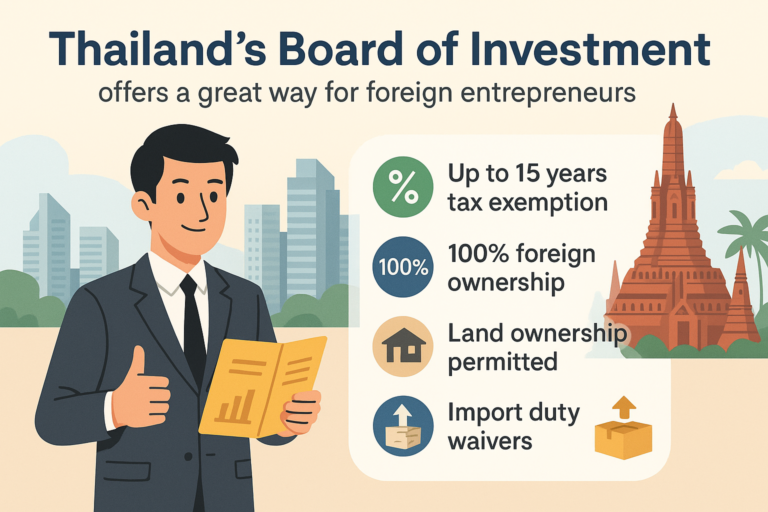
Thailand’s Board of Investment (BOI) offers a great way for foreign entrepreneurs. It helps them start businesses with full ownership and big tax benefits. This framework has changed Thailand into a top place for international investment. It offers new opportunities that avoid old foreign business rules and gives strong financial benefits.
The BOI program helps solve the main problems expatriates face when starting businesses in Thailand. These problems include strict foreign ownership rules, complicated regulations, and high costs of operation. The Thai government promotes certain industries to attract foreign investment. They offer tax breaks and special benefits to encourage this investment.
TL;DR
The article explains Thailand’s Board of Investment (BOI) tax incentives. These incentives let eligible foreign investors have 100% ownership. They can also enjoy exemptions from corporate income tax. Additionally, they may receive benefits for land ownership and import duties. Updates effective in September and October 2025 introduce new land limits and workforce requirements to ensure balanced economic benefits.
Key Takeaways
- Up to 8 years’ corporate income tax exemption under the Investment Promotion Act, up to 13 for advanced technology and research and development, and up to 15 for a targeted industry under the Competitiveness Enhancement Act.
- 100% foreign ownership is allowed for BOI-promoted businesses.
- Land ownership permitted for offices and housing, with new limits from Sept 2025.
- Import duty waivers and fast-track visas are included.
- New salary and staffing rules take effect from 1 October 2025 (1 January 2026 for older certificates), requiring more Thai hires in large factories.
Table of Contents
Understanding Thailand’s Board of Investment
Definition and Purpose
The Thailand Board of Investment is a government agency under the Prime Minister’s Office. Its main job is to promote foreign and domestic investment. This investment focuses on key areas that support Thailand’s economic goals. The BOI was created to attract investment in industries that help technology, regional growth, and sustainable development. It has become Thailand’s main tool for economic modernization.
The agency’s main goal is to invest in important areas for Thailand’s move to a knowledge-based economy. This initiative is called “Thailand 4.0.” This initiative emphasizes innovation, digitalization, and sustainability as pillars for long-term economic growth, positioning Thailand as a regional hub for advanced industries.
Strategic Economic Objectives
The BOI’s investment promotion strategy targets specific outcomes that benefit both investors and Thailand’s broader economic development.
These goals are to:
- Share technology with local workers.
- Build industrial clusters.
- Create good jobs.
- Develop research and development skills.
The program particularly emphasizes activities that enhance Thailand’s competitiveness in global markets while contributing to sustainable economic growth.
Recent policy updates reflect Thailand’s commitment to maintaining its investment attractiveness despite changing global economic conditions. The BOI continues to adapt its incentive structures to address emerging challenges such as supply chain diversification, digital transformation, and environmental sustainability.
Tax Incentives: The Core Advantage
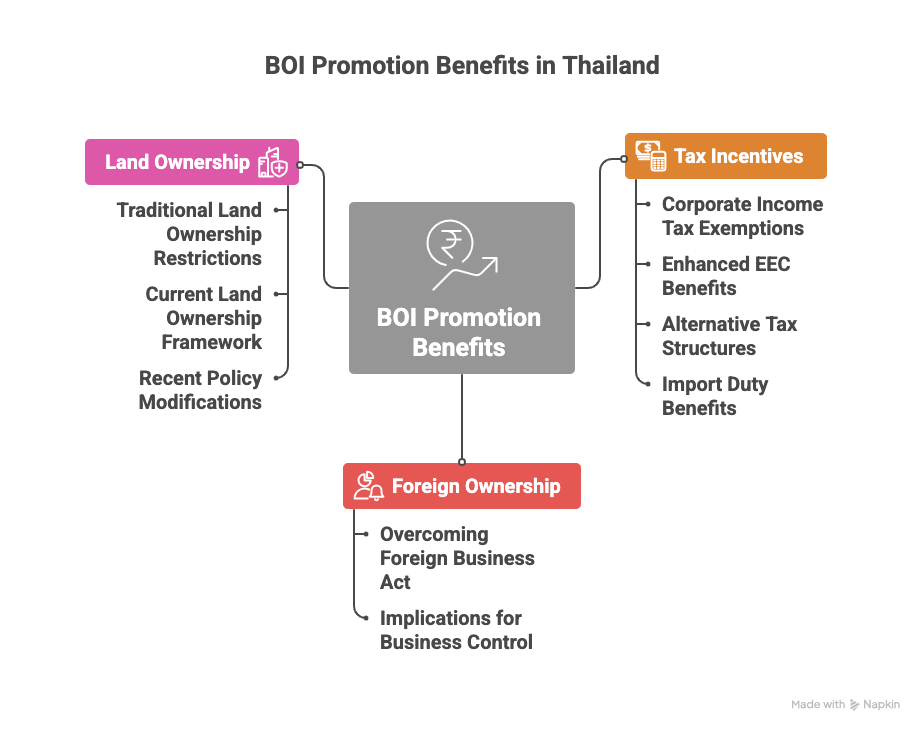
Corporate Income Tax Exemptions
The biggest benefit of BOI promotion is the corporate income tax exemptions. Under the Investment Promotion Act they run for up to 8 years from first revenue (section 31), or up to 13 years for advanced technology and innovation or research and development activities (section 31/1). Up to 15 years is possible only for a targeted industry approved by the national competitiveness policy committee under section 24 of the Competitiveness Enhancement Act for Targeted Industries B.E. 2560. Within those ceilings the length depends on the type of business and its location. These exemptions apply to net profits derived from promoted activities, providing substantial cost savings that dramatically improve investment returns.
Knowledge-based activities that focus on research, development, biotechnology, and advanced technology get the best incentives. They get eight-year corporate income tax exemptions with no limits on how much they can save. This makes a BOI company in Thailand more attractive. This category includes software development, artificial intelligence, biotechnology research, and other innovation-driven sectors that align with Thailand 4.0 objectives.
High-tech activities important for Thailand’s growth get eight-year corporate income tax breaks. These breaks can cover up to 100% of the investment value, but do not include land costs or working capital. These activities typically involve advanced manufacturing processes, specialized equipment, or proprietary technologies that contribute significant value to Thailand’s industrial base.
Standard manufacturing activities with moderate technology components qualify for three-year corporate income tax exemptions, also capped at 100% of investment value. While shorter in duration, these incentives remain attractive for businesses seeking immediate tax relief during critical startup phases.
Enhanced Eastern Economic Corridor Benefits
Projects in the Eastern Economic Corridor (EEC) include Chachoengsao, Chonburi, and Rayong provinces. These projects get better incentives, and a targeted-industry project can reach the 15-year ceiling in section 24 of the Competitiveness Enhancement Act. The EEC represents Thailand’s flagship economic development zone, designed to attract next-generation industries including advanced automotive, intelligent electronics, robotics, and aviation logistics.
EEC-promoted companies enjoy extra benefits. These include a lower personal income tax rate for their executives, experts and researchers, Thai or foreign. Under Royal Decree No. 641 (B.E. 2560), salary from a company in a target industry located in Chachoengsao, Chonburi or Rayong can be taxed by final withholding at 17% instead of the normal rates of up to 35%. Revenue Department Notification No. 335 limits this to companies holding BOI privileges under the EEC measures (BOI Announcements 4/2560 and 6/2561) and to employees earning at least 200,000 baht a month from that business. Companies also get longer visa validity periods and simpler administrative processes. These comprehensive benefits make EEC locations particularly attractive for foreign investors seeking maximum operational advantages.
Alternative Tax Structure Options
Recent BOI innovations include alternative tax structures designed to address global minimum tax requirements while maintaining investment attractiveness. A company already enjoying an exemption can elect a 10% corporate income tax rate instead for the remaining period, which is then doubled, up to a maximum of ten years at the 10% rate (a BOI measure announced in 2023). This option provides flexibility for multinational enterprises managing global tax obligations while preserving significant cost advantages.
Import Duty Benefits
BOI-promoted companies receive comprehensive import duty exemptions on machinery, equipment, and raw materials essential for their operations. Machinery imports for promoted activities can get a full duty exemption. This is a non-tax incentive. It greatly lowers initial capital needs and makes projects more feasible.
Raw materials brought in for export production can get duty exemptions at first. These exemptions may be extended based on performance and compliance. This benefit particularly advantages manufacturing operations focused on export markets, reducing input costs and improving global competitiveness for BOI companies in Thailand.
Research and development materials import without duties, encouraging innovation and technology development within promoted projects. Additional double deductions apply to transportation, electricity, and water supply costs, further reducing operational expenses.
100% Foreign Ownership: Breaking Traditional Barriers
Overcoming Foreign Business Act Restrictions
Thailand’s Foreign Business Act stops a company that is half or more foreign-owned from carrying on the activities on its three lists without permission (Section 4 and Section 8). BOI promotion removes that barrier for promoted activities on List 2 and List 3: the company notifies the Department of Business Development, receives a Foreign Business Certificate within 30 days, and most of the Act then does not apply to it for as long as the activity is promoted (Section 12). List 1 activities cannot be opened this way.
This exemption is one of the most valuable parts of BOI promotion. It removes the need for complex nominee structures or Thai partnerships. These can create legal and operational uncertainties. Foreign investors gain complete control over strategic decisions, financial management, and operational procedures.
The certificate is valid only while the activity remains promoted (Section 21). If promotion ends or is revoked, a foreign-majority company that still carries on a listed activity needs a Foreign Business Licence or must restructure, so plan for the end of the promotion period. This long-term ownership security provides confidence for substantial capital investments and strategic planning.
Implications for Business Control
Full foreign ownership allows for easier decision-making. There are no complications from needing Thai partner approval or dealing with conflicts of interest. This control extends to all aspects of business operations including hiring decisions, strategic partnerships, technology transfer, and expansion planning.
Foreign owners can directly manage intellectual property rights, proprietary technologies, and sensitive business information without disclosure requirements to Thai partners. This protection proves particularly valuable for technology companies, research organizations, and businesses with significant competitive advantages based on proprietary knowledge.
Financial management benefits include direct control over cash flow, profit distribution, and reinvestment decisions. Foreign owners can optimize capital allocation based on global business strategies without local partner constraints.
Land Ownership Privileges
Traditional Land Ownership Restrictions
Thai law generally prohibits foreign ownership of land, creating significant challenges for international businesses requiring secure property rights for operations. This restriction has historically forced foreign companies into complex lease arrangements or nominee structures with inherent legal risks.
BOI promotion provides specific exemptions allowing foreign-owned companies to own land necessary for their promoted business activities. This privilege is a rare exception to Thailand’s strict land ownership laws. It offers real security for long-term investments.
Current Land Ownership Framework
Under new rules starting in late 2024, BOI-promoted companies can own land. These rules aim to attract foreign investment while protecting national interests. Land for the promoted project itself is authorised through the promotion. Land for offices and staff housing is subject to separate BOI criteria, set out in rai (1 rai is 1,600 square meters).
A promoted foreign company needs registered capital of at least 50 million THB to own land for offices and staff housing (BOI Announcement No. 16/2567 and Por. 8/2567, November 2024). It may own up to 5 rai for offices and 20 rai for operational-level worker housing. The former allowance of up to 10 rai for executive and expert housing was removed in July 2025 (Announcement Por. 9/2568). These expanded limits provide sufficient space for substantial industrial operations while maintaining reasonable capital requirements.
Recent Policy Modifications
Significant policy changes implemented from September 1, 2025, restrict land ownership privileges for certain manufacturing sectors including metals, chemicals, and plastics production. These restrictions reflect evolving government priorities and concerns about industrial impact on local communities.
Companies with a strong history of BOI investment are exempt from these new rules. This includes companies that have received at least three BOI promotions in 15 years and have total investments over 5 billion THB. This grandfathering provision protects established investors while implementing more selective criteria for new applicants.
Worker accommodation needs include certain conditions. These ensure that facilities only house employees from the promoted project. The number of rooms must match the actual workforce size. These requirements balance land ownership privileges with practical workforce development objectives.
Eligible Business Activities and Sectors
Priority Industry Categories
BOI promotion covers eight primary categories encompassing activities crucial to Thailand’s economic development strategy. Agriculture and agricultural products represent the foundation category, including modern farming techniques, biotechnology applications, food processing with advanced technology, and sustainable agricultural practices.
Manufacturing and industrial activities are the largest eligible category. They include basic metal production and advanced manufacturing. This is especially true for BOI companies in Thailand. This broad category includes automotive parts, electronics, machinery, and specialized industrial equipment that contribute to Thailand’s manufacturing competitiveness.
Digital and technology sectors receive particular emphasis, reflecting Thailand’s commitment to becoming a regional technology hub. Eligible activities include software development, digital platforms, e-commerce, cloud services, cybersecurity, and artificial intelligence applications.
Healthcare and biotechnology activities address Thailand’s aging population and regional healthcare leadership aspirations. This category covers medical device manufacturing, pharmaceutical production, biotechnology research, and healthcare service delivery using advanced technologies.
Knowledge-Based Activities
Special recognition applies to knowledge-based activities focusing on research and development designed to enhance Thailand’s competitiveness.
These activities get the best incentives. They include eight-year corporate income tax exemptions with no limits and better support for technology transfer.
Research and development activities encompass both independent research organizations and corporate research facilities focused on innovation and technology development.
Biotechnology development, nanotechnology applications, and advanced materials research qualify for maximum incentive packages.
Creative and digital industries represent emerging sectors receiving increased BOI attention. Software development, digital content creation, motion picture production, and creative design services align with Thailand’s cultural and technological development objectives.
Service Sector Opportunities
Service activities eligible for BOI promotion include logistics centers, international business centers, research and development facilities, and specialized technical services. These activities complement manufacturing investments while developing Thailand’s service economy capabilities.
Tourism-related services receive promotion in secondary provinces as part of regional development strategies. Hotels, convention facilities, and tourism infrastructure projects in designated areas qualify for non-tax incentives designed to distribute tourism benefits more broadly across Thailand.
Application Process and Timeline
Pre-Application Preparation
Successful BOI applications require comprehensive preparation beginning with feasibility studies to assess project viability and alignment with BOI objectives. Professional consultation during this phase helps identify potential issues and optimize application strategies.
Business plan development represents the most critical preparation component, requiring detailed financial projections, technology descriptions, employment plans, and economic impact assessments. BOI officers carefully review these plans to ensure projects deliver promised benefits and meet stated objectives.
Document preparation includes company profiles, shareholder information, management team qualifications, and detailed project descriptions. All documentation must demonstrate the project’s contribution to Thailand’s economic development while meeting specific technical and financial requirements.
Formal Application Process
The formal application process begins with online submission through BOI’s e-investment platform, streamlining document submission and tracking. Complete applications include business plans, financial projections, technology transfer plans, and employment forecasts.
A BOI officer review usually includes meetings. These can be online or in-person. The meetings discuss project details, business models, and investment commitments. This interactive process allows applicants to address concerns and provide additional information supporting their applications.
Timeline expectations depend on the size and complexity of the investment. Projects under 200 million THB are processed in 40 working days. Projects between 200 million and 2 billion THB take up to 60 working days. Larger projects may need up to 90 working days for full evaluation.
Post-Approval Requirements
After getting BOI approval, companies must accept the promotion terms within 30 days. They also need to set up Thai corporate entities within six months. Company registration requires standard Thai limited company procedures plus additional documentation confirming BOI promotion status.
Promotion certificate issuance follows company establishment and submission of required supporting documents including evidence of capital injection, company registration certificates, and project location details. The BOI typically issues promotion certificates within 10 working days of receiving complete documentation.
Work Permit and Visa Advantages
Streamlined Processing
BOI-promoted companies benefit from significantly simplified work permit and visa procedures for foreign employees. The One-Stop Service Centre provides consolidated processing, reducing application times from weeks to single days.
Traditional work permit applications require extensive documentation, lengthy processing periods, and strict quotas limiting foreign employee ratios. BOI companies are exempt from the ordinary ratio, but promoted manufacturers with more than 100 employees must now keep at least 70% Thai staff.
Enhanced Visa Categories
Foreign employees of BOI-promoted companies qualify for extended visa validity periods and multiple-entry privileges that facilitate business travel and operational flexibility. These visas support rapid business development and international collaboration.
Management-level employees receive additional privileges including airport fast-track services and reduced reporting requirements. These conveniences make life better for important workers. They also show Thailand’s commitment to attracting global talent with easier visa and work permit processes.
Updated Employment Requirements (2025)
BOI Announcement Por. 8/2568 of 5 June 2025 introduced minimum salaries and a Thai employment ratio. It applies from 1 October 2025 to projects certified on or after 5 June 2025, and from 1 January 2026 to older projects. Executive positions require at least 150,000 THB a month, management positions 75,000 THB (or 50,000 THB with a bachelor’s degree), and operational roles 50,000 THB.
Manufacturing companies with over 100 employees must maintain at least 70% Thai national employment ratios. Service companies and smaller manufacturers remain exempt from these ratios, maintaining flexibility for specialized operations.
Investment Requirements and Capital Considerations
Minimum Investment Thresholds
To get a BOI promotion, you usually need a project investment of at least 1 million THB, excluding land and working capital. However, the exact amount can change based on the type of business and sector. High-technology sectors in Thailand BOI may require higher minimums reflecting the substantial investments needed for advanced operations.
Investment calculations exclude land costs and working capital, focusing on productive assets including machinery, equipment, construction, and technology systems. This approach ensures investment commitments translate into genuine economic contributions.
Capital Injection Requirements
Foreign investors must demonstrate genuine capital commitment through transfers from overseas sources or Bank of Thailand investment certificates. These requirements ensure foreign investment represents actual capital inflows rather than locally sourced financing.
BOI companies usually need only 25% of their registered capital paid when they start. The rest can be paid as the business begins operations. This structure reduces initial cash flow requirements while maintaining investment commitments.
Professional Service Costs and Practical Considerations
Application and Professional Fees
BOI applications involve no government fees, making the process accessible to companies of all sizes. However, professional services typically range from 200,000 to 500,000 THB depending on project complexity and required support.
Legal consultation and document preparation represent the largest professional service costs, typically 100,000 to 200,000 THB for comprehensive application support. Additional costs include translation services, accounting support, and specialized sector consultation.
Ongoing Compliance Costs
BOI-promoted companies must maintain ongoing compliance with promotion conditions including regular progress reporting, employment targets, and investment milestones. Professional compliance support typically costs 80,000 to 150,000 THB annually.
Specialized accounting requirements for BOI companies include separate tracking of promoted activities, tax incentive calculations, and BOI-specific reporting formats. These requirements necessitate experienced accounting services familiar with BOI regulations.
Comparative Analysis: BOI vs Regular Company Structure
Ownership and Control Benefits
The comparison between BOI-promoted companies and regular Thai limited companies reveals substantial advantages favoring BOI structures for foreign investors. A regular company that is half or more foreign-owned cannot carry on a listed activity without a Foreign Business Licence. A BOI company can be 100% foreign-owned for its promoted activity, through the certificate described above.
This ownership advantage removes the need for nominee shareholders, complex trusts, or Thai joint venture partners. These can cause legal issues and operational problems. Foreign investors gain complete control over strategic decisions, financial management, and business development.
Tax and Financial Advantages
Tax benefits are the biggest advantages of BOI promotion. Corporate income tax exemptions can save 15-20% of profits each year during promotion periods. Regular companies pay standard 20% corporate income tax rates throughout their operations.
Import duty exemptions on machinery and raw materials can save costs. This can greatly improve project economics, especially for manufacturing operations that need a lot of equipment. These savings often justify BOI application costs within the first year of operations.
Operational Flexibility
Understanding BOI Tax Incentives
Work permit and visa advantages provide practical benefits that improve daily operations and employee satisfaction. BOI companies do not have to follow the 4:1 Thai-to-foreign employee ratio that Immigration applies to ordinary companies, although since 2025 a promoted manufacturer with more than 100 employees must keep at least 70% Thai staff.
Streamlined government procedures through One-Stop Service Centers reduce administrative burdens and processing delays that can constrain business development. These operational efficiencies become particularly valuable during rapid expansion phases.
Recent Policy Changes and Future Outlook
2025 Regulatory Updates
Significant policy changes implemented throughout 2025 reflect Thailand’s evolving investment priorities and changing global economic conditions. New employment ratio requirements and minimum salary thresholds demonstrate increased focus on local workforce development, particularly encouraging the hiring of Thai employees.
Land ownership restrictions for certain manufacturing sectors indicate more selective approaches to foreign investment, particularly in industries with significant environmental or social impacts. These changes suggest continued evolution toward higher-value, technology-focused investments.
Strategic Directions
Thailand’s investment promotion strategy increasingly emphasizes sustainability, innovation, and regional development. Future BOI policies likely will favor projects contributing to environmental protection, advanced technology development, and economic decentralization.
Digital transformation initiatives, renewable energy projects, and advanced manufacturing using automation and artificial intelligence align with these strategic directions. Companies in these sectors can expect continued government support and potentially enhanced incentives.
FAQs about BOI Incentives in Thailand
What are BOI tax incentives in Thailand and how do they work?
Thailand’s Board of Investment (BOI) gives promoted companies a set of tax benefits. These benefits help lower startup costs and speed up returns on investment. Typical benefits include tax holidays for corporate income tax (CIT) for eligible activities. There are also exemptions or reductions on import duties for machinery and raw materials. Additional deductions are available for research and development, training, or productivity upgrades. These incentives are connected to your promoted “activity” category and merit-based criteria. This means the benefits depend on the project’s impact, such as technology, innovation, sustainability, and location. For many investors, BOI status offers non-tax benefits. These include 100% foreign ownership in allowed sectors and easier work permits or Smart Visas. These advantages add to tax savings and make business operations smoother.
Which industries qualify for BOI corporate income tax holidays in Thailand?
BOI focuses on sectors that improve national competitiveness. These include advanced manufacturing, electronics, biotech, medical devices, digital/AI, logistics, renewable energy, smart farming, creative services, and targeted tourism support. If your project adds significant value through technology transfer, creating intellectual property, or promoting sustainability, you might be eligible for a better CIT exemption. Projects in special development zones or strategic clusters can also gain enhanced packages. In the end, eligibility depends on the official list of “promoted activities.” Your proposal must show innovation, skill development, and clear benefits to Thailand’s economy.
What is the difference between a BOI and a non-BOI company for taxes and foreign ownership?
A non-BOI company generally follows standard Thai tax rules and may face foreign ownership limits in regulated sectors. A company promoted by BOI can get a CIT holiday. In some cases, they may also have lower rates. They can receive relief on import duties for machinery and essential inputs. Additionally, they can get faster VAT treatment on eligible imports. Many BOI categories allow 100% foreign ownership and easier licensing. This is important because the Foreign Business Act can limit control. In practice, the BOI route offers strict qualifications and ongoing compliance. In return, it provides the chance for significant tax savings and more operational flexibility.
Do BOI incentives cover VAT and import duties on machinery and raw materials?
Yes, with approval and depending on the activity, BOI promotion often includes exemptions or reductions on import duties. This applies to machinery needed to set up or expand production. It also includes duty relief and sometimes VAT help on raw materials used for export production. For upgraded technology, automation, or eco-friendly equipment, merit-based measures can extend or deepen the relief. Remember that benefits are limited in time and must follow approved lists and usage. Proper declarations, tracking of fixed assets, and timely reporting are important to keep eligibility.
What ongoing BOI compliance is required to keep tax privileges?
BOI status is not “set and forget.” Companies have several requirements:
1) They must meet milestones such as importing and installing machinery and starting production.
2) They need to file regular reports on production, revenue, export ratios, and local content.
3) They must keep proper invoices and records of fixed assets that connect machinery to the promoted activity.
4) They should inform the BOI about any major changes in capacity, product lines, or location. Many projects must keep a minimum amount of paid-up capital and employment levels. They also need to meet technology transfer and training commitments. Finally, they must pass on-site inspections. Missing deadlines or using assets for unapproved purposes can lead to losing incentives. So, managing your calendar and keeping good records are very important.
Conclusion
BOI company formation represents Thailand’s most comprehensive solution for foreign investors seeking substantial operational advantages combined with significant financial incentives. The combination of 100% foreign ownership rights, extensive tax exemptions, and operational privileges creates investment opportunities unmatched elsewhere in Southeast Asia.
For expatriate entrepreneurs and international businesses, BOI promotion provides real solutions to common barriers. It also offers significant benefits through lower costs and better operational flexibility. The investment in professional application support and ongoing compliance typically generates returns through tax savings and operational efficiencies within the first year of operations.
Success in BOI promotion requires careful preparation, professional guidance, and commitment to genuine business operations that contribute to Thailand’s economic development. Companies that meet these requirements can expect significant benefits. These benefits will help support long-term growth and profit in one of Asia’s busiest markets. This is especially true for companies that hire local Thai workers.
The evolving regulatory landscape demonstrates Thailand’s commitment to maintaining investment attractiveness while addressing changing global economic conditions and domestic development priorities. Foreign investors who match their projects with these goals can expect ongoing government support. They will also have access to Thailand’s best investment incentives.
Links : BOI Thailand
Thai Law Updates, free by email
Plain-English updates on Thai law changes that affect foreigners: property, visas, marriage, business and wills. One short email a month from a firm practicing since 2006. No spam, unsubscribe anytime.