


Reviewed by Wichuda Atthamethakon, LL.M., Thai Bar Licence 3149/2556, for ThaiLawOnline, a Thai law firm acting for foreigners since 2006.
Update log
- 31 October 2026: Added the statute box with Thai, English and French text and checked the page against the official text
If you are planning to visit Thailand in 2026, you need to complete the Thailand Digital Arrival Card (TDAC) before you travel. The TDAC replaced the old paper TM6 arrival and departure card. It is now required for all foreign nationals entering Thailand by air, land, or sea. Failing to complete it can result in boarding denials or delays at immigration.
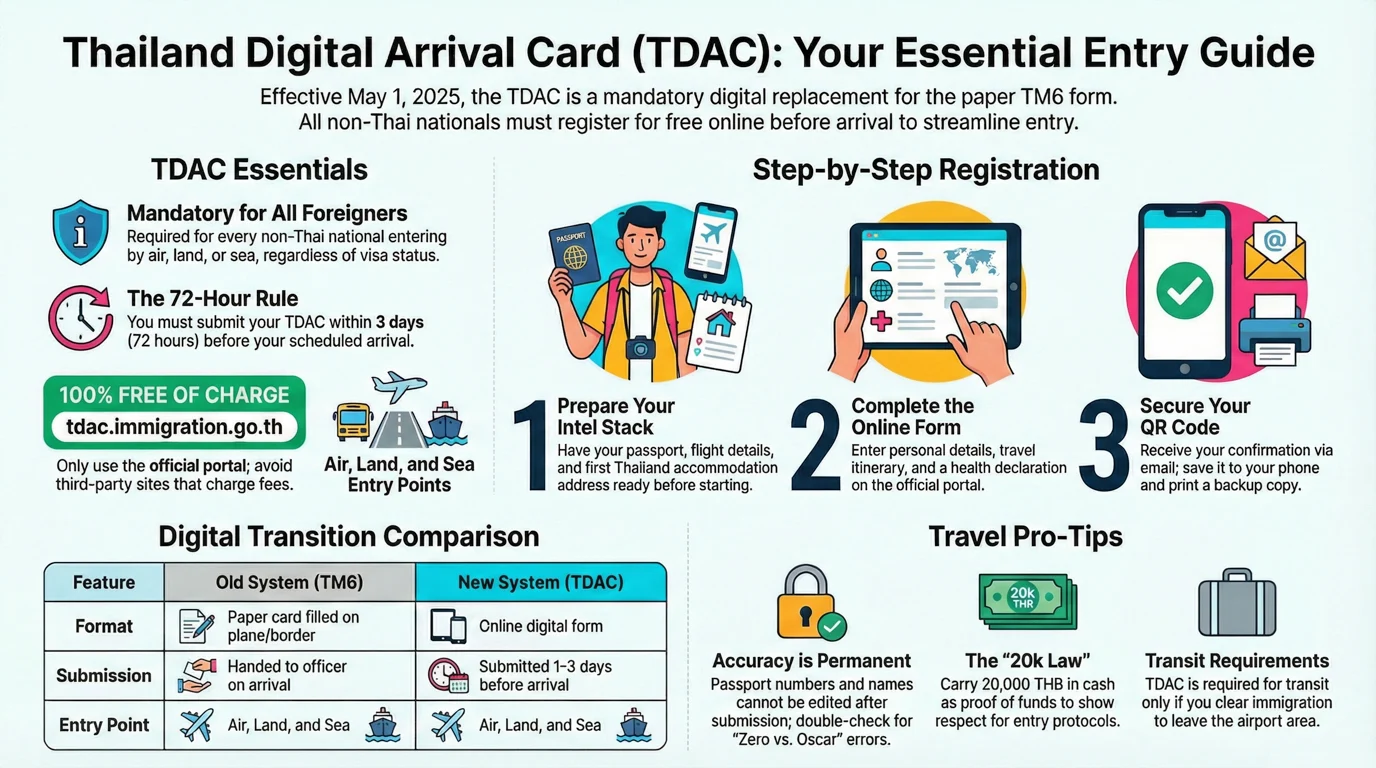
This guide explains exactly what the TDAC is, who needs one, what documents you will need, and how to fill it out step by step. As a Thai law firm, we have 20 years of experience helping expats and foreign visitors. We want you to arrive in Thailand without any complications.
Table of Contents
Last reviewed: 3 September 2026. Every statutory statement below was read against the consolidated text of the Immigration Act B.E. 2522 (1979): section 11 (the channels and checkpoints), section 12 (2) and (9) with section 14 (the grounds of refusal, and where the funds figure actually comes from), section 15 (who is exempt from the duties of aliens, and from which of them), section 18 paragraph two (the filing duty itself), section 62 (the penalty, which is conjunctive) and section 84 (compounding, and the five offences it excludes). Section 18 paragraph two is quoted as amended by Head of the National Council for Peace and Order Order No. 42/2560, which the consolidated text records as the amending instrument. This review does not cover the TDAC portal’s own mechanics, such as the 72-hour window, group submission and which fields stay editable, which come from the portal rather than from the Act, nor the current status of the THIM app, which carries its own check date in its own section below. Added on 4 September 2026: the funds figures themselves were read from the instrument section 14 authorises, the Ministry of Interior announcement of 8 May 2543 (Royal Gazette volume 117, special part 53 Ngor, page 4, 9 June 2543). Section 14 confers the power and states no amount; the announcement sets an amount for each of four visa categories, at two levels, and this page previously carried one of them as though it were the only one. Section 14 paragraph two, which excludes children under twelve, is in the Act itself and the announcement repeats it at clause 3. Re-checked on 4 October 2026: the Act’s sections 12 (9), 14, 15, 62 and 84, the announcement’s clause 2, and clause 7 of the 2016 Ministerial Regulation (as amended in 2017) and the 2019 regulation’s Gazette note were re-read in Thai. The THIM status was updated from a news report of 25 September 2026; the portal’s 72-hour window, the six-month passport expectation and the airport kiosks are practice, not law.
What Is the Thailand Digital Arrival Card?
The Thailand Digital Arrival Card (TDAC) is an online form. It collects your personal, travel, and health information before you enter Thailand. It replaced the paper TM6 form, which was officially discontinued in May 2025.
The TDAC is managed by the Thailand Immigration Bureau and is submitted through an official government portal. It is entirely free, there is no charge to submit your arrival card. Any website or service asking you to pay a fee for TDAC processing is not legitimate.
Key facts about the TDAC:
- Replaced the paper TM6 form in May 2025
- Required for all foreign nationals entering Thailand
- Must be submitted online within the 72 hours (3 days) before your arrival
- Completely free through the official portal
- Covers air, land, and sea entry points
The law behind this page
English
Section 18 Immigration Act B.E. 2522
Full text
The competent official has the power to inspect persons entering or leaving the Kingdom. For this purpose, a person entering or leaving the Kingdom must pass the clearance of the competent official of the immigration checkpoint on that route, and if that person is an alien must also submit particulars in the form prescribed in a Ministerial Regulation.
ThaiLawOnline translation
Section 62 Immigration Act B.E. 2522
Full text
A person who fails to comply with section 11 or section 18 paragraph two shall be liable to imprisonment for a term not exceeding 2 years and a fine not exceeding 20,000 baht. If the offender under paragraph one has Thai nationality, the offender shall be liable to a fine not exceeding 2,000 baht.
ThaiLawOnline translation
Section 11 Immigration Act B.E. 2522
Full text
A person entering or leaving the Kingdom must enter or leave by the routes, immigration checkpoints, port areas, stations or localities, and within the times, announced by the Minister in the Government Gazette.
ThaiLawOnline translation
Section 15 Immigration Act B.E. 2522
Full text
An alien entering the Kingdom, for as long as the alien holds one of the following positions, is exempted from performing the duties of aliens prescribed in this Act, other than the requirements or prohibitions under section 11, section 12 (1), (4) and (5), and section 18 paragraph two: (1) a member of a diplomatic mission sent by a foreign government to perform duties in the Kingdom, or passing through the Kingdom to perform duties in another country; (2) a consular officer or consular employee sent by a foreign government to perform duties in the Kingdom, or passing through the Kingdom to perform duties in another country; (3) a person whom a foreign government, with the approval of the Thai government, causes to enter to perform duties or a mission in the Kingdom; (4) a person performing duties or a mission in the Kingdom for the Thai government under an agreement made by the Thai government with a foreign government; (5) the head of an office of an international organisation or agency whose operations in Thailand are protected by law or have been approved by the Thai government, including employees, experts or other persons whom such organisation or agency appoints or assigns to perform duties or a mission in the Kingdom for that organisation or agency, or for the Thai government under an agreement made by the Thai government with that international organisation or agency; (6) a spouse or child who is dependent on and forms part of the household of a person under (1), (2), (3), (4) or (5); (7) a personal servant travelling from abroad to work regularly at the residence of a person under (1), or of a person enjoying privileges equal to those of a person holding diplomatic rank under an agreement made by the Thai government with a foreign government or with an international organisation or agency. In the cases under (1), (2), (6) or (7), this shall be subject to international obligations and the principle of reciprocity. A competent official has the power to question and to request to see evidence in order to investigate whether a person entering the Kingdom is exempted under this section.
ThaiLawOnline translation
Section 84 Immigration Act B.E. 2522
Full text
For all offences under this Act, other than offences under section 62 paragraph one, section 63, section 64, section 71 and section 82 paragraph two, there shall be a Settlement Committee, composed of the Director General of the Police Department or a representative, the Director General of the Public Prosecution Department or a representative, and the Commander of the Immigration Division or a representative, as members, with the power to settle the offence by fine. For this purpose the Settlement Committee has the power to assign an inquiry official or competent official to carry out the settlement on its behalf, and may set the settlement criteria or any conditions as it considers appropriate. Once the offender has paid the fine as settled, the case is deemed terminated under the Criminal Procedure Code.
ThaiLawOnline translation
Section 12 Immigration Act B.E. 2522
Full text
An alien having any of the following characteristics is prohibited from entering the Kingdom: (1) not having a genuine and valid passport or document used in place of a passport, or having one but without a visa in that passport or document from a Thai embassy or consulate abroad or from the Ministry of Foreign Affairs, except where a visa is not required for certain categories of alien as a special case. Visas and visa exemptions shall be in accordance with the rules, procedures and conditions prescribed in ministerial regulations. A visa under (1) is subject to the fee prescribed in ministerial regulations. (2) not having means of subsistence appropriate to the case of entry into the Kingdom; (3) entering to perform work prohibited to aliens under the law on the management of alien employment; (4) being of unsound mind or having any disease prescribed in ministerial regulations; (5) not having been vaccinated against smallpox, or inoculated, or having undergone other medical procedures for the prevention of communicable diseases as provided by law, and refusing to allow an immigration doctor to carry out such procedures; (6) having received a penalty of imprisonment under a judgment of a Thai court or a lawful order, or under a judgment of a foreign court, except a penalty for a petty offence, an offence committed through negligence, or an offence excepted in ministerial regulations; (7) showing behaviour giving reason to believe that the person is a danger to society, or will commit acts endangering the peace or safety of the public or the security of the Kingdom, or being a person for whom officials of a foreign government have issued an arrest warrant; (8) showing behaviour giving reason to believe that the person is entering for prostitution, trafficking in women or children, narcotics trafficking, customs duty evasion, or to engage in any other business contrary to public order or the good morals of the people; (9) not having money on their person or not having a guarantee as announced by the Minister under section 14; (10) not being permitted by the Minister to enter the Kingdom under section 16; (11) having been deported by the Thai government or a foreign government, or having had the right of residence in the Kingdom or abroad revoked, or having been sent out of the Kingdom by a competent official at the expense of the Thai government, unless, in all these cases, the Minister has granted an exemption as a special individual case. Examination and diagnosis of disease, whether of body or mind, and procedures for the prevention of communicable diseases shall be carried out by immigration doctors.
ThaiLawOnline translation
Section 14 Immigration Act B.E. 2522
Full text
The Minister has the power to require aliens entering the Kingdom to carry money or provide security, or to grant an exemption under any conditions, by notification in the Government Gazette. A notification under paragraph one does not apply to children under 12 years of age.
ThaiLawOnline translation
ไทย
มาตรา 18 พระราชบัญญัติคนเข้าเมือง พ.ศ. 2522
ข้อความเต็ม
พนักงานเจ้าหน้าที่มีอำนาจตรวจบุคคลซึ่งเดินทางเข้ามาในหรือออกไปนอกราชอาณาจักร เพื่อการนี้ บุคคลซึ่งเดินทางเข้ามาในหรือออกไปนอกราชอาณาจักรต้องผ่านการตรวจอนุญาตของพนักงานเจ้าหน้าที่ของด่านตรวจคนเข้าเมืองประจำเส้นทางนั้น และถ้าผู้นั้นเป็นคนต่างด้าวต้องยื่นรายการตามแบบที่กำหนดในกฎกระทรวงด้วย
ตรงตามข้อความในราชกิจจานุเบกษา / สำนักงานคณะกรรมการกฤษฎีกา (Verbatim from the Royal Gazette / Office of the Council of State)
มาตรา 62 พระราชบัญญัติคนเข้าเมือง พ.ศ. 2522
ข้อความเต็ม
ผู้ใดไม่ปฏิบัติตามมาตรา ๑๑ หรือมาตรา ๑๘ วรรคสอง ต้องระวางโทษจำคุกไม่เกินสองปี และปรับไม่เกินสองหมื่นบาท ถ้าผู้กระทำความผิดตามวรรคหนึ่งมีสัญชาติไทย ต้องระวางโทษปรับไม่เกินสองพันบาท
ตรงตามข้อความในราชกิจจานุเบกษา / สำนักงานคณะกรรมการกฤษฎีกา (Verbatim from the Royal Gazette / Office of the Council of State)
มาตรา 11 พระราชบัญญัติคนเข้าเมือง พ.ศ. 2522
ข้อความเต็ม
บุคคลซึ่งเดินทางเข้ามาในหรือออกไปนอกราชอาณาจักรจะต้องเดินทางเข้ามาหรือออกไปตามช่องทาง ด่านตรวจคนเข้าเมือง เขตท่า สถานี หรือท้องที่และตามกำหนดเวลา ทั้งนี้ ตามที่รัฐมนตรีจะได้ประกาศในราชกิจจานุเบกษา
ตรงตามข้อความในราชกิจจานุเบกษา / สำนักงานคณะกรรมการกฤษฎีกา (Verbatim from the Royal Gazette / Office of the Council of State)
มาตรา 15 พระราชบัญญัติคนเข้าเมือง พ.ศ. 2522
ข้อความเต็ม
คนต่างด้าวซึ่งเข้ามาในราชอาณาจักรตราบเท่าที่อยู่ในฐานะดังต่อไปนี้ให้ได้รับการยกเว้นไม่ต้องปฏิบัติการตามหน้าที่ของคนต่างด้าวตามที่กำหนดไว้ในพระราชบัญญัตินี้ นอกจากการปฏิบัติหรือการต้องห้ามตามมาตรา ๑๑ มาตรา ๑๒ (๑) (๔) และ (๕) และมาตรา ๑๘ วรรคสอง (๑) บุคคลในคณะผู้แทนทางทูตซึ่งรัฐบาลต่างประเทศส่งเข้ามาปฏิบัติหน้าที่ในราชอาณาจักรหรือซึ่งเดินทางผ่านราชอาณาจักร เพื่อไปปฏิบัติหน้าที่ในประเทศอื่น (๒) พนักงานฝ่ายกงสุลและลูกจ้างฝ่ายกงสุลซึ่งรัฐบาลต่างประเทศส่งเข้ามาปฏิบัติหน้าที่ในราชอาณาจักร หรือซึ่งเดินทางผ่านราชอาณาจักรเพื่อไปปฏิบัติหน้าที่ในประเทศอื่น (๓) บุคคลซึ่งรัฐบาลต่างประเทศโดยความเห็นชอบของรัฐบาลไทยให้เข้ามาปฏิบัติหน้าที่หรือภารกิจในราชอาณาจักร (๔) บุคคลซึ่งปฏิบัติหน้าที่หรือภารกิจในราชอาณาจักร เพื่อรัฐบาลไทยตามความตกลงที่รัฐบาลไทยได้ทำไว้กับรัฐบาลต่างประเทศ (๕) หัวหน้าสำนักงานขององค์การหรือทบวงการระหว่างประเทศที่มีกฎหมายคุ้มครองการดำเนินงานในประเทศไทย หรือซึ่งรัฐบาลไทยได้ให้ความเห็นชอบด้วยแล้ว และรวมถึงพนักงานหรือผู้เชี่ยวชาญหรือบุคคลอื่นซึ่งองค์การหรือทบวงการเช่นว่านั้น แต่งตั้งหรือมอบหมายให้ปฏิบัติหน้าที่หรือภารกิจในราชอาณาจักร เพื่อองค์การหรือทบวงการดังกล่าว หรือเพื่อรัฐบาลไทยตามความตกลงที่รัฐบาลไทยได้ทำไว้กับองค์การหรือทบวงการระหว่างประเทศนั้น (๖) คู่สมรส หรือบุตร ซึ่งอยู่ในความอุปการะและเป็นส่วนแห่งครัวเรือนของบุคคลตาม (๑) (๒) (๓) (๔) หรือ (๕) (๗) คนรับใช้ส่วนตัวซึ่งเดินทางจากต่างประเทศเพื่อมาทำงานประจำเป็นปกติ ณ ที่พักอาศัยของบุคคลตาม (๑) หรือบุคคลซึ่งได้รับเอกสิทธิเท่าเทียมกันกับบุคคลซึ่งมีตำแหน่งทางทูตตามความตกลงที่รัฐบาลไทยได้ทำไว้กับรัฐบาลต่างประเทศหรือกับองค์การหรือทบวงการระหว่างประเทศ ในกรณีตาม (๑) (๒) (๖) หรือ (๗) ให้เป็นไปตามพันธกรณีระหว่างประเทศและหลักถ้อยทีถ้อยปฏิบัติต่อกัน ให้พนักงานเจ้าหน้าที่มีอำนาจสอบถามและขอดูหลักฐานเพื่อสอบสวนว่าบุคคลซึ่งเข้ามาในราชอาณาจักรนั้นเป็นผู้ได้รับยกเว้นตามมาตรานี้
ตรงตามข้อความในราชกิจจานุเบกษา / สำนักงานคณะกรรมการกฤษฎีกา (Verbatim from the Royal Gazette / Office of the Council of State)
มาตรา 84 พระราชบัญญัติคนเข้าเมือง พ.ศ. 2522
ข้อความเต็ม
บรรดาความผิดตามพระราชบัญญัตินี้ นอกจากความผิดตามมาตรา ๖๒ วรรคหนึ่ง มาตรา ๖๓ มาตรา ๖๔ มาตรา ๗๑ และมาตรา ๘๒ วรรคสอง ให้มีคณะกรรมการเปรียบเทียบ ซึ่งประกอบด้วยอธิบดีกรมตำรวจหรือผู้แทน อธิบดีกรมอัยการหรือผู้แทน และผู้บังคับการกองตรวจคนเข้าเมืองหรือผู้แทนเป็นกรรมการ มีอำนาจเปรียบเทียบได้และในการนี้คณะกรรมการเปรียบเทียบมีอำนาจมอบหมายให้พนักงานสอบสวนหรือพนักงานเจ้าหน้าที่ดำเนินการเปรียบเทียบแทนได้ โดยจะกำหนดหลักเกณฑ์ในการเปรียบเทียบหรือเงื่อนไขประการใด ๆ ก็ได้ตามที่เห็นสมควร เมื่อผู้กระทำความผิดได้เสียค่าปรับตามที่เปรียบเทียบแล้ว ให้ถือว่าคดีเลิกกันตามประมวลกฎหมายวิธีพิจารณาความอาญา
ตรงตามข้อความในราชกิจจานุเบกษา / สำนักงานคณะกรรมการกฤษฎีกา (Verbatim from the Royal Gazette / Office of the Council of State)
มาตรา 12 พระราชบัญญัติคนเข้าเมือง พ.ศ. 2522
ข้อความเต็ม
ห้ามมิให้คนต่างด้าวซึ่งมีลักษณะอย่างใดอย่างหนึ่งดังต่อไปนี้เข้ามาในราชอาณาจักร (๑) ไม่มีหนังสือเดินทางหรือเอกสารใช้แทนหนังสือเดินทางอันถูกต้องและยังสมบูรณ์อยู่ หรือมีแต่ไม่ได้รับการตรวจลงตราในหนังสือเดินทางหรือเอกสารใช้แทนหนังสือเดินทางเช่นว่านั้นจากสถานทูตหรือสถานกงสุลไทยในต่างประเทศ หรือจากกระทรวงการต่างประเทศ เว้นแต่กรณีที่ไม่ต้องมีการตรวจลงตราสำหรับคนต่างด้าวบางประเภทเป็นกรณีพิเศษ การตรวจลงตราและการยกเว้นการตรวจลงตราให้เป็นไปตามหลักเกณฑ์ วิธีการและเงื่อนไขที่กำหนดในกฎกระทรวง การตรวจลงตราตาม (๑) ให้เสียค่าธรรมเนียมตามที่กำหนดในกฎกระทรวง (๒) ไม่มีปัจจัยในการยังชีพตามควรแก่กรณีที่เข้ามาในราชอาณาจักร (๓) เข้ามาเพื่อทำงานที่ห้ามคนต่างด้าวทำตามกฎหมายว่าด้วยการบริหารจัดการการทำงานของคนต่างด้าว (๔) วิกลจริตหรือมีโรคอย่างใดอย่างหนึ่งตามที่กำหนดในกฎกระทรวง (๕) ยังมิได้ปลูกฝีป้องกันไข้ทรพิษ หรือฉีดวัคซีน หรือปฏิบัติการอย่างอื่นตามวิชาการแพทย์เพื่อป้องกันโรคติดต่อตามที่กฎหมายบัญญัติและไม่ยอมให้แพทย์ตรวจคนเข้าเมืองกระทำการเช่นว่านั้น (๖) เคยได้รับโทษจำคุกโดยคำพิพากษาของศาลไทยหรือคำสั่งที่ชอบด้วยกฎหมาย หรือคำพิพากษาของศาลต่างประเทศ เว้นแต่เป็นโทษสำหรับความผิดลหุโทษหรือความผิดอันได้กระทำโดยประมาท หรือความผิดที่ยกเว้นไว้ในกฎกระทรวง (๗) มีพฤติการณ์เป็นที่น่าเชื่อว่าเป็นบุคคลที่เป็นภัยต่อสังคม หรือจะก่อเหตุร้ายให้เกิดอันตรายต่อความสงบสุขหรือความปลอดภัยของประชาชน หรือความมั่นคงแห่งราชอาณาจักร หรือบุคคลซึ่งเจ้าหน้าที่รัฐบาลต่างประเทศได้ออกหมายจับ (๘) มีพฤติการณ์เป็นที่น่าเชื่อว่าเข้ามาเพื่อการค้าประเวณี การค้าหญิงหรือเด็ก การค้ายาเสพติดให้โทษ การลักลอบหนีภาษีศุลกากรหรือเพื่อประกอบกิจการอื่นที่ขัดต่อความสงบเรียบร้อยหรือศีลธรรมอันดีของประชาชน (๙) ไม่มีเงินติดตัวหรือไม่มีประกันตามที่รัฐมนตรีประกาศตามมาตรา ๑๔ (๑๐) รัฐมนตรีไม่อนุญาตให้เข้ามาในราชอาณาจักรตามมาตรา ๑๖ (๑๑) ถูกรัฐบาลไทยหรือรัฐบาลต่างประเทศเนรเทศ หรือถูกเพิกถอนสิทธิการอยู่อาศัยในราชอาณาจักรหรือในต่างประเทศมาแล้ว หรือถูกพนักงานเจ้าหน้าที่ส่งกลับออกไปนอกราชอาณาจักร โดยรัฐบาลไทยเสียค่าใช้จ่าย ทั้งนี้ เว้นแต่รัฐมนตรีได้พิจารณายกเว้นให้เป็นกรณีพิเศษเฉพาะราย การตรวจวินิจฉัยโรค ร่างกายหรือจิต ตลอดจนการปฏิบัติการเพื่อป้องกันโรคติดต่อ ให้ใช้แพทย์ตรวจคนเข้าเมือง
ตรงตามข้อความในราชกิจจานุเบกษา / สำนักงานคณะกรรมการกฤษฎีกา (Verbatim from the Royal Gazette / Office of the Council of State)
มาตรา 14 พระราชบัญญัติคนเข้าเมือง พ.ศ. 2522
ข้อความเต็ม
รัฐมนตรีมีอำนาจกำหนดให้คนต่างด้าวซึ่งเข้ามาในราชอาณาจักรมีเงินติดตัว หรือมีประกันหรือจะยกเว้นภายใต้เงื่อนไขใด ๆ ก็ได้ ทั้งนี้ โดยประกาศในราชกิจจานุเบกษา ประกาศตามวรรคหนึ่งมิให้ใช้บังคับแก่เด็กอายุต่ำกว่าสิบสองปี
ตรงตามข้อความในราชกิจจานุเบกษา / สำนักงานคณะกรรมการกฤษฎีกา (Verbatim from the Royal Gazette / Office of the Council of State)
Français
Article 18 Immigration Act B.E. 2522
L'agent compétent peut contrôler toute personne entrant ou sortant du Royaume. Celle-ci doit passer le contrôle du poste d'immigration de son itinéraire et, si elle est étrangère, remettre aussi le formulaire réglementaire.
résumé non officiel
Article 62 Immigration Act B.E. 2522
Le non-respect de l'article 11 ou de l'article 18, alinéa 2, est puni de 2 ans d'emprisonnement au plus et de 20 000 bahts d'amende au plus. Le contrevenant de nationalité thaïlandaise encourt 2 000 bahts d'amende au plus.
résumé non officiel
Article 11 Immigration Act B.E. 2522
Toute personne entrant ou sortant du Royaume doit passer par les voies, postes d'immigration, zones portuaires, gares ou localités, et aux heures, annoncés par le Ministre au Journal officiel.
résumé non officiel
Article 15 Immigration Act B.E. 2522
Diplomates, agents consulaires, personnes en mission gouvernementale, responsables et agents d'organisations internationales, ainsi que leurs conjoints, enfants à charge et domestiques désignés, sont dispensés des obligations des étrangers, sauf articles 11, 12 (1), (4), (5) et 18 alinéa 2. Le fonctionnaire compétent peut exiger des preuves.
résumé non officiel
Article 84 Immigration Act B.E. 2522
Sauf pour les infractions des articles 62, alinéa 1, 63, 64, 71 et 82, alinéa 2, un comité de trois membres ou ses délégués peut transiger par amende. Le paiement de l'amende met fin à l'affaire selon le Code de procédure pénale.
résumé non officiel
Article 12 Immigration Act B.E. 2522
L'entrée est notamment interdite à l'étranger sans passeport ou visa valables, sans moyens de subsistance, atteint d'une maladie désignée, ayant subi une peine d'emprisonnement (sauf contravention, négligence ou exception), dangereux, venu pour la prostitution ou un trafic, ou déjà expulsé, sauf dérogation du ministre pour ce dernier cas.
résumé non officiel
Article 14 Immigration Act B.E. 2522
Le Ministre peut, par avis au Journal officiel, exiger des étrangers entrants qu'ils aient des fonds ou une garantie, ou les en dispenser sous conditions. L'avis ne s'applique pas aux enfants de moins de 12 ans.
résumé non officiel
Sources
- Immigration Act B.E. 2522, retrieved 31 October 2026
The Law Behind the TDAC: Section 18 of the Immigration Act
The TDAC is not a procedure Immigration invented for convenience. It is how a foreign national discharges a statutory duty. Section 18, paragraph two of the Immigration Act B.E. 2522 (1979) provides that a person travelling into or out of the Kingdom must pass the examination and permission of the competent official of the immigration checkpoint on that route, “and if that person is an alien, must also submit particulars in the form prescribed by ministerial regulation”.
The form prescribed by that ministerial regulation is TM.6. Clause 7 of the Ministerial Regulation Prescribing Forms of Documents under the Immigration Law B.E. 2559 (2016), as amended by Ministerial Regulation (No. 3) B.E. 2560 (2017), provides that an alien filing particulars under section 18 paragraph two files them “in form TM.6 annexed to this Ministerial Regulation”. The TDAC is the online route for filing the same particulars. That is why the obligation did not disappear when the paper card did: the duty sits in the Act, not in the card.
The paper form was last reissued by Ministerial Regulation (No. 4) B.E. 2562, given on 6 August 2019 and published in the Royal Gazette volume 136, part 91 Kor, page 1, on 20 August 2019. Its stated reason is worth knowing, because it shows the paper form was already causing problems at the checkpoints: Chinese and Indian visitors were completing the TM.6 incorrectly because they could not read the Thai and English on it, and the resulting errors were slowing the checkpoints down.
Why Thai nationals are exempt, and where that exemption comes from
Until 2017, section 18 paragraph two bound everyone, Thai nationals included. It was narrowed by Head of the National Council for Peace and Order Order No. 42/2560, dated 13 September 2017, published in the Royal Gazette volume 134, special part 227 Ngor, page 1, on 16 September 2017, under the title “Amending the immigration law to facilitate travellers of Thai nationality“. Clause 1 replaced the paragraph with the wording quoted above, and the words it added were “if that person is an alien”.
The Order states its own reasoning. Requiring Thai nationals to file the particulars placed an undue burden on them, because information about Thai nationals is already collected systematically, so the TM.6 requirement was “no longer necessary” for them. It grounds that in section 38 of the Constitution, which guarantees Thai citizens freedom of movement, and section 26, which requires that a law must not add a burden to, or restrict, a person’s rights or liberties beyond what is reasonably necessary.
There is no diplomatic exemption from the arrival card
Section 15 exempts diplomatic personnel, consular officers and employees, persons entering on a foreign government mission agreed with Thailand, the heads and staff of international organisations, their spouses and dependent children, and their personal servants, from the duties the Act imposes on aliens. Read the section to the end, though, because it is written as an exception. Those people are exempt from the duties of aliens under the Act other than compliance with section 11, section 12 (1), (4) and (5), and section 18 paragraph two. The arrival card is one of the few obligations a diplomatic passport does not remove. Status does not remove it. Nationality is the only exemption section 18 itself draws, and the one other route in the Act is section 17, under which the Minister, with Cabinet approval, may exempt a person or class in a special case.
Why land and sea borders are covered
Section 11 requires everyone entering or leaving the Kingdom to do so through a channel, immigration checkpoint, port zone, station or locality, and within the times, announced by the Minister in the Royal Gazette. Section 18 paragraph two attaches at every one of those points. That is the reason the card is required at a land crossing and at a seaport and not only at an airport.
What non-compliance actually carries
Section 62 paragraph one provides that whoever fails to comply with section 11 or section 18 paragraph two is liable to imprisonment not exceeding two years and a fine not exceeding 20,000 baht. Paragraph two reduces that to a fine not exceeding 2,000 baht where the offender holds Thai nationality.
Two things need saying about that penalty, because it is easy to overstate and easy to dismiss. Section 84 allows a compounding committee to settle most offences under the Act by a fine, after which the case is treated as terminated under the Criminal Procedure Code. Section 62 paragraph one is one of five offences that section 84 expressly excludes from that procedure. On the other hand, this is not what happens to a traveller who has simply not filed: Immigration directs them to a kiosk and they file on arrival, and the realistic consequence is delay rather than prosecution. The point is that the filing duty is an offence-backed statutory obligation, not a formality that can be skipped.
The funds check at the border is a separate rule
The money question travellers ask about is not part of the TDAC at all, and it sits in a different limb of the Act from the one usually cited. Section 12 (2) refuses entry to an alien who has no appropriate means of living for the purpose for which they are entering, and it carries no figure at all. The figure comes from section 12 (9), which refuses entry to an alien who has no money on them and no guarantee of the kind the Minister announces under section 14. So the amount is fixed by a ministerial announcement rather than by the Act itself, and it is checked at the border, never on the arrival card.
The announcement in force is the Ministry of Interior announcement of 8 May 2543 (2000), published in the Royal Gazette volume 117, special part 53 Ngor, page 4, on 9 June 2543, which repealed the 1980 version. It sets the amount separately for four categories of entry, at two levels, and this is the part almost every guide gets wrong by quoting a single figure:
- Visa exemption, Transit and Visa on Arrival: at least 10,000 THB per person, or 20,000 THB for a family
- Tourist visa (TR): at least 20,000 THB per person, or 40,000 THB for a family
- Non-Immigrant visa: at least 20,000 THB per person, or 40,000 THB for a family
Two things follow that travellers are rarely told. Arriving on a tourist visa attracts double the visa-exempt amount, so the widely quoted 10,000 THB is the right answer only for a visa-exempt, transit or Visa on Arrival entry. And section 14 paragraph two of the Act puts children under twelve outside the announcement altogether, so no figure applies to them. That exemption is from the money rule only. It has nothing to do with the arrival card, which every child still needs.
Who Needs to Complete the TDAC?
Every foreign national entering Thailand must complete a Thailand Digital Arrival Card. This includes:
- Tourists on visa-exempt entry. Since 15 September 2026 the exemption gives 30 days to nationals of 60 countries and territories (it was 60 days before that date), and the arrival card is required either way
- Business visitors entering on any visa category
- Long-term visa holders including retirement, marriage, and education visas
- Returning expats who have left and are re-entering Thailand
- Transit passengers who pass through Thai immigration
- Children and infants, every traveler needs their own TDAC, regardless of age
Thai nationals do not need to complete the TDAC. If you travel as a family or group, the portal lets you submit up to 10 arrival cards at once. This saves time.
What You Need Before You Start
Gather these documents before you begin the application:
Required:
- A valid passport. The Act requires a genuine, valid passport; in practice airlines and immigration officers expect at least 6 months of validity remaining from your arrival date
- Your flight details (airline name, flight number, arrival date)
- Accommodation address in Thailand (hotel name and address, or private residence address)
- A working email address to receive your confirmation
Good to have ready:
- Return or onward flight details (airline, flight number, departure date)
- Travel history for the past 14 days (countries visited)
Important note about funds: Thai Immigration may do random border checks. They may ask travelers to prove they have enough funds for their stay. The amount is set by visa category, not by a single figure: 10,000 THB per person or 20,000 THB per family if you arrive visa-exempt, in transit or on a Visa on Arrival, and 20,000 THB per person or 40,000 THB per family on a tourist or Non-Immigrant visa. Children under twelve are outside the rule. This is not part of the TDAC application itself, and the section on the funds check above gives the instrument.
| Item | Detail |
|---|---|
| Cost | Free on the official portal, tdac.immigration.go.th. Any site charging a fee is not authorised |
| When to submit | Within 72 hours (3 days) of your scheduled arrival |
| Who needs one | Every foreign national entering Thailand, including infants and children |
| Who is exempt | Thai passport holders |
| Entry points covered | All: airports, land borders and seaports |
| Group submission | Up to 10 cards in one session |
| Editable after submitting | Minor fixes such as flight time only. Name, passport number, date of birth and nationality cannot be changed; a new application is needed |
| Replaces | The paper TM6 arrival and departure card |
| Proof of funds at entry | Set by visa category: 10,000 THB per person or 20,000 per family arriving visa-exempt, in transit or on a Visa on Arrival; 20,000 per person or 40,000 per family on a tourist or Non-Immigrant visa; children under twelve exempt |
How to Fill Out the Thailand Digital Arrival Card: Step by Step
Step 1: Visit the Official Portal
Go to the official Thailand Immigration TDAC website at https://tdac.immigration.go.th/ and click on “Arrival Card” to begin.
Do not use any third-party websites to submit your TDAC. The only legitimate portal is operated by the Thai Immigration Bureau. The portal is a web-based form that works on any device. The Immigration Bureau’s THIM app is a second, optional way to file the same card; see the THIM section below.
Step 2: Enter Your Personal Information
Fill in your personal details exactly as they appear in your passport:
- Full name (first and last name as shown on your passport information page)
- Date of birth
- Nationality
- Passport number and expiry date
- Gender
Tip: Scan the MRZ (Machine Readable Zone) at the bottom of your passport photo page.Or upload a photo of it. This will auto-fill your personal details. This reduces errors significantly.
Step 3: Provide Your Travel Details
Enter your flight and travel information:
- Port of entry (airport or border crossing)
- Airline and flight number
- Date and time of arrival
- Purpose of visit (tourism, business, etc.)
- Accommodation details, the name and address of your first place of stay in Thailand
You only need to enter your first accommodation. If you are traveling to multiple cities or hotels within Thailand, you do not need to list every address.
Step 4: Complete the Health Declaration
The Ministry of Public Health requires a brief health declaration as part of the TDAC. You will be asked about:
- Your current health status
- Countries you have visited in the past 14 days
- Whether you have experienced specific symptoms
If you visited a country the Ministry of Public Health flagged within the last two weeks, the system may ask for more health information. This is a standard screening measure.
Step 5: Review and Submit
Carefully review all information before submitting. Once submitted, you cannot change core details like your name, passport number, date of birth, or nationality. Minor details such as flight times can still be updated before arrival.
Enter your email address, agree to the Terms and Conditions, and click Submit.
Step 6: Save Your Confirmation
After submission, you will receive a confirmation email with your completed TDAC. Download or print a copy to keep with you during your trip. Immigration officers may ask to see it when you arrive. In most cases, your information is already linked to your passport electronically.
Common Mistakes to Avoid
Based on our experience helping clients with issues at Thai immigration, these are the most common TDAC mistakes:
Name mismatch: Your name on the TDAC must exactly match your passport. If your passport says “ROBERT JAMES SMITH,” do not enter “Bob Smith” or “Robert J. Smith.”
Submitting too early: The TDAC must be submitted within the 72 hours before your arrival. If you submit it a week before your flight, it may fall outside the valid window and you will need to resubmit.
Using unofficial websites: Several commercial websites charge fees ranging from $10 to $50 to “process” your TDAC. The official portal is free. If a website asks for payment, close it and go directly to tdac.immigration.go.th.
Forgetting children: Every traveler needs their own TDAC, including infants. Use the group submission feature to complete cards for your entire family in one session.
All information must be entered in English. The TDAC portal does not accept Thai script in the main form fields.
What If You Cannot Complete the TDAC Online?
If you cannot complete the digital form before your flight, kiosks are available at major Thai airports. These include Suvarnabhumi and Don Mueang. You can complete the TDAC at a kiosk before you reach the immigration counter. However, completing it in advance is strongly recommended to avoid queues.
TDAC vs. Thailand Visa: Understanding the Difference
The Thailand Digital Arrival Card is not a visa. It does not grant you permission to enter Thailand or extend your permitted length of stay. It is a separate immigration requirement that exists alongside whatever visa or visa exemption you are traveling under.
If you need assistance with a Thai visa application, work permit, or any other immigration matter, contact ThaiLawOnline for a consultation. Our immigration team handles all visa categories including retirement visas, marriage visas, business visas, and work permits.
TDAC and the THIM app: what is actually required
Status checked 4 October 2026. In June 2026 the Immigration Bureau introduced the Thailand Immigration Management application, or THIM. Pilot access opened on 11 June 2026, the app went on the App Store, Google Play and Huawei AppGallery on 1 August 2026, and the Bureau has since officially launched it, reporting more than 600,000 downloads (The Nation, 25 September 2026). A great deal of coverage describes the app as compulsory for foreign nationals. It is not, and the difference matters if you are arriving soon.
The Tourism Authority of Thailand’s own announcement is explicit: “During the pilot phase, THIM is an optional app that travellers may use to access TDAC-linked registration”, and “THIM is not an additional arrival-card requirement and does not replace TDAC at this stage.” Travellers are told to continue completing the TDAC as required.
- The TDAC is mandatory. Every foreign national entering Thailand needs one, whatever visa or exemption they hold.
- THIM is optional. It is a mobile route to complete the same TDAC. It is not a second document, and it does not replace the arrival card.
- Installing THIM does not exempt you from the TDAC. If you only download the app and do nothing else, you have not met the requirement.
The app is published on the App Store and Google Play and currently supports English, Russian, Japanese and Chinese, with further languages planned.
As at the date above, no Immigration Bureau announcement making THIM compulsory has been published, and the launch coverage describes THIM as another channel for the card, which remains available on the Bureau’s website. If that changes, the obligation will come from an Immigration Bureau announcement, not from an app-store listing or a news report, and we will date the change here. Sources: Tourism Authority of Thailand newsroom, 11 June 2026; The Nation, 25 September 2026.
Frequently Asked Questions
Is the Thailand Digital Arrival Card free?
Yes. Submitting the TDAC through the official Thai Immigration portal (tdac.immigration.go.th) is completely free. Any website or service charging a fee is not authorized by the Thai government.
How far in advance can I fill out the TDAC?
You must submit the TDAC within 72 hours (3 days) of your scheduled arrival in Thailand. Submitting earlier may result in your application falling outside the valid timeframe.
Do Thai citizens need to complete the TDAC?
No. The TDAC is only required for foreign nationals entering Thailand. Thai passport holders are exempt, and the exemption is statutory: Head of the National Council for Peace and Order Order No. 42/2560 of 13 September 2017 rewrote section 18 paragraph two of the Immigration Act B.E. 2522 so that only an alien has to file the particulars. Before that Order, Thai nationals had to complete a TM.6 as well.
Can I edit my TDAC after submitting it?
You can make minor fixes, like flight time updates.But you cannot change key details after you submit.These include your name, passport number, date of birth, and nationality. If you made an error in these fields, you will need to submit a new application.
Do children need their own TDAC?
Yes. Every traveler entering Thailand needs their own TDAC, including infants and children. The group submission feature allows you to complete up to 10 cards in a single session.
What happens if I arrive without a TDAC?
In practice you will be directed to a kiosk to complete the form on arrival, which adds time to your processing, and some airlines check for TDAC completion before boarding. The statutory position is stricter than that. Filing the particulars is a duty under section 18 paragraph two of the Immigration Act B.E. 2522, and section 62 paragraph one makes failure to comply an offence carrying imprisonment of up to two years and a fine of up to 20,000 baht.
Is the TDAC the same as the old TM6 form?
The TDAC replaced the paper TM6 departure/arrival card. It collects similar information but is submitted digitally before you arrive, rather than on paper during your flight.
Do I need the TDAC for land border crossings?
Yes. The TDAC is required for all entry points into Thailand, including land borders and seaports, not just airports.
With over 20 years of experience, we help expats in Thailand with trusted legal services. We also use modern technology to work faster and more efficiently. Whether you just arrived in Thailand or have lived here for decades, our team is here to help. We support you when legal questions go beyond what a Google search can answer.
Contact ThaiLawOnline for a consultation
Have questions about Thai immigration law? Email us or call our Bangkok office to speak with a member of our legal team.
Immigration requirements can change without notice. While we try to keep this guide accurate, it is for information only. It is not legal advice. For guidance on your specific situation, contact ThaiLawOnline.
Indian travellers can also read our Thailand visa guide for Indians for visa-free entry, the ETA, and the latest 2026 rules.
Thai Law Updates, free by email
Plain-English updates on Thai law changes that affect foreigners: property, visas, marriage, business and wills. One short email a month from a firm practicing since 2006. No spam, unsubscribe anytime.