


Reviewed by ThaiLawOnline, a licensed Thai law firm practising in Thailand since 2006. Thai lawyer of record: Wichuda Atthamethakon, LL.M., Thai Bar Licence 3149/2556.
Last updated on
You’re at a bar in Bangkok. A friend makes an offhand joke about Thai politics. Someone nearby overhears. Two weeks later, police show up at your door. That’s not a hypothetical. It happens.
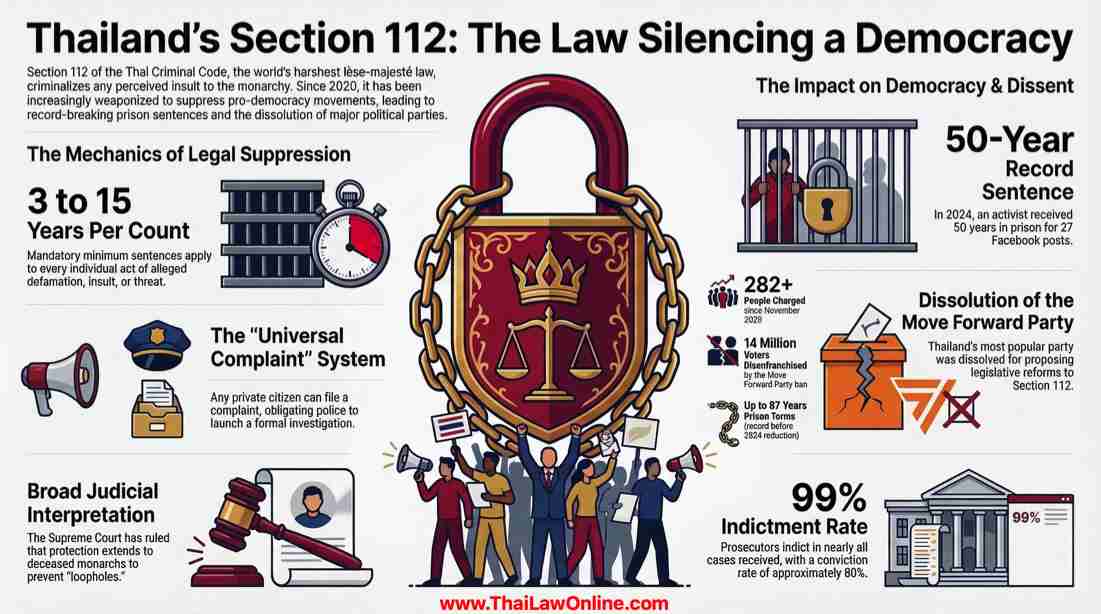
Thailand’s lese majeste law is one of the strictest in the world. It criminalizes any statement that defames, insults, or threatens the monarchy. The penalty? Three to fifteen years in prison. Per count.
If you live in Thailand, visit regularly, or post about it on social media, you need to understand this law. It applies to Thai citizens and foreigners alike. Ignorance isn’t a defense. And the consequences are severe.
This guide covers everything you need to know. We’ll walk through the legal text, explain how courts interpret it, look at real cases (including foreigners who’ve been prosecuted), and tell you exactly what to do if you’re ever accused. We’ve handled criminal defense matters in Thailand since 2006. Here’s what our experience has taught us.
Table of Contents
Last reviewed: 3 September 2026. Criminal Code sections 112, 78, 91 and 116 were read in Thai and English in our own annotated Code. The current text of section 112 and its three-to-fifteen-year penalty were checked against the instrument that created them, Order of the National Administrative Reform Council No. 41 of 21 October 1976, read from the Royal Gazette text. Sections 14, 15, 16 and 20 of the Computer Crime Act B.E. 2550 were read in Thai from the Act. Not verified here, and said rather than implied: whether section 112 reaches a deceased monarch, on which we can produce no Supreme Court judgment either way; the sentencing statistics, conviction rates and individual cases described below, which come from press and NGO reporting and not from judgments we hold; bail practice, which is practice and not statute; and whether the 2017 amendments to the Computer Crime Act altered any section quoted here, since we hold the Act as originally enacted. Re-checked on 6 October 2026: Penal Code section 7 read in Thai and added for the reach of section 112 to acts abroad; the FAQ answer and key takeaway that said the Supreme Court had ruled section 112 covers deceased monarchs were brought into line with the paragraph above, since no such judgment could be produced from our stores; the press-reported cases remain unverified.
What Is Lese Majeste Under Thai Law?
Lese majeste (from the French “injured majesty”) is a criminal offense in Thailand. It’s codified in Section 112 of the Thai Criminal Code. The provision has been in Thai law since 1908. Its present wording and its three-to-fifteen-year penalty are more recent than most accounts say: they were substituted by clause 1 of Order of the National Administrative Reform Council No. 41, published in the Royal Gazette on 21 October 1976 (vol. 93, part 134, special issue, page 46), which repealed the earlier section and raised the penalty.
Here’s the actual legal text of section 112:
“Whoever defames, insults or expresses malice against the King, the Queen, the Heir-apparent or the Regent shall be punished with imprisonment of three to fifteen years.”
That’s it. One sentence. But it carries enormous weight. The law defines none of its three limbs: it does not say what makes an imputation defamatory, what separates an insult from criticism, or what amounts to expressing malice. Courts have broad discretion in interpretation. And that vagueness is, in practice, one of the law’s most dangerous features.
Who Is Protected by Section 112?
The law names four protected persons: the King, the Queen, the Heir-Apparent, and the Regent. Currently, that means King Maha Vajiralongkorn (Rama X) and Queen Suthida.
But there’s an important wrinkle. Whether the section reaches a deceased monarch is unsettled, and we will not tell you it is settled. The text names four living offices and does not mention former Kings, and we can produce no Supreme Court judgment holding that it extends to them. What is not in doubt is the practical exposure: complaints have been made and prosecutions brought over content concerning the late King Bhumibol (Rama IX), who died in 2016, and courts have divided on whether the section applies. In our experience, this catches many expats off guard.
Who Can File a Complaint for Lese Majeste in Thailand?
Anyone can file a lese majeste complaint. You don’t need to be a member of the royal family. You don’t need to be a government official. Any private citizen can walk into a police station and file a complaint against another person.
Police are then obligated to investigate. They can’t simply dismiss the complaint. This creates a system where the law can be weaponized in personal disputes. We’ve seen business rivals, angry neighbors, and disgruntled ex-partners use lese majeste accusations as leverage. It’s not common, but it happens.
What Counts as Lese Majeste in Thailand?
The short answer: almost anything critical of the monarchy. The long answer is more nuanced, but not in the way most Westerners expect. Courts interpret Section 112 broadly.
Spoken and Written Statements
Any public statement that’s seen as negative toward the monarchy can trigger prosecution. This includes speeches, conversations overheard by third parties, written articles, books, and academic papers. Context matters less than you’d think. Even factual statements, if they’re perceived as casting the monarchy in a negative light, can be prosecuted.
Social Media Activity
This is where most people get into trouble today. Sharing, reposting, or even “liking” content about the monarchy on Facebook, X (formerly Twitter), Instagram, or YouTube can lead to charges. It doesn’t matter if you created the content or just shared it. Our guide to online and social media defamation in Thailand covers the broader risks of posting anything controversial online.
Section 14 of the Computer Crime Act, B.E. 2550 (2007) works alongside Section 112 here. Section 14(3) makes it an offence to put into a computer system any data that is itself an offence against the security of the Kingdom under the Criminal Code, which includes Section 112. Prosecutors routinely charge both. A single post is one act, though, so under Section 90 of the Criminal Code the court punishes it under the heavier provision, Section 112, not under both added together.
Real Risk: Social Media PostsIn January 2024, a Thai man received a 50-year sentence for 27 Facebook posts about the monarchy. Each post was treated as a separate count. Sentences ran consecutively. Online activity is not treated any differently from in-person speech.
Artistic and Academic Expression
Plays, films, songs, paintings, and academic research have all led to prosecutions. A stage play in 2014 depicting a fictional king resulted in charges. Self-published novels with oblique references to the monarchy have triggered arrests. Academic conferences discussing the institution of the monarchy have drawn scrutiny.
Private Conversations
Here’s what surprises most foreign clients. Even private messages can be prosecuted if they come to the attention of authorities. Encrypted messaging apps offer technical protection, but if a recipient screenshots the conversation and files a complaint, charges can follow. The same principle applies to online defamation cases under the Computer Crime Act.
Section 14 of the Computer Crime Act: The Digital Layer
Thailand’s Computer Crime Act, B.E. 2550 (2007), adds a second layer of legal risk for anything posted online. Section 14(3) criminalizes inputting data into a computer system that constitutes an offense related to national security. We cover this in detail in our guide to online defamation and the Computer Crime Act.
Prosecutors treat lese majeste as a national security offense. So an online post that violates Section 112 is usually charged under Section 14(3) as well.
The penalty under Section 14 is up to five years in prison or a fine of up to 100,000 baht, or both. Because one post is one act, that penalty is absorbed by the heavier 3-15 years under Section 112 (Criminal Code Section 90); it is separate posts, each a separate count, that add up.
There’s more. Section 15 makes a service provider that cooperates with, consents to or connives at a section 14 offence in a system under its control liable to the same penalty as the person who committed it. That wording was substituted by the Computer Crime Act (No. 2) B.E. 2560, which also directs the Minister to prescribe the steps for notification, suspension and removal, and exempts a provider that proves it followed them. The takedown power is section 20, not section 16: as substituted in 2560 it lets a competent official, with the Minister’s approval, apply to the court for an order suppressing the dissemination of the data or deleting it from the system, over three listed categories beginning with data that is itself an offence under the Act, rather than only data affecting the security of the Kingdom. Section 16 is a different offence altogether, the publishing of a doctored image of another person, which carries up to three years and a fine of up to 200,000 baht, the penalty substituted by the Computer Crime Act (No. 2) B.E. 2560.
| Law | Section | Covers | Penalty per Count |
|---|---|---|---|
| Thai Criminal Code | Section 112 | Defaming, insulting, or threatening the monarchy | 3-15 years imprisonment |
| Computer Crime Act | Section 14(3) | Online content affecting national security | Up to 5 years or a fine up to 100,000 THB, or both (absorbed by Section 112 for the same post, Section 90) |
| Thai Criminal Code | Section 116 | Sedition (often charged alongside) | Up to 7 years imprisonment |
Lese Majeste Penalties and Sentencing in Thailand
The sentencing range under the Thai Criminal Code is 3 to 15 years per count. That “per count” matters enormously. Each individual act (each social media post, each speech, each article) is treated as a separate offense. Sentences can be stacked consecutively.
How Sentences Add Up
Ten counts do not mean 150 years, and this is the point most English guides get wrong. Section 91(3) of the Criminal Code caps the total: where the most serious count carries a maximum above ten years, the combined term of imprisonment must not exceed fifty years, whatever the arithmetic of the individual counts, unless the court imposes life imprisonment. Section 112 has a fifteen-year maximum, so every lese majeste case falls under that cap. The fifty-year sentences reported in the press are not courts stopping short of a larger figure: fifty years is the ceiling the Code sets.
Guilty pleas can reduce sentences. Section 78 of the Criminal Code lets a court reduce a sentence by not more than one half where there are mitigating circumstances, and a confession that assists the court is one of the circumstances it lists. A half reduction is the maximum the section allows, not an entitlement, and it is discretionary. So a 30-year sentence might become 15 years with a guilty plea. That’s still a devastating outcome.
Bail for Lese Majeste in Thailand
Bail is possible but not guaranteed. Courts have denied bail in many lese majeste cases, particularly since 2020. Factors that affect bail decisions include perceived flight risk, severity of the alleged offense, and whether the defendant has prior charges. Foreigners often face extra scrutiny because courts view them as flight risks.
Royal Pardons
Some convicted individuals have received royal pardons. This is more common for foreigners, particularly in high-profile cases that attract international media attention. But a pardon is a grace, not a right. You can’t count on it. And you’ll still spend months (or years) in prison before a pardon is even considered.
Conviction Rates for Lese Majeste in Thailand
Here’s a number that should get your attention. Prosecutors indict in roughly 99% of lese majeste cases they receive. The conviction rate sits around 80%. Those odds aren’t in the defendant’s favor. And they underscore why prevention is so much more important than cure.
Notable Lese Majeste Cases and Sentences
The enforcement of Section 112 intensified sharply after November 2020. Since then, at least 284 people have been charged. Here are some of the most significant cases:
| Year | Defendant | Allegation | Sentence |
|---|---|---|---|
| 2024 | Mongkol Thirakot | 27 Facebook posts about the monarchy | 50 years (record) |
| 2024 | “Maggie” (pseudonym) | 18 posts on X (Twitter) about the monarchy | 25 years |
| 2025 | Pruttikorn | 10 Facebook posts criticizing the monarchy | 30 years (reduced to 20) |
| 2024-2025 | Anon Nampa (human rights lawyer) | Multiple speeches at protests | 18+ years cumulative (10 convictions) |
| 2024-2025 | Chonthicha Jangrew (MP) | Speeches at pro-democracy demonstrations | Multiple sentences totaling several years |
These aren’t outliers. They represent the current enforcement environment. Between 2020 and 2025, sentences have gotten longer and prosecutions more frequent. Anyone living in or visiting Thailand needs to take this seriously.
How Lese Majeste in Thailand Applies to Foreigners
This question comes up in our office constantly. The answer is straightforward. Section 112 applies to every person on Thai soil, and section 7(1) of the Penal Code goes further: the offences against the security of the Kingdom in sections 107 to 129, section 112 among them, are punishable in Thailand even when committed abroad. Your passport doesn’t protect you. Your nationality doesn’t matter.
Documented Foreign Cases
Foreign nationals have been arrested, convicted, and imprisoned for lese majeste. Here are documented examples:
In 2007, a Swiss national was sentenced to 10 years for defacing images of the King while intoxicated. He received a royal pardon after about one month and was deported.
In 2008, Australian author Harry Nicolaides was arrested at Bangkok airport over a self-published novel that contained references to the Thai monarchy. He was sentenced to three years. He received a pardon after six months and was deported.
In 2011, American citizen Joe Gordon was arrested for translating portions of a banned book about the monarchy and posting them online while in the United States. He was sentenced to two and a half years. Prosecuting an act done outside Thailand rests on Penal Code section 7(1), which covers the security offences in sections 107 to 129, section 112 included; his case shows it being used.
In 2025, American academic Paul Chambers was detained on lese majeste charges related to his scholarly work on the Thai military and monarchy. The case drew significant international attention and U.S. government concern.
Warning for Expats and VisitorsYou don’t have to be in Thailand to be charged. Thai courts have asserted jurisdiction over online content posted from other countries. If you enter Thailand after posting content deemed offensive to the monarchy, you can be arrested at immigration. VPNs don’t help if your identity is known.
What Foreign Embassies Can (and Can’t) Do
Your embassy can visit you in prison. They can provide a list of local lawyers. They can notify your family. That’s about it. They can’t override Thai law. They can’t get you released. They can’t negotiate your sentence. Consular assistance is moral support, not legal representation.
Some governments (the U.S., U.K., Australia, Canada) issue travel advisories that specifically mention Thailand’s lese majeste law. If you’re planning to live in or visit Thailand, read your country’s advisory. Then read it again.
Practical Guidance: How to Stay Out of Trouble
We’ve advised hundreds of expats and international businesses in Thailand since 2006. Here’s what we tell every client.
Don’t Discuss the Monarchy
Period. Not in person. Not online. Not in private messages. Not in emails. Not in jest. The safest approach is complete silence on the topic. That might feel extreme to someone from a country with broad free speech protections. But Thailand isn’t Canada, the U.S., or the U.K. Different country, different rules.
Social Media Hygiene
Audit your social media accounts before traveling to Thailand. Delete any posts that could be interpreted as critical of the monarchy. Be careful what you share, like, or comment on. Even reposting a news article can be problematic if the article is viewed as negative toward the royal family.
Don’t assume your account is too small to attract attention. Authorities monitor social media actively. Third parties file complaints based on content they encounter online. A single screenshot from a stranger is enough to start an investigation.
Be Careful with Photos and Symbols
Images of the royal family appear on Thai currency, in public buildings, and at events. Treat them with respect. Don’t step on a coin (it bears the King’s image). Don’t deface or damage any image of the monarchy. Stand when the royal anthem plays before movies. These aren’t just customs. They have legal implications.
Watch What You Read and Share
Certain books, websites, and documentaries are blocked or banned in Thailand because of their content about the monarchy. Possessing or sharing banned material can support a prosecution. If you’re unsure whether something is prohibited, don’t share it.
What to Do If You’re Accused of Lese Majeste
If you find yourself facing a lese majeste accusation, the next 48 hours are critical. Here’s what to do and what not to do.
- Contact a Thai criminal defense lawyer immediately. Don’t wait. Don’t try to handle it yourself. Don’t rely on your embassy. You need qualified Thai legal counsel from the first moment.
- Say nothing to police without your lawyer present. You have the right to remain silent. Exercise it. Anything you say can and will be used against you. Be polite but firm.
- Don’t discuss the case on social media. No posts. No tweets. No messages to friends explaining your side. Every word you put online becomes potential evidence.
- Don’t attempt to leave the country. If charges have been filed, leaving (or attempting to leave) Thailand makes everything worse. It can result in additional charges and will almost certainly result in bail being denied.
- Preserve evidence. Screenshot any relevant communications. Save copies of the content in question. Your lawyer will need this to build your defense.
- Contact your embassy. After you’ve spoken with your lawyer. Your embassy can provide consular assistance, but your lawyer directs the legal strategy.
From Our PracticeIn our experience, the single biggest mistake foreign clients make is talking too much before consulting a lawyer. Thai criminal procedure is different from what you’re used to at home. The interrogation process, the role of confessions, the bail system: none of it works the way you’d expect from watching American or British legal dramas. Get proper counsel first. Everything else follows from there.
Reform Efforts and International Pressure
Section 112 has drawn sustained criticism from international organizations. In January 2025, UN human rights experts called for Thailand to repeal the lese majeste law entirely. Amnesty International, Human Rights Watch, and the International Federation for Human Rights have all issued statements condemning its use.
Inside Thailand, reform efforts have stalled. The Move Forward Party (now the People’s Party) campaigned on amending Section 112 in the 2023 elections. That position contributed to the party’s eventual dissolution by the Constitutional Court. Subsequent governments have shown no appetite for reform.
The political amnesty law, the Act on Promoting a Peaceful Society B.E. 2569, came into force on 24 August 2026. It covers offences connected with political gatherings and political expression between 1 January 2005 and 16 July 2025, but section 3 expressly excludes Section 112. Lese majeste charges were left out of the amnesty.
Bottom line: don’t bet on the law changing anytime soon. Plan your behavior around the law as it stands today, not as you hope it might be tomorrow.
Thailand’s Lese Majeste Law Compared to Other Countries
Many countries have some form of lese majeste or royal defamation law on their books. But Thailand’s version stands out for its severity and enforcement frequency. (Wikipedia on Lese-Majesté)
| Country | Law | Maximum Penalty | Enforcement Level |
|---|---|---|---|
| Thailand | Criminal Code Section 112 | 3-15 years per count | Very active (280+ cases since 2020) |
| Saudi Arabia | Various royal protection laws | Varies (can be severe) | Active |
| Netherlands | Criminal Code Art. 111 | Up to 5 years | Rarely enforced |
| Spain | Criminal Code Art. 490-491 | Up to 2 years | Occasionally enforced |
| Denmark | Repealed in 2017 | N/A | N/A |
| United Kingdom | No lese majeste law | N/A | N/A |
| Canada / USA | No lese majeste law | N/A | N/A |
For Western expats, the key takeaway is this: the legal environment you’re used to doesn’t exist in Thailand when it comes to the monarchy. Free speech protections that you take for granted at home simply don’t apply. Thailand’s law is active, enforced, and carries real prison time.
Frequently Asked Questions About Lese Majeste in Thailand
What is lese majeste in Thailand?
Lese majeste is a criminal offense under Section 112 of the Thai Criminal Code. It prohibits defaming, insulting, or threatening the King, Queen, Heir-Apparent, or Regent. The penalty is 3 to 15 years in prison per count.
Can foreigners be charged with lese majeste in Thailand?
Yes. Section 112 applies to everyone on Thai soil, regardless of nationality, and under Penal Code section 7(1) it can be prosecuted in Thailand even when the act was committed abroad. Foreigners have been arrested, convicted, and imprisoned. Some received royal pardons and deportation, but no outcome is guaranteed.
Can social media posts lead to lese majeste charges?
Yes. Sharing, liking, or commenting on content about the monarchy can trigger charges. Both Section 112 and Section 14 of the Computer Crime Act apply. Online activity is actively monitored by Thai authorities.
What is the maximum penalty for lese majeste in Thailand?
Each count carries 3 to 15 years in prison. Multiple charges run consecutively. The current record sentence is 50 years for 27 social media posts.
Is there bail for lese majeste charges?
Bail is possible but not guaranteed. Courts have denied bail in many cases since 2020. Foreigners face extra scrutiny because courts consider them flight risks. An experienced criminal defense lawyer is essential from day one.
Does lese majeste apply to comments about deceased Thai kings?
It is unsettled. The section names the King, the Queen, the Heir-apparent and the Regent, and we can produce no Supreme Court judgment holding that it extends to a former King. In practice complaints have been filed and prosecutions brought over content about King Bhumibol (Rama IX), who died in 2016, so treat the risk as real.
What should I do if accused of lese majeste in Thailand?
Contact a Thai criminal defense lawyer immediately. Say nothing without your lawyer present. Don’t post about it on social media. Don’t try to leave Thailand. Reach out to our team for urgent assistance.
How ThaiLawOnline Can Help
We’ve been representing clients for criminal matters in Thailand since 2006. Our criminal law team understands the Thai legal system from the inside. We know how police investigations work. We know how prosecutors think. And we know what strategies give clients the best possible outcome.
If you or someone you know is facing a lese majeste accusation, time matters. Early legal intervention can influence how police handle the investigation, whether bail is granted, and how the case proceeds. Don’t wait.
We also provide preventive counsel for businesses operating in Thailand. If your employees create content, manage social media accounts, or engage in public communications, we can help you develop policies that protect your people from inadvertent violations.
Contact ThaiLawOnline for a confidential consultation. We respond within 24 to 48 hours.
Key Takeaways
- Section 112 criminalizes defaming, insulting, or threatening the Thai monarchy. Penalty: 3-15 years per count.
- The law applies to Thai citizens and foreigners alike. Your nationality doesn’t protect you.
- Social media activity (posts, shares, likes, comments) triggers both Section 112 and the Computer Crime Act.
- Sentences can be stacked consecutively. The current record is 50 years for 27 Facebook posts.
- Whether the law reaches deceased monarchs is unsettled, but comments about previous kings have been prosecuted.
- Anyone can file a lese majeste complaint. Police must investigate every report.
- Conviction rates are roughly 80%. Prosecutors indict in about 99% of cases.
- The safest approach: don’t discuss the Thai monarchy at all, in person or online.
- If accused, contact a criminal defense lawyer immediately. Say nothing without counsel present.
Thai Law Updates, free by email
Plain-English updates on Thai law changes that affect foreigners: property, visas, marriage, business and wills. One short email a month from a firm practicing since 2006. No spam, unsubscribe anytime.