


Reviewed by ThaiLawOnline, a licensed Thai law firm practising in Thailand since 2006. Thai lawyer of record: Wichuda Atthamethakon, LL.M., Thai Bar Licence 3149/2556.
Last updated on
Domestic violence is a critical issue that transcends borders, affecting individuals from all walks of life. For expatriates and locals in Thailand, understanding the nuances of this problem within the Thai context is the first step toward safety and justice. This comprehensive guide provides crucial information on domestic violence in Thailand, covering everything from legal definitions and protective laws to the immediate actions you can take and the support systems available to help you end the agony.
Domestic violence is also a statutory ground for divorce, as set out in our guide to Thai family law.

Table of Contents
The Hidden Crisis: Understanding Domestic Violence in Thailand
Domestic violence is a pervasive issue often shrouded in silence. While official statistics may not capture the full extent of the problem due to under-reporting, available data highlights a concerning reality. According to the Public Health Ministry, thousands of women experience physical or sexual violence annually, with a significant portion of this abuse occurring in domestic settings. The COVID-19 pandemic reportedly exacerbated the situation, with many observing an increase in violence within families.
It’s a common misconception that domestic violence is a private family matter; however, under Thai law, it is a criminal offense. The problem affects not only Thai citizens but also the expatriate community, where victims may face additional challenges such as language barriers and unfamiliarity with the local legal system.
What Constitutes Domestic Violence Under Thai Law?
Last reviewed: 27 September 2026. Sections 3 to 12 of the Domestic Violence Victim Protection Act B.E. 2550 were read in the Thai text. Statistics, support organisations and their contact details are as published by those organisations and were not re-checked.
The primary legislation addressing this issue is the Domestic Violence Victim Protection Act, B.E. 2550 (2007). This act provides a broad definition of domestic violence, which includes:
- Physical, Mental, or Health-Related Harm: Any intentional act likely to cause harm to the body, mind, or health of a family member.
- Coercion and Unethical Influence: Using pressure or immoral tactics to wrongfully force a family member to act, refrain from acting, or yield to a specific demand.
- No amendment in force: The 2007 Act has not been amended. The Act on the Promotion of the Development and Protection of the Family Institution B.E. 2562 (2019), which was to replace it, had its commencement postponed indefinitely by an Emergency Decree in August 2019, so the 2007 Act still applies.
The term “family member” is also defined broadly, covering spouses, former spouses, cohabiting partners (even without a marriage certificate), children, adopted children, other family members, and any person who depends on the family and lives in the same household.
The Legal Landscape: Your Rights and Protections
Thailand has several laws in place to protect victims of domestic violence. While enforcement can sometimes be challenging, with authorities occasionally viewing it as a private issue, these legal frameworks provide a crucial foundation for seeking justice.
The Domestic Violence Victim Protection Act (2007)
This landmark act was established to criminalize domestic violence and offer a pathway to protection for victims of intimate partner violence. Key provisions include:
- Criminal Offense: Committing an act of domestic violence is a criminal offense punishable by imprisonment of up to six months, a fine of up to 6,000 THB, or both (section 4). The offence can be settled by the parties, and so can a simple assault under Criminal Code section 295 committed within the family, but settling it does not cancel other offences.
- Duty to Report: The victim, and anyone who sees or knows of domestic violence, has a duty to notify an official, orally, in writing, by telephone or electronically (sections 5 and 6).
- Protection for Reporters: Individuals who report in good faith are protected from civil, criminal, or administrative liability.
- Statute of Limitations: A complaint must typically be filed within three months from the time the victim is able to do so.
Protection Orders (Restraining Orders)
A vital tool for victim safety is the ability to obtain a protection order from the court in domestic violence cases. These orders are legally binding and can be tailored to the specific situation.
- Interim orders by an official (section 10): A designated official can, with or without a request from the victim, order interim relief: for example that the abuser stay away from the family home or from a family member, see a doctor, pay initial compensation, or follow arrangements for the children. The order must be put to the court within 48 hours, and the court confirms, changes or cancels it. Anyone affected can ask the court to review it within 30 days.
- Court orders during the case (section 11): While the case is investigated or tried, the court itself can make any relief order it considers appropriate, and change it as circumstances change. A victim or interested person can also apply for welfare protection under the Juvenile and Family Court procedure law, even after the three-month period below has passed.
- Enforcement: Breaching an official’s order is punishable by up to three months’ imprisonment or a fine of up to 3,000 THB; breaching a court order, by up to six months or 6,000 THB, or both.
Domestic Violence as Grounds for Divorce
For married individuals, domestic violence is a legally recognized ground for a contested divorce in Thailand. If you are seeking a divorce due to physical, psychological, or emotional abuse, you will need to provide substantial evidence to the court, such as medical reports, police records, or witness testimony. For more information, you can read our article on Divorce in Thailand.
Immediate Steps for Victims of Domestic Violence in Thailand
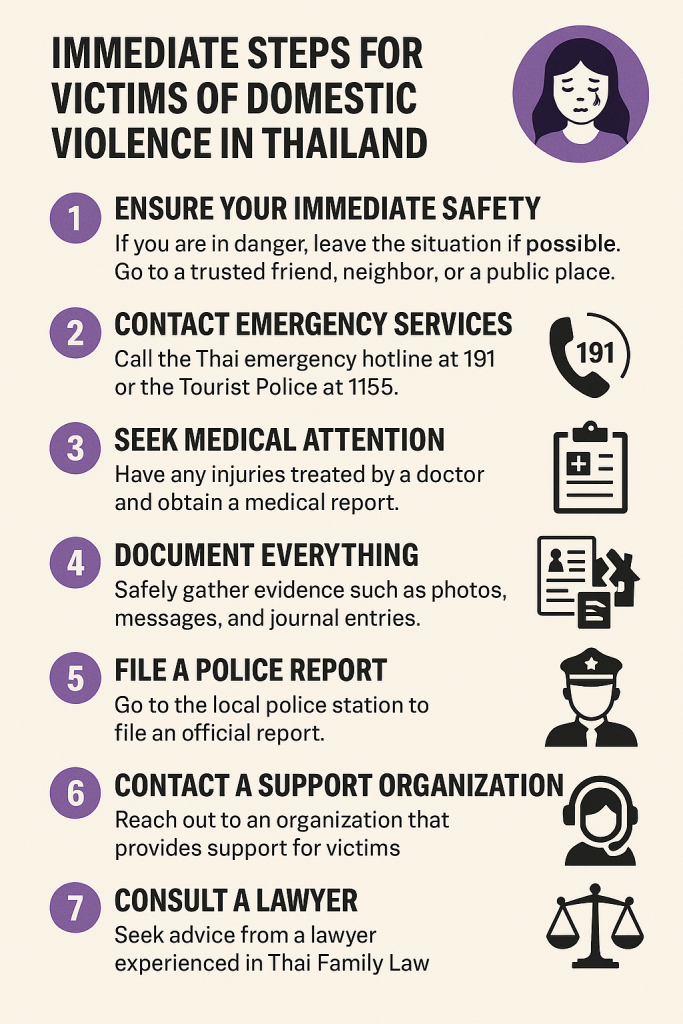
If you are in a situation of domestic violence, your safety is the top priority. Here are seven crucial steps you can take:
- Ensure Your Immediate Safety: If you are in danger, leave the situation if possible. Go to a trusted friend, neighbor, or a public place.
- Contact Emergency Services: Call the Thai emergency hotline at 191 for immediate police or medical assistance. For tourist-specific help, you can also contact the Tourist Police at 1155.
- Seek Medical Attention: Have any injuries treated by a doctor and be sure to get a medical report. This document is critical evidence.
- Document Everything: Safely gather as much evidence as you can regarding the forms of violence you have experienced. This includes photos of injuries, threatening messages, damaged property, and a journal of incidents with dates and times.
- File a Police Report: Go to the local police station to file an official report. It is advisable to do this within the three-month time limit.Bringing a Thai-speaking friend or a lawyer can be extremely helpful.
- Contact a Support Organization: Reach out to one of the many organizations that provide support, counseling, and shelter for victims. Their guidance can be invaluable, especially in navigating domestic violence cases.
- Consult a Lawyer: Seek advice from a law firm experienced in Thai Family Law. A lawyer can help you understand your rights, file for a protection order, and navigate the legal process for divorce or criminal charges.
Finding Help: Support Organizations and Resources
You do not have to face this alone. Several governmental and non-governmental organizations in Thailand are dedicated to helping victims of domestic violence.
| Organization | Services Offered | Contact Information |
| Ministry of Social Development and Human Security | 24/7 hotline for reporting violence, temporary shelters, and assistance from officials. | Hotline: 1300 |
| Women and Men Progressive Movement Foundation | Provides psychosocial and legal support to survivors of domestic violence. | Varies by location. |
| SHero Thailand | Offers pro bono legal assistance, counseling, and emergency support for survivors of gender-based violence. | Contact through their official website or social media. |
| HomeNet Thailand | Supports domestic workers, including migrants, who are survivors of gender-based violence | Hotline: +66-61-775-8181 |
| Rainbow Sky Association of Thailand | Focuses on supporting the LGBTQ+ community facing domestic violence. | Contact through their official channels. |
Frequently Asked Questions (FAQ) about Domestic Violence in Thailand
What is legally considered domestic violence in Thailand?
Domestic violence under Thai law includes not just physical harm but also verbal abuse, emotional intimidation, sexual abuse, and financial control. It can be committed by a spouse, partner, parent, or any family member. Even without visible injuries, repeated threats or controlling behavior may still be treated as domestic violence.
How do I file a restraining order in Thailand?
You usually start by making a report at the police station, then file a petition at the Family Court. If there is clear danger or repeated abuse, the court may issue a temporary order to protect you. However, the process is not automatic and depends on how the case is presented. Having a lawyer can help prepare the correct documents and present the facts clearly.
What documents do I need to report domestic violence in Thailand?
You should bring identification (such as a Thai ID or passport), a detailed written explanation of what happened, and any supporting evidence like medical records, photos of injuries, threatening messages, or witness statements. A police report, if already filed, will also help.
How much does it cost to get a restraining order in Thailand?
here is usually no government filing fee for a restraining order in a domestic violence case. But you may have to pay for legal assistance, translations, or certified copies. If you’re working with a law firm, fees will depend on the complexity of your case and what is required.
Can foreigners get protection from domestic violence in Thailand?
Can foreigners get protection from domestic violence in Thailand?
Yes. Foreigners have the same rights as Thai citizens when it comes to legal protection from domestic violence. You can file police reports, go to court, and apply for a restraining order even if you’re not married or even if you’re on a tourist visa. Your immigration status does not prevent you from seeking protection.
What is the Domestic Violence Victim Protection Act 2007?
This law was introduced to protect victims of family violence in Thailand. It allows courts to issue protection orders and offers alternatives to criminal punishment, such as therapy or rehabilitation. The goal is both to protect the victim and try to prevent future harm.
How long does it take to process a domestic violence complaint in Thailand?
There is no fixed timeframe. Some urgent matters can be addressed quickly, while other cases may take weeks or even months depending on the facts, the evidence, and the local court’s schedule. Cases involving children or repeated abuse are sometimes handled faster, but there are no guarantees.
What evidence do I need to prove domestic violence in Thailand?
Useful evidence can include medical reports, photos of injuries, threatening text messages or emails, video or audio recordings, police reports, and testimony from people who witnessed the abuse. Even if there is no physical violence, emotional or psychological abuse can also be documented and used in court.
Are there free legal services for domestic violence victims in Thailand?
Are there free legal services for domestic violence victims in Thailand?
Some government legal aid centers and NGOs offer free or low-cost legal services for victims of domestic violence. However, these services may not always be available in every area or in every language. ThaiLawOnline provides legal help in English, Thai, and French, and we can guide you through each step.
What happens after I report domestic violence to Thai police?
Police will usually take a written statement and may investigate further. Depending on the severity of the case, they may refer you to the court for a protection order or initiate criminal charges. If the situation is not urgent or if there is not enough evidence, it may be treated as a civil matter or closed.
Can I get temporary housing assistance for domestic violence in Thailand?
There are some shelters and safe houses in Thailand, mostly run by government or non-profit organizations. Availability depends on your location and the urgency of the situation. These facilities usually give priority to women with children and to cases involving physical danger.
How do I get help if I don’t speak Thai?
It’s best to contact a bilingual lawyer or law firm. Some larger police stations or family courts may have staff who speak basic English, but this is not guaranteed. At ThaiLawOnline, we can assist you in English, French, or Thai to help you communicate your case clearly.
How does Thai society view domestic violence, and what changes are occurring?
Traditionally, Thai society has viewed domestic violence as a private matter, but there is a growing recognition of it as a serious offense. Campaigns and education are helping to shift perceptions and encourage reporting and intervention.
How does international human rights law influence the handling of domestic violence cases in Thailand?
International human rights law, including the Convention on the Elimination of All Forms of Discrimination Against Women, influences Thai law by promoting the elimination of all forms of discrimination and violence against women. Thailand is committed to aligning its laws with these international standards.
Are there specific challenges faced by Thai women in reporting domestic violence?
Thai women may face challenges such as fear of stigma, lack of awareness about their rights, and limited access to legal assistance. Efforts to improve education and support networks aim to empower women to report cases of violence.
What measures are being taken to prevent domestic violence in Thailand?
Measures to prevent domestic violence in Thailand include public awareness campaigns, education programs, and collaboration with international organizations. These initiatives aim to change societal attitudes and provide resources for prevention and intervention.
Need Help Now?
If you or someone you care about is experiencing domestic violence in Thailand, don’t wait. Our team of Thai and foreign lawyers can guide you confidentially through your legal options, including protection orders, police reports, and court action.
We’re here to help you feel safe and supported.
Disclaimer: This article is for informational purposes only and does not constitute legal advice. If you are a victim of domestic violence, please contact the authorities and a qualified lawyer for assistance.
LINKS:
Thai Law Updates, free by email
Plain-English updates on Thai law changes that affect foreigners: property, visas, marriage, business and wills. One short email a month from a firm practicing since 2006. No spam, unsubscribe anytime.