


Reviewed by Wichuda Atthamethakon, LL.M., Thai Bar Licence 3149/2556, for ThaiLawOnline, a Thai law firm acting for foreigners since 2006.
Update log
- 2 November 2026: Added the statute box with Thai, English and French text and checked the page against the official text
Thailand has fundamentally transformed how foreign workers obtain and manage work authorization. On October 13, 2025, the Ministry of Labour launched the e-Work Permit System. This new system replaces the old paper “blue book” work permit that expatriates have used for many years. This digital platform is Thailand’s biggest update for managing foreign workers. It moves the whole work permit process online. The system is secure and available 24 hours a day. Understanding the Electronic Work Permit in Thailand is essential for compliance.
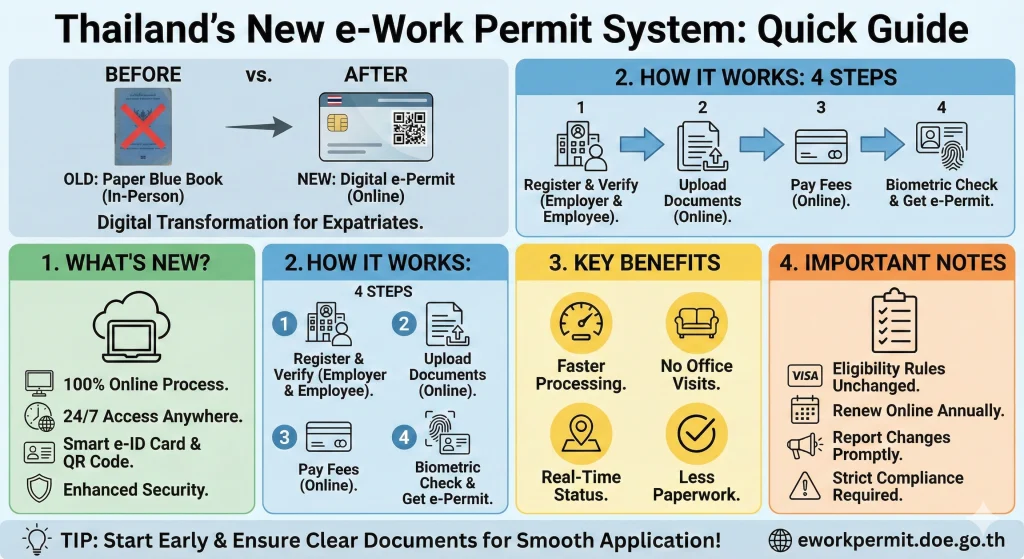
For expatriates living and working in Thailand, it is important to understand the new electronic work permit system. This knowledge helps maintain legal work status and avoid compliance issues. The change impacts all foreign workers. This includes teachers, corporate executives, skilled professionals, and business owners. Everyone must adjust to digital application processes, biometric checks, and electronic permit cards. Familiarity with the Electronic Work Permit in Thailand is crucial for all foreign employees.
Table of Contents
What Is the E-Work Permit System?
The e-Work Permit System is Thailand’s fully digital platform for managing foreign worker authorization. You reach it at eworkpermit.doe.go.th. Note the spelling: there is no hyphen. The hyphenated address does not resolve at all, which is a common way to end up on the wrong page. It manages all steps of work permit administration. This includes initial registration, document submission, application tracking, fee payment, appointment scheduling, and final permit issuance The Electronic Work Permit in Thailand makes it easier for expatriates to get work authorization. It ensures that all steps are done quickly and efficiently.
The e-Work Permit is different from the old system. It does not need many in-person visits to provincial labor offices. Now, both employers and foreign workers can do most tasks online. They can complete these tasks from anywhere with internet access. The platform connects directly to Thailand’s immigration databases. This creates a single record system. It greatly cuts down on delays and improves security with real-time data checks
The most visible change is the physical work permit itself. The old blue booklet is now a credit card-sized electronic work permit ID. It has QR codes and barcodes built in. These digital markers connect to government databases. This allows immigration officers and labor inspectors to quickly check a worker’s authorization status with smartphone scanners. This is a big improvement in security and convenience
The law behind this page
English
Section 8 Emergency Decree on Managing the Work of Foreigners B.E. 2560
Full text
An alien is prohibited from working without a work permit, or from doing work beyond what the alien has the right to do, in violation of this Emergency Decree.
ThaiLawOnline translation
Section 59 Emergency Decree on Managing the Work of Foreigners B.E. 2560
Full text
An alien who resides in the Kingdom, or who has been permitted to enter the Kingdom temporarily under the immigration law other than for tourism or transit through the Kingdom, may do only work not prohibited to aliens by notification under Section 7 paragraph one, and must obtain a work permit. Subject to Section 60, an alien wishing to obtain a work permit under paragraph one shall file an application with the Registrar and, where the alien already has an employer, shall also state the employer's name. The application and the grant of permission under paragraphs one and two shall be in accordance with the rules, procedures and conditions prescribed in ministerial regulations, which may provide for the use of electronic means. A work permit is valid for the period requested by the applicant, but not more than 2 years from the date of issue of the work permit. The ministerial regulations under paragraph three must also prescribe a completion period from the date of receipt of the application to the date of issue of the work permit, which must not exceed 15 working days. Where the Registrar cannot issue the work permit within that period, the Minister or the Director-General shall take action against the officials concerned as the case requires. Where the failure to issue the work permit was without reasonable cause, it is deemed a disciplinary offence and disciplinary action shall follow. Subject to the law, a person permitted to work under paragraph one has the right to do every kind of work not prohibited to aliens by notification under Section 7 paragraph one.
ThaiLawOnline translation
Section 60 Emergency Decree on Managing the Work of Foreigners B.E. 2560
Full text
An alien outside the Kingdom who wishes to apply for permission to work in the Kingdom may file the application and pay the fee through an electronic system. An employer wishing to employ an alien to come to work in its business in the Kingdom may file the work permit application on behalf of the alien with the Registrar, and pay the fee on behalf of the alien. The application, the issue of the work permit and the fees under paragraphs one and two shall be in accordance with the rules, procedures and conditions prescribed in ministerial regulations.
ThaiLawOnline translation
Section 7 Emergency Decree on Managing the Work of Foreigners B.E. 2560
Full text
The Minister, with the approval of the Committee, may by notification prescribe any work as work prohibited to aliens, and the prohibition may be absolute or subject to any conditions. In prescribing under paragraph one, regard shall be had to national security, the employment and professional opportunities of Thai people, the promotion of Thai wisdom and identity, and the need for foreign labour necessary for the development of the country, together with the commitments or obligations of Thailand on a reciprocal basis.
ThaiLawOnline translation
Section 64/1 Emergency Decree on Managing the Work of Foreigners B.E. 2560
Full text
An alien applying for a work permit must have the qualifications and must not have the prohibited characteristics prescribed in a Ministerial Regulation, and must never have been punished under Section 101, unless the alien finished serving that punishment not less than 2 years before the date of applying for the work permit, or is an alien under Section 63 whom the registrar permits to work as a special case. Where the issue of a work permit requires a prior health check of the alien, the alien or the alien's employer shall take the alien for a health check at a medical facility licensed to operate as a medical facility. Paragraph one does not apply to an alien under Section 63/1.
ThaiLawOnline translation
Section 64/2 Emergency Decree on Managing the Work of Foreigners B.E. 2560
Full text
A person permitted to work has a duty to notify the Registrar of the employer, the employer's place of work and the main nature of the work done, within 15 days from the date of starting work, and must notify on every change of employer.
ThaiLawOnline translation
Section 101 Emergency Decree on Managing the Work of Foreigners B.E. 2560
Full text
An alien who violates Section 8 is liable to a fine of 5,000 to 50,000 baht and, once the fine has been paid, shall be sent out of the Kingdom without delay, unless the alien falls under Section 63 or Section 63/1. Paragraph one does not apply to an alien who is an injured person or a witness in a human trafficking offence case under the law on the prevention and suppression of human trafficking. Where an alien accused of an offence under paragraph one consents to travel back out of the Kingdom, the inquiry official shall settle the case by fine in accordance with the rules, procedures and conditions set by the Joint Committee and then notify the Department of Employment, and once the alien has been made to travel back out of the Kingdom, the case is deemed terminated under the Criminal Procedure Code. The Joint Committee under paragraph three consists of a representative of the Office of the Attorney General as chairperson, a representative of the Royal Thai Police as member, and a representative of the Department of Employment as member and secretary. The rules, procedures and conditions for settlement by fine set by the Joint Committee under paragraph three shall take into account the gravity of the offence, repeat offending and the prevention of repeat offending, and shall be published in the Government Gazette.
ThaiLawOnline translation
Section 102 Emergency Decree on Managing the Work of Foreigners B.E. 2560
Full text
A person who takes an alien into work in violation of Section 9 is liable to a fine of 10,000 to 100,000 baht per alien employed. If the offender under paragraph one repeats the offence, the offender is liable to imprisonment for not more than 1 year, or a fine of 50,000 to 200,000 baht per alien employed, or both, and is prohibited from employing aliens for 3 years from the date of the final court judgment imposing punishment. A person living in the same family as the person who took the alien into work under paragraph one shall not be deemed guilty as principal, instigator or supporter.
ThaiLawOnline translation
ไทย
มาตรา 8 พระราชกำหนดการบริหารจัดการการทำงานของคนต่างด้าว พ.ศ. 2560
ข้อความเต็ม
ห้ามคนต่างด้าวทำงานโดยไม่มีใบอนุญาตทำงานหรือทำงานนอกเหนือจากที่มีสิทธิจะทำได้อันเป็นการฝ่าฝืนพระราชกำหนดนี้
ตรงตามข้อความในราชกิจจานุเบกษา / สำนักงานคณะกรรมการกฤษฎีกา (Verbatim from the Royal Gazette / Office of the Council of State)
มาตรา 59 พระราชกำหนดการบริหารจัดการการทำงานของคนต่างด้าว พ.ศ. 2560
ข้อความเต็ม
คนต่างด้าวซึ่งมีถิ่นที่อยู่ในราชอาณาจักรหรือได้รับอนุญาตให้เข้ามาในราชอาณาจักรเป็นการชั่วคราวตามกฎหมายว่าด้วยคนเข้าเมืองซึ่งมิใช่เพื่อการท่องเที่ยวหรือการเดินทางผ่านราชอาณาจักร จะทำงานได้ก็แต่เฉพาะงานที่มิได้มีประกาศห้ามคนต่างด้าวทำตามมาตรา ๗ วรรคหนึ่ง และต้องได้รับใบอนุญาตทำงาน ภายใต้บังคับมาตรา ๖๐ คนต่างด้าวซึ่งประสงค์จะขอรับใบอนุญาตทำงานตามวรรคหนึ่ง ให้ยื่นคำขออนุญาตต่อนายทะเบียน และในกรณีที่มีนายจ้างแล้วให้ระบุชื่อนายจ้างด้วย การขออนุญาตและการอนุญาตตามวรรคหนึ่งและวรรคสอง ให้เป็นไปตามหลักเกณฑ์ วิธีการ และเงื่อนไขที่กำหนดในกฎกระทรวง โดยจะกำหนดให้ใช้วิธีการทางอิเล็กทรอนิกส์ก็ได้ และใบอนุญาตทำงานให้มีอายุเท่าที่ผู้ขออนุญาตร้องขอ แต่ไม่เกินสองปีนับแต่วันที่ออกใบอนุญาตทำงาน ในกฎกระทรวงตามวรรคสามต้องกำหนดระยะเวลาแล้วเสร็จตั้งแต่วันที่ได้รับคำขออนุญาตจนถึงวันที่ออกใบอนุญาตทำงานไว้ด้วยซึ่งต้องไม่เกินสิบห้าวันทำการ ในกรณีที่นายทะเบียนไม่สามารถออกใบอนุญาตทำงานให้ได้ภายในกำหนดเวลา ให้รัฐมนตรีหรืออธิบดีดำเนินการกับเจ้าหน้าที่ที่เกี่ยวข้องตามควรแก่กรณี ในกรณีที่การไม่ออกใบอนุญาตทำงานนั้นเป็นไปโดยไม่มีเหตุอันสมควร ให้ถือว่าเป็นการกระทำผิดวินัย และให้มีการดำเนินการทางวินัยต่อไป ภายใต้บังคับแห่งกฎหมาย ผู้รับอนุญาตให้ทำงานตามวรรคหนึ่งมีสิทธิทำงานที่มิได้มีประกาศห้ามคนต่างด้าวทำตามมาตรา ๗ วรรคหนึ่งได้ทุกชนิด
ตรงตามข้อความในราชกิจจานุเบกษา / สำนักงานคณะกรรมการกฤษฎีกา (Verbatim from the Royal Gazette / Office of the Council of State)
มาตรา 60 พระราชกำหนดการบริหารจัดการการทำงานของคนต่างด้าว พ.ศ. 2560
ข้อความเต็ม
คนต่างด้าวซึ่งอยู่นอกราชอาณาจักรผู้ใดประสงค์จะขออนุญาตทำงานในราชอาณาจักร อาจยื่นคำขออนุญาตและชำระค่าธรรมเนียมผ่านทางระบบอิเล็กทรอนิกส์ได้ นายจ้างผู้ใดประสงค์จะจ้างคนต่างด้าวเข้ามาทำงานในกิจการของตนในราชอาณาจักร จะยื่นคำขออนุญาตทำงานแทนคนต่างด้าวต่อนายทะเบียน พร้อมทั้งชำระค่าธรรมเนียมแทนคนต่างด้าวก็ได้ การขออนุญาตและการออกใบอนุญาตทำงานและค่าธรรมเนียมตามวรรคหนึ่งและวรรคสอง ให้เป็นไปตามหลักเกณฑ์ วิธีการ และเงื่อนไขที่กำหนดในกฎกระทรวง
ตรงตามข้อความในราชกิจจานุเบกษา / สำนักงานคณะกรรมการกฤษฎีกา (Verbatim from the Royal Gazette / Office of the Council of State)
มาตรา 7 พระราชกำหนดการบริหารจัดการการทำงานของคนต่างด้าว พ.ศ. 2560
ข้อความเต็ม
รัฐมนตรีโดยความเห็นชอบของคณะกรรมการอาจประกาศกำหนดให้งานใดเป็นงานที่ห้ามคนต่างด้าวทำก็ได้ โดยจะห้ามเด็ดขาดหรือห้ามโดยมีเงื่อนไขอย่างใดก็ได้ การกำหนดตามวรรคหนึ่ง ให้คำนึงถึงความมั่นคงของชาติ โอกาสในการประกอบอาชีพและวิชาชีพของคนไทย การส่งเสริมภูมิปัญญาและเอกลักษณ์ไทย และความต้องการแรงงานต่างด้าวที่จำเป็นต่อการพัฒนาประเทศ รวมตลอดทั้งความผูกพันหรือพันธกรณีที่ประเทศไทยมีอยู่ในลักษณะถ้อยทีถ้อยปฏิบัติประกอบด้วย
ตรงตามข้อความในราชกิจจานุเบกษา / สำนักงานคณะกรรมการกฤษฎีกา (Verbatim from the Royal Gazette / Office of the Council of State)
มาตรา 64/1 พระราชกำหนดการบริหารจัดการการทำงานของคนต่างด้าว พ.ศ. 2560
ข้อความเต็ม
คนต่างด้าวที่จะขอรับใบอนุญาตทำงานต้องมีคุณสมบัติและไม่มีลักษณะต้องห้ามตามที่กำหนดในกฎกระทรวง และไม่เคยได้รับโทษตามมาตรา ๑๐๑ เว้นแต่ได้พ้นโทษมาแล้วไม่น้อยกว่าสองปีก่อนวันขอรับใบอนุญาตทำงาน หรือเป็นคนต่างด้าวตามมาตรา ๖๓ ที่นายทะเบียนอนุญาตให้ทำงานได้เป็นกรณีพิเศษ ในกรณีที่การออกใบอนุญาตทำงานจำเป็นต้องมีการตรวจสุขภาพของคนต่างด้าวก่อน ให้คนต่างด้าวหรือนายจ้างของคนต่างด้าวนั้นนำคนต่างด้าวไปตรวจสุขภาพ ณ สถานพยาบาลที่ได้รับใบอนุญาตให้ประกอบกิจการสถานพยาบาล ความในวรรคหนึ่งไม่ใช้บังคับแก่คนต่างด้าวตามมาตรา ๖๓/๑
ตรงตามข้อความในราชกิจจานุเบกษา / สำนักงานคณะกรรมการกฤษฎีกา (Verbatim from the Royal Gazette / Office of the Council of State)
มาตรา 64/2 พระราชกำหนดการบริหารจัดการการทำงานของคนต่างด้าว พ.ศ. 2560
ข้อความเต็ม
ผู้รับอนุญาตให้ทำงานมีหน้าที่ต้องแจ้งให้นายทะเบียนทราบถึงผู้เป็นนายจ้าง สถานที่ทำงานของนายจ้าง และลักษณะงานหลักที่ทำ ทั้งนี้ ภายในสิบห้าวันนับแต่วันที่เข้าทำงาน และต้องแจ้งทุกครั้งที่เปลี่ยนนายจ้าง
ตรงตามข้อความในราชกิจจานุเบกษา / สำนักงานคณะกรรมการกฤษฎีกา (Verbatim from the Royal Gazette / Office of the Council of State)
มาตรา 101 พระราชกำหนดการบริหารจัดการการทำงานของคนต่างด้าว พ.ศ. 2560
ข้อความเต็ม
คนต่างด้าวผู้ใดฝ่าฝืนมาตรา ๘ ต้องระวางโทษปรับตั้งแต่ห้าพันบาทถึงห้าหมื่นบาท และเมื่อได้ชำระค่าปรับแล้ว ให้ส่งคนต่างด้าวผู้นั้นกลับออกไปนอกราชอาณาจักรโดยเร็ว เว้นแต่เป็นคนต่างด้าวตามมาตรา ๖๓ หรือมาตรา ๖๓/๑ ความในวรรคหนึ่งไม่ใช้บังคับแก่คนต่างด้าวซึ่งเป็นผู้เสียหายหรือพยานในคดีความผิดฐานค้ามนุษย์ ตามกฎหมายว่าด้วยการป้องกันและปราบปรามการค้ามนุษย์ ในกรณีที่คนต่างด้าวซึ่งถูกกล่าวหาว่ากระทำความผิดตามวรรคหนึ่ง ยินยอมเดินทางกลับออกไปนอกราชอาณาจักร ให้พนักงานสอบสวนดำเนินการเปรียบเทียบปรับตามหลักเกณฑ์ วิธีการ และเงื่อนไขที่คณะกรรมการร่วมกำหนดแล้วแจ้งให้กรมการจัดหางานทราบ และเมื่อได้ดำเนินการให้คนต่างด้าวนั้นเดินทางกลับออกไปนอกราชอาณาจักรแล้ว ให้ถือว่าคดีเลิกกันตามประมวลกฎหมายวิธีพิจารณาความอาญา คณะกรรมการร่วมตามวรรคสาม ประกอบด้วย ผู้แทนสำนักงานอัยการสูงสุดเป็นประธานกรรมการ ผู้แทนสำนักงานตำรวจแห่งชาติเป็นกรรมการ และผู้แทนกรมการจัดหางานเป็นกรรมการและเลขานุการ หลักเกณฑ์ วิธีการ และเงื่อนไขในการเปรียบเทียบปรับที่คณะกรรมการร่วมกำหนดตามวรรคสาม ให้คำนึงถึงสภาพความร้ายแรงของการกระทำความผิด การกระทำความผิดซ้ำ และการป้องกันมิให้ผู้กระทำความผิดกระทำความผิดซ้ำอีก และให้ประกาศในราชกิจจานุเบกษา
ตรงตามข้อความในราชกิจจานุเบกษา / สำนักงานคณะกรรมการกฤษฎีกา (Verbatim from the Royal Gazette / Office of the Council of State)
มาตรา 102 พระราชกำหนดการบริหารจัดการการทำงานของคนต่างด้าว พ.ศ. 2560
ข้อความเต็ม
ผู้ใดเป็นผู้รับคนต่างด้าวเข้าทำงานโดยฝ่าฝืนมาตรา ๙ ต้องระวางโทษปรับตั้งแต่หนึ่งหมื่นบาทถึงหนึ่งแสนบาทต่อคนต่างด้าวที่จ้างหนึ่งคน ถ้าผู้กระทำความผิดตามวรรคหนึ่งกระทำผิดซ้ำอีก ต้องระวางโทษจำคุกไม่เกินหนึ่งปี หรือปรับตั้งแต่ห้าหมื่นบาทถึงสองแสนบาทต่อคนต่างด้าวที่จ้างหนึ่งคน หรือทั้งจำทั้งปรับ และห้ามผู้นั้นจ้างคนต่างด้าวทำงานเป็นเวลาสามปีนับแต่วันที่ศาลมีคำพิพากษาถึงที่สุดให้ลงโทษ มิให้ถือว่าผู้ซึ่งอยู่อาศัยในครอบครัวเดียวกันกับผู้รับคนต่างด้าวเข้าทำงานตามวรรคหนึ่งมีความผิดในฐานะตัวการ ผู้ใช้ หรือผู้สนับสนุน
ตรงตามข้อความในราชกิจจานุเบกษา / สำนักงานคณะกรรมการกฤษฎีกา (Verbatim from the Royal Gazette / Office of the Council of State)
Français
Article 8 Emergency Decree on Managing the Work of Foreigners B.E. 2560
Il est interdit à l'étranger de travailler sans permis de travail ou au-delà de ce qu'il a le droit de faire, en violation du présent décret.
résumé non officiel
Article 59 Emergency Decree on Managing the Work of Foreigners B.E. 2560
Le résident ou le séjournant temporaire, hors tourisme et transit, ne peut exercer qu'un travail non interdit (article 7) et muni d'un permis, valable au plus 2 ans. La demande se dépose auprès du Registrateur; le délai de délivrance ne peut excéder 15 jours ouvrables.
résumé non officiel
Article 60 Emergency Decree on Managing the Work of Foreigners B.E. 2560
L'étranger hors du Royaume peut demander son permis et payer les frais par voie électronique. L'employeur peut déposer la demande auprès du Registrateur et payer les frais pour lui, selon les règles fixées par règlement ministériel.
résumé non officiel
Article 7 Emergency Decree on Managing the Work of Foreigners B.E. 2560
Le ministre, avec l'accord du Comité, peut interdire aux étrangers tout travail, absolument ou sous conditions, en tenant compte notamment de la sécurité nationale, des débouchés des Thaïlandais, de l'identité thaïe, des besoins de main-d'œuvre étrangère et des engagements réciproques de la Thaïlande.
résumé non officiel
Article 64/1 Emergency Decree on Managing the Work of Foreigners B.E. 2560
Le demandeur de permis de travail doit remplir les conditions réglementaires, sans cause d'exclusion, et n'avoir jamais subi la peine de l'article 101, sauf peine purgée depuis au moins 2 ans ou autorisation spéciale du registrateur pour l'étranger de l'article 63 ; ceci ne vise pas l'étranger de l'article 63/1.
résumé non officiel
Article 64/2 Emergency Decree on Managing the Work of Foreigners B.E. 2560
Le titulaire de l'autorisation de travail doit déclarer au Registrateur l'employeur, le lieu de travail et la nature principale du travail dans les 15 jours suivant l'entrée en fonction, et à chaque changement d'employeur.
résumé non officiel
Article 101 Emergency Decree on Managing the Work of Foreigners B.E. 2560
L'étranger contrevenant à l'article 8 encourt 5 000 à 50 000 bahts d'amende puis, sauf articles 63 et 63/1, le renvoi rapide. Ce régime ne s'applique pas aux victimes ou témoins de traite. S'il accepte de repartir, l'amende est transigée et l'affaire est éteinte après son départ.
résumé non officiel
Article 102 Emergency Decree on Managing the Work of Foreigners B.E. 2560
Employer un étranger en violation de l'article 9: 10 000 à 100 000 bahts par étranger; en récidive, 1 an de prison au plus et/ou 50 000 à 200 000 bahts par étranger, et 3 ans d'interdiction d'en employer. La famille cohabitant avec l'employeur n'est pas réputée coupable.
résumé non officiel
Sources
- Emergency Decree on Managing the Work of Foreigners B.E. 2560, retrieved 31 October 2026
Who Must Use the E-Work Permit System?
Since October 13, 2025, the e-Work Permit System is required. This applies to all foreign workers and their employers who need work authorization in Thailand. This requirement applies to almost all work permit types. This includes people with Non-Immigrant “B” Visas. It also includes those with Long-Term Resident (LTR) Visas and Smart Visas. Additionally, it covers individuals working for companies promoted by the Board of Investment (BOI)
You need to submit the following through the digital platform:
- New work permit applications. Urgent work that can be finished within 15 days needs no permit, but section 61 requires written notice to the registrar first
- Annual renewals
- Permit amendments for job duty or location changes
- Cancellations when employment ends
The system combines separate processes into one workflow, which makes it easier to handle related procedures without visiting different government offices.
Transition Period for Existing Blue Book Holders
Foreign workers who already hold traditional blue book work permits need not panic. During the transition period, existing blue book permits remain valid until their expiration date. When it is time to renew, all renewals must go through the new e-Work Permit System. You cannot use the paper format anymore. This grace period allows current permit holders to complete their work authorization cycle before transitioning to the digital system.
Temporary Leniency for Technical Issues
Recognizing that any major system change encounters growing pains, Thailand’s Department of Employment has shown flexibility during implementation. Due to technical glitches and user unfamiliarity, authorities announced temporary measures that allowed manual paper-based applications until 28 January 2026 in certain cases. Employers hitting system errors could take screenshots of the problem and file in person at a provincial Employment Office or one of Bangkok’s area offices. That announced window ran only to 28 January 2026. The paper route was then extended twice. Immigration practice reporting puts the final extension as effective 24 April 2026 and running to 28 July 2026, after which manual filing stopped being a general route and survives only where you can show the platform actually failed. Read that with the caveat we would want ourselves: the Department published its January announcement openly, but appears to have issued the extensions internally. We could find no superseding announcement on doe.go.th, in the Royal Gazette, or in the Thai press. So 28 July 2026 is well attested by practitioners and not by a document we can show you. If you run into system errors today, ask the Employment Office handling your file what fallback, if any, is currently available before you rely on it. The Department set the route out in detail: capture a screenshot of the error, keep it with the supporting documents, and file at the Provincial Employment Office or at one of the Bangkok Area Employment Offices 1 to 10 covering the workplace. A separate transitional rule allowed renewals to be filed on the old system at mworkpermit.doe.go.th where the existing permit expired on or before 13 February 2026.
Key Features and Benefits of the Digital System
The e-Work Permit platform delivers several practical advantages that directly benefit expatriates and their sponsoring employers.
24/7 Online Access
Perhaps the most significant improvement is round-the-clock accessibility. Foreign workers and employers can submit applications and upload documents anytime, from anywhere. They can also pay fees, track application status, and receive notifications. They are no longer limited by office hours or distance from labor departments. This flexibility is particularly valuable for expatriates in remote provinces or those juggling demanding work schedules.
Faster Processing Times
The electronic system dramatically reduces waiting periods. Bangkok applications typically process within 7-10 working days, while provincial offices complete reviews in 10-12 working days. For companies that get help from the Board of Investment using the Single Window System, processing can take only 1 to 3 working days. Once all documents are checked, and biometric data is collected at service centers, the permit card is issued. It takes only 12 minutes to get the card
Real-Time Tracking and Notifications
Applicants receive instant status updates through email, SMS, and Line Official Account notifications. This transparency eliminates the uncertainty of traditional paper systems where applicants had no way to monitor progress. The platform’s e-Tracking menu allows users to check their application status and download approved documents electronically.
Enhanced Security and Fraud Prevention
The integration of biometric authentication (facial recognition, iris scans, and fingerprint verification) combined with QR code verification substantially reduces document fraud risks. Each work permit is now linked to the holder’s biometric profile and government records. This makes unauthorized use or fake permits nearly impossible
Reduced Paperwork and Office Visits
By digitizing the whole process, the system reduces the need for physical documents. It also cuts down on in-person visits to government offices, except for the final biometric appointment. This streamlining saves both time and money for employers managing multiple foreign employees across different locations.
Eligibility Requirements Remain Unchanged
While the application method has changed dramatically, the fundamental eligibility criteria for obtaining a work permit remain exactly the same. Foreign workers must still satisfy all of Thailand’s standard work permit qualifications:
Valid Non-Immigrant Visa: Applicants must have the right visa category. This is usually a Non-Immigrant “B” visa for business. Other options include LTR, Smart Visa, or other work-eligible visas. A foreigner already in Thailand must hold a stay that is not for tourism or transit before applying (section 59). A foreigner still abroad may apply electronically, or the employer may file on their behalf (section 60)
Educational or Professional Credentials: Documentation proving qualifications relevant to the job position, such as university degrees, professional certificates, or specialized training records.
Medical Certificate: A health clearance certificate (Form TMC No. 2) from a licensed Thai doctor. It must be issued within 30 days of submitting your application. This certificate confirms the applicant is free from six prohibited conditions: leprosy, tuberculosis, drug addiction, alcoholism, elephantiasis, and third-stage syphilis.
Signed Employment Contract: A formal contract specifying job title, responsibilities, salary, and employment duration.
Employer Capital and Employee Ratio Requirements, which are Immigration’s criteria for the visa extension rather than conditions of the work permit itself: companies must keep 2 million THB in registered capital for each foreign employee. This amount is reduced to 1 million THB if the foreign worker is married to a Thai national. Also, employers must hire four Thai workers for every one foreign worker. This rule does not apply to BOI-promoted companies, which follow the BOI’s own criteria under Office of the BOI Announcement No. Por. 8/2568 instead
The e-Work Permit makes the application process digital. However, it does not lower the qualification standards. Compliance is still as strict as before
How to Apply: Step-by-Step Process
Navigating the new e-Work Permit System requires coordination between employer and employee. Here is the complete application workflow:
Step 1: Employer Registration and Verification
The process begins with the employer registering the company on the e-Work Permit portal at eworkpermit.doe.go.th. The authorized company director or signatory must verify their identity using the ThaiID mobile application. This digital identity verification is mandatory, the platform will not accept applications without confirmed employer authentication.
Employers must upload company documentation including business registration certificates, recent tax records, shareholder lists, and business licenses. All information in official company records must match exactly with information submitted in the application forms to avoid rejection.
Step 2: Foreign Worker Account Setup
Simultaneously, the foreign employee creates their personal account on the same platform. The worker starts preparing their document uploads. They make sure all materials meet the technical requirements. The files should be in PDF or JPEG format. Each file must be under 5MB and have clear, readable scans
Step 3: Document Upload
Both employer and employee upload all required documents through the platform:
- Passport (biographical page and current Thai visa page)
- Employment contract (signed by both parties)
- Educational certificates and professional licenses
- Medical certificate (Form TMC No. 2, issued within 30 days)
- Company registration documents
- Tax certificates and business licenses
- Three passport-sized photographs (taken within the last six months)
Any documents in foreign languages must include certified Thai translations and official legalization where required.
Step 4: Complete BT.32 Application Form and Fee Payment
The applicant completes the online BT.32 application form with detailed employment information. The standard government fee for a one-year work permit is 3,000 THB. There are lower fees for shorter permits: 1,500 THB for 3-6 months and 750 THB for under 3 months. An additional 100 THB application fee applies to all submissions. Payment is processed electronically through the platform.
Step 5: Appointment Booking for Biometric Verification
Once the application is checked and approved, the system allows the applicant to schedule an appointment. There are more than 40 Foreign Work Permit Service Centers across the country. The applicant selects their preferred location and time slot online.
Step 6: Biometric Data Collection and Permit Issuance
On the appointment date, the foreign worker must appear in person at the designated service center with their original passport and all supporting documents. At the center, officials collect biometric data including facial recognition, iris scans, and fingerprint verification. This biometric profile is permanently linked to the work permit record.
If all documentation is verified and approved, the physical e-Work Permit ID card can be issued the same day, often within 12-15 minutes of completing the biometric process. The card shows the worker’s photo, job details, employer information, work location, and a QR code for quick verification
Special Processing for BOI Companies and LTR Visa Holders
Thailand offers expedited pathways for certain categories of foreign workers.
Board of Investment (BOI) Promoted Companies
Companies receiving BOI promotional privileges access work permit services through the Single Window System at swe-expert.boi.go.th or swboi.boi.go.th. This platform combines visa and work permit applications into one easy process. It usually gives approvals in 1-3 working days. BOI companies do not have to meet the 2 million THB capital requirement. They are also outside the 4:1 Thai-to-foreign employee ratio, though Office of the BOI Announcement No. Por. 8/2568 sets its own criteria, including minimum incomes by position and at least 70% Thai staff in a manufacturing project with more than 100 employees
Long-Term Resident (LTR) Visa Holders
Holders of Thailand’s LTR Visa enjoy digital work permit privileges. They do not need to meet standard capital or employee ratio requirements. LTR visa holders in the Highly-Skilled Professional, Wealthy Global Citizen, and Wealthy Pensioner categories can get work permits. They can do this at the One Stop Service Center for Visas and Work Permits at Chamchuri Square or at local labor offices. The digital work permit costs 3,000 THB per year and must be renewed annually. Work-From-Thailand Professionals in the LTR program cannot get work permits. This category is meant for remote work with foreign employers
Smart Visa Holders
Foreign experts holding Smart Visas in Thailand’s targeted industries (technology, medical, agriculture, food) receive work authorization as part of their visa approval and are exempt from separate work permit requirements. They still need to complete registration. They also need to verify their identity. This is done through the Smart Visa system managed by the Board of Investment
Migrant Workers From Laos, Myanmar and Vietnam: the 8 September to 11 December 2026 Renewal Window
The e-Work Permit system also carries the mass renewals for migrant workers admitted under Cabinet resolutions, and two separate deadlines are running in late 2026. Employers who confuse them lose the worker. Under the Cabinet resolution of 14 July 2026, employers of Lao, Myanmar and Vietnamese workers whose permission ends on 11 December 2026 can apply through e-WorkPermit from 8 September 2026 to extend it; the window closes on 11 December 2026, with applications accepted until 16:30 and fee payment until 20:00 that day (Department of Employment notice of 13 August 2026, “กรมการจัดหางาน แนะนายจ้าง ยื่นต่ออายุใบอนุญาตทำงาน แรงงาน ลาว เมียนมา เวียดนาม ภายใน 11 ธ.ค. 69”, released through the Government Public Relations Department). Fees are 100 THB for the application and 900 THB for the permit. Cambodian workers are not in this group.
The documents are the worker’s passport or a substitute travel document (Myanmar nationals without a passport may file first and add it later), a health check from a state hospital or an approved private hospital linked to the Department, proof of social security registration or a health-insurance policy of at least six months (twelve months for work outside the social security system, such as domestic work), and a power of attorney where the employer files.
The other date, 28 September 2026, belongs to a different group: Lao, Myanmar and Vietnamese workers whose permits expired on 31 March 2026 and were extended under the Cabinet resolution of 2 December 2025. Those workers had to complete their visa stamp or temporary-stay permission at Immigration by 28 September 2026 (Government Public Relations Department release, 1 March 2026). Before quoting either date, identify which Cabinet resolution the worker was admitted under and the expiry date printed on the existing permit.
Renewals, Amendments, and Compliance Requirements
The e-Work Permit imposes strict ongoing compliance obligations on both workers and employers.
Annual Renewal Process
Work permits must be renewed before they expire (section 67 of the Emergency Decree). Once you have filed, you may keep working until the registrar refuses the renewal; filing a few weeks early is prudent practice. The renewal process through the e-Work Permit System requires:
- Current e-Work Permit details
- Tax payment receipts (proof of income tax compliance)
- Updated medical certificate (issued within 30 days)
- Valid passport with appropriate visa extension
- Updated employment contract if terms have changed
If the permit is not renewed on time, it will expire. The foreign worker must stop working right away or face penalties
Reporting Changes and Amendments
The Decree sets fixed reporting deadlines. Under section 13 the employer notifies the registrar within 15 days of hiring a foreigner and within 15 days of the foreigner leaving, and under section 64/2 the worker reports the employer, workplace and main duties within 15 days of starting work and on every change of employer. Employers must notify the Department of Employment through the platform when:
- The foreign worker’s job title or responsibilities change (1,000 THB amendment fee)
- The work location or office address changes (1,000 THB amendment fee)
- The worker changes employers (3,000 THB fee; requires canceling the old permit and applying for a new one)
- Employment is terminated (requires permit cancellation)
Because the e-Work Permit System synchronizes with immigration databases, any inconsistency between reported information and actual circumstances triggers automatic alerts. Companies must implement internal protocols to ensure accurate, timely reporting.
Penalties for Non-Compliance
Working without a valid work permit or breaking permit rules can lead to serious consequences. For the worker, section 101 of the Emergency Decree on Managing the Work of Aliens sets a fine of 5,000 to 50,000 baht, deportation once it is paid, and, under section 64/1, no new permit until two years have passed since the penalty. There is no prison term for the worker: the up-to-five-years figure still quoted online was in the 2560 original and was removed by the 2561 amendment. A permit breach can also cost you your permission to stay and lead to a re-entry ban. Employers who hire foreign workers without proper authorization face penalties including fines and up to one year imprisonment. These penalties have not changed under the new system, only the method of application and verification has been modernized.
Prohibited Occupations for Foreign Workers
Regardless of the application system, certain jobs remain strictly reserved for Thai nationals. The governing instrument is the Ministry of Labour Notification prescribing work prohibited to foreigners, made under section 7 of the Emergency Decree and published in the Royal Gazette on 21 April 2020, which sorts the work into four schedules:
Schedule 1: Prohibited outright, 27 entries, including driving (with exceptions such as piloting an international flight and operating a forklift), hairdressing and beauty work, tour guiding, clerical and secretarial work, Thai massage, legal services (with exceptions such as acting as an arbitrator), and a range of traditional Thai crafts.
Schedule 2: Prohibited except under international agreements, such as accounting and civil engineering, which may be done under an agreement or obligation binding on Thailand, for example an ASEAN mutual recognition arrangement.
Schedule 3: Skilled or semi-skilled work with an employer only, eight trades: farming, livestock, forestry or fishery work; bricklaying, carpentry or building construction; and making mattresses, knives, shoes, hats, clothing or pottery.
Schedule 4: Government-to-government memorandum workers only, general labouring and shop-front selling, open only to a foreigner who has an employer and was admitted under a memorandum between Thailand and a foreign government (in practice workers from Cambodia, Laos, Myanmar and Vietnam).
Work permit applications for jobs falling within prohibited categories will be automatically rejected.
Changing Employers Under the E-Work Permit System
Section 59 paragraph 5 of the Emergency Decree lets a permit holder do any work not prohibited under section 7, subject to other law, so the Decree does not itself tie a permit to one employer. You must tell the registrar your employer, workplace and main work within 15 days of starting, and again each time you change employer (section 64/2). Check whether your permit carries any condition. Where a new permit is required, follow the steps below.
The proper procedure involves:
- Coordinating with both employers to schedule the transition date
- Canceling the old work permit at the labour office on the resignation date
- Canceling the current visa at the Immigration Office usually means you must leave Thailand the same day. You can get an extension if needed
- Applying for a 7-day extension of stay to allow time for the new work permit application
- Obtaining the new work permit through the e-Work Permit System
- Extending the visa to match the new work permit duration (must be completed within the 7-day window)
If executed correctly, this process allows foreign workers to transition between employers without leaving Thailand. However, any mistake can lead to immigration problems. It is wise to work with legal experts or skilled visa agents when changing jobs
Practical Tips for Expatriates
Based on early implementation experiences, expatriates should keep these practical considerations in mind:
Start Early: Begin the application process early. Do this before you need to start work or before your current permit runs out. Even with faster digital processing, unexpected delays can occur.
Ensure Document Quality: Upload only clear, high-resolution scans of all documents. Blurry or incomplete images are a common cause of application rejection.
Coordinate with Your Employer: Successful applications require close coordination between employer and employee. Ensure your company representative is familiar with the ThaiID verification process and has all corporate documents ready.
Keep Original Documents: Bring original passports and supporting documents to your biometric appointment, even though you uploaded digital copies.
Monitor Your Email and Phone: The system sends important notifications via email, SMS, and Line. Check these channels regularly to avoid missing critical updates.
Maintain Valid Medical Certificates: Schedule your medical examination strategically, certificates expire 30 days after issuance, so timing matters.
Track Expiration Dates: Set calendar reminders for permit renewal deadlines. The legal deadline is the expiry date itself, and leaving it late risks a gap if documents are missing.
Be Patient During Transition: When there is a big system change, you might face some technical issues. Processing times may also be longer in the first few months
Conclusion
Thailand’s e-Work Permit System modernizes how we manage foreign workers. It makes the process more efficient, clear, and secure. This change replaces a system that used a lot of paper and took a long time. For expatriates, the digital platform offers genuine improvements: 24/7 online access, faster processing, real-time tracking, reduced office visits, and secure biometric verification.
However, the core requirements for work authorization remain unchanged. Foreign workers must have the right visas and relevant qualifications. They need to submit medical certificates. They must work for employers who have enough capital and follow Thai employee ratios. They also must avoid jobs that are not allowed. The e-Work Permit System streamlines the application method but does not relax eligibility standards or compliance obligations.
Thailand is working on improving the platform. They are also fixing early technical problems. Expatriates should use the system carefully and be patient. Starting applications early, ensuring document quality, maintaining close coordination with employers, and staying informed about system updates will help ensure smooth processing. The change may take some getting used to, but Thailand’s digital work permit system offers long-term benefits. It promises a more efficient and user-friendly experience for foreign professionals. These workers help boost Thailand’s economy and society
Frequently Asked Questions
What is Thailand’s electronic work permit system?
It is the digital work-authorisation process run through the Department of Employment, allowing applications and records to be handled online instead of only through the traditional paper work-permit book.
Do foreigners still need a work permit to work in Thailand?
Yes. A foreigner working in Thailand needs a valid work permit under section 8 of the Emergency Decree, whether it is issued digitally or on paper. The main exceptions are the categories in section 4 and notified urgent work under section 61.
Can I apply for a Thai work permit without an employer?
In practice rarely. The Decree requires the application to name the employer only where there is one (section 59), but the employer usually initiates the application. BOI-promoted companies and some visa categories are exceptions.
What visa do I need before getting a work permit in Thailand?
You normally need a Non-Immigrant B visa, or another work-eligible category, before a work permit can be issued.
Is it legal to start working before the work permit is issued?
No. Working before your permit is approved is an offence under Thai law and can lead to fines, deportation and future entry bans.
Last reviewed: 5 September 2026. The penalty for working without a permit is corrected to section 101 of the Emergency Decree on Managing the Work of Aliens B.E. 2560 as amended in 2561: a fine of 5,000 to 50,000 baht on the worker and no prison term. The 100,000 baht figure belongs to section 102, which is the employer’s liability. The employer’s exposure to up to one year’s imprisonment on a repeat offence is correct and is unchanged. Fees and processing times for the e-Work Permit system were not re-verified. Re-read on 4 October 2026: the prohibited-occupations section was rewritten from the Ministry of Labour Notification of 2020 itself, which the page had dated 2022, giving Schedule 1 twenty-seven entries rather than twenty and moving general labouring to Schedule 4, where it belongs; the capital and ratio rules are now attributed to Immigration, and the BOI exemption is qualified by Por. 8/2568.
Thai Law Updates, free by email
Plain-English updates on Thai law changes that affect foreigners: property, visas, marriage, business and wills. One short email a month from a firm practicing since 2006. No spam, unsubscribe anytime.