


Reviewed by Wichuda Atthamethakon, LL.M., Thai Bar Licence 3149/2556, for ThaiLawOnline, a Thai law firm acting for foreigners since 2006.
Update log
- 4 November 2026: Added the statute box with Thai, English and French text and checked the page against the official text
Short answer: for 4,900 THB we obtain a certified copy of the title deed from the Land Office, both sides, with the official stamp and date, translate it into English and give you a two-page lawyer’s report on who owns the property, what is registered against it and whether you should go further. You have it within 3 business days of sending us a photo of the deed. If you then order the Condominium Package within 30 days, the 4,900 is credited against it.
Table of Contents
FREE DOWNLOAD, THE 25 CHECKS AS A PRINTABLE CHECKLIST
Condo Due Diligence Checklist: The 25 Checks Before You Buy (Word + PDF, English & Thai)
The same 25 points we run under the Condominium Package, line by line: how to verify each one, whether you can do it yourself or need the Land Office or a lawyer, and a status box. With six red flags tied to Supreme Court decisions, the documents to collect before a deposit and a purchase record sheet. Complete English text first, then the complete Thai text. Checked 26 October 2026.
Download free Want us to run the checks? Condominium Package ฿19,900 →
This is the check that every other check depends on. A seller’s photocopy tells you what the deed looked like on the day it was copied. The Land Office copy tells you what the register says today: the registered owner, the exact area, and every mortgage, lease, usufruct, servitude or court seizure recorded on the reverse since the deed was issued. Buyers who skip it are the buyers who later discover a mortgage, a second owner, or a deed that was reported lost and replaced.
What you get for 4,900 THB
- A certified copy of the title deed (Chanote, Nor Sor 4 Jor) or of the condominium unit title (Or Chor 2), front and back, issued by the Land Office with its stamp and the date of issue. We request it through the Land Office network, so a deed registered in Chonburi can be obtained from another provincial office without a trip to the property.
- An English translation of every field on the front: deed number, land number, survey page, sub-district, district, province, the registered owner, the area in rai, ngan and square wah with the metric equivalent, the date of issue and the officer who issued it.
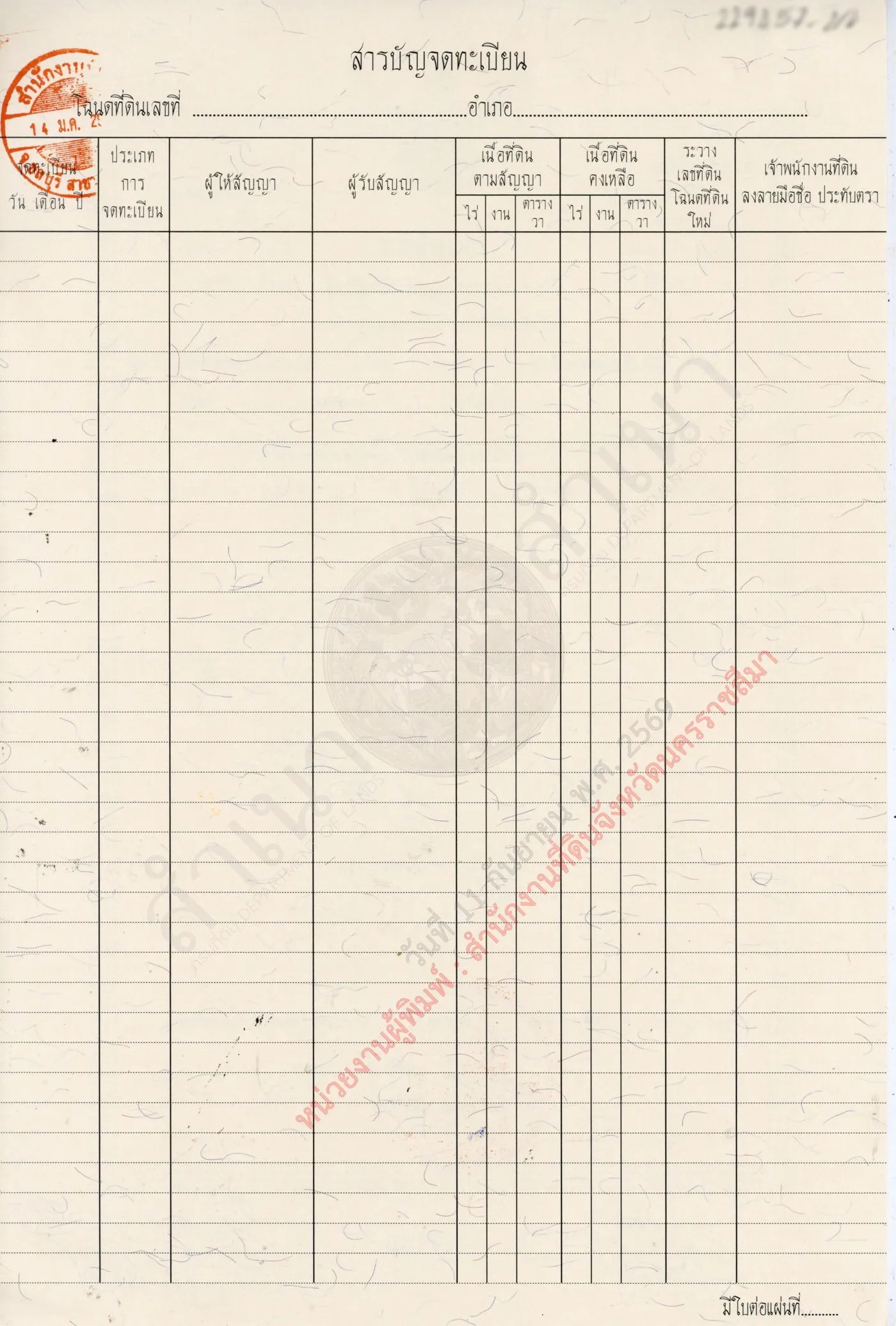
- A translation of the registration index on the back: every registered act in date order, who gave the right and who received it, and the area remaining after each act. An empty index is itself a finding: nothing is registered against the land.
- A two-page report by our Thai lawyer, Wichuda Atthamethakon, LL.M., Thai Bar Licence 3149/2556, with a verdict in the first line: clear, clear with a note, or do not proceed without further checks. The report names the next step for your situation.
- For a condominium unit: the unit’s registered area and share of common property, and a note on whether the unit sits in the foreign or the Thai quota according to the Land Office record.
The law behind this page
English
Section 1 General Provisions
Full text
In this Code: “Land” means the land surface everywhere, and includes mountains, hills, streams, ponds, canals, swamps, marshes, waterways, lakes, islands and the sea coast. “Rights in land” means ownership, and includes possessory rights. “Pre-emption certificate” means the document showing authorisation of temporary occupation of land. “Certificate of use” means the document from the competent official certifying that the land has already been put to use. “Land particulars certificate” means the paper showing the inquiry for the purpose of issuing a title deed, and includes the plot identification slip. “Title deed” means the document showing ownership of the land, and includes a land title deed with map, a pre-emption title deed, and a pre-emption certificate stamped “ALREADY PUT TO USE”. “Survey” means the survey and recording of boundaries, or the computation of area, in order to determine the location of the boundary lines or the area of the land. “Land trading”: repealed by the Land Code Amendment Act (No.12), B.E. 2551 (2008). “Public body” means (1) central administration, provincial administration or local administration; (2) other agencies of the State which are not State enterprises. “Committee” means the Land Allocation Committee. “Competent official” means the official acting under this Code, and any other official appointed by the Minister to act under this Code. “Director-General” means the Director-General of the Department of Lands. “Minister” means the Minister having charge under the Act Promulgating the Land Code and under this Code.
ThaiLawOnline translation
Section 1299
Subject to other applicable statutory provisions, acquisition by juristic act requires writing and registration to be complete. Acquisition by another route follows a separate rule: an unregistered right cannot alter the register or defeat a third party who acquired for value and in good faith and registered in good faith.
Full text
Subject to the provisions of this Code or of other laws, an acquisition by juristic act of immovable property, or of a real right appertaining to immovable property, is not complete unless the juristic act is made in writing and the acquisition is registered with the competent official. Where a person acquires immovable property, or a real right appertaining to immovable property, otherwise than by juristic act, the acquirer's right, so long as it has not been registered, cannot be the subject of any change in the register, and that unregistered right may not be set up against a third person who has acquired a right for value and in good faith and has registered that right in good faith.
ThaiLawOnline translation
Section 63 Issuance of Documents Showing Rights in Land
Full text
The owner of land whose title deed is endangered, damaged or lost by any means whatsoever may apply for a substitute. After the substitute has been issued, the original title deed shall be cancelled unless otherwise ordered by the court. The above-mentioned provisions shall apply mutatis mutandis to the application for a substitute for a pre-emption certificate, certificate of utilization or certificate of investigation (bai tai suan).
Unofficial translation by the Office of the Council of State
Section 569
Full text
A contract of hire of immovable property is not extinguished by the transfer of ownership of the property hired. The transferee is entitled to the rights and is subject to the duties of the transferor towards the hirer.
ThaiLawOnline translation
Section 72 Recording of Rights and Legal Acts
Full text
For any person wishing to effect a right and juristic act registration concerning immovable properties under the Civil and Commercial Code, the parties shall bring a land right document to effect registration with the competent officer under Section 71. In applying for right and juristic act registration under paragraph one for land with a title deed, certificate of investigation (bai tai suan) or certificate or utilization, the parties may file an application with the competent officer at the Department of Lands or any land office for the competent officer under Section 71 to effect registration, except registration that requires an announcement or survey.
Unofficial translation by the Office of the Council of State
Section 4 Condominium Act B.E. 2522
Full text
In this Act: "condominium" means a building in which persons may hold ownership separately in parts, each part consisting of ownership of personal property and co-ownership of common property; "personal property" means a condominium unit, and includes structures or land provided as belonging to each individual unit owner; "condominium unit" means a part of a condominium whose ownership may be held separately as the exclusive part of each person; "common property" means the parts of a condominium that are not condominium units, the land on which the condominium stands, and land or other property provided for the common use or benefit of the co-owners; "condominium unit title deed" means the certificate of ownership of personal property and co-ownership of common property; "co-owner" means an owner of a condominium unit in each condominium; "juristic person of the condominium" means a juristic person registered under this Act; "regulations" means the regulations of the juristic person of the condominium; "general meeting" means an ordinary general meeting or an extraordinary general meeting of the co-owners, as the case may be; "committee" means the committee of the juristic person of the condominium; "committee member" means a member of the committee of the juristic person of the condominium; "manager" means the manager of the juristic person of the condominium; "competent official" means a person appointed by the Minister to perform duties under this Act; "Minister" means the Minister having charge and control of the execution of this Act.
ThaiLawOnline translation
ไทย
มาตรา 1
ข้อความเต็ม
ในประมวลกฎหมายนี้ “ ที่ดิน ” หมายความว่า พื้นที่ดินทั่วไป และให้หมายความรวมถึง ภูเขา ห้วย หนอง คลอง บึง บาง ลำน้ำ ทะเลสาบ เกาะ และที่ชายทะเลด้วย “ สิทธิในที่ดิน ” หมายความว่า กรรมสิทธิ์ และให้หมายความรวมถึงสิทธิครอบครองด้วย “ ใบจอง ” หมายความว่า หนังสือแสดงการยอมให้เข้าครอบครองที่ดินชั่วคราว “ หนังสือรับรองการทำประโยชน์ ” หมายความว่า หนังสือคำรับรองจากพนักงานเจ้าหน้าที่ว่าได้ทำประโยชน์ในที่ดินแล้ว “ ใบไต่สวน ” หมายความว่า หนังสือแสดงการสอบสวนเพื่อออกโฉนดที่ดิน และให้หมายความรวมถึงใบนำด้วย “ โฉนดที่ดิน ” หมายความว่า หนังสือสำคัญแสดงกรรมสิทธิ์ที่ดิน และให้หมายความรวมถึงโฉนดแผนที่ โฉนดตราจอง และตราจองที่ตราว่า “ ได้ทำประโยชน์แล้ว ” “ การรังวัด ” หมายความว่า การรังวัดปักเขต และทำเขต จด หรือคำนวณการรังวัด เพื่อให้ทราบที่ตั้งแนวเขตที่ดิน หรือทราบที่ตั้งและเนื้อที่ของที่ดิน “ การค้าที่ดิน ” (ยกเลิก) “ ทบวงการเมือง ” หมายความว่า (๑) ราชการส่วนกลาง ราชการส่วนภูมิภาค หรือราชการส่วนท้องถิ่น (๒) หน่วยงานอื่นของรัฐที่ไม่ใช่รัฐวิสาหกิจ “ คณะกรรมการ ” หมายความว่า คณะกรรมการจัดที่ดิน “ พนักงานเจ้าหน้าที่ ” หมายความว่า เจ้าพนักงานซึ่งเป็นผู้ปฏิบัติการตามประมวลกฎหมายนี้ และพนักงานอื่นซึ่งรัฐมนตรีแต่งตั้งให้ปฏิบัติการตามประมวลกฎหมายนี้ “ อธิบดี ” หมายความว่า อธิบดีกรมที่ดิน “ รัฐมนตรี ” หมายความว่า รัฐมนตรีผู้รักษาการตามพระราชบัญญัติให้ใช้ประมวลกฎหมายที่ดิน และตามประมวลกฎหมายนี้
ตรงตามข้อความในราชกิจจานุเบกษา / สำนักงานคณะกรรมการกฤษฎีกา (Verbatim from the Royal Gazette / Office of the Council of State)
มาตรา 1299
ข้อความเต็ม
ภายในบังคับแห่งบทบัญญัติในประมวลกฎหมายนี้หรือกฎหมายอื่น ท่านว่าการได้มาโดยนิติกรรมซึ่งอสังหาริมทรัพย์หรือทรัพยสิทธิอันเกี่ยวกับอสังหาริมทรัพย์นั้นไม่บริบูรณ์ เว้นแต่นิติกรรมจะได้ทำเป็นหนังสือและได้จดทะเบียนการได้มากับพนักงานเจ้าหน้าที่ ถ้ามีผู้ได้มาซึ่งอสังหาริมทรัพย์หรือทรัพยสิทธิอันเกี่ยวกับอสังหาริมทรัพย์โดยทางอื่นนอกจากนิติกรรม สิทธิของผู้ได้มานั้น ถ้ายังมิได้จดทะเบียนไซร้ ท่านว่าจะมีการเปลี่ยนแปลงทางทะเบียนไม่ได้ และสิทธิอันยังมิได้จดทะเบียนนั้น มิให้ยกขึ้นเป็นข้อต่อสู้บุคคลภายนอกผู้ได้สิทธิมาโดยเสียค่าตอบแทนและโดยสุจริต และได้จดทะเบียนสิทธิโดยสุจริตแล้ว
ตรงตามข้อความในราชกิจจานุเบกษา / สำนักงานคณะกรรมการกฤษฎีกา (Verbatim from the Royal Gazette / Office of the Council of State)
มาตรา 63
ข้อความเต็ม
โฉนดที่ดินของผู้ใดเป็นอันตราย ชำรุด สูญหายด้วยประการใด ให้เจ้าของมาขอรับใบแทนโฉนดที่ดินนั้นได้ เมื่อได้ออกใบแทนไปแล้ว โฉนดที่ดินเดิมเป็นอันยกเลิก เว้นแต่ศาลจะสั่งเป็นอย่างอื่น สำหรับการขอใบแทนใบจอง หนังสือรับรองการทำประโยชน์หรือใบไต่สวน ให้นำความดังกล่าวข้างต้นมาใช้บังคับโดยอนุโลม
ตรงตามข้อความในราชกิจจานุเบกษา / สำนักงานคณะกรรมการกฤษฎีกา (Verbatim from the Royal Gazette / Office of the Council of State)
มาตรา 569
ข้อความเต็ม
อันสัญญาเช่าอสังหาริมทรัพย์นั้นย่อมไม่ระงับไป เพราะเหตุโอนกรรมสิทธิ์ทรัพย์สินซึ่งให้เช่า ผู้รับโอนย่อมรับไปทั้งสิทธิและหน้าที่ของผู้โอนซึ่งมีต่อผู้เช่านั้นด้วย
ตรงตามข้อความในราชกิจจานุเบกษา / สำนักงานคณะกรรมการกฤษฎีกา (Verbatim from the Royal Gazette / Office of the Council of State)
มาตรา 72
ข้อความเต็ม
ผู้ใดประสงค์จะจดทะเบียนสิทธิและนิติกรรมเกี่ยวกับอสังหาริมทรัพย์ตามประมวลกฎหมายแพ่งและพาณิชย์ ให้คู่กรณีนำหนังสือแสดงสิทธิในที่ดินมาขอจดทะเบียนต่อพนักงานเจ้าหน้าที่ตามมาตรา ๗๑ การขอจดทะเบียนสิทธิและนิติกรรมตามวรรคหนึ่ง สำหรับที่ดินที่มีโฉนดที่ดิน ใบไต่สวนหรือหนังสือรับรองการทำประโยชน์ คู่กรณีอาจยื่นคำขอต่อพนักงานเจ้าหน้าที่ ณ กรมที่ดิน หรือสำนักงานที่ดินแห่งใดแห่งหนึ่ง เพื่อให้พนักงานเจ้าหน้าที่ตามมาตรา ๗๑ ดำเนินการจดทะเบียนให้ เว้นแต่การจดทะเบียนที่ต้องมีการประกาศหรือต้องมีการรังวัด
ตรงตามข้อความในราชกิจจานุเบกษา / สำนักงานคณะกรรมการกฤษฎีกา (Verbatim from the Royal Gazette / Office of the Council of State)
มาตรา 4 พระราชบัญญัติอาคารชุด พ.ศ. 2522
ข้อความเต็ม
ในพระราชบัญญัตินี้ “อาคารชุด” หมายความว่า อาคารที่บุคคลสามารถแยกการถือกรรมสิทธิ์ออกได้เป็นส่วน ๆ โดยแต่ละส่วนประกอบด้วยกรรมสิทธิ์ในทรัพย์ส่วนบุคคลและกรรมสิทธิ์ร่วมในทรัพย์ส่วนกลาง “ทรัพย์ส่วนบุคคล” หมายความว่า ห้องชุด และหมายความรวมถึงสิ่งปลูกสร้าง หรือที่ดินที่จัดไว้ให้เป็นของเจ้าของห้องชุดแต่ละราย “ห้องชุด” หมายความว่า ส่วนของอาคารชุดที่แยกการถือกรรมสิทธิ์ออกได้เป็นส่วนเฉพาะของแต่ละบุคคล “ทรัพย์ส่วนกลาง” หมายความว่า ส่วนของอาคารชุดที่มิใช่ห้องชุด ที่ดินที่ตั้งอาคารชุด และที่ดินหรือทรัพย์สินอื่นที่มีไว้เพื่อใช้หรือเพื่อประโยชน์ร่วมกันสำหรับเจ้าของร่วม “หนังสือกรรมสิทธิ์ห้องชุด” หมายความว่า หนังสือสำคัญแสดงกรรมสิทธิ์ในทรัพย์ส่วนบุคคล และกรรมสิทธิ์ร่วมในทรัพย์ส่วนกลาง “เจ้าของร่วม” หมายความว่า เจ้าของห้องชุดในอาคารชุดแต่ละอาคารชุด “นิติบุคคลอาคารชุด” หมายความว่า นิติบุคคลที่ได้จดทะเบียนตามพระราชบัญญัตินี้ “ข้อบังคับ” หมายความว่า ข้อบังคับของนิติบุคคลอาคารชุด “การประชุมใหญ่” หมายความว่า การประชุมใหญ่สามัญหรือการประชุมใหญ่วิสามัญของเจ้าของร่วม แล้วแต่กรณี “คณะกรรมการ” หมายความว่า คณะกรรมการนิติบุคคลอาคารชุด “กรรมการ” หมายความว่า กรรมการนิติบุคคลอาคารชุด “ผู้จัดการ” หมายความว่า ผู้จัดการนิติบุคคลอาคารชุด “พนักงานเจ้าหน้าที่” หมายความว่า ผู้ซึ่งรัฐมนตรีแต่งตั้งให้ปฏิบัติการตามพระราชบัญญัตินี้ “รัฐมนตรี” หมายความว่า รัฐมนตรีผู้รักษาการตามพระราชบัญญัตินี้
ตรงตามข้อความในราชกิจจานุเบกษา / สำนักงานคณะกรรมการกฤษฎีกา (Verbatim from the Royal Gazette / Office of the Council of State)
Français
Article 1
Définit notamment terrain (y compris montagnes, cours d'eau, lacs, îles, rivage), droits fonciers (propriété et droit de possession), bai chong, certificat d'utilisation, titre foncier (chanote), arpentage, organisme public, comité, agent compétent, directeur général et ministre.
résumé non officiel
Article 1299
Sous réserve des dispositions du présent Code ou d'autres lois, l'acquisition par acte juridique d'un immeuble ou d'un droit réel immobilier n'est parfaite que si l'acte juridique est fait par écrit et si l'acquisition est enregistrée auprès du fonctionnaire compétent. Lorsqu'une personne acquiert un immeuble ou un droit réel immobilier autrement que par un acte juridique, le droit de l'acquéreur, tant qu'il n'a pas été enregistré, ne peut donner lieu à aucune modification du registre, et ce droit non enregistré ne peut être opposé au tiers qui a acquis un droit à titre onéreux et de bonne foi et qui a fait enregistrer ce droit de bonne foi.
résumé non officiel
Article 63
Si le titre foncier (chanote) est détruit, endommagé ou perdu, le propriétaire peut en demander un duplicata; l'original est alors annulé, sauf décision contraire du tribunal. La règle s'applique par analogie au certificat de réservation, au certificat d'utilisation et au procès-verbal d'enquête.
résumé non officiel
Article 569
Le bail d'un immeuble ne prend pas fin du fait du transfert de la propriété du bien loué. L'acquéreur reprend à la fois les droits et les obligations du cédant envers le preneur.
résumé non officiel
Article 72
Pour enregistrer des droits et actes immobiliers, les parties présentent leur document de droit foncier au fonctionnaire de l'article 71; pour un chanote, procès-verbal d'enquête ou certificat d'utilisation, elles peuvent déposer la demande au Département des terres ou à tout bureau foncier, sauf enregistrement exigeant publication ou arpentage.
résumé non officiel
Article 4 Condominium Act B.E. 2522
Définitions: copropriété (immeuble divisé en lots, chacun comprenant une partie privative et une quote-part des parties communes); partie privative (le lot, avec constructions ou terrain attribués à chaque propriétaire); lot; parties communes (parties non privatives, terrain d'assiette, autres biens à usage commun); titre de propriété du lot; copropriétaire; personne morale de la copropriété (enregistrée selon la loi); règlement; assemblée générale ordinaire ou extraordinaire; comité et membres; gérant; fonctionnaire compétent nommé par le ministre; ministre chargé de la loi.
résumé non officiel
Supreme Court decisions
- 8015/2551 (2008): An Unregistered Superficies Still Binds the Parties Who Signed It: Just Not Third Parties
Sources
- Land Code, Office of the Council of State, retrieved 31 October 2026
- Civil and Commercial Code, Office of the Council of State, retrieved 31 October 2026
- Condominium Act B.E. 2522, retrieved 4 November 2026
- deka.supremecourt.or.th, Supreme Court of Thailand decisions database (copy held in our library), retrieved 19 February 2026
A real example: what a certified copy looks like
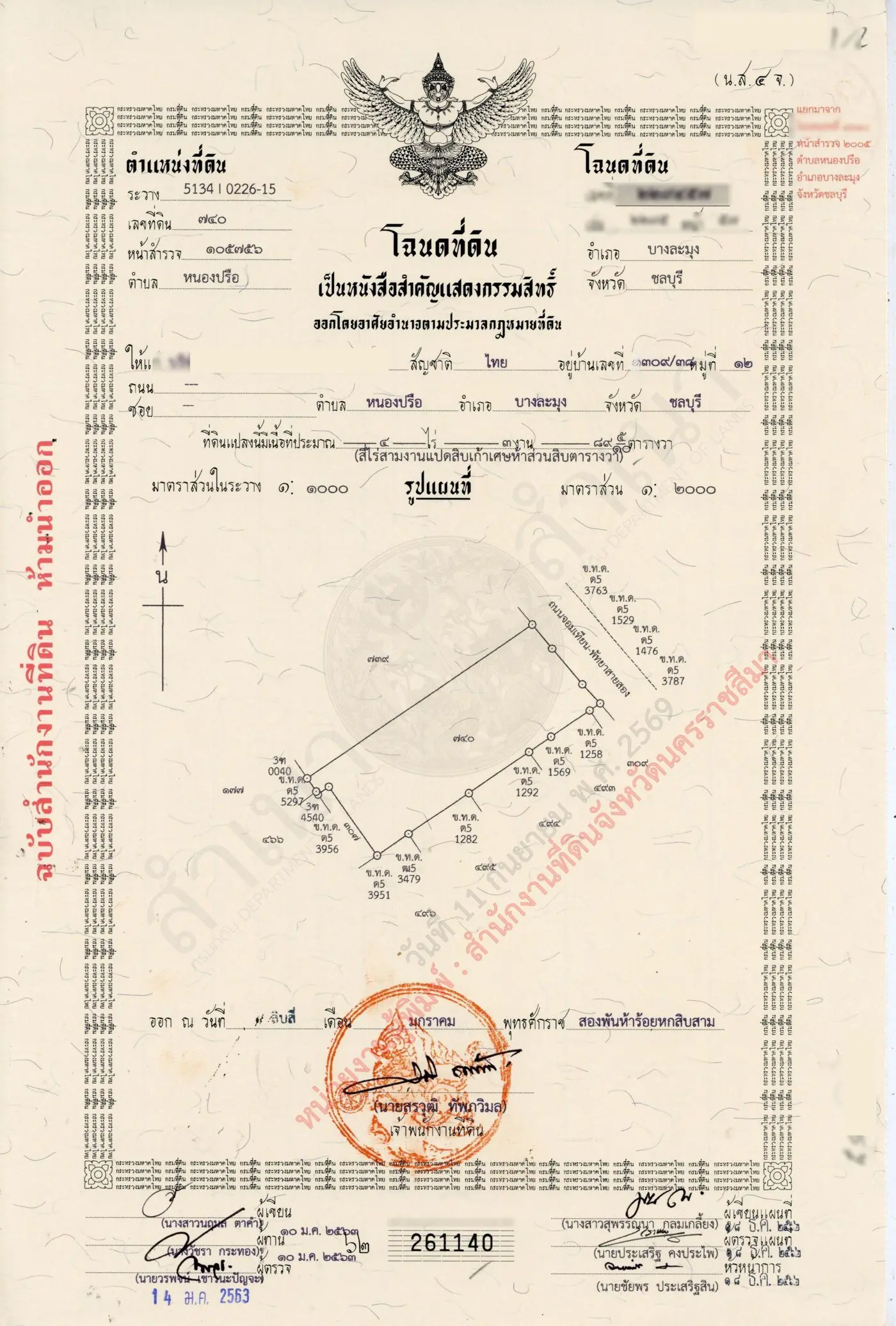
The two images below are a certified copy we obtained for a client in September 2026 (deed number and owner redacted). The deed itself was issued in January 2020 for a plot of 4 rai, 3 ngan and 89.5 square wah in Nong Prue sub-district, Bang Lamung district, Chonburi (the Pattaya area). The copy was issued and stamped by the Nakhon Ratchasima Provincial Land Office on 11 September 2026, which shows two things buyers rarely know: a certified copy can be obtained from a Land Office other than the one where the land is registered, and the copy carries the date it was produced, so you know how current it is.
The translation we supplied with it
| Field on the deed (Thai) | English | What it says on this deed |
|---|---|---|
| โฉนดที่ดิน (น.ส. 4 จ.) | Title deed, form Nor Sor 4 Jor (Chanote) | Full freehold title under the Land Code |
| เลขที่ / เล่ม / หน้า | Deed number / book / page | Redacted / book 2295, page 57 |
| ระวาง | Map sheet | 5134 I 0226-15 |
| เลขที่ดิน / หน้าสำรวจ | Land number / survey page | 740 / 105756 |
| ตำบล / อำเภอ / จังหวัด | Sub-district / district / province | Nong Prue / Bang Lamung / Chonburi |
| แยกมาจากโฉนดเลขที่ | Split from deed number | Redacted, survey page 2005: this plot was subdivided from a larger parcel |
| ให้แก่ / สัญชาติ | Issued to / nationality | A Thai limited company (name redacted), Thai |
| ที่ดินแปลงนี้มีเนื้อที่ประมาณ | Approximate area of this plot | 4 rai, 3 ngan, 89.5 square wah (about 7,958 square metres) |
| มาตราส่วนในระวาง / มาตราส่วน | Scale on the map sheet / plan scale | 1:1000 / 1:2000 |
| รูปแผนที่ | Survey plan | Boundary markers (หลักเขต) numbered on each corner, road frontage shown on the north-east side |
| ออก ณ วันที่ | Date of issue | 14 January B.E. 2563 (2020) |
| เจ้าพนักงานที่ดิน | Land officer (signature and seal) | Signed, with the Land Office seal |
| สารบัญจดทะเบียน (back) | Registration index | No entries: no mortgage, lease, usufruct, superficies, servitude or seizure registered |
| Diagonal stamp | Certified copy stamp | Issued by the Nakhon Ratchasima Provincial Land Office on 11 September B.E. 2569 (2026) |
Our report on this deed said, in its first line, that the title was clear: full Chanote title, a single registered owner that matched the seller’s company documents, no registered encumbrance, and road frontage on the plan. The next step we named was a company search on the owner, because when the owner is a company the buyer must also see who is authorised to sign the sale.
Why the seller’s copy is not enough
Three things happen between the day a seller photocopies a deed and the day you pay. A mortgage can be registered, and in Thailand the lender then holds the original, so a seller who cannot show the original usually has one. A lease, usufruct or superficies can be registered in favour of a third party, and a registered right survives the transfer: a usufruct or superficies is a real right that follows the land, and a lease binds the buyer under section 569 of the Civil and Commercial Code. The deed itself can be reported lost and a replacement issued, which is the fraud the Supreme Court punished in Decision 914/2569 (an unsuspended prison sentence under Penal Code sections 267 and 268). The certified copy, dated and stamped, is your evidence of what the register said when you decided to buy.
Which document you are looking at
| Document | What it is | Can it be sold, leased or mortgaged at the Land Office? |
|---|---|---|
| Chanote (Nor Sor 4 Jor) | Full freehold title with GPS-surveyed boundaries | Yes |
| Or Chor 2 | Condominium unit title, issued under the Condominium Act once the building is registered | Yes |
| Nor Sor 3 Gor | Certificate of use, aerial-surveyed, a right of possession rather than ownership | Yes, registered like a Chanote, with no 30-day public notice |
| Nor Sor 3 | Certificate of use without a fixed survey | Yes, with public notice; boundaries are uncertain |
| Por Bor Tor 5 | A local land tax receipt | No. It is not a title. The Land Office will register nothing on it |
Our guide to Thai title deeds explains each one, and how to read a title deed walks through the front and the back field by field.
How it runs
| Step | What happens | Time |
|---|---|---|
| 1. Order | You pay 4,900 THB online and your matter opens in the client portal. | Same day |
| 2. Send the deed | You upload a photo or scan of the deed the seller showed you (front is enough), or just the deed number, sub-district and province, plus the seller’s name as written on it. | Same day |
| 3. Land Office | We request the certified copy, front and back, through the Land Office. | 1 to 2 business days |
| 4. Translation and report | We translate both sides and Khun Wichuda writes the report with the verdict and the next step. | By business day 3 |
| 5. Delivery | PDF of the certified copy, the translation and the report in your portal and by email. The paper copy is posted to you in Thailand on request. | Business day 3 |
What it costs
Title Deed Check: what is included, what is not, and how long it takes
| Fixed fee | 4,900 THB, credited against the Condominium Package if you order it within 30 days |
|---|---|
| Included |
|
| Not included |
|
| Timeline | 3 business days from payment and the deed details |
| After you order |
|
Government fees and third-party costs are charged at cost and no VAT is added. The full process, payment methods and our urgent-matter procedure are on How We Work; every fee is on the pricing page.
- Title Deed Check: 4,900 THB, all included: the Land Office copy and its fee, the translation and the lawyer’s report.
- Condominium Package: 19,900 THB (the full 25-point due diligence, contract review, FET guidance and written transfer instructions). Order it within 30 days of your Title Deed Check and the 4,900 is deducted.
- Condominium Premium Package: 34,900 THB, with our lawyer at the Land Office on transfer day.
- Land and house due diligence: from 19,900 THB, quoted before we start.
Not included anywhere: the government transfer fee (2% of the appraised value), specific business tax at 3.3% or stamp duty at 0.5%, and withholding tax. Those are paid at the Land Office on the day, and we calculate them for you in advance. The published market range for a condominium purchase with a lawyer in Thailand is 25,000 to 80,000 THB; our package is 19,900 with the scope published.
Frequently Asked Questions
Can you check a title deed if I only have a photo from the seller or the agent?
Yes. The deed number, the sub-district and the province are enough to request the certified copy. A photo of the front gives us all three. If you have nothing but the address, send it with the seller’s name and we will tell you within a day whether the Land Office can locate the parcel from it.
Do you need to go to the Land Office where the land is registered?
No. Certified copies can be requested through the Land Office network, so a deed registered in Chonburi or Phuket can be obtained from another provincial office. The example on this page is a Chonburi deed copied at the Nakhon Ratchasima Provincial Land Office on 11 September 2026, and the copy carries that office’s stamp and date.
What does the back of the deed show?
The registration index: every act registered against the land since the deed was issued, in date order, with the parties and the area remaining. Mortgages, leases over three years, usufructs, superficies, servitudes, court seizures and transfers all appear there. An empty back page means nothing is registered. A full one is read line by line in our report.
Does a clear title deed mean I can buy safely?
It means the register is clear on that date. It does not tell you whether the seller is the person in front of you, whether a condominium’s foreign quota has room for your unit, whether the juristic person will issue a debt-free certificate, or what the contract says. Those are the other 24 points of the Condominium Package. The Title Deed Check tells you whether that bigger spend is worth making.
Is the translation official?
It is a lawyer’s translation prepared for your understanding and for your bank or lawyer abroad. The Land Office works only in Thai, so no English translation is ever “official” for registration purposes. If a certified translation is required for a court or an embassy, we can arrange one at cost and tell you the price first.
How is this different from a title search by other firms?
Some firms sell a copy of the deed in Thai with no opinion, others a report in Thai with an English copy of the deed. Ours is the certified copy, both sides, the full English translation and a report signed by a licensed Thai lawyer that ends with a verdict and a next step, for one price with no travel or per-page charges added.
Can I order a check on land, not only a condominium unit?
Yes. The same 4,900 THB covers a Chanote or Nor Sor 3 Gor for land or a house. For a Nor Sor 3 or a Por Bor Tor 5 we tell you before we start what the document can and cannot do, because a Por Bor Tor 5 is a tax receipt and not a title at all.
What happens if the check finds a problem?
The report says what it is and what it means for you: a mortgage that must be redeemed at transfer, a registered lease that survives the sale, a seller who is not the registered owner. We tell you whether it is a reason to walk away or a point to fix in the contract, and the 4,900 is still credited against the package if you go on.
Thai Law Updates, free by email
Plain-English updates on Thai law changes that affect foreigners: property, visas, marriage, business and wills. One short email a month from a firm practicing since 2006. No spam, unsubscribe anytime.