


Reviewed by Wichuda Atthamethakon, LL.M., Thai Bar Licence 3149/2556, for ThaiLawOnline, a Thai law firm acting for foreigners since 2006.
Update log
- 4 November 2026: Added the statute box with Thai, English and French text and checked the page against the official text
Every English guide to child support in Thailand tells you the same thing: there is no formula, it depends. That is true and useless. Thai courts do reach a number, they reach it the same way every time, and the reasoning sits in one section of the Civil and Commercial Code that almost no competing page quotes. This guide gives you the test the judge applies, a real case with the figure at every instance, the rule that lets a child claim for years already gone, and what happens when the paying parent leaves the country. Our full guide: divorce in Thailand.
The short answer
Thailand has no statutory child support formula. No percentage of income, no state calculator, no published table. Section 1598/38 of the Civil and Commercial Code gives the court three factors and nothing else:
- the ability of the person who must pay;
- the condition in life of the child receiving it;
- the circumstances of the case.
Those three words decide every maintenance case in Thailand. In the leading Supreme Court decision on a foreign father, the mother asked for 50,000 baht a month, the father said he could manage 1,000, and the Supreme Court fixed 10,000. Below you can follow how the courts got there.
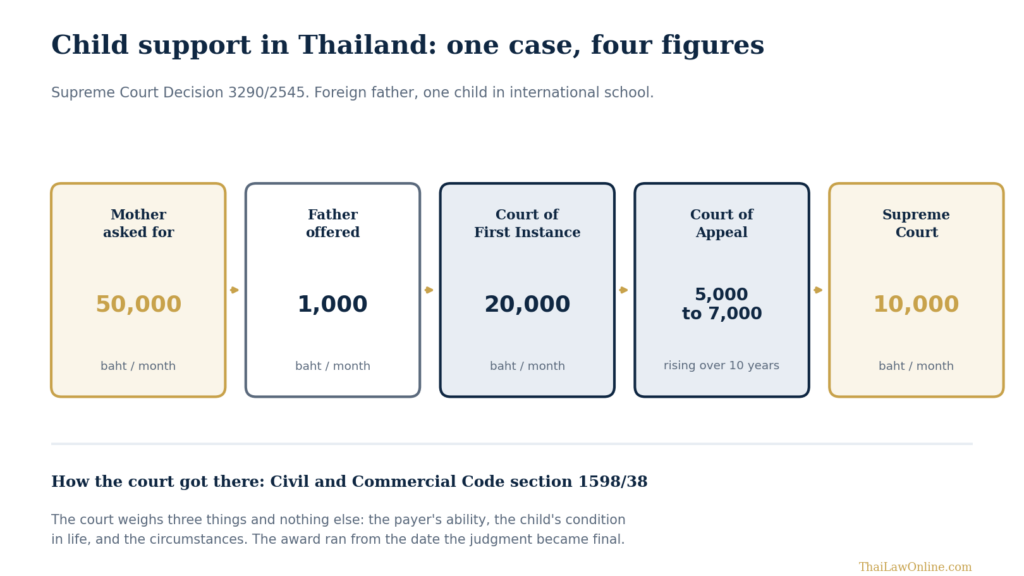
Table of Contents
What Thai law actually says about child support
Five sections carry the whole subject. Read them in this order and the system makes sense.
| Section | What it does |
|---|---|
| CCC s.1564 | Creates the duty. Parents must maintain their children and provide proper education during minority. Paragraph 2 continues the duty for an adult child who is infirm and cannot earn a living. |
| CCC s.19 | Majority at twenty. This is the normal end date of the duty, subject to s.1564 paragraph 2. |
| CCC s.1598/38 | Sets the amount. Maintenance may be claimed where the child has received none or has received too little for their condition in life. The court weighs ability, condition in life, and the circumstances. |
| CCC s.1598/39 | Allows change. On a change in circumstances, means or condition in life, the court may cancel, reduce, increase or re-establish the maintenance. |
| CCC s.1598/40 | Sets the mode. Periodical money payments unless the parties agree or the court orders otherwise. Where there is special reason, the court may order support in another form, including sending the child to a named school at the payer’s expense. |
| CCC s.1598/41 | Protects the right. The Thai text gives three limbs: the right to maintenance cannot be renounced, cannot be transferred, and is not subject to execution. That last limb is what keeps an award out of reach of creditors once it has been made. Note that the common English translation adds the word “attached”, which does not appear in the Thai. |
Two competitor pages in this search result cite section 1598/33 as the authority for support outside marriage. That section sits in the adoption title. The maintenance chapter runs from 1598/38 to 1598/41, and everything above comes from it.
The law behind this page
English
Section 1598/38Amended on 23 January 2025
Full text
Maintenance between spouses, or between parents and children, may be claimed from one another where the party who ought to receive maintenance does not receive it, or receives maintenance insufficient for that party's condition in life. The court may grant such maintenance to such extent as it thinks fit, or refuse it, having regard to the ability of the person bound to provide it, the condition of the recipient and the circumstances of the case.
ThaiLawOnline translation
Section 1564
Parents must maintain and educate their minor children. After the child reaches majority, the duty continues only if the child is disabled and unable to support themselves.
Full text
The father and mother are bound to maintain and give appropriate education to a child during the child's minority. The father and mother are bound to maintain a child who has attained majority only where that child is disabled and unable to earn a living.
ThaiLawOnline translation
Section 1598/39
Full text
Where an interested person shows that the circumstances, income or condition of a party have changed, the Court may order an alteration of the maintenance by cancelling, reducing or increasing it, or by granting it again. Where the Court has not awarded maintenance solely because the other party was not at that time in a position to pay maintenance, if the circumstances, income or condition of that other party have changed and the circumstances, income or condition of the claimant are such that the claimant ought to receive maintenance, the claimant may apply to the Court to vary its order in that case.
ThaiLawOnline translation
Section 1598/41
Full text
The right to maintenance cannot be renounced or transferred and is not subject to execution.
ThaiLawOnline translation
Section 1522Amended on 23 January 2025
Full text
If the spouses divorce by mutual consent, they shall agree in the divorce agreement on how much both of them, or one of them, is to contribute towards the maintenance of the children. If the divorce is by judgment of the court, or if the divorce agreement makes no provision for the maintenance of the children, the court shall fix it.
ThaiLawOnline translation
Section 1547
A child becomes legitimate when (1) the parents subsequently marry, (2) the father registers the child as his child (Section 1548 sets the consent requirements), or (3) the court issues a legitimation order.
Full text
A child born of parents who are not married to each other becomes legitimate only when the parents subsequently marry each other, or the father has registered the child as his child, or the court has given judgment that the child is his child.
ThaiLawOnline translation
Section 1557Amended on 8 March 2008
Legitimation under Section 1547 takes effect from the day of the child's birth. It may not, however, be set up so as to prejudice the rights of a third person who acted in good faith during the period between the birth and the time when the parents married, the father registered the child as his own, or a final judgment of the court declared the child to be his.
Full text
Legitimacy under Section 1547 takes effect from the day of the child's birth. However, it may not be set up to the prejudice of the rights of a third person who acted in good faith during the period between the birth of the child and the time when the parents married, the father registered the child as his own, or a final judgment of the court declared the child to be his.
ThaiLawOnline translation
Section 1598/40
Full text
Maintenance shall be paid in money, by periodical payments at fixed times, unless the parties agree that it be paid in another form or by another method. If there is no agreement and there are special reasons, the Court may, on the application of either party and if it thinks fit, fix the maintenance in another form or by another method, with or without payment in money. In a claim for maintenance of a child, where there are special reasons and the Court thinks fit for the benefit of the child, the Court may order that the child be maintained in any manner other than that agreed by the parties or applied for by either party, for example by placing the child in an educational or vocational institution, with the person liable to pay maintenance bearing the expense.
ThaiLawOnline translation
ไทย
มาตรา 1598/38แก้ไขเมื่อ 23 มกราคม 2568
ข้อความเต็ม
ค่าอุปการะเลี้ยงดูระหว่างคู่สมรส หรือระหว่างบิดามารดากับบุตรนั้น ย่อมเรียกจากกันได้ในเมื่อฝ่ายที่ควรได้รับอุปการะเลี้ยงดูไม่ได้รับการอุปการะเลี้ยงดูหรือได้รับการอุปการะเลี้ยงดูไม่เพียงพอแก่อัตภาพ ค่าอุปการะเลี้ยงดูนี้ศาลอาจให้เพียงใดหรือไม่ให้ก็ได้ โดยคำนึงถึงความสามารถของผู้มีหน้าที่ต้องให้ ฐานะของผู้รับ และพฤติการณ์แห่งกรณี
ตรงตามข้อความในราชกิจจานุเบกษา / สำนักงานคณะกรรมการกฤษฎีกา (Verbatim from the Royal Gazette / Office of the Council of State)
มาตรา 1564
ข้อความเต็ม
บิดามารดาจำต้องอุปการะเลี้ยงดูและให้การศึกษาตามสมควรแก่บุตรในระหว่างที่เป็นผู้เยาว์ บิดามารดาจำต้องอุปการะเลี้ยงดูบุตรซึ่งบรรลุนิติภาวะแล้วแต่เฉพาะผู้ทุพพลภาพและหาเลี้ยงตนเองมิได้
ตรงตามข้อความในราชกิจจานุเบกษา / สำนักงานคณะกรรมการกฤษฎีกา (Verbatim from the Royal Gazette / Office of the Council of State)
มาตรา 1598/39
ข้อความเต็ม
เมื่อผู้มีส่วนได้เสียแสดงว่าพฤติการณ์รายได้ หรือฐานะของคู่กรณีได้เปลี่ยนแปลงไป ศาลจะสั่งแก้ไขในเรื่องค่าอุปการะเลี้ยงดูโดยให้เพิกถอน ลด เพิ่ม หรือกลับให้ค่าอุปการะเลี้ยงดูอีกก็ได้ในกรณีที่ศาลไม่พิพากษาให้ค่าอุปการะเลี้ยงดู เพราะเหตุแต่เพียงอีกฝ่ายหนึ่งไม่อยู่ในฐานะที่จะให้ค่าอุปการะเลี้ยงดูได้ในขณะนั้น หากพฤติการณ์ รายได้ หรือฐานะของอีกฝ่ายหนึ่งนั้นได้เปลี่ยนแปลงไป และพฤติการณ์รายได้หรือฐานะของผู้เรียกร้องอยู่ในสภาพที่ควรได้รับค่าอุปการะเลี้ยงดู ผู้เรียกร้องอาจร้องขอให้ศาลเปลี่ยนแปลงคำสั่งในคดีนั้นใหม่ได้
ตรงตามข้อความในราชกิจจานุเบกษา / สำนักงานคณะกรรมการกฤษฎีกา (Verbatim from the Royal Gazette / Office of the Council of State)
มาตรา 1598/41
ข้อความเต็ม
สิทธิที่จะได้ค่าอุปการะเลี้ยงดูนั้น จะสละหรือโอนมิได้และไม่อยู่ในข่ายแห่งการบังคับคดี
ตรงตามข้อความในราชกิจจานุเบกษา / สำนักงานคณะกรรมการกฤษฎีกา (Verbatim from the Royal Gazette / Office of the Council of State)
มาตรา 1522แก้ไขเมื่อ 23 มกราคม 2568
ข้อความเต็ม
ถ้าคู่สมรสหย่าโดยความยินยอม ให้ทำความตกลงกันไว้ในสัญญาหย่าว่า คู่สมรสทั้งสองฝ่าย หรือคู่สมรสฝ่ายใดฝ่ายหนึ่ง จะออกเงินค่าอุปการะเลี้ยงดูบุตรเป็นจำนวนเงินเท่าใด ถ้าหย่าโดยคำพิพากษาของศาลหรือในกรณีที่สัญญาหย่ามิได้กำหนดเรื่องค่าอุปการะเลี้ยงดูบุตรไว้ ให้ศาลเป็นผู้กำหนด
ตรงตามข้อความในราชกิจจานุเบกษา / สำนักงานคณะกรรมการกฤษฎีกา (Verbatim from the Royal Gazette / Office of the Council of State)
มาตรา 1547
ข้อความเต็ม
เด็กเกิดจากบิดามารดาที่มิได้สมรสกัน จะเป็นบุตรชอบด้วยกฎหมายต่อเมื่อบิดามารดาได้สมรสกันในภายหลังหรือบิดาได้จดทะเบียนว่าเป็นบุตรหรือศาลพิพากษาว่าเป็นบุตร
ตรงตามข้อความในราชกิจจานุเบกษา / สำนักงานคณะกรรมการกฤษฎีกา (Verbatim from the Royal Gazette / Office of the Council of State)
มาตรา 1557แก้ไขเมื่อ 8 มีนาคม 2551
ข้อความเต็ม
การเป็นบุตรชอบด้วยกฎหมายตามมาตรา ๑๕๔๗ ให้มีผลนับแต่วันที่เด็กเกิด แต่ทั้งนี้จะอ้างเป็นเหตุเสื่อมสิทธิของบุคคลภายนอกผู้ทำการโดยสุจริตในระหว่างเวลาตั้งแต่เด็กเกิดจนถึงเวลาที่บิดามารดาได้สมรสกันหรือบิดาได้จดทะเบียนว่าเป็นบุตรหรือศาลพิพากษาถึงที่สุดว่าเป็นบุตรไม่ได้
ตรงตามข้อความในราชกิจจานุเบกษา / สำนักงานคณะกรรมการกฤษฎีกา (Verbatim from the Royal Gazette / Office of the Council of State)
มาตรา 1598/40
ข้อความเต็ม
ค่าอุปการะเลี้ยงดูนั้นให้ชำระเป็นเงิน โดยวิธีชำระเป็นครั้งคราวตามกำหนด เว้นแต่คู่กรณีจะตกลงกันให้ชำระเป็นอย่างอื่นหรือโดยวิธีอื่น ถ้าไม่มีการตกลงกันและมีเหตุพิเศษ เมื่อฝ่ายใดฝ่ายหนึ่งร้องขอและศาลเห็นสมควร จะกำหนดให้ค่าอุปการะเลี้ยงดูเป็นอย่างอื่นหรือโดยวิธีอื่น โดยจะให้ชำระเป็นเงินด้วยหรือไม่ก็ได้ในกรณีขอค่าอุปการะเลี้ยงดูบุตร เมื่อมีเหตุพิเศษและศาลเห็นเป็นการสมควรเพื่อประโยชน์แก่บุตร จะกำหนดให้บุตรได้รับการอุปการะเลี้ยงดูโดยประการใด ๆ นอกจากที่คู่กรณีตกลงกัน หรือนอกจากที่ฝ่ายใดฝ่ายหนึ่งร้องขอก็ได้ เช่นให้ไปอยู่ในสถานการศึกษาหรือวิชาชีพ โดยให้ผู้ที่มีหน้าที่ต้องชำระค่าอุปการะเลี้ยงดูออกค่าใช้จ่ายในการนี้
ตรงตามข้อความในราชกิจจานุเบกษา / สำนักงานคณะกรรมการกฤษฎีกา (Verbatim from the Royal Gazette / Office of the Council of State)
Français
Article 1598/38Modifié le 23 janvier 2025
Les aliments entre époux, ou entre père et mère et enfants, peuvent être réclamés de l'un à l'autre lorsque la partie qui doit en bénéficier n'en reçoit pas, ou n'en reçoit pas suffisamment eu égard à sa condition. Le tribunal peut accorder ces aliments dans la mesure qu'il estime appropriée, ou les refuser, en tenant compte des facultés de celui qui les doit, de la situation de celui qui les reçoit et des circonstances de l'espèce.
résumé non officiel
Article 1564
Les père et mère sont tenus d'entretenir leur enfant et de lui donner une éducation convenable pendant sa minorité. Les père et mère ne sont tenus d'entretenir l'enfant devenu majeur que si celui-ci est invalide et incapable de subvenir à ses propres besoins.
résumé non officiel
Article 1598/39
Si circonstances, revenus ou situation changent, le tribunal peut révoquer, réduire, augmenter ou rétablir la pension alimentaire. Si elle fut refusée seulement faute de moyens du débiteur, le demandeur peut solliciter une nouvelle décision lorsque la situation de celui-ci change et que la sienne le justifie.
résumé non officiel
Article 1598/41
Le droit à une pension alimentaire ne peut être ni abandonné ni cédé. Ce droit n'est pas non plus soumis à l'exécution forcée, de sorte que les créanciers ne peuvent pas le saisir.
résumé non officiel
Article 1522Modifié le 23 janvier 2025
En cas de divorce par consentement, l'accord fixe le montant de l'entretien de l'enfant et qui le paie. En cas de jugement, ou si l'accord n'en dit rien, le tribunal le fixe.
résumé non officiel
Article 1547
L'enfant né de père et mère qui ne sont pas mariés l'un avec l'autre ne devient enfant légitime que lorsque ses père et mère se marient ultérieurement, ou que le père l'a fait enregistrer comme son enfant, ou que le tribunal a jugé qu'il est son enfant.
résumé non officiel
Article 1557Modifié le 8 mars 2008
La légitimité de l'enfant prévue à l'article 1547 prend effet à compter de sa naissance. Elle ne peut toutefois porter atteinte aux droits des tiers ayant agi de bonne foi entre la naissance et le mariage des parents, l'enregistrement de l'enfant par le père ou le jugement définitif reconnaissant la filiation.
résumé non officiel
Article 1598/40
La pension alimentaire se paie en argent, par versements périodiques, sauf accord contraire des parties. À défaut d'accord et pour un motif particulier, le tribunal peut, à la demande d'une partie, fixer une autre forme ou modalité, avec ou sans argent. Pour un enfant, s'il y a un motif particulier et dans son intérêt, il peut ordonner toute autre modalité, par exemple un placement en établissement d'enseignement ou professionnel, aux frais du débiteur.
résumé non officiel
Supreme Court decisions
- 3290/2545 (2002): Paternity and Maintenance in Single Action
- 7345/2560 (2017): Child Maintenance Runs From Birth, Not From the Judgment
- 1218/2567 (2024): Child Support Order Can Be Modified When the Child Permanently Moves to the Other Parent
- 2971/2544 (2001): Silence on Maintenance in a Divorce Agreement Does Not Bind the Court
Sources
- Civil and Commercial Code, Office of the Council of State, retrieved 31 October 2026
- deka.supremecourt.or.th, Supreme Court of Thailand decisions database (copy held in our library), retrieved 19 February 2026
How a Thai court gets to a figure: one case, start to finish
Supreme Court Decision 3290/2545 is the clearest worked example in Thai family law, and we publish the full Thai text of it in our library. A Thai mother and a foreign resident married in an Indian ceremony without registering. Their daughter was born in October 1992. The relationship broke down, the mother moved home to Chonburi with the child, and the father paid nothing and never visited.
The mother sued for two things in one action: an order declaring paternity, and maintenance. DNA testing at Siriraj Hospital established that the defendant was the father. Then the courts went to work on the number.
| Stage | Figure |
|---|---|
| Mother’s demand | 50,000 baht per month |
| Father’s answer | No more than 1,000 baht per month |
| Court of First Instance | 20,000 baht per month until majority |
| Court of Appeal | 5,000 for five years, then 6,000 for five years, then 7,000 until majority |
| Supreme Court | 10,000 baht per month, from the date the judgment became final, until majority |
The evidence explains the movement. The child was at an international school in India costing 150,000 baht a year, rising to 170,000 in later grades, plus roughly 80,000 baht a year in flights, 30,000 in clothing and 10,000 in incidentals. The father ran a motorcycle dealership, a fabric shop and a tailoring business on Koh Samui. The Supreme Court held that the father alone could not carry the full cost of an education the mother had chosen, and in the same breath held that the Court of Appeal‘s stepped schedule was too low. It replaced both with 10,000 baht a month.
One detail matters: the Supreme Court ordered payment from the date the judgment became final, not from the child’s birth. Retroactive support arrived fifteen years later, in a different case, which is the next section.
Read the full bilingual judgment: Decision 3290/2545, paternity and maintenance in a single action.
Can you claim for the years already gone?
Yes, if the parents never married and the father is legitimated. This is the single most valuable rule on this page, and no English guide we found covers it.
Supreme Court Decision 7345/2560 (2017) decided a claim by a child of unmarried parents for 10,000 baht a month from birth to the filing date, a total of 1,720,000 baht. The father argued the claim was time-barred by the five-year prescription for periodical payments in CCC s.193/33(4). The Court of First Instance rejected that argument, holding this was not a claim for maintenance fixed to be paid periodically, and the father failed to preserve the point on appeal, so the prescription ruling stood.
The Supreme Court then decided the two questions that matter for anyone in this position:
- Support runs from birth. Section 1557 once made legitimation effective only from the date of the judgment. The section was amended with effect from 8 March 2008 to make legitimation date back to the child’s birth. A child legitimated after that amendment is treated as legitimate from birth and can therefore claim maintenance from the day they were born, in the same action that asks the court to declare paternity.
- Parents do not split the bill down the middle. The Court of Appeal had cut the trial court’s award of 1,370,000 baht in half, to 685,000, reasoning that both parents are jointly liable in equal shares. The Supreme Court restored the full 1,370,000. Joint liability under s.1564 does not mean identical contributions. Section 1598/38 governs, and it looks at each parent’s ability, not at arithmetic.
For a mother who waited years before having the child legitimated, that rule is the difference between starting at zero and starting at seven figures.
What the amount depends on in practice
The payer’s real ability, not the payer’s declared income. Courts look at businesses, property and lifestyle, not just a salary slip. The obvious workaround does not work: a parent who voluntarily reduces their own income does not reduce the obligation, because variation under s.1598/39 requires a change of circumstances and a self-inflicted drop in earnings is not treated as one.
The child’s established standard of living. International school fees, medical needs and travel all feed the figure. So does the reverse: a court will not order private-school money for a child in a government school.
The shape of the payment. Under s.1598/40 the court is not limited to a flat monthly figure. It can order a stepped schedule that rises as the child ages, as the Court of Appeal did in 3290/2545, and where there is special reason it can direct payment in another form, such as tuition paid to a named institution by the parent who must provide maintenance. If you want school fees paid directly to the school rather than into an ex-partner’s account, ask for it in the pleadings.
More children does not mean multiplying the figure. The test is the payer’s capacity across the whole family, weighed against each child’s needs.
Unmarried parents: no legitimation, no claim against the father
A child born to an unmarried mother is the legitimate child of the mother alone (s.1546). The father owes nothing until he is legitimated, by one of three routes under s.1547: the parents marry afterwards, the father registers the child at the district office, or a court declares paternity.
Two procedural points decide real cases. Section 1556 turns on the child’s age. While the child has not completed fifteen years, the action is brought by the child’s statutory representative on the child’s behalf, not by the mother in her own name; in 3290/2545 the Court of Appeal dismissed the mother’s personal claim while allowing the child’s, and the Supreme Court confirmed the reason. From fifteen the child must sue personally, and does not need the statutory representative’s consent to do it. Where the child has no statutory representative, or has one who cannot act, a close relative or the public prosecutor may ask the court to appoint a representative for the case. Section 1556 also runs a clock: a child who has reached majority must file within one year, which is the point our own Decision 3379/2565 turned on. And section 1557, as amended in 2008, makes legitimation effective from the child’s birth, which is what unlocks the retroactive claim above.
Our guide to the registration route sits here: legitimation and a father’s rights in Thailand. For parental power and who decides where the child lives, see child custody in Thailand.
Child support in a divorce
Section 1522 splits the question in two. In a divorce by mutual consent, the agreement fixes maintenance for the children. In a divorce by court judgment, or where the consent agreement says nothing about it, the court fixes the amount.
Do not read that as permission to settle it privately and forget the court. Section 1598/41 is the reason: the right to maintenance belongs to the child and cannot be renounced or transferred. A private agreement binds the parents between themselves, but it cannot bind the child. Between the parents it is a contract that can be sued on, as Decision 1218/2567 shows, but unlike a court order it cannot be executed until a court gives judgment on it. A clause in which a mother waives child support in exchange for keeping the house does not extinguish the child’s claim, and the child can bring it later.
See divorce in Thailand for the consent route and contested divorce for the litigated one. Division of assets is a separate exercise, covered in marital property under Thai law.
He is not paying. What now?
A maintenance order is a civil judgment and you enforce it like any other, under the Civil Procedure Code. You apply to the court that gave the judgment for a writ of execution, then work with the Legal Execution Department (กรมบังคับคดี) to garnish wages or bank accounts, or to seize and sell property.
What that means in practice for a foreign payer in Thailand: a Thai employer served with a garnishment order will comply, and a Thai bank account is reachable. A payer with no Thai employer, no Thai account and no Thai asset is a much harder target, which is why the enforcement plan belongs in the case strategy before you file, not after you win. Expect execution to take months rather than weeks, and budget for it. Our page on what to know before you go to court in Thailand sets out the procedural reality.
He left Thailand. Can I still collect?
Start with the fact that every competitor page gets wrong or dodges. Thailand is not a Contracting Party to the Hague Convention of 23 November 2007 on the International Recovery of Child Support and Other Forms of Family Maintenance. The HCCH status table for that Convention lists 56 Contracting Parties as at its last update on 30 June 2025, and Thailand does not appear on it. There is no treaty channel, no central authority, no automatic registration of a Thai order abroad.
What works instead is comity. A court in the payer’s home country may recognise and enforce a Thai maintenance judgment under its own rules on foreign judgments. Whether it does turns almost entirely on the Thai proceeding: did the Thai court have jurisdiction over the defendant, was he properly served, did he have a real chance to be heard. In practice a Thai court will hear the case even where the foreign parent does not appear, provided service was properly effected, and a clean record on service and participation is what makes later recognition possible.
The practical lesson is unglamorous. Build the file for a foreign judge you will never meet: proper service, certified translations, a reasoned judgment, and a payment history. That file is your asset if the payer moves to a jurisdiction that will hear you.
Changing an order that already exists
Section 1598/39 is wider than most guides say. It is not limited to the parents: any interested person who can show a change in circumstances, means or condition in life may ask the court to alter the maintenance, which brings in the child’s statutory representative and the public prosecutor as well. The court may cancel, reduce, increase or re-establish it. Spousal maintenance does not depend on a divorce at all: in Decision 2109/2567 the Supreme Court dismissed a husband’s divorce claim and held that the right to claim maintenance does not arise only when a divorce is filed, so a spouse who is not being maintained may claim it under Section 1598/38 on its own. The wife there had no regular work and an uncertain income. Decision 1218/2567 (2024) shows what happens when the child moves permanently to the parent who was paying: the Supreme Court held that a divorce-agreement clause paying support to the mother stopped applying from the move, and ordered the mother to contribute under sections 1564 and 1598/38.
Two cautions. Losing a job is a change in circumstances; choosing to earn less is not. And an order stays in force until a court varies it. Arrears accrue in the meantime, so file the application rather than paying less and explaining later.
What this costs with us
An initial consultation is 2,000 THB per hour with a bilingual Thai-licensed attorney, and it includes a written fee estimate before any work starts. Divorce by mutual consent, where the agreement covers custody and support, is a fixed 9,900 THB including registration at the district office. Child custody and support work through the Juvenile and Family Court is quoted after the consultation, because the route and the opponent decide the workload. Contested litigation starts at 70,000 THB. Court filing fees are a government disbursement charged at cost. Under Table 1 of the Civil Procedure Code, a claim for future periodic child support costs 100 THB and a claim that cannot be valued in money, such as custody, 200 THB; a claim for a sum of money, such as unpaid past support, is charged at 2% of the amount, capped at 200,000 THB. Full list on our pricing page.
Book a consultation if you want the figure in your own case assessed against the three factors above rather than against a number you read on a forum.
Alimony and child support after the divorce
How long does child support last, and can it be changed? Parental power runs until the child turns 20, and under Section 1564 the duty to maintain an adult child survives only where that child is disabled and unable to earn a living. Most divorce settlements go further and commit the paying parent to support the child through university, which is entirely valid: Supreme Court Decision No. 1694/2569 (Juvenile and Family Division) confirms that an agreement to maintain a child past majority is enforceable in Thailand.
What the same decision also confirms is that the amount never becomes untouchable. Under Section 1598/39 either parent, or any other interested person, may apply to revoke, reduce, increase or restore maintenance where circumstances, income or condition in life have changed, and that power applies even to figures fixed by a compromise approved by the court. In 1694/2569 the father was released from all future payments with effect from 9 June 2566: the daughter was 25 and working, and the son had completed his bachelor’s degree, the event the agreement itself named as the end of payments for him and of the mother’s maintenance. The father had also pleaded that he had retired without a stable income, but the Court rested on those two facts. Critically, the court read the settlement wording “bachelor’s degree or the highest level of education” as meaning whichever came first, so the first degree ended the obligation. If you intend to fund postgraduate study, the agreement must say so in terms. See our full analysis on child custody in Thailand.
The court has discretion in awarding alimony and will consider the specifics of each case. It’s advisable to seek legal counsel to understand one’s rights and obligations regarding spousal support.
Warning: do not tie your alimony to your child’s education. Supreme Court Decision No. 1694/2569 (Juvenile and Family Division) is a hard lesson in drafting. The wife’s own maintenance had been written to run until her son graduated. When the son completed his bachelor’s degree, her maintenance ended with it, and the husband was released from all future payments under the settlement, including the maintenance for both children.
Spousal maintenance agreed in a settlement should be given its own duration, its own end date and its own review trigger, drafted separately from anything concerning the children. Keep it distinct in your mind from the statutory living allowance under Section 1526, which is narrower: it is available only where the divorce is granted on the sole fault of the other spouse, the divorce leaves the claimant poorer, and the claim is raised in the divorce pleadings. In a divorce by mutual consent, your maintenance is only as strong as the clause you signed. And because Section 1598/39 keeps maintenance open to variation, do not rely on a clause declaring the figure “final and not subject to variation”. Build the review mechanism you want into the agreement rather than assuming variation cannot happen.
Frequently asked questions
How much child support will a Thai court order?
There is no set figure. The court applies CCC s.1598/38 and weighs the payer’s ability, the child’s condition in life, and the circumstances. In Decision 3290/2545 the courts moved between 5,000 and 20,000 baht a month for one child in international education before the Supreme Court settled on 10,000.
Is there a child support formula in Thailand?
No. Thailand has no percentage-of-income formula and no official calculator. The three factors in s.1598/38 are the whole method.
Can I claim child support for past years?
A child of unmarried parents can claim back to the date of birth once paternity is established, following Decision 7345/2560 and the 2008 amendment to s.1557 that makes legitimation effective from birth. The claim can be brought in the same action as the paternity claim.
Does child support stop at 20?
Usually yes, because majority arrives at twenty under s.19. Section 1564 paragraph 2 continues the duty for an adult child who is infirm and unable to earn a living.
Can we agree an amount ourselves and skip court?
You can agree, and many parents do. The agreement binds the parents between themselves but does not bind the child. Between the parents it can be sued on, but unlike a court order it cannot be executed until a court gives judgment on it. Section 1598/41 puts it beyond argument: the right to maintenance cannot be renounced.
I was never married to the mother. Do I have to pay?
Not until you are legitimated as the father, by later marriage, by registration at the district office, or by court judgment under s.1547. Once that happens the duty applies from the child’s birth.
Can the amount be reduced if I lose my job?
Apply under s.1598/39 and show the change. A genuine loss of income is a change in circumstances. Deliberately reducing your own income is not.
Can a Thai order be enforced in my home country?
There is no treaty route, because Thailand is not a party to the 2007 Hague Child Support Convention. Recognition depends on the foreign court’s own rules on foreign judgments, and it turns on whether the Thai proceeding gave the defendant jurisdiction-grounded, properly served, fair notice.
Does paying support give me custody or visitation rights?
No. Maintenance and parental power are separate questions under Thai law. Paying does not create a right to see the child, and being refused contact does not suspend the duty to pay.
Can the mother waive child support in a divorce agreement?
She cannot waive the child’s right. Section 1598/41 makes maintenance non-renounceable and non-transferable, so a waiver clause does not stop the child claiming later.
How long does child support last after a divorce in Thailand?
Until the child turns 20 as a matter of statute, and beyond that only if the parents have agreed to it or the adult child is disabled and unable to earn a living (CCC s. 1564). An agreement to support the child through university is valid and enforceable, as Supreme Court Decision 1694/2569 confirms, but it can still be revisited by the court under Section 1598/39.
Can child support or alimony fixed in our divorce agreement be changed later?
Yes. Section 1598/39 allows any interested person to apply to the court to revoke, reduce, increase or restore maintenance whenever circumstances, income or condition in life have changed. Supreme Court Decision 1694/2569 makes clear that this power applies even where the amount was set by a compromise agreement approved by the court, so a settlement figure is a starting point rather than a permanent one.
Can my alimony end because my child finished university?
It can, if the clause was drafted that way. In Supreme Court Decision 1694/2569 the wife’s maintenance was pegged to her son’s graduation and ended when he took his bachelor’s degree. Always give spousal maintenance its own independent end date.
More from our own decision library
Two further decisions we hold in full Thai text bear on the questions this page raises most often.
- Decision 3772/2565, on a second bite. A father who once sued for legitimation by registration and dropped that claim on a settlement is not barred from bringing a fresh claim, because the first case ended in agreement rather than adjudication.
- Decision 3902/2568, on what happens to parental power when a parent dies. It vests in the survivor automatically, with no further court order. Worth reading alongside the point above that maintenance and parental power are separate questions.
Where to go next
- Child custody in Thailand, for parental power and who decides
- Legitimation and a father’s rights, the step that creates the duty
- Divorce in Thailand and what a divorce costs
- Travel permits for children, when one parent takes the child abroad
- The full Thai family law guide
ThaiLawOnline has advised foreign residents and international families in Thailand since 2006. Statutory references are to the Civil and Commercial Code; the Supreme Court decisions cited are published in full Thai text in our Thai Law Library. This guide is information, not legal advice on your matter.
Last reviewed: 27 September 2026. Read in Thai: Civil and Commercial Code sections 19, 1522, 1546, 1547, 1556, 1557 (as replaced by Amendment Act No. 19 B.E. 2551, in force 8 March 2008) and 1598/38 to 1598/41; Supreme Court Decisions 3290/2545, 3379/2565, 3772/2565, 1218/2567 and 3902/2568. Decision 7345/2560 was read by an earlier review. The court fee figures were checked on 12 October 2026 against Table 1 of the Civil Procedure Code as replaced by Amendment Act No. 24 B.E. 2551. The HCCH status and enforcement abroad are not checked against a primary source here.
Thai Law Updates, free by email
Plain-English updates on Thai law changes that affect foreigners: property, visas, marriage, business and wills. One short email a month from a firm practicing since 2006. No spam, unsubscribe anytime.