


Reviewed by ThaiLawOnline, a licensed Thai law firm practising in Thailand since 2006. Thai lawyer of record: Wichuda Atthamethakon, LL.M., Thai Bar Licence 3149/2556.
Last updated on
If you’re doing business or living in Thailand, you may eventually face a situation where someone owes you money and refuses to pay. Whether it’s a client not settling invoices, a tenant who left without paying rent, or a friend who never returned a loan, getting your money back can be frustrating. That’s when a debt collection lawyer in Thailand can make all the difference. We can help you whether you are in Bangkok, Pattaya, Phuket, Chiangmai or other areas.
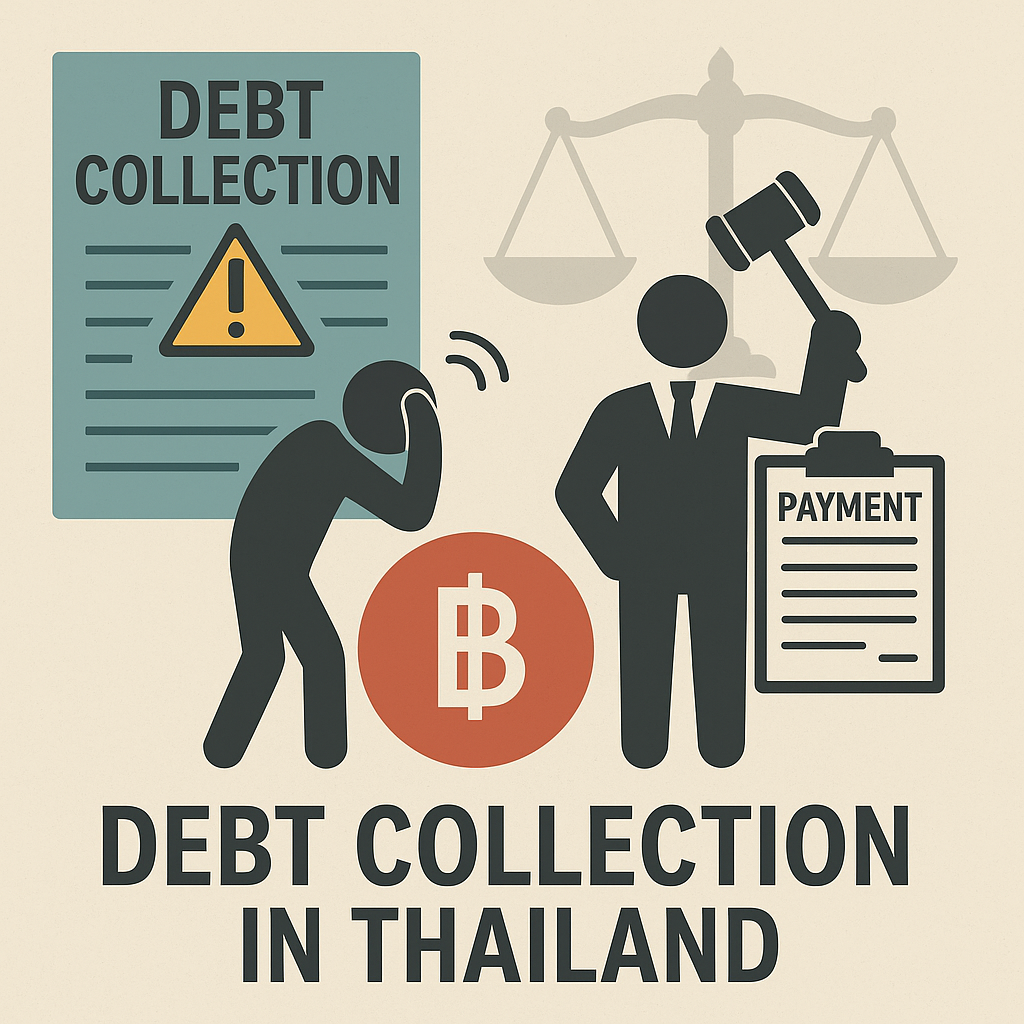
Table of Contents
Debt recovery in Thailand involves legal procedures, negotiation, and sometimes court action. But the approach often depends on where you are in Thailand. That’s why having a lawyer who understands both the legal system and the local way things work is crucial.
Why You Might Need a Debt Collection Lawyer
Debt issues in Thailand can come from many situations:
- An unpaid loan to a friend or partner
- Business clients who ignore invoices
- Rental tenants who left without paying
- Unpaid services or salaries
- Cheque bouncing, still a criminal offence under the Act on Offences Arising from the Use of Cheques B.E. 2534, although a government bill to repeal that Act passed its first reading in the House of Representatives on 20 May 2026 and is now before a special committee; if it becomes law, a bounced cheque becomes a civil debt only
Unlike in some countries, not all debts in Thailand are easy to enforce. Even if you have proof, you may still need to go through a formal demand letter, then civil litigation, and in some cases a criminal complaint. A good lawyer can guide you through these steps while trying to negotiate a fair settlement first.
Agency or lawyer? What Thai law allows each to do
Debt collection is regulated. The Debt Collection Act B.E. 2558, in force since 2 September 2015, protects debtors who are individuals, including an individual guarantor (section 3). It binds creditors who lend or sell as a business: banks and other credit providers, anyone who buys the debt from them, businesses covered by the consumer protection law, and any creditor whose claim arises in the ordinary course of its trade. It also binds everyone acting for such a creditor: an agent, a collection agency, and a lawyer acting for the client (section 3). A company debtor is outside it, and so is a one-off private loan, for example between friends, because the lender is not in the business of lending.
Anyone who collects debts as a business must register with the registrar (section 5). Where that business is a lawyer or a law office, the Lawyers Council acts as registrar and can cancel the registration (section 6).
The conduct rules are what matter in practice. A collector may contact the debtor at the address the debtor gave, or, after reasonable attempts, at home or at work (section 9(1)), and only between 08:00 and 20:00 from Monday to Friday, or 08:00 to 18:00 on public holidays (section 9(2)). Third parties, other than a person the debtor named for the purpose, may be approached only to confirm where the debtor can be contacted, and must not be told about the debt, except that a spouse, parent or child who asks why they are being contacted may be told as much as is necessary (section 8). A collector must not threaten or insult, must not reveal the debt to people unconnected with it, and must not use a postcard or open envelope that shows a debt is being collected (section 11). Nor may anyone imply that the demand comes from a court or a government agency, or from a lawyer or law office when it does not, or state that a suit, a seizure or an attachment of salary is coming when it is not (section 12).
The penalties are real: up to one year in prison or a 100,000 baht fine for contacting third parties about the debt, insulting language, revealing the debt, and postcard or marked-envelope demands (section 39), up to three years or 300,000 baht for falsely dressing a demand as a lawyer’s or threatening enforcement that is not coming (section 40), and up to five years or 500,000 baht for threats of violence or posing as a court or state agency (section 41). Calling outside the permitted hours is not itself a crime: the committee orders the collector to stop and, if the order is ignored, imposes an administrative fine of up to 100,000 baht (section 34).
That is the practical difference between an agency and a lawyer. A lawyer can say that a claim will be filed and then file it. An agency cannot appear in court for you, and an agency, or anyone else, that threatens a suit, a seizure or a salary attachment that is not actually coming commits an offence under section 12(3). The Act binds us too, which is why our demand letters identify the creditor, the amount and the legal basis, and say only what we will actually do.
Being chased by a collector in Thailand?
The same rules protect you. A collector calling at midnight, telling your employer or your neighbours about the debt, or threatening to seize your salary when no such step is coming is breaking the Act, if the debt is owed to a lender or a business. Keep the messages, note the dates and times, and complain to the Debt Collection Supervisory Committee for your province, which the provincial governor chairs; in Bangkok the committee is chaired by the Metropolitan Police Commissioner (section 27). None of that cancels the debt; it limits how it may be collected.
The Debt Collection Process in Thailand
Here’s a basic outline of how debt recovery usually works in Thailand:
1. Legal Demand Letter
The first step is usually a written demand letter, prepared by a lawyer. It sets out the amount owed, the legal basis and a deadline to pay. It also does two legal jobs. Where no payment date was agreed, the debtor is only in default once a demand has been made, and default is what starts default interest running (Civil and Commercial Code section 204). And two written demands at least 30 days apart that go unpaid raise the presumption of insolvency a bankruptcy petition relies on, whether the debtor is an individual or a company (Bankruptcy Act section 8(9)); the petition also needs a debt of at least 1 million baht from an individual or 2 million baht from a company (section 9). A demand letter is not a legal precondition to filing an ordinary money claim, whatever you may read elsewhere.
2. Negotiation
Sometimes, the debtor replies and tries to settle. A lawyer can help negotiate a repayment plan or partial settlement that works for both parties and helps to collect the debt.
3. Filing a Lawsuit
If the debtor ignores the letter or refuses to cooperate, your lawyer may file a civil lawsuit in the Thai courts. Where the claim is for 300,000 baht or less, it goes to a Kwaeng (district) court, which is the quicker route; above that it goes to the Civil Court in Bangkok or to the Provincial Court where the defendant lives or where the claim arose (Civil Procedure Code section 4; Courts of Justice Organisation Act B.E. 2543, sections 17 and 25(4); the 300,000 baht figure can be raised by Royal Decree). The court fee is 2 percent of the amount claimed, capped at 200,000 baht on the first 50 million baht, plus 0.1 percent on any part above that, and capped at 1,000 baht on a small claim of up to 300,000 baht.
4. Court Judgment and Enforcement
Winning is not collecting. Turning a judgment into money is a separate procedure that you start, pay for and steer. The court that tried the case fixes the method and issues the writ (Civil Procedure Code Sections 275 and 276), and an executing officer at the Legal Execution Department then seizes property and attaches money a third party owes the debtor, such as a bank balance or unpaid wages (Section 296), then sells what is seized at auction (Section 331).
Three things catch creditors out. You have ten years from the date of the judgment to enforce it (Section 274), running instead from the date each payment becomes enforceable where the judgment is payable by instalments. Finding the assets is your job, not the officer’s, though Section 277 lets you ask the court to summon the debtor, or a third party likely to know, to be examined and to produce documents. And you pay for enforcement (Section 153): the officer can require a deposit up front and will stop work until it is paid (Section 154).
Some property cannot be taken at all. A government employee’s salary is exempt in full; a private-sector employee’s pay is exempt up to 20,000 baht a month, severance up to 300,000 baht, and the tools of a trade to around 100,000 baht (Sections 301 and 302). Treat those as starting points rather than fixed limits, because the executing officer may set a different amount. This is why a judgment against someone on a modest salary with no registered property is often worth less than it looks, and why we check what a debtor owns before you spend money suing.
5. Criminal Action (in some cases)
If the debt involves a bounced cheque or fraud, a criminal case might also be possible. A criminal complaint changes the debtor’s calculation, which is often what moves a stalled matter.
Debt Collection Legal Support by Region and examples of what we do
| Location | Local Court | Common Issues | ThaiLawOnline Services |
|---|---|---|---|
| Bangkok | Civil Court, or the South Bangkok, Taling Chan, Thon Buri, Phra Khanong or Min Buri Civil Court by area; a Kwaeng court up to 300,000 baht | Bounced cheques, business debts | Demand letters, litigation, asset search |
| Pattaya (Chonburi) | Provincial | Loans between expats and locals | Local filing, negotiation, court support |
| Chiang Mai | Provincial | Rental disputes, service debts | Bilingual lawyers, landlord support |
| Phuket | Provincial | Tourist-related business debt | Urgent recovery, court representation |
| Khon Kaen | Provincial | Unpaid contracts, local partnerships | Issan-local experience, court cases |
| Udon Thani | Provincial | Cheque fraud, land lease payments | Litigation and mediation |
| Ubon Ratchathani | Provincial | Informal loans, personal debt recovery | Civil suits, settlement support |
| Hua Hin (Prachuap) | Provincial | Property-related unpaid commissions | Local presence, bilingual service |
| Rayong | Provincial | Industrial or factory unpaid invoices | Corporate recovery process |
| Samui / Surat Thani | Provincial | Rental disputes, unpaid salaries | Negotiation and court filing |
Even though Thai law is the same throughout the country, local courts, judges, and practices can differ a lot. That’s why it’s helpful to work with a firm like ThaiLawOnline that knows how to work across Thailand.
BEFORE YOU LEND · LAWYER-DRAFTED TEMPLATES
Most debt cases we see started without a proper document
A loan over 2,000 baht cannot be enforced in a Thai court without written evidence signed by the borrower (Section 653). If you are about to lend, put it in writing first. Bilingual English-Thai, Word and print-ready PDF, instant download.
Loan agreement, ฿590 Loan with mortgage security, ฿990 Promissory note, ฿390
How ThaiLawOnline Can Help You
At ThaiLawOnline, we’ve been helping expats and Thais recover debts for years. Our team includes experienced Thai lawyers and a foreign lawyer who understands the cultural and language barriers that can make debt collection so hard.
We offer:
- Custom demand letters, bilingual if needed
- Negotiation services
- Court representation across Thailand
- Affordable fixed fees
- Updates at every step
No matter where you are, whether in Bangkok, Pattaya, Chiang Mai, or a small province, we can help you. We can assist you in court. We can also work to find a fair settlement without going to court.
We also offer debt collection services online, so you don’t have to travel or deal with paperwork yourself. Just send us your documents, and we’ll take care of the rest.
Last reviewed: 28 September 2026. Read in Thai: the Debt Collection Act B.E. 2558 sections 3, 5, 6, 8, 9, 11, 12, 27, 34 and 39 to 41; Civil Procedure Code sections 4, 153, 154, 274 to 277, 296, 301, 302 and 331; Civil and Commercial Code sections 7, 193/30, 193/33, 193/34, 204, 224, 653 and 654; and Bankruptcy Act sections 8 and 9. The court fee table and the Courts of Justice Organisation Act were not re-read, and the fees and times quoted by the firm are practice, not statute.
FAQ: Debt Collection in Thailand
How long does a civil debt case take in Thailand?
It depends on the court and the amount. Simple cases might be resolved in 6-12 months. Bigger or contested cases can take longer. Mediation is often offered early in the process.
Do I need a contract to sue someone for a debt?
Not always. You can also use bank transfers, LINE chats, emails, or other proof to support your claim. But written contracts make things easier and stronger in court.
Can I collect debt from someone who left Thailand?
This is difficult, but not impossible. If the person still has assets or family in Thailand, or if they return, you may be able to enforce a Thai court judgment. We can also help you try to contact them through local channels.
Is debt collection expensive in Thailand?
We offer fixed-fee services starting at 5,000 THB for a legal demand letter, the rate as at September 2026. Court cases cost more but we always give you a full quote before starting. We provide skilled Thai lawyers for around 2,000 baht per hour. This price is reasonable for the quality we offer.
Can you help if the debtor is Thai and I am a foreigner?
Yes, absolutely. In fact, most of our clients are foreigners dealing with Thai debtors. We can handle translation, cultural differences, and legal representation so you don’t have to worry.
Can I file a police report because someone owes me money?
Usually not. An unpaid debt is a civil matter, and the police will send you to the civil court. It becomes criminal only if the other side deceived you from the start in order to get the money, which is fraud under section 341 of the Penal Code, or where a cheque was involved. If you think you were deceived rather than simply not repaid, see our guide to fraud and scam laws in Thailand.
How long do I have to sue for a debt in Thailand?
The general limit is ten years from the moment the claim could first have been enforced, under Section 193/30 of the Civil and Commercial Code. Shorter limits override it: a merchant, manufacturer or craftsman suing for goods delivered or work done has two years under Section 193/34(1), unless what was supplied was for the debtor’s own business, in which case Section 193/33(5) gives five years. Arrears of interest, rent and salary are also five years. This is the limit for bringing the claim, not the separate ten years you have to enforce a judgment after you win.
Ready to Take Action?
If someone owes you money in Thailand and refuses to pay, don’t wait too long. The law fixes how long you have to bring the claim, and debtors often move or hide assets. The sooner you act, the better your chances.
How long you have to sue. Usually ten years, and as little as two for a trader suing on unpaid goods or work. The FAQ above sets out the periods.
What the delay costs the debtor. Once the debtor is in default, a money debt carries default interest of at least 5 percent a year, or a higher rate the creditor is lawfully entitled to, such as an agreed contract rate (section 224): the 3 percent base rate in section 7 of the Civil and Commercial Code plus the 2 percent in section 224, with no interest on interest during default. The base rate can be changed by Royal Decree and has not been changed since April 2021. Interest agreed in a loan contract is capped at 15 percent a year, and section 654 says an excessive rate is reduced to 15 percent; but where the rate also breaches the Prohibition of Charging Excessive Interest Act, the Supreme Court treats the whole interest term as void, so no agreed interest runs before default and payments already made go to principal (Supreme Court Decision 2131/2560).
→ Contact ThaiLawOnline today for fast, reliable help with your debt collection needs anywhere in Thailand.
Email: info@thailawonline.com
Our firm is here to protect your rights and help you get what you’re owed.
- Legal Execution Department of Thailand : Responsible to execute legal decisions
Need Help?
Get expert legal advice.Book Consultation
Thai Law Updates, free by email
Plain-English updates on Thai law changes that affect foreigners: property, visas, marriage, business and wills. One short email a month from a firm practicing since 2006. No spam, unsubscribe anytime.