


Reviewed by ThaiLawOnline, a licensed Thai law firm practising in Thailand since 2006. Thai lawyer of record: Wichuda Atthamethakon, LL.M., Thai Bar Licence 3149/2556.
Last updated on
Thailand’s legal framework views fraud both as a criminal offense under the criminal code and a civil matter. Victims can pursue criminal charges as well as civil compensation. New laws, such as the Emergency Decree on Measures for the Prevention and Suppression of Technological Crime B.E. 2566 (2023) and the (No. 2) Decree of B.E. 2568 (2025) that rebuilt much of it, target the online forms of the offense of cheating and fraud. Here is an article with the latest numbers in July 2025. They also provide quick help for victims. They also give more responsibilities to banks, telecom companies, and digital platforms. Understanding the Fraud and Scam Laws in Thailand is essential for all stakeholders.
Table of Contents
Fraud complaints run through the ordinary criminal process described in our guide to criminal law in Thailand.
Expatriates must clearly understand both traditional Penal Code offenses and emerging regulations affecting banking, digital communications, and online transactions related to cheating and fraud.
Familiarity with the Fraud and Scam Laws in Thailand is crucial for expatriates navigating these complexities.
Section 343: fraud on the public (updated August 2026)
Section 343 is the aggravated form of fraud, and it is the section that now governs most online selling scams. It applies where the deception is held out to the general public rather than to one identified person. The penalty is imprisonment of up to five years, a fine of up to 100,000 THB, or both.
Supreme Court Decision (Dika) No. 736/2569 upheld a conviction for public fraud under Section 343 over a Facebook Marketplace listing for goods the seller did not have. The seller confessed, so the Supreme Court did not have to rule on Section 341 against Section 343; it held that the indictment, describing a public post that anyone could read, properly pleaded Section 343, and the conviction stood although only one buyer was shown to have paid.
Two consequences follow. First, the exposure is five years rather than three. Second, and more important in practice, Section 343 is not compoundable under Section 348. Refunding the buyer does not withdraw the case. Sellers who assume a refund closes the file are relying on the wrong section.
| Section 341 | Section 343 | |
|---|---|---|
| Who is deceived | An identified person | The public at large |
| Maximum prison term | 3 years | 5 years |
| Maximum fine | 60,000 THB | 100,000 THB |
| Compoundable under Section 348 | Yes | No |
| Typical fact pattern | Private message, known counterparty | Marketplace post, public group, open advertisement |
See our full case note on Facebook Marketplace fraud and Dika 736/2569.
Section 14(1) and online selling scams. The 2017 amendment narrowed Section 14(1) away from defamation and aimed it at fraud, phishing and fake commercial offers. Dika 736/2569 is consistent with that: the listing for stock that did not exist was pleaded and accepted as false computer data entered into a computer system in a way likely to cause damage to the public. The result is that a single Facebook post produces two offences: the deception of the buyer under Penal Code Section 343, and publication of the false listing under Section 14(1). The penalty under Section 14(1) is up to five years, a fine of up to 100,000 THB, or both.
Restitution and suspended sentences (Section 56)
Thai courts may suspend a prison term under Section 56 of the Penal Code. The decision is discretionary and remorse is the hinge. Dika 736/2569 puts a usable standard on it: repaying the victim is treated as the bare minimum, and restitution above the actual loss is what persuades a court that the contrition is genuine.
Three rules follow. Pay before the prosecutor files, not after conviction. Pay in full and then above, because instalments read as negotiation. Keep the transfer slip and a signed acknowledgement from the victim. Compare Dika 914/2569, where the court refused to suspend a four-month term because the victim had not been made whole.
This section explains the Fraud and Scam Laws in Thailand. It gives a clear overview for victims and possible offenders.
Key Laws and Regulations on Fraud in Thailand
| Legal Area | Law or Regulation | What It Covers | Who It Affects |
|---|---|---|---|
| Criminal Fraud | Thai Penal Code Sections 341-348 | Fraud, cheating, deception, document manipulation, false representation | Offenders and victims |
| Civil Liability | Thai Civil and Commercial Code | Victims can seek financial compensation for damages caused by fraud or misrepresentation | Victims of scams or fraud |
| Tech-Related Fraud | Emergency Decree on Technological Crime B.E. 2566 (2023), as amended by the (No. 2) Decree B.E. 2568 (2025) | Online scams, phishing, SMS fraud, social media fraud, identity theft | Offenders, banks, platforms, victims |
| Financial Institutions | Bank of Thailand Regulations | Know-Your-Customer (KYC) rules, fraud detection, reporting obligations | Banks, fintech companies |
| Telecoms and Digital Media | NBTC & Digital Economy Ministry Guidelines | Platform accountability, content takedown, fraud reporting, user protection | Telecom companies, platforms, consumers |
| Consumer Protection | Consumer Protection Act & Office of the Consumer Protection Board (OCPB) | False advertising, misleading claims, unfair contract terms | Businesses, sellers, consumers |
Thai Penal Code (Sections 341-348)
- Section 341 defines fraud as tricking someone in a dishonest way to deceive. This can happen by giving false information or hiding important facts. The goal is to gain property or change documents. Penalties include imprisonment up to three years, a fine up to 60,000 THB, or both.
Sections 342 to 347 set out the related offences:
- Section 342, impersonation, or exploiting a child or a weak mind: up to 5 years, a fine up to 100,000 THB, or both
- Section 343, fraud on the public: up to 5 years, a fine up to 100,000 THB, or both; 6 months to 7 years and a fine of 10,000 to 140,000 THB where a Section 342 circumstance is also present
- Section 344, deceiving ten or more people into working unpaid or underpaid: up to 3 years, a fine up to 60,000 THB, or both
- Section 345, ordering food or drink, or staying in a hotel, knowing you cannot pay: up to 3 months, a fine up to 5,000 THB, or both
- Section 346, inducing a weak-minded person or a child to dispose of property at a disadvantage: up to 2 years, a fine up to 40,000 THB, or both
- Section 347, damaging insured property to claim on the insurance: up to 5 years, a fine up to 100,000 THB, or both
Seven years is the ceiling only for public fraud combined with a Section 342 circumstance. Every offence in the chapter is compoundable (Section 348), allowing an out-of-court settlement, but except public fraud under Section 343.
Computer Crime Act (CCA) 2007, amended 2017
Under Section 14, you can go to prison for up to five years for uploading false or misleading data. This data must harm people, national security, or the economy. You may also face fines of up to 100,000 THB. Section 18 permits investigators to request traffic data from service providers without a warrant, raising privacy concerns. Amendments post-2017 (and ongoing reforms) have added safeguards, and the Constitutional Court has scrutinized warrantless access. Also, fines are up to 100,000 THB per the text, but for some violations, they can reach 200,000 THB or more
2023 & 2025 Emergency Decrees on Technological Crime
These decrees establish greater accountability for financial institutions, telecom companies, and digital platforms. Violations can result in fines up to 500,000 THB and executive jail terms of up to one year. The 2025 Decree went further and made banks, payment and digital-asset operators, telecom companies and social media platforms share liability for a victim’s loss unless they can prove they followed the prevention standards set by the Bank of Thailand, the SEC, the NBTC or the Electronic Transactions Committee (Section 8/10). It also created a statutory operations centre inside the Ministry of Digital Economy and Society, which can suspend a suspect account immediately and which treats a victim’s report to it as a formal criminal complaint. Recovering the money is a separate route run by AMLO: the accounts are published in the Royal Gazette, victims and account holders have 90 days to file, the Transaction Committee under the Anti-Money Laundering Act orders repayment, and either side may take that decision to the Civil Court within 30 days. Since 12 August 2026 that route has had a written procedure. The Ministerial Regulation on the Refund of Money to Victims of Technology Crime B.E. 2569 (Royal Gazette vol. 143, part 31 Kor, p. 1, 14 May 2026), made under sections 8/1 and 8/2 of the Decree, requires the claim to go to AMLO, through the electronic system it prescribes, within 90 days of the Gazette notice listing the account, supported by either proof of the criminal complaint, an electronic complaint included, or a copy of a judgment awarding the refund. A complete filing is receipted within seven days; a filing sent by registered post takes the date of the posting postmark; and where the money cannot be traced to one victim, the refund is pro rata to each victim’s loss. The cost of transferring or converting digital assets is deducted from what the victim receives. AOC 1441 remains the number a victim calls, and the Royal Thai Police run an online reporting portal for the same purpose.
Personal Data Protection Act (PDPA) 2019
Ties into privacy concerns in scams (e.g., data breaches enabling identity theft). The PDPA imposes administrative fines of up to 5 million THB, the ceiling reserved for breaches involving sensitive personal data (section 84), and makes misuse of sensitive data for unlawful gain a crime punishable by up to one year, a fine of up to 1 million THB, or both (section 79). It complements the CCA.
Electronic Transactions Act (digital ID and platforms)
Digital identity and online platforms are governed by the Electronic Transactions Act B.E. 2544 (2001), as amended in 2019, and by the 2022 Royal Decree on digital platform services that must be notified to the Electronic Transactions Development Agency, not by a separate 2022 Act.
Sector-Specific Statutes
- Act on Offences Arising from the Use of Cheques B.E. 2534 (1991): a separate statute, outside the Penal Code, that makes issuing a cheque that is dishonoured an offence in defined cases.
- Securities and Exchange Act: This law aims to stop market manipulation and securities fraud. Insider trading and orders that mislead the market about price or volume carry up to two years in prison, a fine of 500,000 to 2 million THB, or both (section 296); a sustained run of trades meant to move the price away from the market carries up to five years, a fine of 1 to 5 million THB, or both (section 296/1); and where the offender gained, the fine can instead be up to twice the benefit (section 296/2). Instead of prosecution the SEC can impose civil sanctions: a civil fine, repayment of the benefit obtained, a ban of up to five years on trading and of up to ten years on serving as a director or executive of a listed or securities company (section 317/4).
- Anti-Money Laundering Act (1999): Under section 48 the Transaction Committee can order assets connected with an offence to be provisionally seized or attached for up to 90 days, and the Secretary-General can do it first in an urgent case and report afterwards. Section 49/1 is the route by which those assets reach victims: the Secretary-General compiles the loss, the public prosecutor applies to the court before it makes a forfeiture order, and the court can order the assets returned or paid to the victims. Victims have 90 days from the Office’s Royal Gazette announcement to file.
- Payment Systems Act (2017): Regulates fintech and mandates fraud prevention in digital payments.
Elements Needed to Prove Fraud in Thailand
Actus Reus and Mens Rea
Prosecutors must establish three main components:
- Deceptive acts (falsehood or concealment of truth to deceive)
- Intent to acquire property or cause harm
- Resulting damage or risk thereof
Related offences with their own penalties include fraud on the public (Section 343), deceiving ten or more people into working unpaid (Section 344) and insurance fraud (Section 347).
Special Circumstances
Fraud involving impersonation or exploitation of minors or mentally vulnerable individuals significantly increases penalties. Thai courts broadly interpret impersonation, including online false identities.
Statute of Limitations
Two clocks run on a fraud complaint, and the shorter one is the one victims miss. Ordinary fraud under Section 341 is a compoundable offense (Section 348), so Section 96 gives the injured person three months from the day they learn both of the offense and of the offender to lodge a complaint. Once that window closes the case is barred, however much of the ten years is left. Section 95(3) sets the outer limit at ten years from the date of the offense for anything punishable by more than one year and up to seven years in prison, which covers Section 341 and Section 343 alike.
Public fraud under Section 343 is the exception. Section 348 makes every offense in this chapter compoundable except that one, so a public fraud carries no three-month bar and the victim cannot settle it privately. On the civil side, Section 448 bars a claim for damages from a wrongful act one year after the injured person learns of the act and of the person liable to pay, or ten years after the act itself. That section carries a limb worth knowing: where the damage comes from conduct that is also a criminal offense carrying a longer criminal prescription, the longer period governs the civil claim instead.
Criminal Penalties and Legal Procedures
Penalties differ significantly by offense severity, ranging from fines to extensive imprisonment for the offense of cheating and fraud. Victims can file reports at local police stations, Tourist Police (1155), or the CCIB cyber desk. Complex or cross-border cases can be escalated to the Department of Special Investigation (DSI).
Case Studies of Fraud Cases in Thailand
The decided case this page relies on is Supreme Court decision 736/2569, set out above: a Facebook Marketplace listing for goods the seller did not have was public fraud under Section 343 and an offence under Section 14(1) of the Computer Crime Act. The pattern in scam cases generally is that speed decides recovery: a victim who reports to the AOC quickly gives the operations centre the chance to suspend the receiving account before the money moves on, and the refund then runs through AMLO as described above.
Preventing Technology-Driven Scams: Platform Responsibilities
With scam calls and SMS surging, Thailand mandates:
- SIM-card registration and prompt suspension of fraudulent numbers.
- 24/7 bank fraud hotlines with immediate transaction freezes.
- A published list of people, accounts and digital wallets linked to scams. Once a name or wallet is listed, banks and payment or digital-asset operators must refuse to open an account, suspend the service or the transaction, or close the account, until the listing is revoked (Section 4/2, added in 2025). Separately, Department of Business Development Order 3/2568 requires a partner, shareholder or director connected with a mule account on the AMLO list to appear in person before the registrar when a company is registered.
- Strict penalties for renting or selling financial accounts to scammers. Letting someone else use your own deposit account, electronic card, electronic money account or mobile number carries up to 3 years, a fine up to 300,000 THB, or both (Section 9 of the 2023 Decree). Procuring, advertising or brokering the sale, rent or loan of such accounts, or of mobile numbers that cannot be traced to a user, carries 2 to 5 years, a fine of 200,000 to 500,000 THB, or both (Sections 10 and 11).
- Digital platforms must remove phishing or scam content. They face daily fines if they do not comply. Wrongful data disclosure can lead to imprisonment.
Civil Remedies and Compensation for Scam Victims
Tort under Civil & Commercial Code (Sections 420-437)
Victims can sue for intentional or negligent wrongful acts causing economic loss or property damage. Remedies are compensatory: return of the property lost through the wrongful act or its value, plus compensation for the damage caused, with the court fixing the amount according to the circumstances and the gravity of the wrong (Section 438). Thai tort law does not award punitive damages.
Contractual Remedies and Restitution
Contracts formed through fraudulent means can be invalidated, and restitution claimed under unjust enrichment provisions.
Government-Supported Restitution
- Asset-freeze procedures: AMLO’s Transaction Committee can order a provisional seizure or attachment of scam proceeds for up to 90 days under section 48 of the Anti-Money Laundering Act, and in an urgent case the Secretary-General can order it first and report afterwards. That is a 90-day holding period, not a final forfeiture, and it is separate from the short transaction suspensions a bank itself can apply.
- SEC compensation fund: Proposed levy-based fund for investment-fraud victims.
- Quick partial refunds: Enabled by technological crime decrees, shortening compensation timelines.
Practical Steps for Victims of Fraud in Thailand
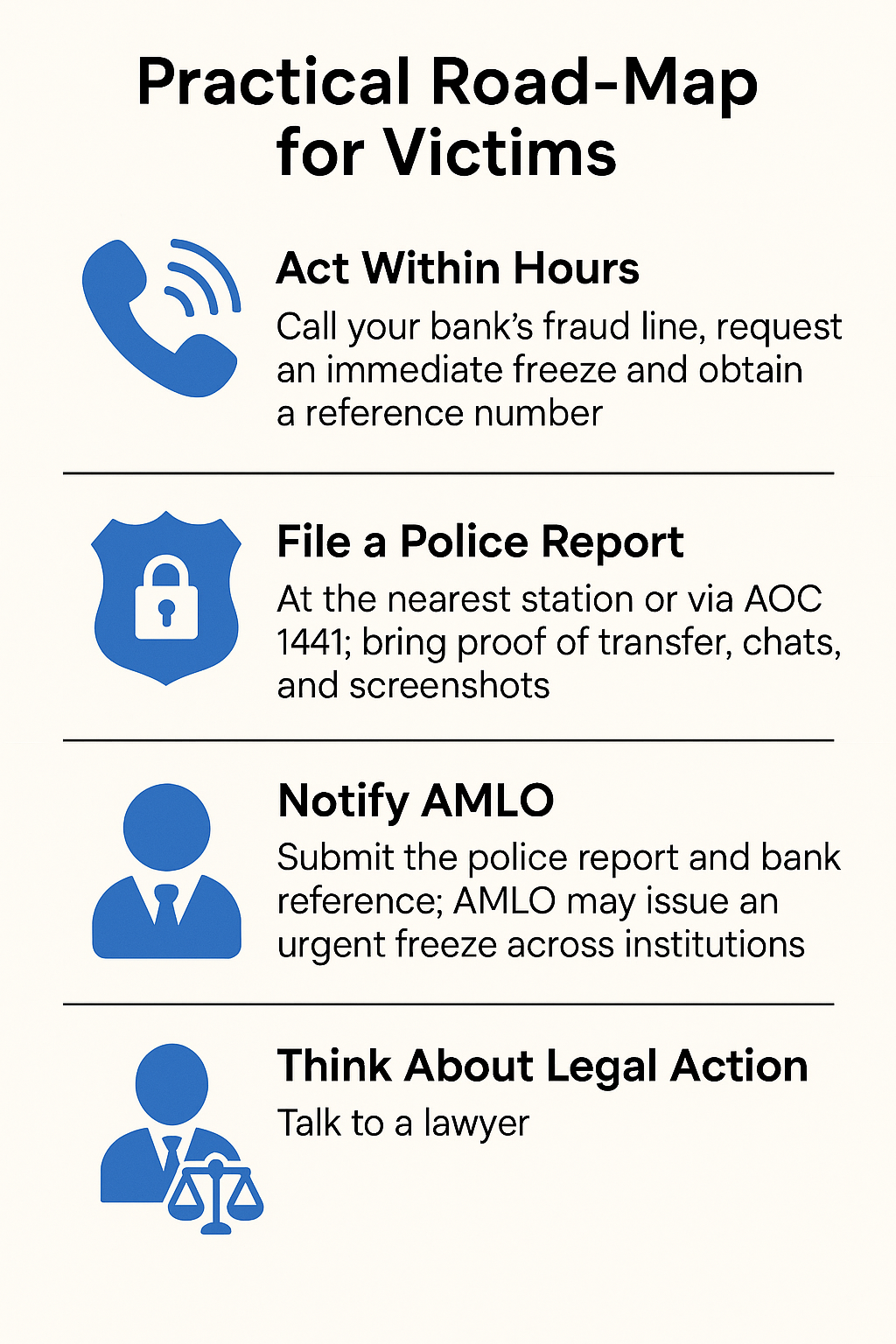
- Immediate Action: Contact your bank’s fraud hotline immediately; obtain a reference number.
- File a Police Report: Provide detailed evidence (screenshots, chats) at local stations or via AOC 1441.
- Notify AMLO: Facilitate rapid asset freezes.
- Seek Legal Advice: File tort actions or cancel fraudulent contracts promptly.
- Contact Your Embassy for assistance in cases involving scams in Thailand.: For translation, notarization, and authority liaison.
Quick action within 72 hours is crucial, especially for financial fraud to prevent scams in Thailand.
International Aspects for Expatriates
Expatriates in Thailand face unique challenges with fraud, often involving cross-border elements. Under international agreements like the ASEAN Mutual Legal Assistance Treaty (MLAT) or bilateral extradition treaties, Thai authorities can work with foreign agencies. They can gather evidence or extradite offenders with the help of countries like the US or those in the EU. If you’re a victim from abroad, consult your embassy early, many provide free legal aid referrals. Thailand is not a party to the Budapest Convention on Cybercrime, although the Council of Europe records that the Computer Crime Act, as amended in 2017, covers most of its procedural powers. Cooperation on scams therefore runs through mutual legal assistance and bilateral channels. However, there are challenges. One challenge is proving the scam’s connection to Thailand for local prosecution
Compliance and Defense Strategies for Businesses
- Enforce robust Know Your Customer (KYC) and monitoring systems to prevent “corporate mule” accusations.
- Retain computer traffic data for at least 90 days (CCA Section 26) and have efficient takedown protocols. Traffic data is the defined term in Section 3 and is not the same as your server logs generally; in a particular case an officer may order a provider to keep it for up to two years. Whether your business counts as a service provider at all is fixed by the ministerial notification issued under Section 26, not by the Act.
- Supervise staff who handle customer accounts: an employer is liable for a wrongful act its employee commits in the course of employment (CCC Section 425).
- Follow guidelines from TB-CERT and the Bank of Thailand (BOT) for risk management and compliance regarding scams in Thailand.
FAQs on Fraud and Scam Laws in Thailand
What are the key fraud and scam laws in Thailand?
The key fraud and scam laws in Thailand are primarily outlined in the Thai Criminal Code. These laws address various forms of financial fraud, including online scams, cheating, and other fraudulent activities. Offenders can face serious penalties. These can include imprisonment for several years or fines. The maximum fine under Section 341 is 60,000 THB. Offenders may receive both imprisonment and a fine. Fraud on the public (Section 343) and insurance fraud (Section 347) carry fines of up to 100,000 THB; Sections 344 and 345 carry lower maximums.
How does Thailand law define financial fraud?
Under Thai law, financial fraud is any act that tricks a person. It involves lying or hiding facts to make someone act based on false information. This includes fraud cases where a victim is tricked into giving up property or money based on an assertion of a falsehood. The law emphasizes the importance of truthful communication in financial transactions.
What are the penalties for online scams in Thailand?
Penalties for online scams in Thailand can be severe. Those found guilty of committing fraud and scams online may face imprisonment or hefty fines. Most online selling scams fall under Section 343 (fraud on the public, up to 5 years or a fine up to 100,000 THB, or both) and Section 14(1) of the Computer Crime Act (up to 5 years or a fine up to 100,000 THB). Ordinary fraud under Section 341 carries up to 3 years or a fine up to 60,000 THB, or both. The Thai Criminal Code provides specific guidelines for sentencing in these cases.
How can someone report a financial fraud case in Thailand?
To report financial fraud in Thailand, people should call the Anti Online Scam Operation Center on 1441 or use the Royal Thai Police online reporting portal, or go to the local police; complex cases can go to the Department of Special Investigation (DSI). It is advisable to gather all relevant evidence, including documentation and witness statements, before making a report. Victims should also consider consulting a Thailand lawyer to navigate the legal process effectively.
What measures for the prevention and suppression of technology crimes exist in Thailand?
The main instrument is the Emergency Decree on Measures for the Prevention and Suppression of Technological Crime B.E. 2566 (2023), rebuilt in large part by the (No. 2) Decree of B.E. 2568 (2025). Banks, payment operators and digital-asset businesses must share account and transaction data where a technology crime is suspected, and must suspend a suspect transfer. The 2025 Decree created a statutory operations centre inside the Ministry of Digital Economy and Society, which treats a victim’s report as a formal criminal complaint, can suspend an account immediately, and publishes the list of people and digital wallets that banks must then refuse to serve. Money is returned through AMLO: the accounts are published in the Royal Gazette, victims have 90 days from that notice to claim, and the Transaction Committee under the Anti-Money Laundering Act orders repayment. The Ministerial Regulation on the Refund of Money to Victims of Technology Crime B.E. 2569, in force since 12 August 2026, sets out how: the claim goes to AMLO through the electronic system it prescribes, with either proof of the criminal complaint or a copy of a judgment awarding the refund, and the Committee order can be challenged in the Civil Court within 30 days of notification. Banks, telecom operators and social media platforms now share liability for a victim’s loss unless they prove they met the prevention standards set by their regulator, and renting or selling a bank account or SIM card is itself an offence carrying up to 3 years, or 2 to 5 years for anyone who brokers or advertises it.
Can a person be punished for a false assertion in Thailand?
Yes, in Thailand, a person can be punished for making a false assertion or statement that deceives another individual. The Thai Criminal Code says that tricking someone or lying can lead to criminal charges. This can result in jail time or fines. Legal consequences are aimed at protecting victims from fraud and ensuring accountability for deceptive practices.
What should a victim do if they are deceived by a scam in Thailand?
If someone is tricked by a scam in Thailand, they should report it to the police right away. They should also collect all important information about the scam. This includes any communications, receipts, or documents involved. Talking to a lawyer in Thailand, like those at ThaiLawOnline, can help you understand what to do next. They can guide you on possible legal actions to recover your losses.
What is the role of a Thailand lawyer in fraud cases?
A lawyer in Thailand plays an important role in fraud cases. They give legal advice and represent victims or accused people. They can help you understand the Thai legal system. They prepare important documents and represent clients in criminal court. Furthermore, lawyers can help victims understand their rights and the possible outcomes of their cases.
Last reviewed: 25 September 2026. Read end to end. Penal Code sections 341 to 348 were read in Thai; the penalties of the Technological Crime Decree B.E. 2566 and its (No. 2) Decree B.E. 2568 (sections 8/11 and 9 to 11) were checked against our section map built from the two instruments. This review corrected the list of sections 342 to 347, the name of the cheque statute, the digital ID statute and the Budapest Convention statement, and replaced an unsourced case study. Not verified in this review: the 2026 refund regulation, the Securities and Exchange Act penalty, the Anti-Money Laundering Act section 49/1 route, and the PDPA fine ceiling. Re-checked on 6 October 2026: the 2026 refund regulation (Royal Gazette vol. 143 part 31 Kor) and Anti-Money Laundering Act sections 48 and 49/1 read in Thai and found as stated; the PDPA penalties (sections 79 and 82 to 85) and the Securities and Exchange Act penalties (sections 244/3, 296, 296/1, 296/2 and 317/4) read in Thai and the two sentences on them made precise.
Conclusion
Thailand combines traditional Penal Code provisions with swift technological decrees to address evolving fraud risks. For expatriates, quick reporting and good evidence management are important. Working with a law firm helps take coordinated legal action. This ensures effective help against scams in Thailand. Businesses must prioritize compliance to avoid significant penalties, reinforcing the importance of proactive fraud management strategies in Thailand.
As technology evolves, so do fraud tactics, think AI-generated deepfakes or blockchain-based scams. Thailand is making changes. They are proposing new rules for AI through the Digital Economy Promotion Agency (DEPA). They are also improving data protection with the Personal Data Protection Act (PDPA) 2019. Businesses and individuals should stay informed through annual BOT fraud reports, which predict a rise in mule accounts. Proactive measures, like two-factor authentication and scam-awareness training, can mitigate risks before they escalate to legal action.
If you’ve been a victim of fraud in Thailand, don’t wait: contact a specialized lawyer today for a consultation. Visit our consultation page or call +66 (0)8 7225 1340 to protect your rights and recover losses.
Links:
Thai Law Updates, free by email
Plain-English updates on Thai law changes that affect foreigners: property, visas, marriage, business and wills. One short email a month from a firm practicing since 2006. No spam, unsubscribe anytime.