


Last updated on
Reviewed by ThaiLawOnline, a licensed Thai law firm practising in Thailand since 2006. Thai lawyer of record: Wichuda Atthamethakon, LL.M., Thai Bar Licence 3149/2556.
Last reviewed: 19 September 2026. The law on this page was read in Thai against the Civil and Commercial Code (sections 172, 173, 193/30, 411, 419, 538, 540, 566, 569, 570, 1410 to 1412, 1417 and 1418) and against the full text of Supreme Court Judgments 4655/2566, 6763/2541, 5277/2540, 545/2532 and 8760/2556. Not verified here: how lower courts have applied 4655/2566 since, and market practice among developers, both of which rest on law-firm reporting. Re-checked on 5 October 2026: Supreme Court decisions 1213/2517 and 4872/2539 read in Thai; the sentence on a landlord’s death no longer says a renewal promise usually fails against heirs, since the outcome turns on whether the tenant knew of the death before accepting. Nothing else re-checked.
Table of Contents
In Supreme Court Case No. 4655/2566, the court struck down the Thailand 30 year lease renewal structure known as 30+30+30: a registered 30-year lease signed together with pre-agreed, pre-paid promises of two further 30-year terms. The court held that the renewal clauses circumvented Section 540 of the Civil and Commercial Code and were void. The lease ended at year 30, and the tenant who stayed on became a trespasser paying damages.
Most commentary stops there. This page goes further, because “the renewal is void” is the beginning of the problem, not the end of it. If you hold one of these leases, three questions decide real money: whether your first 30 years is safe, whether the money you pre-paid for years 31 to 90 comes back, and what structure still gives you security beyond a single registered term.
What the Supreme Court decided in Case 4655/2566
The parties signed a 30-year registered lease over land and a house in Phuket in 1990, with the full 30-year rent of 1,500,000 baht paid up front. On the same day, a separate document promised two further 30-year terms and recorded an advance payment of 600,000 baht for each of them. The court found the landlord had received 2,700,000 baht in all. When the lease expired in May 2020, the tenant refused to leave, relying on the renewal promise. The owner sued to evict.
The Supreme Court found that agreeing all three terms at once, with all the money paid in advance and no new rent or conditions for terms that would begin 30 and 60 years later, showed a clear intent by both parties to bypass the 30-year ceiling in Section 540. The renewal clauses were void. The court rejected the argument that the promise survived as a merely personal right between the parties, because that reading would empty Section 540 of its mandatory force. The lease ended on 22 May 2020, the tenant’s continued occupation was a wrongful act, and the court ordered eviction, demolition of the tenant’s buildings, and damages of 30,000 baht per month. Our full English summary of the judgment, with the procedural history and the named judges, is on our case page for Supreme Court Decision 4655/2566.
Section 540 itself is short. A lease of immovable property cannot exceed 30 years; a longer term is cut down to 30. The same section allows renewal on expiry, but each renewal is capped at 30 years from its own date. The court’s point is that a renewal must be a real decision made at renewal time, not a fiction signed and paid for decades in advance.
The only renewal the Code makes automatic is a different thing. Under Section 570, if the tenant stays on after the agreed term and the landlord, knowing it, does not object, the parties are deemed to have made a new lease for no fixed period. That gives little security: either side can end a lease of no fixed period at the end of any rent period on one period’s notice, and never more than two months’ notice is needed (Section 566). In Case 4655/2566 the landlord gave notice to leave when the term ran out, so no such renewal arose.
Is the first 30 years of my lease still valid?
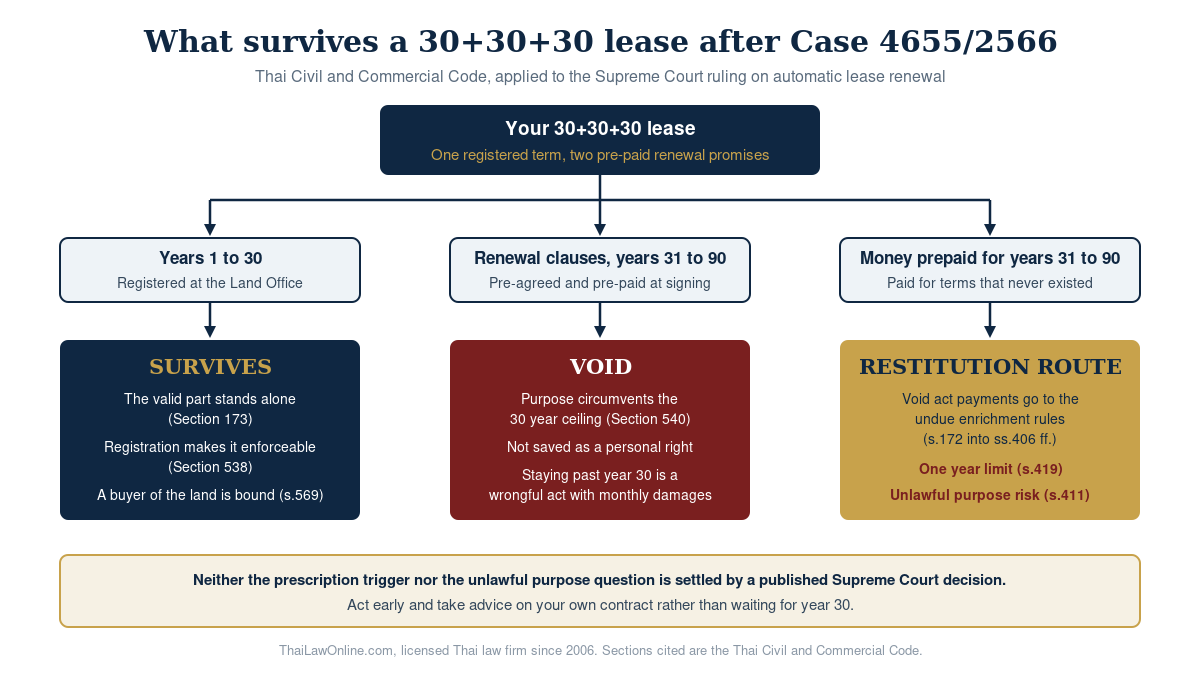
Yes, if it was registered, and here is the legal reason nobody spells out. Section 173 of the Civil and Commercial Code provides that where part of a juristic act is void, the whole act is void, unless the circumstances allow the assumption that the parties intended the valid part to stand on its own. A registered 30-year lease is exactly the bargain Section 540 permits. In Case 4655/2566 the first term had run its full course and nobody questioned it; the fight was only about the renewals. The structure of the decision follows the severability logic: the void renewal clauses fell away, and the registered term produced its normal effects until its own expiry date.
Two other sections do the protective work during those 30 years. Section 538 makes a lease over three years enforceable beyond year three only if it is in writing and registered at the Land Office, which is why registration is not paperwork but the right itself. Section 569 provides that a transfer of the property does not extinguish a registered lease: a buyer of the land takes it subject to your lease. What the buyer does not inherit is the seller’s personal promise to renew. The Supreme Court confirmed that limit in Decision 6763/2541: a renewal promise does not bind a new owner of the land. If your landlord sells, the registered years survive and the renewal promise does not bind the buyer. If your landlord dies, the registered years survive too, but whether a renewal promise you had not yet accepted binds the heirs turns on whether you knew of the death when you accepted it (sections 169 and 360): in Decision 1213/2517 the tenant knew and the heirs were not bound; in Decision 4872/2539 the tenant did not know and the promise bound the person who took the property.
Can I recover money I pre-paid for years 31 to 90?
This is the question the 2026 commentary skips, and the honest answer is that the Code gives you a route and two serious hazards on it.
The route: Section 172 paragraph 2 provides that restitution of what was given under a void act is governed by the provisions on undue enrichment, Sections 406 and following. Money paid for renewal terms that never legally existed is money paid without a legal ground. In Case 4655/2566 itself, the tenant had paid 1,200,000 baht for the two void terms; the Supreme Court decided the eviction and the counterclaim for renewal, and the judgment as reported does not order the money returned, because that was not the claim before it. The money did count for something: in fixing the tenant’s damages for staying on, the Supreme Court took into account the rent he had already paid and cut the award from the Court of Appeal’s 50,000 baht a month to 30,000.
The first hazard is time. Section 419 bars an undue enrichment claim one year after the injured party became aware of the right to restitution, and in any event ten years after the right accrued. When does that one year start for a void renewal prepayment: when you signed, when you learned of the ruling, or when the landlord refuses to renew at year 30? No published Supreme Court decision that we have located answers that for this situation. A cautious lessee treats the clock as possibly already running, because waiting until year 31 to ask may be decades too late.
There is a second half to that hazard, and it runs the other way. Section 419 only bites if the claim is characterised as undue enrichment in the first place. In Decision 545/2532 the Supreme Court held in terms that money which has to be returned because a contract was terminated is not undue enrichment, and that the Section 419 limitation cannot be applied to it. In Decision 8760/2556 it held that where a payment is not undue enrichment and no limitation provision governs the case specifically, the ordinary ten-year period under Section 193/30 applies instead. So the one-year clock is the worst case rather than the only case: on a different characterisation of the same payment the period is ten years. That is a reason to take advice early, not a reason to assume the claim is already dead.
The second hazard is Section 411: a person who performs an act whose purpose is contrary to a legal prohibition or good morals cannot demand restitution. A court could reason that paying up front to circumvent Section 540 is exactly such a performance. It could also reason the other way, that an ordinary buyer who signed what a developer put in front of them was not pursuing an unlawful purpose in the sense of Section 411. We have found no Supreme Court decision applying Section 411 to renewal prepayments, so nobody can honestly promise you the money back, and nobody should tell you it is lost either. What you can do is act early, document what you paid and why, and get advice on your specific contract. This is precisely the situation our consultation service exists for.
When can a renewal promise still be enforced?
The ruling does not make every long lease arrangement worthless, and one doctrine cuts the other way. Thai courts have long recognised the special reciprocal contract, in Thai สัญญาต่างตอบแทนพิเศษยิ่งกว่าสัญญาเช่าธรรมดา, a contract that is more than an ordinary lease because the tenant gave the landlord something substantial beyond rent, most typically by constructing buildings that become the landlord’s property. Where that doctrine applies, courts have enforced obligations that ordinary lease rules would not carry, and the agreement binds even heirs in ways an ordinary renewal promise does not. We explain the case law on our page about reciprocal agreements under Thai law.
The limits matter as much as the doctrine. In Decision 5277/2540 the lease itself reserved the landlord’s right to refuse renewal, and the Supreme Court held that renewal under that clause required a new contract actually made, not one arising by operation of law, and Decision 6763/2541 kept renewal promises from binding land buyers. Case 4655/2566 now adds the sharpest limit: where the whole arrangement is a device to exceed 30 years, the court will not save it under any label. The tenant in that case had built a house and a parking building, and it did not help him. Whether a genuine investment-for-tenure bargain, made without the pre-paid 90-year architecture, still supports enforceable renewal obligations is exactly the kind of question that needs a lawyer reading your documents, not a general article.
What are courts doing with 30+30+30 leases in 2026?
The decision carries the number 4655/2566, placing it in B.E. 2566, which is 2023, and it spread through the market during 2025 as firms reported it. By 2026, law firm reporting describes the precedent as widely circulated and applied by lower courts in new disputes. Developers in lease-heavy markets have moved their standard documents away from pre-agreed renewal chains, and buyers are renegotiating. We updated this page on 31 August 2026 to reflect that the question we now hear is no longer “is my 90-year lease safe” but “what do I do about the one I already signed”. If a lower court has applied or distinguished 4655/2566 in a case that matters to you, our team can obtain and read the decision; reported lower-court practice is not itself binding precedent in Thailand, and each case turns on its own documents.
What still works instead
Three structures give real security within the law, and we compare them fully on our guide to usufruct vs lease vs superficies.
A registered 30-year lease remains the workhorse. Drafted honestly, it binds any buyer of the land under Section 569 for its full term, can carry a succession clause, and can include a renewal framework that creates a real negotiation at year 30 instead of a void fiction. Beware of anyone still marketing 60 or 90 guaranteed years; our 90-year lease myth page explains why those numbers were never real.
A superficies under Section 1410 gives you ownership of the buildings on land you cannot own. Some published guides state that a superficies is capped at 30 years; that is incomplete. Section 1412 allows a superficies for a fixed period (capped at 30 years through section 1403 paragraph 3), or for the life of the landowner or of the superficiary, and unless the grant says otherwise it is transferable and inheritable (section 1411). The life-term option is what makes it powerful after this ruling. See our superficies guide.
A usufruct under Section 1417 gives possession, use and enjoyment of the property, registrable for a period or for the usufructuary’s life. It does not make you owner of the buildings, which is a point some commentary gets wrong in the other direction; ownership of structures on another’s land is what superficies does. Our usufruct page covers the details, and combinations of a lease with a registered real right are often the practical answer.
Before you sign anything, run the lease through our free Thai lease scanner. It checks the five clauses that most often cause trouble, including exactly the renewal wording this ruling condemned. The full text of the Code sections cited on this page is in our Civil and Commercial Code library.
Supreme Court Judgment No. 4655/2566: full summary
Here is our summary and translation of the decision in English. It is for information purposes only.
Parties: Mrs. S., plaintiff; Mr. R., defendant. Provision: Civil and Commercial Code, Section 540.
Facts. The plaintiff owns land under Certificates of Utilization (N.S.3 Kor.) Nos. 1691 and 1692 and a house originally numbered 75/25, later 159/3. On 10 May 1990 the parties signed a 30-year lease of the land and house for a total rent of 1,500,000 baht, registered on 21 May 1990 and effective from 22 May 1990. The defendant built a parking building and house No. 159/8 on the land. Clause 3 of the lease promised two further 30-year terms if the defendant wished to continue, and a separate document of the same day recorded an advance payment of 600,000 baht for each of those terms, bringing the total received to 2,700,000 baht. After the lease expired on 22 May 2020 the plaintiff demanded that the defendant vacate and demolish his constructions. He refused, claiming 60 more years.
Reasoning. The court found that signing the initial term and both renewals at once, with everything paid up front and no new rent or conditions for terms starting 30 and 60 years later, demonstrated intent by both parties to bypass Section 540. The renewal clauses were void because their purpose violated that section. The court rejected the personal-right argument: enforcing the promise between the parties would defeat the mandatory character of Section 540. The lease therefore ended on 22 May 2020, and the defendant’s continued occupation after notice was a wrongful act.
Result. The Supreme Court affirmed the Court of Appeal Region 8 on eviction, demolition and dismissal of the counterclaim, and reduced damages from 50,000 to 30,000 baht per month, running from the day after the suit was filed on 12 June 2020 until the defendant vacates. The Court of First Instance, which had ordered the plaintiff to register a renewal, was reversed on appeal. Judges: Thira Benjaratsamiroj, Narong Prachumart, Wayuree Wattanaworalak. Source: Office of the Assistant Judges of the Supreme Court. More lease decisions are collected on our Supreme Court lease decisions page.
Frequently Asked Questions
Are automatic lease renewals enforceable in Thailand?
No, not when they are pre-agreed as part of a scheme to exceed 30 years. Case 4655/2566 held such clauses void under Section 540. A renewal negotiated and registered at expiry remains lawful, and a genuine renewal clause may still bind the original landlord as a promise, though not a buyer of the land.
Do 30+30+30 lease renewals really give 90 years?
No. Only the first 30 years is registrable and secure. The Supreme Court has now held that pre-agreed, pre-paid renewal chains are void, so the further 60 years never legally existed.
Can I get back money I prepaid for void renewal years?
Possibly. Section 172 routes restitution of payments under a void act into the undue enrichment rules, but Section 419 imposes a one-year limit from awareness of the claim, and Section 411 may bar recovery where the payment pursued an unlawful purpose. The one-year clock is not automatic: Decision 545/2532 holds that money repayable because a contract was terminated is not undue enrichment at all, and Decision 8760/2556 applies the ordinary ten-year period under Section 193/30 where no limitation provision governs the case specifically. No Supreme Court decision settles either point for renewal prepayments in particular, so take advice early rather than waiting for year 30.
How long can a lease be registered in Thailand?
Thirty years maximum for residential and commercial leases, registered at the Land Office under Section 540. A longer agreed term is automatically reduced to 30 years.
How can I make a lease renewal more secure?
Register the lease, keep the renewal an honest framework for a future negotiation rather than a pre-paid guarantee, and consider adding a registered real right such as a superficies or usufruct. Take legal advice on the combination.
What happens to my lease if the property is sold?
The registered term binds the new owner under Section 569. An unregistered renewal promise generally does not, as Decision 6763/2541 confirms, which is why registration and structure matter more than promises.
Thai Law Updates, free by email
Plain-English updates on Thai law changes that affect foreigners: property, visas, marriage, business and wills. One short email a month from a firm practicing since 2006. No spam, unsubscribe anytime.