


Reviewed by ThaiLawOnline, a licensed Thai law firm practising in Thailand since 2006. Thai lawyer of record: Wichuda Atthamethakon, LL.M., Thai Bar Licence 3149/2556.
Last updated on
Thailand has many ways for tourists to enter the country. One option is the Thailand Tourist Visa. Each option is made for different travel needs and nationalities. This guide explains the main differences between visa-free entry, visa exemption, tourist visas, and visas on arrival. It also covers the rules published in the Royal Gazette on 31 August 2026 and the digital arrival card required since 1 May 2025.
If you are weighing a tourist visa against a longer route, the Thai Visa Finder compares them side by side.
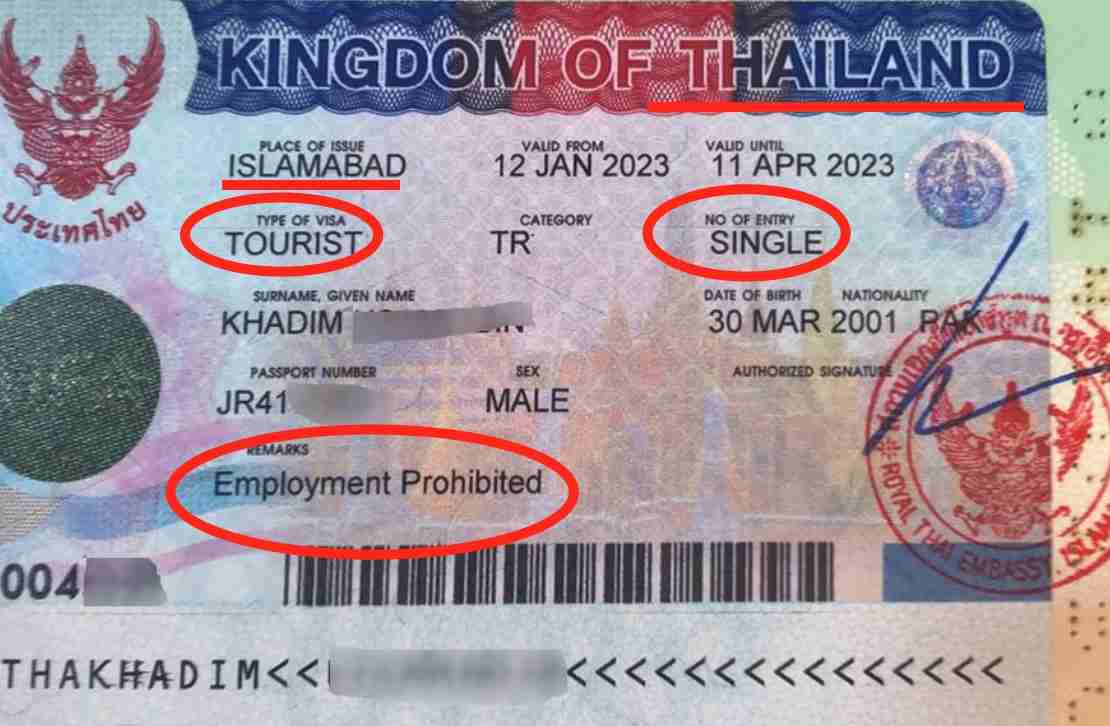
This is an example of a Tourist Visa, single entry (so good for 60 days) done in Islamabad (Pakistan).
Table of Contents
Current Status of the Visa Exemption
The Ministry of Interior announcements were published in the Royal Gazette on 31 August 2026. Official Thai travel guidance identifies 15 September 2026 as the start of the new visa-exemption arrangements. For travel planning, use the date of admission to Thailand, not the booking date or the date your flight departs.
Admissions up to and including 14 September 2026 fell under the previous 60-day exemption. From 15 September 2026, the new tourism exemption provides up to 30 days for the 60 listed countries and territories, including Canada, France and India. Separate arrangements apply to other nationalities. Check the permission-to-stay date stamped in your passport and follow the conditions attached to your admission.
Read the official announcement and our updated visa-exemption guide.
Understanding Your Entry Options
1. Visa Exemption (Visa-Free Entry)
Who Qualifies: Citizens of the 60 countries and territories on the list published in the Royal Gazette on 31 August 2026. The list runs from Australia at (1) to the United States at (60) and includes India at (23), the Maldives, Taiwan and all 27 EU member states. We set out the full list of 60, read from the Gazette
Duration: 30 days from 15 September 2026, tourism only, extendable once by a further 30 days. Travelers admitted before 15 September 2026 keep the 60 days stamped at entry
Cost: Completely free
Process: Simply present your passport at immigration, no advance application needed
The Thailand Tourist Visa is for people who want to stay longer than the usual visa-free time. It offers more flexibility for travelers.
Visa exemption is the most convenient option for short-term tourists. You get an entry stamp when you arrive. You can extend your stay for 30 more days. To do this, pay 1,900 THB at any Thai Immigration Office.
Key Countries Included:
- Europe: All EU member states, United Kingdom, Switzerland, Norway
- Americas: United States and Canada (Brazil, Argentina and Chile are no longer on the exemption list but keep 90 days under their bilateral agreements)
- Asia-Pacific: Japan, Singapore, Malaysia, Indonesia, the Philippines, India, Taiwan, Australia, New Zealand (South Korea keeps 90 days under its bilateral agreement)
- Middle East: UAE, Saudi Arabia, Israel, Kuwait, Qatar
Important Restrictions:
- Limited to 2 land border entries per calendar year from 15 September 2026 (nationals of Malaysia, Brunei, Indonesia and Singapore excepted)
- Unlimited entries by air
- Must be able to show funds, and two figures are in circulation. The Ministry of Interior announcement of 8 May 2543 (2000), made under section 14 of the Immigration Act B.E. 2522 and published in the Royal Gazette on 9 June 2543, sets 10,000 THB per person, or 20,000 THB for a family, for entry under a visa exemption, and by its clause 3 does not apply to a child under twelve. Several Royal Thai embassies, including Washington and London, now publish 20,000 THB per person for the tourist exemption scheme in force since 15 September 2026, and Washington adds 40,000 THB per family. Carry the higher figure, in cash or on an accessible statement, until Immigration publishes one rule
- Proof of onward travel within your permitted stay required
2. Visa on Arrival (VOA)
Visa on Arrival serves travelers from countries not eligible for visa exemption who need short visits to Thailand. It is 15 days and cannot be extended. The statutory fee is 2,000 THB (Ministerial Regulation No. 30 of 2016), paid in cash on arrival; it does not vary by nationality, though temporary reductions have been announced in the past. You apply at immigration checkpoint upon arrival. We won’t talk much about it as it is not very popular and limited to some countries. It used to cover around 31 nationalities, but from 15 September 2026 Visa on Arrival narrows to three nationalities, Azerbaijan, Belarus and Serbia, for 15 days with no extension (India is on the 30-day exemption list instead).
3. Tourist Visas (Single and Multiple Entry)
Tourist visas must be obtained in advance from the e-visa system. Do note that since 1st January 2025, all requests must normally go through the e-visa portal.
Single Entry Tourist Visa (see the first picture on this text, a tourist visa single entry from Islamabad)
- Duration: 60 days (extendable to an additional 30 days)
- Validity: 3 months from issue date
- Cost: Approximately $40-80 USD (can vary per country)
- Entries: One entry only
Multiple Entry Tourist Visa (METV)
- Duration: 60 days per entry (extendable to an additional 30 days per entry)
- Validity: 6 months from issue date
- Cost: Approximately $200-400 USD (varies by country)
- Entries: Unlimited within validity period
Funds you may be asked to show: the announcement above sets the amount by visa category, and a tourist visa attracts double the visa-exempt figure. For a TOURIST VISA it is 20,000 THB per person, or 40,000 THB for a family. A Non-Immigrant visa is the same 20,000 and 40,000; transit, Visa on Arrival and visa-exempt entry are 10,000 and 20,000 in the announcement, although Thai embassies now publish 20,000 and 40,000 for the 30-day exemption scheme as well (see the visa exemption section above). Children under twelve are outside the announcement altogether.
Advantages of Tourist Visas:
It is a guaranteed entry, pre-approved (unlike visa exemption which can be denied). It Suitable for travelers with complex immigration history. It is normally available regardless of nationality and you have also a multiple entry option for frequent visitors
Major Differences Between Entry Methods
Visa Exemption vs. Visa on Arrival
The fundamental difference lies in the application process and duration:
Visa Exemption:
- No visa application required whatsoever. You simply receive an entry stamp on arrival. From 15 September 2026 the stamp is 30 days, available to 60 countries and territories, extendable once by 30 days for about 60 days in total. Entries before that date received 60 days, extendable to 90.
Visa on Arrival:
- You must apply for the visa at the border or airport. You will pay fees when you arrive. The stay is only 15 days, which is much shorter. From 15 September 2026 this visa is available only to Azerbaijan, Belarus and Serbia, and it cannot be extended
Tourist Visa vs. Visa Exemption
When to Choose Tourist Visa:
If you need guaranteed entry to Thailand. Also if you are planning stays longer than 30 days: a Tourist Visa (TR) gives 60 days on entry. If you need frequent multiple trips within 6 months. Sometimes you need it if your nationality is not eligible for visa exemption or you have previous immigration issues.
When to Choose Visa Exemption:
For a short-term visit (under 30 days, or under 60 days with one extension), spontaneous travel plans. If you want to avoid advance paperwork and costs and you are from an eligible nationality.
Critical New Requirement: Thailand Digital Arrival Card (TDAC)
Starting May 1, 2025, all foreign nationals must complete the Thailand Digital Arrival Card online. This must be done before arriving in Thailand.
Every non-Thai national, regardless of visa type or stay duration. It must be submitted within 3 days (72 hours) before arrival. There is only one official website: https://tdac.immigration.go.th and it is completely free. For more information, consult our article on the Thailand Digital Arrival Card (TDAC)
Upcoming Changes: Electronic Travel Authorization (ETA)
The Electronic Travel Authorization system was supposed to start in December 2024. However, it has been delayed repeatedly and still has no confirmed start date. The arrival formality actually in use is the TDAC described above.
Border Entry Limitations and Restrictions
Land Border Rules
- From 15 September 2026, visa-exempt travelers are limited to 2 land border entries per calendar year (the count resets on 1 January)
- Unlimited air entries allowed
- Nationals of Malaysia, Brunei, Indonesia and Singapore are exempt from the land border cap
Immigration Officer Discretion
Immigration officers maintain full discretion to deny entry even with valid documentation. They may request additional proof of funds, accommodation, and travel plans.
Overstay Penalties
Thailand strictly enforces overstay regulations with severe consequences:
Financial Penalties:
- 500 THB per day fine
- Maximum fine of 20,000 THB
Serious Consequences for Extended Overstays:
- 1-90 days: Fines only
- 91 days-1 year: 1-year entry ban
- 1-3 years: 3-year entry ban
- 3-5 years: 5-year entry ban
- Over 5 years: 10-year entry ban
Those are the bans for a traveller who leaves voluntarily. If immigration or the police find you first, the same overstay draws a longer ban: any overstay of up to one year, even under 90 days, brings a 5-year ban, and more than one year brings 10 years. Only who started the contact differs. Our overstay guide sets both ladders out side by side.
Additional penalties include detention, deportation at traveler’s expense, and permanent immigration records. Read our article about overstay in Thailand for more information.
Recent Policy Timeline and Updates (We also have a section about recent updates by immigration)
Essential Tips for Smooth Entry
Before Travel
- Complete the TDAC in the 72 hours before you arrive, this is now mandatory
- Ensure passport validity and blank pages
- Prepare proof of accommodation and onward travel
- Have adequate funds available (cash preferred)
- Purchase comprehensive travel insurance
At Immigration
- Present TDAC confirmation along with passport
- Have all supporting documents readily accessible
- Be prepared to answer questions about trip purpose
- Remain patient and polite with officers
- Keep your immigration stamp safe for departure
Special Considerations by Region
European Union Citizens
All EU member states remain on the exemption list. The stay is 30 days for entries from 15 September 2026 (60 days before that date). Thailand stays highly accessible for European tourists, with the 60-day Tourist Visa (TR) as the pre-arranged option for longer trips.
North American Travelers
Citizens of the United States and Canada remain visa-exempt, at 30 days for entries from 15 September 2026. Mexico was dropped from both the exemption and the Visa on Arrival lists, so Mexican citizens now apply through the Thai e-Visa system.
Asian Neighbors
- Malaysia: Unlimited land border entries (special arrangement)
- China: No longer on the exemption list, but Chinese citizens keep 30 days visa-free under the 2024 Thailand-China mutual exemption agreement.
- Japan: On the 30-day exemption list. South Korea: 90 days under its bilateral agreement, unaffected by the reform.
Frequently Asked Questions about Tourist Visa or Visa Exemption in Thailand
Has the 60-day visa exemption really been cancelled?
Yes. The Ministry of Interior announcements were published in the Royal Gazette on 31 August 2026 and take effect on 15 September 2026. From that date, visa-exempt entry is 30 days (tourism only, one 30-day extension) for 60 countries and territories. Travelers admitted before 15 September 2026 keep their 60-day stamp. For a guaranteed longer stay, use a 60-day Tourist Visa (TR).
Do I need TDAC if I already have a tourist visa?
Yes, TDAC is mandatory for ALL foreign nationals entering Thailand, regardless of visa type.
Can I extend my visa-exempt stay?
Yes, you can extend once for 30 additional days at any Thai Immigration Office for 1,900 THB.
When will the ETA system actually start?
It has been delayed more than once and no confirmed start date has been announced. Our Thailand ETA guide tracks the position.
What happens if I forget to complete TDAC?
You may face significant delays at immigration checkpoints. It’s essential to complete it within the 72-hour window.
Conclusion
Thailand’s visa policy in 2026 still favours easy tourist access while tightening the record it keeps of who enters. The generous 60-day visa exemption ended on 14 September 2026: since 15 September 2026, visa-exempt entry is 30 days for 60 countries and territories.
The two changes that affect a traveller today are the mandatory TDAC and the cut to 30 days, published in the Royal Gazette on 31 August 2026 and effective 15 September 2026. Plan around the rule in force on your date of admission to Thailand.
Most Important Reminders for 2026:
- The cut to 30 days is law: it applies to entries from 15 September 2026. Entries before that date still receive 60 days. See the status box above.
- TDAC is mandatory since 1 May 2025, complete it within 72 hours before arrival.
- ETA pre-registration has no confirmed start date. See our guide to the Thailand ETA.
- Financial proof requirements, carry adequate funds and documentation.
For the latest information, always check official Thai government sources. This includes the Royal Thai Embassy websites and the Thailand Immigration Bureau before you travel.
Travelling on an Indian passport? See our dedicated guide to Thailand visa requirements for Indians, covering the 30-day visa-free rules from 15 September 2026, the TDAC, and the ETA project.
Last reviewed: 4 September 2026. The entry rules on this page were read against the instruments themselves. The 60-country exemption list, the tourism-only purpose and the two-per-calendar-year land-border cap were read from the Ministry of Interior announcement of 31 August 2026 (Royal Gazette, Volume 143, Special Part 207 Ngor, pages 31 to 34): every country statement on this page was checked against that list item by item, including that Mexico, China, Brazil, Argentina, Chile and South Korea are off it and that Taiwan is on it at (55), India at (23) and the Maldives at (37), and clause 3 is the source of the land-border cap and of the Malaysia, Brunei, Indonesia and Singapore exception. The proof-of-funds figures were corrected: they are set by visa category by the Ministry of Interior announcement of 8 May 2543 (2000), made under section 14 of the Immigration Act B.E. 2522 and published in the Royal Gazette volume 117, special part 53 Ngor, page 4, on 9 June 2543. Transit, Visa on Arrival and visa-exempt entry are 10,000 THB per person and 20,000 per family; a tourist visa and a Non-Immigrant visa are 20,000 and 40,000; clause 3 excludes children under twelve. This page had previously published the tourist-visa figure under visa exemption and no figure at all under the tourist visa. The overstay bans listed here are the figures for a traveller who leaves voluntarily, which the page now says. Not verified from a primary source: the tourist visa fees in USD, which vary by post, and the statement that the e-Visa portal became the normal route on 1 January 2025.
Thailand Visa Fees and Costs at a Glance
The figures below summarise the costs set out in this guide. Visa fees are set by the Thai embassy or consulate handling your application and differ from one country to another, so treat these as a planning range and confirm the current amount with the mission you apply to before you travel.
| Entry route | Cost | Length of stay |
|---|---|---|
| Visa exemption (visa-free entry) | Free | 30 days from 15 September 2026 (60 days for entries before that date) |
| Extension of a visa-exempt stay | 1,900 THB at any Thai Immigration Office | One 30-day extension |
| Visa on Arrival | 2,000 THB, paid in cash on arrival | 15 days, not extendable |
| Single-entry tourist visa | Approximately 40 to 80 USD, varies by country | 60 days, extendable by 30 days |
| Multiple-entry tourist visa (METV) | Approximately 200 to 400 USD, varies by country | 60 days per entry, extendable by 30 days per entry |
Two further amounts are worth budgeting for. Immigration may ask you to demonstrate adequate funds: 20,000 THB per person is the figure to carry, on a tourist visa and on visa-exempt entry alike. The 2000 announcement sets 10,000 THB for visa-exempt entry, but Thai embassies now publish 20,000 THB per person, or 40,000 THB per family, for the exemption scheme. And overstaying carries a fine of 500 THB per day up to a maximum of 20,000 THB, before the entry bans described above.
Thai Law Updates, free by email
Plain-English updates on Thai law changes that affect foreigners: property, visas, marriage, business and wills. One short email a month from a firm practicing since 2006. No spam, unsubscribe anytime.