


Reviewed by ThaiLawOnline, a licensed Thai law firm practising in Thailand since 2006. Thai lawyer of record: Wichuda Atthamethakon, LL.M., Thai Bar Licence 3149/2556.
Last updated on
The yellow book, or yellow tabien baan (ทะเบียนบ้าน, form Tor Ror 13), is the Thai house registration book issued to foreigners. It is the foreigner’s counterpart of the blue book (Tor Ror 14) that every Thai household keeps, and it is issued under Section 38 of the Civil Registration Act B.E. 2534 (1991). It records the house number and the people living at the address; it says nothing about who owns the house. This guide explains what the yellow house book proves, which sections of the Act govern it, how it differs from the blue book, and how to apply for one at your district office (amphur, or khet in Bangkok).
Table of Contents
What is a Ta Bian Baan or “House Registration” in Thailand?
A Ta Bian Baan (ทะเบียนบ้าน) is Thailand’s official house registration document. Thai citizens and permanent residents are entered in the blue book, and other foreigners staying temporarily in the yellow one. It lists the names and personal details of individuals registered at a specific address, establishing their legal domicile. The house book is what people are asked for when they deal with the state, for enrolling a child in school, applying for an identity card, and completing all manner of legal and administrative business. Those uses belong to the book generally, and in practice mostly to the blue one; what the yellow book does for a foreigner is set out further down. It is typically maintained at the district office and is required to demonstrate residency in a particular area.
It doesn’t say who the owner of the house is, but shows the house “holder(s)” and “resident(s)”. Often, Thai people think the ownership of the house is linked to the Thai house book. When translated from Thai to English, "Ta bien" means "registration." "Baan" means "house." Together, they create the term "house registration book" or "Thai House Book."
A large majority of Thai individuals possess a Thai house book. It serves as a residency verification document or a proof of address. This Thai house book holds significant importance for Thais, particularly when engaging in official transactions. For example, when someone wants to register a vehicle, this document is needed. It is important for the registration process at the Department of Transport and for transportation needs. Foreigners without this document can show a letter from the local Immigration office. This letter must verify their address. This document is referred to as a “Certificate of Residence.” You can find an article about the certificate or residence under “immigration” section of our website.
In Thailand, employers frequently inquire about the “Ta bien baan” of potential employees.
Examples of Thai House Book
Thailand has 2 types of house registration books: the yellow house registration and the blue book.
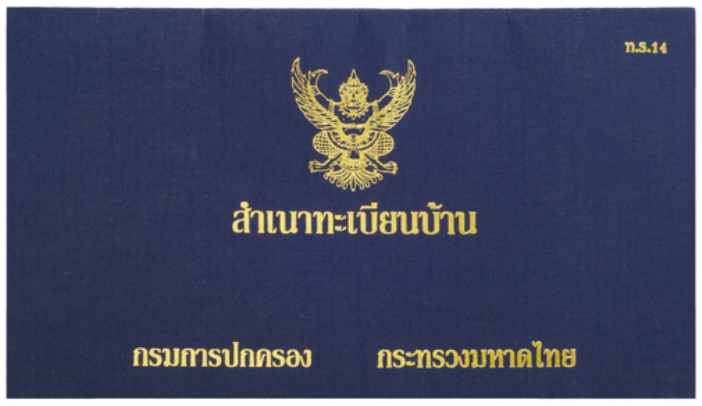
Example of Blue Thai House Book
There is one exception. Foreigners with permanent residency can be included in a Blue House Book. The statutory basis is Section 36 of the Civil Registration Act (house registration for non-Thai nationals having a residence in the Kingdom), applied through clause 44 of the Regulations of the Central Registration Bureau on Civil Registration B.E. 2535 (1992).
2) The Yellow Ta Bien Baan (To.Ro.13) for Foreigners.
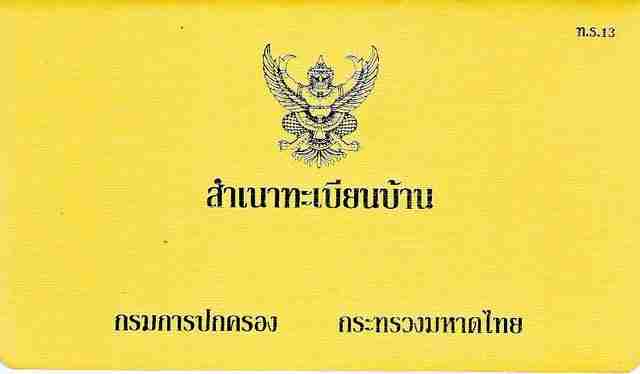
Example of Yellow Ta Bien Baan
The house book should not be mistakenly taken as a legal documentation pertaining to ownership. This document states the house “holder” and people “residing” in the property. It is prepared under the Civil Registration Act B.E. 2534 (1991), as amended by Act No. 2 B.E. 2551 (2008) and Act No. 3 B.E. 2562 (2019). Section 34 paragraph four of the Act says so in terms: no person may rely on a house number or a house registration to show that he has rights in, or is the owner of, land.
Legal basis: the Civil Registration Act B.E. 2534 (1991)
The house registration system is not a local custom of each amphur. It is created by the Civil Registration Act B.E. 2534 (1991), as amended in 2551 (2008) and 2562 (2019), and administered by the Department of Provincial Administration of the Ministry of Interior. The full English text of the Act is in our Thai Law Library. The sections a foreigner should know are these:
- Section 4 defines the house, the house registration (ทะเบียนบ้าน), the householder (เจ้าบ้าน, the head of the household who possesses the house as owner, tenant or otherwise), the dweller (a person whose name appears in the book) and the Central House Registration (ทะเบียนบ้านกลาง).
- Section 29 creates the presumption that a person named in a house registration lives and has his domicile there. This is why banks, the Land Transport Office and courts accept the book as proof of address.
- Sections 30 to 30/2 require the householder to report a move-out and a move-in within fifteen days, and let the person moving report the move personally.
- Section 34 governs house numbers and, in paragraph four, states that a house number or a house registration may not be relied on to show any right in, or ownership of, land.
- Section 36 is the basis of the blue book (Tor Ror 14) for Thai nationals and for non-Thai nationals having a residence in the Kingdom, which is why a foreigner with permanent residence can be entered in a blue book.
- Section 38 is the basis of the yellow book (Tor Ror 13): the district or local registrar prepares a house registration for non-Thai nationals staying in the Kingdom temporarily under the Immigration Act, and for their children born in Thailand. When the foreigner’s permission to stay ends, the registrar removes the entry.
- Sections 38/1 to 38/3 govern the identity card for non-Thai nationals, the pink card, which is valid for ten years and must be renewed within sixty days of expiry. Section 38/3 adds an exception worth knowing if you are retiring here: once the holder reaches seventy, the card already held is valid for life.
- Section 39 gives the copy of the house registration to the householder for safekeeping and requires it to be updated within fifteen days of any change.
- Section 50 makes it a criminal offence to use false evidence or to obtain an unlawful entry in a house registration; for a non-Thai national the penalty is six months to five years in prison and a fine of 20,000 to 200,000 baht. Never let an agent “arrange” an entry at an address where you do not live.
- Section 51 and the fee schedule: a late report is regularised by paying a late-notification fee of up to 1,000 baht rather than by prosecution.
2. Application for a Thai House Book or Ta Bian Baan
The application for this document is done individually at the local registration office, called Amphur (or Khet in Bangkok). For a new house, the householder must ask for a house number, and with it the house registration, within fifteen days of completing construction (Section 34); in practice the builder or developer often handles that step. A foreigner’s entry in a yellow book is a separate application made later. The price to get this book is not very high, but you have to go through certain procedures.
Even if there is a National regulation for obtaining the Yellow House Book, each district can have their own rules. You will have to show relevant proofs of identity, which may include pictures to apply for a yellow tabien baan. Most Amphurs will require a letter from your Embassy stating that you are residing in Thailand but some don’t! You should call the local administration office. Ask them what documents you need before applying for a yellow tabien baan on your own. Interviews and witnesses can be asked.
The documents required to get a yellow Ta bian baan in Nakhon Ratchasima can be found on the link below here.
How foreigners can use their yellow ta bian baan
For Foreigners, this book can be used to get a Thai Driving License or if you want to purchase a car. You can use it while applying for an extension of visa. But it’s not necessary and a Certificate of Residence can be used instead. Some people say you can get health benefits from Thai government hospitals with a yellow house book. However, we have not been able to confirm this.
What is a Ta Bian Baan Klang?
A Ta Bian Baan Klang (ทะเบียนบ้านกลาง) is a central house registration record maintained by the local district office in Thailand. A Ta Bian Baan Klang is different from a standard house registration (tabien baan). It is for people who do not have their names in a permanent house book. It is the register for people who are not listed in an ordinary house book, and for most people it is not something they choose. Section 30 paragraph one puts you there automatically: where someone has reported a move-out and has not moved into another house within thirty days of that report, the registrar enters their name in the central house registration. The Act defines it in Section 4, alongside the house registration itself. This record ensures that Thai citizens and legal residents can still access essential governmental services and complete official procedures, including those related to residency in Thailand.
Who ends up in the central house registration
The Ta Bian Baan Klang is especially useful in the following situations:
- Renters or Transient Residents: These are people living in rental properties. The landlord does not add them to the property’s house registration.
- Homeless or Displaced Persons: Citizens without a permanent address can use this registration to secure their legal rights.
Children or Dependents: Minors or adopted children not listed in a family’s house registration may need this. This is important for school enrollment, ID card issuance, or other legal needs.
This type of registration helps people prove they live in a district. This is useful for those without a regular house registration.
How to Register for a Ta Bian Baan Klang?
To apply for a Ta Bian Baan Klang, follow these steps:
Visit the Local District Office: Go to the amphoe or khet where you currently reside. This is typically the administrative authority overseeing your area.
Bring what identifies you and what ties you to the district:
a Thai identity card if one has been issued; and proof that you live in the district, such as a rental agreement or a letter from the property owner.
Additional documents like birth certificates or adoption papers for dependents may be required for an entry in the central registration.
The district office may conduct a verification process to ensure the applicant genuinely resides within their jurisdiction. Once approved, your name will be listed in the Ta Bian Baan Klang. This will let you start legal processes such as applying for an identity card or registering for benefits. It is a separate register from the yellow book, and being in one says nothing about the other.
Why is a Ta Bian Baan Klang Important?
A Ta Bian Baan Klang helps people without permanent house registration. It ensures they can access rights and services under Thai law. It is a helpful solution for people in temporary living situations. It also helps those facing legal and administrative issues about residency. This system is important for protecting citizens' rights. It makes sure that no one is left out of essential benefits because of their housing status.
Last reviewed: 7 September 2026. Sections 4, 29, 30, 30/1, 34, 36, 38, 38/1 to 38/3, 39, 50 and 51 of the Civil Registration Act B.E. 2534, and the fee schedule annexed to it, were read in Thai from a consolidated text carrying both the B.E. 2551 and B.E. 2562 amendments. The statutory statements above were checked against that text and left as they stood; what changed is the central house registration material, which cited nothing and described as an application something Section 30 does automatically. Not verified in this review: the district-by-district document practice, which is practice rather than law. Re-read on 4 October 2026 against the consolidated Act (krisdika text): the ownership rule is paragraph four of Section 34, as stated; Section 38/3 (ten years, sixty days, lifetime at seventy) matches; three lines that named the yellow book where the blue book or the central registration was meant were corrected, and the house-number duty in Section 34 paragraph one was added.
FAQs About Yellow House Book in Thailand
What is a yellow tabien baan?
A yellow tabien baan is a house registration book in Thailand specifically for foreigners. It serves as a record of a foreigner’s address in Thailand and is distinct from the blue tabien baan, which is for Thai citizens.
How does a yellow tabien baan differ from a blue tabien baan?
The blue tabien baan (Tor Ror 14) is issued under Section 36 of the Civil Registration Act to Thai nationals and to non-Thai nationals who have a residence in the Kingdom, which in practice means permanent residents. The yellow tabien baan (Tor Ror 13) is issued under Section 38 to foreigners staying in Thailand temporarily on a visa or extension of stay, and to their children born in Thailand. Both books record the house number and the people living at the address, and neither is proof of ownership.
What are the benefits of having a yellow tabien baan?
The benefits of having a yellow tabien baan include easier access to certain services and legal benefits in Thailand, such as the ability to apply for a Thai driving license or open a bank account. It also helps in proving residency in the country.
What are the requirements for obtaining a yellow tabien baan?
The requirements for obtaining a yellow tabien baan typically include proof of ownership or lease of a house or condo, a valid passport, a visa, and documents translated into Thai. Specific requirements may vary by district or local registration office.
Can foreigners apply for a Thai ID card with a yellow tabien baan?
Yes. Once a foreigner is entered in a yellow tabien baan, the district office can issue the identity card for non-Thai nationals, the pink card, under Sections 38/1 to 38/3 of the Civil Registration Act. The card carries the same 13-digit identity number as the yellow book, is valid for ten years and must be renewed within sixty days of expiry.
How can one apply for a yellow house registration book in Thailand?
To apply for a yellow house registration book in Thailand, one must visit the district or local registration office, amphur or tessaban, with the necessary documents, including proof of residency and identification, and complete the application process.
Is it mandatory for all foreigners to have a yellow tabien baan?
No. The Civil Registration Act leaves the detail of which non-Thai nationals must register to Ministerial Regulations, and district offices treat the yellow tabien baan as optional for foreigners on a temporary stay. It is worth having if you own a condominium or a house, or plan to stay long-term, because it is the simplest proof of address under Section 29 of the Act and the gateway to the pink ID card.
Does obtaining a yellow tabien baan grant permanent residency in Thailand?
No, obtaining a yellow tabien baan does not grant permanent residency in Thailand. It only serves as a house registration book for foreigners and does not affect one’s residency status.
Can a foreigner with a yellow tabien baan purchase property in Thailand?
Having a yellow tabien baan does not change the legal restrictions on property ownership for foreigners in Thailand. Foreigners can own condos in their name, but land ownership is generally restricted, requiring other legal arrangements.
PS: If you can’t get a Yellow Ta Bien Baan or a Certificate of Residence by the Immigration Authorities, you might be able to get a police report that will do the same thing. You must go at a police station, show proof of your identity and residence. They should make a report. Some police stations refuse to do it, some will charge you 20 baht, some will charge more.
- Information in Thai about documents needed for yellow ta bian baan in Nakhon Ratchasima
- Department of Lands of Thailand
Thai Law Updates, free by email
Plain-English updates on Thai law changes that affect foreigners: property, visas, marriage, business and wills. One short email a month from a firm practicing since 2006. No spam, unsubscribe anytime.