


Last updated on
Short answer: A condo lawyer for Koh Samui costs 4,900 THB for a Title Deed Check or 19,900 THB for the full Condominium Package, handled remotely from our Bangkok office. The one thing that matters most on Samui is to find out what you are being sold before you pay a deposit: a registered condominium unit, a villa in a project registered under the Condominium Act, or a thirty-year lease presented as ownership.
Table of Contents
Which Land Office registers condominiums on Koh Samui
Koh Samui is a district of Surat Thani province. Every condominium unit on the island, from Chaweng to Taling Ngam, is registered at the Surat Thani Provincial Land Office, Koh Samui Branch, on the island itself. The branch also has a sub-office for Koh Phangan. It holds the unit title deed register, each project’s condominium registration and each building’s foreign ownership count.
The same office registers leases over three years under section 538 of the Civil and Commercial Code, and on Samui much of what is marketed as “ownership” is a registered lease over a villa, not a unit title deed.
What is different about buying a condo on Koh Samui
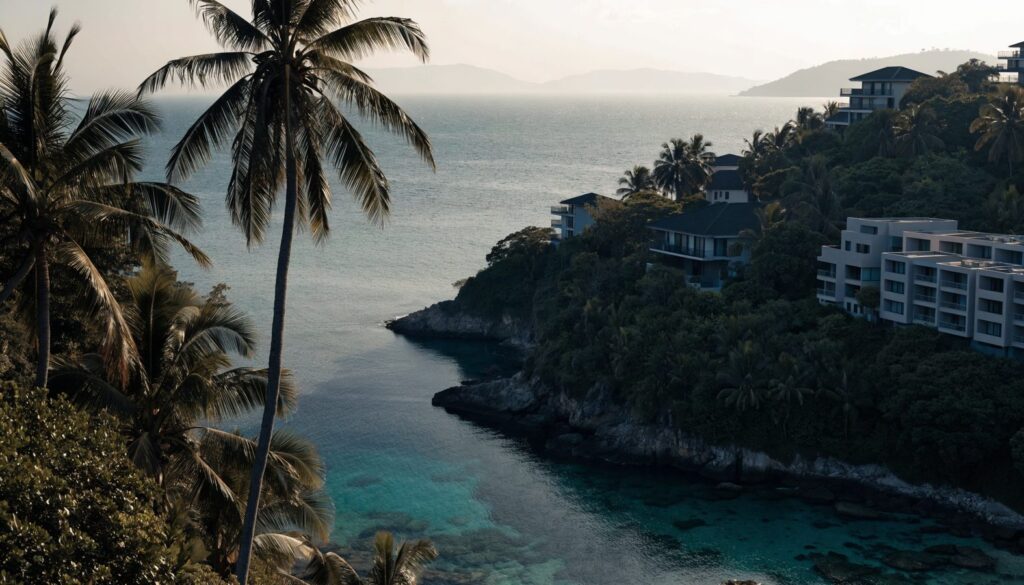
Much of the stock is low-rise projects on the hillsides above Chaweng, Lamai and Bophut, sold under one of two structures: the whole project is registered as a condominium so each villa is a unit with its own title deed, or the land stays with the developer and each villa is sold on a thirty-year lease. A group of detached villas can be a lawful condominium, but only if the registration exists at the Koh Samui Branch. A brochure saying “condominium title” is not registration.
The hillsides are regulated. The Ministry of Natural Resources and Environment notification on environmental protection for Koh Samui, Koh Phangan and Koh Tao, B.E. 2568 (2025), which replaced the 2014 notification, restricts what can be built on land above 80 metres and above 140 metres above sea level, and on slopes of 35 per cent or more, where only single detached houses with a 6-metre height cap are allowed. The municipal rules add a general 12-metre height limit and a 10-metre setback from the shoreline. A hillside project above those lines needs its building permit checked before you commit.
Foreign quota in small buildings fills quickly: 49 per cent of the combined area of all units under section 19 bis is five or six villas in a twelve-villa project, and the rest can only be leased. And a high share of sellers are foreigners reselling, often from abroad, which adds a power of attorney and withholding tax to the checklist.
Mistakes buyers make on Koh Samui
- Buying a “condominium villa” that is not a registered condominium. If the project has no condominium registration at the Koh Samui Branch, there is no unit title deed to transfer. You are buying a house on someone else’s Chanote, and the most you can register is a lease.
- Treating the quota as a formality in a small building. In a ten-unit project the foreign side can be full after five sales. The juristic person must state in writing the foreign ratio after your transfer, and the figure must match the count at the Land Office. See how the quota is counted.
- Paying a foreign seller abroad. Settling the price into the seller’s account in Europe produces no FET form in your name, and section 19 ter requires evidence that the price was remitted into Thailand in foreign currency. The Koh Samui Branch officer will refuse the registration. See the FET form.
- Accepting an offshore company as the buyer. When the quota is full, some developers suggest a company incorporated abroad “because companies are not counted”. They are, and the Supreme Court has said so.
What the Supreme Court has said: an offshore company is a foreigner
In Dika 840/2561 a British Virgin Islands company contracted to buy a condominium unit for 72,960,361 baht. The Supreme Court held that a company incorporated under foreign law has no Thai nationality and is an alien for the purposes of section 19 of the Condominium Act. It could take ownership only in the category of section 19 that requires an investment promotion certificate, which it did not have. It could not own the unit, whatever the sale agreement said.
Apply that to a Bophut hillside project where the foreign-quota villas are gone and the developer offers the next one to your BVI or Hong Kong company. The contract is signed, the deposit is paid, and the Koh Samui Branch refuses the transfer, because the company is a foreigner without the certificate section 19 requires. The lawful routes when the quota is full are a registered lease under section 538, a registered usufruct, or a unit inside the quota held in your own name.
How we handle a Koh Samui purchase from Bangkok
Our only office is in Bangkok, by appointment. We do not have an office on Samui. Documents move by email and through the client portal. We obtain the certified copy of the unit title deed, front and back with the official stamp and date, through the Land Office network; the condominium registration and the juristic person’s documents are requested in Thai and reported to you in English.
Every report is reviewed by Wichuda Atthamethakon, LL.M., Thai Bar Licence 3149/2556, our Thai lawyer of record, and the file is supervised by Sebastien Brousseau, LL.B., B.Sc., Managing Director, who has managed law firms in Thailand since 2006. On transfer day you receive written transfer instructions for the Koh Samui Branch counter: documents, fee lines and what the quota letter must say. Koh Samui is outside the Premium package area, so Land Office attendance is quoted before you commit.
How it runs, step by step
| Step | What we do | What you do | Timing |
|---|---|---|---|
| 1. Order | Open the file, identify the structure: condominium unit, villa under condominium registration, or leasehold | Send the project name, unit number, seller’s name and the listing | Day 1 |
| 2. Title Deed Check | Obtain the certified copy, translate it, report on owner, area, encumbrances and condominium registration | Nothing until the report arrives | 3 business days |
| 3. 25-point due diligence | Quota letter and Land Office count, debt-free position, juristic person accounts, building permit and hillside rules, seller’s capacity and power of attorney, mortgage | Forward what the seller, developer and juristic person send | Days 4 to 10 |
| 4. Contract review | Mark up the sale or lease agreement, make the deposit conditional on quota and debt-free certificate, fix who pays which tax | Sign only the cleared version | Days 8 to 12 |
| 5. FET guidance | Remittance instructions so the receiving Thai bank issues the FET form in your name under section 19 ter | Remit from abroad in foreign currency | Before transfer |
| 6. Transfer instructions | Written checklist for the Koh Samui Branch counter; attendance quoted if requested | Attend, or appoint a representative under a Land Office power of attorney | Transfer day |
| 7. After transfer | Verify the new unit title deed or registered lease and close the file | Send a scan of the registered document | Within 7 days |
What it costs
Our fees are flat and in Thai baht. Government fees at the Land Office (2 per cent transfer fee, 3.3 per cent specific business tax or 0.5 per cent stamp duty, and withholding tax) are paid at the counter and are never included.
- Title Deed Check: 4,900 THB. Certified copy of the unit title deed, front and back, official stamp and date, English translation and a two-page lawyer’s report, in 3 business days. Credited against the Condominium Package if ordered within 30 days.
- Condominium Package: 19,900 THB. The 25-point due diligence, contract review, FET guidance and written transfer instructions, in 7 to 14 business days.
- Condominium Premium Package: 34,900 THB. Adds Land Office attendance and translation on transfer day in Bangkok, Pattaya, Nakhon Ratchasima, Khon Kaen, Surin, Buriram or nearby. For Koh Samui, attendance is quoted separately before you commit.
- Land and house due diligence (a villa that is not a registered condominium): from 19,900 THB, quoted before we start.
- Consultation: 2,000 THB per hour, credited against a package.
Order the Condominium Package (19,900 THB)
Order a Title Deed Check (4,900 THB)
Download the free condo buying checklist, book a consultation, or read our pages on title deeds in Thailand and off-plan condos.
Frequently Asked Questions
Is a “condominium villa” on Samui real ownership?
It can be, if the whole project is registered as a condominium at the Koh Samui Branch and your villa is a unit with its own title deed inside the foreign quota. The Condominium Act allows low-rise and detached units. If there is no registration, the villa sits on the developer’s land and the most you can register is a lease. The certified copy settles the question in 3 business days.
Do you have an office on Koh Samui?
No. Our only office is in Bangkok, by appointment. Samui files are handled remotely: documents by email and the client portal, the certified copy through the Land Office network, Thai-language requests to the juristic person by our team, the report and contract mark-up in English. Land Office attendance on Samui is quoted before you commit.
How quickly does the foreign quota fill in a small project?
Fast. Section 19 bis allows foreigners to own 49 per cent of the combined area of all units, so in a twelve-villa project five or six villas may be all there is, and large villas use the quota faster than small ones. We get the juristic person’s written ratio after your transfer and the Land Office count before your deposit is released, and the contract returns the deposit if the quota is not there.
The seller is a foreigner living abroad. What changes?
The seller signs a Land Office power of attorney, normally certified at a Thai embassy, and the price must still be remitted into Thailand in foreign currency so your FET form issues in your name. The seller’s withholding tax and any specific business tax are settled at the counter. We verify the power of attorney, the seller’s identity against the certified copy and the debt-free certificate before any money moves.
What do the hillside rules mean for a unit above Chaweng or Lamai?
The 2025 environment notification for Koh Samui restricts building above 80 metres and 140 metres above sea level and on slopes of 35 per cent or more, and the municipal rules cap height at 12 metres in most areas. A unit that does not fit those rules may have a permit problem that follows you. We check the building permit and the land title under the project as part of the 25-point due diligence.
Can I buy through my company abroad if the quota is full?
No. The Supreme Court held in Dika 840/2561 that a company incorporated under foreign law is an alien under section 19 of the Condominium Act and can own a unit only with an investment promotion certificate. Without it the Koh Samui Branch will refuse the transfer. When the quota is full, the lawful routes are a registered lease, a registered usufruct, or another project with quota available.
What is the difference between a lease and a unit title deed on Samui?
A unit title deed is ownership: you can sell, mortgage and leave it by will, and you vote at the general meeting. A lease over three years is a registered right to occupy, enforceable for its term under section 538, with no vote and a value that falls each year. Both are lawful. The mistake is paying a freehold price for a lease. We tell you which one the contract gives you before you sign.
Thai Law Updates, free by email
Plain-English updates on Thai law changes that affect foreigners: property, visas, marriage, business and wills. One short email a month from a firm practicing since 2006. No spam, unsubscribe anytime.